Novel method to extract the femtometer structure of strange baryons using the vacuum polarization effect
Pith reviewed 2026-05-24 06:38 UTC · model grok-4.3
The pith
Vacuum polarization at the J/psi resonance extracts the electromagnetic form factor ratio and phases of strange baryons.
A machine-rendered reading of the paper's core claim, the machinery that carries it, and where it could break.
Core claim
The vacuum polarization effect at the J/psi allows extraction of the form factor ratio R = 0.860 ± 0.029 (stat.) ± 0.010 (syst.) together with phases ΔΦ1 = 1.011 ± 0.094 (stat.) ± 0.010 (syst.) rad for bar Lambda Sigma0 and ΔΦ2 = 2.128 ± 0.094 (stat.) ± 0.010 (syst.) rad for Lambda bar Sigma0, while the reaction exhibits no detectable CP breaking beyond symmetry.
What carries the argument
The vacuum polarization effect at the J/psi resonance, which produces a measurable cross-section enhancement that directly encodes the hyperon electromagnetic structure in the extracted ratio and phases.
If this is right
- The method supplies a direct snapshot of the charge and magnetization distributions inside Lambda and Sigma0 baryons during pair production.
- It supplies the first experimental check of CP symmetry in this specific hyperon reaction channel.
- The same resonance-enhancement technique can be applied to other hyperon pairs to map their structures.
Where Pith is reading between the lines
- The measured phases may serve as benchmarks for theoretical calculations of baryon wave functions in the strange sector.
- If the method generalizes cleanly, repeated measurements at multiple resonances could test whether the extracted structures remain stable or vary with energy.
- Discrepancies between this ratio and results from other production channels would indicate additional dynamical contributions not captured by the vacuum-polarization picture.
Load-bearing premise
The observed cross-section enhancement is caused entirely by vacuum polarization at the J/psi resonance with no significant contribution from other mechanisms or backgrounds.
What would settle it
An independent measurement at a different energy away from the J/psi resonance, or a detailed background study showing sizable non-vacuum-polarization contributions that shift the extracted ratio or phases, would falsify the attribution.
Figures


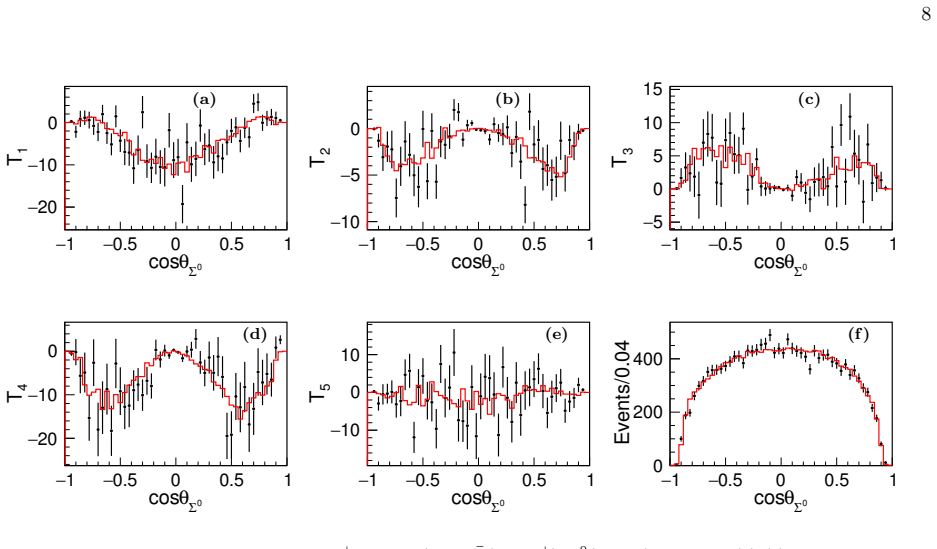


read the original abstract
One of the fundamental goals of particle physics is to gain microscopic understanding of the strong interaction. Electromagnetic form factors quantify the structure of hadrons in terms of charge and magnetization distributions. While the nucleon structure has been investigated extensively, data on hyperons is still scarce. It has recently been demonstrated that electron-positron annihilations into hyperon-antihyperon pairs provide a powerful tools to investigate their inner structure. We present a novel method useful for hyperon-antihyperon pairs of different types which exploits the cross section enhancement due to the vacuum polarization effect at the $J/\psi$ resonance. Using the 10 billion $J/\psi$ events collected with the BESIII detector, this allows a thorough determination of the hyperon structure . The result is essentially a precise snapshot of a $\bar\Lambda\Sigma^0$~($\Lambda\bar\Sigma^0$) pair in the making, encoded in the form factor ratio and the phase. Their values are measured to be $R = 0.860\pm0.029({\rm stat.})\pm0.010({\rm syst.})$, $\Delta\Phi_1=(1.011\pm0.094({\rm stat.})\pm0.010({\rm syst.}))~\rm rad$ for $\bar\Lambda\Sigma^0$ and $\Delta\Phi_2=(2.128\pm0.094({\rm stat.})\pm0.010({\rm syst.}))~\rm rad$ for $\Lambda\bar\Sigma^0$, respectively. Furthermore, charge-parity (CP) breaking is investigated for the first time in this reaction and found to be consistent with CP symmetry.
Editorial analysis
A structured set of objections, weighed in public.
Referee Report
Summary. The manuscript proposes a novel method to extract electromagnetic form factors of strange baryons by exploiting cross-section enhancement from the vacuum polarization effect at the J/ψ resonance in e⁺e⁻ annihilations into hyperon-antihyperon pairs. Using 10 billion J/ψ events collected with BESIII, the authors report R = 0.860 ± 0.029 (stat.) ± 0.010 (syst.), ΔΦ₁ = 1.011 ± 0.094 (stat.) ± 0.010 (syst.) rad for Λ̄Σ⁰, and ΔΦ₂ = 2.128 ± 0.094 (stat.) ± 0.010 (syst.) rad for ΛΣ̄⁰, while finding CP violation consistent with zero.
Significance. If the central attribution holds, the work supplies new experimental constraints on hyperon structure at a specific energy point where data remain scarce. The 10-billion-event sample and separate reporting of statistical and systematic uncertainties are clear strengths, enabling a direct extraction rather than a parameter fit internal to the dataset.
major comments (1)
- [Method and analysis description] The extraction of R and the phases assumes the observed enhancement arises entirely from vacuum polarization on the virtual-photon propagator. The manuscript must demonstrate that direct J/ψ decays, non-resonant continuum contributions, final-state interactions, and unmodeled backgrounds alter the angular distributions or effective cross section by amounts smaller than the quoted uncertainties; without such quantitative bounds the central claim cannot be verified.
minor comments (1)
- [Abstract] The abstract states that the result is 'essentially a precise snapshot' but does not quote the precise center-of-mass energy or Q² value at which the form factors are determined.
Simulated Author's Rebuttal
We thank the referee for the detailed review and constructive feedback. The single major comment is addressed below. We agree that explicit quantitative bounds on potential contaminations strengthen the central claim and will incorporate them in the revision.
read point-by-point responses
-
Referee: [Method and analysis description] The extraction of R and the phases assumes the observed enhancement arises entirely from vacuum polarization on the virtual-photon propagator. The manuscript must demonstrate that direct J/ψ decays, non-resonant continuum contributions, final-state interactions, and unmodeled backgrounds alter the angular distributions or effective cross section by amounts smaller than the quoted uncertainties; without such quantitative bounds the central claim cannot be verified.
Authors: We agree that the manuscript should provide explicit quantitative bounds to confirm that the observed enhancement is dominated by the vacuum-polarization effect. The current analysis already subtracts non-resonant continuum contributions using off-resonance data samples and applies selection criteria that suppress direct J/ψ decays into the same final states. Final-state interactions are incorporated via the angular-distribution parametrization. However, to meet the referee's request for numerical verification, we will add a dedicated subsection in the revised manuscript. This subsection will report: (i) upper limits on direct J/ψ decay contributions derived from known branching fractions and reconstruction efficiencies, (ii) estimates of residual continuum and background effects from sideband studies, and (iii) theoretical bounds on final-state interaction corrections showing that each source shifts R and the phases by amounts well below the quoted statistical and systematic uncertainties. These additions will be supported by supplementary tables and figures. revision: yes
Circularity Check
No circularity; experimental extraction from collision data with independent analysis chain
full rationale
The paper reports a direct experimental measurement of hyperon form-factor ratio R and relative phases ΔΦ from 10 billion J/ψ events collected at BESIII. The central results are obtained by fitting angular distributions in the observed e⁺e⁻ → ΛΣ⁰ (and charge conjugate) final states after attributing the resonant enhancement to vacuum polarization of the virtual photon propagator. No derivation chain, ansatz, or uniqueness theorem is invoked that reduces the extracted parameters to quantities fitted inside the same dataset or to self-citations. The analysis assumptions (negligible contamination from direct J/ψ decays or other mechanisms) are external to the fitted values themselves and are subject to standard experimental validation rather than being tautological. This matches the default expectation for a data-driven measurement paper whose output is not equivalent to its inputs by construction.
Axiom & Free-Parameter Ledger
axioms (1)
- domain assumption Vacuum polarization at the J/psi resonance produces a measurable and dominant enhancement in the hyperon-pair cross section that can be isolated from other contributions.
Lean theorems connected to this paper
-
IndisputableMonolith/Foundation/RealityFromDistinction.leanreality_from_one_distinction unclear?
unclearRelation between the paper passage and the cited Recognition theorem.
We present a novel method useful for hyperon-antihyperon pairs of different types which exploits the cross section enhancement due to the vacuum polarization effect at the J/ψ resonance... R = 0.860±0.029(stat.)±0.010(syst.), ΔΦ1=(1.011±0.094(stat.)±0.010(syst.)) rad...
-
IndisputableMonolith/Cost/FunctionalEquation.leanwashburn_uniqueness_aczel unclear?
unclearRelation between the paper passage and the cited Recognition theorem.
the ratio of the cross section at the J/ψ peak to that at any specific energy is the same for different purely electromagnetic processes
What do these tags mean?
- matches
- The paper's claim is directly supported by a theorem in the formal canon.
- supports
- The theorem supports part of the paper's argument, but the paper may add assumptions or extra steps.
- extends
- The paper goes beyond the formal theorem; the theorem is a base layer rather than the whole result.
- uses
- The paper appears to rely on the theorem as machinery.
- contradicts
- The paper's claim conflicts with a theorem or certificate in the canon.
- unclear
- Pith found a possible connection, but the passage is too broad, indirect, or ambiguous to say the theorem truly supports the claim.
Forward citations
Cited by 1 Pith paper
-
Tests of CP symmetry in entangled hyperon anti-hyperon pairs at BESIII
A review summarizing progress on CP asymmetry measurements in Lambda, Sigma, and Xi hyperon pairs from BESIII charmonium data.
Reference graph
Works this paper leans on
-
[1]
Monte Carlo simulation The optimization of the event selection criteria and the estimation of physics background as well as the determination of efficiency are performed using MC simulated samples. The geant4-based [38] MC pack- age includes the geometric description of the BESIII detector and the detector response. The inclusive MC sample includes both t...
-
[2]
Initial Selection Criteria Candidates for J/ψ → ¯Λ(→ ¯pπ+) Σ 0(→ γΛ → γpπ −) are required to have four charged tracks with net zero charge and at least one photon. Charged tracks are selected in the MDC within ±20 cm of the interaction point in the beam direction and within 10 cm in the plane perpendicular to the beam. The polar angles of these tracks are...
-
[3]
2, where the clear cluster corresponds to the de- cays of Λ → pπ− and ¯Λ → ¯pπ+
Final Selection Criteria After the initial selection, the scatter plot of Mpπ− versus M¯pπ+ of the accepted candidates is shown in Fig. 2, where the clear cluster corresponds to the de- cays of Λ → pπ− and ¯Λ → ¯pπ+. The Λ and ¯Λ signal candidates are selected by requiring |Mpπ− −MΛ| < 5 MeV/c2 and |M¯pπ+ − MΛ| < 5 MeV/ c2. To further suppress backgrounds...
-
[4]
Background Analysis Possible background sources are investigated with an inclusive MC sample of 10 billion J/ψ decays. Using the same selection criteria, with the help of a generic event type analysis tool [46], the surviv- ing background events mainly originate from J/ψ → Σ0 ¯Σ0, J/ψ → Λ¯Λ and J/ψ → γΛ¯Λ (including a res- onant contribution from γηc), bu...
-
[5]
Signal Extraction The signal yields are obtained from an extended unbinned maximum likelihood fit to the γΛ ( γ ¯Λ) mass spectrum. The total probability density func- tion (PDF) consists of a signal and various back- ground contributions. The signal component is mod- eled as the MC simulated signal shape convolved with a Gaussian function to account for t...
-
[6]
Helicity Amplitude The structure of the six dimensional angular dis- tribution is determined by global parameters ω = (αJ/ψ, ∆Φ, αγ, αΛ, α¯Λ) independent of the Σ 0 scat- tering angle, θΣ0, and is written in a modular form as W (ξ; ω) = 3X µ,ν=0 3X µ′=0 CµνaΣ0 µµ′aΛ µ′0a ¯Λ ν0 , (A2) where the Cµν(θ; αJ/ψ, ∆Φ) is a 4 × 4 spin density matrix, describing th...
-
[7]
A simul- taneous fit is performed to the two conjugate chan- nels, J/ψ → ¯ΛΣ0 and J/ψ → Λ¯Σ0
Global Fit of Parameters A non-zero phase angle difference ∆Φ indicates the transverse hyperon polarization, which allows us to measure these parameters at the same time. A simul- taneous fit is performed to the two conjugate chan- nels, J/ψ → ¯ΛΣ0 and J/ψ → Λ¯Σ0. The likeli- hood function constructed from the probability den- sity function for an event c...
-
[8]
For the Λ, ¯Λ reconstruction, a correction to the MC effi- ciency is made
Systematic Uncertainty The uncertainties in the measurement of the form factors are mainly from the Λ , ¯Λ reconstruction, the 4C kinematic fit, and the background estimation. For the Λ, ¯Λ reconstruction, a correction to the MC effi- ciency is made. We also use the control sample of J/ψ → ¯pK+Λ to obtain the efficiencies of the data and MC simulation in ...
-
[9]
R. W. McAllister and R. Hofstadter, Phys. Rev. 102, 851 (1956)
work page 1956
-
[10]
V. Punjabi, C. F. Perdrisat, M. K. Jones, E. J. Brash and C. E. Carlson, Eur. Phys. J. A 51, 79 (1956)
work page 1956
-
[11]
A. J. R. Puckett et al . (Jefferson Lab Hall A Collaboration), Phys. Rev. C 85, 045203 (2012)
work page 2012
-
[12]
M. Ablikim et al. (BESIII Collaboration), Phys. Lett. B 817, 136328 (2021)
work page 2021
-
[13]
Y. H. Lin, H. W. Hammer and U. Meißner, Phys. Lett. B 816, 136254 (2021)
work page 2021
-
[14]
A. Mangoni, S. Pacetti, and E. Tomasi-Gustafsson, Phys. Rev. D 104, 116016 (2021)
work page 2021
-
[15]
J. Segovia, I. C. Cloet, C. D. Roberts, and S. M. Schmidt, Few Body Syst. 55, 1185 (2014)
work page 2014
- [16]
- [17]
-
[18]
M. Ablikim et al. (BESIII Collaboration), EPJ Web Conf 192, 00023 (2018)
work page 2018
- [19]
- [20]
-
[21]
M. Ablikim et al. (BESIII Collaboration), EPJ Web Conf. 199, 03009 (2019)
work page 2019
- [22]
-
[23]
M. Ablikim et al . (BESIII Collaboration), J. Phys. Conf. Ser. 1137, 012010 (2019)
work page 2019
- [24]
-
[25]
M. Ablikim et al. (BESIII Collaboration), AIP Conf. Proc. 2130, 040009 (2019)
work page 2019
-
[26]
M. Ablikim et al . (BESIII Collaboration), J. Phys. Conf. Ser. 1435, 012031 (2020)
work page 2020
-
[27]
M. Ablikim et al. (BESIII Collaboration), Phys. Lett. B 814, 136110 (2021)
work page 2021
-
[28]
M. Ablikim et al. (BESIII Collaboration), Phys. Lett. B 831, 137187 (2022)
work page 2022
-
[29]
M. Ablikim et al. (BESIII Collaboration), Phys. Rev. D 106, L091101 (2022)
work page 2022
-
[30]
M. Ablikim et al. (BESIII Collaboration), Phys. Rev. Lett. 123, 122003 (2019)
work page 2019
-
[31]
R. B. Ferroli, A. Mangoni, and S. Pacetti, Eur. Phys. J. C 80, 903 (2020)
work page 2020
- [32]
-
[33]
M. Ablikim et al . (BESIII Collaboration), Chin. Phys. C 46, 074001 (2022)
work page 2022
-
[34]
M. Ablikim et al . (BESIII Collaboration), Nucl. Instrum. Meth. A 614, 345 (2010)
work page 2010
-
[35]
C. H. Yu et al ., Proceedings of IPAC2016, Busan, Korea, 2016, doi:10.18429/JACoW-IPAC2016- TUYA01
-
[36]
M. Ablikim et al. (BESIII Collaboration), Phys. Lett. B 791, 375 (2019)
work page 2019
-
[37]
A. Z. Dubnickova, S. Dubniˇ cka, and M. P. Rekalo, Nuovo Cimento A 109, 241 (1996)
work page 1996
-
[38]
S. Pacetti, R. B. Ferroli, and E. Tomasi-Gustafsson, Phys. Rep. 550, 1 (2015)
work page 2015
- [39]
-
[40]
J. Haidenbauer, U. Meißner, and L. Y. Dai, Phys. Rev. D 103, 014028 (2021). 14
work page 2021
-
[41]
M. Ablikim et al. (BESIII Collaboration), Phys. Rev. Lett. 129, 131801 (2022)
work page 2022
- [42]
-
[43]
M. Ablikim et al . (BESIII Collaboration), Chin. Phys. C 44, 040001 (2022)
work page 2022
- [44]
-
[45]
G Barucca et al., Eur. Phys. J. A 57, 154 (2021)
work page 2021
-
[46]
S. Agostinelli et al., Nucl. Instrum. Meth. A 506, 250 (2003)
work page 2003
- [47]
-
[48]
D. J. Lange, Nucl. Instrum. Meth. A 462, 152 (2001); R. G. Ping, Chin. Phys. C 32, 599 (2008)
work page 2001
-
[49]
P. A. Zyla et al ., Prog. Theor. Exp. Phys. 2022, 083C01 (2022)
work page 2022
-
[50]
J. C. Chen, G. S. Huang, X. R. Qi, D. H. Zhang, and Y. S. Zhu, Phys. Rev. D 62, 034003 (2000); R. L. Yang, R. G. Ping, and H. Chen, Chin. Phys. Lett. 31, 061301 (2014)
work page 2000
-
[51]
R. G. Ping, Chin. Phys. C 38, 083001 (2014)
work page 2014
- [52]
- [53]
-
[54]
X. Y. Zhou, S. X. Du, G. Li, and C. P. Shen, Comput. Phys. Commun. 258, 107540 (2021)
work page 2021
-
[55]
S. J. Brodsky and G. R. Farrar, Phys. Rev. Lett. 31, 1153 (1973)
work page 1973
-
[56]
E. Perotti, G. F¨ aldt, A. Kupsc, S. Leupold, and J. J. Song, Phys. Rev. D 99, 056008 (2019)
work page 2019
discussion (0)
Sign in with ORCID, Apple, or X to comment. Anyone can read and Pith papers without signing in.