Accessibility, planar graphs, and quasi-isometries
Pith reviewed 2026-05-24 07:05 UTC · model grok-4.3
The pith
A connected locally finite quasi-transitive graph quasi-isometric to a planar graph must be accessible, so finitely generated groups with this property are virtually free products of free and surface groups.
A machine-rendered reading of the paper's core claim, the machinery that carries it, and where it could break.
Core claim
We prove that a connected, locally finite, quasi-transitive graph which is quasi-isometric to a planar graph is necessarily accessible. This leads to a complete classification of the finitely generated groups which are quasi-isometric to planar graphs. In particular, such a group is virtually a free product of free and surface groups, and thus virtually admits a planar Cayley graph.
What carries the argument
Quasi-isometry from a quasi-transitive locally finite graph to a planar graph, which forces accessibility via preservation of finite cuts and ends.
If this is right
- The graph decomposes along finite vertex cuts into accessible one-ended components.
- Any finitely generated group quasi-isometric to a planar graph is virtually a free product of free groups and surface groups.
- Such a group virtually possesses a planar Cayley graph.
- The classification is complete for all finitely generated groups with this quasi-isometry property.
Where Pith is reading between the lines
- Dropping quasi-transitivity may allow inaccessible graphs that are still quasi-isometric to planar graphs.
- The result suggests checking whether quasi-isometries to graphs on higher-genus surfaces yield analogous classifications.
- Accessibility here may interact with the number of ends of the group in ways not fully spelled out.
Load-bearing premise
The graph must be quasi-transitive so that its automorphisms make the accessibility property translate into a group-theoretic classification.
What would settle it
A connected locally finite quasi-transitive graph that is quasi-isometric to a planar graph yet fails to be accessible would disprove the claim.
Figures


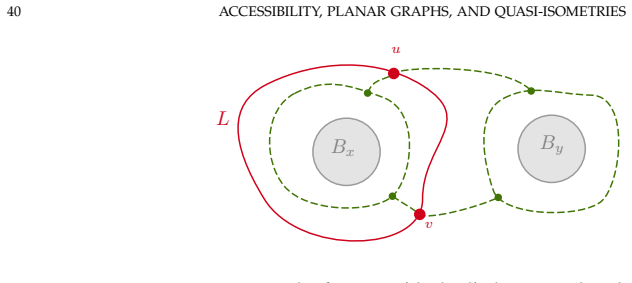


read the original abstract
We prove that a connected, locally finite, quasi-transitive graph which is quasi-isometric to a planar graph is necessarily accessible. This leads to a complete classification of the finitely generated groups which are quasi-isometric to planar graphs. In particular, such a group is virtually a free product of free and surface groups, and thus virtually admits a planar Cayley graph.
Editorial analysis
A structured set of objections, weighed in public.
Referee Report
Summary. The manuscript proves that a connected, locally finite, quasi-transitive graph quasi-isometric to a planar graph is necessarily accessible. This yields a classification of finitely generated groups quasi-isometric to planar graphs: such groups are virtually free products of free groups and surface groups, and thus virtually admit planar Cayley graphs.
Significance. If the result holds, the classification supplies a complete structural description for the quasi-isometry class of planar graphs within geometric group theory. It combines accessibility splittings with planarity constraints on the factors, extending known results on groups with planar Cayley graphs and providing a falsifiable group-theoretic consequence (virtual planarity of a Cayley graph) that aligns with standard techniques in the area.
minor comments (2)
- The abstract is concise but could explicitly reference the main theorem number for easier navigation from the introduction.
- Notation for quasi-transitivity and accessibility should be introduced with a brief reminder of the standard definitions in §1 to aid readers outside the immediate subfield.
Simulated Author's Rebuttal
We thank the referee for their positive summary, significance assessment, and recommendation to accept the manuscript.
Circularity Check
No significant circularity; derivation self-contained
full rationale
The paper states a theorem establishing accessibility for connected locally finite quasi-transitive graphs quasi-isometric to planar graphs, then derives a group classification as a corollary. The provided abstract and reader summary contain no equations, fitted parameters, self-citations invoked as load-bearing uniqueness theorems, or renamings of known results that reduce the central claim to its inputs by construction. The logical chain is presented as a direct implication under explicit hypotheses (quasi-transitivity, local finiteness), consistent with standard geometric group theory techniques without internal reduction to self-definition or prior author results that would force the outcome. This is the expected outcome for a self-contained proof paper.
Axiom & Free-Parameter Ledger
axioms (2)
- standard math Quasi-isometry is an equivalence relation that preserves coarse geometric properties such as accessibility.
- standard math Finitely generated groups act properly and cocompactly on their Cayley graphs.
Forward citations
Cited by 2 Pith papers
-
Relative accessibility for graphs
Relative accessibility in graphs is defined relative to peripheral systems, characterized via Boolean ring subrings for quasi-transitive graphs, and shown to match the group-theoretic version while being quasi-isometr...
-
Almost planar finitely presented groups
Finitely presented groups with k-planar Cayley graphs have finite-index subgroups with planar Cayley graphs; k-planar coarsely simply connected quasi-transitive graphs are quasi-isometric to planar graphs.
Reference graph
Works this paper leans on
-
[1]
G. N. Arzhantseva and P.-A. Cherix. On the Cayley graph of a generic finitely presented group. Bulletin of the Belgian Mathematical Society-Simon Stevin, 11(4):589–601, 2004
work page 2004
-
[2]
B. H. Bowditch. Planar groups and the Seifert conjecture.Journal f¨ur die reine und angewandte Mathematik, 576:11–62, 2004
work page 2004
-
[3]
B. H. Bowditch. Notes on Maskit’s planarity theorem.L’Enseignement Math´ematique, 68(1): 1–24, 2022
work page 2022
-
[4]
M. R. Bridson and A. Haefliger.Metric spaces of non-positive curvature, volume 319. Springer Science & Business Media, 2013
work page 2013
-
[5]
A. Casson and D. Jungreis. Convergence groups and Seifert fibered 3-manifolds. Inven- tiones mathematicae, 118(1):441–456, 1994
work page 1994
-
[6]
W. Dicks and M. J. Dunwoody.Groups acting on graphs, volume 17. Cambridge University Press, 1989
work page 1989
-
[7]
R. Diestel. Graph Theory. Springer-Verlag, 5th edition, 2017
work page 2017
-
[8]
C. Droms. Infinite-ended groups with planar Cayley graphs.Journal of Group Theory, 9(4): 487–496, 2006
work page 2006
- [9]
-
[10]
M. J. Dunwoody. Accessibility and groups of cohomological dimension one. Proceedings of the London Mathematical Society, 3(2):193–215, 1979
work page 1979
-
[11]
M. J. Dunwoody. Cutting up graphs. Combinatorica, 2:15–23, 1982
work page 1982
-
[12]
M. J. Dunwoody. The accessibility of finitely presented groups. Inventiones mathematicae, 81:449–458, 1985
work page 1985
-
[13]
M. J. Dunwoody. An inaccessible group. Geometric group theory, 1:75–78, 1993
work page 1993
-
[14]
M. J. Dunwoody. Planar graphs and covers. arXiv preprint arXiv:0708.0920, 2007
work page internal anchor Pith review Pith/arXiv arXiv 2007
-
[15]
L. Esperet and U. Giocanti. Coarse geometry of quasi-transitive graphs beyond planarity. arXiv preprint arXiv:2312.08902, 2023. 50 ACCESSIBILITY, PLANAR GRAPHS, AND QUASI-ISOMETRIES
-
[16]
L. Esperet, U. Giocanti, and C. Legrand-Duchesne. The structure of quasi-transitive graphs avoiding a minor with applications to the domino problem.arXiv preprint arXiv:2304.01823, 2023
-
[17]
H. Fleischner and W. Imrich. Transitive planar graphs. Mathematica Slovaca, 29(2):97–106, 1979
work page 1979
-
[18]
D. Gabai. Convergence groups are Fuchsian groups. Annals of Mathematics, 136(3):447– 510, 1992
work page 1992
-
[19]
A. Georgakopoulos. On planar Cayley graphs and Kleinian groups. Transactions of the American Mathematical Society, 373(7):4649–4684, 2020
work page 2020
-
[20]
A. Georgakopoulos and M. Hamann. The planar Cayley graphs are effectively enumerable I: consistently planar graphs. Combinatorica, 39(5):993–1019, 2019
work page 2019
-
[21]
The planar Cayley graphs are effectively enumerable II
A. Georgakopoulos and M. Hamann. The planar Cayley graphs are effectively enumerable II. arXiv preprint arXiv:1901.00347, 2019
work page internal anchor Pith review Pith/arXiv arXiv 1901
-
[22]
A. Georgakopoulos and P. Papasoglu. Graph minors and metric spaces. arXiv preprint arXiv:2305.07456, 2023
-
[23]
M. Gromov. Groups of polynomial growth and expanding maps (with an appendix by Jacques Tits). Publications Math´ematiques de l’IH´ES, 53:53–78, 1981
work page 1981
-
[24]
J. R. J. Groves and G. Swarup. Remarks on a technique of Dunwoody. Journal of Pure and Applied Algebra, 75(3):259–269, 1991
work page 1991
-
[25]
I. A. Grushko. On the bases of a free product of groups. Matematicheskii Sbornik, 8(50): 169–182, 1940
work page 1940
-
[26]
V. Guirardel and G. Levitt. JSJ decompositions of groups. arXiv preprint arXiv:1602.05139, 2016
work page internal anchor Pith review Pith/arXiv arXiv 2016
-
[27]
R. Halin. A note on Menger’s theorem for infinite locally finite graphs. In Abhandlungen aus dem Mathematischen Seminar der Universit¨at Hamburg, volume 40, pages 111–114, 1974
work page 1974
-
[28]
M. Hamann. Accessibility in transitive graphs. Combinatorica, 38(4):847–859, 2018
work page 2018
-
[29]
M. Hamann. Planar transitive graphs. The Electronic Journal of Combinatorics, pages P4–8, 2018
work page 2018
-
[30]
H. Levinson and B. Maskit. Special embeddings of Cayley diagrams.Journal of Combinato- rial Theory, Series B, 18(1):12–17, 1975
work page 1975
-
[31]
R. C. Lyndon, P. E. Schupp, R. Lyndon, and P. Schupp. Combinatorial group theory, vol- ume 89. Springer, 1977
work page 1977
-
[32]
S. Maillot. Quasi-isometries of groups, graphs and surfaces. Commentarii Mathematici Hel- vetici, 76:29–60, 2001
work page 2001
-
[33]
H. Maschke. The representation of finite groups, especially of the rotation groups of the regular bodies of three-and four-dimensional space, by Cayley’s color diagrams.American Journal of Mathematics, 18(2):156–194, 1896
-
[34]
B. Maskit. A theorem on planar covering surfaces with applications to 3-manifolds.Annals of Mathematics, pages 341–355, 1965
work page 1965
-
[35]
K. Menger. Zur allgemeinen kurventheorie. Fundamenta Mathematicae, 10(1):96–115, 1927
work page 1927
-
[36]
G. Mess. The Seifert conjecture and groups which are coarse quasiisometric to planes. preprint, 1988
work page 1988
-
[37]
R. G. M ¨oller. Ends of graphs. In Math. Proc. Camb. Phil. Soc, volume 111, pages 255–266, 1992
work page 1992
-
[38]
R. G. M ¨oller. Accessibility and ends of graphs. Journal of Combinatorial Theory, Series B, 66 (2):303–309, 1996
work page 1996
-
[39]
B. H. Neumann. On the number of generators of a free product. Journal of the London Mathematical Society, 1(1):12–20, 1943
work page 1943
-
[40]
P. Papasoglu and K. Whyte. Quasi-isometries between groups with infinitely many ends. Commentarii Mathematici Helvetici, 77(1):133–144, 2002
work page 2002
-
[41]
F. Raymond. The end point compactification of manifolds. Pacific J. Math., 10(4):947–963, 1960
work page 1960
-
[42]
R. Richter and C. Thomassen. 3-connected planar spaces uniquely embed in the sphere. Transactions of the American Mathematical Society, 354(11):4585–4595, 2002
work page 2002
-
[43]
J.-P. Serre. Trees. Springer Science & Business Media, 2002. ACCESSIBILITY, PLANAR GRAPHS, AND QUASI-ISOMETRIES 51
work page 2002
-
[44]
J. R. Stallings. On torsion-free groups with infinitely many ends. Annals of Mathematics, pages 312–334, 1968
work page 1968
-
[45]
J. R. Stallings. Group theory and three-dimensional manifolds. Yale Mathematical Mono- graphs, 4, 1971
work page 1971
-
[46]
G. Swarup. A note on accessibility. Geometric Group Theory I (Sussex, 1991), 181:204–207, 1993
work page 1991
-
[47]
C. Thomassen and W. Woess. Vertex-transitive graphs and accessibility. Journal of Combi- natorial Theory, Series B, 58(2):248–268, 1993
work page 1993
-
[48]
P. Tukia. Homeomorphic conjugates of Fuchsian groups.Journal f¨ur die reine und angewandte Mathematik, 390:1–54, 1988
work page 1988
-
[49]
C. Wall. Pairs of relative cohomological dimension one.Journal of Pure and Applied Algebra, 1(2):141–154, 1971
work page 1971
-
[50]
H. Whitney. 2-isomorphic graphs. American Journal of Mathematics, 55(1):245–254, 1933
work page 1933
-
[51]
H. C. Wilkie. On non-Euclidean crystallographic groups. Mathematische Zeitschrift, 91: 87–102, 1966
work page 1966
-
[52]
H. Zieschang, E. Vogt, and H.-D. Coldewey. Fl¨achen und ebene diskontinuierliche Gruppen. Springer, 1970. 52 ACCESSIBILITY, PLANAR GRAPHS, AND QUASI-ISOMETRIES Appendix A. Tracks In this appendix we discuss Dunwoody’s theory of tracks to the extent which is required for this paper. We recommend cross-referencing this appendix with Chapter VI of the Dicks–...
work page 1970
discussion (0)
Sign in with ORCID, Apple, or X to comment. Anyone can read and Pith papers without signing in.