City formation by dual migration of firms and workers
Pith reviewed 2026-05-24 06:06 UTC · model grok-4.3
The pith
Extending the Core-Periphery model to let firms migrate by profit gaps produces the same agglomeration patterns as the worker-only version.
A machine-rendered reading of the paper's core claim, the machinery that carries it, and where it could break.
Core claim
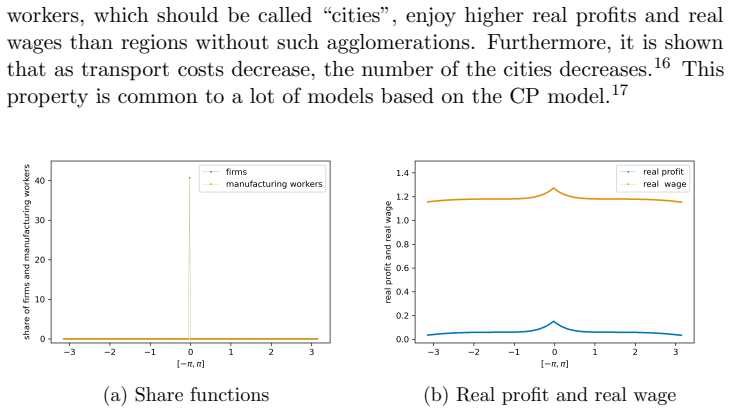
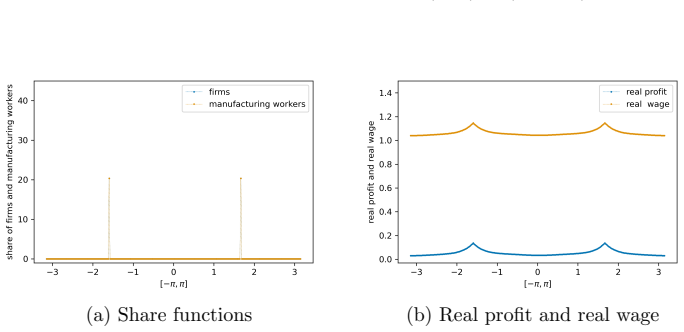
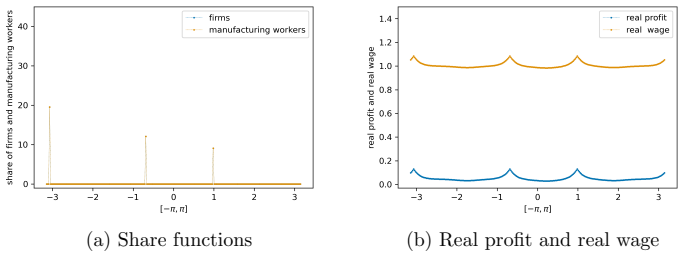
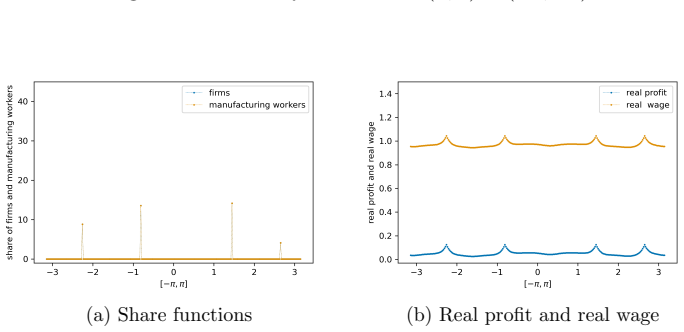
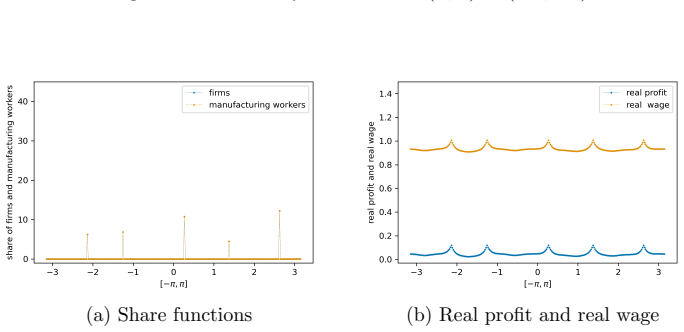
In this dual migration model, the behavior of the solutions is qualitatively similar to that of solutions of the single migration model. Spatially homogeneous distributions of firms and workers become destabilized and eventually form several cities where both firms and workers agglomerate; the number of cities decreases as transport costs decrease. The results have provided a more general theoretical justification for the use of the single migration models in NEG.
What carries the argument
The dual-migration extension of the Core-Periphery model, in which workers relocate according to real-wage differences and firms relocate according to real-profit differences.
If this is right
- Initially uniform firm and worker distributions destabilize into multiple agglomerated cities.
- Lower transport costs reduce the number of surviving cities.
- The sequence of agglomeration events remains unchanged from the single-migration case.
- Single-migration models can be used with added theoretical support across NEG studies.
Where Pith is reading between the lines
- Simpler worker-only models can be retained for policy simulations of regional development without first-order loss of accuracy.
- Empirical checks could compare observed firm relocation rates against the profit-gap predictions in real metropolitan data.
- The result suggests that further extensions, such as adding multiple transport modes, are unlikely to change the basic city-count dynamics if the same stability structure holds.
Load-bearing premise
Adding firm migration driven by real profit inequality does not introduce new bifurcations or stability changes that would qualitatively alter the agglomeration process seen in the worker-only model.
What would settle it
A numerical simulation or stability analysis of the dual-migration equations that produces a different number of stable cities or different critical transport-cost thresholds than the corresponding single-migration equations.
Figures
read the original abstract
This paper studies a mathematical model of city formation by migration of firms and workers. The Core-Periphery model in the new economic geography, which considers the single migration of workers driven by real wage inequality among regions, is extended to incorporate the migration of firms driven by real profit inequality among regions. In this dual migration model, it is found that the behavior of the solutions is qualitatively similar to that of solutions of the single migration model, which is frequently used in the new economic geography (NEG). That is, 1) spatially homogeneous distributions of firms and workers become destabilized and eventually form several cities where both firms and workers agglomerate; 2) The number of cities decreases as transport costs decrease. The results have provided a more general theoretical justification for the use of the single migration models in NEG.
Editorial analysis
A structured set of objections, weighed in public.
Referee Report
Summary. The paper extends the standard Core-Periphery model of new economic geography by adding firm migration driven by real-profit differentials alongside the usual worker migration driven by real-wage differentials. It claims that the resulting dual-migration system produces the same qualitative dynamics as the single-migration version: the spatially homogeneous equilibrium loses stability, leading to agglomeration into a finite number of cities, and that number falls as transport costs decline. This is presented as a robustness result that justifies continued reliance on single-migration NEG models.
Significance. If the stability analysis confirms that the added firm-migration term does not alter the sign pattern of the relevant eigenvalues or introduce new bifurcations, the result supplies a useful generalization that strengthens the theoretical basis for the single-migration Core-Periphery framework commonly used in NEG.
minor comments (1)
- [Abstract] Abstract: the claim of qualitative similarity is stated without any reference to the dual-migration equations, the linearization around the homogeneous state, or the eigenvalue conditions that establish preservation of the bifurcation structure; including a brief indication of the analytical steps would make the central result immediately verifiable from the abstract.
Simulated Author's Rebuttal
We thank the referee for the positive assessment of our work and the recommendation for minor revision. The referee accurately captures the paper's contribution as a robustness result showing that dual migration of firms and workers yields the same qualitative agglomeration patterns and transport-cost dependence as the standard single-migration Core-Periphery model.
Circularity Check
No significant circularity; derivation self-contained
full rationale
The paper constructs an explicit extension of the standard single-migration Core-Periphery model by adding a firm-migration term driven by real-profit differentials. It then reports that numerical or stability analysis of the resulting dual-migration system yields the same qualitative features (homogeneous-state destabilization into agglomerated cities whose number declines with falling transport costs). No equation, stability calculation, or comparison in the abstract or visible text reduces any claimed prediction to a fitted input, a self-citation chain, or a definitional identity; the similarity is presented as an observed consequence of the extended dynamics rather than an imposed assumption.
Axiom & Free-Parameter Ledger
axioms (1)
- domain assumption Migration flows respond proportionally to real-wage or real-profit differences across regions.
Reference graph
Works this paper leans on
-
[1]
Akamatsu, T., Y. Takayama, and K. Ikeda , “Spatial discounting, Fourier, and racetrack economy: A recipe for the analysis of spatial ag- glomeration models,” J. Econ. Dyn. Control , 2012, 36 (11), 1729–1759. Chincarini, L. and N. Asherie , “An analytical model for the formation of economic clusters,” Reg. Sci. Urban Econ., 2008, 38 (3), 252–270. Fabinger,...
work page 2012
-
[2]
An analytically solvable core-periphery model,
Forslid, R. and G. I. Ottaviano, “An analytically solvable core-periphery model,” J. Econ. Geogr., 2003, 3 (3), 229–240. Fujita, M. and J. F. Thisse, Economics of Agglomeration: Cities, Indus- trial Location, and Globalization, Cambridge University Press,
work page 2003
-
[3]
Agglomeration patterns in a multi-regional economy without income ef- fects,
Gaspar, Jos´ e M., Sofia B. S. D. Castro, and Jo˜ ao Correia da Silva, “Agglomeration patterns in a multi-regional economy without income ef- fects,” Econ. Theor., 2018, 66 (4), 863–899. Goryunov, Maxim, Sergey Kokovin, and Takatoshi Tabuchi, “Con- tinuous spatial monopolistic competition: matching goods with con- sumers,” Econ. Theor., 2022, pp. 793–832....
work page 2018
-
[4]
Spatial period-doubling ag- glomeration of a core-periphery model with a system of cities,
Ikeda, K., T. Akamatsu, and T. Kono , “Spatial period-doubling ag- glomeration of a core-periphery model with a system of cities,” J. Econ. Dyn. Control, 2012, 36 (5), 754–778. 24 Krugman, P. , “Increasing returns and economic geography,” J. Polit. Econ., 1991, 99 (3), 483–499. , The Self-organizing Economy, Blackwell Publishers,
work page 2012
-
[5]
Matsuyama, K., “Symmetry breaking,” in “The new palgrave dictionary of economics, 2nd ed.,” Vol. 8, Palgrave-Macmillan, 2008, pp. 128–130. Mossay, P., “Increasing returns and heterogeneity in a spatial economy,” Reg. Sci. Urban Econ., 2003, 33 (4), 419–444. Ohtake, K., “A continuous space model of new economic geography with a quasi-linear log utility fun...
work page 2008
-
[6]
Continuous space core-periphery model with transport costs in differ- entiated agriculture,
, “Continuous space core-periphery model with transport costs in differ- entiated agriculture,” arXiv preprint arXiv:2206.01040 ,
-
[7]
Pointwise agglomeration in continuous racetrack model,
and A. Yagi, “Pointwise agglomeration in continuous racetrack model,” Port. Econ. J. , 2022, 21 (2), 211–235. Palma, Andr´ e De, Yorgos Y Papageorgiou, Jacques-Fran¸ cois Thisse, and Philip Ushchev , “About the origin of cities,” J. Urban Econ., 2019, 111, 1–13. Pfl¨ uger, M., “A simple, analytically solvable, Chamberlinian agglomera- tion model,” Reg. Sc...
work page 2022
-
[8]
and , “A population explosion in an evolutionary game in spatial economics: Blow up radial solutions to the initial value problem for the replicator equation whose growth rate is determined by the continuous 25 Dixit-Stiglitz-Krugman model in an urban setting,” Nonlinear Anal. Real World Appl., 2015, 23, 26–46. and , “Approximation of a Continuous Core-pe...
work page 2015
-
[9]
A new economic geography model of central places,
Tabuchi, T. and J. F. Thisse , “A new economic geography model of central places,” J. Urban Econ., 2011, 69 (2), 240–252. 26
work page 2011
discussion (0)
Sign in with ORCID, Apple, or X to comment. Anyone can read and Pith papers without signing in.