Skin modes in a nonlinear Hatano-Nelson model
Pith reviewed 2026-05-25 08:11 UTC · model grok-4.3
The pith
Nonlinear skin modes emerge from linear ones in the Hatano-Nelson model at any non-reciprocal strength via perturbation theory.
A machine-rendered reading of the paper's core claim, the machinery that carries it, and where it could break.
Core claim
Based on perturbation theory, families of nonlinear skin modes emerge from the linear ones at any non-reciprocal strength. In the case of focusing nonlinearity, these families of nonlinear skin modes tend to exhibit enhanced localization, bridging the gap between weakly nonlinear modes and the highly nonlinear states (discrete solitons) when approaching the anti-continuum limit with vanishing couplings. Conversely, for defocusing nonlinearity, these nonlinear skin modes tend to become more extended than their linear counterpart.
What carries the argument
Perturbation theory that continues linear skin modes of the open-boundary Hatano-Nelson chain into the nonlinear regime with Kerr nonlinearity.
If this is right
- Families of nonlinear skin modes exist for any non-reciprocal strength.
- Focusing nonlinearity produces enhanced localization relative to the linear modes.
- Defocusing nonlinearity produces more extended profiles than the linear modes.
- Focusing nonlinear skin modes connect continuously to discrete solitons in the anti-continuum limit.
- Linear stability analysis applies uniformly across the obtained nonlinear mode families.
Where Pith is reading between the lines
- The continuation result implies that non-Hermitian skin localization can be preserved under weak nonlinear perturbations in open chains.
- The same perturbative construction could be tested on other non-reciprocal lattices or with different nonlinearities such as saturable or nonlocal terms.
- In driven-dissipative photonic or acoustic platforms the intensity dependence of localization could be used to steer wave propagation toward one boundary.
- Stability of the nonlinear skin modes opens the possibility of observing them as attractors in long-time evolution under small perturbations.
Load-bearing premise
The nonlinearity remains a small perturbation around the linear skin modes so that the perturbative expansion remains valid across the parameter range studied.
What would settle it
Numerical computation of exact nonlinear stationary solutions at moderate nonlinearity strength that deviate in profile or existence from the first-order perturbative predictions.
Figures
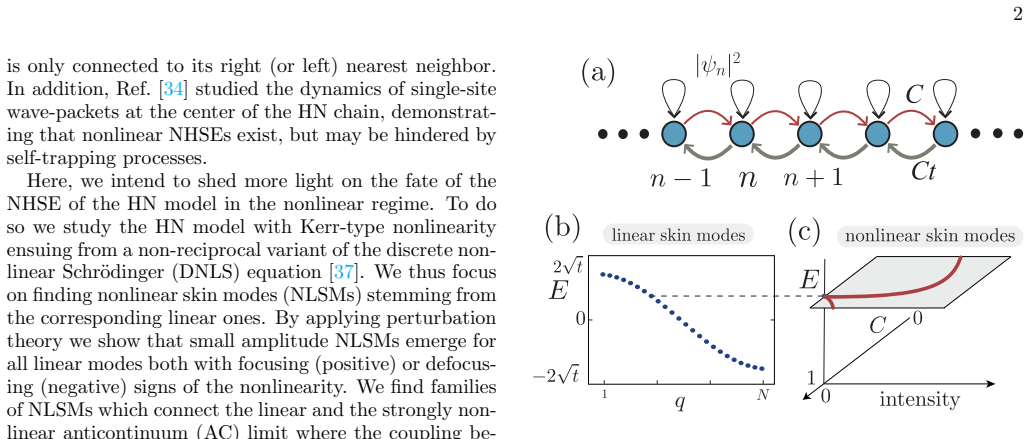


read the original abstract
Non-Hermitian lattices with non-reciprocal couplings under open boundary conditions are known to possess linear modes exponentially localized on one edge of the chain. This phenomenon, dubbed non-Hermitian skin effect, induces all input waves in the linearized limit of the system to unidirectionally propagate toward the system's preferred boundary. Here we investigate the fate of the non-Hermitian skin effect in the presence of Kerr-type nonlinearity within the well-established Hatano-Nelson lattice model. Our method is to probe the presence of nonlinear stationary modes which are localized at the favored edge, when the Hatano-Nelson model deviates from the linear regime. Based on perturbation theory, we show that families of nonlinear skin modes emerge from the linear ones at any non-reciprocal strength. Our findings reveal that, in the case of focusing nonlinearity, these families of nonlinear skin modes tend to exhibit enhanced localization, bridging the gap between weakly nonlinear modes and the highly nonlinear states (discrete solitons) when approaching the anti-continuum limit with vanishing couplings. Conversely, for defocusing nonlinearity, these nonlinear skin modes tend to become more extended than their linear counterpart. To assess the stability of these solutions, we conduct a linear stability analysis across the entire spectrum of obtained nonlinear modes and also explore representative examples of their evolution dynamics.
Editorial analysis
A structured set of objections, weighed in public.
Referee Report
Summary. The manuscript studies the nonlinear Hatano-Nelson chain with Kerr nonlinearity under open boundaries. Using perturbation theory around the known linear skin modes, it constructs families of nonlinear stationary skin modes that exist for any non-reciprocal hopping asymmetry. Focusing nonlinearity is shown to enhance localization (approaching discrete solitons in the anti-continuum limit), while defocusing nonlinearity delocalizes the modes relative to the linear case. Linear stability analysis is performed over the obtained families, supplemented by representative dynamical simulations.
Significance. If the perturbative construction is uniformly valid, the work supplies a systematic route from linear skin modes to their nonlinear counterparts in a canonical non-Hermitian lattice, together with a stability survey. This bridges the weakly nonlinear regime to the anti-continuum limit and clarifies how non-reciprocity and nonlinearity interact to control localization.
major comments (1)
- [Perturbative construction (around the linear eigenmodes)] The central claim that nonlinear skin-mode families exist “at any non-reciprocal strength” rests on the perturbative expansion remaining controlled for arbitrary asymmetry. Because the linear eigenmodes localize exponentially with increasing non-reciprocity, the overlap integrals that set the first-order frequency shift and higher-order corrections can grow; the manuscript provides no explicit bound or radius-of-convergence estimate that is independent of the asymmetry parameter. This uniformity assumption is load-bearing for the stated result.
minor comments (2)
- [Abstract] The abstract states that stability is assessed “across the entire spectrum of obtained nonlinear modes”; a brief statement of the range of nonlinearity coefficients and system sizes actually examined would improve clarity.
- [Figures] Figure captions would benefit from explicit listing of the non-reciprocal parameter values and nonlinearity strengths used in each panel.
Simulated Author's Rebuttal
We thank the referee for the detailed reading and the constructive comment on the perturbative construction. We address the point below and indicate planned revisions.
read point-by-point responses
-
Referee: [Perturbative construction (around the linear eigenmodes)] The central claim that nonlinear skin-mode families exist “at any non-reciprocal strength” rests on the perturbative expansion remaining controlled for arbitrary asymmetry. Because the linear eigenmodes localize exponentially with increasing non-reciprocity, the overlap integrals that set the first-order frequency shift and higher-order corrections can grow; the manuscript provides no explicit bound or radius-of-convergence estimate that is independent of the asymmetry parameter. This uniformity assumption is load-bearing for the stated result.
Authors: We agree that the manuscript does not furnish an explicit radius-of-convergence bound that is uniform with respect to the non-reciprocal asymmetry. Our construction proceeds for each fixed value of the asymmetry parameter, with the Kerr nonlinearity strength serving as the small parameter. For any fixed asymmetry the linear skin mode is a well-defined, exponentially localized eigenfunction of the linear operator; standard perturbative arguments (Lyapunov–Schmidt reduction or the implicit-function theorem in suitable function spaces) then guarantee the local continuation of a nonlinear branch for sufficiently small nonlinearity amplitude. The size of the admissible nonlinearity interval may indeed depend on the asymmetry through the growth of nonlinear overlap integrals, but this dependence does not invalidate the existence statement “at any non-reciprocal strength,” which refers to each fixed strength separately. We will revise the manuscript to clarify the scope of the perturbation (fixed asymmetry, small nonlinearity) and to add a short remark acknowledging the possible shrinkage of the convergence radius with increasing asymmetry. revision: yes
Circularity Check
No circularity: standard perturbative construction from independently known linear modes
full rationale
The paper starts from the established linear eigenmodes of the Hatano-Nelson model (known from prior non-self-referential literature) and applies standard perturbation theory to generate nonlinear corrections. No equation reduces to a fitted parameter renamed as a prediction, no self-definitional loop exists between the claimed nonlinear families and their linear seeds, and no load-bearing uniqueness theorem or ansatz is imported via self-citation. The derivation chain remains self-contained against external benchmarks (linear spectrum and perturbation theory), yielding an independent result rather than a tautology.
Axiom & Free-Parameter Ledger
free parameters (2)
- nonlinearity coefficient
- non-reciprocal coupling strength
axioms (2)
- domain assumption The underlying lattice is described by a discrete nonlinear Schrödinger equation with non-reciprocal nearest-neighbor couplings under open boundary conditions.
- domain assumption Perturbation theory around the linear eigenmodes remains valid for the range of nonlinearity strengths considered.
Reference graph
Works this paper leans on
-
[1]
= (0 , 0, . . . , eiκN )T , with κn being a random phase uniformly drawn in the interval [−π, π]. The time evolu- tion of this perturbed initial condition ⃗ψ(τ = 0) = ⃗ u+ϵ ⃗ w is shown in Fig. 6(c) for the stable NLSM of Fig 6(a) and Fig. 5(a). Since this is a stable NLSM, one would expect its dynamics to be straightforwardly robust, similarly, e.g., to ...
-
[2]
C. M. Bender and S. Boettcher, Real spectra in non- Hermitian Hamiltonians having PT symmetry, Physical Review Letters 80, 5243 (1998). 11
work page 1998
-
[3]
C. M. Bender, D. C. Brody, and H. F. Jones, Complex ex- tension of quantum mechanics, Physical Review Letters 89, 270401 (2002)
work page 2002
-
[4]
C. M. Bender, Making sense of non-Hermitian Hamilto- nians, Reports on Progress in Physics 70, 947 (2007)
work page 2007
-
[5]
Moiseyev, Non-Hermitian quantum mechanics (Cam- bridge University Press, 2011)
N. Moiseyev, Non-Hermitian quantum mechanics (Cam- bridge University Press, 2011)
work page 2011
-
[6]
D. Christodoulides and J. Yang, Parity-time Symmetry and Its Applications (Springer Singapore, 2018)
work page 2018
- [7]
-
[8]
K. Kawabata, K. Shiozaki, M. Ueda, and M. Sato, Sym- metry and topology in non-Hermitian physics, Phys. Rev. X 9, 041015 (2019)
work page 2019
- [9]
-
[10]
J. Claes and T. L. Hughes, Skin effect and winding num- ber in disordered non-Hermitian systems, Physical Re- view B 103, L140201 (2021)
work page 2021
- [11]
-
[12]
Q. Wang and Y. D. Chong, Non-Hermitian photonic lat- tices: Tutorial, J. Opt. Soc. Am. B 40, 1443 (2023)
work page 2023
- [13]
-
[14]
R. Lin, T. Tai, L. Li, and C. H. Lee, Topological non- Hermitian skin effect, Frontiers of Physics 18, 53605 (2023)
work page 2023
-
[15]
N. Okuma and M. Sato, Non-Hermitian topological phe- nomena: A review, Annual Review of Condensed Matter Physics 14, 83 (2023)
work page 2023
-
[16]
N. Hatano and D. R. Nelson, Localization transitions in non-Hermitian quantum mechanics, Physical Review Letters 77, 570 (1996)
work page 1996
-
[17]
N. Hatano and D. R. Nelson, Non-Hermitian delocal- ization and eigenfunctions, Physical Review B 58, 8384 (1998)
work page 1998
-
[18]
S. Weidemann, M. Kremer, T. Helbig, T. Hofmann, A. Stegmaier, M. Greiter, R. Thomale, and A. Szameit, Topological funneling of light, Science 368, 311 (2020)
work page 2020
- [19]
- [20]
-
[21]
M. Brandenbourger, X. Locsin, E. Lerner, and C. Coulais, Non-reciprocal robotic metamaterials, Nature communications 10, 4608 (2019)
work page 2019
- [22]
-
[23]
S. Liu, R. Shao, S. Ma, L. Zhang, O. You, H. Wu, Y. Jiang Xiang, T. Jun Cui, and S. Zhang, Non- Hermitian skin effect in a non-Hermitian electrical cir- cuit, Research 2021, 1 (2021)
work page 2021
- [24]
-
[25]
D. Leykam and Y. D. Chong, Edge solitons in nonlinear- photonic topological insulators, Physical Review Letters 117, 143901 (2016)
work page 2016
-
[26]
F. Zangeneh-Nejad and R. Fleury, Nonlinear second- order topological insulators, Physical Review Letters 123, 053902 (2019)
work page 2019
-
[27]
R. Chaunsali, H. Xu, J. Yang, P. G. Kevrekidis, and G. Theocharis, Stability of topological edge states under strong nonlinear effects, Physical Review B 103, 024106 (2021)
work page 2021
-
[28]
L. Jezequel and P. Delplace, Nonlinear edge modes from topological one-dimensional lattices, Physical Review B 105, 035410 (2022)
work page 2022
-
[29]
S. Kruk, Nonlinear topological photonics, in Advances in Nonlinear Photonics, Woodhead Publishing Series in Electronic and Optical Materials, edited by G. C. Righini and L. Sirleto (Woodhead Publishing, 2023) pp. 85–111
work page 2023
-
[30]
X. Ni, S. Yves, A. Krasnok, and A. Al` u, Topological metamaterials, Chemical Reviews 123, 7585 (2023)
work page 2023
-
[31]
V. V. Konotop, J. Yang, and D. A. Zezyulin, Nonlin- ear waves in PT-symmetric systems, Reviews of Modern Physics 88, 035002 (2016)
work page 2016
-
[32]
S. V. Suchkov, A. A. Sukhorukov, J. Huang, S. V. Dmitriev, C. Lee, and Y. S. Kivshar, Nonlinear switching and solitons in PT-symmetric photonic systems, Laser & Photonics Reviews 10, 177 (2016)
work page 2016
-
[33]
S. Xia, D. Kaltsas, D. Song, I. Komis, J. Xu, A. Szameit, H. Buljan, K. G. Makris, and Z. Chen, Nonlinear tuning of PT symmetry and non-Hermitian topological states, Science 372, 72 (2021)
work page 2021
-
[34]
Yuce, Nonlinear non-Hermitian skin effect, Physics Letters A 408, 127484 (2021)
C. Yuce, Nonlinear non-Hermitian skin effect, Physics Letters A 408, 127484 (2021)
work page 2021
-
[35]
M. Ezawa, Dynamical nonlinear higher-order non- Hermitian skin effects and topological trap-skin phase, Physical Review B 105, 125421 (2022)
work page 2022
-
[36]
B. Zhu, Q. Wang, D. Leykam, H. Xue, Q. J. Wang, and Y. D. Chong, Anomalous single-mode lasing induced by nonlinearity and the non-Hermitian skin effect, Physical Review Letters 129, 013903 (2022)
work page 2022
- [37]
-
[38]
P. G. Kevrekidis, The discrete nonlinear Schr¨ odinger equation: mathematical analysis, numerical computa- tions and physical perspectives, Vol. 232 (Springer Sci- ence & Business Media, 2009)
work page 2009
-
[39]
D. N. Christodoulides and R. I. Joseph, Discrete self- focusing in nonlinear arrays of coupled waveguides, Op- tics Letters 13, 794 (1988)
work page 1988
-
[40]
H. S. Eisenberg, Y. Silberberg, R. Morandotti, A. R. Boyd, and J. S. Aitchison, Discrete spatial optical soli- tons in waveguide arrays, Physical Review Letters 81, 3383 (1998)
work page 1998
-
[41]
F. Lederer, G. I. Stegeman, D. N. Christodoulides, G. As- santo, M. Segev, and Y. Silberberg, Discrete solitons in optics, Physics Reports 463, 1 (2008)
work page 2008
-
[42]
A. J. Leggett, Bose-Einstein condensation in the alkali gases: Some fundamental concepts, Reviews of Modern 12 Physics 73, 307 (2001)
work page 2001
-
[43]
O. Morsch and M. Oberthaler, Dynamics of Bose- Einstein condensates in optical lattices, Reviews of Mod- ern Physics 78, 179 (2006)
work page 2006
-
[44]
Scott, Davydov’s soliton, Physics Reports 217, 1 (1992)
A. Scott, Davydov’s soliton, Physics Reports 217, 1 (1992)
work page 1992
-
[45]
N. Molkenthin, S. Hu, and A. J. Niemi, Discrete non- linear schr¨ odinger equation and polygonal solitons with applications to collapsed proteins, Physical Review Let- ters 106, 078102 (2011)
work page 2011
-
[46]
E. Edvardsson, J. L. K. K¨ onig, and M. St˚ alhammar, Biorthogonal renormalization (2023), arXiv:2212.06004 [quant-ph]
- [47]
- [48]
-
[49]
Openly accessible at: https://sourceforge.net/ projects/matcont/files/
-
[50]
At this juncture, the branch stem- ming from the normal mode splits into three branches
For the DNLS model (HN system with t = 1), we men- tion the presence of a Pitchfork bifurcation point located at C = 0 .9036454. At this juncture, the branch stem- ming from the normal mode splits into three branches. Two of these branches converge to the one-site solutions at positions n = N/2 and n = N/2 + 1 along the chain in the AC limit, with N being...
-
[51]
D. Pelinovsky, P. Kevrekidis, and D. Frantzeskakis, Sta- bility of discrete solitons in nonlinear Schr¨ odinger lat- tices, Physica D: Nonlinear Phenomena 212, 1 (2005)
work page 2005
- [52]
-
[53]
C. Danieli, B. Many Manda, T. Mithun, and C. Skokos, Computational efficiency of numerical integration meth- ods for the tangent dynamics of many-body Hamiltonian systems in one and two spatial dimensions, Mathematics in Engineering 1, 447 (2019)
work page 2019
-
[54]
Openly accessible at: http://www.unige.ch/~hairer/ software.html
-
[55]
K. O. Rasmussen, T. Cretegny, P. G. Kevrekidis, and N. Grønbech-Jensen, Statistical mechanics of a discrete nonlinear system, Physical Review Letters 84, 3740 (2000)
work page 2000
-
[56]
P. G. Kevrekidis, D. E. Pelinovsky, and A. Saxena, When linear stability does not exclude nonlinear instability, Physical Review Letters 114, 214101 (2015)
work page 2015
-
[57]
M. I. Molina, Solitons in a modified discrete nonlinear Schr¨ odinger equation, Scientific Reports8, 2186 (2018)
work page 2018
discussion (0)
Sign in with ORCID, Apple, or X to comment. Anyone can read and Pith papers without signing in.