pith. sign in

arxiv: 2311.12895 · v1 · submitted 2023-11-21 · ✦ hep-ex

Improved measurement of the decays η' to π⁺π⁻π⁺⁽⁰⁾π⁻⁽⁰⁾ and search for the rare decay η' to 4π⁰

BESIII Collaboration: M. Ablikim , M. N. Achasov , P. Adlarson , X. C. Ai , R. Aliberti , A. Amoroso , M. R. An , Q. An
show 611 more authors
Y. Bai O. Bakina I. Balossino Y. Ban H.-R. Bao V. Batozskaya K. Begzsuren N. Berger M. Berlowski M. Bertani D. Bettoni F. Bianchi E. Bianco A. Bortone I. Boyko R. A. Briere A. Brueggemann H. Cai X. Cai A. Calcaterra G. F. Cao N. Cao S. A. Cetin J. F. Chang W. L. Chang G. R. Che G. Chelkov C. Chen Chao Chen G. Chen H. S. Chen M. L. Chen S. J. Chen S. L. Chen S. M. Chen T. Chen X. R. Chen X. T. Chen Y. B. Chen Y. Q. Chen Z. J. Chen S. K. Choi X. Chu G. Cibinetto S. C. Coen F. Cossio J. J. Cui H. L. Dai J. P. Dai A. Dbeyssi R. E. de Boer D. Dedovich Z. Y. Deng A. Denig I. Denysenko M. Destefanis F. De Mori B. Ding X. X. Ding Y. Ding J. Dong L. Y. Dong M. Y. Dong X. Dong M. C. Du S. X. Du Z. H. Duan P. Egorov Y. H. Fan J. Fang S. S. Fang W. X. Fang Y. Fang Y. Q. Fang R. Farinelli L. Fava F. Feldbauer G. Felici C. Q. Feng J. H. Feng Y. T. Feng K Fischer M. Fritsch C. D. Fu J. L. Fu Y. W. Fu H. Gao Y. N. Gao Yang Gao S. Garbolino I. Garzia P. T. Ge Z. W. Ge C. Geng E. M. Gersabeck A Gilman K. Goetzen L. Gong W. X. Gong W. Gradl S. Gramigna M. Greco M. H. Gu Y. T. Gu C. Y Guan Z. L. Guan A. Q. Guo L. B. Guo M. J. Guo R. P. Guo Y. P. Guo A. Guskov J. Gutierrez K. L. Han T. T. Han W. Y. Han X. Q. Hao F. A. Harris K. K. He K. L. He F. H. H. Heinsius C. H. Heinz Y. K. Heng C. Herold T. Holtmann P. C. Hong G. Y. Hou X. T. Hou Y. R. Hou Z. L. Hou B. Y. Hu H. M. Hu J. F. Hu T. Hu Y. Hu G. S. Huang K. X. Huang L. Q. Huang X. T. Huang Y. P. Huang T. Hussain N H\"usken N. in der Wiesche M. Irshad J. Jackson S. Jaeger S. Janchiv J. H. Jeong Q. Ji Q. P. Ji X. B. Ji X. L. Ji Y. Y. Ji X. Q. Jia Z. K. Jia H. B. Jiang P. C. Jiang S. S. Jiang T. J. Jiang X. S. Jiang Y. Jiang J. B. Jiao Z. Jiao S. Jin Y. Jin M. Q. Jing X. M. Jing T. Johansson X. K. S. Kabana N. Kalantar-Nayestanaki X. L. Kang X. S. Kang M. Kavatsyuk B. C. Ke V. Khachatryan A. Khoukaz R. Kiuchi O. B. Kolcu B. Kopf M. Kuessner A. Kupsc W. K\"uhn J. J. Lane P. Larin L. Lavezzi T. T. Lei Z. H. Lei H. Leithoff M. Lellmann T. Lenz C. Li C. H. Li Cheng Li D. M. Li F. Li G. Li H. Li H. B. Li H. J. Li H. N. Li Hui Li J. R. Li J. S. Li J. W. Li Ke Li L. J Li L. K. Li Lei Li M. H. Li P. R. Li Q. X. Li S. X. Li T. Li W. D. Li W. G. Li X. H. Li X. L. Li Xiaoyu Li Y. G. Li Z. J. Li Z. X. Li C. Liang H. Liang Y. F. Liang Y. T. Liang G. R. Liao L. Z. Liao Y. P. Liao J. Libby A. Limphirat D. X. Lin T. Lin B. J. Liu B. X. Liu C. Liu C. X. Liu F. H. Liu Fang Liu Feng Liu G. M. Liu H. Liu H. B. Liu H. M. Liu Huanhuan Liu Huihui Liu J. B. Liu J. Y. Liu K. Liu K. Y. Liu Ke Liu L. Liu L. C. Liu Lu Liu M. H. Liu P. L. Liu Q. Liu S. B. Liu T. Liu W. K. Liu W. M. Liu X. Liu Y. Liu Y. B. Liu Z. A. Liu Z. Q. Liu X. C. Lou F. X. Lu H. J. Lu J. G. Lu X. L. Lu Y. Lu Y. P. Lu Z. H. Lu C. L. Luo M. X. Luo T. Luo X. L. Luo X. R. Lyu Y. F. Lyu F. C. Ma H. Ma H. L. Ma J. L. Ma L. L. Ma M. M. Ma Q. M. Ma R. Q. Ma X. Y. Ma Y. Ma Y. M. Ma F. E. Maas M. Maggiora S. Malde Q. A. Malik A. Mangoni Y. J. Mao Z. P. Mao S. Marcello Z. X. Meng J. G. Messchendorp G. Mezzadri H. Miao T. J. Min R. E. Mitchell X. H. Mo B. Moses N. Yu. Muchnoi J. Muskalla Y. Nefedov F. Nerling I. B. Nikolaev Z. Ning S. Nisar Q. L. Niu W. D. Niu Y. Niu S. L. Olsen Q. Ouyang S. Pacetti X. Pan Y. Pan A. Pathak P. Patteri Y. P. Pei M. Pelizaeus H. P. Peng Y. Y. Peng K. Peters J. L. Ping R. G. Ping S. Plura V. Prasad F. Z. Qi H. Qi H. R. Qi M. Qi T. Y. Qi S. Qian W. B. Qian C. F. Qiao J. J. Qin L. Q. Qin X. S. Qin Z. H. Qin J. F. Qiu S. Q. Qu C. F. Redmer K. J. Ren A. Rivetti M. Rolo G. Rong Ch. Rosner S. N. Ruan N. Salone A. Sarantsev Y. Schelhaas K. Schoenning M. Scodeggio K. Y. Shan W. Shan X. Y. Shan J. F. Shangguan L. G. Shao M. Shao C. P. Shen H. F. Shen W. H. Shen X. Y. Shen B. A. Shi H. C. Shi J. L. Shi J. Y. Shi Q. Q. Shi R. S. Shi X. Shi J. J. Song T. Z. Song W. M. Song Y. J. Song S. Sosio S. Spataro F. Stieler Y. J. Su G. B. Sun G. X. Sun H. Sun H. K. Sun J. F. Sun K. Sun L. Sun S. S. Sun T. Sun W. Y. Sun Y. Sun Y. J. Sun Y. Z. Sun Z. T. Sun Y. X. Tan C. J. Tang G. Y. Tang J. Tang Y. A. Tang L. Y Tao Q. T. Tao M. Tat J. X. Teng V. Thoren W. H. Tian Y. Tian Z. F. Tian I. Uman Y. Wan S. J. Wang B. Wang B. L. Wang Bo Wang C. W. Wang D. Y. Wang F. Wang H. J. Wang J. P. Wang K. Wang L. L. Wang M. Wang Meng Wang N. Y. Wang S. Wang T. Wang T. J. Wang W. Wang W. P. Wang X. Wang X. F. Wang X. J. Wang X. L. Wang Y. Wang Y. D. Wang Y. F. Wang Y. L. Wang Y. N. Wang Y. Q. Wang Yaqian Wang Yi Wang Z. Wang Z. L. Wang Z. Y. Wang Ziyi Wang D. Wei D. H. Wei F. Weidner S. P. Wen C. W. Wenzel U. Wiedner G. Wilkinson M. Wolke L. Wollenberg C. Wu J. F. Wu L. H. Wu L. J. Wu X. Wu X. H. Wu Y. Wu Y. H. Wu Y. J. Wu Z. Wu L. Xia X. M. Xian T. Xiang D. Xiao G. Y. Xiao S. Y. Xiao Y. L. Xiao Z. J. Xiao C. Xie X. H. Xie Y. Xie Y. G. Xie Y. H. Xie Z. P. Xie T. Y. Xing C. F. Xu C. J. Xu G. F. Xu H. Y. Xu Q. J. Xu Q. N. Xu W. Xu W. L. Xu X. P. Xu Y. C. Xu Z. P. Xu Z. S. Xu F. Yan L. Yan W. B. Yan W. C. Yan X. Q. Yan H. J. Yang H. L. Yang H. X. Yang Tao Yang Y. Yang Y. F. Yang Y. X. Yang Yifan Yang Z. W. Yang Z. P. Yao M. Ye M. H. Ye J. H. Yin Z. Y. You B. X. Yu C. X. Yu G. Yu J. S. Yu T. Yu X. D. Yu C. Z. Yuan L. Yuan S. C. Yuan Y. Yuan Z. Y. Yuan C. X. Yue A. A. Zafar F. R. Zeng S. H. Zeng X. Zeng Y. Zeng Y. J. Zeng X. Y. Zhai Y. C. Zhai Y. H. Zhan A. Q. Zhang B. L. Zhang B. X. Zhang D. H. Zhang G. Y. Zhang H. Zhang H. C. Zhang H. H. Zhang H. Q. Zhang H. Y. Zhang J. Zhang J. J. Zhang J. L. Zhang J. Q. Zhang J. W. Zhang J. X. Zhang J. Y. Zhang J. Z. Zhang Jianyu Zhang L. M. Zhang L. Q. Zhang Lei Zhang P. Zhang Q. Y. Zhang Shuihan Zhang Shulei Zhang X. D. Zhang X. M. Zhang X. Y. Zhang Y. Zhang Y. T. Zhang Y. H. Zhang Yan Zhang Yao Zhang Z. D. Zhang Z. H. Zhang Z. L. Zhang Z. Y. Zhang G. Zhao J. Y. Zhao J. Z. Zhao Lei Zhao Ling Zhao M. G. Zhao R. P. Zhao S. J. Zhao Y. B. Zhao Y. X. Zhao Z. G. Zhao Z. H. Zhao A. Zhemchugov B. Zheng J. P. Zheng W. J. Zheng Y. H. Zheng B. Zhong X. Zhong H. Zhou L. P. Zhou X. Zhou X. K. Zhou X. R. Zhou X. Y. Zhou Y. Z. Zhou J. Zhu K. Zhu K. J. Zhu L. Zhu L. X. Zhu S. H. Zhu S. Q. Zhu T. J. Zhu W. J. Zhu Y. C. Zhu Z. A. Zhu J. H. Zou J. Zu
This is my paper

Pith reviewed 2026-05-24 05:57 UTC · model grok-4.3

classification ✦ hep-ex
keywords eta prime decaysfour pion final statesbranching fraction measurementsisovector form factorvector meson dominancerare decay upper limitsamplitude analysis
0
0 comments X

The pith

Branching fraction of eta prime to four charged pions measured as 8.56 times 10 to the minus five, with upper limit below 1.24 times 10 to the minus five for the neutral mode.

A machine-rendered reading of the paper's core claim, the machinery that carries it, and where it could break.

The paper reports improved measurements of the branching fractions for two four-pion decay modes of the eta prime meson from a large sample of radiative J/psi decays. The charged four-pion mode is found at 8.56 times 10 to the minus five and the mixed mode at 2.12 times 10 to the minus four, both with smaller uncertainties than prior results. No signal appears in the all-neutral four-pion channel, yielding a new upper limit at 90 percent confidence level. An amplitude analysis of the charged mode extracts the doubly virtual isovector form factor for the first time, returning a value consistent with vector meson dominance expectations.

Core claim

Using ten billion J/psi events, the branching fraction for eta prime to four charged pions is measured to be 8.56 plus or minus 0.25 statistical plus or minus 0.23 systematic times ten to the minus five, and for the mixed charged-neutral mode 2.12 plus or minus 0.12 statistical plus or minus 0.10 systematic times ten to the minus four. No significant signal is observed for eta prime to four neutral pions, so the branching fraction is bounded above by 1.24 times ten to the minus five at 90 percent confidence level. The amplitude analysis of the charged mode determines the doubly virtual isovector form factor alpha to be 1.22 plus or minus 0.33 statistical plus or minus 0.04 systematic, in the

What carries the argument

Amplitude analysis of the four-pion final state to extract the doubly virtual isovector form factor alpha

If this is right

  • These branching fractions supply tighter constraints for theoretical calculations of eta prime decay widths.
  • The extracted form factor value supports the vector meson dominance description of the decay dynamics.
  • The upper limit on the neutral mode restricts possible contributions from additional intermediate states or new mechanisms.
  • Higher-precision data on these modes enable sharper tests of chiral effective theories.

Where Pith is reading between the lines

These are editorial extensions of the paper, not claims the author makes directly.

  • The measured form factor could be used as input to refine models of light meson structure beyond the vector meson dominance approximation.
  • Similar amplitude analyses on other rare meson decays might yield comparable form factor determinations with existing or future data samples.
  • The upper limit could guide experimental searches for related processes such as eta prime decays involving additional photons or leptons.

Load-bearing premise

The amplitude model chosen for the four-pion final state correctly captures all relevant intermediate resonances and interference effects without significant missing contributions that would bias the extracted form factor.

What would settle it

An independent experiment reporting a branching fraction for eta prime to four charged pions outside 8.0 to 9.1 times ten to the minus five or a form factor alpha differing from 1.22 by more than its combined uncertainty would challenge the central results.

Figures
Figures reproduced from arXiv: 2311.12895 by A. Amoroso, A. A. Zafar, A. Bortone, A. Brueggemann, A. Calcaterra, A. Dbeyssi, A. Denig, A Gilman, A. Guskov, A. Khoukaz, A. Kupsc, A. Limphirat, A. Mangoni, A. Pathak, A. Q. Guo, A. Q. Zhang, A. Rivetti, A. Sarantsev, A. Zhemchugov, B. A. Shi, B. C. Ke, B. Ding, BESIII Collaboration: M. Ablikim, B. J. Liu, B. Kopf, B. L. Wang, B. L. Zhang, B. Moses, Bo Wang, B. Wang, B. X. Liu, B. X. Yu, B. X. Zhang, B. Y. Hu, B. Zheng, B. Zhong, C. Chen, C. D. Fu, C. F. Qiao, C. F. Redmer, C. F. Xu, C. Geng, Chao Chen, Cheng Li, C. Herold, C. H. Heinz, C. H. Li, Ch. Rosner, C. J. Tang, C. J. Xu, C. Li, C. Liang, C. Liu, C. L. Luo, C. P. Shen, C. Q. Feng, C. Wu, C. W. Wang, C. W. Wenzel, C. Xie, C. X. Liu, C. X. Yu, C. X. Yue, C. Y Guan, C. Z. Yuan, D. Bettoni, D. Dedovich, D. H. Wei, D. H. Zhang, D. M. Li, D. Wei, D. Xiao, D. X. Lin, D. Y. Wang, E. Bianco, E. M. Gersabeck, F. A. Harris, Fang Liu, F. Bianchi, F. C. Ma, F. Cossio, F. De Mori, F. E. Maas, Feng Liu, F. Feldbauer, F. H. H. Heinsius, F. H. Liu, F. Li, F. Nerling, F. R. Zeng, F. Stieler, F. Wang, F. Weidner, F. X. Lu, F. Yan, F. Z. Qi, G. B. Sun, G. Chelkov, G. Chen, G. Cibinetto, G. F. Cao, G. Felici, G. F. Xu, G. Li, G. Mezzadri, G. M. Liu, G. R. Che, G. R. Liao, G. Rong, G. S. Huang, G. Wilkinson, G. X. Sun, G. Y. Hou, G. Y. Tang, G. Yu, G. Y. Xiao, G. Y. Zhang, G. Zhao, H. B. Jiang, H. B. Li, H. B. Liu, H. Cai, H. C. Shi, H. C. Zhang, H. F. Shen, H. Gao, H. H. Zhang, H. J. Li, H. J. Lu, H. J. Wang, H. J. Yang, H. K. Sun, H. L. Dai, H. Leithoff, H. Li, H. Liang, H. Liu, H. L. Ma, H. L. Yang, H. Ma, H. M. Hu, H. Miao, H. M. Liu, H. N. Li, H. P. Peng, H. Qi, H. Q. Zhang, H.-R. Bao, H. R. Qi, H. S. Chen, H. Sun, Huanhuan Liu, Huihui Liu, Hui Li, H. X. Yang, H. Y. Xu, H. Y. Zhang, H. Zhang, H. Zhou, I. Balossino, I. B. Nikolaev, I. Boyko, I. Denysenko, I. Garzia, I. Uman, J. B. Jiao, J. B. Liu, J. Dong, J. Fang, J. F. Chang, J. F. Hu, J. F. Qiu, J. F. Shangguan, J. F. Sun, J. F. Wu, J. G. Lu, J. G. Messchendorp, J. Gutierrez, J. H. Feng, J. H. Jeong, J. H. Yin, J. H. Zou, Jianyu Zhang, J. Jackson, J. J. Cui, J. J. Lane, J. J. Qin, J. J. Song, J. J. Zhang, J. L. Fu, J. Libby, J. L. Ma, J. L. Ping, J. L. Shi, J. L. Zhang, J. Muskalla, J. P. Dai, J. P. Wang, J. P. Zheng, J. Q. Zhang, J. R. Li, J. S. Li, J. S. Yu, J. Tang, J. W. Li, J. W. Zhang, J. X. Teng, J. X. Zhang, J. Y. Liu, J. Y. Shi, J. Y. Zhang, J. Y. Zhao, J. Zhang, J. Zhu, J. Zu, J. Z. Zhang, J. Z. Zhao, K. Begzsuren, Ke Li, Ke Liu, K Fischer, K. Goetzen, K. J. Ren, K. J. Zhu, K. K. He, K. L. Han, K. L. He, K. Liu, K. Peters, K. Schoenning, K. Sun, K. Wang, K. X. Huang, K. Y. Liu, K. Y. Shan, K. Zhu, L. B. Guo, L. C. Liu, Lei Li, Lei Zhang, Lei Zhao, L. Fava, L. Gong, L. G. Shao, L. H. Wu, Ling Zhao, L. J Li, L. J. Wu, L. K. Li, L. Lavezzi, L. Liu, L. L. Ma, L. L. Wang, L. M. Zhang, L. P. Zhou, L. Q. Huang, L. Q. Qin, L. Q. Zhang, L. Sun, Lu Liu, L. Wollenberg, L. Xia, L. X. Zhu, L. Yan, L. Y. Dong, L. Y Tao, L. Yuan, L. Zhu, L. Z. Liao, M. Berlowski, M. Bertani, M. C. Du, M. Destefanis, Meng Wang, M. Fritsch, M. Greco, M. G. Zhao, M. H. Gu, M. H. Li, M. H. Liu, M. H. Ye, M. Irshad, M. J. Guo, M. Kavatsyuk, M. Kuessner, M. L. Chen, M. Lellmann, M. Maggiora, M. M. Ma, M. N. Achasov, M. Pelizaeus, M. Qi, M. Q. Jing, M. R. An, M. Rolo, M. Scodeggio, M. Shao, M. Tat, M. Wang, M. Wolke, M. X. Luo, M. Y. Dong, M. Ye, N. Berger, N. Cao, N H\"usken, N. in der Wiesche, N. Kalantar-Nayestanaki, N. Salone, N. Yu. Muchnoi, N. Y. Wang, O. Bakina, O. B. Kolcu, P. Adlarson, P. C. Hong, P. C. Jiang, P. Egorov, P. Larin, P. L. Liu, P. Patteri, P. R. Li, P. T. Ge, P. Zhang, Q. A. Malik, Q. An, Q. Ji, Q. J. Xu, Q. Liu, Q. L. Niu, Q. M. Ma, Q. N. Xu, Q. Ouyang, Q. P. Ji, Q. Q. Shi, Q. T. Tao, Q. X. Li, Q. Y. Zhang, R. A. Briere, R. Aliberti, R. E. de Boer, R. E. Mitchell, R. Farinelli, R. G. Ping, R. Kiuchi, R. P. Guo, R. P. Zhao, R. Q. Ma, R. S. Shi, S. A. Cetin, S. B. Liu, S. C. Coen, S. C. Yuan, S. Garbolino, S. Gramigna, Shuihan Zhang, Shulei Zhang, S. H. Zeng, S. H. Zhu, S. Jaeger, S. Janchiv, S. J. Chen, S. Jin, S. J. Wang, S. J. Zhao, S. Kabana, S. K. Choi, S. L. Chen, S. L. Olsen, S. Malde, S. Marcello, S. M. Chen, S. Nisar, S. N. Ruan, S. Pacetti, S. Plura, S. P. Wen, S. Qian, S. Q. Qu, S. Q. Zhu, S. S. Fang, S. S. Jiang, S. Sosio, S. Spataro, S. S. Sun, S. Wang, S. X. Du, S. X. Li, S. Y. Xiao, Tao Yang, T. Chen, T. Holtmann, T. Hu, T. Hussain, T. J. Jiang, T. J. Min, T. Johansson, T. J. Wang, T. J. Zhu, T. Lenz, T. Li, T. Lin, T. Liu, T. Luo, T. Sun, T. T. Han, T. T. Lei, T. Wang, T. Xiang, T. Y. Qi, T. Yu, T. Y. Xing, T. Z. Song, U. Wiedner, V. Batozskaya, V. Khachatryan, V. Prasad, V. Thoren, W. B. Qian, W. B. Yan, W. C. Yan, W. D. Li, W. D. Niu, W. G. Li, W. Gradl, W. H. Shen, W. H. Tian, W. J. Zheng, W. J. Zhu, W. K. Liu, W. K\"uhn, W. L. Chang, W. L. Xu, W. M. Liu, W. M. Song, W. P. Wang, W. Shan, W. Wang, W. X. Fang, W. X. Gong, W. Xu, W. Y. Han, W. Y. Sun, X. B. Ji, X. Cai, X. C. Ai, X. Chu, X. C. Lou, X. Dong, X. D. Yu, X. D. Zhang, X. F. Wang, X. H. Li, X. H. Mo, X. H. Wu, X. H. Xie, Xiaoyu Li, X. J. Wang, X. K., X. K. Zhou, X. Liu, X. L. Ji, X. L. Kang, X. L. Li, X. L. Lu, X. L. Luo, X. L. Wang, X. M. Jing, X. M. Xian, X. M. Zhang, X. Pan, X. P. Xu, X. Q. Hao, X. Q. Jia, X. Q. Yan, X. R. Chen, X. R. Lyu, X. R. Zhou, X. Shi, X. S. Jiang, X. S. Kang, X. S. Qin, X. T. Chen, X. T. Hou, X. T. Huang, X. Wang, X. Wu, X. X. Ding, X. Y. Ma, X. Y. Shan, X. Y. Shen, X. Y. Zhai, X. Y. Zhang, X. Y. Zhou, X. Zeng, X. Zhong, X. Zhou, Yang Gao, Yan Zhang, Yao Zhang, Yaqian Wang, Y. A. Tang, Y. Bai, Y. Ban, Y. B. Chen, Y. B. Liu, Y. B. Zhao, Y. C. Xu, Y. C. Zhai, Y. C. Zhu, Y. Ding, Y. D. Wang, Y. Fang, Y. F. Liang, Y. F. Lyu, Y. F. Wang, Y. F. Yang, Y. G. Li, Y. G. Xie, Y. H. Fan, Y. Hu, Y. H. Wu, Y. H. Xie, Y. H. Zhan, Y. H. Zhang, Y. H. Zheng, Yifan Yang, Yi Wang, Y. Jiang, Y. Jin, Y. J. Mao, Y. J. Song, Y. J. Su, Y. J. Sun, Y. J. Wu, Y. J. Zeng, Y. K. Heng, Y. Liu, Y. Lu, Y. L. Wang, Y. L. Xiao, Y. Ma, Y. M. Ma, Y. Nefedov, Y. N. Gao, Y. Niu, Y. N. Wang, Y. Pan, Y. P. Guo, Y. P. Huang, Y. P. Liao, Y. P. Lu, Y. P. Pei, Y. Q. Chen, Y. Q. Fang, Y. Q. Wang, Y. R. Hou, Y. Schelhaas, Y. Sun, Y. T. Feng, Y. T. Gu, Y. Tian, Y. T. Liang, Y. T. Zhang, Y. Wan, Y. Wang, Y. W. Fu, Y. Wu, Y. Xie, Y. X. Tan, Y. X. Yang, Y. X. Zhao, Y. Yang, Y. Y. Ji, Y. Y. Peng, Y. Yuan, Y. Zeng, Y. Zhang, Y. Z. Sun, Y. Z. Zhou, Z. A. Liu, Z. A. Zhu, Z. D. Zhang, Z. F. Tian, Z. G. Zhao, Z. H. Duan, Z. H. Lei, Z. H. Lu, Z. H. Qin, Z. H. Zhang, Z. H. Zhao, Ziyi Wang, Z. J. Chen, Z. Jiao, Z. J. Li, Z. J. Xiao, Z. K. Jia, Z. L. Guan, Z. L. Hou, Z. L. Wang, Z. L. Zhang, Z. Ning, Z. P. Mao, Z. P. Xie, Z. P. Xu, Z. P. Yao, Z. Q. Liu, Z. S. Xu, Z. T. Sun, Z. Wang, Z. W. Ge, Z. Wu, Z. W. Yang, Z. X. Li, Z. X. Meng, Z. Y. Deng, Z. Y. Wang, Z. Y. You, Z. Y. Yuan, Z. Y. Zhang.

Figure 1
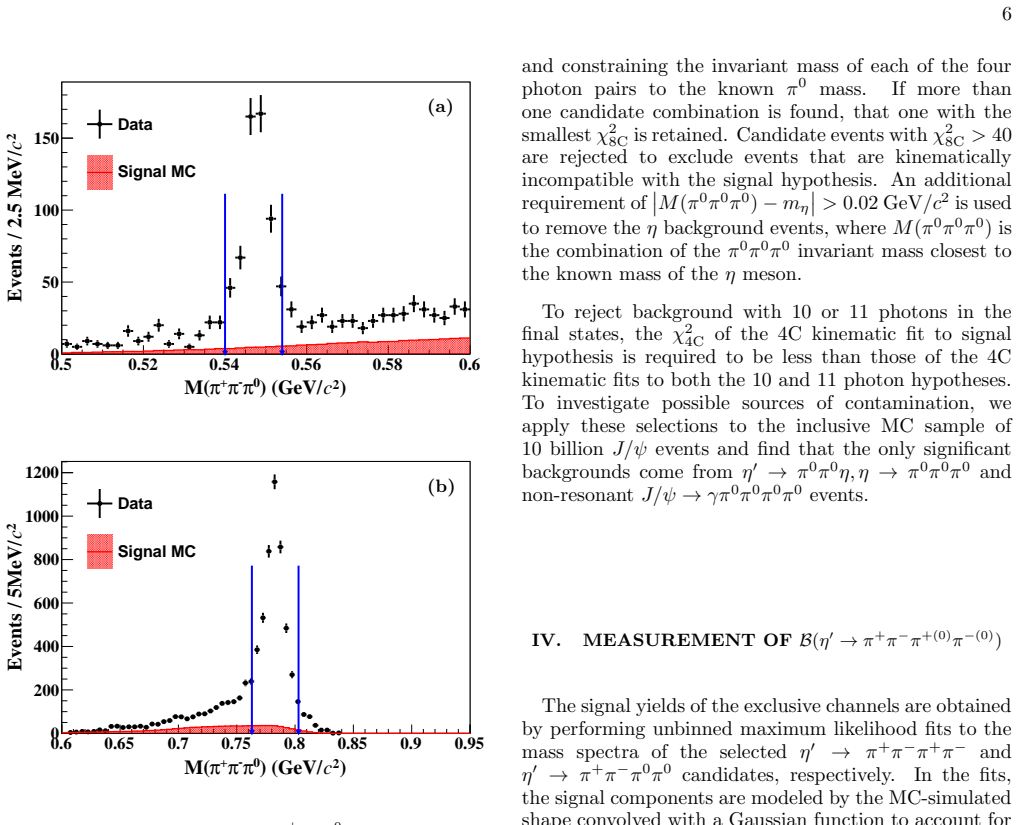
Figure 1. Figure 1: The fit results of the mass spectra of π +π −π +π − (a) and π +π −π 0π 0 (b). γπ+π −π 0π 0 . Figures 2(a) and 2(b) show the invariant￾mass spectra of the π +π −π 0 combination passing this selection and lying closest to the known η (ω) mass (denoted as mη/mω), respectively, where the η and ω peaks are evident. To reject background events with η (ω) in the final states, the combination closest to mη (mω) is… view at source ↗
Figure 2
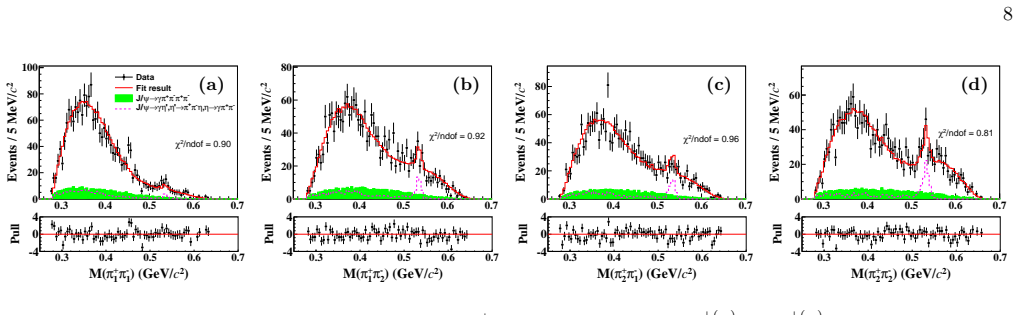
Figure 2. Figure 2: The distributions of the π +π −π 0 invariant masses closest to the known masses of (a) η and (b) ω. The blue arrows mark the interval for rejecting each resonance. The signal MC is displayed with arbitrary normalization. events satisfying the above requirements, in which a clean η ′ peak is evident. The same selection is performed on the inclusive MC sample of 10 billion J/ψ events to investigate possible … view at source ↗
Figure 3
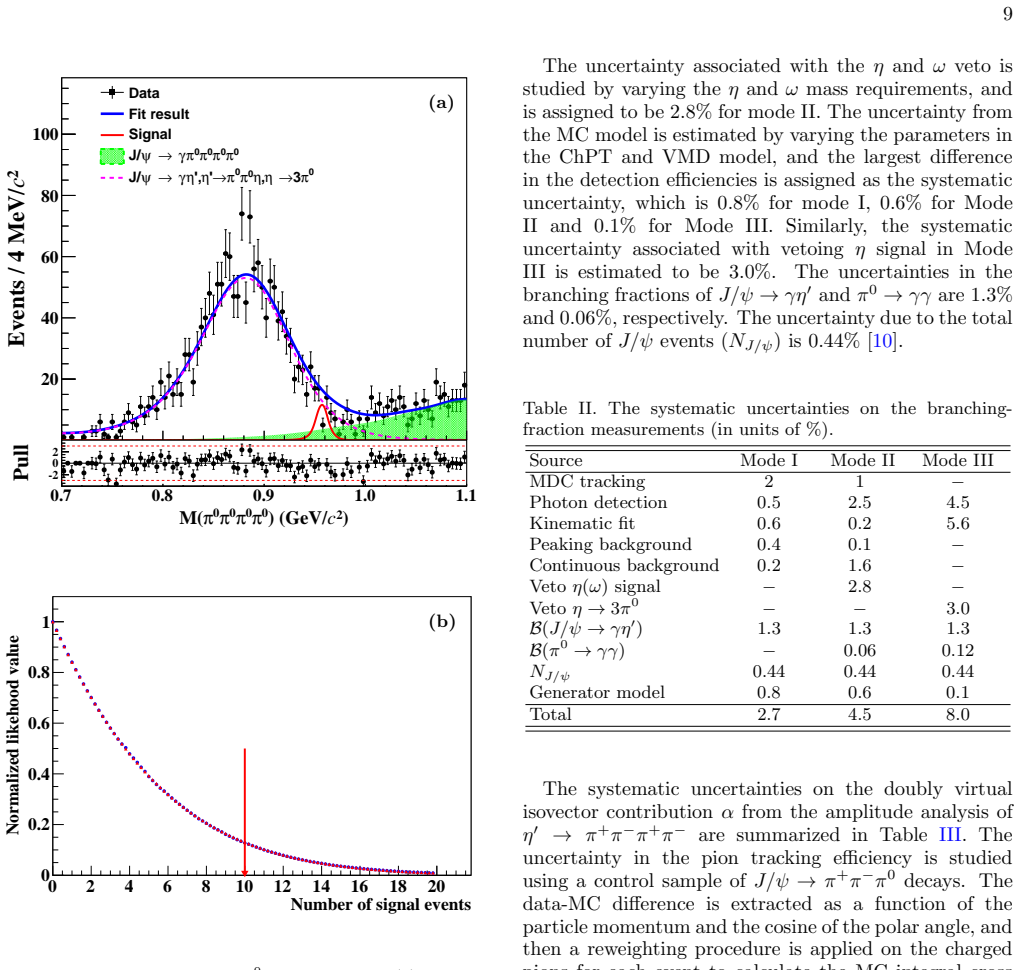
Figure 3. Figure 3: The fitted projections to the invariant mass of four [PITH_FULL_IMAGE:figures/full_fig_p008_3.png] view at source ↗
Figure 4
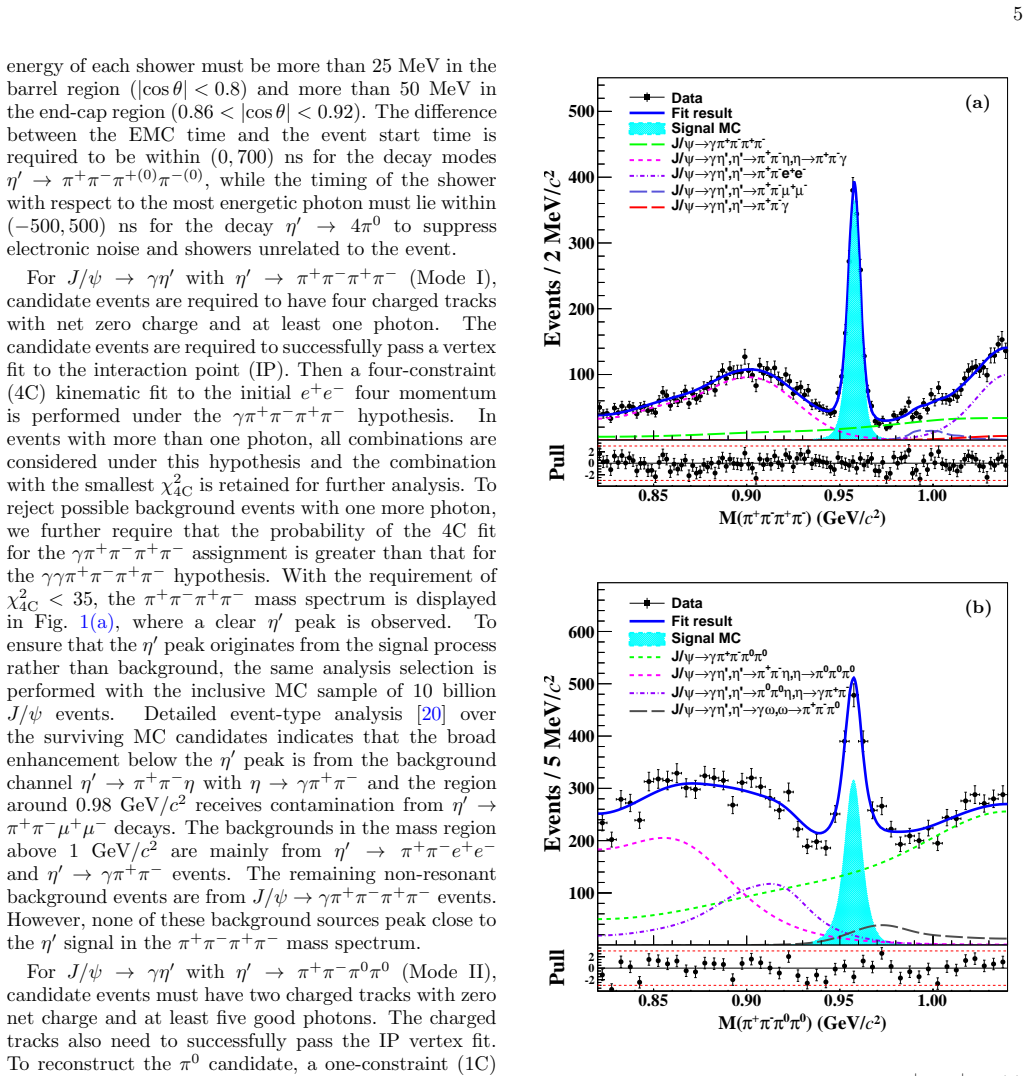
Figure 4. Figure 4: The fit result to the 4π 0 invariant mass (a) and the normalized likelihood distribution (b). In (b), the blue dots and red triangles are the likelihood distributions before and after convolution with a Gaussian function with resolution equal to the total systematic uncertainty, respectively. The red arrow indicates the upper limit at the 90% confidence level. MC shapes with a third-order Chebychev functio… view at source ↗
read the original abstract

Using a sample of 10 billion $J/{\psi}$ events collected with the BESIII detector, the decays $\eta' \to \pi^{+}\pi^{-}\pi^{+}\pi^{-}$, $\eta' \to \pi^{+}\pi^{-}\pi^{0}\pi^{0}$ and $\eta' \to 4 \pi^{0}$ are studied via the process $J/{\psi}\to\gamma\eta'$. The branching fractions of $\eta' \to \pi^{+}\pi^{-}\pi^{+}\pi^{-}$ and $\eta' \to \pi^{+}\pi^{-}\pi^{0}$ $\pi^{0}$ are measured to be $( 8.56 \pm 0.25({\rm stat.}) \pm 0.23({\rm syst.}) ) \times {10^{ - 5}}$ and $(2.12 \pm 0.12({\rm stat.}) \pm 0.10({\rm syst.})) \times {10^{ - 4}}$, respectively, which are consistent with previous measurements but with improved precision. No significant $\eta' \to 4 \pi^{0}$ signal is observed, and the upper limit on the branching fraction of this decay is determined to be less than $1.24 \times {10^{-5}}$ at the $90\%$ confidence level. In addition, an amplitude analysis of $\eta' \to \pi^{+}\pi^{-}\pi^{+}\pi^{-}$ is performed to extract the doubly virtual isovector form factor $\alpha$ for the first time. The measured value of $\alpha=1.22 \pm 0.33({\rm stat.}) \pm 0.04({\rm syst.})$, is in agreement with the prediction of the VMD model.

Editorial analysis

A structured set of objections, weighed in public.

Desk editor's note, referee report, simulated authors' rebuttal, and a circularity audit. Tearing a paper down is the easy half of reading it; the pith above is the substance, this is the friction.

Referee Report

1 major / 2 minor

Summary. Using 10 billion J/ψ events collected with BESIII, the paper measures the branching fractions Br(η' → π⁺π⁻π⁺π⁻) = (8.56 ± 0.25(stat) ± 0.23(syst)) × 10^{-5} and Br(η' → π⁺π⁻π⁰π⁰) = (2.12 ± 0.12(stat) ± 0.10(syst)) × 10^{-4}, sets an upper limit Br(η' → 4π⁰) < 1.24 × 10^{-5} at 90% CL, and performs an amplitude analysis of the charged mode to extract the doubly virtual isovector form factor α = 1.22 ± 0.33(stat) ± 0.04(syst) for the first time, finding agreement with the VMD prediction.

Significance. The branching-fraction results benefit from the large data sample and provide improved precision over prior work. The extraction of α constitutes the first direct measurement of this quantity from data and offers a test of the VMD model; if the amplitude model is shown to be robust, the result is a useful addition to the literature on η' decays.

major comments (1)
  1. [Amplitude analysis] Amplitude analysis section: the central value of α is obtained by fitting a specific resonance model to the four-pion final state. Because the statistical uncertainty is already 27% and the result is the first extraction of this quantity, the paper must demonstrate that the model is complete (e.g., by showing fit quality, testing alternative models with additional scalars or non-resonant terms, or quantifying the model systematic beyond the quoted 0.04). Without such validation the extracted α could be biased, undermining the claim of agreement with VMD.
minor comments (2)
  1. The abstract reports combined uncertainties for the branching fractions; the text should explicitly state whether the systematic uncertainty on α includes contributions from the choice of amplitude model.
  2. Table or figure presenting the fit results should include the χ²/ndf or equivalent goodness-of-fit metric for the amplitude fit.

Simulated Author's Rebuttal

1 responses · 0 unresolved

We thank the referee for the positive evaluation of the branching-fraction results and for the constructive comment on the amplitude analysis. We address the concern point by point below and will revise the manuscript to incorporate additional model-validation material.

read point-by-point responses
  1. Referee: Amplitude analysis section: the central value of α is obtained by fitting a specific resonance model to the four-pion final state. Because the statistical uncertainty is already 27% and the result is the first extraction of this quantity, the paper must demonstrate that the model is complete (e.g., by showing fit quality, testing alternative models with additional scalars or non-resonant terms, or quantifying the model systematic beyond the quoted 0.04). Without such validation the extracted α could be biased, undermining the claim of agreement with VMD.

    Authors: We agree that additional validation of the amplitude model is warranted for a first measurement of α with a 27% statistical uncertainty. The present manuscript describes the VMD-inspired resonance model and quotes a 0.04 systematic uncertainty intended to cover model variations. To strengthen the result, the revised version will include (i) the χ²/ndf of the nominal fit, (ii) projections of the fit onto the relevant kinematic distributions, and (iii) the outcome of an alternative fit that incorporates a non-resonant amplitude component. The model systematic will be re-evaluated on the basis of these tests and updated if necessary. These additions will be made in the next iteration of the paper. revision: yes

Circularity Check

0 steps flagged

No circularity: purely experimental measurements and data-driven fit

full rationale

The paper reports branching-fraction measurements and an amplitude-analysis extraction of the form factor α directly from 10 billion J/ψ events. Branching fractions are obtained via efficiency-corrected yields in the J/ψ → γ η' channel; α is obtained by fitting an amplitude model to the four-pion Dalitz plot. Neither quantity is defined in terms of itself, nor is any central result obtained by renaming a fitted input or by a self-citation chain. The comparison to the VMD model is external. The analysis is therefore self-contained against external benchmarks and contains no load-bearing step that reduces to its own inputs by construction.

Axiom & Free-Parameter Ledger

1 free parameters · 2 axioms · 0 invented entities

The measurements rest on standard experimental assumptions about detector response, background subtraction, and the validity of the chosen amplitude model; the only fitted quantity that directly supports a headline result is the form factor α itself.

free parameters (1)
  • α = 1.22
    Form factor parameter extracted by fitting the amplitude model to the four-pion decay data distribution.
axioms (2)
  • domain assumption Monte Carlo simulation accurately reproduces detector efficiencies and backgrounds for four-pion final states
    Invoked to correct observed yields for acceptance and to subtract backgrounds.
  • domain assumption The J/ψ → γ η' branching fraction is known and used for normalization
    Required to convert observed event yields into absolute branching fractions.

pith-pipeline@v0.9.0 · 9234 in / 1544 out tokens · 44560 ms · 2026-05-24T05:57:24.129792+00:00 · methodology

discussion (0)

Sign in with ORCID, Apple, or X to comment. Anyone can read and Pith papers without signing in.

Lean theorems connected to this paper

Citations machine-checked in the Pith Canon. Every link opens the source theorem in the public Lean library.

What do these tags mean?
matches
The paper's claim is directly supported by a theorem in the formal canon.
supports
The theorem supports part of the paper's argument, but the paper may add assumptions or extra steps.
extends
The paper goes beyond the formal theorem; the theorem is a base layer rather than the whole result.
uses
The paper appears to rely on the theorem as machinery.
contradicts
The paper's claim conflicts with a theorem or certificate in the canon.
unclear
Pith found a possible connection, but the passage is too broad, indirect, or ambiguous to say the theorem truly supports the claim.

Reference graph

Works this paper leans on

25 extracted references · 25 canonical work pages

  1. [1]

    If more than one candidate combination is found, that one with the smallest χ2 8C is retained

    A further eight-constraint (8C) kinematic fit to the initial e+e− four momentum and the nominal π0 masses for four γγ pairs is performed to the γπ 0π0π0π0 hypothesis by enforcing energy-momentum conservation and constraining the invariant mass of each of the four photon pairs to the known π0 mass. If more than one candidate combination is found, that one ...

  2. [2]

    Aoyama et al., Phys

    T. Aoyama et al., Phys. Rept. 887, 1 (2020)

  3. [3]

    S. S. Fang, Natl. Sci. Rev. 8, 11 (2021)

  4. [4]

    Ablikim et al

    M. Ablikim et al. (BESIII Collaboration), Phys. Rev. Lett. 112, 251801 (2014)

  5. [5]

    F. K. Guo, Bastian Kubis and Andreas Wirzba, Phys. Rev. D 85, 014014 (2012)

  6. [6]

    Pich and E

    A. Pich and E. Rafael, Nucl. Phys. B 367, 313 (1991)

  7. [7]

    Ottnad, B

    K. Ottnad, B. Kubis, U. G. Meißner and F. K. Guo, Phys. Lett. B 687, 42 (2010)

  8. [8]

    S. V. Donskov et al. (GAMS Collaboration), Mod. Phys. Lett. A 29, 1450213 (2014)

  9. [9]

    Alde et al., Z

    D. Alde et al., Z. Phys. C 36, 603 (1987)

  10. [10]

    Ablikim et al

    M. Ablikim et al. (BESIII Collaboration), Phys. Rev. D 101, 032001 (2020)

  11. [11]

    Abikim et al

    M. Abikim et al. (BESIII Collaboration), Chin. Phys. C 46, 074001 (2022)

  12. [12]

    Ablikim et al

    M. Ablikim et al. (BESIII Collaboration), Nucl. Instr. Meth. Phys. Res. Sect. A 614, 345 (2010)

  13. [13]

    C. Yu, Z. Duan, S. Gu, Y. Guo, X. Huang, D. Ji, H. Ji, Y. Jiao, Z. Liu and Y. Peng et al. , BEPCII Performance and Beam Dynamics Studies on Luminosity, Joint Accelerator Conferences

  14. [14]

    Ablikim et al

    M. Ablikim et al. (BESIII Collaboration), Chin. Phys. C 44, 040001 (2020)

  15. [15]

    Agostinelli et al

    S. Agostinelli et al. (GEANT4 Collaboration), Nucl. Instr. Meth. A 506, 250 (2003)

  16. [16]

    Jadach, B

    S. Jadach, B. F. L. Ward and Z. Was, Comput. Phys. Commun. 130, 260 (2000); Phys. Rev. D 130, 113009 (2001)

  17. [17]

    D. J. Lange, Nucl. Instrum. Meth. A 462, 152 (2001); R. G. Ping, Chin. Phys. C 32, 599 (2008)

  18. [18]

    R. L. Workman et al. (Particle Data Group), Prog. Theor. Exp. Phys. 2022, 083C01 (2022)

  19. [19]

    J. C. Chen, G. S. Huang, X. R. Qi, D. H. Zhang and Y. S. Zhu, Phys. Rev. D 62, 034003 (2000)

  20. [20]

    Richter-Was, Phys

    E. Richter-Was, Phys. Lett. B 303, 163 (1993)

  21. [21]

    X. Y. Zhou, S. X. Du, G. Li and C. P. Shen, Comput. Phys. Commun. 258, 107540 (2021)

  22. [22]

    Langenbruch, Eur

    C. Langenbruch, Eur. Phys. J. C 82, 393 (2022)

  23. [23]

    Y. S. Zhu, Chin. Phys. C 32, 363 (2008)

  24. [24]

    Ablikim et al

    M. Ablikim et al. (BESIII Collaboration), Phys. Rev. D 87, 012002 (2013)

  25. [25]

    Ablikim et al

    M. Ablikim et al. (BESIII Collaboration), Phys. Rev. D 94, 072005 (2016)