Cosmic Magnetism Science with the SKA
Pith reviewed 2026-07-02 09:40 UTC · model grok-4.3
The pith
The Square Kilometre Array will enable studies of magnetic fields from star formation to the large-scale structure of the Universe.
A machine-rendered reading of the paper's core claim, the machinery that carries it, and where it could break.
Core claim
The SKA will mark a transformational step forward in addressing questions about the origin, amplification, and role of magnetic fields in structure formation and evolution, enabling studies across a large range of spatial scales and environments through direct polarization imaging, Faraday rotation, rotation-measure grids, and Zeeman splitting, with attention to SKA-Low versus SKA-Mid and wide-area versus deep strategies.
What carries the argument
The four main observational techniques: direct polarization imaging, Faraday rotation, rotation-measure grids, and Zeeman splitting, which together allow mapping of magnetic fields at different scales and depths.
If this is right
- Magnetic field measurements will become feasible in the smallest scales governing planet and star formation.
- Rotation-measure grids will trace fields through the intergalactic medium and large-scale structure.
- Comparisons of SKA-Low and SKA-Mid performance will determine optimal strategies for different magnetism questions.
- Wide-area surveys will complement deep fields to cover both statistical samples and faint individual sources.
Where Pith is reading between the lines
- Success would allow direct tests of whether magnetic fields regulate the efficiency of star formation across galaxies.
- The data could link small-scale dynamo processes in stars to the seeding of fields on cosmic scales.
- Multi-messenger follow-up with optical or X-ray telescopes would become essential to interpret the SKA magnetism results.
Load-bearing premise
The assumption that the listed techniques will deliver the needed sensitivity and calibration accuracy under the planned SKA-Low, SKA-Mid, wide-area, and deep observing strategies.
What would settle it
Early SKA commissioning data showing that polarization sensitivity or rotation-measure precision falls short of the levels required for the described science cases on relevant source populations.
Figures
read the original abstract
Magnetic fields are a fundamental component of astrophysical systems, yet many key questions about their origin, amplification, and role in structure formation and evolution remain unresolved. The SKA will mark a transformational step forward in addressing these questions, enabling studies of cosmic magnetism across a large range of spatial scales and environments. This overview summarizes the main science cases in the Cosmic Magnetism Science Working Group, which cover a huge breadth of scales from the smallest scales governing planet and star formation, all the way up to the large-scale structure of the Universe. The chapter summarizes the main observational techniques for studying magnetic fields, including direct polarization imaging, Faraday rotation, rotation-measure grids, and Zeeman splitting. We also address fundamental considerations of these studies including SKA-Low vs SKA-Mid and wide-area vs deep observing strategies.
Editorial analysis
A structured set of objections, weighed in public.
Referee Report
Summary. The manuscript is an overview of the science cases developed by the SKA Cosmic Magnetism Science Working Group. It argues that the SKA will enable transformative studies of magnetic fields across scales from planet/star formation to large-scale structure by employing techniques such as direct polarization imaging, Faraday rotation, rotation-measure grids, and Zeeman splitting, while discussing trade-offs between SKA-Low/SKA-Mid and wide-area versus deep strategies.
Significance. If the described observing strategies can be realized, the work will help coordinate community efforts toward high-impact magnetism observations with the SKA. As a consolidated science-case summary rather than a new derivation or data product, its value lies in breadth and forward planning rather than in novel quantitative results.
minor comments (2)
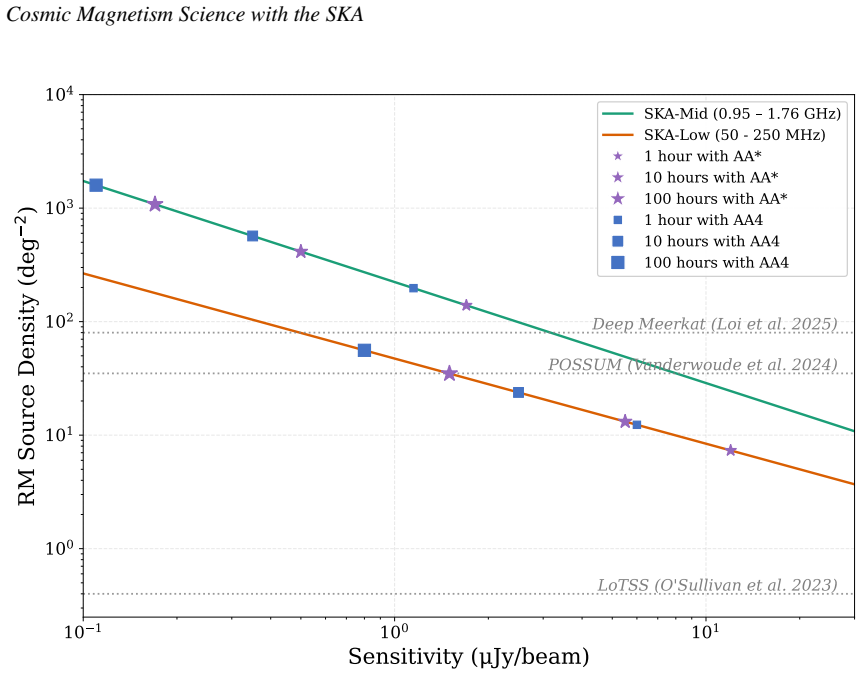
- [Abstract / §1] The abstract states that the SKA 'will mark a transformational step forward' but provides no quantitative benchmarks (e.g., expected RM grid density or polarization sensitivity relative to current facilities); adding one or two concrete performance figures in §1 or the techniques section would strengthen the claim without altering the overview character.
- [Observational techniques section] The discussion of SKA-Low versus SKA-Mid strategies is presented at a high level; a short table comparing frequency coverage, resolution, and primary science targets for each band would improve clarity for readers planning proposals.
Simulated Author's Rebuttal
We thank the referee for their thoughtful review and positive recommendation to accept the manuscript. We appreciate the recognition of the paper's value as a consolidated science-case summary for coordinating SKA Cosmic Magnetism observations.
Circularity Check
No significant circularity; forward-looking science-case overview with no derivations or fitted predictions
full rationale
The document is a prospective science-case summary for SKA observations of cosmic magnetism. It contains no equations, no new derivations, no fitted parameters, and no quantitative predictions that could reduce to prior fits or self-citations. All content is descriptive of planned techniques (polarization imaging, Faraday rotation, RM grids, Zeeman splitting) and observing strategies, with claims resting on future instrument performance rather than any internal derivation chain. No load-bearing steps exist to analyze.
Axiom & Free-Parameter Ledger
Reference graph
Works this paper leans on
-
[1]
Akahori et al
T. Akahori et al. In Advancing Astrophysics with the SKA -- II (AASKAII). 2026. arXiv search: Report number AASKAII/Akahori01
2026
-
[2]
Basu et al
A. Basu et al. In Advancing Astrophysics with the SKA -- II (AASKAII). 2026. arXiv search: Report number AASKAII/AritraBasu01
2026
-
[3]
T. L. Bourke et al. In Advancing Astrophysics with the SKA -- II (AASKAII). 2026. arXiv search: Report number AASKAII/Bourke01
2026
-
[4]
Bracco et al
A. Bracco et al. In Advancing Astrophysics with the SKA -- II (AASKAII). 2026. arXiv search: Report number AASKAII/Bracco01
2026
-
[5]
Carcamo et al
M. Carcamo et al. In Advancing Astrophysics with the SKA -- II (AASKAII). 2026. arXiv search: Report number AASKAII/Carcamo01
2026
-
[6]
J. Y. H. Chan et al. In Advancing Astrophysics with the SKA -- II (AASKAII). 2026. arXiv search: Report number AASKAII/Chan01
2026
-
[7]
B. M. Gaensler et al. , 42: 0 e091, June 2025. doi:10.1017/pasa.2025.10031
-
[8]
G. Heald et al. Galaxies, 8 0 (3): 0 53, July 2020. doi:10.3390/galaxies8030053
-
[9]
M. Johnston-Hollitt et al. In Advancing Astrophysics with the Square Kilometre Array (AASKA14), page 92, Apr. 2015. doi:10.22323/1.215.0092
-
[10]
Kurahara et al
K. Kurahara et al. In Advancing Astrophysics with the SKA -- II (AASKAII). 2026. arXiv search: Report number AASKAII/Kurahara01
2026
-
[11]
F. Loi et al. , 694: 0 A125, Feb. 2025. doi:10.1051/0004-6361/202451711
-
[12]
Loi et al
F. Loi et al. In Advancing Astrophysics with the SKA -- II (AASKAII). 2026. arXiv search: Report number AASKAII/Loi01
2026
-
[13]
Y. K. Ma et al. In Advancing Astrophysics with the SKA -- II (AASKAII). 2026. arXiv search: Report number AASKAII/Ma01
2026
-
[14]
S. A. Mao et al. In Advancing Astrophysics with the SKA -- II (AASKAII). 2026. arXiv search: Report number AASKAII/Mao01
2026
-
[15]
S. P. O'Sullivan et al. , 519 0 (4): 0 5723--5742, Mar. 2023. doi:10.1093/mnras/stac3820
-
[16]
S. P. O'Sullivan et al. In Advancing Astrophysics with the SKA -- II (AASKAII). 2026. arXiv search: Report number AASKAII/OSullivan01
2026
-
[17]
Robishaw et al
T. Robishaw et al. In Advancing Astrophysics with the SKA -- II (AASKAII). 2026. arXiv search: Report number AASKAII/Robishaw01
2026
-
[18]
Sakemi et al
H. Sakemi et al. In Advancing Astrophysics with the SKA -- II (AASKAII). 2026. arXiv search: Report number AASKAII/Sakemi01
2026
-
[19]
Sawada-Satoh et al
S. Sawada-Satoh et al. In Advancing Astrophysics with the SKA -- II (AASKAII). 2026. arXiv search: Report number AASKAII/Sawada-Satoh01
2026
-
[20]
Sun et al
X. Sun et al. In Advancing Astrophysics with the SKA -- II (AASKAII). 2026 a . arXiv search: Report number AASKAII/Sun01
2026
-
[21]
Sun et al
X. Sun et al. In Advancing Astrophysics with the SKA -- II (AASKAII). 2026 b . arXiv search: Report number AASKAII/Sun02
2026
-
[22]
Tahani et al
M. Tahani et al. In Advancing Astrophysics with the SKA -- II (AASKAII). 2026. arXiv search: Report number AASKAII/Tahani01
2026
-
[23]
Vacca et al
V. Vacca et al. In Advancing Astrophysics with the SKA -- II (AASKAII). 2026 a . arXiv search: Report number AASKAII/Vacca01
2026
-
[24]
Vacca et al
V. Vacca et al. In Advancing Astrophysics with the SKA -- II (AASKAII). 2026 b . arXiv search: Report number AASKAII/Vacca02
2026
-
[25]
S. Vanderwoude et al. , 167 0 (5): 0 226, May 2024. doi:10.3847/1538-3881/ad2fc8
discussion (0)
Sign in with ORCID, Apple, or X to comment. Anyone can read and Pith papers without signing in.