Assessment of the Value of Frequency Response Times in Power Systems
Pith reviewed 2026-05-24 20:02 UTC · model grok-4.3
The pith
Faster frequency response products can cost-effectively meet UK power system balancing needs with rising renewables.
A machine-rendered reading of the paper's core claim, the machinery that carries it, and where it could break.
Core claim
The paper claims that its MILP unit commitment model, which simultaneously optimizes inertial response, mandatory FR, and EFR, demonstrates that faster reacting FR products meet system balancing requirements at lower cost than typical slower products when evaluated in projected UK market and system conditions.
What carries the argument
A mixed integer linear programming (MILP) unit commitment model that co-optimizes inertial response, mandatory frequency response, and enhanced frequency response (EFR) to compare value across response times.
If this is right
- Faster FR products mitigate the balancing impact of reduced system inertia from renewables.
- Including sub-second EFR in the schedule lowers overall system operating costs.
- The value of EFR varies with the specific future energy mix and demand profile.
- Mandatory FR and inertial response alone become insufficient or more expensive without faster options.
Where Pith is reading between the lines
- Market designs that procure response by speed rather than by product type could capture similar savings.
- The same scheduling logic could be tested on systems outside the UK with comparable inertia decline.
- If EFR procurement volumes increase, the model implies a shift in the mix of conventional plant needed for other services.
Load-bearing premise
The chosen future energy scenarios and the MILP formulation's representation of costs, constraints, and response dynamics accurately reflect real UK market and system conditions.
What would settle it
Compare the model's predicted cost savings from EFR against actual UK balancing services market outcomes or real frequency event data under comparable renewable penetration levels.
Figures
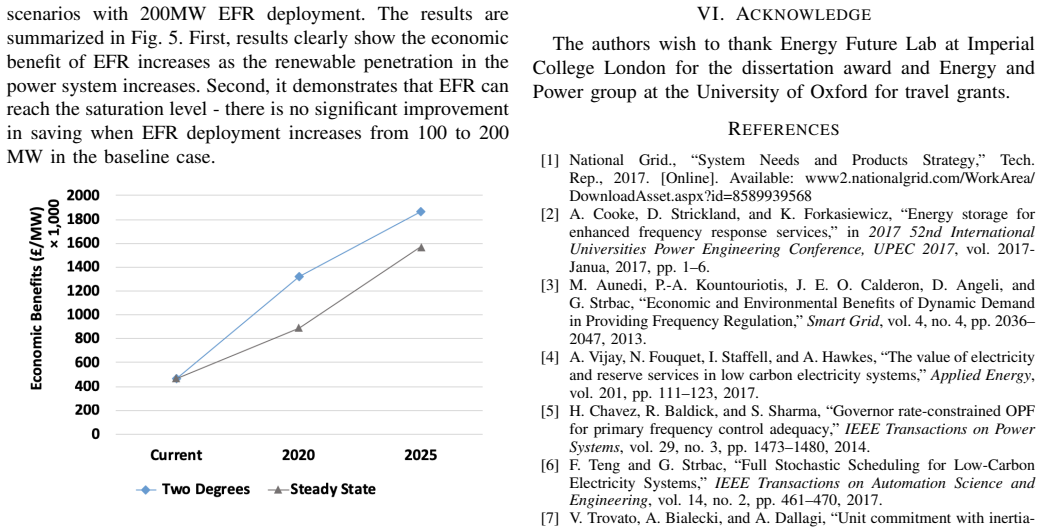
read the original abstract
Given the increasing penetration in renewable generation, the UK power system is experiencing a decline in system inertia and an increase in frequency response (FR) requirements. Faster FR products are a mitigating solution that can cost-effectively meet the system balancing requirements. Thus, this paper proposes a mixed integer linear programming (MILP) unit commitment model which can simultaneously schedule inertial response, mandatory FR, as well as a sub-second FR product - enhanced frequency response (EFR). The model quantifies the value of providing faster reacting FR products in comparison with other response times from typical FR products. The performance and value of EFR are determined in a series of future energy scenarios with respect to the UK market and system conditions.
Editorial analysis
A structured set of objections, weighed in public.
Referee Report
Summary. The paper proposes a mixed-integer linear programming (MILP) unit commitment model that co-optimizes inertial response, mandatory frequency response, and sub-second enhanced frequency response (EFR) to quantify the cost savings from faster FR products relative to conventional ones. The model is applied to future UK energy scenarios with declining inertia due to renewables, with the central claim that EFR can cost-effectively meet balancing requirements.
Significance. If the MILP formulation and its linearization of response dynamics are shown to be accurate, the results would provide a quantitative basis for valuing faster FR products in low-inertia systems and could inform UK market design for frequency services. The use of external scenarios and standard costs avoids obvious circularity.
major comments (2)
- [Abstract, model formulation (likely §3)] The central claim (abstract) that EFR reduces total balancing costs requires that the MILP correctly couples sub-second EFR provision to frequency metrics (ROCOF, nadir) via inertia and response constraints. The manuscript must specify the time resolution of the unit-commitment problem and the exact linearization used for EFR dynamics; standard 30-min or hourly resolutions without explicit differential-equation validation risk misstating the attributed savings.
- [Scenario description and results sections] The performance claims rest on the chosen future energy scenarios and cost parameters accurately reflecting UK conditions. The paper should report sensitivity of the EFR value to variations in these inputs (e.g., inertia levels, reserve requirements) to demonstrate robustness of the cost-effectiveness conclusion.
minor comments (1)
- [Abstract] The abstract states the model purpose but supplies no equations or numerical results; the main text should include at least one key constraint or objective term illustrating how EFR response time enters the optimization.
Simulated Author's Rebuttal
We thank the referee for the constructive comments on our manuscript. We address each major point below and have revised the manuscript to provide additional clarification and analysis.
read point-by-point responses
-
Referee: [Abstract, model formulation (likely §3)] The central claim (abstract) that EFR reduces total balancing costs requires that the MILP correctly couples sub-second EFR provision to frequency metrics (ROCOF, nadir) via inertia and response constraints. The manuscript must specify the time resolution of the unit-commitment problem and the exact linearization used for EFR dynamics; standard 30-min or hourly resolutions without explicit differential-equation validation risk misstating the attributed savings.
Authors: The model employs a standard hourly time resolution for the unit commitment decisions. Frequency metrics (ROCOF and nadir) are enforced via linearized constraints derived from the swing equation that explicitly incorporate the sub-second response time of EFR. We will revise §3 to state the time resolution explicitly and to provide the precise linearization formulas together with the underlying differential-equation approximations and any validation steps performed. These additions will remove ambiguity about how the cost savings are attributed. revision: yes
-
Referee: [Scenario description and results sections] The performance claims rest on the chosen future energy scenarios and cost parameters accurately reflecting UK conditions. The paper should report sensitivity of the EFR value to variations in these inputs (e.g., inertia levels, reserve requirements) to demonstrate robustness of the cost-effectiveness conclusion.
Authors: We agree that robustness checks strengthen the conclusions. The scenarios are taken from established UK projections, but we will add a dedicated sensitivity subsection that varies inertia levels and reserve requirements over plausible ranges and reports the resulting changes in EFR value. This will confirm that the cost-effectiveness finding is not an artifact of the base-case inputs. revision: yes
Circularity Check
No significant circularity; model uses external scenarios and standard costs
full rationale
The paper formulates a MILP unit commitment model to schedule inertial response, mandatory FR, and EFR, then evaluates it against external future UK energy scenarios and market conditions. No load-bearing step reduces by construction to a fitted parameter, self-definition, or self-citation chain; the cost savings attributed to faster EFR emerge from the optimization constraints and input data rather than being presupposed. The derivation chain is therefore self-contained against external benchmarks.
Axiom & Free-Parameter Ledger
axioms (2)
- domain assumption The MILP formulation accurately captures the technical and economic constraints of frequency response products and system inertia.
- domain assumption The selected future energy scenarios represent plausible UK market and system conditions.
Lean theorems connected to this paper
-
IndisputableMonolith/Cost/FunctionalEquation.leanwashburn_uniqueness_aczel unclear?
unclearRelation between the paper passage and the cited Recognition theorem.
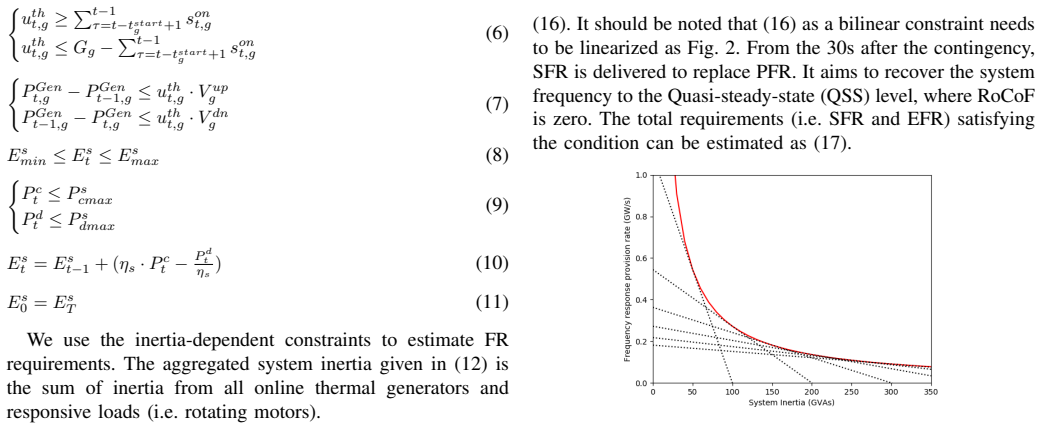
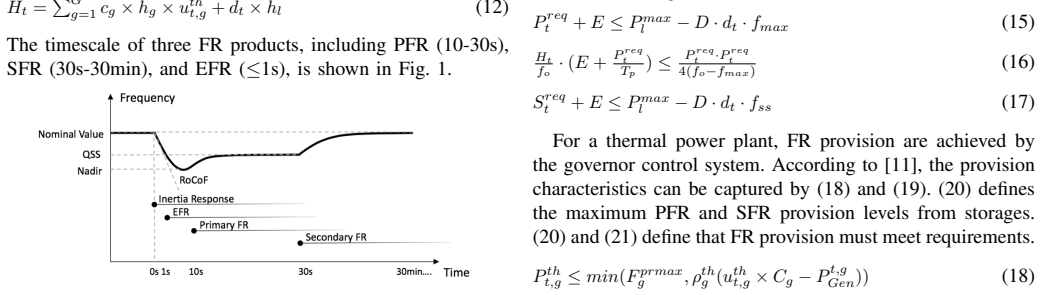
The model quantifies the value of providing faster reacting FR products... inertia-dependent constraints... swing equation (13)... bilinear constraint linearization (Fig. 2)
-
IndisputableMonolith/Foundation/RealityFromDistinction.leanreality_from_one_distinction unclear?
unclearRelation between the paper passage and the cited Recognition theorem.
Ht = sum cg×hg×utht,g + dt×hl (12); Preq_t + E ≤ Pmax_l - D·dt·fmax (15)
What do these tags mean?
- matches
- The paper's claim is directly supported by a theorem in the formal canon.
- supports
- The theorem supports part of the paper's argument, but the paper may add assumptions or extra steps.
- extends
- The paper goes beyond the formal theorem; the theorem is a base layer rather than the whole result.
- uses
- The paper appears to rely on the theorem as machinery.
- contradicts
- The paper's claim conflicts with a theorem or certificate in the canon.
- unclear
- Pith found a possible connection, but the passage is too broad, indirect, or ambiguous to say the theorem truly supports the claim.
Reference graph
Works this paper leans on
-
[1]
System Needs and Products Strategy,
National Grid., “System Needs and Products Strategy,” Tech. Rep., 2017. [Online]. Available: www2.nationalgrid.com/WorkArea/ DownloadAsset.aspx?id=8589939568
work page 2017
-
[2]
Energy storage for enhanced frequency response services,
A. Cooke, D. Strickland, and K. Forkasiewicz, “Energy storage for enhanced frequency response services,” in 2017 52nd International Universities Power Engineering Conference, UPEC 2017 , vol. 2017- Janua, 2017, pp. 1–6
work page 2017
-
[3]
Economic and Environmental Benefits of Dynamic Demand in Providing Frequency Regulation,
M. Aunedi, P.-A. Kountouriotis, J. E. O. Calderon, D. Angeli, and G. Strbac, “Economic and Environmental Benefits of Dynamic Demand in Providing Frequency Regulation,” Smart Grid, vol. 4, no. 4, pp. 2036– 2047, 2013
work page 2036
-
[4]
The value of electricity and reserve services in low carbon electricity systems,
A. Vijay, N. Fouquet, I. Staffell, and A. Hawkes, “The value of electricity and reserve services in low carbon electricity systems,” Applied Energy, vol. 201, pp. 111–123, 2017
work page 2017
-
[5]
Governor rate-constrained OPF for primary frequency control adequacy,
H. Chavez, R. Baldick, and S. Sharma, “Governor rate-constrained OPF for primary frequency control adequacy,” IEEE Transactions on Power Systems, vol. 29, no. 3, pp. 1473–1480, 2014
work page 2014
-
[6]
Full Stochastic Scheduling for Low-Carbon Electricity Systems,
F. Teng and G. Strbac, “Full Stochastic Scheduling for Low-Carbon Electricity Systems,” IEEE Transactions on Automation Science and Engineering, vol. 14, no. 2, pp. 461–470, 2017
work page 2017
-
[7]
Unit commitment with inertia- dependent and multi-speed allocation of frequency response services,
V . Trovato, A. Bialecki, and A. Dallagi, “Unit commitment with inertia- dependent and multi-speed allocation of frequency response services,” IEEE Transactions on Power Systems , 2018
work page 2018
-
[8]
A system operator’s utility function for the frequency response market,
T. Greve, F. Teng, P. Micheal, and G. Strbac, “A system operator’s utility function for the frequency response market,” 2017. [Online]. Available: www.eprg.group.cam.ac.uk/wp-content/uploads/2017/07/1713-Text.pdf
work page 2017
-
[9]
Stochastic Scheduling With Inertia- Dependent Fast Frequency Response Requirements,
F. Teng, V . Trovato, and G. Strbac, “Stochastic Scheduling With Inertia- Dependent Fast Frequency Response Requirements,” Power system , vol. 31, no. 2, pp. 1557–1565, 2016
work page 2016
-
[10]
Power system frequency response from the control of bitumen tanks,
M. Cheng, J. Wu, S. J. Galsworthy, C. E. Ugalde-Loo, N. Gargov, W. W. Hung, and N. Jenkins, “Power system frequency response from the control of bitumen tanks,” IEEE Transactions on Power Systems , 2016
work page 2016
-
[11]
I. Erinmez, D. Bickers, G. Wood, and W. Hung, “NGC experience with frequency control in England and Wales- provision of frequency response by generators,” IEEE Power Engineering Society. 1999 Winter Meeting (Cat. No.99CH36233) , vol. 1, pp. 590–596 vol.1, 1999. [Online]. Available: http://ieeexplore.ieee.org/lpdocs/epic03/wrapper.htm?arnumber=747521
work page 1999
-
[12]
Future Energy Scenarios (FES) 2017,
National Grid., “Future Energy Scenarios (FES) 2017,” 2017. [Online]. Available: http://fes.nationalgrid.com/fes-document/
work page 2017
-
[13]
Balancing mechanism reporting services,
Elexon Limited, “Balancing mechanism reporting services,” Tech. Rep.,
-
[14]
Available: https://www.bmreports.com/bmrs/?q=help/ about-us
[Online]. Available: https://www.bmreports.com/bmrs/?q=help/ about-us
-
[15]
S. Pfenninger and I. Staffell, “Long-term patterns of European PV output using 30 years of validated hourly reanalysis and satellite data,” Energy, vol. 114, pp. 1251–1265, 2016
work page 2016
-
[16]
SEM-11-052 2011-12 Validated SEM Generator Data Parameters PUBLIC v1,
Single Electricity Market Committee, “SEM-11-052 2011-12 Validated SEM Generator Data Parameters PUBLIC v1,”
work page 2011
-
[17]
Available: https://www.semcommittee.com/news-centre/ 2011-plexos-validation-reports-and-models
[Online]. Available: https://www.semcommittee.com/news-centre/ 2011-plexos-validation-reports-and-models
work page 2011
-
[18]
Wholesale Energy Markets in 2016,
Ofgem, “Wholesale Energy Markets in 2016,” 2016. [On- line]. Available: https://www.ofgem.gov.uk/system/files/docs/2016/08/ wholesale energy markets in 2016.pdf
work page 2016
-
[19]
P. J. V ogler-Finck and W.-G. Fr ¨uh, “Evolution of primary frequency control requirements in Great Britain with increasing wind generation,” International Journal of Electrical Power & Energy Systems , vol. 73, pp. 377–388, 2015. [Online]. Available: http://www.sciencedirect.com/ science/article/pii/S0142061515001945
work page 2015
discussion (0)
Sign in with ORCID, Apple, or X to comment. Anyone can read and Pith papers without signing in.