pith. sign in

arxiv: 2401.02184 · v1 · submitted 2024-01-04 · 🧮 math.GT

The primitive curve complex for a handlebody

Pith reviewed 2026-05-24 04:51 UTC · model grok-4.3

classification 🧮 math.GT
keywords handlebodyprimitive curvecurve complexconnectivityessential diskboundary surfacesequence construction
0
0 comments X

The pith

The primitive curve complex for the handlebody is connected.

A machine-rendered reading of the paper's core claim, the machinery that carries it, and where it could break.

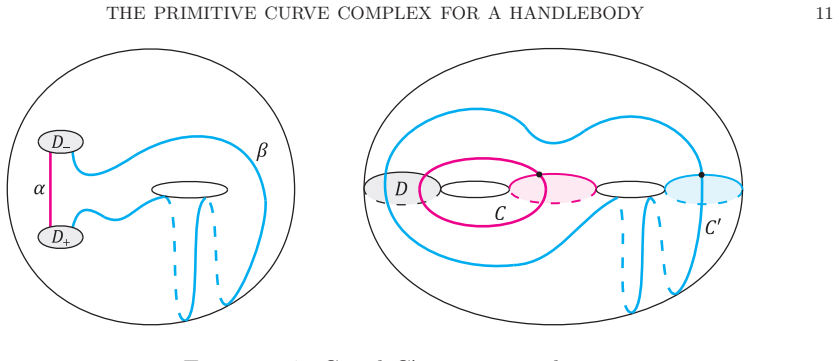
A curve on the boundary of a handlebody is primitive if it intersects the boundary of some essential disk in exactly one point. The primitive curve complex is the subcomplex of the curve complex on that surface whose vertices are these primitive curves. The paper constructs, for any two primitive curves, a finite sequence of primitive curves joining them such that consecutive curves in the sequence satisfy a fixed intersection condition. The existence of these sequences shows the complex is connected. This establishes a basic path property among all primitive curves on the boundary surface.

Core claim

Given any two primitive curves, we construct a sequence of primitive curves from one to the other one satisfying a certain property. As a consequence, we prove that the primitive curve complex for the handlebody is connected.

What carries the argument

The explicit sequence of primitive curves joining arbitrary pairs while preserving primitivity and meeting the required intersection condition.

Load-bearing premise

The sequence constructed between arbitrary primitive curves consists entirely of primitive curves and satisfies the intersection property on the boundary of every handlebody.

What would settle it

Two primitive curves on the boundary of a single handlebody for which no sequence of primitive curves meeting the intersection property exists would falsify the connectivity claim.

Figures

Figures reproduced from arXiv: 2401.02184 by Jung Hoon Lee, Sangbum Cho.

Figure 1
Figure 1. Figure 1: (a) ∆+ ∩ ∆− = p and (b) ∆+ ⊂ ∆−. (a) Take a point d+ in ∂D+ ∩ ∆+ between c+ and c ′ +. Let d− be the point in ∂D− that is identified with d+. Then d− is not in ∆−. Take a point q in α+ between c+ and p. Let δ+ be an arc in ∆+ connecting d+ and q. Since D+ ∪ D− ∪ ∆+ ∪ ∆− is homotopy equivalent to a point, we can take a non-separating arc δ− in Σ′ − (D+ ∪ D− ∪ ∆+ ∪ ∆−) connecting q and d− (see [PITH_FULL_IM… view at source ↗
Figure 2
Figure 2. Figure 2: The arc δ+ and δ−. endpoints e+ and e− in ∂D+ and ∂D− respectively with the following properties (see [PITH_FULL_IMAGE:figures/full_fig_p004_2.png] view at source ↗
Figure 3
Figure 3. Figure 3: ). • The arc ǫ is disjoint from α and δ. • The two points e+ and e− become the same point if we identify D+ and D−. Then δ is c-connected to α via ǫ (if we regard the endpoints of each arc are identified in V ) with a common dual disk D [PITH_FULL_IMAGE:figures/full_fig_p004_3.png] view at source ↗
Figure 4
Figure 4. Figure 4: The arc δ+ and δ−. Case 2. At least one of α+ ∪ β+ and α− ∪ β−, say α+ ∪ β+, does not cut off a disk from Σ ′ − D+. Without loss of generality, assume that β+ is incident to p in the right side of α, and then take a point d+ in ∂D+ near c+ and in the right side of c+ as in [PITH_FULL_IMAGE:figures/full_fig_p005_4.png] view at source ↗
Figure 5
Figure 5. Figure 5: ) [PITH_FULL_IMAGE:figures/full_fig_p005_5.png] view at source ↗
Figure 6
Figure 6. Figure 6: The primitive curve C2 in Case 1. Case 2. α is incident to C in the opposite sides of C at a and b. By a surgery of C along α, we obtain a new primitive curve Γ = γ1 ∪ α with a dual disk D. After a slight isotopy, |Γ ∩ C| = 1, and |Γ ∩ C ′ | ≤ |C ∩ C ′ | − 1 (see [PITH_FULL_IMAGE:figures/full_fig_p006_6.png] view at source ↗
Figure 7
Figure 7. Figure 7: The primitive curve Γ in Case 2 [PITH_FULL_IMAGE:figures/full_fig_p006_7.png] view at source ↗
Figure 8
Figure 8. Figure 8: The primitive curve C2 in Case 1. Case 2. α is incident to C in the opposite sides of C at a and b. By a surgery of C along α, we obtain a new primitive curve Γ = γ1 ∪ α with a dual disk D. After a slight isotopy, |Γ ∩ C| = 1, and |Γ ∩ ∂D′ | ≤ |C ∩ ∂D′ | − 1 (see [PITH_FULL_IMAGE:figures/full_fig_p007_8.png] view at source ↗
Figure 9
Figure 9. Figure 9: The primitive curve Γ in Case 2. Theorem 2.4. Let C and C ′ be primitive curves in Σ, the boundary of a genus-g handle￾body V for g ≥ 2. Then C and C ′ are c-connected. Proof. Take any dual disks D and D′ of C and C ′ respectively. By the standard disk surgery argument, there exists a sequence D = D1, D2, . . . , Dn = D′ of non-separating disks in V such that Dj and Dj+1 are disjoint for each j ∈ {1, 2, . … view at source ↗
Figure 10
Figure 10. Figure 10: |(Γ ∪ D) ∩ (C ′′′ ∪ D′ )| ≤ 1 [PITH_FULL_IMAGE:figures/full_fig_p009_10.png] view at source ↗
Figure 11
Figure 11. Figure 11: A band sum of D and D′ is a common dual disk of Γ and C ′′′ . If |Γ ∩ C ′′′| = 0, then Γ and C ′′′ are c-connected obviously. If |Γ ∩ C ′′′| = 1, then Γ and C ′′′ are again c-connected by Lemma 2.1. 3. Proof of the main theorem in the case of g = 2 For convenience, we simply say that two primitive curves C and C ′ are s-connected if there exists a sequence C = C1, C2, . . . , Ck = C ′ of primitive curves … view at source ↗
Figure 12
Figure 12. Figure 12: α ∪ β ∪ D+ ∪ D− is homotopy equivalent to a meridian [PITH_FULL_IMAGE:figures/full_fig_p010_12.png] view at source ↗
Figure 13
Figure 13. Figure 13: illustrates that C and C ′ are s-connected via C ′′ and C ′′′ [PITH_FULL_IMAGE:figures/full_fig_p010_13.png] view at source ↗
Figure 14
Figure 14. Figure 14: C and C ′ are separated [PITH_FULL_IMAGE:figures/full_fig_p011_14.png] view at source ↗
Figure 15
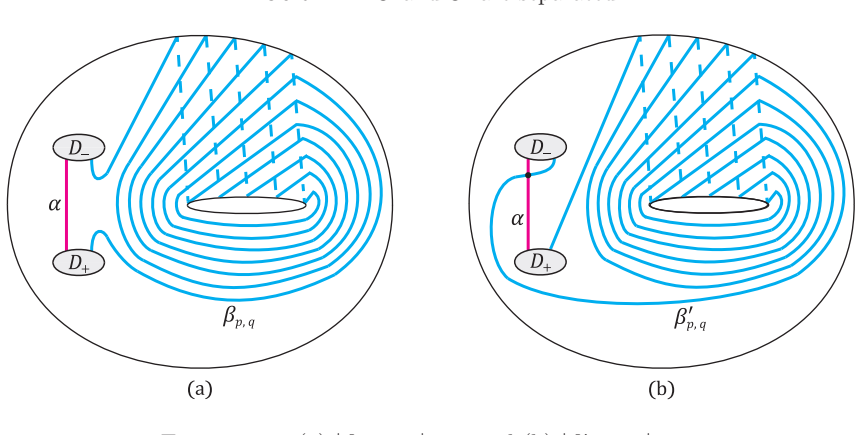
Figure 15. Figure 15: (a) |βp,q ∩ α| = 0 and (b) |β ′ p,q ∩ α| = 1. and |βr,s ∩ βp,q| = |β ′ r,s ∩ β ′ p,q| = 1 as in [PITH_FULL_IMAGE:figures/full_fig_p011_15.png] view at source ↗
Figure 16
Figure 16. Figure 16: (a) |βr,s ∩ α| = 0 and (b) |β ′ r,s ∩ α| = 1, and |βr,s ∩ βp,q| = |β ′ r,s ∩ β ′ p,q| = 1. and those of β ′ p,q with respect to β ′ r,s are (p − r, q − s). In the example of [PITH_FULL_IMAGE:figures/full_fig_p012_16.png] view at source ↗
Figure 17
Figure 17. Figure 17: β ′ p−r,t = β ′ p−r,q−s . Now the initial conditions of the induction, (p, q) = (1, 0) and (1, 1) are remained. We only need to consider |β ′ 1,0 ∩ α| = |β ′ 1,1 ∩ α| = 1 because we already dealt the cases of |β1,0 ∩ α| = |β1,1 ∩ α| = 0 ( [PITH_FULL_IMAGE:figures/full_fig_p012_17.png] view at source ↗
Figure 18
Figure 18. Figure 18: C and C ′ are s-connected via C ′′ [PITH_FULL_IMAGE:figures/full_fig_p013_18.png] view at source ↗
Figure 19
Figure 19. Figure 19: C and C ′ are s-connected via C ′′ . Let C, C ′′ , C ′ be the primitive curves in ∂V obtained by identifying endpoints of α, βr,s(or β ′ r,s), βp,q(or β ′ p,q) respectively. Since r < p and s ≤ q, C and C ′′ are s-connected by our induction hypothesis. Since p − r < p and q − s < q, C ′′ and C ′ are s-connected by our induction hypothesis. Hence C and C ′ are s-connected. 4. Proof of the main theorem in t… view at source ↗
Figure 20
Figure 20. Figure 20: (a) V ′ is a handlebody and (b) V ′ is two handlebodies. Lemma 4.2 (Common dual disk). Let (C, D) and (C ′ , D) be dual pairs for V . Suppose that C and C ′ are disjoint. Then (C, D) and (C ′ , D) are p-connected. Proof. Cut V along D. Then we have a genus-(g − 1) handlebody V ′ with two copies D+ and D− of D on Σ′ = ∂V ′ . The primitive curves C and C ′ are cut into arcs α and α ′ in Σ ′ respectively suc… view at source ↗
Figure 21
Figure 21. Figure 21: The dual pairs (C ′′ 1 , D′′) and (C ′′ 2 , D′′). Since (C ′′ 1 , D′′) is a dual pair in a genus-(g − 1) handlebody V ′ , and C ′′ 1 ∪ C ′′ 2 bounds an annulus, and D− is disjoint from D′′ ∪ A, we can take a new dual pair (C3, D3) in V ′ disjoint from D′′ ∪ A ∪ D−. All of (C ′′ 1 , D′′) and (C ′′ 2 , D′′) and (C3, D3) can be regarded as dual pairs in V because they are disjoint from D+ ∪ D−. The dual pair… view at source ↗
Figure 22
Figure 22. Figure 22: (C, D) and (C ′′, D) are p-connected and |C ′′ ∩ ∂D′ | ≤ 1. Suppose that |C ′′ ∩ ∂D′ | = 1. Then D′ is a common dual disk of C ′′ and C ′ . By Lemma 2.2, there exists a sequence C ′′ = C1, C2, . . . , Ck = C ′ of primitive curves (by an abuse of notations) with a common dual disk D′ such that Ci and Ci+1 are disjoint for each i ∈ {1, 2, . . . , k − 1}. Since (Ci , D′ ) and (Ci+1, D′ ) are p-connected for … view at source ↗
read the original abstract

A simple closed curve in the boundary surface of a handlebody is called primitive if there exists an essential disk in the handlebody whose boundary circle intersects the curve transversely in a single point. The primitive curve complex is then defined to be the full subcomplex of the curve complex for the boundary surface, spanned by the vertices of primitive curves. Given any two primitive curves, we construct a sequence of primitive curves from one to the other one satisfying a certain property. As a consequence, we prove that the primitive curve complex for the handlebody is connected.

Editorial analysis

A structured set of objections, weighed in public.

Desk editor's note, referee report, simulated authors' rebuttal, and a circularity audit. Tearing a paper down is the easy half of reading it; the pith above is the substance, this is the friction.

Referee Report

1 major / 2 minor

Summary. The paper defines primitive curves on the boundary of a handlebody (those intersecting the boundary of an essential disk in exactly one point) and constructs, for arbitrary primitive curves a and b, an explicit finite sequence a = c0, c1, …, ck = b of primitive curves such that consecutive terms satisfy the adjacency condition in the curve complex. This yields the conclusion that the primitive curve complex is connected.

Significance. Connectivity is a foundational structural property of the primitive curve complex. An explicit construction, rather than a non-constructive existence argument, is a strength that could support further work on the diameter, higher connectivity, or relations to the full curve complex and Heegaard theory.

major comments (1)
  1. [construction section] The construction (detailed after the definitions): the verification that every intermediate curve ci remains primitive (i.e., bounds an essential disk meeting it once) is not carried out with sufficient generality. The 3-dimensional primitivity condition must be checked explicitly for each step of the surface construction, especially when the handlebody genus exceeds 2; without this, the path may exit the vertex set of the complex.
minor comments (2)
  1. The abstract refers to 'a certain property' without naming it; state explicitly that consecutive curves are disjoint (the standard adjacency condition in the curve complex).
  2. Add a low-genus example (e.g., genus 2) with a diagram showing one step of the sequence to illustrate how primitivity is preserved.

Simulated Author's Rebuttal

1 responses · 0 unresolved

We thank the referee for the positive summary and for highlighting the foundational importance of connectivity. We address the single major comment below.

read point-by-point responses
  1. Referee: [construction section] The construction (detailed after the definitions): the verification that every intermediate curve ci remains primitive (i.e., bounds an essential disk meeting it once) is not carried out with sufficient generality. The 3-dimensional primitivity condition must be checked explicitly for each step of the surface construction, especially when the handlebody genus exceeds 2; without this, the path may exit the vertex set of the complex.

    Authors: We agree that the primitivity verification for the intermediate curves requires a more explicit and genus-independent argument. The current manuscript constructs the sequence via successive handle slides and disk-bounding modifications that are intended to preserve primitivity, but the 3-dimensional check is presented only in outline form. In the revision we will insert a dedicated lemma that, for each step, explicitly produces an essential disk in the handlebody intersecting ci in exactly one point; the argument uses the fixed meridian system of the handlebody and tracks the algebraic intersection numbers, which works uniformly for all genera g ≥ 2. revision: yes

Circularity Check

0 steps flagged

No circularity: explicit construction is self-contained

full rationale

The paper's central claim is an explicit construction of a finite sequence of primitive curves connecting any two given primitive curves on the boundary of a handlebody, with each consecutive pair satisfying the required intersection property. This is a direct topological argument performed on the surface while verifying the 3-manifold primitivity condition for each intermediate curve. No equations, fitted parameters, or self-citations appear in the load-bearing steps; the derivation does not reduce any claimed prediction or uniqueness result to its own inputs by definition or by prior self-work. The connectivity of the primitive curve complex follows immediately from the existence of the constructed path without circularity.

Axiom & Free-Parameter Ledger

0 free parameters · 1 axioms · 0 invented entities

The result relies on standard facts from 3-manifold topology about essential disks and transversality on surfaces; no free parameters or new entities are introduced in the abstract.

axioms (1)
  • domain assumption A handlebody contains essential disks whose boundaries are simple closed curves on the boundary surface that intersect given curves transversely.
    Invoked implicitly in the definition of primitive curves.

pith-pipeline@v0.9.0 · 5606 in / 1212 out tokens · 31351 ms · 2026-05-24T04:51:45.360368+00:00 · methodology

discussion (0)

Sign in with ORCID, Apple, or X to comment. Anyone can read and Pith papers without signing in.

Reference graph

Works this paper leans on

2 extracted references · 2 canonical work pages

  1. [1]

    Wajnryb, B., Mapping class group of a handlebody, Fund. Math. 158 (1998), no. 3, 195–228

  2. [2]

    Zupan, A., The Powell conjecture and reducing sphere complexe s, J. Lond. Math. Soc. (2) 101 (2020), no. 1, 328–348. Department of Mathematics Education, Hanyang University, Seoul 04763, Korea, and School of Mathematics, Korea Institute for Advanced Study, Seoul 02455, Korea Email address : scho@hanyang.ac.kr Department of Mathematics and Institute of Pur...