Cutoff for mixtures of permuted Markov chains: reversible case
Pith reviewed 2026-05-24 04:10 UTC · model grok-4.3
The pith
Mixtures of permuted Markov chains exhibit cutoff at the entropic time log n/h with high probability.
A machine-rendered reading of the paper's core claim, the machinery that carries it, and where it could break.
Core claim
Under mild assumptions on the base Markov chains, the resulting mixture chain exhibits the cutoff phenomenon at entropic time log n/h with high probability, where h is a constant related to the entropy of the chain. The results are a consequence of work on a more general non-reversible model, and the proofs mostly do not require reversibility.
What carries the argument
A novel concentration result for low-degree functions on the symmetric group, used to control the random permutation's effect on mixing.
If this is right
- The simple random walk on a graph with an added uniform random matching exhibits cutoff at entropic time.
- The cutoff holds for superpositions of deterministic graphs with randomly permuted second graphs.
- The mixing time is determined by the entropy rate of the chain.
- Similar cutoff results are expected for non-reversible versions in a companion paper.
Where Pith is reading between the lines
- This low-degree concentration inequality on the symmetric group may apply to other problems involving random permutations of chain states.
- Explicit computation of h for concrete chains would yield exact cutoff times for specific randomized models.
- The approach could extend to studying cutoff in other disordered or random media Markov chains.
Load-bearing premise
The base Markov chains have a well-defined positive entropy rate and satisfy the conditions needed for the low-degree concentration inequality to bound the effect of the random permutation.
What would settle it
A concrete counterexample where the total variation distance fails to exhibit a sharp cutoff around time log n/h for base chains meeting the mild assumptions would disprove the result.
Figures
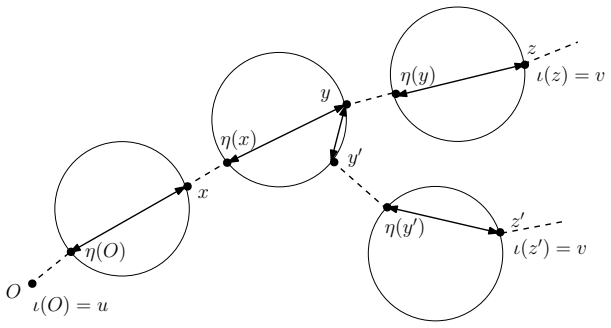
read the original abstract
We investigate the mixing properties of a model of reversible Markov chains in random environment, which notably contains the simple random walk on the superposition of a deterministic graph and a second graph whose vertex set has been permuted uniformly at random. It generalizes in particular a result of Hermon, Sly and Sousi, who proved the cutoff phenomenon at entropic time for the simple random walk on a graph with an added uniform matching. Under mild assumptions on the base Markov chains, we prove that with high probability the resulting chain exhibits the cutoff phenomenon at entropic time log n/h, h being some constant related to the entropy of the chain. We note that the results presented here are the consequence of a work conducted for a more general model that does not assume reversibility, which will be the object of a companion paper. Thus, most of our proofs do not actually require reversibility, which constitutes an important technical contribution. Finally, our argument relies on a novel concentration result for "low-degree" functions on the symmetric group, established specifically for our purpose but which could be of independent interest.
Editorial analysis
A structured set of objections, weighed in public.
Referee Report
Summary. The manuscript studies the mixing time of a reversible Markov chain formed as a mixture of two base chains, one of which is defined on a uniformly random permutation of the vertices of the second graph. Under mild assumptions ensuring a positive entropy rate h, the authors prove that the mixture exhibits cutoff at time (log n)/h with high probability. The argument relies on a new concentration inequality for low-degree functions on the symmetric group S_n; reversibility is used only in a few steps and the non-reversible case is deferred to a companion paper. The result generalizes the Hermon–Sly–Sousi theorem on graphs with an added uniform matching.
Significance. The central claim, if correct, extends cutoff results from specific random-graph models to a broader class of permuted mixtures while isolating the entropy calculation from the permutation analysis. The novel concentration bound for low-degree functions on S_n is presented as potentially of independent interest and is the main technical tool. The observation that reversibility is not essential for most of the argument is a useful technical clarification.
minor comments (3)
- §1.2: the statement of the mild assumptions on the base chains could be collected in a single numbered assumption block rather than scattered across the introduction and the entropy section.
- The dependence of the high-probability statement on the random permutation is stated in the abstract but the precise probability space (over the choice of permutation) should be recalled explicitly in the statement of the main theorem.
- Notation for the entropy rate h is introduced in the abstract and §2 but the precise definition (in terms of the transition probabilities of the base chains) appears only later; a forward reference would help.
Simulated Author's Rebuttal
We thank the referee for the positive report and recommendation of minor revision. The summary and significance assessment accurately capture the main results, including the cutoff at entropic time for reversible mixtures of permuted Markov chains, the generalization of the Hermon-Sly-Sousi theorem, and the novel concentration inequality for low-degree functions on S_n. We also appreciate the note that reversibility is used only in a few steps. No specific major comments are listed in the report.
Circularity Check
No significant circularity; derivation self-contained via new concentration inequality
full rationale
The paper defines the random-permutation mixture model explicitly, computes the entropy rate h from the base chains under stated assumptions, and applies a newly derived concentration bound on low-degree functions of S_n to establish the cutoff at (log n)/h w.h.p. No step reduces a claimed prediction to a fitted parameter or prior result by construction; the concentration inequality is introduced as original technical content (with potential independent interest) rather than imported via self-citation. The generalization of Hermon-Sly-Sousi is cited as motivation but the proof chain does not rely on it for the central claim. The companion-paper note is incidental and does not create a load-bearing loop. The derivation therefore stands on independent probabilistic arguments.
Axiom & Free-Parameter Ledger
axioms (1)
- standard math Standard axioms of probability and Markov chain theory, including existence of stationary distributions and positive entropy rates under mild assumptions
Lean theorems connected to this paper
-
IndisputableMonolith/Cost/FunctionalEquation.leanwashburn_uniqueness_aczel unclear?
unclearRelation between the paper passage and the cited Recognition theorem.
Theorem 1.1 … cutoff phenomenon at entropic time log n/h … novel concentration result for 'low-degree' functions on the symmetric group
-
IndisputableMonolith/Foundation/RealityFromDistinction.leanreality_from_one_distinction unclear?
unclearRelation between the paper passage and the cited Recognition theorem.
Proposition 3.1 … concentration of drift and entropy … |−log w(ξ)| − ht| ≤ Ch √t
What do these tags mean?
- matches
- The paper's claim is directly supported by a theorem in the formal canon.
- supports
- The theorem supports part of the paper's argument, but the paper may add assumptions or extra steps.
- extends
- The paper goes beyond the formal theorem; the theorem is a base layer rather than the whole result.
- uses
- The paper appears to rely on the theorem as machinery.
- contradicts
- The paper's claim conflicts with a theorem or certificate in the canon.
- unclear
- Pith found a possible connection, but the passage is too broad, indirect, or ambiguous to say the theorem truly supports the claim.
Reference graph
Works this paper leans on
-
[1]
Random walks on finite groups and rapidly mixing markov chains
David Aldous. Random walks on finite groups and rapidly mixing markov chains. pages 243– 297, 1983. URL: https://doi.org/10.1007%2Fbfb0068322, doi:10.1007/bfb0068322. 7
-
[2]
Shuffling cards and stopping times.The American Math- ematical Monthly, 93(5):333–348, 1986
David Aldous and Persi Diaconis. Shuffling cards and stopping times.The American Math- ematical Monthly, 93(5):333–348, 1986. URL:http://www.jstor.org/stable/2323590. 7
-
[3]
Luca Avena, Hakan Güldaş, Remco van der Hofstad, and Frank den Hollander. Random walks on dynamic configuration models: A trichotomy.Stochastic Processes and their Applications, 129(9):3360–3375, sep 2019. URL:https://doi.org/10.1016%2Fj.spa.2018.09.010, doi: 10.1016/j.spa.2018.09.010. 8
-
[4]
Phase transition for random walks on graphs with added weighted random matching
Zsuzsanna Baran, Jonathan Hermon, Anđela Šarković, and Perla Sousi. Phase transition for random walks on graphs with added weighted random matching. 2023.arXiv:2306.13077. 7, 9
-
[5]
Anna Ben-Hamou. A threshold for cutoff in two-community random graphs.The Annals of Applied Probability, 30(4):1824 – 1846, 2020.doi:10.1214/19-AAP1544. 7
-
[6]
Anna Ben-Hamou, Eyal Lubetzky, and Yuval Peres. Comparing mixing times on sparse random graphs.Annales de l’Institut Henri Poincaré, Probabilités et Statistiques, 55(2):1116 – 1130, 2019.doi:10.1214/18-AIHP911. 7
-
[7]
Cutoff for permuted Markov chains
Anna Ben-Hamou and Yuval Peres. Cutoff for permuted Markov chains. Annales de l’Institut Henri Poincaré, Probabilités et Statistiques, 59(1):230 – 243, 2023.doi:10.1214/ 22-AIHP1248. 7, 8
work page 2023
-
[8]
Cutoff for nonbacktracking random walks on sparse random graphs
Anna Ben-Hamou and Justin Salez. Cutoff for nonbacktracking random walks on sparse random graphs. The Annals of Probability, 45(3):1752–1770, 2017. 3, 4, 7, 9, 10, 50
work page 2017
-
[9]
The mixing time of the gi- ant component of a random graph
Itai Benjamini, Gady Kozma, and Nicholas Wormald. The mixing time of the gi- ant component of a random graph. Random Structures & Algorithms , 45(3):383– 407, 2014. URL: https://onlinelibrary.wiley.com/doi/abs/10.1002/rsa.20539, arXiv:https://onlinelibrary.wiley.com/doi/pdf/10.1002/rsa.20539, doi:https:// doi.org/10.1002/rsa.20539. 4, 7
-
[10]
Nathanaël Berestycki, Eyal Lubetzky, Yuval Peres, and Allan Sly. Random walks on the ran- dom graph.The Annals of Probability, 46(1):456–490, 2018.doi:doi:10.1214/17-AOP1189. 4, 7, 25
-
[11]
E. Bolthausen. An estimate of the remainder in a combinatorial central limit theorem.Prob- ability Theory and Related Fields, 66(3):379–386, 1984.doi:10.1007/BF00533704. 8 69
-
[12]
The rate of convergence for multivariate sampling statistics
Erwin Bolthausen and Friedrich Götze. The rate of convergence for multivariate sampling statistics. Ann. Stat., 21(4):1692–1710, 1993.doi:10.1214/aos/1176349393. 8
-
[13]
A new proof of Friedman’s second eigenvalue theorem and its extension to random lifts
Charles Bordenave. A new proof of Friedman’s second eigenvalue theorem and its extension to random lifts. Ann. Sci. Éc. Norm. Supér. (4), 53(6):1393–1439, 2020.doi:10.24033/ asens.2450. 8
work page 2020
-
[14]
Random walk on sparse ran- dom digraphs
Charles Bordenave, Pietro Caputo, and Justin Salez. Random walk on sparse ran- dom digraphs. Probab. Theory Relat. Fields, 170(3-4):933–960, 2018. doi:10.1007/ s00440-017-0796-7. 3, 4, 7, 8, 9, 10, 45, 50
work page 2018
-
[15]
Charles Bordenave, Pietro Caputo, and Justin Salez. Cutoff at the “entropic time” for sparse Markov chains.Probability Theory and Related Fields, 173(1):261–292, February 2019.doi: 10.1007/s00440-018-0834-0. 3, 7, 8, 9, 10, 11, 45
-
[16]
Cutoff at the entropic time for random walks on covered expander graphs
Charles Bordenave and Hubert Lacoin. Cutoff at the entropic time for random walks on covered expander graphs. J. Inst. Math. Jussieu, 21(5):1571–1616, 2022. doi:10.1017/ S1474748020000663. 8, 34
work page 2022
-
[17]
On concentration of self-bounding functions
Stéphane Boucheron, Gábor Lugosi, and Pacal Massart. On concentration of self-bounding functions. Electron. J. Probab., 14:no. 64, 1884–1899, 2009.doi:10.1214/EJP.v14-690. 63
-
[18]
Stéphane Boucheron, Gábor Lugosi, and Pascal Massart.Concentration inequalities. Oxford University Press, Oxford, 2013. A nonasymptotic theory of independence, With a foreword by Michel Ledoux.doi:10.1093/acprof:oso/9780199535255.001.0001. 65
work page doi:10.1093/acprof:oso/9780199535255.001.0001 2013
-
[19]
Mixing time of PageRank surfers on sparse random digraphs
Pietro Caputo and Matteo Quattropani. Mixing time of PageRank surfers on sparse random digraphs. Random Structures & Algorithms, 59(3):376–406, apr 2021. URL:https://doi. org/10.1002%2Frsa.21009, doi:10.1002/rsa.21009. 8
-
[20]
Mixing time trichotomy in regenerating dynamic digraphs
Pietro Caputo and Matteo Quattropani. Mixing time trichotomy in regenerating dynamic digraphs. Stochastic Processes and their Applications, 137:222–251, jul 2021. URL:https: //doi.org/10.1016%2Fj.spa.2021.03.003, doi:10.1016/j.spa.2021.03.003. 8
-
[21]
Concentration inequalities with exchangeable pairs (Ph.D. thesis)
Sourav Chatterjee.Concentration inequalities with exchangeable pairs. PhD thesis, Stanford University, 2005. arXiv:math/0507526. 4, 8, 62, 63, 64, 65, 66
work page internal anchor Pith review Pith/arXiv arXiv 2005
-
[22]
Concentration of Haar measures, with an application to random matrices
Sourav Chatterjee. Concentration of Haar measures, with an application to random matrices. J. Funct. Anal., 245(2):379–389, 2007.doi:10.1016/j.jfa.2007.01.003. 8, 63, 66
-
[23]
Stein’s method for concentration inequalities.Probab
Sourav Chatterjee. Stein’s method for concentration inequalities.Probab. Theory Related Fields, 138(1-2):305–321, 2007.doi:10.1007/s00440-006-0029-y. 4, 8, 63
-
[24]
A short survey of Stein's method
Sourav Chatterjee. A short survey of Stein’s method, 2014.arXiv:1404.1392. 8
work page internal anchor Pith review Pith/arXiv arXiv 2014
-
[25]
Speeding up Markov chains with deterministic jumps
Sourav Chatterjee and Persi Diaconis. Speeding up Markov chains with deterministic jumps. Probab. Theory Related Fields, 181(1-3):377–400, 2021.doi:10.1007/s00440-021-01049-1. 7 70
-
[26]
Exchangeable pairs and Poisson approximation
Sourav Chatterjee, Persi Diaconis, and Elizabeth Meckes. Exchangeable pairs and Poisson approximation. Probability Surveys, 2(none):64 – 106, 2005. doi:10.1214/ 154957805100000096. 8
work page 2005
-
[27]
Cutoff for random lifts of weighted graphs
Guillaume Conchon-Kerjan. Cutoff for random lifts of weighted graphs. The Annals of Probability, 50(1):304 – 338, 2022.doi:10.1214/21-AOP1534. 7
-
[28]
The cutoff phenomenon in finite Markov chains.Proc
Persi Diaconis. The cutoff phenomenon in finite Markov chains.Proc. Natl. Acad. Sci. USA, 93(4):1659–1664, 1996.doi:10.1073/pnas.93.4.1659. 7
-
[29]
Generating a random permutation with random transpositions
Persi Diaconis and Mehrdad Shahshahani. Generating a random permutation with random transpositions. Z. Wahrsch. Verw. Gebiete, 57(2):159–179, 1981.doi:10.1007/BF00535487. 7, 63, 66
-
[30]
Cutoff for mixtures of permuted markov chains: general case, 2024.arXiv: 2402.03415
Bastien Dubail. Cutoff for mixtures of permuted markov chains: general case, 2024.arXiv: 2402.03415. 3
-
[31]
Sean Eberhard and Péter P. Varjú. Mixing time of the Chung–Diaconis–Graham random process. Probability Theory and Related Fields, 179(1):317–344, February 2021. doi:10. 1007/s00440-020-01009-1. 8
work page 2021
-
[32]
Intersecting families of permutations.J
David Ellis, Ehud Friedgut, and Haran Pilpel. Intersecting families of permutations.J. Amer. Math. Soc., 24(3):649–682, 2011.doi:10.1090/S0894-0347-2011-00690-5. 6
-
[33]
An Introduction to Probability Theory and Its Applications, Volume I
William Feller. An Introduction to Probability Theory and Its Applications, Volume I. 1967. 31
work page 1967
-
[34]
N. Fountoulakis and B.A. Reed. The evolution of the mixing rate of a sim- ple random walk on the giant component of a random graph. Random Structures & Algorithms, 33(1):68–86, 2008. URL: https://onlinelibrary.wiley.com/doi/abs/ 10.1002/rsa.20210, arXiv:https://onlinelibrary.wiley.com/doi/pdf/10.1002/rsa. 20210, doi:https://doi.org/10.1002/rsa.20210. 4, 7
-
[35]
David A. Freedman. On tail probabilities for martingales.The Annals of Probability, 3:100– 118, 1975. doi:doi:10.1214/aop/1176996452. 52
-
[36]
Joel Friedman. A proof of alon’s second eigenvalue conjecture and related problems.Memoirs of the American Mathematical Society, 195(910):0–0, 2008. URL: https://doi.org/10. 1090%2Fmemo%2F0910, doi:10.1090/memo/0910. 8
-
[37]
Cutoff for almost all random walks on abelian groups, 2021
Jonathan Hermon and Sam Olesker-Taylor. Cutoff for almost all random walks on abelian groups, 2021. arXiv:2102.02809. 7
-
[38]
Cutoff for random walks on upper triangular matrices, 2021
Jonathan Hermon and Sam Olesker-Taylor. Cutoff for random walks on upper triangular matrices, 2021. arXiv:1911.02974. 7
-
[39]
Jonathan Hermon, Allan Sly, and Perla Sousi. Universality of cutoff for graphs with an added random matching.The Annals of Probability, 50(1), Jan 2022. URL:https://doi.org/10. 1214%2F21-aop1532, doi:10.1214/21-aop1532. 1, 3, 7, 9, 12, 13, 25, 37, 40, 42 71
-
[40]
Cutoff for random walk on random graphs with a community structure
Jonathan Hermon, Anđela Šarković, and Perla Sousi. Cutoff for random walk on random graphs with a community structure. 2022.arXiv:2212.04469. 7, 9
-
[41]
On Information and Sufficiency
Wassily Hoeffding. A combinatorial central limit theorem. The Annals of Mathematical Statistics, 22(4):558–566, 1951.doi:doi:10.1214/aoms/1177729545. 8
-
[42]
V. A. Kaimanovich and A. M. Vershik. Random walks on discrete groups: Boundary and entropy. The Annals of Probability, 11:457–490, 1983.doi:doi:10.1214/aop/1176993497. 42
-
[43]
David A. Levin and Yuval Peres.Markov chains and mixing times. American Mathematical Society, Providence, RI, 2017. Second edition of [ MR2466937], With contributions by Eliza- beth L. Wilmer, With a chapter on “Coupling from the past” by James G. Propp and David B. Wilson. doi:10.1090/mbk/107. 34
-
[44]
Lectures on the coupling method
Torgny Lindvall. Lectures on the coupling method. Dover Publications, Inc., Mineola, NY,
-
[45]
Torgny Lindvall and L. C. G. Rogers. On coupling of random walks and renewal processes. Journal of Applied Probability, 33:122–126, 1996. 30
work page 1996
-
[46]
Eyal Lubetzky and Yuval Peres. Cutoff on all Ramanujan graphs.Geometric and Functional Analysis, 26(4):1190–1216, July 2016.doi:10.1007/s00039-016-0382-7. 8
-
[47]
Cutoff phenomena for random walks on random regular graphs
Eyal Lubetzky and Allan Sly. Cutoff phenomena for random walks on random regular graphs. Duke Mathematical Journal, 153(3):475 – 510, 2010.doi:10.1215/00127094-2010-029. 7
-
[48]
Russell Lyons, Robin Pemantle, and Yuval Peres. Ergodic theory on Galton—Watson trees: speed of random walk and dimension of harmonic measure.Ergodic Theory and Dynamical Systems, 15(3):593–619, 1995.doi:10.1017/S0143385700008543. 42
-
[49]
Cambridge University Press, New York,
Russell Lyons and Yuval Peres.Probability on trees and networks, volume 42 ofCambridge Series in Statistical and Probabilistic Mathematics. Cambridge University Press, New York,
- [50]
-
[51]
Construction de suites symétriques
Bernard Maurey. Construction de suites symétriques. CR Acad. Sci. Paris Sér. AB, 288(14):A679–A681, 1979. 4
work page 1979
-
[52]
Narutaka Ozawa. An entropic proof of cutoff on Ramanujan graphs.Electronic Communica- tions in Probability, 25:1 – 8, 2020.doi:10.1214/20-ECP358. 8
-
[53]
Concentration inequalities for Markov chains by Marton couplings and spectral methods
Daniel Paulin. Concentration inequalities for Markov chains by Marton couplings and spectral methods. Electron. J. Probab., 20:no. 79, 32, 2015.doi:10.1214/EJP.v20-4039. 34, 35
-
[54]
Cutoff for non-negatively curved markov chains
Justin Salez. Cutoff for non-negatively curved markov chains. Journal of the European Mathematical Society, May 2023. URL: https://doi.org/10.4171%2Fjems%2F1348, doi: 10.4171/jems/1348. 7, 8
-
[55]
Laurent Saloff-Coste. Random walks on finite groups. In Probability on Discrete Struc- tures, pages 263–346. Springer Berlin Heidelberg, 2004. URL:https://doi.org/10.1007% 2F978-3-662-09444-0_5, doi:10.1007/978-3-662-09444-0_5. 7 72
-
[56]
Charles Stein. A bound for the error in the normal approximation to the distribution of a sum of dependent random variables. Berkeley Symposium on Mathematical Statistics and Probability, 1972, 1972. URL:http://projecteuclid.org/euclid.bsmsp/1200514239. 8
-
[57]
Approximate computation of expectations.Lecture Notes-Monograph Series, 7:i–164, 1986
Charles Stein. Approximate computation of expectations.Lecture Notes-Monograph Series, 7:i–164, 1986. URL:http://www.jstor.org/stable/4355512. 8
-
[58]
Concentration of measure and isoperimetric inequalities in product spaces
Michel Talagrand. Concentration of measure and isoperimetric inequalities in product spaces. Publications mathématiques de l'IHÉS, 81(1):73–205, Dec 1995. URL:https://doi.org/10. 1007%2Fbf02699376, doi:10.1007/bf02699376. 4 73
discussion (0)
Sign in with ORCID, Apple, or X to comment. Anyone can read and Pith papers without signing in.