The Rise and Fall of the Initial Era
Pith reviewed 2026-05-24 02:26 UTC · model grok-4.3
The pith
Bibliographic records reveal a distinct historical period when authors used initials rather than full names on scholarly papers.
A machine-rendered reading of the paper's core claim, the machinery that carries it, and where it could break.
Core claim
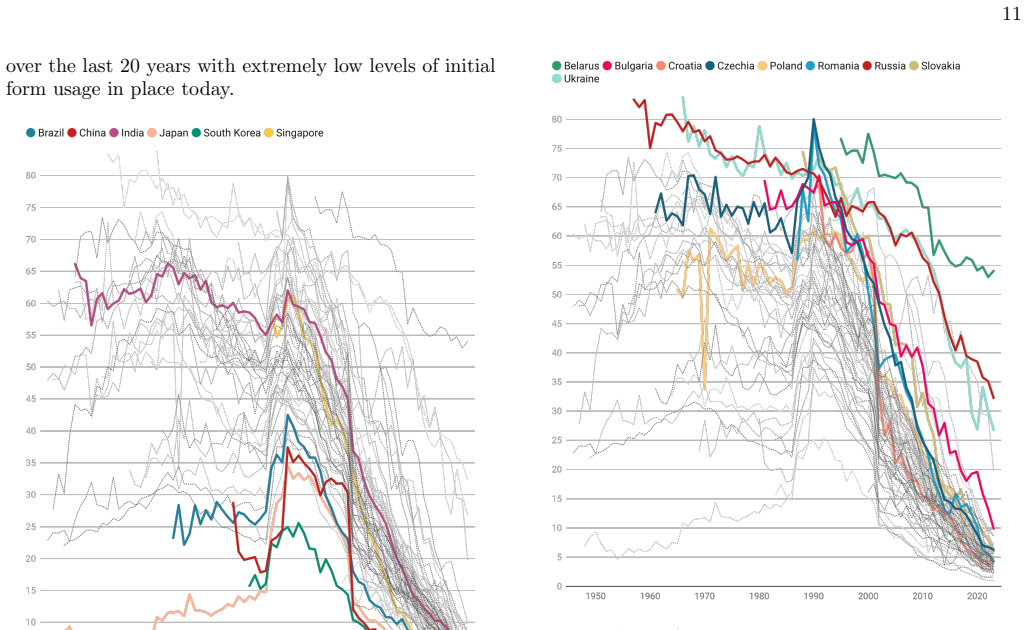
An initial era existed during which authors systematically favored initials over full names in scholarly communications; the era had identifiable causes for its emergence and its later disappearance, with direct effects on research culture and practice.
What carries the argument
The initial era, a defined historical interval identified by tracking the preference for initials versus full names in bibliographic databases.
If this is right
- Modern name-disambiguation systems must incorporate historical shifts in formatting conventions.
- Attribution and credit practices changed when the initial era ended.
- Bibliographic data can serve as a source for studying long-term changes in research community norms.
- Search and citation tools benefit from knowing when and why abbreviation practices varied.
Where Pith is reading between the lines
- Similar eras may exist for other elements of the scholarly record, such as title length or reference formatting.
- Database providers could improve historical accuracy by flagging periods when house styles overrode author choices.
- The decline of the initial era may connect to broader moves toward transparency and individual visibility in science.
Load-bearing premise
Patterns of name formatting in bibliographic databases mainly reflect authors' own preferences and cultural norms rather than journal rules, data-entry habits, or gaps in old records.
What would settle it
Direct examination of original journal issues and author manuscripts from the 19th and 20th centuries to check whether submitted names were full but later shortened in publication or databases.
Figures




read the original abstract
Bibliographic data is a rich source of information that goes beyond the use cases of location and citation -- it also encodes both cultural and technological context. For most of its existence, the scholarly record has changed slowly and hence provides an opportunity to gain insight through its reflection of the cultural norms of the research community over the last four centuries. While it is often difficult to distinguish the originating driver of change, it is still valuable to consider the motivating influences that have led to changes in the structure of the scholarly record. An "initial era" is identified during which initials were used in preference to full names by authors on scholarly communications. Causes of the emergence and demise of this era are considered as well as the implications of this era on research culture and practice.
Editorial analysis
A structured set of objections, weighed in public.
Referee Report
Summary. The paper claims that bibliographic data spanning four centuries reveals an 'initial era' in which authors on scholarly communications preferred initials over full names; it examines causes for the era's rise and fall and discusses implications for research culture and practice.
Significance. If the identification of the era rests on transparent extraction of name-formatting patterns from a well-defined corpus and successfully distinguishes author preferences from external constraints, the work could illuminate long-term shifts in scholarly communication norms. The premise of treating bibliographic records as a cultural mirror is potentially valuable, but the current presentation provides no basis for evaluating whether the result would hold.
major comments (2)
- [Abstract] Abstract: the central claim that an 'initial era' has been identified rests on patterns in author name formatting, yet the abstract (and by extension the manuscript) supplies no data sources, corpus size, time window, extraction criteria, or statistical validation, preventing any assessment of whether the era is empirically supported.
- [Throughout] Throughout (no dedicated methods section referenced): the interpretation that observed initial-use patterns primarily reflect author preferences and cultural norms is load-bearing for the cultural-era narrative and its implications, but the manuscript does not address or control for confounding factors such as evolving journal house styles, cataloging standards (e.g., AACR2 vs. RDA), or database ingestion pipelines that normalize or truncate names.
minor comments (1)
- [Abstract] Abstract: the statement 'for most of its existence' is imprecise without an explicit start date or coverage of the bibliographic dataset.
Simulated Author's Rebuttal
We thank the referee for their constructive feedback on our manuscript identifying the 'initial era' in scholarly name formatting. We address each major comment below, indicating planned revisions to improve clarity and rigor.
read point-by-point responses
-
Referee: [Abstract] Abstract: the central claim that an 'initial era' has been identified rests on patterns in author name formatting, yet the abstract (and by extension the manuscript) supplies no data sources, corpus size, time window, extraction criteria, or statistical validation, preventing any assessment of whether the era is empirically supported.
Authors: The abstract is intentionally brief, but we recognize the need for more transparency. The underlying analysis uses large-scale bibliographic data from sources spanning four centuries, with the era delineated by shifts in the proportion of initial-only vs. full-name entries. We will revise the abstract to specify the primary data sources, the overall time window (approximately 1600-present), key extraction methods for name formats, and note that validation involves temporal trend analysis and statistical tests for change points. This will allow readers to better evaluate the empirical support. revision: yes
-
Referee: [Throughout] Throughout (no dedicated methods section referenced): the interpretation that observed initial-use patterns primarily reflect author preferences and cultural norms is load-bearing for the cultural-era narrative and its implications, but the manuscript does not address or control for confounding factors such as evolving journal house styles, cataloging standards (e.g., AACR2 vs. RDA), or database ingestion pipelines that normalize or truncate names.
Authors: This is a valid concern, as external factors could influence observed patterns. Our current manuscript emphasizes the long-term cultural interpretation but does not include a dedicated discussion of potential confounders or a methods section detailing controls. We will add a methods section in the revision that describes the data extraction process, acknowledges these possible influences, and explains why the cross-database, multi-century consistency supports a cultural rather than purely technical explanation. If space allows, we may include supplementary analyses to test robustness against cataloging changes. revision: yes
Circularity Check
No significant circularity; observational analysis of external bibliographic data
full rationale
The paper identifies an 'initial era' of name formatting preferences by inspecting patterns in bibliographic records spanning four centuries. No self-definitional loops, fitted parameters renamed as predictions, or load-bearing self-citations appear in the abstract or described structure. The central claim rests on external data sources rather than internal definitions or author-overlapping uniqueness theorems, rendering the derivation self-contained against external benchmarks.
Axiom & Free-Parameter Ledger
axioms (1)
- domain assumption Bibliographic data is a rich source of information that encodes both cultural and technological context beyond location and citation.
Reference graph
Works this paper leans on
-
[1]
Gradual Evolution of the Scholarly Record : The development of conventions around the schol- arly record, such as the norm of naming authors on papers, reveals a slow evolutionary process. It highlights that it took nearly two centuries to estab- lish a general expectation for author attribution on scholarly works. This gradual change underscores the iner...
-
[2]
Accelerated Changes in Recent Times : The pace at which the scholarly record has been trans- forming has markedly increased in recent years. This acceleration is evident in the rapid shift from a median of two authors to five authors per paper across a span of 60 years, a change driven by the increasing frequency, volume, and data size of schol- arly outp...
-
[3]
Reflective Richness of Data: The data surround- ing scholarly communication not only mirrors the evolution of the research community but has, in recent times, also become indicative of the technolo- gies that facilitate this communication. The grow- ing complexity and interconnectedness of research outputs, evidenced by the increasing number of co- author...
work page 1945
-
[4]
This part of significant growth began to see the development of norms and standards that needed to reach across journals and the community started to become large enough that the prior “gentlemanly” approach was no longer sufficient to handle the level of publication volumes and the community which needed to share in the knowledge being generated. During ...
work page 1945
-
[5]
Technological harmonisation: Allowing the choice of capturing and using full names across many different types of system from research information manage- ment within institutions to evaluation, and from publishing to grant application and administration
-
[6]
Globalisation of research: The natural harmonisa- tion of norms as more and more researchers collab- orate outside a narrow context
-
[7]
Trust: The ongoing need to propagate trust in the sense of understanding the identity of participants in the research ecosystem. All three of these points play into the greater narra- tive of how research is changing around us. There is a greater need for transparency as research has an increas- ingly significant effect on everyday lives and as govern- me...
-
[8]
P. A. Hall, ed., Varieties Of Capitalism: The Institutional Foundations of Comparative Advantage, illustrated edition ed. (Oxford University Press, U.S.A., Oxford England ; New York, 2001)
work page 2001
-
[9]
J. Jarvis, The Gutenberg Parenthesis: The Age of Print and Its Lessons for the Age of the Internet (Bloomsbury Academic, New York, 2023)
work page 2023
-
[10]
A. Johns, The Science of Reading: Information, Media, and Mind in Modern America (University of Chicago Press, Chicago ; London, 2023)
work page 2023
-
[11]
How do publications find their audience?
M. Taylor, “How do publications find their audience?” (2024), publisher: figshare
work page 2024
-
[12]
B. Macaluso, V. Larivi` ere, T. Sugimoto, and C. R. Sugi- moto, Academic Medicine 91, 1136 (2016)
work page 2016
-
[13]
C. Ni, E. Smith, H. Yuan, V. Larivi` ere, and C. R. Sug- imoto, Science Advances 7, eabe4639 (2021), publisher: American Association for the Advancement of Science
work page 2021
-
[14]
C. R. Sugimoto, Y.-Y. Ahn, E. Smith, B. Macaluso, and V. Larivi` ere, The Lancet393, 550 (2019), publisher: El- sevier
work page 2019
-
[15]
D. Kozlowski, D. S. Murray, A. Bell, W. Hulsey, V. Lar- ivi` ere, T. Monroe-White, and C. R. Sugimoto, PLOS ONE 17, e0264270 (2022), publisher: Public Library of Science
work page 2022
-
[16]
D. Kozlowski, V. Larivi` ere, C. R. Sugimoto, and T. Monroe-White, Proceedings of the National Academy of Sciences 119, e2113067119 (2022), publisher: Proceed- ings of the National Academy of Sciences
work page 2022
-
[17]
Meadows, Journal of Information Science 11, 27 (1985)
A. Meadows, Journal of Information Science 11, 27 (1985)
work page 1985
-
[18]
D. W. Hook and S. J. Porter, Frontiers in Research Metrics and Analytics 6 (2021)
work page 2021
-
[19]
L. Bornmann, R. Haunschild, and R. Mutz, Humanities and Social Sciences Communications 8, 1 (2021), number: 1 Publisher: Palgrave
work page 2021
-
[20]
Philosophical Transactions of the Royal Society of London 4, 1075 (1997), publisher: Royal Society
work page 1997
-
[21]
L. A. Whited, ed., The Ivory Tower and Harry Potter: Perspectives on a Literary Phenomenon (University of Missouri Press, Columbia, Mo., 2004)
work page 2004
-
[22]
Bitcoin: A Peer-to-Peer Electronic Cash System,
S. Nakamoto, “Bitcoin: A Peer-to-Peer Electronic Cash System,” (2008)
work page 2008
-
[23]
R. E. Sorge, L. J. Martin, K. A. Isbester, S. G. Sotocinal, S. Rosen, A. H. Tuttle, J. S. Wieskopf, E. L. Acland, A. Dokova, B. Kadoura, P. Leger, J. C. S. Mapplebeck, 20 M. McPhail, A. Delaney, G. Wigerblad, A. P. Schumann, T. Quinn, J. Frasnelli, C. I. Svensson, W. F. Sternberg, and J. S. Mogil, Nature Methods 11, 629 (2014), publisher: Nature Publishing Group
work page 2014
-
[24]
Katsnelson, Nature (2014), 10.1038/na- ture.2014.15106, publisher: Nature Publishing Group
A. Katsnelson, Nature (2014), 10.1038/na- ture.2014.15106, publisher: Nature Publishing Group
work page doi:10.1038/na- 2014
-
[25]
Reardon, Nature (2017), 10.1038/nature.2017.23022, publisher: Nature Publishing Group
S. Reardon, Nature (2017), 10.1038/nature.2017.23022, publisher: Nature Publishing Group
-
[26]
Adams, Nature 497, 557 (2013), number: 7451 Pub- lisher: Nature Publishing Group
J. Adams, Nature 497, 557 (2013), number: 7451 Pub- lisher: Nature Publishing Group
work page 2013
-
[27]
M. Thelwall and N. Maflahi, Quantitative Science Studies 3, 331 (2022)
work page 2022
-
[28]
The first paper in Dimensions with co-authorship of more than 100 authors is in Chemistry from 1928 [66]
work page 1928
-
[29]
J. P. Pardo-Guerra, The Quantified Scholar: How Re- search Evaluations Transformed the British Social Sci- ences (Columbia University Press, 2022)
work page 2022
-
[30]
S. J. Porter and D. W. Hook, Frontiers in Research Metrics and Analytics 7 (2022)
work page 2022
-
[31]
V. Bush, The Endless Frontier, Report to the President on a Program for Postwar Scientific Research , Tech. Rep. (OFFICE OF SCIENTIFIC RESEARCH AND DEVEL- OPMENT WASHINGTON DC, 1945)
work page 1945
-
[32]
J. R. Oppenheimer, Proceedings of the National Academy of Sciences 50, 1194 (1963), publisher: Proceedings of the National Academy of Sciences
work page 1963
-
[33]
D. Yan, Z. Hai-qing, D. Guo-bao, and T. Cheng, Chinese Journal of Integrative Medicine 11, 229 (2005)
work page 2005
-
[34]
Br¨ uck, Communications Medicine3, 1 (2023), pub- lisher: Nature Publishing Group
O. Br¨ uck, Communications Medicine3, 1 (2023), pub- lisher: Nature Publishing Group
work page 2023
-
[35]
Gender bias in peer review – opening up the black box,
A. Holmes and S. Hardy, “Gender bias in peer review – opening up the black box,” (2019)
work page 2019
-
[36]
W. R. Lefanu, Bulletin of the Institute of the History of Medicine 5, 735 (1937), publisher: The Johns Hopkins University Press
work page 1937
-
[37]
D. W. Hook, S. J. Porter, and C. Herzog, Frontiers in Research Metrics and Analytics 3 (2018)
work page 2018
-
[38]
W. A. Kretzschmar, in Language in the USA: Themes for the Twenty-first Century , edited by E. Finegan and J. R. Rickford (Cambridge University Press, Cambridge, 2004) pp. 39–57
work page 2004
-
[39]
T. A. Velden, A.-u. Haque, and C. Lagoze, in Proceed- ings of the 11th annual international ACM/IEEE joint conference on Digital libraries , JCDL ’11 (Association for Computing Machinery, New York, NY, USA, 2011) pp. 241–250
work page 2011
-
[40]
Y. Liu, L. Chen, Y. Yuan, and J. Chen, American Journal of Physical Anthropology 148, 341 (2012)
work page 2012
-
[41]
Hofstede, Journal of International Business Studies 14, 75 (1983)
G. Hofstede, Journal of International Business Studies 14, 75 (1983)
work page 1983
-
[42]
G. Hofstede, Culture’s Consequences: Comparing Values, Behaviors, Institutions and Organizations Across Nations , second edition ed. (SAGE Publications, Inc, Thousand Oaks, Calif., 2003)
work page 2003
-
[43]
Hofstede, Online Readings in Psychology and Culture 2 (2011), 10.9707/2307-0919.1014
G. Hofstede, Online Readings in Psychology and Culture 2 (2011), 10.9707/2307-0919.1014
-
[44]
S. J. Porter, L. Hawizy, and D. W. Hook, Quantitative Science Studies 4, 127 (2023)
work page 2023
-
[45]
C. P. Snow, The Two Cultures , reissue edition ed. (Cam- bridge University Press, Cambridge, 2012)
work page 2012
-
[46]
Journal of Biological Chemistry 275, 12361 (2000)
work page 2000
-
[47]
A. B. Watson, Journal of Vision 11, ii (2011)
work page 2011
- [48]
-
[49]
MEDLINE Data Changes - 2002. NLM Technical Bulletin. Nov-Dec 2001,
NLM, “MEDLINE Data Changes - 2002. NLM Technical Bulletin. Nov-Dec 2001,” (2002)
work page 2002
-
[50]
Skill Kit: Searching Full Author Names in PubMed®,
NLM, “Skill Kit: Searching Full Author Names in PubMed®,” (2009), publisher: U.S. National Library of Medicine
work page 2009
-
[51]
Crossref, The Formation of CrossRef: A Short History , Tech. Rep. (CrossRef, 2009)
work page 2009
-
[52]
Web of Science Core Collection: Explanation on Full Author Names,
Clarivate, “Web of Science Core Collection: Explanation on Full Author Names,” (2022)
work page 2022
-
[53]
Elsevier Announces Scopus Service,
P. J. Hane, “Elsevier Announces Scopus Service,” (2004)
work page 2004
-
[54]
Sullo, Journal of the Medical Library Association 95, 367 (2007)
E. Sullo, Journal of the Medical Library Association 95, 367 (2007)
work page 2007
-
[55]
J¨ org, Data Science Journal 9 (2010), 10.2481/dsj.CRIS4
B. J¨ org, Data Science Journal 9 (2010), 10.2481/dsj.CRIS4
-
[56]
Butler, Nature 485, 564 (2012), number: 7400 Pub- lisher: Nature Publishing Group
D. Butler, Nature 485, 564 (2012), number: 7400 Pub- lisher: Nature Publishing Group
work page 2012
-
[57]
Schiermeier, Nature 526, 281 (2015), number: 7572 Publisher: Nature Publishing Group
Q. Schiermeier, Nature 526, 281 (2015), number: 7572 Publisher: Nature Publishing Group
work page 2015
-
[58]
A. Meadows, L. L. Haak, and J. Brown, 32, 9 (2019), number: 1 Publisher: UKSG in association with Ubiquity Press
work page 2019
-
[59]
L´ opez Lloreda, (2022), 10.1126/science.caredit.adf3063
C. L´ opez Lloreda, (2022), 10.1126/science.caredit.adf3063
-
[60]
E. G. Teich, J. Z. Kim, C. W. Lynn, S. C. Simon, A. A. Klishin, K. P. Szymula, P. Srivastava, L. C. Bassett, P. Zurn, J. D. Dworkin, and D. S. Bassett, Nature Physics 18, 1161 (2022), publisher: Nature Publishing Group
work page 2022
-
[61]
C. D. Zhou, M. G. Head, D. C. Marshall, B. J. Gilbert, M. A. El-Harasis, R. Raine, H. O’Connor, R. Atun, and M. Maruthappu, BMJ Open 8, e018625 (2018), publisher: British Medical Journal Publishing Group Section: Health policy
work page 2018
-
[62]
H. Draux and S. Kundu, Gender Imbalance in Cancer Re- search Grants, Tech. Rep. ([object Object], 2018) artwork Size: 2013631 Bytes
work page 2018
- [63]
- [64]
-
[65]
J. W. Lockhart, M. M. King, and C. Munsch, Nature Human Behaviour 7, 1084 (2023)
work page 2023
-
[66]
Share of women among total re- searchers by country, 1996–2018,
U. I. for Statistics, “Share of women among total re- searchers by country, 1996–2018,”
work page 1996
-
[67]
L. L. Haak, A. Meadows, and J. Brown, Frontiers in Research Metrics and Analytics 3 (2018)
work page 2018
-
[68]
S. J. Porter, Frontiers in Research Metrics and Analytics 7, 779097 (2022)
work page 2022
-
[69]
V. Ilik, M. Conlon, G. Triggs, M. White, M. Javed, M. Brush, K. Gutzman, S. Essaid, P. Friedman, S. Porter, M. Szomszor, M. A. Haendel, D. Eichmann, and K. L. Holmes, Frontiers in Research Metrics and Analytics 2 (2018), 10.3389/frma.2017.00012, publisher: Frontiers
-
[70]
Identifying Fabri- cated Networks within Authorship-for-Sale Enterprises,
S. J. Porter and L. D. McIntosh, “Identifying Fabri- cated Networks within Authorship-for-Sale Enterprises,” (2024), arXiv:2401.04022 [cs]
- [71]
- [72]
-
[73]
F. Emich, A. Benedetti-Pichler, F. Henrich, L. Moser, R. Strebinger, F. Pregl, F. Zaribnicky, L. Rosenthaler, E. M. Chamot, H. Herbst, H. Fitting, H. Ambronn, A. Frey, L. Wright, K. John, F. K. Reinsch, A. Zim- 21 mern, M. Coutin, E. Lehmann, J. L. Pech, R. Harder, H. Siedentopf, C. Spierer, Lieberk¨ uhn, W. Kaiser, Rhein- berger, W. Kraemer, C. Kern, H. ...
work page 1928
discussion (0)
Sign in with ORCID, Apple, or X to comment. Anyone can read and Pith papers without signing in.