Extensions of finitely generated Veech groups
Pith reviewed 2026-05-24 00:17 UTC · model grok-4.3
The pith
The π₁-extension of a finitely generated Veech group acts cocompactly on a hyperbolic space obtained by collapsing a surface bundle.
A machine-rendered reading of the paper's core claim, the machinery that carries it, and where it could break.
Core claim
Given a closed surface S with finitely generated Veech group G and its π₁(S)-extension Γ, there exists a hyperbolic space Ê on which Γ acts isometrically and cocompactly. The space Ê is obtained by collapsing some regions of the surface bundle over the convex hull of the limit set of G. Using the nice action of Γ on the hyperbolic space Ê, it is shown that Γ is hierarchically hyperbolic.
What carries the argument
The collapsing procedure on the surface bundle over the convex hull of the limit set of G, which yields the hyperbolic space Ê admitting a cocompact action by the full extension Γ.
If this is right
- Γ is hierarchically hyperbolic.
- This holds without assuming G is a lattice in the mapping class group.
- The construction provides a model for studying geometric finiteness in mapping class groups.
- Similar extensions of other subgroups may admit analogous hyperbolic actions.
Where Pith is reading between the lines
- The hierarchical hyperbolicity of Γ may imply that these groups have properties like the Morse boundary or quasi-isometric rigidity.
- Collapsing constructions could extend to other finitely generated subgroups of mapping class groups beyond Veech groups.
- This work suggests that geometric finiteness can be defined via cocompact actions on hyperbolic spaces for surface group extensions.
Load-bearing premise
The collapsing procedure applied to the surface bundle over the convex hull of the limit set of G produces a space Ê that is hyperbolic and on which the full extension Γ acts cocompactly.
What would settle it
An explicit computation for a specific finitely generated Veech group, such as the one generated by two parabolic elements with distinct fixed points, showing that the collapsed space fails to be hyperbolic or that the action of Γ is not cocompact.
Figures


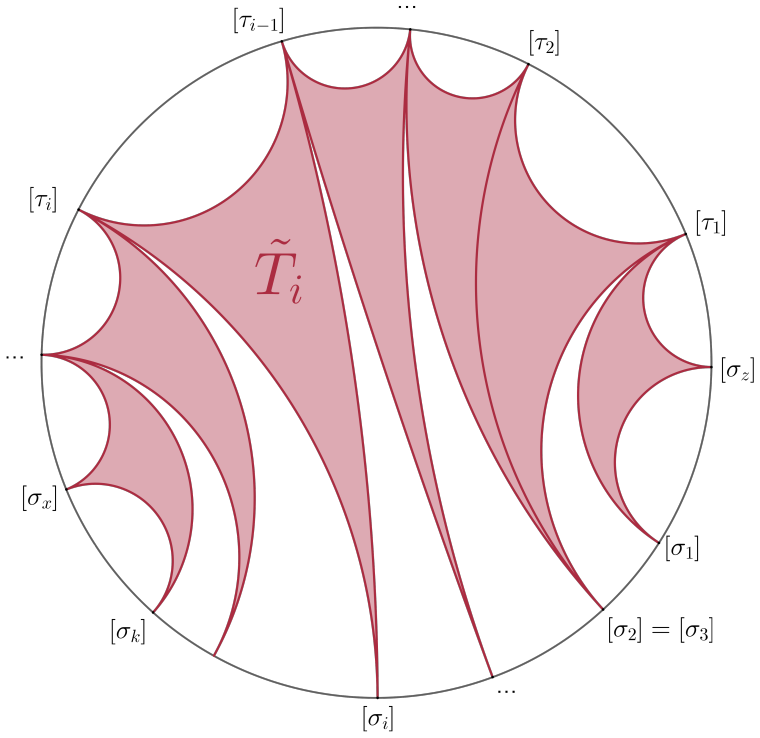


read the original abstract
Given a closed surface $S$ with finitely generated Veech group $G$ and its $\pi_1(S)$-extension $\Gamma$, there exists a hyperbolic space $\hat{E}$ on which $\Gamma$ acts isometrically and cocompactly. The space $\hat{E}$ is obtained by collapsing some regions of the surface bundle over the convex hull of the limit set of $G$. Using the nice action of $\Gamma$ on the hyperbolic space $\hat{E}$, it is shown that $\Gamma$ is hierarchically hyperbolic. These are generalizations of results from Dowdall-Durham-Leininger-Sisto, which assume in addition that $G$ is a lattice. Because finitely generated Veech groups are among the most basic examples of subgroups of mapping class groups which are expected to qualify as geometrically finite, this result is evidence for the development of a broader theory of geometric finiteness.
Editorial analysis
A structured set of objections, weighed in public.
Referee Report
Summary. The manuscript claims that given a closed surface S with finitely generated Veech group G and its π₁(S)-extension Γ, there exists a hyperbolic space Ê obtained by collapsing regions of the surface bundle over the convex hull of the limit set Λ(G) such that Γ acts isometrically and cocompactly on Ê; this action is then used to conclude that Γ is hierarchically hyperbolic. The result generalizes Dowdall-Durham-Leininger-Sisto by removing the lattice hypothesis on G.
Significance. If the construction of Ê and the verification of hyperbolicity plus cocompactness hold, the paper supplies concrete evidence that extensions by finitely generated Veech groups are hierarchically hyperbolic, supporting the broader program of geometric finiteness for subgroups of mapping class groups. The explicit geometric construction (rather than parameter fitting) is a strength.
major comments (2)
- [Abstract] Abstract, paragraph 2: the claim that collapsing the surface bundle over CH(Λ(G)) produces a space Ê on which the full Γ acts cocompactly is load-bearing for both the hyperbolicity statement and the hierarchical hyperbolicity conclusion, yet the abstract (and the sketched construction) provides no explicit modification of the DDLS collapsing map that absorbs the infinite-volume complement when G is not a lattice.
- [Construction of Ê] The weakest assumption identified in the reader's report is not discharged: without a lattice hypothesis, the π₁(S)-fibers transverse to the base CH(Λ(G)) may remain non-compact after collapsing, and no argument is supplied showing that the quotient Ê/Γ is nevertheless compact.
minor comments (1)
- [Abstract] Notation for the collapsed space is introduced as Ê in the abstract but should be cross-referenced to the precise definition in the body for clarity.
Simulated Author's Rebuttal
We thank the referee for their thoughtful report and for identifying points where the presentation of the construction and its consequences for non-lattice Veech groups can be strengthened. We respond to each major comment below and will revise the manuscript to improve clarity while preserving the core arguments.
read point-by-point responses
-
Referee: [Abstract] Abstract, paragraph 2: the claim that collapsing the surface bundle over CH(Λ(G)) produces a space Ê on which the full Γ acts cocompactly is load-bearing for both the hyperbolicity statement and the hierarchical hyperbolicity conclusion, yet the abstract (and the sketched construction) provides no explicit modification of the DDLS collapsing map that absorbs the infinite-volume complement when G is not a lattice.
Authors: We agree that the abstract is too brief on this point. The manuscript (Sections 3.2–3.4) describes the modified collapsing map that uses the finite generation of G to select collapsing regions whose boundaries capture the ends of the complement of CH(Λ(G)); this is the explicit adaptation of the DDLS map. In the revision we will expand the abstract by one sentence summarizing this adaptation and its role in producing a cocompact quotient. revision: yes
-
Referee: [Construction of Ê] The weakest assumption identified in the reader's report is not discharged: without a lattice hypothesis, the π₁(S)-fibers transverse to the base CH(Λ(G)) may remain non-compact after collapsing, and no argument is supplied showing that the quotient Ê/Γ is nevertheless compact.
Authors: The cocompactness argument appears in the proof of Theorem 4.1, which shows that the quotient Ê/Γ is compact by combining the cocompactness of the G-action on CH(Λ(G)) with the fact that finite generation of G implies that the “cusps” of the surface bundle are absorbed by the collapsing regions chosen in Section 3.3; the resulting fibers are compact and the quotient is therefore compact. We concede that this step is not isolated as a separate lemma and will add an explicit corollary (or expanded remark) after Theorem 4.1 that isolates the compactness of Ê/Γ and highlights where finite generation replaces the lattice hypothesis. revision: yes
Circularity Check
No circularity; explicit geometric construction of Ê via collapsing is independent of inputs
full rationale
The paper presents a direct geometric construction: the space Ê is obtained by collapsing regions of the surface bundle over CH(Λ(G)), yielding an isometric cocompact Γ-action from which hierarchical hyperbolicity follows. No equations, fitted parameters, or self-referential definitions appear. The result generalizes DDLS (distinct authors) without load-bearing self-citations or ansatzes smuggled via prior work by the same author. The derivation chain is self-contained as an explicit modification of the bundle, with no reduction of the claimed prediction to the input data by construction.
Axiom & Free-Parameter Ledger
axioms (2)
- domain assumption Veech groups are subgroups of the mapping class group that preserve a flat structure on the surface.
- domain assumption The convex hull of the limit set of G supports a surface bundle whose fundamental group extension is Γ.
Lean theorems connected to this paper
-
IndisputableMonolith/Foundation/AlexanderDuality.leanalexander_duality_circle_linking unclear?
unclearRelation between the paper passage and the cited Recognition theorem.
The space Ê is obtained by collapsing some regions of the surface bundle over the convex hull of the limit set of G… Γ admits an isometric action on Gromov hyperbolic space Ê, quasi-isometric to the Cayley graph of Γ coned off along the cosets of vertex subgroups.
-
IndisputableMonolith/Cost/FunctionalEquation.leanwashburn_uniqueness_aczel unclear?
unclearRelation between the paper passage and the cited Recognition theorem.
Theorem 3.3 (Generalized Veech dichotomy)… Corollary 3.9… fan lemma (Lemma 6.22)
What do these tags mean?
- matches
- The paper's claim is directly supported by a theorem in the formal canon.
- supports
- The theorem supports part of the paper's argument, but the paper may add assumptions or extra steps.
- extends
- The paper goes beyond the formal theorem; the theorem is a base layer rather than the whole result.
- uses
- The paper appears to rely on the theorem as machinery.
- contradicts
- The paper's claim conflicts with a theorem or certificate in the canon.
- unclear
- Pith found a possible connection, but the passage is too broad, indirect, or ambiguous to say the theorem truly supports the claim.
Forward citations
Cited by 1 Pith paper
-
Characterizing hierarchically hyperbolic free by cyclic groups
Free-by-cyclic groups with coarse medians are algebraically characterized by unbranched blocks in maximal virtually F_n x Z subgroups and excessive linearity of completely split relative train track maps.
Reference graph
Works this paper leans on
-
[1]
isbn: 0-471-84539-6. [GL00] Frederick P. Gardiner and Nikola Lakic. Quasiconformal Teichmüller theory. Mathematical Surveys and Monographs 76. American Mathematical Society,
-
[2]
Word hyperbolic extensions of surface groups
isbn: 978-0-8218-1983-8. doi: 10.1090/surv/076. [GM08] Daniel Groves and Jason Fox Manning. “Dehn filling in relatively hyperbolic groups”. In:Israel Journal of Mathematics168 (2008), pp. 317–429.doi: 10. 1007/s11856-008-1070-6. [Ham05] Ursula Hamenstaedt. Word hyperbolic extensions of surface groups. May 2005. arXiv: math/0505244. [HS06] Pascal Hubert an...
work page internal anchor Pith review Pith/arXiv arXiv doi:10.1090/surv/076 1983
-
[3]
Geometry of Teichmüller space with the Teichmüller metric
issn: 1435-9855. doi: 10.4171/JEMS/495. [Mas10] Howard Masur. “Geometry of Teichmüller space with the Teichmüller metric”. In: Geometry of Riemann surfaces and their moduli spaces. Ed. by Lizhen Ji, Scott A. Wolpert, and Shing-Tung Yau. Vol. 14. Surveys in Differential Geom- etry. 2010, pp. 295–314.doi: 10.4310/SDG.2009.v14.n1.a11. [MS13] Howard Masur and...
discussion (0)
Sign in with ORCID, Apple, or X to comment. Anyone can read and Pith papers without signing in.