Structure-preserving approximations of the Serre-Green-Naghdi equations in standard and hyperbolic form
Pith reviewed 2026-05-23 22:03 UTC · model grok-4.3
The pith
Numerical methods for the Serre-Green-Naghdi equations conserve mass and energy using summation-by-parts operators.
A machine-rendered reading of the paper's core claim, the machinery that carries it, and where it could break.
Core claim
The novel numerical methods conserve both the total water mass and the total energy. In addition, the methods for the original Serre-Green-Naghdi equations conserve the total momentum for flat bathymetry. For variable topography, all the methods proposed are well-balanced for the lake-at-rest state. The schemes are obtained by replacing continuous integration-by-parts identities with their discrete summation-by-parts counterparts, and energy-stable variants follow from consistent high-order artificial viscosity.
What carries the argument
Summation-by-parts operators that replace continuous integration by parts to enforce exact discrete conservation of mass and energy.
If this is right
- Any discretization family (finite difference, finite element, discontinuous Galerkin, spectral) that supplies summation-by-parts operators can be turned into a mass- and energy-conserving method for the Serre-Green-Naghdi system.
- The hyperbolic approximation yields fully explicit time stepping while retaining the same conservation properties.
- Adding consistent artificial viscosity produces energy-stable variants without destroying the underlying conservation structure.
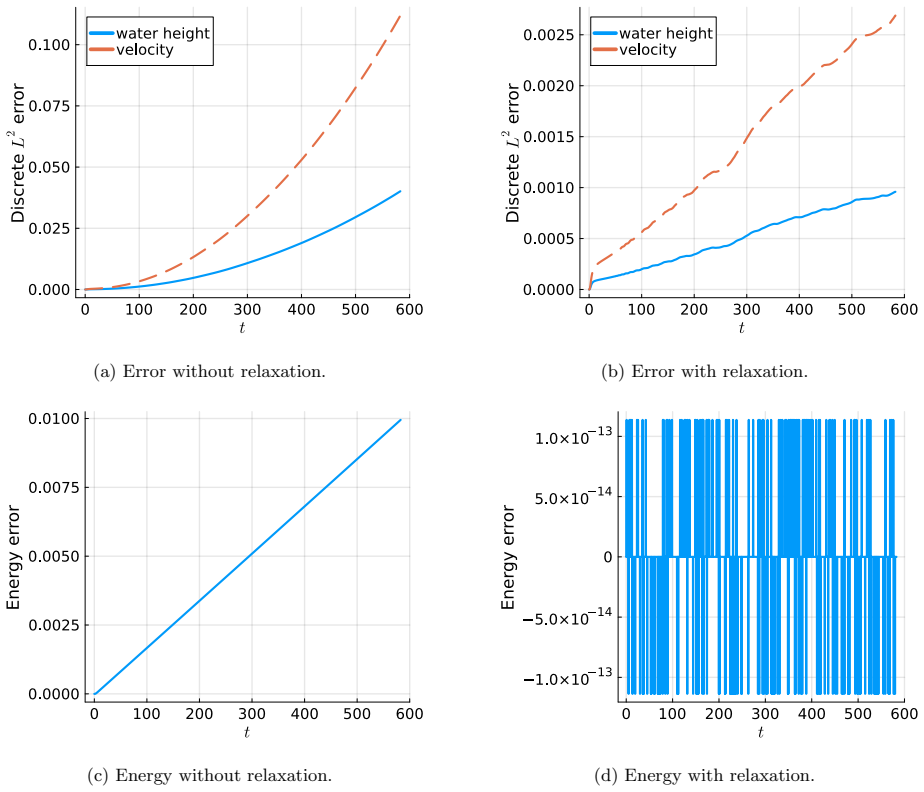
- Benchmarks confirm that energy preservation yields visibly more accurate dispersive wave solutions on coarse meshes than non-structure-preserving alternatives.
Where Pith is reading between the lines
- The same summation-by-parts construction could be applied to other nonlinear dispersive models whose continuous equations admit similar energy identities.
- Long-time coastal or ocean simulations that rely on accurate energy budgets may benefit directly from these discretizations.
- The approach supplies a template for proving conservation in related shallow-water or Boussinesq-type systems once suitable summation-by-parts operators are identified.
Load-bearing premise
That summation-by-parts operators exist in the chosen spatial discretization and that they transfer the continuous conservation identities to the discrete level without extra conditions on the nonlinear elliptic operator.
What would settle it
A numerical run on a periodic or flat-bottom domain in which the computed total energy changes by more than machine round-off after many time steps, or a lake-at-rest state that develops nonzero velocities under the proposed scheme.
Figures
read the original abstract
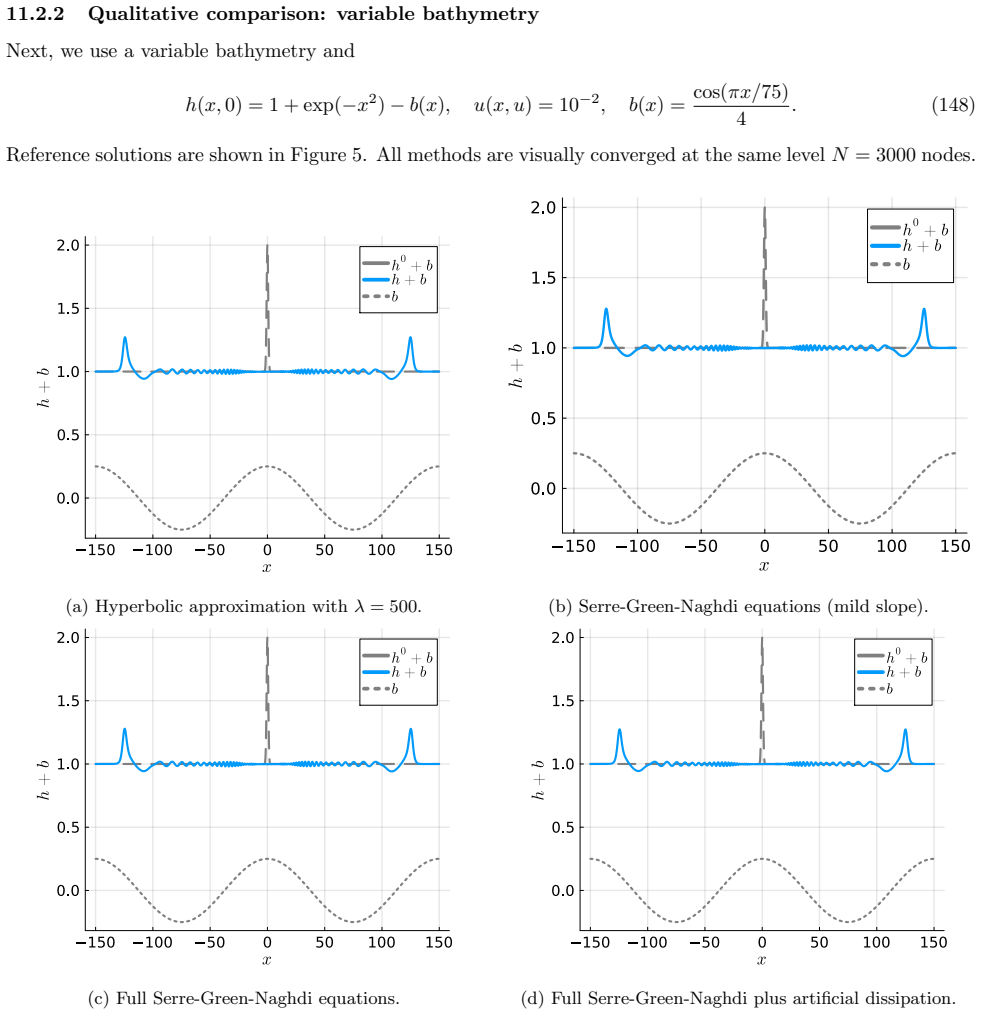
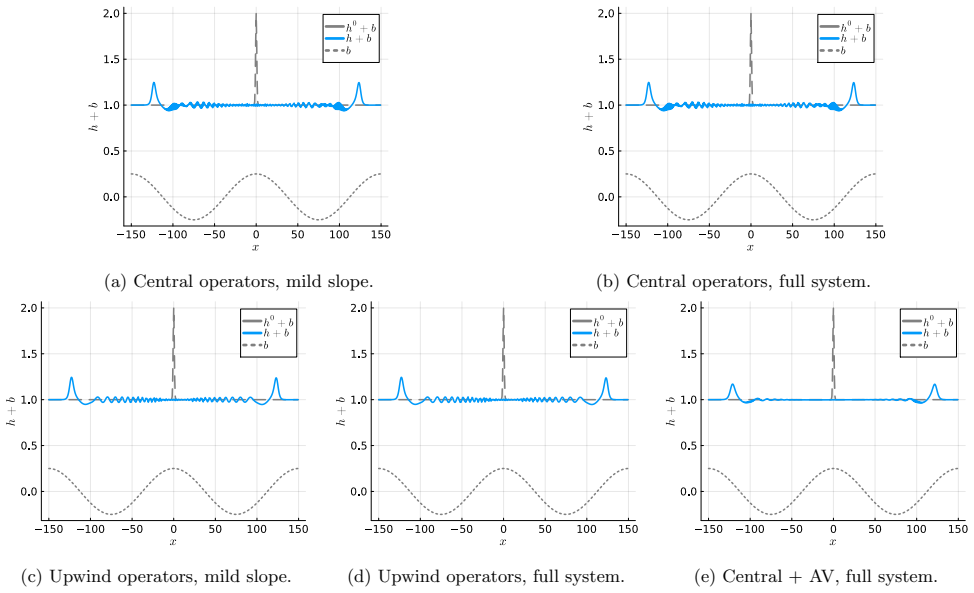
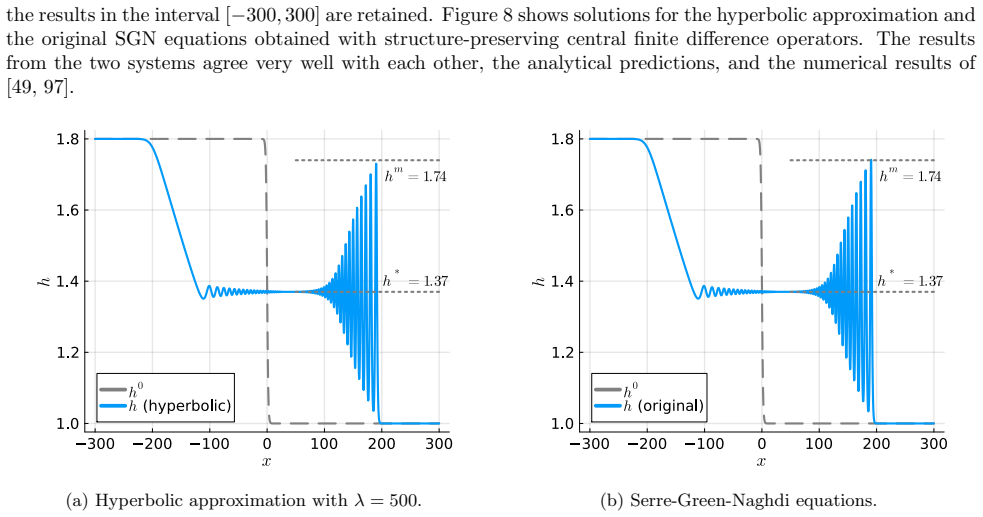
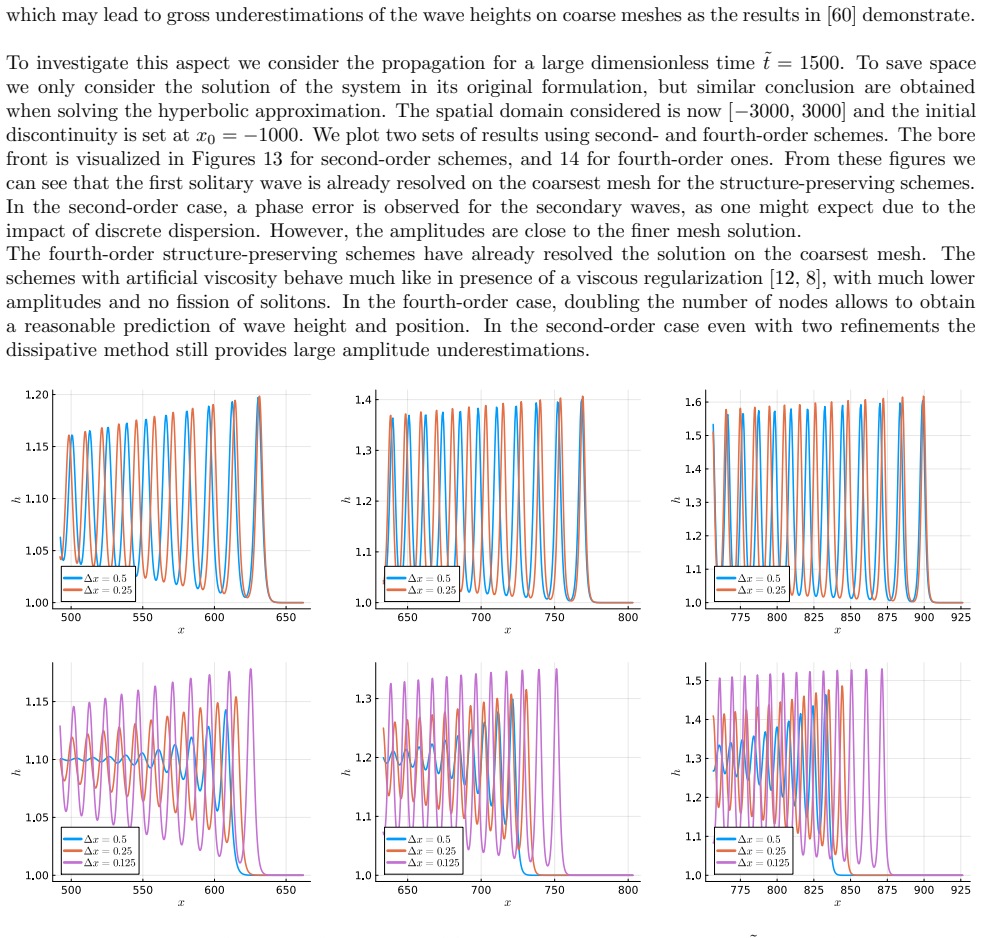
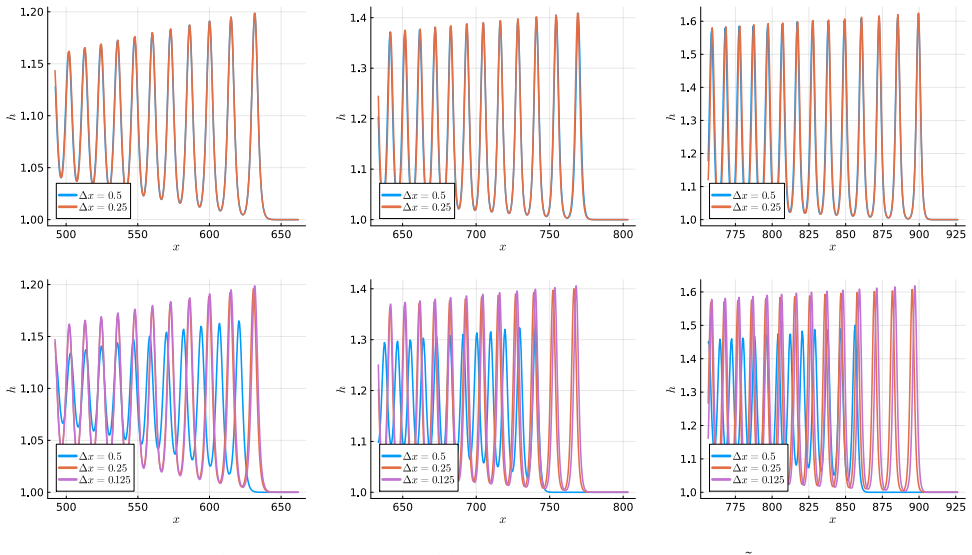
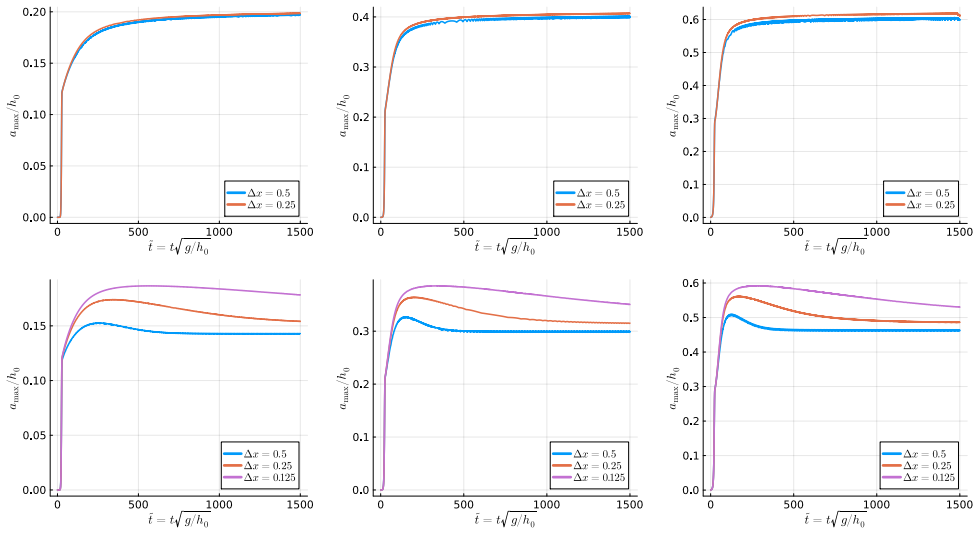
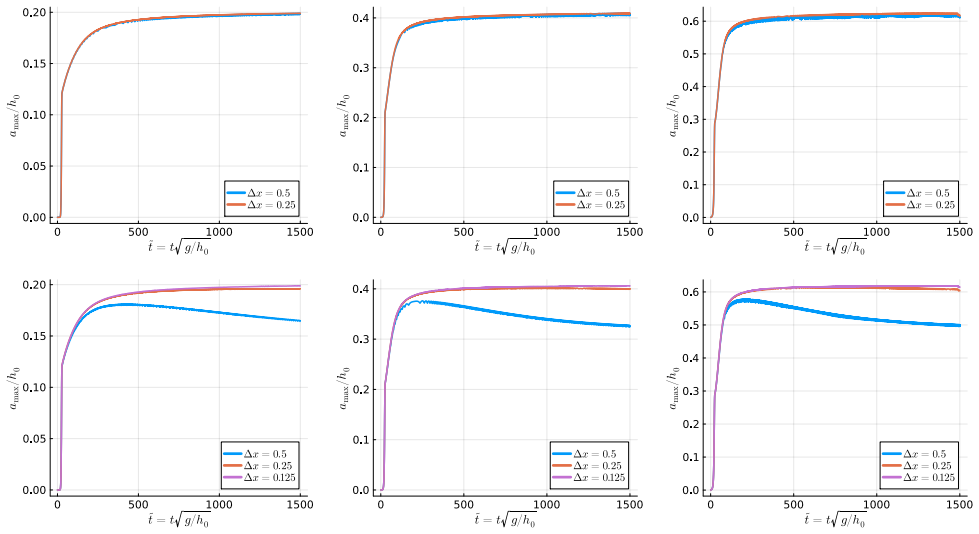
We develop structure-preserving numerical methods for the Serre-Green-Naghdi equations, a model for weakly dispersive free-surface waves. We consider both the classical form, requiring the inversion of a non-linear elliptic operator, and a hyperbolic approximation of the equations, allowing fully explicit time stepping. Systems for both flat and variable topography are studied. Our novel numerical methods conserve both the total water mass and the total energy. In addition, the methods for the original Serre-Green-Naghdi equations conserve the total momentum for flat bathymetry. For variable topography, all the methods proposed are well-balanced for the lake-at-rest state. We provide a theoretical setting allowing us to construct schemes of any kind (finite difference, finite element, discontinuous Galerkin, spectral, etc.) as long as summation-by-parts operators are available in the chosen setting. Energy-stable variants are proposed by adding a consistent high-order artificial viscosity term. The proposed methods are validated through a large set of benchmarks to verify all the theoretical properties. Whenever possible, comparisons with exact, reference numerical, or experimental data are carried out. The impressive advantage of structure preservation, and in particular energy preservation, to resolve accurately dispersive wave propagation on very coarse meshes is demonstrated by several of the tests.
Editorial analysis
A structured set of objections, weighed in public.
Referee Report
Summary. The manuscript develops structure-preserving numerical methods for the Serre-Green-Naghdi equations in both their classical form (involving inversion of a nonlinear elliptic operator) and a hyperbolic approximation. Using summation-by-parts (SBP) operators, the methods are designed to conserve mass and energy exactly, conserve momentum for flat bathymetry in the classical case, and remain well-balanced for the lake-at-rest state with variable topography. Energy-stable variants are introduced by adding consistent high-order artificial viscosity. The framework applies to any discretization (finite difference, finite element, discontinuous Galerkin, spectral, etc.) provided SBP operators are available, and the methods are validated on a suite of benchmarks demonstrating advantages for dispersive wave propagation on coarse meshes.
Significance. If the conservation properties hold rigorously, the work provides a general, discretization-agnostic framework for structure-preserving schemes on dispersive free-surface models. The explicit handling of both standard and hyperbolic forms, the well-balancing property, and the demonstrated accuracy on coarse meshes would be useful for long-time simulations of nonlinear waves. The availability of machine-checkable or parameter-free derivations is not claimed, but the SBP-based construction is a clear strength if the elliptic-operator cancellation is fully justified.
major comments (1)
- [§3 (discrete energy identity)] §3 (or the section presenting the discrete energy identity): the assertion that the inner product of the solution with the residual of the nonlinear elliptic operator vanishes identically solely from the SBP property needs explicit verification. The continuous energy conservation relies on integration by parts that cancels the elliptic term; the discrete analogue requires that this cancellation survives the chosen discretization of the elliptic operator (including any approximation or boundary treatment). Without a detailed proof or a statement of the precise compatibility conditions (e.g., exact commutation with the discrete divergence), the exact energy conservation claim remains conditional.
minor comments (2)
- [Abstract / §1] The abstract states that comparisons with exact, reference numerical, or experimental data are carried out 'whenever possible,' but the manuscript would benefit from a short table or list in the introduction or results section indicating which benchmarks admit exact solutions versus numerical/experimental references.
- [§2] Notation for the hyperbolic approximation (e.g., the relaxation parameter or the auxiliary variables) should be introduced once with a clear forward reference to the section where the hyperbolic system is derived.
Simulated Author's Rebuttal
We thank the referee for the careful reading and constructive feedback on the discrete energy identity. We address the single major comment below.
read point-by-point responses
-
Referee: §3 (or the section presenting the discrete energy identity): the assertion that the inner product of the solution with the residual of the nonlinear elliptic operator vanishes identically solely from the SBP property needs explicit verification. The continuous energy conservation relies on integration by parts that cancels the elliptic term; the discrete analogue requires that this cancellation survives the chosen discretization of the elliptic operator (including any approximation or boundary treatment). Without a detailed proof or a statement of the precise compatibility conditions (e.g., exact commutation with the discrete divergence), the exact energy conservation claim remains conditional.
Authors: We agree that the manuscript would benefit from an explicit verification of the cancellation. While the construction in §3 is designed so that the SBP property directly implies the required inner-product identity (by mimicking the continuous integration-by-parts step for the chosen discretization of the elliptic operator), we acknowledge that the precise compatibility conditions on boundary terms and commutation with the discrete divergence operator are not spelled out in full detail. In the revised manuscript we will insert a short lemma (or expanded paragraph) in §3 that states the exact assumptions on the SBP operators and the elliptic discretization under which the inner product vanishes identically, together with a one-page derivation of the discrete energy identity. This addition will make the claim unconditional and machine-checkable from the stated hypotheses. revision: yes
Circularity Check
No circularity; conservation derived from SBP properties on continuous equations
full rationale
The paper constructs structure-preserving discretizations for the Serre-Green-Naghdi system (both classical and hyperbolic forms) by applying summation-by-parts operators that replicate the continuous integration-by-parts identities for mass, energy, and momentum. This yields the claimed conservation statements directly from the PDE structure without fitted parameters, self-referential predictions, or load-bearing self-citations. The theoretical setting is stated as general for any SBP-equipped discretization (FD, FE, DG, spectral) and is validated on benchmarks against external data. No step reduces by construction to its own inputs; the elliptic-operator cancellation is asserted to follow from the SBP inner-product property alone, which is an independent algebraic fact rather than a redefinition. The reader's score of 2.0 is consistent with this self-contained derivation.
Axiom & Free-Parameter Ledger
axioms (1)
- standard math Summation-by-parts operators satisfy a discrete analog of integration by parts that enables exact conservation when applied to the Serre-Green-Naghdi system.
Reference graph
Works this paper leans on
-
[1]
Analysis of the SBP-SAT stabi- lization for finite element methods part I: Linear problems
R´ emi Abgrall, Jan Nordstr¨ om, Philipp¨Offner, and Svetlana Tokareva. Analysis of the SBP-SAT stabi- lization for finite element methods part I: Linear problems. Journal of Scientific Computing , 85(2):1–29, 2020
work page 2020
-
[2]
Algorithm 837: AMD, an approximate minimum degree ordering algorithm
Patrick R Amestoy, Timothy A Davis, and Iain S Duff. Algorithm 837: AMD, an approximate minimum degree ordering algorithm. ACM Transactions on Mathematical Software (TOMS) , 30(3):381–388, 2004
work page 2004
-
[3]
T. Baba, N. Chikasada, K. Imai, Y. Tanioka, and S. Kodaira. Frequency dispersion amplifies tsunamis caused by outer-rise normal faults. Sci.Rep., 1, 2021
work page 2021
-
[4]
S Beji and J.A. Battjes. Experimental investigation of wave propagation over a bar. Coastal Engineering, 19(1–2):151–162, 1993
work page 1993
-
[5]
Martin Berzins. Temporal error control for convection-dominated equations in two space dimensions.SIAM Journal on Scientific Computing , 16(3):558–580, 1995
work page 1995
-
[6]
Julia: A fresh approach to numerical computing
Jeff Bezanson, Alan Edelman, Stefan Karpinski, and Viral B Shah. Julia: A fresh approach to numerical computing. SIAM Review, 59(1):65–98, 2017
work page 2017
-
[7]
Abhijit Biswas and David I Ketcheson. Accurate solution of the nonlinear Schr¨ odinger equation via conservative multiple-relaxation ImEx methods, 2023. 54
work page 2023
- [8]
-
[9]
P. Bonneton, N. Bonneton, J.-P. Parisot, and B. Castelle. Tidal bore dynamics in funnel-shaped estuaries. Journal of Geophysical Research: Oceans , 120(2):923–941, 2015
work page 2015
-
[10]
Fran¸ cois Bouchut. Nonlinear Stability of Finite Volume Methods for Hyperbolic Conservation Laws and Well-Balanced Schemes for Sources . Birkh¨ auser Verlag, Basel, 2004
work page 2004
-
[11]
D. Bresch and B. Desjardins. Sur un mod` ele de Saint-Venant visqueux et sa limite quasi-g´ eostrophique. Comptes Rendus. Math´ ematique, 335(12):1079–1084, 2002
work page 2002
-
[12]
Oscillatory and regular- ized shock waves for a dissipative Peregrine-Boussinesq system
Larkspur Brudvik-Lindner, Dimitrios Mitsotakis, and Athanasios E Tzavaras. Oscillatory and regular- ized shock waves for a dissipative Peregrine-Boussinesq system. IMA Journal of Applied Mathematics , 88(4):602–631, 10 2023
work page 2023
- [13]
-
[14]
Mark H Carpenter, Travis C Fisher, Eric J Nielsen, and Steven H Frankel. Entropy stable spectral collocation schemes for the Navier-Stokes equations: Discontinuous interfaces. SIAM Journal on Scientific Computing, 36(5):B835–B867, 2014
work page 2014
-
[15]
A. Cauquis, M. Ricchiuto, and P. Heinrich. Lax–wendroff schemes with polynomial extrapolation and simplified lax–wendroff schemes for dispersive waves: A comparative study. Water Waves , 4:345–377, 2022
work page 2022
-
[16]
Jesse Chan. On discretely entropy conservative and entropy stable discontinuous Galerkin methods.Journal of Computational Physics , 362:346–374, 2018
work page 2018
-
[17]
R. Chassagne, A.G. Filippini, M. Ricchiuto, and P. Bonneton. Dispersive and dispersive-like bores in channels with sloping banks. Journal of mechanics , 870:595?616, 2019
work page 2019
-
[18]
Robust benchmarking in noisy environments, 08 2016
Jiahao Chen and Jarrett Revels. Robust benchmarking in noisy environments, 08 2016
work page 2016
-
[19]
Yanqing Chen, Timothy A Davis, William W Hager, and Sivasankaran Rajamanickam. Algorithm 887: CHOLMOD, supernodal sparse Cholesky factorization and update/downdate.ACM Transactions on Math- ematical Software (TOMS), 35(3):1–14, 2008
work page 2008
-
[20]
Y.-K. Choi, F. Shi, M. Malej, J. M. Smith, J. T. Kirby, and S. T. Grilli. Block-structured, equal-workload, multi-grid-nesting interface for the Boussinesq wave model FUNWAVE-TVD (total variation diminishing). Geoscientific Model Development, 15(14):5441–5459, 2022
work page 2022
-
[21]
Plots.jl — a user extendable plotting API for the Julia programming language
Simon Christ, Daniel Schwabeneder, Christopher Rackauckas, Michael Krabbe Borregaard, and Thomas Breloff. Plots.jl — a user extendable plotting API for the Julia programming language. Journal of Open Research Software, 2023
work page 2023
-
[22]
Algorithm 836: COLAMD, a column approximate minimum degree ordering algorithm
Timothy A Davis, John R Gilbert, Stefan I Larimore, and Esmond G Ng. Algorithm 836: COLAMD, a column approximate minimum degree ordering algorithm. ACM Transactions on Mathematical Software (TOMS), 30(3):377–380, 2004
work page 2004
-
[23]
J De Frutos and Jesus Maria Sanz-Serna. Accuracy and conservation properties in numerical integration: the case of the Korteweg-de Vries equation. Numerische Mathematik, 75(4):421–445, 1997
work page 1997
- [24]
- [25]
-
[26]
Optimization.jl: A unified optimization package, March 2023
Vaibhav Kumar Dixit and Christopher Rackauckas. Optimization.jl: A unified optimization package, March 2023
work page 2023
-
[27]
The numerical integration of relative equilibrium solutions
Angel Dur´ an and Jesus Maria Sanz-Serna. The numerical integration of relative equilibrium solutions. Geometric theory. Nonlinearity, 11(6):1547, 1998
work page 1998
-
[28]
The numerical integration of relative equilibrium solutions
Angel Dur´ an and Jesus Maria Sanz-Serna. The numerical integration of relative equilibrium solutions. The nonlinear Schr¨ odinger equation.IMA Journal of Numerical Analysis , 20(2):235–261, 2000
work page 2000
-
[29]
Arnaud Duran and Fabien Marche. A discontinuous galerkin method for a new class of Green–Naghdi equations on simplicial unstructured meshes. Applied Mathematical Modelling, 45:840–864, 2017
work page 2017
-
[30]
G. A. El. Resolution of a shock in hyperbolic systems modified by weak dispersion. Chaos: An Interdis- ciplinary Journal of Nonlinear Science , 15(3):037103, 10 2005
work page 2005
- [31]
-
[32]
G.A. El and M.A. Hoefer. Dispersive shock waves and modulation theory. Physica D: Nonlinear Phenom- ena, 333:11–65, 2016. Dispersive Hydrodynamics
work page 2016
-
[33]
G.A. El, V.V. Khodorovskii, and A.V. Tyurina. Undular bore transition in bi-directional conservative wave dynamics. Phys. D Nonlinear Phenom. , 206:232?251, 2005
work page 2005
-
[34]
C. Escalante and T.M. de Luna. A general non-hydrostatic hyperbolic formulation for Boussinesq dispersive shallow flows and its numerical approximation. J.Sci.Comput., 83(62), 2020
work page 2020
-
[35]
An unstructured spectral/hp element model for enhanced Boussinesq-type equations
Claes Eskilsson, SJ Sherwin, and Lars Bergdahl. An unstructured spectral/hp element model for enhanced Boussinesq-type equations. Coastal Engineering, 53(11):947–963, 2006
work page 2006
-
[36]
H. Favre. Etude th´ eorique et exp´ erimentale des ondes de translation dans les canaux d´ ecouverts. Dunod, 1935
work page 1935
-
[37]
N Favrie and S Gavrilyuk. A rapid numerical method for solving Serre-Green-Naghdi equations describing long free surface gravity waves. Nonlinearity, 30(7):2718, 2017
work page 2017
-
[38]
David C Del Rey Fern´ andez, Jason E Hicken, and David W Zingg. Review of summation-by-parts oper- ators with simultaneous approximation terms for the numerical solution of partial differential equations. Computers & Fluids , 95:171–196, 2014
work page 2014
-
[39]
A.G. Filippini, L. Arpaia P. Bonneton, and M. Ricchiuto. Modeling analysis of tidal bore formation in convergent estuaries. European Journal of Mechanics - B/Fluids , 73:55–68, 2019. Breaking Waves
work page 2019
-
[40]
On the nonlinear behaviour of Boussinesq type models: Amplitude-velocity vs amplitude-flux forms
Andrea Gilberto Filippini, Stevan Bellec, Mathieu Colin, and Mario Ricchiuto. On the nonlinear behaviour of Boussinesq type models: Amplitude-velocity vs amplitude-flux forms. Coastal Engineering, 99:109–123, 2015
work page 2015
-
[41]
A flexible genuinely nonlinear approach for nonlinear wave propagation, breaking and run-up
Andrea Gilberto Filippini, Maria Kazolea, and Mario Ricchiuto. A flexible genuinely nonlinear approach for nonlinear wave propagation, breaking and run-up. Journal of Computational Physics , 310:381–417, 2016
work page 2016
-
[42]
High-order entropy stable finite difference schemes for nonlinear conservation laws: Finite domains
Travis C Fisher and Mark H Carpenter. High-order entropy stable finite difference schemes for nonlinear conservation laws: Finite domains. Journal of Computational Physics , 252:518–557, 2013. 56
work page 2013
-
[43]
Travis C Fisher, Mark H Carpenter, Jan Nordstr¨ om, Nail K Yamaleev, and Charles Swanson. Discretely conservative finite-difference formulations for nonlinear conservation laws in split form: Theory and bound- ary conditions. Journal of Computational Physics , 234:353–375, 2013
work page 2013
-
[44]
Ulrik Skre Fjordholm, Siddhartha Mishra, and Eitan Tadmor. Well-balanced and energy stable schemes for the shallow water equations with discontinuous topography. Journal of Computational Physics , 230(14):5587–5609, 2011
work page 2011
-
[45]
The design and implementation of FFTW3
Matteo Frigo and Steven G Johnson. The design and implementation of FFTW3. Proceedings of the IEEE, 93(2):216–231, 2005
work page 2005
-
[46]
Implementing the Nelder-Mead simplex algorithm with adaptive parameters
Fuchang Gao and Lixing Han. Implementing the Nelder-Mead simplex algorithm with adaptive parameters. Computational Optimization and Applications , 51(1):259–277, 2012
work page 2012
-
[47]
Gregor Josef Gassner. A skew-symmetric discontinuous Galerkin spectral element discretization and its relation to SBP-SAT finite difference methods. SIAM Journal on Scientific Computing , 35(3):A1233– A1253, 2013
work page 2013
-
[48]
Gregor Josef Gassner, Andrew Ross Winters, and David A Kopriva. A well balanced and entropy conserva- tive discontinuous Galerkin spectral element method for the shallow water equations. Applied Mathematics and Computation, 272:291–308, 2016
work page 2016
-
[49]
S. Gavrilyuk, B. Nkonga, K.-M. Shyue, and L. Truskinovsky. Stationary shock-like transition fronts in dispersive systems. Nonlinearity, 33:5477–5509, 2020
work page 2020
-
[50]
S. Gavrilyuk and K.-M. Shyue. 2D Serre-Green-Naghdi equations over topography: Elliptic operator inversion method. Journal of Hydraulic Engineering , 150(1):04023054, 2024
work page 2024
-
[51]
Derivation of viscous saint-venant system for laminar shallow water; numerical validation, 2001
Jean-Fr´ ed´ eric Gerbeau and Benoit Perthame. Derivation of viscous saint-venant system for laminar shallow water; numerical validation, 2001
work page 2001
-
[52]
S. Glimsdal, G. K. Pedersen, C. B. Harbitz, and F. Løvholt. Dispersion of tsunamis: does it really matter? Natural Hazards and Earth System Sciences , 13(6):1507–1526, 2013
work page 2013
-
[53]
A. E. Green and P. M. Naghdi. A derivation of equations for wave propa-gation in water of variable depth. J.Fluid Mech., 78, 1976
work page 1976
-
[54]
Jean-Luc Guermond, Chris Kees, Bojan Popov, and Eric Tovar. Hyperbolic relaxation technique for solving the dispersive Serre-Green-Naghdi equations with topography. Journal of Computational Physics , 450:110809, 2022
work page 2022
-
[55]
Entropy viscosity method for nonlinear con- servation laws
Jean-Luc Guermond, Richard Pasquetti, and Bojan Popov. Entropy viscosity method for nonlinear con- servation laws. Journal of Computational Physics , 230(11):4248–4267, 2011. Special issue High Order Methods for CFD Problems
work page 2011
-
[56]
Entropy-stable, high-order summation-by-parts discretizations without interface penalties
Jason E Hicken. Entropy-stable, high-order summation-by-parts discretizations without interface penalties. Journal of Scientific Computing , 82(2):50, 2020
work page 2020
-
[57]
Multidimensional summation-by-parts operators: General theory and application to simplex elements
Jason E Hicken, David C Del Rey Fern´ andez, and David W Zingg. Multidimensional summation-by-parts operators: General theory and application to simplex elements. SIAM Journal on Scientific Computing , 38(4):A1935–A1958, 2016
work page 2016
-
[58]
M.A. Hoefer. Shock Waves in Dispersive Eulerian Fluids. J.Nonlinear Sci., 24:525–577, 2014
work page 2014
-
[59]
H. T. Huynh. A flux reconstruction approach to high-order schemes including discontinuous Galerkin methods. In 18th AIAA Computational Fluid Dynamics Conference . American Institute of Aeronautics and Astronautics, 2007. 57
work page 2007
-
[60]
B. Jouy, D. Violeau, M. Ricchiuto, and M. Le. One dimensional modelling of favre waves in channels. Applied Mathematical Modelling, 133:170–194, 2024
work page 2024
-
[61]
Entropy-dissipating semi-discrete Runge-Kutta schemes for nonlin- ear diffusion equations
Ansgar J¨ ungel and Stefan Schuchnigg. Entropy-dissipating semi-discrete Runge-Kutta schemes for nonlin- ear diffusion equations. Communications in Mathematical Sciences , 15(1):27–53, 2017
work page 2017
-
[62]
An unstructured finite volume numerical scheme for extended 2D Boussinesq-type equations
M Kazolea, AI Delis, IK Nikolos, and CE Synolakis. An unstructured finite volume numerical scheme for extended 2D Boussinesq-type equations. Coastal Engineering, 69:42–66, 2012
work page 2012
-
[63]
M. Kazolea, A.G. Filippini, and M. Ricchiuto. Low dispersion finite volume/element discretization of the enhanced Green–Naghdi equations for wave propagation, breaking and runup on unstructured meshes. Ocean Modelling, 182:102157, 2023
work page 2023
-
[65]
Full nonlinearity in weakly dispersive Boussinesq models: Luxury or necessity
Maria Kazolea and Mario Ricchiuto. Full nonlinearity in weakly dispersive Boussinesq models: Luxury or necessity. Journal of Hydraulic Engineering , 150(1):04023061, 2024
work page 2024
-
[66]
Relaxation Runge-Kutta methods: Conservation and stability for inner-product norms
David I Ketcheson. Relaxation Runge-Kutta methods: Conservation and stability for inner-product norms. SIAM Journal on Numerical Analysis , 57(6):2850–2870, 2019
work page 2019
-
[67]
More efficient time inte- gration for Fourier pseudo-spectral DNS of incompressible turbulence
David I Ketcheson, Mikael Mortensen, Matteo Parsani, and Nathanael Schilling. More efficient time inte- gration for Fourier pseudo-spectral DNS of incompressible turbulence. International Journal for Numerical Methods in Fluids , 92(2):79–93, 2020
work page 2020
-
[68]
James T. Kirby. Boussinesq models and their application to coastal processes across a wide range of scales. Journal of Waterway, Port, Coastal, and Ocean Engineering , 142(6):03116005, 2016
work page 2016
-
[69]
Finite element and finite difference methods for hyperbolic par- tial differential equations
Heinz-Otto Kreiss and Godela Scherer. Finite element and finite difference methods for hyperbolic par- tial differential equations. In Carl de Boor, editor, Mathematical Aspects of Finite Elements in Partial Differential Equations, pages 195–212, New York, 1974. Academic Press
work page 1974
-
[70]
Joshua Lampert and Hendrik Ranocha. Structure-preserving numerical methods for two nonlinear systems of dispersive wave equations, 02 2024
work page 2024
-
[71]
D Lannes. Modeling shallow water waves. Nonlinearity, 33(5):R1, mar 2020
work page 2020
-
[72]
David Lannes and Fabien Marche. A new class of fully nonlinear and weakly dispersive Green–Naghdi models for efficient 2D simulations. Journal of Computational Physics , 282:238–268, 2015
work page 2015
-
[73]
Influence of timescales on the generation of seismic tsunamis
Marine Le Gal, Damien Violeau, and Michel Benoit. Influence of timescales on the generation of seismic tsunamis. European Journal of Mechanics - B/Fluids , 65:257–273, 2017
work page 2017
-
[74]
A CDG-FE method for the two-dimensional Green-Naghdi model with the enhanced dispersive property
Maojun Li, Liwei Xu, and Yongping Cheng. A CDG-FE method for the two-dimensional Green-Naghdi model with the enhanced dispersive property. Journal of Computational Physics , 399:108953, 2019
work page 2019
-
[75]
Hamiltonian structure and linear stability of solitary waves of the Green-Naghdi equations
Yi A Li. Hamiltonian structure and linear stability of solitary waves of the Green-Naghdi equations. Journal of Nonlinear Mathematical Physics , 9(Suppl 1):99–105, 2002
work page 2002
-
[76]
Entropy production by explicit Runge-Kutta schemes
Carlos Lozano. Entropy production by explicit Runge-Kutta schemes. Journal of Scientific Computing , 76(1):521–565, 2018
work page 2018
-
[77]
Yvon Maday, Sidi M. Ould Kaber, and Eitan Tadmor. Legendre pseudospectral viscosity method for nonlinear conservation laws. SIAM Journal on Numerical Analysis , 30(2):321–342, 1993. 58
work page 1993
-
[78]
P. A. Madsen and H. A. Schaffer. Higher-order Boussinesq-type equations for surface gravity waves: derivation and analysis. Philosophical Transactions of the Royal Society of London. Series A: Mathematical, Physical and Engineering Sciences , 356(1749):3123–3181, 1998
work page 1998
-
[79]
Boussinesq type equations with high accuracy in dispersion and nonlinearity
PA Madsen, B Banijamali, HA Sch¨ affer, and OR Sørensen. Boussinesq type equations with high accuracy in dispersion and nonlinearity. In Coastal Engineering 1996, pages 95–108. 1996
work page 1996
-
[80]
Ken Mattsson. Summation by parts operators for finite difference approximations of second-derivatives with variable coefficients. Journal of Scientific Computing , 51(3):650–682, 2012
work page 2012
-
[81]
Diagonal-norm upwind SBP operators
Ken Mattsson. Diagonal-norm upwind SBP operators. Journal of Computational Physics , 335:283–310, 2017
work page 2017
discussion (0)
Sign in with ORCID, Apple, or X to comment. Anyone can read and Pith papers without signing in.