On the Regulary of Reaction Systems
Pith reviewed 2026-05-23 21:23 UTC · model grok-4.3
The pith
A linear Lyapunov function provides a checkable condition for regularity of reaction systems in stochastic and deterministic models.
A machine-rendered reading of the paper's core claim, the machinery that carries it, and where it could break.
Core claim
By constructing a simple linear Lyapunov function, we obtain the regularity in both senses for a class of reaction systems in terms of a simple checkable condition. As an application, we prove that every second-order endotactic mass-action system is regular, and hence every bimolecular weakly reversible mass-action system is regular.
What carries the argument
linear Lyapunov function with an upper-bounded drift
If this is right
- Every second-order endotactic mass-action system is regular.
- Every bimolecular weakly reversible mass-action system is regular.
- The condition applies to diverse models in biochemistry, epidemiology, ecology, synthetic biology, and natural computing.
Where Pith is reading between the lines
- The method offers a uniform way to verify regularity across many networks without case-specific analysis.
- Similar Lyapunov constructions might extend the result to other classes of reaction systems beyond second-order.
- Regularity ensures that long-term behavior analysis is valid for these models.
Load-bearing premise
The reaction networks admit a linear Lyapunov function whose drift can be bounded to ensure non-explosion and global existence.
What would settle it
Observing finite-time explosion in the stochastic process or ODE solution of a second-order endotactic mass-action system would falsify the regularity claim.
Figures
read the original abstract
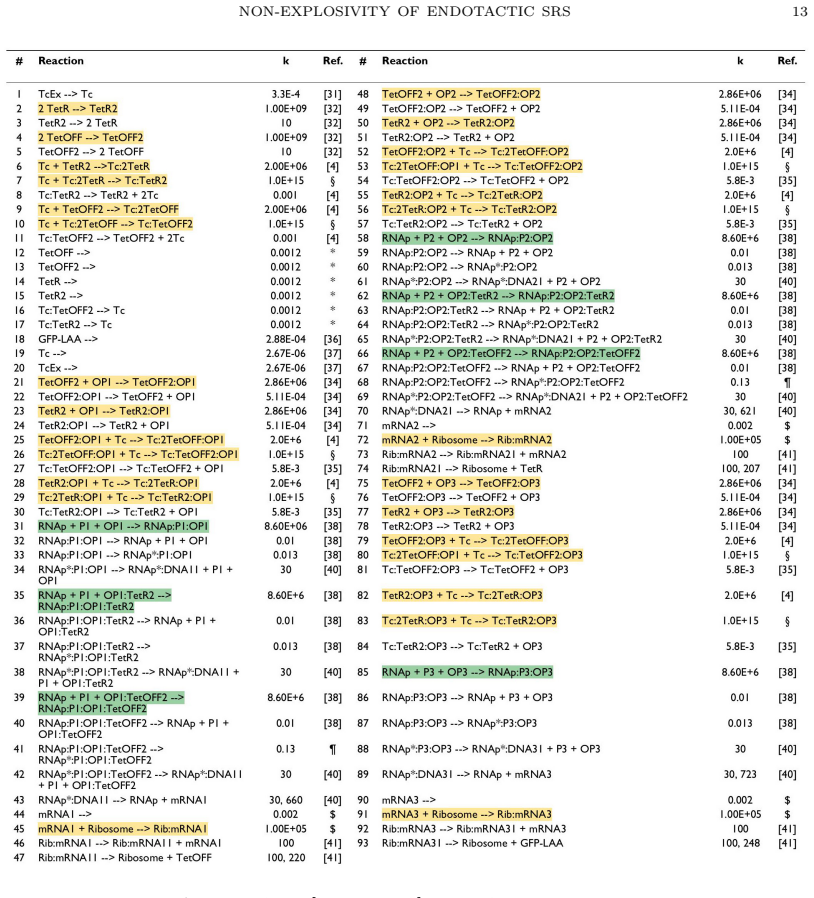
Reaction networks have been widely used as generic models in diverse areas of applied sciences, such as biology, chemistry, ecology, epidemiology, and computer science. A reaction network incorporating noisy effects is modeled as a continuous time Markov chain (CTMC) and is called a stochastic reaction system. In contrast, the mean field limit of a sequence of volume-scaled stochastic reaction systems as the volume tends to infinity is modeled as an ordinary differential equation (ODE) and is called a deterministic reaction system. Non-explosivity of CTMCs and global existence of solutions of ODEs capture the regularity of respective dynamical processes. In this paper, we study the regularity of reaction systems, in both stochastic and deterministic senses. By constructing a simple linear Lyapunov function, we obtain the regularity in both sense for a class of reaction systems in terms of a simple checkable condition. As an application, we prove that (i) every second-order endotactic mass-action system is regular, and hence (ii) every bimolecular weakly reversible mass-action system is regular. We apply our results to diverse models in biochemistry, epidemiology, ecology, synthetic biology, and natural computing in the literature.
Editorial analysis
A structured set of objections, weighed in public.
Referee Report
Summary. The manuscript claims that regularity (non-explosion of the CTMC and global existence for the ODE) for reaction systems can be established via a linear Lyapunov function V(x) = w · x whose drift satisfies the linear growth bound w · f(x) ≤ K(1 + V(x)). This yields a checkable structural condition on the reaction network. As an application, every second-order endotactic mass-action system satisfies the condition and is therefore regular, which implies that every bimolecular weakly reversible mass-action system is regular. The results are illustrated on models from biochemistry, epidemiology, ecology, synthetic biology, and natural computing.
Significance. If the central construction holds, the paper supplies a unified, parameter-free criterion that simultaneously guarantees well-posedness for both the deterministic and stochastic models of a reaction network. The fact that the same algebraic object (the linear Lyapunov function) controls both the ODE comparison argument and the Foster–Lyapunov non-explosion criterion for the CTMC is a clear technical strength. The verification that the endotactic sign pattern on quadratic terms guarantees the required bound on the drift, without any fitting of parameters, adds concrete value for applied modelers.
minor comments (4)
- [Title] Title: 'Regulary' is a typographical error and should read 'Regularity'.
- [Abstract] Abstract, line 8: 'regularity in both sense' should be 'regularity in both senses'.
- [Abstract] Abstract, final sentence: the claim that the results are applied to 'diverse models in the literature' is stated without naming any concrete networks or citing the relevant sections; a brief parenthetical list of the models treated in §5 would improve clarity.
- [§3] The manuscript repeatedly refers to 'the checkable condition' without an explicit numbered definition or algorithm; placing the precise statement of the condition in a displayed box or numbered definition would make the main theorem easier to apply.
Simulated Author's Rebuttal
We thank the referee for the positive summary and significance assessment, and for recommending minor revision. The report highlights the unified linear Lyapunov approach for both CTMC non-explosion and ODE global existence, which aligns with the manuscript's contribution.
Circularity Check
No significant circularity; derivation is self-contained
full rationale
The paper constructs a linear Lyapunov function V(x) = w · x directly from the reaction network and verifies the drift bound w · f(x) ≤ K(1 + V(x)) from a checkable condition on the network structure. This bound is then used with standard comparison theorems for ODE global existence and Foster-Lyapunov for CTMC non-explosion. The application to endotactic systems follows by direct verification that the endotactic sign pattern satisfies the condition. No step reduces by definition, by fitting, or by self-citation chain to its own inputs; the argument is a direct algebraic proof.
Axiom & Free-Parameter Ledger
axioms (1)
- domain assumption Existence of a linear Lyapunov function whose generator drift admits an upper bound sufficient to prevent explosion.
Lean theorems connected to this paper
-
IndisputableMonolith/Cost/FunctionalEquation.leanwashburn_uniqueness_aczel unclear?
unclearRelation between the paper passage and the cited Recognition theorem.
By constructing a simple linear Lyapunov function, we obtain the regularity in both sense for a class of reaction systems in terms of a simple checkable condition.
-
IndisputableMonolith/Foundation/RealityFromDistinction.leanreality_from_one_distinction unclear?
unclearRelation between the paper passage and the cited Recognition theorem.
every second-order endotactic mass-action system is regular
What do these tags mean?
- matches
- The paper's claim is directly supported by a theorem in the formal canon.
- supports
- The theorem supports part of the paper's argument, but the paper may add assumptions or extra steps.
- extends
- The paper goes beyond the formal theorem; the theorem is a base layer rather than the whole result.
- uses
- The paper appears to rely on the theorem as machinery.
- contradicts
- The paper's claim conflicts with a theorem or certificate in the canon.
- unclear
- Pith found a possible connection, but the passage is too broad, indirect, or ambiguous to say the theorem truly supports the claim.
Forward citations
Cited by 2 Pith papers
-
Perron-Volterra Lyapunov functions and competitive exclusion partitions in n-strain models with diagonal Metzler transversal Jacobian and rank-one blocks
A new Perron-Volterra Lyapunov construction unifies stability proofs for rank-one epidemic models and establishes the competitive exclusion partition property for two-strain cases.
-
Perron-Volterra Lyapunov functions and competitive exclusion partitions in n-strain models with diagonal Metzler transversal Jacobian and rank-one blocks
Proves parameter-space partitions into regions with unique stable equilibria in n-strain models via explicit Perron-Volterra Lyapunov functions for boundary and coexistence equilibria.
Reference graph
Works this paper leans on
-
[1]
Seemingly stable chemical kinetics can be stable, marginally stable, or unstable
Andrea Agazzi and Jonathan C Mattingly. Seemingly stable chemical kinetics can be stable, marginally stable, or unstable. Communications in Mathematical Sciences , 18(6):1605–1642, 2018
work page 2018
-
[2]
David F Anderson, Daniele Cappelletti, and Jinsu Kim. Stochastically modeled weakly reversible reaction networks with a single linkage class.Journal of Applied Probability, 57(3):792–810, 2020
work page 2020
-
[3]
Tier structure of stronglyendotacticreactionnetworks
David F Anderson, Daniele Cappelletti, Jinsu Kim, and Tung D Nguyen. Tier structure of stronglyendotacticreactionnetworks. Stochastic Processes and their Applications, 130(12):7218– 7259, 2020
work page 2020
-
[4]
Non- explosivity of stochastically modeled reaction networks that are complex balanced
David F Anderson, Daniele Cappelletti, Masanori Koyama, and Thomas G Kurtz. Non- explosivity of stochastically modeled reaction networks that are complex balanced. Bulletin 14 CHUANG XU of Mathematical Biology, 80:2561–2579, 2018
work page 2018
-
[5]
Product-form stationary dis- tributions for deficiency zero chemical reaction networks
David F Anderson, Gheorghe Craciun, and Thomas G Kurtz. Product-form stationary dis- tributions for deficiency zero chemical reaction networks. Bulletin of Mathematical Biology , 72:1947–1970, 2010
work page 1947
-
[6]
David F Anderson and Jinsu Kim. Some network conditions for positive recurrence of stochastic- ally modeled reaction networks.SIAM Journal on Applied Mathematics , 78(5):2692–2713, 2018
work page 2018
-
[7]
Mixingtimesfortwoclassesofstochasticallymodeledreaction networks
DavidFAndersonandJinsuKim. Mixingtimesfortwoclassesofstochasticallymodeledreaction networks. Mathematical Biosciences and Engineering , 20(3):4690–4713, 2023
work page 2023
-
[8]
Continuous time Markov chain models for chemical reaction networks
David F Anderson and Thomas G Kurtz. Continuous time Markov chain models for chemical reaction networks. In Design and analysis of biomolecular circuits: engineering approaches to systems and synthetic biology , pages 3–42. Springer, 2011
work page 2011
-
[9]
Results on stochastic reaction networks with non-mass action kinetics
David F Anderson and Tung D Nguyen. Results on stochastic reaction networks with non-mass action kinetics. Mathematical Biosciences and Engineering , 16:2118–2140, 2019
work page 2019
-
[10]
Stochastic Turing patterns in the Brusselator model
Tommaso Biancalani, Duccio Fanelli, and Francesca Di Patti. Stochastic Turing patterns in the Brusselator model. Physical Review E-Statistical, Nonlinear, and Soft Matter Physics , 81(4):046215, 2010
work page 2010
-
[11]
Stationary distributions of systems with discreteness-inducedtransitions
Enrico Bibbona, Jinsu Kim, and Carsten Wiuf. Stationary distributions of systems with discreteness-inducedtransitions. Journal of The Royal Society Interface, 17(168):20200243, 2020
work page 2020
-
[12]
General Chemistry: The Essenstial Concepts
Raymond Chang. General Chemistry: The Essenstial Concepts . McGraw-Hill, 5th edition, 2006
work page 2006
-
[13]
Persistence and permanence of mass- actionandpower-lawdynamicalsystems
Gheorghe Craciun, Fedor Nazarov, and Casian Pantea. Persistence and permanence of mass- actionandpower-lawdynamicalsystems. SIAM Journal on Applied Mathematics, 73(1):305–329, 2013
work page 2013
-
[14]
Stewart N Ethier and Thomas G Kurtz.Markov Processes: Characterization and Convergence . John Wiley & Sons, 2009
work page 2009
-
[15]
Fan, Jinsu Kim, and Chaojie Yuan
Wai-Tong L. Fan, Jinsu Kim, and Chaojie Yuan. Boundary-induced slow mixing for Markov chains and its application to stochastic reaction networks.arXiv:2407.12166, 2024
-
[16]
Chemical reaction network structure and the stability of complex isothermal reactors-I
Martin Feinberg. Chemical reaction network structure and the stability of complex isothermal reactors-I. The deficiency zero and deficiency one theorems. Chemical Engineering Science , 42(10):2229–2268, 1987
work page 1987
-
[17]
Foundations of Chemical Reaction Network Theory
Martin Feinberg. Foundations of Chemical Reaction Network Theory . Springer Science & Busi- ness Media, 2019
work page 2019
-
[18]
Dynamics of open chemical systems and the algebraic structure of the underlying reaction network
Martin Feinberg and Friedrich JM Horn. Dynamics of open chemical systems and the algebraic structure of the underlying reaction network. Chemical Engineering Science , 29(3):775–787, 1974
work page 1974
-
[19]
Modeling the kinetics of bimolecular reactions.Chemical Reviews, 106(11):4518–4584, 2006
Antonio Fernández-Ramos, James A Miller, Stephen J Klippenstein, and Donald G Truhlar. Modeling the kinetics of bimolecular reactions.Chemical Reviews, 106(11):4518–4584, 2006
work page 2006
-
[20]
Oscillations in chemical systems
Richard J Field, Endre Körös, and Richard M Noyes. Oscillations in chemical systems. II. Thorough analysis of temporal oscillation in the bromate-cerium-malonic acid system.Journal of the American Chemical Society , 94(25):8649–8664, 1972
work page 1972
-
[21]
Oscillations in chemical systems
Richard J Field and Richard M Noyes. Oscillations in chemical systems. IV. Limit cycle behavior in a model of a real chemical reaction.The Journal of Chemical Physics , 60(5):1877–1884, 1974
work page 1974
-
[22]
Three steady state situation in an open chemical reaction system
W Geiseler and H H Föllner. Three steady state situation in an open chemical reaction system. I. Biophysical Chemistry, 6(2):107–115, 1977
work page 1977
-
[23]
A geometric approach to the global attractor conjecture
Manoj Gopalkrishnan, Ezra Miller, and Anne Shiu. A geometric approach to the global attractor conjecture. SIAM Journal on Applied Dynamical Systems , 13(2):758–797, 2014
work page 2014
-
[24]
Ankit Gupta, Corentin Briat, and Mustafa Khammash. A scalable computational framework for establishing long-term behavior of stochastic reaction networks.PLoS Computational Biology , 10(6):e1003669, 2014
work page 2014
-
[25]
Ankit Gupta and Mustafa Khammash. Computational identification of irreducible state-spaces for stochastic reaction networks.SIAM Journal on Applied Dynamical Systems , 17(2):1213–1266, 2018
work page 2018
-
[26]
Ankit Gupta, Andreas Milias-Argeitis, and Mustafa Khammash. Dynamic disorder in simple enzymatic reactions induces stochastic amplification of substrate.Journal of The Royal Society Interface, 14(132):20170311, 2017
work page 2017
-
[27]
Mads C Hansen, Carsten Wiuf, and Chuang Xu. Stationary measures of continuous time Markov chains with applications to stochastic reaction networks.arXiv:2312.06186, 2023. NON-EXPLOSIVITY OF ENDOTACTIC SRS 15
-
[28]
Thetheoryofoscillatingreactions-kineticssymposium
JosephHiggins. Thetheoryofoscillatingreactions-kineticssymposium. Industrial & Engineering Chemistry, 59(5):18–62, 1967
work page 1967
-
[29]
Squeezing stationary distributions of stochastic chemical reaction systems
Yuji Hirono and Ryo Hanai. Squeezing stationary distributions of stochastic chemical reaction systems. Journal of Statistical Physics , 190(4):86, 2023
work page 2023
-
[30]
Hyukpyo Hong, Bryan S Hernandez, Jinsu Kim, and Jae K Kim. Computational translation framework identifies biochemical reaction networks with special topologies and their long-term dynamics. SIAM Journal on Applied Mathematics , 83(3):1025–1048, 2023
work page 2023
-
[31]
Hyukpyo Hong, Jinsu Kim, M Ali Al-Radhawi, Eduardo D Sontag, and Jae K Kim. Deriva- tion of stationary distributions of biochemical reaction networks via structure transformation. Communications Biology, 4(1):620, 2021
work page 2021
-
[32]
Necessary and sufficient conditions for complex balancing in chemical kinetics
Fritz Horn. Necessary and sufficient conditions for complex balancing in chemical kinetics. Archive for Rational Mechanics and Analysis , 49(3):172–186, 1972
work page 1972
-
[33]
Futile cycles revisited: a Markov chain model of simultaneous glycolysis and gluconeogenesis
M E Jones, M N Berry, and J W Phillips. Futile cycles revisited: a Markov chain model of simultaneous glycolysis and gluconeogenesis. Journal of theoretical biology , 217(4):509–523, 2002
work page 2002
-
[34]
Minjoon Kim and Jinsu Kim. A path method for non-exponential ergodicity of Markov chains and its application for chemical reaction systems.arXiv:2402.05343, 2024
-
[35]
Juan Kuntz, Philipp Thomas, Guy-Bart Stan, and Mauricio Barahona. Stationary distributions of continuous-time Markov chains: a review of theory and truncation-based approximations. SIAM Review, 63(1):3–64, 2021
work page 2021
-
[36]
V. Kuzovkov and E. Kotomin. Kinetics of bimolecular reactions in condensed media: critical phenomena and microscopic self-organisation.Reports on Progress in Physics, 51(12):1479, 1988
work page 1988
-
[37]
A scaling approach to stochastic chemical reaction net- works
Lucie Laurence and Philippe Robert. A scaling approach to stochastic chemical reaction net- works. arXiv:2310.01949, 2023
-
[38]
Erel Levine and Terence Hwa. Stochastic fluctuations in metabolic pathways.Proceedings of the National Academy of Sciences , 104(22):9224–9229, 2007
work page 2007
-
[39]
Undamped oscillations derived from the law of mass action
Alfred J Lotka. Undamped oscillations derived from the law of mass action. Journal of the American Chemical Society, 42(8):1595–1599, 1920
work page 1920
-
[40]
Stochastic approach to chemical kinetics.Journal of Applied Probability , 4(3):413–478, 1967
Donald A McQuarrie. Stochastic approach to chemical kinetics.Journal of Applied Probability , 4(3):413–478, 1967
work page 1967
-
[41]
Mikhail Menshikov and Dimitri Petritis. Explosion, implosion, and moments of passage times for continuous-time Markov chains: a semimartingale approach.Stochastic Processes and Their Applications, 124(7):2388–2414, 2014
work page 2014
-
[42]
Sean P Meyn and Richard L Tweedie. Stability of Markovian processes III: Foster–Lyapunov criteria for continuous-time processes.Advances in Applied Probability, 25(3):518–548, 1993
work page 1993
-
[43]
Springer Science & Business Media, 2009
Sean P Meyn and Richard L Tweedie.Markov Chains and Stochastic Stability . Springer Science & Business Media, 2009
work page 2009
-
[44]
Stefan Müller, Christoph Flamm, and Peter F Stadler. What makes a reaction network “chem- ical”?Journal of Cheminformatics , 14(1):63, 2022
work page 2022
-
[45]
Number 2 in Cambridge Series in Statistical and Probabilistic Mathematics
James R Norris.Markov Chains. Number 2 in Cambridge Series in Statistical and Probabilistic Mathematics. Cambridge University Press, 1998
work page 1998
-
[46]
Oscillatory kinetics of the peroxidase-oxidase reaction in an open system
Lars F Olsen and Hans Degn. Oscillatory kinetics of the peroxidase-oxidase reaction in an open system. Experimental and theoretical studies. Biochimica et Biophysica Acta (BBA)- Enzymology, 523(2):321–334, 1978
work page 1978
-
[47]
Casian Pantea. On the persistence and global stability of mass-action systems.SIAM Journal on Mathematical Analysis, 44(3):1636–1673, 2012
work page 2012
-
[48]
Global injectivity and multiple equilibria in uni-and bi-molecular reaction networks.Discrete Contin
Casian Pantea, Heinz Koeppl, and Gheorghe Craciun. Global injectivity and multiple equilibria in uni-and bi-molecular reaction networks.Discrete Contin. Dyn. Syst. Ser. B , 17(6):2153–2170, 2012
work page 2012
-
[49]
Dynamical properties of discrete reaction networks
Loïc Paulevé, Gheorghe Craciun, and Heinz Koeppl. Dynamical properties of discrete reaction networks. Journal of Mathematical Biology , 69:55–72, 2014
work page 2014
-
[50]
Vassilios Sotiropoulos and Yiannis N Kaznessis. Synthetic tetracycline-inducible regulatory net- works: computer-aided design of dynamic phenotypes.BMC systems biology , 1:1–18, 2007
work page 2007
-
[51]
Mechanisms of noise- resistance in genetic oscillators
José MG Vilar, Hao Y Kueh, Naama Barkai, and Stanislas Leibler. Mechanisms of noise- resistance in genetic oscillators. Proceedings of the National Academy of Sciences , 99(9):5988– 5992, 2002. 16 CHUANG XU
work page 2002
-
[52]
Théorie mathématique de la lutte pour la vie
Vito Volterra. Théorie mathématique de la lutte pour la vie . Gauthiers-Villars, 1931
work page 1931
-
[53]
Classification and threshold dynamics of stochastic reaction networks
Carsten Wiuf and Chuang Xu. Classification and threshold dynamics of stochastic reaction networks. arXiv:2012.07954, 2020
-
[54]
Any stochastic reaction network has a stationary measure
Carsten Wiuf and Chuang Xu. Any stochastic reaction network has a stationary measure. arXiv:2312.07590, 2023
-
[55]
Global stability of first order endotactic reaction systems.arXiv preprint arXiv:2409.01598, 2024
Chuang Xu. Global stability of first order endotactic reaction systems.arXiv:2409.01598, 2024
-
[56]
Chuang Xu, Mads C Hansen, and Carsten Wiuf. Structural classification of continuous time Markov chains with applications.Stochastics, 94(7):1003–1030, 2022
work page 2022
-
[57]
Chuang Xu, Mads C Hansen, and Carsten Wiuf. Full classification of dynamics for one- dimensional continuous-time Markov chains with polynomial transition rates.Advances in Ap- plied Probability, 55(1):321–355, 2023. Appendix A. Drift criteria for non-explosivity Proposition A.1. [42, Theorem 2.1] LetXt be a CTMC on an infinite state spaceX ⊆Zd. Assume the...
work page 2023
discussion (0)
Sign in with ORCID, Apple, or X to comment. Anyone can read and Pith papers without signing in.