REVIEW 2 major objections 1 minor 20 references
Global and Distributed Reproduction Numbers of a Multilayer SIR Model with an Infrastructure Network
T0 review · 2 major / 1 minor · reviewed 2026-05-23 · grok-4.3
Pith's one-line read In a multilayer SIR model with coupled population and infrastructure networks, distributed reproduction numbers at each node give more accurate local and global thresholds for infection spread than the single global effective reproduction
desk verdict The paper defines node-level distributed reproduction numbers for a coupled SIR-infrastructure model and claims they beat the global effective reproduction number, but that edge rests on one specific unvalidated interlayer coupling. read the letter →
The pith
A machine-rendered reading of the paper's core claim, the machinery that carries it, and where it could break.
The reading
What carries the argument
Distributed reproduction numbers (DRNs) at each node, which act as local thresholds and enable prediction of global dynamics from local conditions in the coupled networks.
What would settle it
A simulation or empirical data set in which the global effective reproduction number and the distributed reproduction numbers disagree on whether the infection will grow or on the timing of peaks.
Extended reading notes
Core claim
The authors establish that distributed reproduction numbers of each node in the multilayer network provide local threshold conditions for the dynamical behavior of each entity and can be leveraged to predict the global behavior based on node-level assumptions, yielding a more accurate analysis of the networked spreading process than the global effective reproduction number.
Load-bearing premise
The specific form of coupling between the population SIR dynamics and the infrastructure pathogen layer is assumed to hold without additional validation against real data or alternative coupling structures.
Editorial analysis
A structured set of objections, weighed in public.
Referee Report
Summary. The paper proposes an SIR spread model on a population network coupled to an infrastructure network in which pathogens also spread. It derives a threshold condition based on the global (network-wide) effective reproduction number that characterizes monotonicity and peak time of a weighted average of the infection states. It further defines distributed reproduction numbers (DRNs) at each node that supply local threshold conditions for the dynamical behavior of individual entities and that are then used to predict global behavior from node-level assumptions. Both analytical derivations and simulations are presented to argue that the DRNs yield a more accurate analysis of the networked spreading process than the single global effective reproduction number.
Significance. If the central claims hold under the stated model, the introduction of node-level DRNs that aggregate to improved global predictions would constitute a useful refinement for threshold analysis in multilayer epidemic models. The combination of analytical threshold conditions with simulation comparisons is a positive feature. The practical significance remains conditional on the validity of the interlayer coupling, which is treated as given rather than tested against data or alternative functional forms.
major comments (2)
- [Abstract] Abstract: the claim that DRNs permit a more accurate analysis than the global effective reproduction number is demonstrated only under one specific coupling structure between the population SIR dynamics and the infrastructure pathogen layer. No sensitivity analysis with respect to alternative incidence functions, directed vs. undirected infrastructure edges, or node-specific multipliers is reported, so the superiority result inherits the same untested assumption.
- [Model construction and threshold derivations] Model construction and threshold derivations (sections defining the interlayer interaction): both the analytical local/global threshold conditions and the simulation comparisons rest on the same fixed interlayer coupling. If this coupling is misspecified, the node-level DRN thresholds lose their claimed advantage and the global R may perform comparably or better; this is load-bearing for the central comparative claim.
minor comments (1)
- Notation: the distinction between the global effective reproduction number and the per-node DRNs should be made explicit in the first appearance of each symbol to avoid reader confusion.
Simulated Author's Rebuttal
We thank the referee for the thoughtful comments on our manuscript. We address each major comment below.
read point-by-point responses
-
Referee: [Abstract] Abstract: the claim that DRNs permit a more accurate analysis than the global effective reproduction number is demonstrated only under one specific coupling structure between the population SIR dynamics and the infrastructure pathogen layer. No sensitivity analysis with respect to alternative incidence functions, directed vs. undirected infrastructure edges, or node-specific multipliers is reported, so the superiority result inherits the same untested assumption.
Authors: The interlayer coupling is an integral part of the proposed multilayer model, chosen to represent pathogen transmission through infrastructure networks interacting with population SIR dynamics. The DRNs are defined and analyzed specifically for this structure, with both the threshold conditions and simulations derived consistently from it. The abstract claim is scoped to the model under consideration and does not assert superiority for arbitrary couplings. While sensitivity analyses could be valuable extensions, they lie outside the scope of the present work, which introduces the DRN framework and demonstrates its properties within the stated model. revision: no
-
Referee: [Model construction and threshold derivations] Model construction and threshold derivations (sections defining the interlayer interaction): both the analytical local/global threshold conditions and the simulation comparisons rest on the same fixed interlayer coupling. If this coupling is misspecified, the node-level DRN thresholds lose their claimed advantage and the global R may perform comparably or better; this is load-bearing for the central comparative claim.
Authors: The model construction, including the interlayer interaction, is explicitly stated and forms the basis for all derivations. The DRNs provide local threshold conditions that aggregate to global predictions under these assumptions, offering finer resolution than the single global reproduction number for the networked process. If the coupling were altered, the model equations would change and the DRNs would be redefined accordingly; the paper does not claim results independent of the model assumptions. The comparative advantage is shown analytically and via simulation for the given multilayer setup, consistent with the manuscript's focus. revision: no
Circularity Check
No significant circularity; DRN definitions and thresholds derive independently from model equations
full rationale
The paper constructs a multilayer SIR model with explicit interlayer coupling, then defines global effective reproduction number and node-level DRNs directly from the resulting system of differential equations. Threshold conditions for monotonicity, peak time, and local/global behavior follow as standard next-generation matrix or Lyapunov analyses applied to those equations. Simulations compare DRN-based local thresholds against the single global quantity under the same assumed dynamics; this is a consistency check, not a reduction of the claimed superiority to a fitted parameter or self-citation. No self-definitional loop, fitted-input-as-prediction, or load-bearing self-citation is exhibited in the provided abstract or skeptic summary. The coupling form is an explicit modeling assumption whose validity is external to the derivation chain.
Assumptions & free parameters
assumptions (2)
- domain assumption Standard SIR compartmental dynamics hold in each layer
- domain assumption The coupling between population and infrastructure layers follows the form stated in the model
Cite this review
Pith. "Pith review of Global and Distributed Reproduction Numbers of a Multilayer SIR Model with an Infrastructure Network." pith.science (2026). https://pith.science/paper/2409.08430
@misc{pith2026240908430,
  author       = {Pith},
  title        = {Pith review of: Global and Distributed Reproduction Numbers of a Multilayer SIR Model with an Infrastructure Network},
  year         = {2026},
  howpublished = {\url{https://pith.science/paper/2409.08430}},
  note         = {Machine review of arXiv:2409.08430}
}
read the original abstract
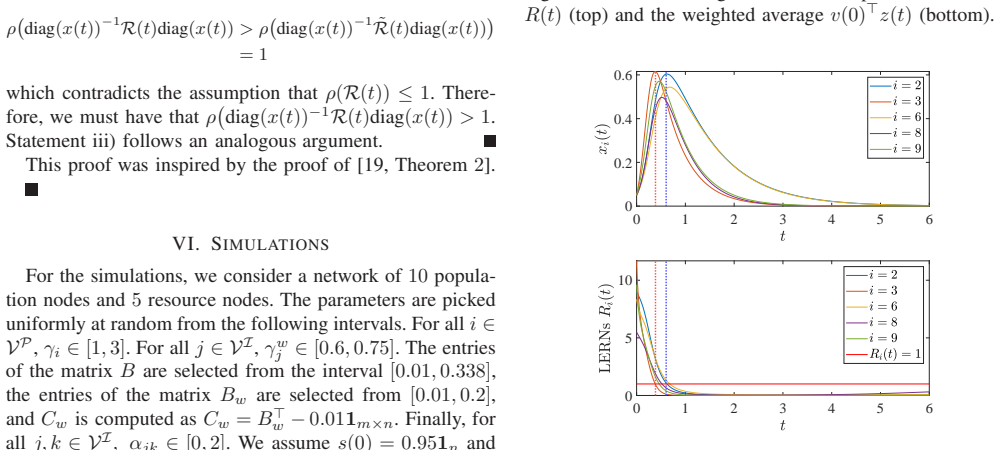
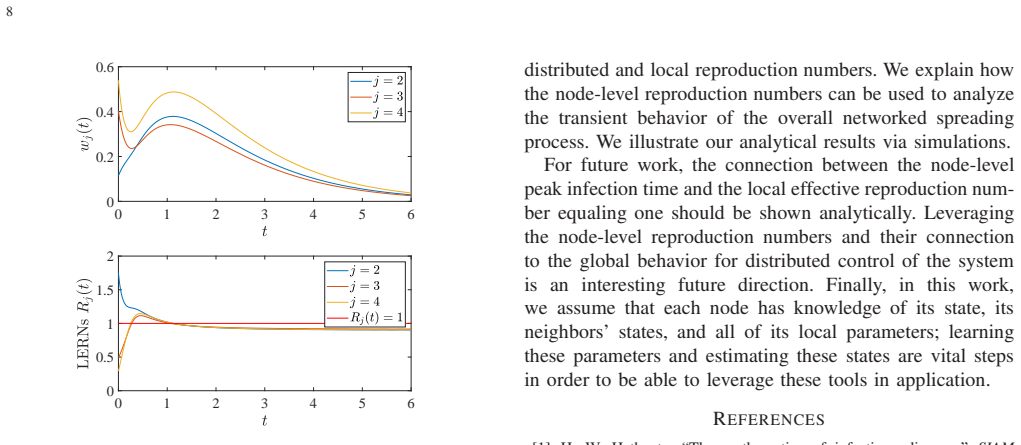
In this paper, we propose an SIR spread model in a population network coupled with an infrastructure network that has a pathogen spreading in it. We develop a threshold condition to characterize the monotonicity and peak time of a weighted average of the infection states in terms of the global (network-wide) effective reproduction number. We further define the distributed reproduction numbers (DRNs) of each node in the multilayer network which are used to provide local threshold conditions for the dynamical behavior of each entity. Furthermore, we leverage the DRNs to predict the global behavior based on the node-level assumptions. We use both analytical and simulation results to illustrate that the DRNs allow a more accurate analysis of the networked spreading process than the global effective reproduction number.
Figures

Figures from the paper (1 more)

Reference graph
Works this paper leans on
-
[1]
The mathematics of infectious diseases ,
H. W. Hethcote, “The mathematics of infectious diseases ,” SIAM Review, vol. 42, no. 4, pp. 599–653, 2000
work page 2000
-
[2]
Modeling, estimat ion, and analysis of epidemics over networks: An overview,
P . E. Par´ e, C. L. Beck, and T. Bas ¸ar, “Modeling, estimat ion, and analysis of epidemics over networks: An overview,” Annual Reviews in Control, vol. 50, pp. 345–360, 2020
work page 2020
-
[3]
On the d ynamics of deterministic epidemic propagation over networks,
W. Mei, S. Mohagheghi, S. Zampieri, and F. Bullo, “On the d ynamics of deterministic epidemic propagation over networks,” Annual Reviews in Control, vol. 44, pp. 116–128, 2017
work page 2017
-
[4]
SARS-CoV-2 RNA in wastewater anticipated COVID-19 occurrence in a low prevalence area,
W. Randazzo, P . Truchado, E. Cuevas-Ferrando, P . Sim ´ on , A. Al- lende, and G. S´ anchez, “SARS-CoV-2 RNA in wastewater anticipated COVID-19 occurrence in a low prevalence area,” W ater Research, vol. 181, p. 115942, 2020
work page 2020
-
[5]
Ad vancing waterborne pathogen modelling: Lessons from global nutrie nt export models,
L. C. V ermeulen, N. Hofstra, C. Kroeze, and G. Medema, “Ad vancing waterborne pathogen modelling: Lessons from global nutrie nt export models,” Current Opinion in Environmental Sustainability, vol. 14, pp. 109–120, 2015
work page 2015
-
[6]
D. Vrabac, M. Shang, B. Butler, J. Pham, R. Stern, and P . E. Par´ e, “Capturing the effects of transportation on the spread of CO VID- 19 with a multi-networked SEIR model,” in Proc. American Control Conference (ACC), 2021, pp. 3152–3157
work page 2021
-
[7]
Infection prevention in a connected wo rld: The case for a regional approach,
M. Ciccolini, T. Donker, R. K¨ ock, M. Mielke, R. Hendrix, A. Jurke, J. Rahamat-Langendoen, K. Becker, H. G. Niesters, H. Grundm ann, and A. W. Friedrich, “Infection prevention in a connected wo rld: The case for a regional approach,” International Journal of Medical Microbiology, vol. 303, no. 6, pp. 380–387, 2013, special Issue Antibiotic Resistance
work page 2013
-
[8]
Multiple transmission pathw ays and disease dynamics in a waterborne pathogen model,
J. H. Tien and D. J. D. Earn, “Multiple transmission pathw ays and disease dynamics in a waterborne pathogen model,” Bulletin of Mathematical Biology , vol. 72, no. 6, pp. 1506–1533, Aug. 2010
work page 2010
Show all 20 references
-
[9]
Global dynamics of cho lera models with differential infectivity,
Z. Shuai and P . van den Driessche, “Global dynamics of cho lera models with differential infectivity,” Mathematical Biosciences , vol. 234, no. 2, pp. 118–126, 2011
2011
-
[10]
A networked SIS dis ease dynamics model with a waterborne pathogen,
J. Liu, P . E. Par´ e, E. Du, and Z. Sun, “A networked SIS dis ease dynamics model with a waterborne pathogen,” in Proc. American Control Conference (ACC) , 2019, pp. 2735–2740
2019
-
[11]
Multilayer SIS model with an infrastructure ne twork,
P . E. Par´ e, A. Janson, S. Gracy, J. Liu, H. Sandberg, and K. H. Johansson, “Multilayer SIS model with an infrastructure ne twork,” IEEE Transactions on Control of Network Systems , vol. 10, no. 1, pp. 295–307, 2023
2023
-
[12]
Peak infection time for a networked SIR epidemic with opinion dynamics,
B. She, H. C. H. Leung, S. Sundaram, and P . E. Par´ e, “Peak infection time for a networked SIR epidemic with opinion dynamics,” in Proc. 60th IEEE Conference on Decision and Control (CDC) , 2021, pp. 2104–2109
2021
-
[13]
On a network ed SIS epidemic model with cooperative and antagonistic opinion d ynamics,
B. She, J. Liu, S. Sundaram, and P . E. Par´ e, “On a network ed SIS epidemic model with cooperative and antagonistic opinion d ynamics,” IEEE Transactions on Control of Network Systems , vol. 9, no. 3, pp. 1154–1165, 2022
2022
-
[14]
Reproduction numbers of infecti ous disease models,
P . van den Driessche, “Reproduction numbers of infecti ous disease models,” Infectious Disease Modelling , vol. 2, no. 3, pp. 288–303, 2017
2017
-
[15]
Analysis, prediction, and control o f epidemics: A survey from scalar to dynamic network models,
L. Zino and M. Cao, “Analysis, prediction, and control o f epidemics: A survey from scalar to dynamic network models,” IEEE Circuits and Systems Magazine , vol. 21, no. 4, pp. 4–23, 2021
2021
-
[16]
Analysis a nd control of epidemics: A survey of spreading processes on complex net works,
C. Nowzari, V . M. Preciado, and G. J. Pappas, “Analysis a nd control of epidemics: A survey of spreading processes on complex net works,” IEEE Control Systems Magazine , vol. 36, no. 1, pp. 26–46, 2016. 9
2016
-
[17]
Analysis and control of a continuous-time bi-virus model,
J. Liu, P . E. Par´ e, A. Nedi´ c, C. Y . Tang, C. L. Beck, and T . Bas ¸ar, “Analysis and control of a continuous-time bi-virus model, ” IEEE Transactions on Automatic Control , vol. 64, no. 12, pp. 4891–4906, 2019
2019
-
[18]
Multi-co mpetitive virus spread over a time-varying networked SIS model with an infrastructure network,
S. Gracy, Y . Wang, P . E. Par´ e, and C. A. Uribe, “Multi-co mpetitive virus spread over a time-varying networked SIS model with an infrastructure network,” IF AC-PapersOnLine, vol. 56, no. 2, pp. 19–24, 2023
2023
-
[19]
Distributed reproduct ion numbers of networked epidemics,
B. She, P . E. Par´ e, and M. Hale, “Distributed reproduct ion numbers of networked epidemics,” in Proc. American Control Conference (ACC) , 2023, pp. 4302–4307
2023
-
[20]
R. S. V arga, Matrix Iterative Analysis . Springer Berlin, Heidelberg, 2000, ch. 2
2000
Reviewed May 23, 2026 · model on record in the stance chip above.
Discussion (0). Sign in to comment.