Model-independent searches of new physics in DARWIN with a semi-supervised deep learning pipeline
Pith reviewed 2026-05-23 20:09 UTC · model grok-4.3
The pith
A variational autoencoder and classifier pipeline detects anomalous events in DARWIN detector data more effectively than traditional likelihood tests.
A machine-rendered reading of the paper's core claim, the machinery that carries it, and where it could break.
Core claim
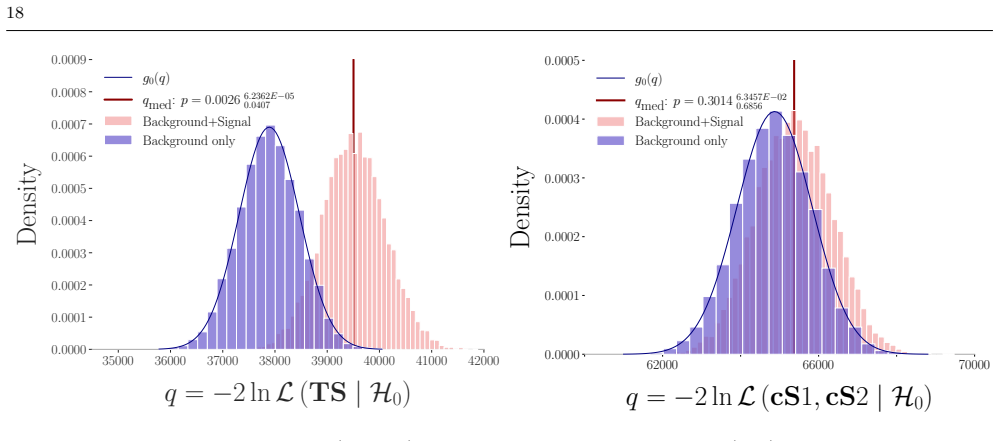
The neural networks learn relevant energy features of the events from low-level, high-dimensional detector outputs, without the need to compress this data into lower-dimensional observables, and the resulting anomaly score rejects the background-only hypothesis more powerfully than the classical likelihood-based background rejection test in the presence of an injected WIMP signal.
What carries the argument
A variational autoencoder combined with a classifier that produces a one-dimensional anomaly score optimized for rejecting the background-only hypothesis.
If this is right
- The approach enables model-independent searches for new physics in DARWIN data.
- It eliminates the need for many corrections and cuts in the analysis chain.
- Analysis time can be significantly reduced while achieving higher accuracy.
- The method works with extensive simulated detector response data for training.
Where Pith is reading between the lines
- Similar pipelines could be adapted for other direct detection experiments using different target materials.
- Real-time anomaly detection during data taking might become feasible with this end-to-end approach.
- The reduction in information loss from avoiding compression could improve sensitivity to unexpected signals beyond WIMPs.
Load-bearing premise
The simulated detector responses used for training accurately represent the real DARWIN experiment and the possible new physics signals.
What would settle it
Applying the trained anomaly score to real DARWIN data containing known injected signals and verifying whether it still outperforms the likelihood method or if performance drops due to mismatches between simulation and reality.
Figures



read the original abstract
We present a novel deep learning pipeline to perform a model-independent, likelihood-free search for anomalous (i.e., non-background) events in the proposed next generation multi-ton scale liquid Xenon-based direct detection experiment, DARWIN. We train an anomaly detector comprising a variational autoencoder and a classifier on extensive, high-dimensional simulated detector response data and construct a one-dimensional anomaly score optimised to reject the background only hypothesis in the presence of an excess of non-background-like events. We benchmark the procedure with a sensitivity study that determines its power to reject the background-only hypothesis in the presence of an injected WIMP dark matter signal, outperforming the classical, likelihood-based background rejection test. We show that our neural networks learn relevant energy features of the events from low-level, high-dimensional detector outputs, without the need to compress this data into lower-dimensional observables, thus reducing computational effort and information loss. For the future, our approach lays the foundation for an efficient end-to-end pipeline that eliminates the need for many of the corrections and cuts that are traditionally part of the analysis chain, with the potential of achieving higher accuracy and significant reduction of analysis time.
Editorial analysis
A structured set of objections, weighed in public.
Referee Report
Summary. The paper presents a semi-supervised deep learning pipeline using a variational autoencoder combined with a classifier, trained on high-dimensional simulated DARWIN detector responses, to construct a one-dimensional anomaly score for model-independent rejection of the background-only hypothesis. It benchmarks this score via a sensitivity study with injected WIMP signals, claiming superior performance over classical likelihood-based tests, and states that the networks learn relevant energy features directly from low-level data without compression into lower-dimensional observables.
Significance. If the outperformance claim is substantiated with full methodological details and holds under independent validation, the work could enable more efficient end-to-end analyses for next-generation direct detection experiments by reducing reliance on traditional corrections, cuts, and data compression, with potential gains in sensitivity and reduced analysis time. The simulation-based demonstration of learning from raw high-dimensional outputs is a positive step toward model-independent searches, though no machine-checked proofs or reproducible code are provided.
major comments (2)
- [Abstract] Abstract (sensitivity study description): The reported outperformance over the classical likelihood test lacks any quantitative details on the training procedure, validation splits, error estimation, or checks against overfitting to the injected signal, rendering the central benchmark claim impossible to assess for robustness.
- [Abstract] Abstract (sensitivity study description): The entire benchmark is performed inside the same simulated dataset used for training the networks, with no independent tests that the simulated waveforms and S1/S2 responses match actual DARWIN detector behavior (including unmodeled systematics) or that the anomaly score generalizes to non-WIMP signals.
Simulated Author's Rebuttal
We thank the referee for their constructive comments on our manuscript. We address each major comment below and indicate the revisions that will be incorporated.
read point-by-point responses
-
Referee: [Abstract] Abstract (sensitivity study description): The reported outperformance over the classical likelihood test lacks any quantitative details on the training procedure, validation splits, error estimation, or checks against overfitting to the injected signal, rendering the central benchmark claim impossible to assess for robustness.
Authors: We agree that the abstract would benefit from additional quantitative information to improve assessability of the benchmark. The full details on training (including dataset sizes of 10^6 background events for VAE training and 5x10^5 for the classifier, 80/20 train/validation splits, bootstrapped error estimation, and overfitting checks via separate validation loss monitoring with no signal injection during training) are provided in Sections 3.2 and 4.1. We will revise the abstract to concisely include these elements along with the reported sensitivity metrics and their uncertainties. revision: yes
-
Referee: [Abstract] Abstract (sensitivity study description): The entire benchmark is performed inside the same simulated dataset used for training the networks, with no independent tests that the simulated waveforms and S1/S2 responses match actual DARWIN detector behavior (including unmodeled systematics) or that the anomaly score generalizes to non-WIMP signals.
Authors: The study is simulation-based, as is standard for sensitivity projections of a proposed experiment like DARWIN. We will revise the text to explicitly state that evaluation uses a held-out test set drawn from the same simulation campaign but disjoint from the training data, and to discuss the simulation assumptions and potential effects of unmodeled systematics. The anomaly score is constructed to be model-independent; we will expand the discussion section to address expected generalization beyond the WIMP benchmark case. revision: partial
- Independent validation that simulated waveforms and S1/S2 responses match actual DARWIN detector behavior (including unmodeled systematics), as the experiment has not yet been constructed or operated and no real data exist.
Circularity Check
No significant circularity; benchmark is internal simulation comparison without reduction to inputs.
full rationale
The paper trains a VAE+classifier anomaly detector on background-only simulations and reports superior rejection power versus a classical likelihood test when a WIMP signal is injected into the same simulated dataset. This is a standard internal validation procedure; the reported outperformance does not reduce by construction to any fitted parameter, self-definition, or self-citation chain. No equations or steps equate the anomaly score or sensitivity result to its training inputs. External validity (simulation fidelity to real DARWIN data) is a separate assumption, not a circularity flaw. The derivation chain is self-contained against the stated simulation benchmarks.
Axiom & Free-Parameter Ledger
axioms (1)
- domain assumption Simulated high-dimensional detector response data accurately models real DARWIN behavior for both background and signal-like events
Reference graph
Works this paper leans on
-
[1]
M.W. Goodman, E. Witten, Phys. Rev. D 31, 3059 (1985). DOI 10.1103/PhysRevD.31.3059
-
[2]
Aprile, et al., JINST 9, P11006 (2014)
E. Aprile, et al., JINST 9, P11006 (2014). DOI 10.1088/ 1748-0221/9/11/P11006
work page 2014
-
[3]
D. Akerib, et al., (2015). DOI 10.1016/j.phpro.2014.12. 013
-
[4]
X. Cui, et al., Phys. Rev. Lett. 119(18), 181302 (2017). DOI 10.1103/PhysRevLett.119.181302
-
[5]
Fatemighomi, in 35th International Symposium on Physics in Collision (2016)
N. Fatemighomi, in 35th International Symposium on Physics in Collision (2016)
work page 2016
-
[6]
C. Aalseth, et al., Eur. Phys. J. Plus 133, 131 (2018). DOI 10.1140/epjp/i2018-11973-4
-
[7]
Calvo, et al., JCAP 03, 003 (2017)
J. Calvo, et al., JCAP 03, 003 (2017). DOI 10.1088/ 1475-7516/2017/03/003
work page 2017
-
[8]
Aalbers, et al., JCAP 11, 017 (2016)
J. Aalbers, et al., JCAP 11, 017 (2016). DOI 10.1088/ 1475-7516/2016/11/017
work page 2016
-
[9]
J.A. et. al, Journal of Physics G: Nuclear and Particle Physics 50(1), 013001 (2022). DOI 10.1088/1361-6471/ ac841a. URL https://dx.doi.org/10.1088/1361-6471/ ac841a
-
[10]
t (XLZD Design Book in preparation), (2024)
work page 2024
- [11]
- [12]
-
[13]
L.M. Dery, B. Nachman, F. Rubbo, A. Schwartzman, J. Phys. Conf. Ser. 1085(4), 042006 (2018). DOI 10.1088/ 1742-6596/1085/4/042006
work page 2018
-
[14]
J.H. Collins, K. Howe, B. Nachman, Phys. Rev. Lett. 121(24), 241803 (2018). DOI 10.1103/PhysRevLett.121. 241803
- [15]
- [16]
-
[17]
M. van Beekveld, S. Caron, L. Hendriks, P. Jackson, A. Leinweber, S. Otten, R. Patrick, R. Ruiz de Austri, M. Santoni, M. White, (2020)
work page 2020
-
[18]
A. Blance, M. Spannowsky, P. Waite, Journal of High En- ergy Physics 2019(10) (2019). DOI 10.1007/jhep10(2019)
-
[19]
URL http://dx.doi.org/10.1007/JHEP10(2019)047
-
[20]
Quantum machine learning for particle physics using a variational quantum classifier
A. Blance, M. Spannowsky, Journal of High Energy Physics 2021(2) (2021). DOI 10.1007/jhep02(2021)212. URL http://dx.doi.org/10.1007/JHEP02(2021)212
-
[21]
Heavy operators and hydrodynamic tails
T. Heimel, G. Kasieczka, T. Plehn, J.M. Thompson, Sci- Post Phys. 6(3), 030 (2019). DOI 10.21468/SciPostPhys. 6.3.030 22
- [22]
-
[23]
M. Kuusela, T. Vatanen, E. Malmi, T. Raiko, T. Aalto- nen, Y. Nagai, J. Phys. Conf. Ser. 368, 012032 (2012). DOI 10.1088/1742-6596/368/1/012032
-
[24]
O. Cerri, T.Q. Nguyen, M. Pierini, M. Spiropulu, J.R. Vlimant, Journal of High Energy Physics 2019(5), 36 (2019)
work page 2019
- [25]
-
[26]
A. Andreassen, B. Nachman, D. Shih, Phys. Rev. D 101(9), 095004 (2020). DOI 10.1103/PhysRevD.101. 095004
-
[27]
B. Nachman, D. Shih, Phys. Rev. D 101, 075042 (2020). DOI 10.1103/PhysRevD.101.075042
-
[28]
J.H. Collins, K. Howe, B. Nachman, Phys. Rev. D 99(1), 014038 (2019). DOI 10.1103/PhysRevD.99.014038
-
[29]
Coarasa, et al., JCAP 11, 048 (2022)
I. Coarasa, et al., JCAP 11, 048 (2022). DOI 10. 1088/1475-7516/2022/11/048. [Erratum: JCAP 06, E01 (2023)]
work page 2022
-
[30]
J. Herrero-Garcia, R. Patrick, A. Scaffidi, JCAP 02(02), 039 (2022). DOI 10.1088/1475-7516/2022/02/039
-
[31]
D.S. Akerib, others (LUX Collaboration), Physical Re- view D 106(7), 072009 (2022). URL 10.1103/PhysRevD. 106.072009
-
[32]
P. Agnes, et al., Eur. Phys. J. C 83, 322 (2023). DOI 10.1140/epjc/s10052-023-11410-4
-
[33]
E. Aprile, et al., Phys. Rev. D 108(1), 012016 (2023). DOI 10.1103/PhysRevD.108.012016
-
[34]
A.C.S. Jørgensen, A. Ghosh, M. Sturrock, V. Shahrezaei, bioRxiv (2021). DOI 10.1101/2021.10.04.462980
- [35]
-
[36]
T. Charnock, G. Lavaux, B. Wandelt, Physical Review D 97 (2018). DOI 10.1103/PhysRevD.97.083004
- [37]
- [38]
-
[39]
M.R. Lovell, N.A. Montel, A. Coogan, C.A. Correa, C. Weniger, The Astrophysical Journal 900(2), 111 (2020). DOI 10.3847/1538-4357/aba5a1
-
[40]
G. Louppe, C. Weniger. Truncated marginal neural ratio estimation - data. https://zenodo.org/record/4781662 (2021). DOI 10.5281/zenodo.4781662
-
[41]
S.J. Witte, D. Noordhuis, T.D. Edwards, C. Weniger, Progress in Particle and Nuclear Physics 130, 103961 (2022). DOI 10.1016/j.ppnp.2022.103961
-
[42]
B.K. Miller, C. Weniger, P. Forr’e, Monthly Notices of the Royal Astronomical Society 512(1), 661 (2021). DOI 10.1093/mnras/staa1577
-
[43]
MacKinlay, Dan MacKinlay’s notebook (2022)
D. MacKinlay, Dan MacKinlay’s notebook (2022)
work page 2022
-
[44]
D.J. MacKay, C. Weniger, B.M. Turner, F. Lieder, eLife 11, e77220 (2022). DOI 10.7554/eLife.77220
- [45]
-
[46]
M. Arthurs, in Conference on Science at the Sanford Under- ground Research Facility (SD Mines, South Dakota, USA, 2024). URL https://indico.sanfordlab.org/event/68/ contributions/1323/
work page 2024
-
[47]
M. Abadi, A. Agarwal, P. Barham, E. Brevdo, Z. Chen, C. Citro, G.S. Corrado, A. Davis, J. Dean, M. Devin, S. Ghemawat, I. Goodfellow, A. Harp, G. Irving, M. Is- ard, Y. Jia, R. Jozefowicz, L. Kaiser, M. Kudlur, J. Lev- enberg, D. Man´ e, R. Monga, S. Moore, D. Murray, C. Olah, M. Schuster, J. Shlens, B. Steiner, I. Sutskever, K. Talwar, P. Tucker, V. Vanh...
work page 2015
-
[48]
D. Bank, N. Koenigstein, R. Giryes. Autoencoders (2021)
work page 2021
-
[49]
Schmidhuber, Deep learning in neural networks: An overview, Neural Networks 61 (2015) 85 – 117
J. Schmidhuber, Neural Networks 61, 85 (2015). DOI 10.1016/j.neunet.2014.09.003. URL http://dx.doi.org/ 10.1016/j.neunet.2014.09.003
- [50]
- [51]
- [52]
-
[53]
I. Higgins, L. Matthey, A. Pal, C. Burgess, X. Glo- rot, M. Botvinick, S. Mohamed, A. Lerchner, in Inter- national Conference on Learning Representations (2017). URL https://openreview.net/forum?id=Sy2fzU9gl
work page 2017
-
[54]
Ostdiek, SciPost Physics 12(1) (2022)
B. Ostdiek, SciPost Physics 12(1) (2022). DOI 10.21468/ scipostphys.12.1.045. URL http://dx.doi.org/10.21468/ SciPostPhys.12.1.045
work page 2022
-
[55]
D. Mimno, D.M. Blei, B.E. Engelhardt, Proceedings of the National Academy of Sciences112(26), E3441 (2015). DOI 10.1073/pnas.1412301112. URL https://www.pnas. org/doi/abs/10.1073/pnas.1412301112
-
[56]
A. Gelman, J.B. Carlin, H.S. Stern, D.B. Dunson, A. Ve- htari, D.B. Rubin, (2013)
work page 2013
-
[57]
I. Goodfellow, Y. Bengio, A. Courville, Deep Learning (MIT Press, Cambridge, MA, 2016)
work page 2016
-
[58]
S. Agostinelli, et al., Nucl. Instrum. Meth. A 506, 250 (2003). DOI 10.1016/S0168-9002(03)01368-8
-
[59]
D. Collaboration. Cosmogenic background simulations for the darwin observatory at different underground lo- cations (2023)
work page 2023
-
[60]
M. Szydagis, et al. Nest version v2.3.12 (2018). DOI 10. 5281/zenodo.1314499. URL https://doi.org/10.5281/ zenodo.1314499
work page 2018
-
[61]
collaboration, Journal of Instrumentation 17(06), P06026 (2022)
I. collaboration, Journal of Instrumentation 17(06), P06026 (2022). DOI 10.1088/1748-0221/17/06/p06026. URL https://doi.org/10.1088%2F1748-0221%2F17%2F06% 2Fp06026
-
[62]
Extragalactic sources in Cosmic Microwave Background maps
M. Schumann, L. Baudis, L. B¨ utikofer, A. Kish, M. Selvi, Journal of Cosmology and Astroparticle Physics 2015(10), 016 (2015). DOI 10.1088/1475-7516/2015/ 10/016. URL https://doi.org/10.1088%2F1475-7516% 2F2015%2F10%2F016
-
[63]
Weber, Gentle neutron signals and noble back- ground in the xenon100 dark matter search experi- ment
M. Weber, Gentle neutron signals and noble back- ground in the xenon100 dark matter search experi- ment. Ph.D. thesis, Ruprecht-Karls-Universit¨ at Heidel- berg (2013). URL https://core.ac.uk/download/pdf/ 161443046.pdf
work page 2013
-
[64]
Kessler, in 20th International Conference on Parti- cles and Nuclei (2014), pp
G. Kessler, in 20th International Conference on Parti- cles and Nuclei (2014), pp. 357–360. DOI 10.3204/ DESY-PROC-2014-04/109
work page 2014
-
[65]
Aprile, et al., JINST 18(07), P07054 (2023)
E. Aprile, et al., JINST 18(07), P07054 (2023). DOI 10.1088/1748-0221/18/07/P07054
- [66]
- [67]
- [68]
-
[69]
Vetter, in Neutrino Physics and Machine Learning (NPML) (ETH Zurich, 2024)
S. Vetter, in Neutrino Physics and Machine Learning (NPML) (ETH Zurich, 2024). URL https://indico.phys. ethz.ch/event/113/contributions/890/ 23
work page 2024
-
[70]
C.K. Khosa, L. Mars, J. Richards, V. Sanz, J. Phys. G 47(9), 095201 (2020). DOI 10.1088/1361-6471/ab8e94
- [71]
-
[72]
X. Collaboration, et al., (2024). DOI 10.48550/arXiv. 2406.13638
work page internal anchor Pith review doi:10.48550/arxiv 2024
-
[73]
X. collaboration, Phys. Rev. Lett. 129, 161805 (2022). DOI 10.1103/PhysRevLett.129.161805. URL https:// link.aps.org/doi/10.1103/PhysRevLett.129.161805
-
[74]
collaboratiom, Physical Review Letters 131(4) (2023)
L.Z. collaboratiom, Physical Review Letters 131(4) (2023). DOI 10.1103/physrevlett.131.041002. URL http: //dx.doi.org/10.1103/PhysRevLett.131.041002
-
[75]
C.A.J. O’Hare, Phys. Rev. D 94(6), 063527 (2016). DOI 10.1103/PhysRevD.94.063527
-
[76]
Strigari, New Journal of Physics 11(10), 105011 (2009)
L.E. Strigari, New Journal of Physics 11(10), 105011 (2009). DOI 10.1088/1367-2630/11/10/105011. URL https://dx.doi.org/10.1088/1367-2630/11/10/105011
-
[77]
L. van der Maaten, G. Hinton, Journal of Machine Learn- ing Research 9(86), 2579 (2008). URL http://jmlr.org/ papers/v9/vandermaaten08a.html
work page 2008
-
[78]
D.G. Cerdeno, A.M. Green, pp. 347–369 (2010). DOI 10.1017/CBO9780511770739.018
-
[80]
J. Herrero-Garcia, A. Scaffidi, M. White, A.G. Williams, JCAP 01, 008 (2019). DOI 10.1088/1475-7516/2019/01/ 008
-
[81]
J. Herrero-Garcia, A. Scaffidi, M. White, A.G. Williams, JCAP 11, 021 (2017). DOI 10.1088/1475-7516/2017/11/ 021
discussion (0)
Sign in with ORCID, Apple, or X to comment. Anyone can read and Pith papers without signing in.