Bridge Multisections of Knotted Surfaces in S⁴
Pith reviewed 2026-05-23 19:58 UTC · model grok-4.3
The pith
Band surgery supplies a complete set of moves connecting any two multiplane diagrams of the same knotted surface in four-space.
A machine-rendered reading of the paper's core claim, the machinery that carries it, and where it could break.
Core claim
The authors prove a uniqueness result for bridge multisections: any two multiplane diagrams of the same surface are related by a sequence of band surgeries. Band surgery is a surgery operation on multiplane diagrams. As applications, any n-valent graph with an n-edge coloring is the spine of a bridge multisection for an unknotted surface, and any multisected surface in S^4 can be unknotted by finitely many band surgeries.
What carries the argument
Band surgery, the surgery operation on multiplane diagrams that changes the diagram while keeping the isotopy class of the surface fixed.
If this is right
- Any two multiplane diagrams of the same surface are related by band surgeries.
- Any n-valent graph with an n-edge coloring arises as the spine of a bridge multisection of an unknotted surface.
- Every multisected surface in S^4 can be reduced to an unknotted one by a finite sequence of band surgeries.
Where Pith is reading between the lines
- Diagrams of the same surface can be transformed into each other, which may support the development of invariants or recognition algorithms based on diagram simplification.
- Bridge multisections may extend to other 4-manifolds or higher-dimensional links through similar diagrammatic techniques.
Load-bearing premise
Band surgery preserves the isotopy class of the embedded surface while only changing its diagram.
What would settle it
Two multiplane diagrams representing isotopic surfaces that cannot be connected by any sequence of the given moves including band surgery.
Figures






read the original abstract
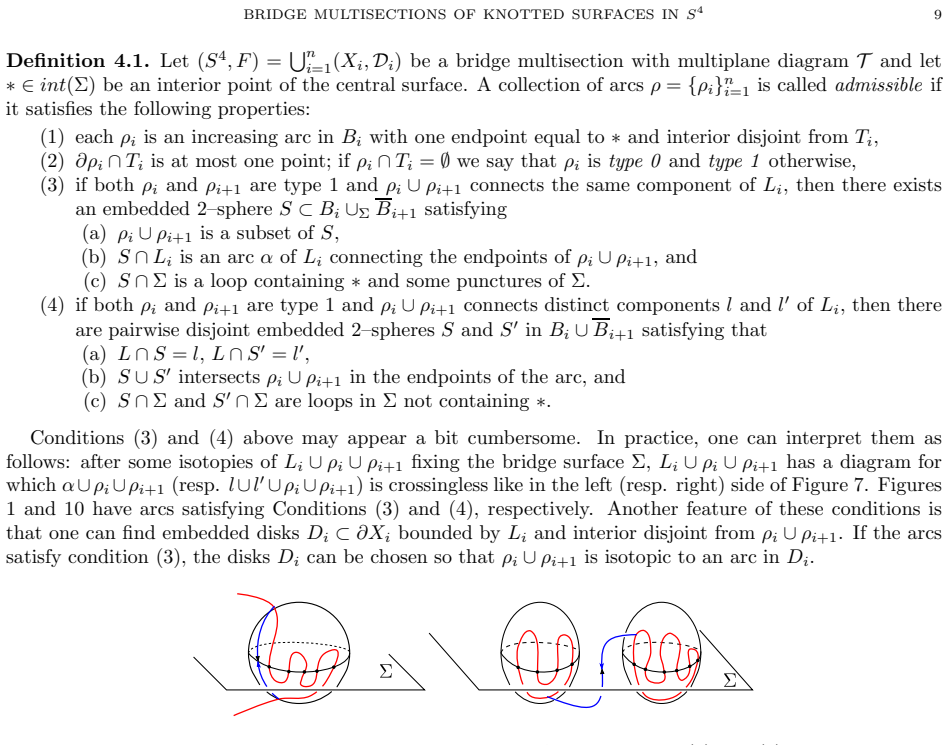
Bridge multisections are combinatorial descriptions of surface links in 4-space using tuples of trivial tangles. They were introduced by Islambouli, Karimi, Lambert-Cole, and Meier to study curves in rational surfaces. In this paper, we prove a uniqueness result for bridge multisections of surfaces in 4-space: we give a complete set of moves relating to any two multiplane diagrams of the same surface. This is done by developing a surgery operation on multiplane diagrams called band surgery. Another application of this surgery move is that any $n$-valent graph with an $n$-edge coloring is the spine of a bridge multisection for an unknotted surface. We also prove that any multisected surface in $S^4$ can be unknotted by finitely many band surgeries.
Editorial analysis
A structured set of objections, weighed in public.
Referee Report
Summary. The paper introduces bridge multisections of knotted surfaces in S^4 via tuples of trivial tangles and multiplane diagrams. It claims to prove a uniqueness theorem by exhibiting a complete set of moves between diagrams of the same surface, achieved through a new operation called band surgery on multiplane diagrams. Additional results state that any n-valent graph equipped with an n-edge coloring arises as the spine of a bridge multisection of an unknotted surface, and that any multisected surface in S^4 can be unknotted via finitely many band surgeries.
Significance. If the invariance of band surgery under isotopy and the completeness of the resulting moves are established, the work supplies a combinatorial calculus for surface links in 4-space that extends earlier constructions of bridge multisections. The unknitting theorem and the realization result for colored graphs would then constitute concrete applications with potential utility for unknotting questions and diagram-based invariants in 4-dimensional topology.
major comments (2)
- [Section defining band surgery] The central uniqueness claim rests on the assertion that band surgery preserves the isotopy class of the embedded surface while only changing the diagram. This step is load-bearing for both the completeness of the moves and the unknitting result; a detailed verification (including how the surgery is performed on the underlying 4-manifold and why the resulting surface remains isotopic) is required in the section introducing the operation.
- [Section on realization of colored graphs] The statement that any n-valent n-edge-colored graph is the spine of a bridge multisection of an unknotted surface is derived from the surgery move; the construction must be shown to produce a surface whose bridge multisection recovers the given colored graph, with explicit checks that the resulting surface is unknotted.
minor comments (2)
- [Introduction and definitions] Notation for multiplane diagrams and the precise relation between bridge multisections and the diagrams should be clarified early, with a table or diagram summarizing the correspondence between combinatorial data and the embedded surface.
- [Uniqueness theorem] The abstract states that proofs exist; the manuscript should include explicit references to the relevant lemmas or propositions when invoking the preservation property in later arguments.
Simulated Author's Rebuttal
We thank the referee for their careful reading and constructive feedback. We address the major comments point by point below.
read point-by-point responses
-
Referee: [Section defining band surgery] The central uniqueness claim rests on the assertion that band surgery preserves the isotopy class of the embedded surface while only changing the diagram. This step is load-bearing for both the completeness of the moves and the unknitting result; a detailed verification (including how the surgery is performed on the underlying 4-manifold and why the resulting surface remains isotopic) is required in the section introducing the operation.
Authors: We agree that the current exposition would benefit from greater explicitness. In the revised manuscript we will expand the definition of band surgery with a self-contained verification: we will describe the operation directly on the underlying 4-manifold (specifying the 4-dimensional handle attachments and the resulting change to the surface), and we will prove that the new surface is isotopic to the original by exhibiting an explicit isotopy supported in a neighborhood of the surgery band. This added material will make the invariance statement fully rigorous and will serve as the foundation for both the move-completeness theorem and the unknitting result. revision: yes
-
Referee: [Section on realization of colored graphs] The statement that any n-valent n-edge-colored graph is the spine of a bridge multisection of an unknotted surface is derived from the surgery move; the construction must be shown to produce a surface whose bridge multisection recovers the given colored graph, with explicit checks that the resulting surface is unknotted.
Authors: We accept that the realization argument requires more explicit verification. In the revision we will rewrite the construction to proceed in two clear steps: first, we apply a sequence of band surgeries to a standard unknotted surface whose multiplane diagram is known, producing a diagram whose spine is the prescribed colored graph; second, we verify directly that the resulting surface is unknotted by exhibiting a sequence of isotopies (or equivalently, by showing that its fundamental group and Seifert form match those of the unknot). These checks will be inserted immediately after the construction so that the claim is fully substantiated. revision: yes
Circularity Check
No circularity; derivation is self-contained via explicit definitions and standard topological arguments
full rationale
The paper defines bridge multisections and the new band surgery operation directly on multiplane diagrams, then proves (within the manuscript) that the operation preserves isotopy class of the embedded surface while relating diagrams. The completeness of the moves, the unknitting result, and the spine realization for colored graphs all follow from these definitions plus standard 4-dimensional isotopy and handlebody arguments. No equations reduce by construction to fitted inputs, no load-bearing self-citations appear, and the cited prior work (Islambouli et al.) is external and non-overlapping with the present authors. The derivation chain is therefore independent of its own outputs.
Axiom & Free-Parameter Ledger
axioms (2)
- domain assumption Multiplane diagrams faithfully encode surface links in 4-space up to isotopy
- domain assumption Band surgery is a well-defined local operation on diagrams that preserves the embedded surface
Reference graph
Works this paper leans on
-
[1]
Tri-plane diagrams for simple surfaces in S^4
Wolfgang Allred, Manuel Arag\'on, Zack Dooley, Alexander Goldman, Yucong Lei, Isaiah Martinez, Nicholas Meyer, Devon Peters, Scott Warrander, Ana Wright, and Alexander Zupan. Tri-plane diagrams for simple surfaces in S^4 . J. Knot Theory Ramifications , 32(6):Paper No. 2350041, 28, 2023
work page 2023
-
[2]
Pants distances of knotted surfaces in 4-manifolds, 2023
Román Aranda, Sarah Blackwell, Devashi Gulati, Homayun Karimi, Geunyoung Kim, Nicholas Paul Meyer, and Puttipong Pongtanapaisan. Pants distances of knotted surfaces in 4-manifolds, 2023
work page 2023
-
[3]
Colin Adams, Erica Flapan, Allison Henrich, Louis H. Kauffman, Lewis D. Ludwig, and Sam Nelson, editors. Encyclopedia of knot theory . CRC Press, Boca Raton, FL, [2021] 2021
work page 2021
-
[4]
Bounds for K irby- T hompson invariants of knotted surfaces
Rom\'an Aranda, Puttipong Pongtanapaisan, and Cindy Zhang. Bounds for K irby- T hompson invariants of knotted surfaces. Geom. Dedicata , 217(6):Paper No. 99, 30, 2023
work page 2023
-
[5]
Ryan Blair, Marion Campisi, Scott A. Taylor, and Maggy Tomova. Kirby–thompson distance for trisections of knotted surfaces. Journal of the London Mathematical Society , 105(2):765--793, 2022
work page 2022
-
[6]
A group-theoretic framework for low-dimensional topology, 2024
Sarah Blackwell, Robion Kirby, Michael Klug, Vincent Longo, and Benjamin Ruppik. A group-theoretic framework for low-dimensional topology, 2024
work page 2024
-
[7]
\.Inan c Baykur and Nathan Sunukjian
R. \.Inan c Baykur and Nathan Sunukjian. Knotted surfaces in 4-manifolds and stabilizations. J. Topol. , 9(1):215--231, 2016
work page 2016
-
[8]
Surfaces in 4-space , volume 142 of Encyclopaedia of Mathematical Sciences
Scott Carter, Seiichi Kamada, and Masahico Saito. Surfaces in 4-space , volume 142 of Encyclopaedia of Mathematical Sciences . Springer-Verlag, Berlin, 2004. Low-Dimensional Topology, III
work page 2004
-
[9]
J. H. Conway. An enumeration of knots and links, and some of their algebraic properties. In Computational P roblems in A bstract A lgebra ( P roc. C onf., O xford, 1967) , pages 329--358. Pergamon, Oxford-New York-Toronto, Ont., 1970
work page 1967
-
[10]
On the uniqueness of the decomposition of a link
Yoko Hashizume. On the uniqueness of the decomposition of a link. Osaka Math. J. , 10:283--300, 1958
work page 1958
-
[11]
Allen Hatcher. Topology of numbers . American Mathematical Society, Providence, RI, [2022] 2022
work page 2022
-
[12]
Proposals for unknotted surfaces in four-spaces
Fujitsugu Hosokawa and Akio Kawauchi. Proposals for unknotted surfaces in four-spaces. Osaka Math. J. , 16(1):233--248, 1979
work page 1979
-
[13]
Toric multisections and curves in rational surfaces, 2022
Gabriel Islambouli, Homayun Karimi, Peter Lambert-Cole, and Jeffrey Meier. Toric multisections and curves in rational surfaces, 2022
work page 2022
-
[14]
Jason M. Joseph, Michael R. Klug, Benjamin M. Ruppik, and Hannah R. Schwartz. Unknotting numbers of 2-spheres in the 4-sphere. J. Topol. , 14(4):1321--1350, 2021
work page 2021
-
[15]
Bridge trisections and classical knotted surface theory
Jason Joseph, Jeffrey Meier, Maggie Miller, and Alexander Zupan. Bridge trisections and classical knotted surface theory. Pacific J. Math. , 319(2):343--369, 2022
work page 2022
-
[16]
Bridge trisections and seifert solids, 2022
Jason Joseph, Jeffrey Meier, Maggie Miller, and Alexander Zupan. Bridge trisections and seifert solids, 2022
work page 2022
-
[17]
Bridge numbers and meridional ranks of knotted surfaces and welded knots, 2023
Jason Joseph and Puttipong Pongtanapaisan. Bridge numbers and meridional ranks of knotted surfaces and welded knots, 2023
work page 2023
-
[18]
Cords and 1-handles attached to surface-knots
Seiichi Kamada. Cords and 1-handles attached to surface-knots. Bol. Soc. Mat. Mex. (3) , 20(2):595--609, 2014
work page 2014
-
[19]
Kauffman and Sofia Lambropoulou
Louis H. Kauffman and Sofia Lambropoulou. On the classification of rational tangles. Adv. in Appl. Math. , 33(2):199--237, 2004
work page 2004
-
[20]
Charles Livingston. Surfaces bounding the unlink. Michigan Math. J. , 29(3):289--298, 1982
work page 1982
-
[21]
On the relationship among unknotting number, knotting genus and A lexander invariant for 2 -knots
Katura Miyazaki. On the relationship among unknotting number, knotting genus and A lexander invariant for 2 -knots. Kobe J. Math. , 3(1):77--85, 1986
work page 1986
-
[22]
Cubic graphs induced by bridge trisections
Jeffrey Meier, Abigail Thompson, and Alexander Zupan. Cubic graphs induced by bridge trisections. Math. Res. Lett. , 30(4):1207--1231, 2023
work page 2023
-
[23]
Bridge trisections of knotted surfaces in S^4
Jeffrey Meier and Alexander Zupan. Bridge trisections of knotted surfaces in S^4 . Trans. Amer. Math. Soc. , 369(10):7343--7386, 2017
work page 2017
-
[24]
Bridge trisections of knotted surfaces in 4-manifolds
Jeffrey Meier and Alexander Zupan. Bridge trisections of knotted surfaces in 4-manifolds. Proceedings of the National Academy of Sciences , 115(43):10880--10886, 2018
work page 2018
-
[25]
Pr\'esentations en ponts du n ud trivial
Jean-Pierre Otal. Pr\'esentations en ponts du n ud trivial. Comptes Rendus Acad\'emie des Sciences Paris S\'er I Math , 294(16):553--556, 1982
work page 1982
-
[26]
Studying links via plats: The unlink, 2023
Deepisha Solanki. Studying links via plats: The unlink, 2023
work page 2023
-
[27]
The bridge number of surface links and kei colorings
Kouki Sato and Kokoro Tanaka. The bridge number of surface links and kei colorings. Bull. Lond. Math. Soc. , 54(5):1763--1771, 2022
work page 2022
-
[28]
An enumeration of surfaces in four-space
Katsuyuki Yoshikawa. An enumeration of surfaces in four-space. Osaka J. Math. , 31(3):497--522, 1994
work page 1994
discussion (0)
Sign in with ORCID, Apple, or X to comment. Anyone can read and Pith papers without signing in.