On Interactions for Large Scale Interacting Systems
Pith reviewed 2026-05-23 19:12 UTC · model grok-4.3
The pith
Equivalence classes of separable interactions for systems with two, three, or four local states number one, two, and five respectively.
A machine-rendered reading of the paper's core claim, the machinery that carries it, and where it could break.
Core claim
When the set of local states consists of two, three or four elements, the number of equivalence classes of separable interactions are respectively one, two and five. The irreducibly quantified condition for interactions is preserved by wedge sums and box products.
What carries the argument
The equivalence relation on interactions defined using the space of conserved quantities, which classifies interactions reflecting their macroscopic properties.
If this is right
- Interactions underlying exclusion processes, multi-species processes, and lattice-gas processes can be classified by their conserved quantities.
- Wedge sums and box products provide methods to construct new interactions from existing ones.
- The irreducibly quantified condition, important for hydrodynamic limits, remains intact under these constructions.
- Abundant examples are generated suitable for considering hydrodynamic limits of large-scale interacting systems.
Where Pith is reading between the lines
- Such a classification might extend to larger numbers of states if computational methods are developed.
- Interactions with the same conserved quantities may exhibit identical large-scale behaviors in simulations or experiments.
- This framework could connect to other combinatorial objects in statistical mechanics beyond the listed processes.
Load-bearing premise
The equivalence relation defined by spaces of conserved quantities accurately reflects the corresponding macroscopic properties of the large-scale interacting systems.
What would settle it
Finding two separable interactions with the same conserved quantities but different hydrodynamic limits, or vice versa, would challenge the equivalence classification.
Figures


read the original abstract
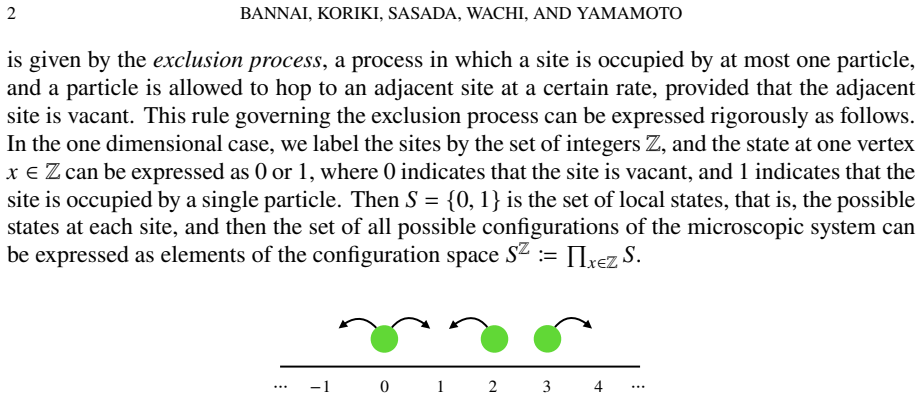
Statistical mechanics explains the properties of macroscopic phenomena based on the movements of microscopic particles such as atoms and molecules. Movements of microscopic particles can be represented by large-scale interacting systems. In this article, we study a combinatorial object which we call interactions, given as a symmetric directed graph representing the possible transition of states on adjacent sites of large-scale interacting systems. Such interactions underlie various standard processes such as the exclusion processes, generalized exclusion processes, multi-species exclusion processes, lattice-gas processes with energy, and the multi-lane particle processes. We introduce the notion of equivalences of interactions using their space of conserved quantities. This allows for the classification of interactions reflecting corresponding macroscopic properties. In particular, we prove that when the set of local states consists of two, three or four elements, then the number of equivalence classes of separable interactions are respectively one, two and five. We also define the wedge sums and box products of interactions, which give systematic methods for constructing new interactions from existing ones. Furthermore, we prove that the irreducibly quantified condition for interactions, which has implicitly played an important role in the theory of hydrodynamic limits, is preserved by wedge sums and box products. Our results provide a systematic method to construct and classify interactions, offering abundant examples suitable for considering hydrodynamic limits.
Editorial analysis
A structured set of objections, weighed in public.
Referee Report
Summary. The paper defines 'interactions' as symmetric directed graphs encoding allowed state transitions on adjacent sites of large-scale interacting particle systems. It introduces an equivalence relation on interactions via equality of their spaces of conserved quantities, proves that the number of equivalence classes of separable interactions is 1, 2, and 5 when the local state set S has cardinality 2, 3, and 4 respectively, and shows that the wedge sum and box product operations preserve the irreducibly quantified condition. The results are positioned as providing systematic construction and classification tools for examples suitable for hydrodynamic limit analysis.
Significance. If the combinatorial classification is correct, the explicit counts for small |S| together with the closure properties under wedge sums and box products supply a concrete supply of inequivalent interactions with controlled conserved quantities. This is a useful contribution to the literature on interacting particle systems, as it organizes families (exclusion, multi-species, energy-conserving, multi-lane) under a single framework and identifies which constructions preserve a condition known to be relevant for hydrodynamic limits.
major comments (2)
- [Introduction] Introduction, paragraph 3 and abstract: the claim that the equivalence 'reflects corresponding macroscopic properties' is not supported by any explicit derivation or comparison of hydrodynamic PDEs (or even fluxes) for representatives of distinct classes. The combinatorial definition via conserved quantities is load-bearing for the classification, but the reflection step to distinct scaling limits remains an unverified bridge; a concrete test would be to compute the hydrodynamic limit for at least two inequivalent interactions with |S|=3 and exhibit different conservation laws or fluxes.
- [§4] §4, Theorem 4.3 (classification for |S|=4): the enumeration of the five equivalence classes is asserted via exhaustive checking of conserved-quantity spaces, but the manuscript provides no explicit list of graph representatives or the dimension of the conserved-quantity spaces for each class. Without these data, independent verification of the count of five (as opposed to four or six) is not possible from the text alone.
minor comments (2)
- [§5] Notation for the wedge sum and box product is introduced in §5 but the associativity or commutativity properties are not stated explicitly; adding a short remark or table summarizing the algebraic structure would improve readability.
- [§3] The definition of 'separable interaction' (used throughout the classification theorems) appears only in §3; moving a concise restatement to the introduction would help readers who focus on the main results.
Simulated Author's Rebuttal
We thank the referee for the careful reading and the constructive comments on our manuscript. We address each major comment below and indicate the revisions we will make.
read point-by-point responses
-
Referee: [Introduction] Introduction, paragraph 3 and abstract: the claim that the equivalence 'reflects corresponding macroscopic properties' is not supported by any explicit derivation or comparison of hydrodynamic PDEs (or even fluxes) for representatives of distinct classes. The combinatorial definition via conserved quantities is load-bearing for the classification, but the reflection step to distinct scaling limits remains an unverified bridge; a concrete test would be to compute the hydrodynamic limit for at least two inequivalent interactions with |S|=3 and exhibit different conservation laws or fluxes.
Authors: The equivalence relation is defined precisely by equality of the spaces of conserved quantities. Any hydrodynamic limit, if it exists, must conserve exactly those quantities that are conserved microscopically; hence distinct spaces of conserved quantities necessarily produce hydrodynamic equations with distinct conservation laws. We will add a short clarifying paragraph in the introduction (and a corresponding sentence in the abstract) that makes this direct implication explicit. Performing a full hydrodynamic-limit computation for two |S|=3 representatives lies outside the combinatorial scope of the present work and would require separate analytic effort; we therefore view the added explanatory paragraph as the appropriate strengthening of the manuscript. revision: partial
-
Referee: [§4] §4, Theorem 4.3 (classification for |S|=4): the enumeration of the five equivalence classes is asserted via exhaustive checking of conserved-quantity spaces, but the manuscript provides no explicit list of graph representatives or the dimension of the conserved-quantity spaces for each class. Without these data, independent verification of the count of five (as opposed to four or six) is not possible from the text alone.
Authors: We agree that the current text does not supply the explicit representatives or dimensions needed for independent verification. In the revised manuscript we will insert a table (or enumerated list) in §4 that, for each of the five classes, gives (i) one concrete graph representative on four vertices and (ii) the dimension of its space of conserved quantities. This addition will make the classification fully verifiable from the text. revision: yes
Circularity Check
No significant circularity; combinatorial classification is self-contained
full rationale
The paper defines interactions as symmetric directed graphs and an equivalence relation via the space of conserved quantities, then enumerates the resulting classes for |S|=2,3,4 and proves preservation of the irreducibly quantified condition under wedge sums and box products. These counts and preservation statements follow directly from the definitions and combinatorial arguments internal to the paper. No load-bearing self-citations, no fitted parameters renamed as predictions, no ansatzes imported via citation, and no self-definitional loops are present. The results are independent mathematical statements about the defined objects.
Axiom & Free-Parameter Ledger
axioms (2)
- domain assumption Interactions are modeled as symmetric directed graphs on the set of local states.
- domain assumption Equivalence classes are determined by the space of conserved quantities.
invented entities (1)
-
separable interactions
no independent evidence
Reference graph
Works this paper leans on
-
[1]
K. Adachi, K. Takasan, and K. Kawaguchi,Activity-induced phase transition in a quantum many-body system, Phys. Rev. Research4 (2022), DOI 10.1103/PhysRevResearch.4.013194. INTERACTIONS 29
-
[2]
Generalized Exclusion Processes: Transport Coefficients
C. Arita, P. L. Krapivsky, and K. Mallick, Generalized Exclusion Processes: Transport Coefficients, Phys. Rev. E.90 (2014), DOI 10.1103/PhysRevE.90.052108, available atarXiv:1407.3228
work page internal anchor Pith review Pith/arXiv arXiv doi:10.1103/physreve.90.052108 2014
- [3]
-
[4]
K. Bannai and M. Sasada, On Uniform Functions on the Configuration Space of Large Scale Interacting Systems (2024), preprint, available at arXiv:2408.12886[math.PR]
-
[5]
, Inverse Harmonic Periods and the Diffusion Matrices associated to Large Scale Interacting Systems (2024), in preparation
work page 2024
-
[6]
A. Dermoune and P. Heinrich, Spectral gap for multicolor nearest-neighbor exclusion processes with site disorder, J. Stat. Phys. 131 (2008), no. 1, 117–125, DOI 10.1007/s10955-008-9496-0. MR2394700
- [7]
-
[8]
T. Funaki, K. Uchiyama, and H. T. Yau,Hydrodynamic limit for lattice gas reversible under Bernoulli measures, Nonlinear stochastic PDEs (Minneapolis, MN, 1994), IMA Vol. Math. Appl., vol. 77, Springer, New York, 1996, pp. 1–40, DOI 10.1007/978-1-4613-8468-7 1. MR1395890
-
[9]
Mathematics of Hydrodynamic Limits
R. Giavarini, Research Internship Report “Mathematics of Hydrodynamic Limits” (2023)
work page 2023
-
[10]
Griffeath, Frank Spitzer’s pioneering work on interacting particle systems, Ann
D. Griffeath, Frank Spitzer’s pioneering work on interacting particle systems, Ann. Probab. 21 (1993), no. 2, 608–621. MR1217556
work page 1993
-
[11]
M. Z. Guo, G. C. Papanicolaou, and S. R. S. Varadhan, Nonlinear diffusion limit for a system with nearest neighbor interactions, Comm. Math. Phys. 118 (1988), no. 1, 31–59. MR954674
work page 1988
-
[12]
Z. Halim and B. Hac `ene, Computation for the canonical measures of a colored disordered lattice gas and spectral gap, J. Math. Phys. 50 (2009), no. 10, 103302, 8, DOI 10.1063/1.3238479. MR2573130
-
[13]
Y. Komiya, Irreducibly Quantification and Exchangeability of Affine Interactions , Master’s Thesis, Keio University (2023) (Japanese)
work page 2023
-
[14]
C. Kipnis and C. Landim, Scaling limits of interacting particle systems , Grundlehren der Mathematischen Wissenschaften [Fundamental Principles of Mathematical Sciences], vol. 320, Springer-Verlag, Berlin, 1999. MR1707314
work page 1999
-
[15]
C. Kipnis, C. Landim, and S. Olla, Hydrodynamical limit for a nongradient system: the generalized symmetric exclusion process, Comm. Pure Appl. Math. 47 (1994), no. 11, 1475–1545, DOI 10.1002/cpa.3160471104. MR1296786
-
[16]
, Macroscopic properties of a stationary non-equilibrium distribution for a non-gradient interacting particle system, Ann. Inst. H. Poincar´e Probab. Statist. 31 (1995), no. 1, 191–221 (English, with English and French summaries). MR1340037
work page 1995
-
[17]
C. Kourbane-Houssene, C. Erignoux, T. Bodineau, and J. Tailleur,Exact Hydrodynamic Description of Active Lattice Gases, Phys. Rev. Lett.120 (2018), DOI 10.1103/PhysRevLett.120.268003
-
[18]
T. M. Liggett, Interacting particle systems, Classics in Mathematics, Springer-Verlag, Berlin, 2005. Reprint of the 1985 original. MR2108619
work page 2005
-
[19]
, Stochastic interacting systems: contact, voter and exclusion processes, Grundlehren der mathematis- chen Wissenschaften [Fundamental Principles of Mathematical Sciences], vol. 324, Springer-Verlag, Berlin,
-
[20]
Nagahata, Fluctuation dissipation equation for lattice gas with energy , J
Y. Nagahata, Fluctuation dissipation equation for lattice gas with energy , J. Stat. Phys. 110 (2003), no. 1-2, 219–246, DOI 10.1023/A:1021022829221. MR1966328
-
[21]
Y. Nagahata and M. Sasada, Spectral gap for multi-species exclusion processes , J. Stat. Phys. 143 (2011), no. 2, 381–398, DOI 10.1007/s10955-011-0176-0. MR2793170
-
[22]
Quastel, Diffusion of color in the simple exclusion process , Comm
J. Quastel, Diffusion of color in the simple exclusion process , Comm. Pure Appl. Math. 45 (1992), no. 6, 623–679, DOI 10.1002/cpa.3160450602. MR1162368
-
[23]
Sasada, Hydrodynamic limit for two-species exclusion processes , Stochastic Process
M. Sasada, Hydrodynamic limit for two-species exclusion processes , Stochastic Process. Appl. 120 (2010), no. 4, 494–521, DOI 10.1016/j.spa.2010.01.002. MR2594368 30 BANNAI, KORIKI, SASADA, WACHI, AND YAMAMOTO
-
[24]
T. Sepp ¨al¨ainen, Existence of hydrodynamics for the totally asymmetric simple 𝐾-exclusion process, Ann. Probab. 27 (1999), no. 1, 361–415, DOI 10.1214/aop/1022677266. MR1681094
-
[25]
F. Spitzer, Interaction of Markov processes, Advances in Math.5 (1970), 246–290 (1970), DOI 10.1016/0001- 8708(70)90034-4. MR0268959
-
[26]
H. Spohn, Large Scale Dynamics of Interacting Particles , Theoretical and Mathematical Physics, Springer- Verlag, Berlin Heidelberg, 1991
work page 1991
-
[27]
S. R. S. Varadhan and H. T. Yau,Diffusive limit of lattice gas with mixing conditions, Asian J. Math. 1 (1997), no. 4, 623–678, DOI 10.4310/AJM.1997.v1.n4.a1. MR1621569
-
[28]
Wachi, Decision Problem on Interactions (2024), in preparation
H. Wachi, Decision Problem on Interactions (2024), in preparation. Email address: bannai@math.keio.ac.jp (Bannai, Koriki, Wachi, Yamamoto) Department of Mathematics, Faculty of Science and Technology , Keio University , 3-14-1 Hiyoshi, Kouhoku-ku, Yokohama 223-8522, Japan. (Sasada) Department of Mathematics, University of Tokyo, 3-8-1 Komaba, Meguro-ku, T...
work page 2024
discussion (0)
Sign in with ORCID, Apple, or X to comment. Anyone can read and Pith papers without signing in.