Dynamics of McMillan mappings III. Symmetric map with mixed nonlinearity
Pith reviewed 2026-05-23 19:22 UTC · model grok-4.3
The pith
The symmetric McMillan map reduces to two irreducible parameters and supplies exact solutions plus action-angle variables for its dynamics.
A machine-rendered reading of the paper's core claim, the machinery that carries it, and where it could break.
Core claim
The symmetric McMillan map is defined by a biquadratic invariant whose single ratio parameter, together with the linear rotation number, completely determines the dynamics. This two-parameter structure permits an exhaustive classification of bounded orbits, explicit integration of the recurrence, and derivation of canonical action-angle coordinates whose frequencies give the exact rotation number and its nonlinear dependence on amplitude. The same reduced map reproduces the essential features of both the Hénon map and thin-sextupole lattices to high accuracy across wide ranges of the physical parameters.
What carries the argument
The biquadratic invariant whose term ratio supplies the single nonlinear parameter that, with the fixed-point rotation number, reduces the six-parameter family to an integrable two-parameter system.
If this is right
- Exact closed-form solutions exist for every orbit once the two parameters are fixed.
- Canonical action-angle variables exist and supply analytic expressions for the rotation number and tune shift.
- Stable-motion regimes are completely classified by the two-parameter plane.
- The map furnishes a uniform second-order description that links the Hénon map to accelerator lattices with thin sextupoles.
- The reduction to two parameters extends to any standard-form area-preserving map that shares the same invariant structure.
Where Pith is reading between the lines
- The same two-parameter reduction may simplify long-term tracking studies in storage-ring design by replacing full lattice codes with the analytic map inside the claimed validity window.
- The construction suggests a route to higher-order integrable approximations by adding controlled corrections to the biquadratic invariant while preserving the exact solvability.
- Because the map is area-preserving and integrable, its frequency map could serve as a benchmark for numerical integrators used in celestial mechanics or plasma dynamics.
- Experimental beam-dynamics measurements of tune shift versus amplitude in a sextupole-dominated ring could directly test the predicted analytic curve.
Load-bearing premise
The biquadratic invariant continues to capture the dominant nonlinear behavior of the underlying continuous system over the parameter intervals examined.
What would settle it
A side-by-side computation of the rotation number versus amplitude in a full thin-sextupole lattice tracking code versus the analytic McMillan formula, performed at parameter values where the paper claims agreement holds; systematic deviation beyond a stated tolerance would refute the claim.
Figures




read the original abstract
This article extends the study of the dynamical properties of the symmetric McMillan map, emphasizing its utility in understanding and modeling complex nonlinear systems. Although the map features six parameters, we demonstrate that only two are irreducible: the linearized rotation number at the fixed point and a nonlinear parameter representing the ratio of terms in the biquadratic invariant. Through a detailed analysis, we classify regimes of stable motion, provide exact solutions to the mapping equations, and derive a canonical set of action-angle variables, offering analytical expressions for the rotation number and nonlinear tune shift. We further establish connections between general standard-form mappings and the symmetric McMillan map, using the area-preserving H\'enon map and accelerator lattices with thin sextupole magnet as representative case studies. Our results show that, despite being a second-order approximation, the symmetric McMillan map provides a highly accurate depiction of dynamics across a wide range of system parameters, demonstrating its practical relevance in both theoretical and applied contexts.
Editorial analysis
A structured set of objections, weighed in public.
Referee Report
Summary. The paper extends prior work on McMillan maps by analyzing the symmetric case with mixed nonlinearity. It shows that the map's six parameters reduce to two irreducible ones (linearized rotation number at the fixed point and the ratio of terms in the biquadratic invariant), classifies regimes of stable motion, derives exact solutions to the iteration equations, constructs canonical action-angle variables, and obtains closed-form expressions for the rotation number and nonlinear tune shift. Connections are made to the area-preserving Hénon map and to accelerator lattices with thin sextupoles; the central practical claim is that the map remains a highly accurate second-order model over a wide parameter range.
Significance. If the two-parameter reduction and the exact analytic expressions hold, the work supplies a compact, integrable model that yields explicit formulas for rotation number and tune shift without numerical fitting. This is useful for theoretical classification of nonlinear maps and for accelerator applications where thin-sextupole effects dominate. The provision of exact solutions and action-angle variables is a concrete strength that enables falsifiable predictions.
major comments (2)
- [case studies] § on case studies (accelerator lattice example): the assertion that the symmetric McMillan map 'provides a highly accurate depiction of dynamics across a wide range of system parameters' is not supported by any quantitative deviation measure, error threshold, or breakdown value for the rotation number or tune shift relative to the underlying continuous system; this directly underpins the practical-relevance claim.
- [invariant and reduction] Derivation of the two-parameter reduction (via the biquadratic invariant): while the reduction follows formally from the invariant's structure, the manuscript does not supply an explicit check that the nonlinear ratio remains independent of the rotation number when the map is embedded in a higher-order or non-integrable lattice; this is load-bearing for the claim that only two parameters are irreducible.
minor comments (2)
- [introduction] Notation for the six original parameters is introduced without an explicit list or table; adding one would improve readability when the reduction is first stated.
- [figures] Figure captions for the phase-space plots do not indicate the specific values of the two reduced parameters used; this makes it harder to reproduce the displayed orbits.
Simulated Author's Rebuttal
We thank the referee for the careful reading and constructive comments. We address each major comment below.
read point-by-point responses
-
Referee: [case studies] § on case studies (accelerator lattice example): the assertion that the symmetric McMillan map 'provides a highly accurate depiction of dynamics across a wide range of system parameters' is not supported by any quantitative deviation measure, error threshold, or breakdown value for the rotation number or tune shift relative to the underlying continuous system; this directly underpins the practical-relevance claim.
Authors: We agree that the practical-relevance claim would be strengthened by quantitative support. In the revised manuscript we will augment the accelerator-lattice case study with explicit comparisons of rotation number and nonlinear tune shift, reporting deviation measures, error thresholds, and the parameter values at which the second-order approximation begins to deviate appreciably from the underlying continuous system. revision: yes
-
Referee: [invariant and reduction] Derivation of the two-parameter reduction (via the biquadratic invariant): while the reduction follows formally from the invariant's structure, the manuscript does not supply an explicit check that the nonlinear ratio remains independent of the rotation number when the map is embedded in a higher-order or non-integrable lattice; this is load-bearing for the claim that only two parameters are irreducible.
Authors: The reduction to two irreducible parameters follows directly from the algebraic structure of the biquadratic invariant that defines the symmetric McMillan map; the nonlinear ratio is therefore independent of the rotation number by construction of the map itself. When the map is used to model a lattice, its two parameters are chosen to reproduce the local linear and nonlinear properties, preserving this independence. We will insert a short clarifying paragraph in the section on the invariant to make this explicit and will add a brief numerical illustration using one of the existing case-study embeddings. revision: partial
Circularity Check
No significant circularity; derivation self-contained from invariant form
full rationale
The paper reduces the six-parameter symmetric McMillan map to two irreducible parameters (linearized rotation number and nonlinear ratio from the biquadratic invariant) by direct algebraic inspection of the invariant's structure, then derives exact solutions, action-angle variables, rotation number, and nonlinear tune shift analytically from the resulting two-parameter map. Case-study connections to the Hénon map and thin-sextupole lattices are presented as external mappings rather than internal fits. No quoted step shows a 'prediction' (e.g., tune shift) being statistically forced by re-using a fitted parameter, nor does any load-bearing claim reduce to a self-citation or ansatz smuggled from prior work by the same authors. The accuracy assertion for wide parameter ranges is an empirical claim about the second-order approximation, not a definitional tautology.
Axiom & Free-Parameter Ledger
Forward citations
Cited by 1 Pith paper
-
Geometry of Almost-Conserved Quantities in Symplectic Maps. Part III: Approximate Invariants in Nonlinear Accelerator Systems
A perturbative framework builds approximate invariants for nonlinear symplectic maps as a direct nonlinear extension of Courant-Snyder theory, demonstrated on operational accelerator configurations.
Reference graph
Works this paper leans on
-
[1]
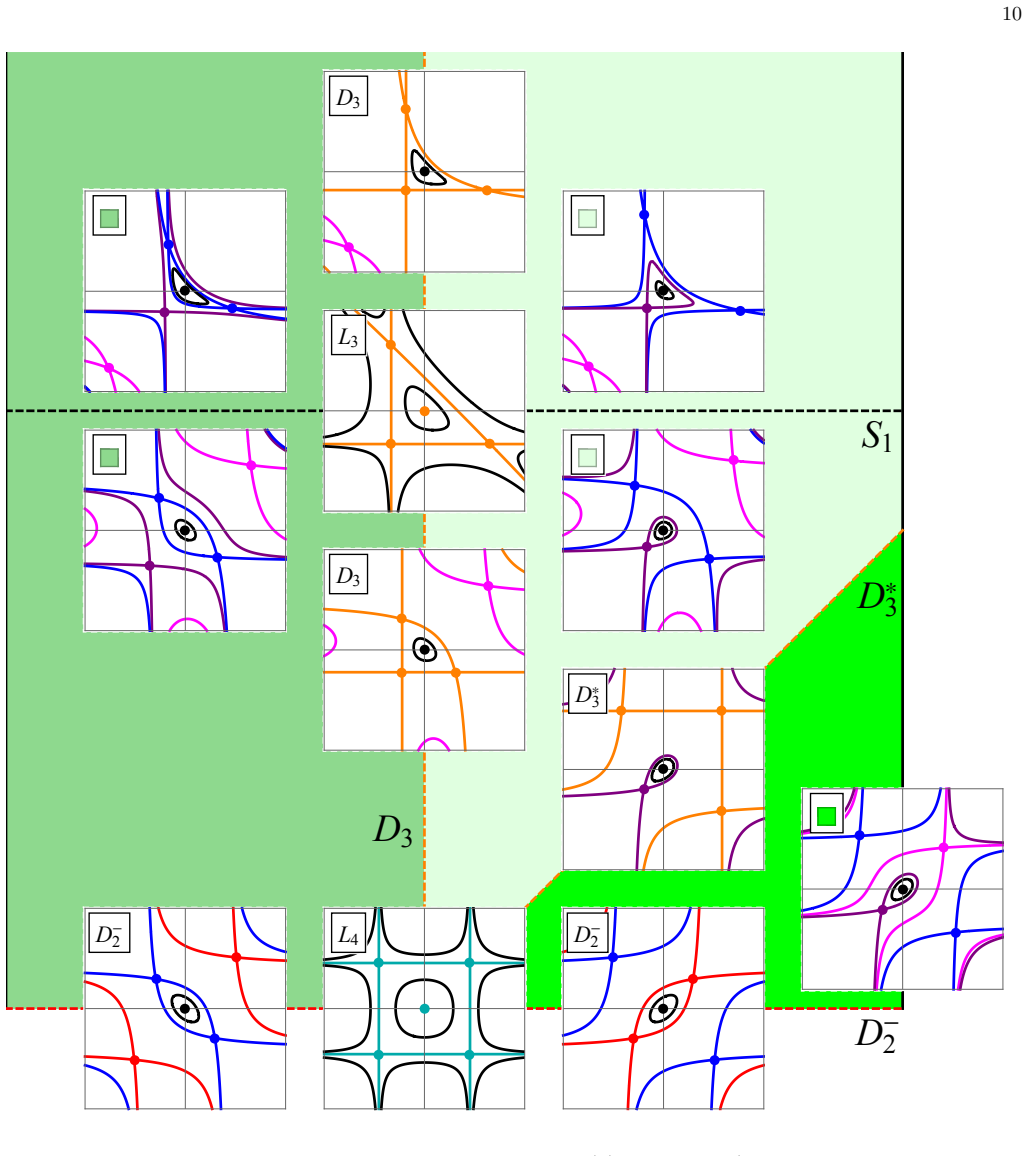
Additionally, vertical lines shown in dotted black and orange represent the asymptotes at a = −10 (associated with B2) and a = −1 (related to D3 and D∗ 3), respectively. The point at the origin, ζ1, exists for any set of parameters, and its stability is entirely determined by the trace of the linearized transformation, requiring −2 < a < 2. By comparing t...
-
[2]
− 8 h0h3 h0(h2 1 − h0h2
-
[3]
, B = h1 h0 , a = h1 4 h3 1 + 4 h0(2 h0h3 − h1h2) h0(h2 1 − h0h2
-
[4]
H´ enon” refers to the chaotic H´ enon map, “SX-2
, with h0 = 4X i=1 qi, −h1 = X 1≤i<j≤4 qiqj, h 2 = X 1≤i<j<k≤4 qiqjqk, −h3 = 4Y i=1 qi. Similarly, the action can be calculated analytically as a sum of five complete elliptic integrals: J = p |R0| (cKK[κ] + cEE[κ] + c0Π[α0, κ] + c1Π[α1, κ] + c2Π[α2, κ]) /(2 A), (5) where the modulus κ matches that in Table I, with the other coefficients provided in Appen...
-
[5]
(4,5) and the appropriate scaling factor provided byε
Action-angle variables With the approximate invariant in hand, we can now define the corresponding approximate action variable J and rotation number ν for the H´ enon map, using Eqs. (4,5) and the appropriate scaling factor provided byε. To illustrate the dependence ν(J), Fig. 6 shows samples for McMillan mappings with the normalized invariant K(2n) SX-2[...
-
[6]
Stability diagrams In [33], we demonstrated that although the McMillan mapping with invariant K(2) SX-2[p, q] is only a second-order approximation to the quadratic H´ enon map, it provides an exact expression for the nonlinear detuning at the origin, µSX-2 0 , which aligns with both numerical simulations and analytical methods like Deprit perturbation the...
-
[7]
Rough estimate: The simplest estimate is provided by the fixed point ζSX−2 un and the associated separatrix crossings, which define a simply connected region around the origin, shown with dashed red and red/white curves. Although these estimates quickly deviate from the actual stability region, they remain accurate up to O(δr2 1/3), where δr1/3 = a + 1. U...
-
[8]
By using its coordinate we can reduce the error above the resonance by approximately 50%
Improved Estimate: A more accurate estimate can be achieved by incorporating the non-isolated period-3 orbit in the SX-2 approximation (defined for a < −1 and shown as a solid cyan line). By using its coordinate we can reduce the error above the resonance by approximately 50%
-
[9]
Linear Estimates: Finally, simple linear estimates obtained from the fixed point ζSX−2 un and its corresponding separatrix provide a reasonable approximation (shown with black dotted lines). Observation #3. Interestingly, both mappings exhibit an orbit where ∂qν = 0 which appears for a < −1/2: solid white for the H´ enon map and dashed black/white for the...
-
[10]
Mid-range amplitudes Before proceeding to the next section, it is important to note that while the SX-2 model has limited applicability in determining the precise boundary of stability in the entire range of parameter a, it offers a better fit when considering “mid-range” amplitudes, just before the main mode-locking regions. Although the fractal complexi...
work page 2024
-
[11]
Numerical study of quadratic area-preserving mappings,
Michel H´ enon, “Numerical study of quadratic area-preserving mappings,” Quarterly of Applied Mathematics 27, 291–312 (1969)
work page 1969
-
[12]
A problem in the stability of periodic systems,
Edwin M. McMillan, “A problem in the stability of periodic systems,” in Topics in modern physics. A Tribute to Edward U. Condon, edited by W. E. Brittin and H. Odabasi (Colorado Associated University Press, Boulder, CO, 1971) pp. 219–244
work page 1971
-
[13]
Aleksandr Petrovich Veselov, “Integrable maps,” Russian Mathematical Surveys 46, 1–51 (1991)
work page 1991
-
[14]
38 (Springer New York, NY, 2003)
Allan J Lichtenberg and Michael A Lieberman, Regular and chaotic dynamics , 2nd ed., Applied Mathematical Sciences (AMS), Vol. 38 (Springer New York, NY, 2003)
work page 2003
-
[15]
Devaney, An introduction to chaotic dynamical systems (CRC press, 2021) p
Robert L. Devaney, An introduction to chaotic dynamical systems (CRC press, 2021) p. 434
work page 2021
-
[16]
2 (Springer New York, NY, 2003)
Stephen Wiggins, Introduction to applied nonlinear dynamical Systems and Chaos , 2nd ed., Texts in Applied Mathematics (TAM), Vol. 2 (Springer New York, NY, 2003)
work page 2003
-
[17]
A. I. Neishtadt V. I. Arnold, V. V. Kozlov, Mathematical Aspects of Classical and Celestial Mechanics , 2nd ed. (Springer Berlin, Heidelberg, 1997)
work page 1997
-
[18]
Kenneth R. Meyer and Daniel C. Offin, Introduction to Hamiltonian dynamical systems and the N-body problem , 3rd ed., Applied Mathematical Sciences (AMS), Vol. 90 (Springer CHAM, 2017)
work page 2017
-
[19]
Symplectic maps for diverted plasmas,
Iberˆ e Luiz Caldas, Bruno F. Bartoloni, David Ciro, Geraldo Roberson, Adriane B. Schelin, Tiago Kroetz, Marisa Roberto, Ricardo Luiz Viana, Kelly Cristiane Iarosz, Antonio Marcos Batista, and Philip J. Morrison, “Symplectic maps for diverted plasmas,” IEEE Transactions on Plasma Science 46, 2354–2361 (2018)
work page 2018
-
[20]
Hamiltonian description of the ideal fluid,
P. J. Morrison, “Hamiltonian description of the ideal fluid,” Rev. Mod. Phys. 70, 467–521 (1998)
work page 1998
-
[21]
Stirring by chaotic advection,
Hassan Aref, “Stirring by chaotic advection,” Journal of Fluid Mechanics 143, 1–21 (1984)
work page 1984
-
[22]
3 (Cambridge university press, 1989)
Julio M Ottino, The kinematics of mixing: stretching, chaos, and transport , Vol. 3 (Cambridge university press, 1989)
work page 1989
-
[23]
Optical bistability: controlling light with light,
Hyatt M Gibbs, “Optical bistability: controlling light with light,” (1985), https://doi.org/10.1016/B978-0-12-281940- 7.X5001-X
-
[24]
Physical defects in fiber optics: A theoretical framework in phase space,
A.L. Rivera and V.M. Casta˜ no, “Physical defects in fiber optics: A theoretical framework in phase space,” Optik 121, 1563–1569 (2010)
work page 2010
-
[25]
Simple mathematical models with very complicated dynamics,
Robert M. May, “Simple mathematical models with very complicated dynamics,” Nature 261, 459–467 (1976)
work page 1976
-
[26]
Julien Clinton Sprott, Chaos and Time-Series Analysis (Oxford University Press, Inc., 2003)
work page 2003
-
[27]
Approximation of nearly-periodic symplectic maps via structure- preserving neural networks,
Valentin Duruisseaux, Joshua W. Burby, and Qi Tang, “Approximation of nearly-periodic symplectic maps via structure- preserving neural networks,” Scientific Reports 13, 1563–1569 (2023)
work page 2023
-
[28]
Integrable mappings and soliton equations,
Gilles Reinout Willem Quispel, Jhon A. G. Roberts, and Colin J. Thompson, “Integrable mappings and soliton equations,” Physics Letters A 126, 419–421 (1988)
work page 1988
-
[29]
Integrable mappings and soliton equations II,
Gilles Reinout Willem Quispel, Jhon A. G. Roberts, and Colin J. Thompson, “Integrable mappings and soliton equations II,” Physica D: Nonlinear Phenomena 34, 183–192 (1989)
work page 1989
-
[30]
Nalini Joshi and Pavlos Kassotakis, “Re-factorising a qrt map,” Journal of Computational Dynamics 6, 325–343 (2019)
work page 2019
-
[31]
Integrable mappings of the plane preserving biquadratic invariant curves,
Apostolos Iatrou and John A. G. Roberts, “Integrable mappings of the plane preserving biquadratic invariant curves,” Journal of Physics A: Mathematical and General 34, 6617 (2001)
work page 2001
-
[32]
Integrable mappings of the plane preserving biquadratic invariant curves II,
Apostolos Iatrou and John A. G. Roberts, “Integrable mappings of the plane preserving biquadratic invariant curves II,” Nonlinearity 15, 459–489 (2002)
work page 2002
-
[33]
Integrable mappings of the plane preserving biquadratic invariant curves III,
Apostolos Iatrou and John A. G. Roberts, “Integrable mappings of the plane preserving biquadratic invariant curves III,” Physica A: Statistical Mechanics and its Applications 326, 400–411 (2003). 27
work page 2003
-
[34]
A three-dimensional generalization of qrt maps,
Jaume Alonso, Yuri B Suris, and Kangning Wei, “A three-dimensional generalization of qrt maps,” Journal of Nonlinear Science 33, 117 (2023)
work page 2023
-
[35]
Integrable four-dimensional symplectic maps of standard type,
Robert I. McLachlan, “Integrable four-dimensional symplectic maps of standard type,” Physics Letters A 177, 211–214 (1993)
work page 1993
-
[36]
Two examples of integrable systems with round colliding beams,
V.V. Danilov and E.A. Perevedentsev, “Two examples of integrable systems with round colliding beams,” in Proceedings of the 1997 Particle Accelerator Conference (Cat. No.97CH36167) , Vol. 2 (1997) pp. 1759–1761 vol.2
work page 1997
-
[37]
An integrable optics lens for the psr and sns,
V. Danilov, J. Galambos, D. Jeon, J. Holmes, D. Olsen, D. Fitzgerald, R. Macek, and M. Plum, “An integrable optics lens for the psr and sns,” in Proceedings of the 1999 Particle Accelerator Conference (Cat. No.99CH36366) , Vol. 2 (1999) pp. 1198–1200 vol.2
work page 1999
-
[38]
Considerations on compensation of beam-beam effects in the tevatron with electron beams,
V. Shiltsev, V. Danilov, D. Finley, and A. Sery, “Considerations on compensation of beam-beam effects in the tevatron with electron beams,” Phys. Rev. ST Accel. Beams 2, 071001 (1999)
work page 1999
-
[39]
Dynamics of McMillan mappings II. Axially symmetric map,
Tim Zolkin, Brandon Cathey, and Sergei Nagaitsev, “Dynamics of McMillan mappings II. Axially symmetric map,” (2024), arXiv:2405.05657 [nlin.SI]
-
[40]
Leo P. Michelotti, Intermediate Classical Dynamics with Applications to Beam Physics , Wiley Series in Beam Physics and Accelerator Technology (Wiley, 1995)
work page 1995
-
[41]
Johan Bengtsson, The sextupole scheme for the Swiss Light Source (SLS): an analytic approach , Tech. Rep. SLS-TME- TA-1997-0009 (Paul Scherrer Institut, Villigen, Switzerland, 1997)
work page 1997
-
[42]
Dynamical aperture control in accelerator lattices with multipole potentials,
Ivan Morozov and Evgeny Levichev, “Dynamical aperture control in accelerator lattices with multipole potentials,” in Proceedings of the CERN-BINP Workshop for Young Scientists in e+e− Colliders, Geneva, Switzerland, 22 – 25 August 2016, CERN Proceedings, Vol. 1/2017, edited by Valeria Brancolini and Lucie Linssen (CERN, Geneva, 2017) pp. 195–206, CERN-Pro...
work page 2016
-
[43]
Dynamics of McMillan mappings I. McMillan multipoles,
Tim Zolkin, Sergei Nagaitsev, and Ivan Morozov, “Dynamics of McMillan mappings I. McMillan multipoles,” (2024), arXiv:2405.05652 [nlin.SI]
-
[44]
Integrable mappings of the standard type,
Yuri B. Suris, “Integrable mappings of the standard type,” Functional Analysis and Its Applications 23, 74–76 (1989)
work page 1989
-
[45]
Research conserning the theory of non-linear resonance and stochasticity,
Boris V. Chirikov, “Research conserning the theory of non-linear resonance and stochasticity,” (1971), translated at CERN by A. T. Sanders from the Russian [CERN-Trans-71-40]. Nuclear Physics Institute of the Siberian Section of the USSR Academy of Science, Report 267, Novosibirsk, 1969 [IYAF-267-TRANS-E]
work page 1971
-
[46]
A universal instability of many-dimensional oscillator systems,
Boris V. Chirikov, “A universal instability of many-dimensional oscillator systems,” Physics Reports 52, 263–379 (1979)
work page 1979
-
[47]
J. Moser, “Private communication,” (1993), this is a conjecture of H. Cohen communicated by Y. Colin-de Verdi´ ere to J. Moser April 10, 1993
work page 1993
-
[48]
Algebraic non-integrability of the cohen map,
Marek Rychlik and Mark Torgerson, “Algebraic non-integrability of the cohen map,” New York J. Math 4, 74 (1998)
work page 1998
-
[49]
Morton Brown, “Advanced problems 6439,” Am. Math. Mon 90, 569 (1983)
work page 1983
-
[50]
Advanced problems. (Solutions),
Morton Brown and James F. Slifker, “Advanced problems. (Solutions),” Am. Math. Mon 92, 218 (1985)
work page 1985
-
[51]
A periodic homeomorphism of the plane,
Morton Brown, “A periodic homeomorphism of the plane,” in Continuum theory and dynamical systems , Lecture Notes in Pure and Appl. Math. No. 149 (Marcel Dekker AG, New York, 1993) pp. 83–87
work page 1993
-
[52]
Piecewise linear periodic maps of the plane with integer coefficients
Grant Cairns, Yuri Nikolayevsky, and Gavin Rossiter, “Piecewise linear periodic maps of the plane with integer coeffi- cients,” (2014), arXiv:1407.3364 [math.DS]
work page internal anchor Pith review Pith/arXiv arXiv 2014
-
[53]
Conewise linear periodic maps of the plane with integer coefficients,
Grant Cairns, Yuri Nikolayevsky, and Gavin Rossiter, “Conewise linear periodic maps of the plane with integer coefficients,” The American Mathematical Monthly 123, 363–375 (2016)
work page 2016
-
[54]
Machine-assisted discovery of integrable symplectic mappings,
T. Zolkin, Y. Kharkov, and S. Nagaitsev, “Machine-assisted discovery of integrable symplectic mappings,” Phys. Rev. Res. 5, 043241 (2023)
work page 2023
-
[55]
Integrable symplectic maps with a polygon tessellation,
T. Zolkin, Y. Kharkov, and S. Nagaitsev, “Integrable symplectic maps with a polygon tessellation,” Phys. Rev. Res. 6, 023324 (2024)
work page 2024
-
[56]
Daniel C. Lewis Jr., “Reversible transformations,” Pacific Journal of Mathematics 11, 1077–1087 (1961)
work page 1961
-
[57]
IV. On the structure of symmetric periodic solutions of conservative systems, with applications,
Ren´ e DeVogelaere, “IV. On the structure of symmetric periodic solutions of conservative systems, with applications,” in Contributions to the Theory of Nonlinear Oscillations (AM-41), Volume IV , edited by Solomon Lefschetz (Princeton University Press, 1958) pp. 53–84
work page 1958
-
[58]
Chaos and time-reversal symmetry. order and chaos in reversible dynamical systems,
J.A.G. Roberts and G.R.W. Quispel, “Chaos and time-reversal symmetry. order and chaos in reversible dynamical systems,” Physics Reports 216, 63–177 (1992)
work page 1992
-
[59]
Rotation number of integrable symplectic mappings of the plane
Timofey Zolkin, Sergei Nagaitsev, and Viatcheslav Danilov, “Rotation number of integrable symplectic mappings of the plane,” (2017), arXiv:1704.03077 [nlin.SI]
work page internal anchor Pith review Pith/arXiv arXiv 2017
-
[60]
Betatron frequency and the Poincar´ e rotation number,
Sergei Nagaitsev and Timofey Zolkin, “Betatron frequency and the Poincar´ e rotation number,” Phys. Rev. Accel. Beams 23, 054001 (2020)
work page 2020
-
[61]
Chad E. Mitchell, Robert D. Ryne, Kilean Hwang, Sergei Nagaitsev, and Timofey Zolkin, “Extracting dynamical frequen- cies from invariants of motion in finite-dimensional nonlinear integrable systems,” Phys. Rev. E 103, 062216 (2021)
work page 2021
-
[62]
On conservation of conditionally periodic motions for a small change in Hamilton’s function,
Andrey Nikolaevich Kolmogorov, “On conservation of conditionally periodic motions for a small change in Hamilton’s function,” (1954) pp. 527–530
work page 1954
-
[63]
On invariant curves of area-preserving mapping of an annulus,
J¨ urgen Moser, “On invariant curves of area-preserving mapping of an annulus,” Matematika6, 51–68 (1962)
work page 1962
-
[64]
Vladimir I. Arnold, “Proof of a theorem of A. N. Kolmogorov on the preservation of conditionally periodic motions under a small perturbation of the Hamiltonian,” Russian Mathematical Surveys 18, 9–36 (1963)
work page 1963
-
[65]
(World Scientific Publishing Company, 2018)
Shyh-Yuan Lee, Accelerator Physics, 4th ed. (World Scientific Publishing Company, 2018)
work page 2018
-
[66]
Theory of the alternating-gradient synchrotron,
Ernest D. Courant and Hartland S. Snyder, “Theory of the alternating-gradient synchrotron,” Annals of Physics 3, 1–48 (1958)
work page 1958
discussion (0)
Sign in with ORCID, Apple, or X to comment. Anyone can read and Pith papers without signing in.