Power law convergence and concavity for the Logarithmic Schr\"odinger equation
Pith reviewed 2026-05-23 17:50 UTC · model grok-4.3
The pith
Positive solutions to the logarithmic Schrödinger equation exist with concave logarithm in convex domains.
A machine-rendered reading of the paper's core claim, the machinery that carries it, and where it could break.
Core claim
By choosing σ_q=2/(q-1) and letting q → 1^+ we eventually construct a solution u of the Logarithmic Schrödinger equation such that log u is concave. Solutions u_q to the auxiliary problems are built so that u_q^{(1-q)/2} is convex; the constant rank theorem and Liouville theorems on convex epigraphs are used to justify that the limit preserves the concavity property and solves the logarithmic equation.
What carries the argument
The σ_q-scaled power-law approximations to the logarithmic nonlinearity, where convexity of u_q^{(1-q)/2} passes to concavity of log u under the limit q → 1^+.
If this is right
- The constructed u satisfies log u concave, so u itself is log-concave.
- The approximation technique extends concavity analysis to superlinear sign-changing sources.
- Liouville theorems on convex epigraphs are proved and can apply to related limit problems.
- The constant rank theorem is applied in a new setting to control the limit passage.
Where Pith is reading between the lines
- The same scaling limit might produce log-concave solutions for other nonlinearities whose linearization at 1 matches the logarithmic case.
- Concavity of log u could be used to derive explicit bounds on the L^∞ norm or the location of the maximum without further analysis.
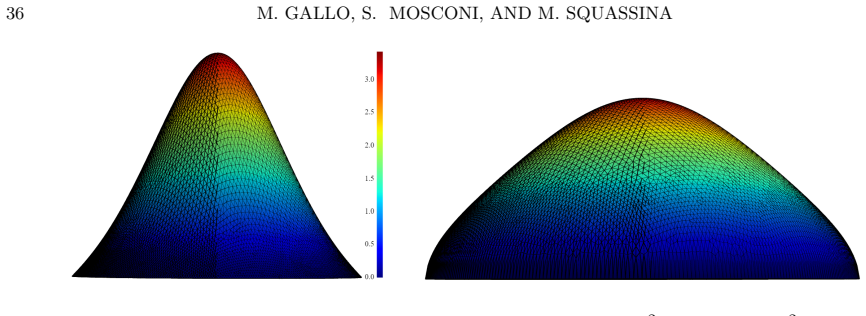
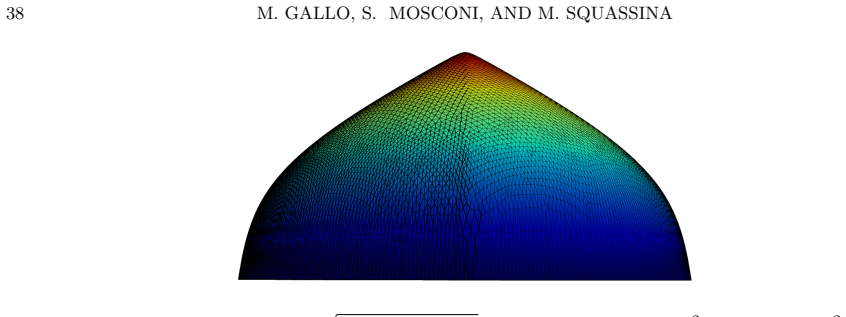
- Numerical checks in one-dimensional intervals or radial domains would directly test whether the constructed solutions indeed have concave logarithm.
Load-bearing premise
The auxiliary Lane-Emden problems admit solutions making u_q^{(1-q)/2} convex, and the limit as q approaches 1 from above preserves this convexity to yield a concave log u that solves the logarithmic equation.
What would settle it
An explicit positive solution (or numerical approximation) to -Δu = u log(u²) in a convex domain such as a ball, for which log u fails to be concave.
Figures
read the original abstract
We study concavity properties of positive solutions to the Logarithmic Schr\"odinger equation $-\Delta u=u\, \log u^2$ in a general convex domain with Dirichlet conditions. To this aim, we analyse the auxiliary Lane-Emden problems $-\Delta u = \sigma\, (u^q-u)$ and build, for any $\sigma>0$ and $q>1$, solutions $u_q$ such that $u_q^{(1-q)/2}$ is convex. By choosing $\sigma_q=2/(q-1)$ and letting $q \to 1^+$ we eventually construct a solution $u$ of the Logarithmic Schr\"odinger equation such that $\log u$ is concave. This seems to be one of the few attempts at studying concavity properties for superlinear, sign changing sources. To get the result, we both make inspections on the constant rank theorem and develop Liouville theorems on convex epigraphs, which might be useful in other frameworks.
Editorial analysis
A structured set of objections, weighed in public.
Referee Report
Summary. The paper constructs positive solutions u to the logarithmic Schrödinger equation −Δu = u log(u²) in convex domains with Dirichlet boundary conditions such that log u is concave. The construction proceeds by considering auxiliary Lane-Emden problems −Δu_q = σ_q (u_q^q − u_q) with σ_q = 2/(q−1), establishing convexity of v_q = u_q^{(1−q)/2} for each q > 1 via the constant-rank theorem, and passing to the limit q → 1^+ to obtain the target equation and concavity of log u, supported by new Liouville theorems on convex epigraphs.
Significance. If the limit passage is rigorously justified with uniform remainder control, the result would provide one of the first concavity statements for superlinear sign-changing nonlinearities and introduce potentially reusable Liouville theorems on epigraphs. The paper explicitly credits the constant-rank theorem and develops auxiliary Liouville results that could apply elsewhere.
major comments (2)
- [limit passage to the logarithmic equation] The central limit argument (as q → 1^+ with σ_q = 2/(q−1)) requires uniform estimates showing that the O(α²) remainder in the expansion of D²v_q (with α = (1−q)/2) is o(|α|) so that convexity of v_q implies concavity of log u after dividing by α < 0. No such estimate is supplied in the limit passage, and the constant-rank and Liouville results are applied only for each fixed q.
- [construction of the limiting solution] The claim that the limit u satisfies the logarithmic equation relies on the specific scaling σ_q = 2/(q−1) producing the exact nonlinearity 2u log u, but the passage must also preserve the Dirichlet condition and positivity; the manuscript does not detail the compactness or convergence mode used to justify this.
minor comments (2)
- [abstract and introduction] Notation for the logarithmic nonlinearity alternates between log u² and 2 log u; a single consistent expression should be used throughout.
- [Liouville theorems section] The statement of the Liouville theorems on convex epigraphs would benefit from an explicit list of the assumptions on the domain and the precise conclusion (e.g., constancy or boundedness).
Simulated Author's Rebuttal
We thank the referee for the careful reading and constructive criticism. The two major comments correctly identify gaps in the justification of the limit passage and the convergence details. We will perform a major revision to supply the missing uniform estimates and compactness arguments.
read point-by-point responses
-
Referee: [limit passage to the logarithmic equation] The central limit argument (as q → 1^+ with σ_q = 2/(q−1)) requires uniform estimates showing that the O(α²) remainder in the expansion of D²v_q (with α = (1−q)/2) is o(|α|) so that convexity of v_q implies concavity of log u after dividing by α < 0. No such estimate is supplied in the limit passage, and the constant-rank and Liouville results are applied only for each fixed q.
Authors: We agree that the manuscript lacks explicit uniform control on the remainder. In the revised version we will insert a new subsection (after the application of the constant-rank theorem) that derives the o(|α|) estimate uniformly for q near 1. The argument combines the Liouville theorems on convex epigraphs (already proved for each fixed q) with a compactness argument that yields uniform bounds on the third derivatives of v_q, allowing the remainder to be controlled independently of q. This will justify passing to the limit inside the inequality for D²(log u). revision: yes
-
Referee: [construction of the limiting solution] The claim that the limit u satisfies the logarithmic equation relies on the specific scaling σ_q = 2/(q−1) producing the exact nonlinearity 2u log u, but the passage must also preserve the Dirichlet condition and positivity; the manuscript does not detail the compactness or convergence mode used to justify this.
Authors: We acknowledge that the convergence mode is not spelled out. The revised proof of the main theorem will contain an additional paragraph detailing the following steps: (i) uniform L^∞ bounds for u_q independent of q, obtained from the maximum principle and the choice of σ_q; (ii) C^{2,α} estimates via standard elliptic regularity that are uniform on compact subsets; (iii) extraction of a subsequence converging in C^{2,α} to a limit u > 0 that satisfies the Dirichlet condition and, by the exact scaling σ_q = 2/(q−1), the logarithmic equation. Positivity of the limit follows from the strong maximum principle. revision: yes
Circularity Check
No significant circularity; derivation relies on external theorems and limit passage
full rationale
The paper's central construction proceeds by solving auxiliary Lane-Emden equations for each fixed q>1 with the explicit choice σ_q=2/(q-1), establishing convexity of v_q = u_q^{(1-q)/2} via the constant rank theorem and Liouville results on epigraphs, then passing to the limit q→1^+ to obtain a solution u of the logarithmic equation with the claimed concavity of log u. None of these steps defines the target concavity in terms of itself, renames a fitted quantity as a prediction, or reduces the result to a self-citation chain; the supporting theorems are developed or inspected within the paper as independent analytic tools rather than assumed by ansatz or prior self-reference. The argument therefore remains non-circular and self-contained against external mathematical benchmarks.
Axiom & Free-Parameter Ledger
axioms (1)
- standard math Standard results from elliptic PDE theory including maximum principles and regularity for semilinear equations
Reference graph
Works this paper leans on
-
[1]
An introduction to nonlinear functional analysis and elliptic problems
A. Ambrosetti, D. Arcoya, “An introduction to nonlinear functional analysis and elliptic problems”, Progr. Nonlinear Differential Equations Appl. 82, Birkh¨ auser, Boston, 2011. 25
work page 2011
-
[2]
N. M. Almousa, J. Assettini, M. Gallo, M. Squassina, Concavity properties for quasilin- ear equations and optimality remarks , Differential Integral Equations 37:1-2 (2024), 1–26. 3
work page 2024
-
[3]
O. Alvarez, J.-M. Lasry, P.-L. Lions, Convex viscosity solutions and state constraints J. Math. Pures. Appl. 76:3 (1997), 265–288. 4
work page 1997
-
[4]
R. F. Basener, Nonlinear Cauchy-Riemann equations and q-pseudoconvexity, Duke Math. J. 43:1 (1976), 203–213. 15
work page 1976
-
[5]
I. Bialynicki-Birula, J. Mycielski, Nonlinear wave mechanics , Ann. Physics 100:1-2 (1976), 62–93. 2
work page 1976
-
[6]
B. Bian, P. Guan, A microscopic convexity principle for nonlinear partial differential equations, Invent. Math. 177:2 (2009), 307–335. 11
work page 2009
-
[7]
B. Bian, P. Guan, X.-N. Ma, L. Xu, A constant rank theorem for quasiconcave solutions of fully nonlinear partial differential equations , Indiana Univ. Math. J. 60:1 (2011), 101–119. 7, 11
work page 2011
-
[8]
Geometric Properties for Parabolic and Elliptic PDE’s
M. Bianchini, P. Salani, Power concavity for solutions of nonlinear elliptic problems in convex domains, in “Geometric Properties for Parabolic and Elliptic PDE’s”, eds. R. Magnanini, S. Sakaguchi, A. Alvino, Springer INdAM Series 2, 2013. 4
work page 2013
-
[9]
N. H. Bingham, C. M. Goldie, J. L. Teugels, “Regular Variation”, Encyclopedia of Mathematics and its Applications 27, Cambridge University Press, Cambridge, 1987. 33
work page 1987
-
[10]
W. Borrelli, S. Mosconi, M. Squassina, Concavity properties for solutions to p-Laplace equations with concave nonlinearities, Adv. Calc. Var. 17:1 (2022), 79–97. 3, 4, 6, 10, 32, 35
work page 2022
-
[11]
H. J. Brascamp, E. H. Lieb, On extensions of the Brunn-Minkowski and Pr´ ekopa- Leindler theorems, inlcuding inequalities for log concave functions, and with an appli- cation to the diffusion equation , J. Funct. Anal. 22:4 (1976), 366–389. 3
work page 1976
- [12]
- [13]
-
[14]
X. Cabr` e, S. Chanillo,Stable solutions of semilinear elliptic problems in convex domains , Selecta Math. (N.S.) 4:1 (1998), 1–10. 5
work page 1998
-
[15]
L. A. Caffarelli, A. Friedman, Convexity of solutions of semilinear elliptic equations , Duke Math. J. 52:2 (1985), 431–456. 10
work page 1985
-
[16]
Carles, Logarithmic Schr¨ odinger equation and isothermal fluids, EMS Surv
R. Carles, Logarithmic Schr¨ odinger equation and isothermal fluids, EMS Surv. Math. Sci. 9:1 (2022), 99–134. 2, 8
work page 2022
-
[17]
Cazenave, Stable solutions of the logarithmic Schr¨ odinger equation, Nonlinear Anal
T. Cazenave, Stable solutions of the logarithmic Schr¨ odinger equation, Nonlinear Anal. 7:10 (1983), 1127–1140. 2
work page 1983
- [18]
-
[19]
L. Damascelli, M. Grossi, F. Pacella, Qualitative properties of positive solutions of semilinear elliptic equations in symmetric domains via the maximum principle , Ann. Inst. H. Poincar´ e C Anal. Non Lin´ eaire16:5 (1999), 631–652. 2, 6, 23, 33
work page 1999
-
[20]
Morse index of solutions of nonlinear elliptic equations
L. Damascelli, F. Pacella, “Morse index of solutions of nonlinear elliptic equations”, Ser. Nonlinear Anal. Appl. 30, De Gruyter, Leck, 2019. 35
work page 2019
-
[21]
E. N. Dancer, Some notes on the method of moving planes , Bull. Aust. Math. Soc. 46:3 (1992), 425–434. 45
work page 1992
-
[22]
E. N. Dancer, On the uniqueness of the positive solution of a singularly perturbed problem, Rocky Mountain J. Math. 25:3 (1995), 957–975. 2, 7, 8, 33
work page 1995
-
[23]
D. G. de Figueiredo, P.-L. Lions, R. D. Nussbaum, A priori estimates and existence of positive solutions of semilinear elliptic equations , J. Math. Pures Appl. 61 (1982), 133–155. 8, 24
work page 1982
-
[24]
J. Dolbeault, P. Felmer, Monotonicity up to radially symmetric cores of positive solutions to nonlinear elliptic equations: local moving planes and unique continuation in a non-Lipschitz case , Nonlinear Anal. 58:3-4 (2004), 299–317. 35
work page 2004
-
[25]
L. Dupaigne, A. Farina, T. Petitt, Liouville-type theorems for the Lane-Emden equation in the half-space and cones , J. Func. Anal. 284:10 (2023), 109906, pp. 27. 8
work page 2023
-
[26]
M. J. Esteban, P.-L. Lions, Existence and nonexistence results for semilinear elliptic problems in unbounded domains , Proc. Roy. Soc. Edinburgh Sect. A 93:1-2 (1982), 1–14. 8, 45
work page 1982
-
[27]
Farina, On the classification of solutions of the Lane–Emden equation on unbounded domains of RN, J
A. Farina, On the classification of solutions of the Lane–Emden equation on unbounded domains of RN, J. Math. Pures Appl. 87:5 (2007), 537–561. 8, 49
work page 2007
- [28]
-
[29]
B. Gidas, W.-M. Ni, L. Nirenberg, Symmetry and related properties via the maximum principles, Commun. Math. Phys. 68:3 (1979), 209–243. 35
work page 1979
- [30]
-
[31]
J. M. Gomes, Sufficient conditions for the convexity of the level sets of ground-state solutions, Arch. Math. (Basel) 88:3 (2007), 269–278. 7
work page 2007
-
[32]
P. Guerrero, J. L. L´ opez, J. Nieto, Global H1 solvability of the 3D logarithmic Schr¨ odinger equation, Nonlinear Anal. Real World Appl. 11:1 (2010), 79–87. 2
work page 2010
-
[33]
Elliptic partial differential equations
Q. Han, F. Lin, “Elliptic partial differential equations”, second edition, Courant Lect. Notes Math. 1, AMS, USA, 2011. 46
work page 2011
- [34]
-
[35]
E. F. Hefter, Application of the nonlinear Schr¨ odinger equation with a logarithmic inhomogeneous term to nuclear physics , Phys. Rev. A 32:2 (1985), 1201–1204. 2
work page 1985
-
[36]
Hofer, A note on the topological degree at a critical point of mountain-pass type , Proc
H. Hofer, A note on the topological degree at a critical point of mountain-pass type , Proc. Amer. Math. Soc. 90:2 (1984), 309–315. 25
work page 1984
- [37]
- [38]
- [39]
- [40]
-
[41]
L. Jeanjean, J. Zhang, X. Zhong, A global branch approach to normalized solutions for the Schr¨ odinger equation, J. Math. Pures Appl. 183 (2024), 44–75. 24, 25
work page 2024
-
[42]
J. Kar´ atson, P. L. Simon, On the stability properties of nonnegative solutions of semilinear problems with convex or concave nonlinearity , J. Comput. Appl. Math. 131:1-2 (2001), 497–501. 5
work page 2001
-
[43]
N. J. Korevaar, Convex solutions to nonlinear elliptic and parabolic boundary value problems, Indiana Univ. Math. J 32:4 (1983), 603–614. 3, 6, 9
work page 1983
-
[44]
N. J. Korevaar, Convexity of level sets for solutions to elliptic ring problems , Comm. Partial Differential Equations 15(4) (1990), 541–556. 11, 12
work page 1990
-
[45]
N. J. Korevaar, J. L. Lewis, Convex solutions of certain elliptic equations have constant rank Hessian, Arch. Ration. Mech. Anal. 97:1 (1987), 19–32. 7, 9, 10, 11, 15
work page 1987
-
[46]
A. U. Kennington, Power concavity and boundary value problems , Indiana Univ. Math. J. 34:3 (1985), 687–704. 3, 6, 9
work page 1985
-
[47]
O. A. Ladyzhenskaya, N. N. Ural’tseva, Linear and quasilinear elliptic equations , Aca- demic Press 44, New York-London, 1968. 18
work page 1968
-
[48]
K.-A. Lee, J. L. Vazquez, Parabolic approach to nonlinear elliptic eigenvalue problems , Adv. Math. 219:6 (2008), 2006–2028. 3
work page 2008
-
[49]
Lin, Uniqueness of least energy solutions to a semilinear elliptic equation in R2, Manuscripta Math
C.-S. Lin, Uniqueness of least energy solutions to a semilinear elliptic equation in R2, Manuscripta Math. 84:1 (1994) 13–19. 3, 6, 7
work page 1994
-
[50]
Lindqvist, A note on the nonlinear Rayleigh quotient , Potential Anal
P. Lindqvist, A note on the nonlinear Rayleigh quotient , Potential Anal. 2 (1993), 199–218. 35, 36
work page 1993
-
[51]
P. L. Lions, Two geometrical properties of solutions of semilinear problems , Appl. Anal. 12:4 (1981), 264–272. 3, 4, 8
work page 1981
-
[52]
P. J. McKenna, F. Pacella, M. Plum, D. Roth, A uniqueness result for a semilinear elliptic problem: a computer-assisted proof , J. Differential Equations 247 (2009), 2140–
work page 2009
-
[53]
L. G. Makar-Limanov, Solution of Dirichlet’s problem for the equation ∆u = −1 in a convex region, Mat. Zametki 9:1 (1971), 89–92. 3
work page 1971
-
[54]
S. Mosconi, G. Riey, M. Squassina, Concave solutions to Finsler p-Laplace type equa- tions, Discrete Contin. Dyn. Syst. Ser. A 44:12 (2024), 3669–3697. 3, 4, 10, 32, 35
work page 2024
-
[55]
Pardy, The incompleteness of the Schr¨ odinger equation, Ratio Mathematica 52 (2024)
M. Pardy, The incompleteness of the Schr¨ odinger equation, Ratio Mathematica 52 (2024). 2
work page 2024
-
[56]
P. Pucci, J. Serrin, “The maximum principle”, Progr. Nonlinear Differential Equations Appl. 73, Birkh¨ auser, Berlin, 2007. 13, 17, 26, 34, 35
work page 2007
-
[57]
Superlinear parabolic problems: blow-up, global existence and steady states
P. Quittner, P. Souplet, “Superlinear parabolic problems: blow-up, global existence and steady states”, second edition, Birkh¨ auser Adv. Texts, Basler Lehrb¨ ucher, Springer Nature Switzerland AG, 2019. 8, 20, 46
work page 2019
-
[58]
R. T. Rockafellar, “Convex analysis”, Princet. Math. Ser. 28, Princeton University Press, USA, 1996. 43, 44, 45 POWER LA W CONVERGENCE AND LOGARITHMIC SCHR ¨ODINGER EQUATION 53
work page 1996
-
[59]
S. Sakaguchi, Concavity properties of solutions to some degenerate quasilinear elliptic Dirichlet problems, Ann. Sc. Norm. Super. Pisa Cl. Sci. (4), 14:3 (1987), 403–421. 3
work page 1987
-
[60]
J. S´ anchez, P. Ubilla,Uniqueness results for the one-dimensional m-Laplacian consid- ering superlinear nonlinearities, Nonlinear Anal., 54:5 (2003), 927–938. 36
work page 2003
-
[61]
Soltan, Polarity and separation of cones , Linear Algebra Appl
V. Soltan, Polarity and separation of cones , Linear Algebra Appl. 538 (2018), 212–224. 44
work page 2018
-
[62]
Z.-Q. Wang, C. Zhang, Convergence from power-law to logarithmic-law in nonlinear scalar field equations, Arch. Rational Mech. Anal. 231:6 (2019) 45–61. 8
work page 2019
-
[63]
K. G. Zloshchastiev, Logarithmic nonlinearity in theories of quantum gravity: origin of time and observational consequences , Gravit. Cosmol. 16:4 (2010), 288-297. 2 (S. Mosconi) Department of Mathematics and Computer Science University of Catania Viale A. Doria 6, 95125 Catania, Italy Email address : sunra.mosconi@unict.it (M. Gallo, M. Squassina) Dipart...
work page 2010
discussion (0)
Sign in with ORCID, Apple, or X to comment. Anyone can read and Pith papers without signing in.