REVIEW 3 major objections 5 minor 57 references
Modeling time-delayed acoustic interactions of cavitation bubbles and bubble clusters
T0 review · 3 major / 5 minor · reviewed 2026-08-12 · deepseek-v4-flash
Pith's one-line read Accounting for the finite speed of sound materially changes predicted dynamics of dense cavitation bubble clusters, including the onset of cavitation.
desk verdict A useful extension of wave tracking to time-delayed bubble interactions, but the free pruning coefficient C needs a sensitivity study before the headline claims are fully credible. read the letter →
The pith
A machine-rendered reading of the paper's core claim, the machinery that carries it, and where it could break.
The reading
What carries the argument
The quasi-acoustic assumption: the Mach number is small, density and sound speed are nearly constant, so the velocity potential satisfies the linear wave equation and both the potential and its time derivative propagate unchanged along outgoing characteristics at the liquid sound speed. These invariants are stored on Lagrangian emission nodes emitted at each bubble wall; superposing the retarded potentials of all neighbor bubbles gives the local velocity and pressure fields, and the resulting driving pressure for each bubble. This yields a Keller-Miksis-style radial equation per bubble that is accurate to first order in the Mach number, with the interaction terms entering through the driving pressure and its time derivative.
What would settle it
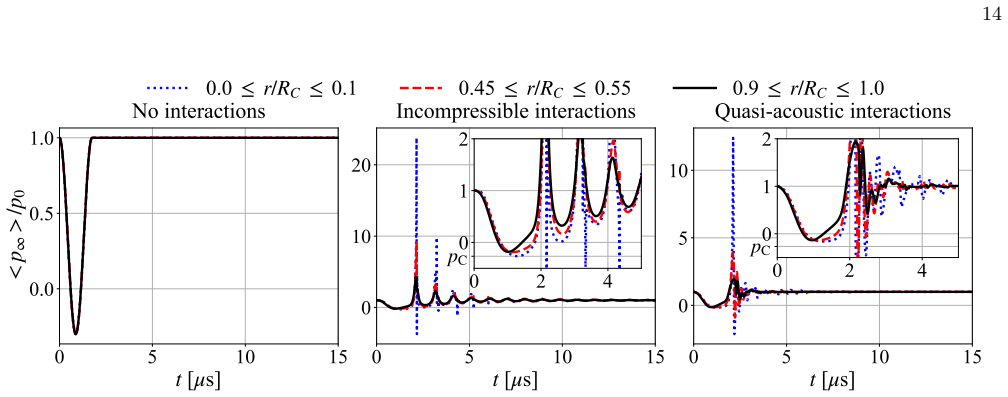
In a dense monodisperse spherical cluster (e.g., 250 bubbles of 2 µm radius in a 232 µm cluster), compare the predicted mean radius evolution and pressure at the cluster center under a 1.75 µs tension pulse against a fully resolved compressible two-phase simulation. If the resolved simulation shows no difference from an incompressible-interaction model in the onset time or peak pressure, the paper's central claim of appreciable time-delay effects in dense clusters is not supported.
Extended reading notes
Core claim
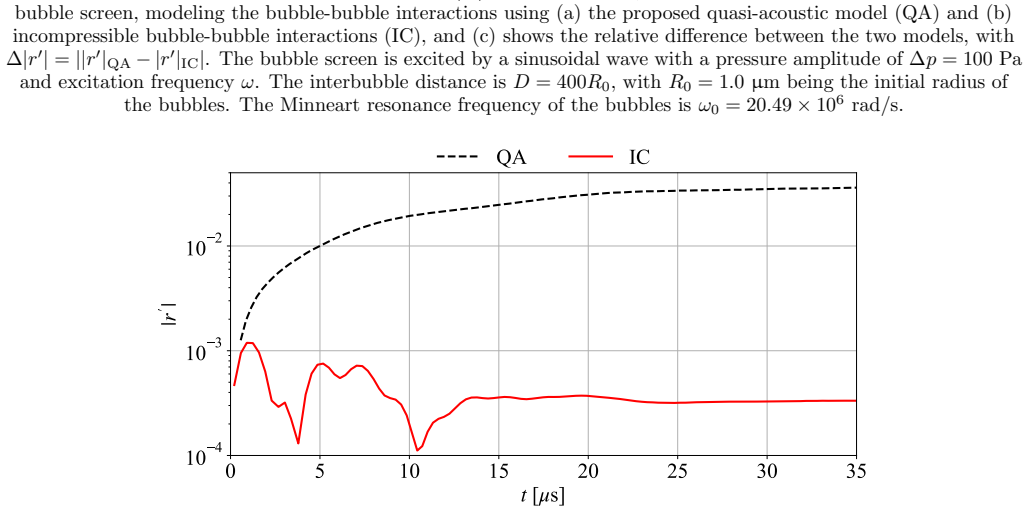
The central claim is that time-delayed, first-order-compressible bubble-bubble interactions materially change the predicted dynamics of dense mono- and polydisperse bubble clusters compared with models that treat interactions as instantaneous. The authors' quasi-acoustic model, built from the Keller-Miksis radial equation and a Lagrangian wave-tracking scheme, reproduces established collective phenomena while revealing strong quantitative differences: at resonance, the incompressible model predicts radial oscillation amplitudes that are only about 2% of the quasi-acoustic value for most bubbles in a bubble screen; in the two-bubble onset-of-cavitation case, the smaller bubble expands more under quasi-acoustic interactions because the pressure rise from the larger neighbor arrives late; and in tension-pulsed spherical clusters, incompressible interactions produce larger, more persistent pressure peaks than the time-delayed model. The paper therefore argues that finite propagation speed is a first-order effect for dense clusters, not a small correction.
Load-bearing premise
The model assumes a linear superposition of spherically symmetric wave potentials from all bubbles and neglects wave scattering, the finite size of the receiving bubble, and non-spherical radiation; in the densest clusters these neglected effects may be as large as the time-delay corrections being studied.
Editorial extensions
If this is right
- For dense bubble screens near resonance, neglecting the propagation delay can underestimate radial oscillation amplitudes by roughly two orders of magnitude.
- The onset of cavitation of a small bubble near a larger one is predicted to occur at less negative applied pressures (or with larger expansion) when time delays are included.
- In polydisperse clusters excited by a tension pulse, quasi-acoustic interactions make the system more damped, with faster decay of oscillations and shorter-lived excited states.
- Because the model retains first-order compressibility at a computational cost typical of ordinary differential equation systems, it offers a practical alternative to fully resolved simulations for multi-bubble problems.
- The differences between interaction models grow with cluster size and density, so finite sound speed matters most in large, dense systems.
Reading between the lines
- The Lagrangian emission-node framework already outputs the local velocity and pressure fields, so extending it to track bubble translation under Bjerknes forces should be straightforward and would test the spherical-stationary assumption.
- The prediction that time delays lower the pressure felt by a small bubble during expansion suggests that experimentally measured cavitation-inception thresholds near large bubbles could differ from incompressible-model predictions; a calibrated two-bubble experiment measuring the critical negative pressure would be a direct test.
- The pruning criterion for obsolete emission nodes relies on a case-dependent coefficient C; a systematic error analysis of this pruning would determine how much it affects the accuracy of the predicted delay effects in polydisperse clusters.
- For stronger collapses the constant-density, constant-sound-speed assumption breaks down (errors below 6% up to 50 MPa for water), so coupling this delay framework to a real-fluid equation of state might extend the model to shock-producing collapses.
Editorial analysis
A structured set of objections, weighed in public.
Referee Report
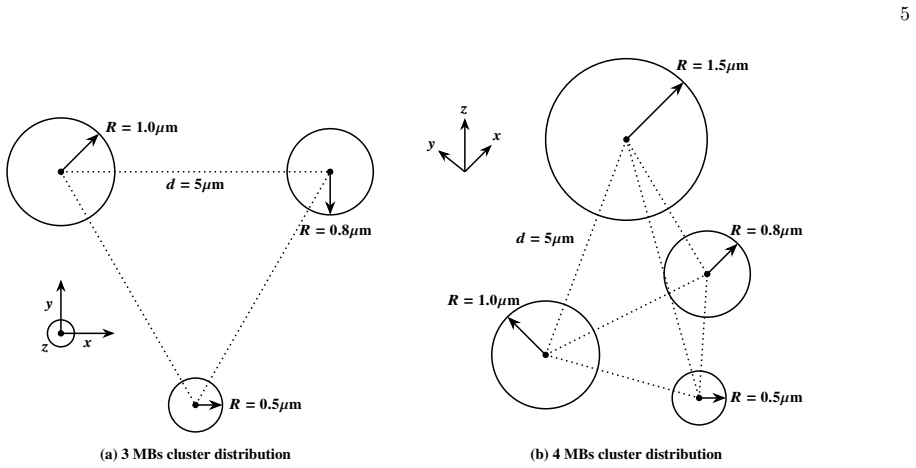
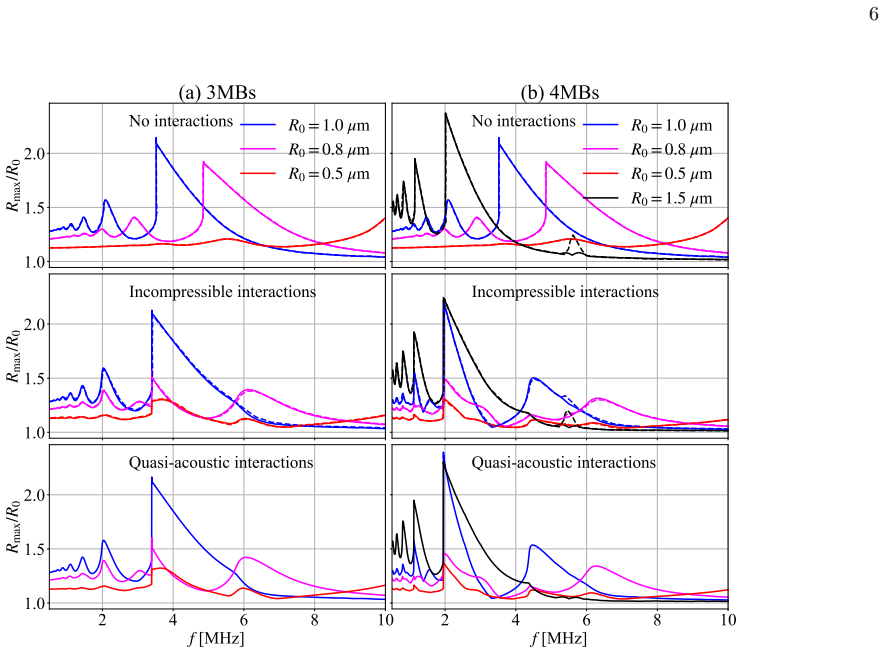
Summary. The paper proposes a low-dimensional model for the radial dynamics, acoustic emissions, and acoustic interactions of cavitation bubbles and bubble clusters, based on a quasi-acoustic assumption that retains first-order Mach number corrections and finite propagation speed. The model couples a Keller-Miksis equation for each bubble with a Lagrangian wave-tracking scheme for the emitted acoustic field and computes inter-bubble interaction pressures from superposed retarded potentials. The claims are tested against literature cases: frequency response of small polydisperse clusters, resonance patterns in a bubble screen, asymmetric collapse of a spherical cluster, and pressure-drop-induced cavitation onset in two-bubble and cluster configurations. The central claim is that finite-speed (quasi-acoustic) interactions materially change predicted dynamics in dense systems compared with incompressible-interaction models.
Significance. If the central claim holds, the paper offers an efficient computational tool that is more faithful than instantaneous-interaction RP-type models for dense bubble clusters, and it is accompanied by a public implementation (APECSS v1.7) and data repository. The derivation of the Keller-Miksis equation from the quasi-acoustic assumption is internally consistent, and the emission-node expressions reduce correctly to the bubble-wall boundary conditions. The independent literature comparisons (Haghi et al., Fan et al., Ida, Maeda and Colonius) are appropriate and no target constants are fitted to reproduce those results. However, the numerical demonstrations that underpin the headline results depend on an undocumented, case-dependent pruning coefficient C in Eq. (A2), and the validation against Fan et al. is only qualitative; these issues must be resolved before the significance of the claimed time-delay effects can be assessed.
major comments (3)
- [Appendix A, Eq. (A2); Sections VI B, VI D, VI E] The pruning criterion for emission nodes contains the free coefficient C, which the authors state is case-dependent and 'determined mainly by trial and error'. No C values are reported for any of the figures, and no sensitivity study is given. Because the central QA-vs-IC differences in Fig. 6 and the cavitation-onset results in Figs. 10-17 are produced by the numerical implementation of Eq. (27) using this pruning, the observed differences could in part be controlled by C rather than by finite propagation speed. This is a load-bearing issue. The authors should report the actual C values used for each test case and provide a sensitivity analysis over a range of C, demonstrating that the qualitative and quantitative conclusions are unchanged.
- [Appendix A, interaction-averaging approximation] The interaction model represents the retarded invariants phi_j and g_j of a neighbor by the mean of all emission nodes located inside the receiving bubble. This is an ad-hoc approximation: it averages over a volume that may contain only a few nodes in sparse cases or many nodes with high gradients in dense cases, and it neglects the finite size and curvature of the receiving bubble. The paper provides no validation of this approximation. Since the authors themselves note that other weighting schemes are possible, the sensitivity of the reported cluster dynamics to this averaging choice should be assessed, for instance by comparing with a higher-order interpolation or with direct evaluation of the retarded potentials at the bubble center.
- [Section VI B, Fig. 6] The comparison with Fan, Li, and Fuster for the bubble screen is only qualitative. The text states 'good agreement' but also acknowledges 'qualitative differences' in amplitude patterns, and the color scales in Fig. 6 indicate only order-of-magnitude agreement. Since this is the principal demonstration that finite-speed interactions create spatial patterns, a quantitative metric (e.g., relative amplitude error, pattern correlation, or a profile comparison along a centerline) is needed to support the claim of agreement and to allow the reader to judge the significance of the QA-IC differences.
minor comments (5)
- [Section I and Section VI B] The name 'Minneart' is a misspelling; the correct form is 'Minnaert' (as in the cited reference).
- [Figures 10 and 11] The axis labels appear as 'R [ m]' and 't [ s]'; the radius axis should be labeled with the proper unit (likely micrometers, 'R [µm]') to avoid ambiguity.
- [Eq. (26)] The notation N_i for the number of neighbor bubbles is introduced after N has been used for the total number of bubbles; this distinction should be clarified in the text to prevent confusion.
- [Section VI A] The phrase 'progressive sinusoidal wave' should probably read 'propagating sinusoidal wave'.
- [Appendix A, Eq. (A2)] The pruning condition is said to be 'based on Eq. (20)', but Eq. (20) uses the liquid density rho, whereas Eq. (A2) writes rho_0; the notation should be made consistent.
Circularity Check
No significant circularity: the central derivation is self-contained and validated against independent external benchmarks; only minor methodological self-citations are present.
full rationale
The paper's central derivation is self-contained: Sections II-V start from the quasi-acoustic assumption and the spherically symmetric wave equation, derive the Keller-Miksis equation (Eq. 15), and construct the multi-bubble interaction pressure (Eqs. 24-26) from a superposition of propagating velocity-potential invariants. The physical predictions are not obtained by fitting to the target outputs. The main self-citations are methodological: Ref. 48 (Denner & Schenke 2023) is cited for the Lagrangian wave-tracking of emission nodes, and Ref. 51 (APECSS) for the open-source implementation. These do not carry the physical argument alone, because the tracked fields and interaction sums are re-derived here and the model results are compared against independent literature results from Haghi, Sojahrood, and Kolios, Fan, Li, and Fuster, Ida, and Maeda and Colonius. The pruning coefficient C in Eq. (A2) is an undocumented, trial-and-error numerical tolerance rather than a physical parameter, and the absence of a sensitivity study is a legitimate robustness concern, but C is not fitted to reproduce the reported differences between quasi-acoustic and incompressible predictions. No equation is defined in terms of the quantity it is used to predict, no fitted parameter is renamed as a prediction, and no uniqueness claim is imported from the authors' prior work. The paper therefore exhibits no significant circularity; at most there is minor reliance on the authors' own software and prior tracking methodology.
Assumptions & free parameters
free parameters (1)
- C (emission-node pruning coefficient)
assumptions (4)
- domain assumption The liquid is isentropic with dρ = dp/c², and density and speed of sound are treated as constant.
- domain assumption Bubbles remain spherical and stationary; only radial dynamics are considered.
- domain assumption The acoustic field is the linear superposition of spherically symmetric potentials of all bubbles, evaluated at the receiving bubble's center.
- ad hoc to paper Retarded invariants φ and g of a neighbor are represented by the mean of emission nodes located inside the receiving bubble.
Cite this review
Pith. "Pith review of Modeling time-delayed acoustic interactions of cavitation bubbles and bubble clusters." pith.science (2026). https://pith.science/paper/IJ6RZKUF
@misc{pith2026241109021,
  author       = {Pith},
  title        = {Pith review of: Modeling time-delayed acoustic interactions of cavitation bubbles and bubble clusters},
  year         = {2026},
  howpublished = {\url{https://pith.science/paper/IJ6RZKUF}},
  note         = {Machine review of arXiv:2411.09021}
}
read the original abstract
We propose a low-dimensional modeling approach to simulate the dynamics, acoustic emissions and interactions of cavitation bubbles, based on a quasi-acoustic assumption. This quasi-acoustic assumption accounts for the compressibility of the medium surrounding the bubble and its finite speed of sound, whereby the potential of the acoustic wave emitted by the bubble propagates along outgoing characteristics. With these ingredients, a consistent set of equations describing the radial bubble dynamics as well as the resulting acoustic emissions and bubble-bubble interactions is obtained, which is accurate to the first order of the Mach number. This model is tested by considering several representative test cases, including the resonance behavior of multiple interacting bubbles and the response of dense mono- and polydisperse bubble clusters to a change in ambient pressure. The results are shown to be in excellent agreement with results reported in the literature. The differences associated with the finite propagation speed of the acoustic waves are observed to be most pronounced for the pressure-driven bubble dynamics in dense bubble clusters and the onset of cavitation in response to a change in ambient pressure.
Figures

Figures from the paper (14 more)






Reference graph
Works this paper leans on
-
[1]
author author Y. Matsumoto \ and\ author S. Yoshizawa ,\ title en title Behaviour of a bubble cluster in an ultrasound field , \ 10.1002/fld.833 journal journal International Journal for Numerical Methods in Fluids \ volume 47 ,\ pages 591--601 ( year 2005 ) NoStop
-
[2]
author author J. H. \ Song , author A. Moldovan , \ and\ author P. Prentice ,\ title en title Non-linear Acoustic Emissions from Therapeutically Driven Contrast Agent Microbubbles , \ 10.1016/j.ultrasmedbio.2019.04.005 journal journal Ultrasound in Medicine & Biology \ volume 45 ,\ pages 2188--2204 ( year 2019 ) NoStop
-
[3]
author author J.-P. \ Franc \ and\ author J.-M. \ Michel ,\ 10.1007/1-4020-2233-6 en title Fundamentals of Cavitation ,\ series Fluid Mechanics and Its Applications , Vol. volume 76 \ ( publisher Kluwer Academic Publishers ,\ address Dordrecht ,\ year 2005 ) NoStop
-
[4]
author author C.-T. \ Hsiao \ and\ author G. L. \ Chahine ,\ title en title Dynamic response of a composite propeller blade subjected to shock and bubble pressure loading , \ 10.1016/j.jfluidstructs.2015.01.012 journal journal Journal of Fluids and Structures \ volume 54 ,\ pages 760--783 ( year 2015 ) NoStop
-
[5]
author author M. Dular , author T. Požar , author J. Zevnik , \ and\ author R. Petkovšek ,\ title en title High speed observation of damage created by a collapse of a single cavitation bubble , \ 10.1016/j.wear.2018.11.004 journal journal Wear \ volume 418-419 ,\ pages 13--23 ( year 2019 ) NoStop
-
[6]
author author R. S. \ Salzar , author D. Treichler , author A. Wardlaw , author G. Weiss , \ and\ author J. Goeller ,\ title en title Experimental Investigation of Cavitation as a Possible Damage Mechanism in Blast - Induced Traumatic Brain Injury in Post - Mortem Human Subject Heads , \ 10.1089/neu.2016.4600 journal journal Journal of Neurotrauma \ volum...
-
[7]
author author P. L. L. \ Walls , author O. McRae , author V. Natarajan , author C. Johnson , author C. Antoniou , \ and\ author J. C. \ Bird ,\ title en title Quantifying the potential for bursting bubbles to damage suspended cells , \ 10.1038/s41598-017-14531-5 journal journal Scientific Reports \ volume 7 ,\ pages 15102 ( year 2017 ) NoStop
-
[8]
author author E. Johnsen \ and\ author T. Colonius ,\ title title Numerical simulations of non-spherical bubble collapse , \ 10.1017/S0022112009006351 journal journal Journal of Fluid Mechanics \ volume 629 ,\ pages 231--262 ( year 2009 ) NoStop
Show all 57 references
-
[9]
Ida ,\ title en title Multibubble cavitation inception , \ 10.1063/1.3265547 journal journal Physics of Fluids \ volume 21 ,\ pages 113302 ( year 2009 ) NoStop
author author M. Ida ,\ title en title Multibubble cavitation inception , \ 10.1063/1.3265547 journal journal Physics of Fluids \ volume 21 ,\ pages 113302 ( year 2009 ) NoStop
2009 doi
-
[10]
\ Wang \ and\ author C
author author Y.-C. \ Wang \ and\ author C. E. \ Brennen ,\ title title Numerical Computation of Shock Waves in a Spherical Cloud of Cavitation Bubbles , \ 10.1115/1.2823549 journal journal Journal of Fluids Engineering \ volume 121 ,\ pages 872--880 ( year 1999 ) NoStop
-
[11]
Shen , author L
author author Y. Shen , author L. Zhang , author Y. Wu , \ and\ author W. Chen ,\ title en title The role of the bubble–bubble interaction on radial pulsations of bubbles , \ 10.1016/j.ultsonch.2021.105535 journal journal Ultrasonics Sonochemistry \ volume 73 ,\ pages 105535 (...
2021
-
[12]
Deng , author D
author author F. Deng , author D. Zhao , author L. Zhang , \ and\ author Y. Li ,\ title en title Acoustic radiation of bubble clusters with different volume fractions , \ 10.1063/5.0195923 journal journal Physics of Fluids \ volume 36 ,\ pages 033308 ( year 2024 ) NoStop
-
[13]
author author L. Rayleigh ,\ title title On the pressure developed in a liquid during the collapse of a spherical cavity , \ 10.1080/14786440808635681 journal journal Philosophical Magazine \ volume 34 ,\ pages 94--98 ( year 1917 ) NoStop
-
[14]
author author F. R. \ Gilmore ,\ https://resolver.caltech.edu/CaltechAUTHORS:Gilmore_fr_26-4 title The growth or collapse of a spherical bubble in a viscous compressible liquid , \ type Tech. Rep. \ number Report No. 26-4 \ ( institution California Institute of Technology ,\ a...
1952
-
[15]
author author L. Trilling ,\ title en title The Collapse and Rebound of a Gas Bubble , \ 10.1063/1.1701962 journal journal Journal of Applied Physics \ volume 23 ,\ pages 14--17 ( year 1952 ) NoStop
1952 doi
-
[16]
author author J. B. \ Keller \ and\ author M. Miksis ,\ title title Bubble oscillations of large amplitude , \ 10.1121/1.384720 journal journal The Journal of the Acoustical Society of America \ volume 68 ,\ pages 628--633 ( year 1980 ) NoStop
-
[17]
Prosperetti \ and\ author A
author author A. Prosperetti \ and\ author A. Lezzi ,\ title en title Bubble dynamics in a compressible liquid. Part 1. First -order theory , \ 10.1017/S0022112086000460 journal journal Journal of Fluid Mechanics \ volume 168 ,\ pages 457--478 ( year 1986 ) NoStop
-
[18]
Lezzi \ and\ author A
author author A. Lezzi \ and\ author A. Prosperetti ,\ title en title Bubble dynamics in a compressible liquid. Part 2. Second -order theory , \ 10.1017/S0022112087003185 journal journal Journal of Fluid Mechanics \ volume 185 ,\ pages 289--321 ( year 1987 ) NoStop
-
[19]
author author F. Denner ,\ title en title The Gilmore - NASG model to predict single-bubble cavitation in compressible liquids , \ 10.1016/j.ultsonch.2020.105307 journal journal Ultrasonics Sonochemistry \ volume 70 ,\ pages 105307 ( year 2021 ) NoStop
2020
-
[20]
Fuster , author J
author author D. Fuster , author J. M. \ Conoir , \ and\ author T. Colonius ,\ title title Effect of direct bubble-bubble interactions on linear-wave propagation in bubbly liquids , \ 10.1103/PhysRevE.90.063010 journal journal Physical Review E \ volume 90 ,\ pages 063010 ( ye...
-
[21]
author author D. Fuster ,\ title en title A Review of Models for Bubble Clusters in Cavitating Flows , \ 10.1007/s10494-018-9993-4 journal journal Flow, Turbulence and Combustion \ volume 102 ,\ pages 497--536 ( year 2019 ) NoStop
2019 doi
-
[22]
author author M. S. \ Plesset \ and\ author A. Prosperetti ,\ title title Bubble Dynamics and Cavitation , \ 10.1146/annurev.fl.09.010177.001045 journal journal Annual Review of Fluid Mechanics \ volume 9 ,\ pages 145--185 ( year 1977 ) NoStop
-
[23]
Lauterborn \ and\ author T
author author W. Lauterborn \ and\ author T. Kurz ,\ title en title Physics of bubble oscillations , \ 10.1088/0034-4885/73/10/106501 journal journal Reports on Progress in Physics \ volume 73 ,\ pages 106501 ( year 2010 ) NoStop
2010 doi
-
[24]
author author F. Denner ,\ title en title The Kirkwood – Bethe hypothesis for bubble dynamics, cavitation, and underwater explosions , \ 10.1063/5.0209167 journal journal Physics of Fluids \ volume 36 ,\ pages 051302 ( year 2024 ) NoStop
-
[25]
Fu , author X.-X
author author L. Fu , author X.-X. \ Liang , author S. Wang , author S. Wang , author P. Wang , author Z. Zhang , author J. Wang , author A. Vogel , \ and\ author C. Yao ,\ title en title Laser induced spherical bubble dynamics in partially confined geometry with acoustic feed...
-
[26]
Stricker , author A
author author L. Stricker , author A. Prosperetti , \ and\ author D. Lohse ,\ title en title Validation of an approximate model for the thermal behavior in acoustically driven bubbles , \ 10.1121/1.3626132 journal journal The Journal of the Acoustical Society of America \ volu...
-
[27]
Zhou \ and\ author A
author author G. Zhou \ and\ author A. Prosperetti ,\ title en title Modelling the thermal behaviour of gas bubbles , \ 10.1017/jfm.2020.645 journal journal Journal of Fluid Mechanics \ volume 901 ,\ pages R3 ( year 2020 ) NoStop
2020 doi
-
[28]
Klapcsik \ and\ author F
author author K. Klapcsik \ and\ author F. Hegedűs ,\ title en title Study of non-spherical bubble oscillations under acoustic irradiation in viscous liquid , \ 10.1016/j.ultsonch.2019.01.031 journal journal Ultrasonics Sonochemistry \ volume 54 ,\ pages 256--273 ( year 2019 ) NoStop
2019 doi
-
[29]
author author T. S. \ Folden \ and\ author F. J. \ Aschmoneit ,\ title en title A classification and review of cavitation models with an emphasis on physical aspects of cavitation , \ 10.1063/5.0157926 journal journal Physics of Fluids \ volume 35 ,\ pages 081301 ( year 2023 ) NoStop
-
[30]
Mnich , author F
author author D. Mnich , author F. Reuter , author F. Denner , \ and\ author C.-D. \ Ohl ,\ title en title Single cavitation bubble dynamics in a stagnation flow , \ 10.1017/jfm.2023.1048 journal journal Journal of Fluid Mechanics \ volume 979 ,\ pages A18 ( year 2024 ) NoStop
2023
-
[31]
Saini , author Y
author author M. Saini , author Y. Saade , author D. Fuster , \ and\ author D. Lohse ,\ title en title Finite speed of sound effects on asymmetry in multibubble cavitation , \ 10.1103/PhysRevFluids.9.043602 journal journal Physical Review Fluids \ volume 9 ,\ pages 043602 ( ye...
-
[32]
Fan , author H
author author Y. Fan , author H. Li , \ and\ author D. Fuster ,\ title en title Time-delayed interactions on acoustically driven bubbly screens , \ 10.1121/10.0008905 journal journal The Journal of the Acoustical Society of America \ volume 150 ,\ pages 4219--4231 ( year 2021 ) NoStop
-
[33]
Haghi \ and\ author M
author author H. Haghi \ and\ author M. C. \ Kolios ,\ title en title The role of primary and secondary delays in the effective resonance frequency of acoustically interacting microbubbles , \ 10.1016/j.ultsonch.2022.106033 journal journal Ultrasonics Sonochemistry \ volume 86...
2022
-
[34]
Mettin , author I
author author R. Mettin , author I. Akhatov , author U. Parlitz , author C.-D. \ Ohl , \ and\ author W. Lauterborn ,\ title en title Bjerknes forces between small cavitation bubbles in a strong acoustic field , \ 10.1103/PhysRevE.56.2924 journal journal Physical Review E \ vol...
-
[35]
Jiang , author F
author author L. Jiang , author F. Liu , author H. Chen , author J. Wang , \ and\ author D. Chen ,\ title en title Frequency spectrum of the noise emitted by two interacting cavitation bubbles in strong acoustic fields , \ 10.1103/PhysRevE.85.036312 journal journal Physical Re...
-
[36]
Jiang , author H
author author L. Jiang , author H. Ge , author F. Liu , \ and\ author D. Chen ,\ title title Investigations on dynamics of interacting cavitation bubbles in strong acoustic fields , \ 10.1016/j.ultsonch.2016.05.017 journal journal Ultrasonics Sonochemistry \ volume 34 ,\ pages...
2016 doi
-
[37]
Haghi , author A
author author H. Haghi , author A. Sojahrood , \ and\ author M. C. \ Kolios ,\ title en title Collective nonlinear behavior of interacting polydisperse microbubble clusters , \ 10.1016/j.ultsonch.2019.104708 journal journal Ultrasonics Sonochemistry \ volume 58 ,\ pages 104708...
2019
-
[38]
Guédra , author C
author author M. Guédra , author C. Cornu , \ and\ author C. Inserra ,\ title en title A derivation of the stable cavitation threshold accounting for bubble-bubble interactions , \ 10.1016/j.ultsonch.2017.03.010 journal journal Ultrasonics Sonochemistry \ volume 38 ,\ pages 16...
2017 doi
-
[39]
Yasui , author J
author author K. Yasui , author J. Lee , author T. Tuziuti , author A. Towata , author T. Kozuka , \ and\ author Y. Iida ,\ title en title Influence of the bubble-bubble interaction on destruction of encapsulated microbubbles under ultrasound , \ 10.1121/1.3179677 journal jour...
-
[40]
D'Agostino \ and\ author C
author author L. D'Agostino \ and\ author C. E. \ Brennen ,\ title en title Linearized dynamics of spherical bubble clouds , \ 10.1017/S0022112089000339 journal journal Journal of Fluid Mechanics \ volume 199 ,\ pages 155--176 ( year 1989 ) NoStop
-
[41]
Arora , author C
author author M. Arora , author C. D. \ Ohl , \ and\ author D. Lohse ,\ title title Effect of nuclei concentration on cavitation cluster dynamics , \ 10.1121/1.2722045 journal journal The Journal of the Acoustical Society of America \ volume 121 ,\ pages 3432--3436 ( year 2007...
-
[42]
author author E. S. \ Nasibullaeva \ and\ author I. S. \ Akhatov ,\ title title Bubble cluster dynamics in an acoustic field , \ 10.1121/1.4802906 journal journal The Journal of the Acoustical Society of America \ volume 133 ,\ pages 3727--3738 ( year 2013 ) NoStop
-
[43]
Zhao , author W
author author G. Zhao , author W. Chen , author F. Tao , author L. Zhang , \ and\ author Y. Wu ,\ title en title Dynamics of bubbles in cavitation cloud based on lattice model , \ 10.1063/5.0010924 journal journal Journal of Applied Physics \ volume 127 ,\ pages 244701 ( year ...
-
[44]
\ Ohl , author J
author author S.-W. \ Ohl , author J. M. \ Rosselló , author D. Fuster , \ and\ author C.-D. \ Ohl ,\ title en title Finite amplitude wave propagation through bubbly fluids , \ 10.1016/j.ijmultiphaseflow.2024.104826 journal journal International Journal of Multiphase Flow \ vo...
2024
-
[45]
Bremond , author M
author author N. Bremond , author M. Arora , author C.-D. \ Ohl , \ and\ author D. Lohse ,\ title title Controlled Multibubble Surface Cavitation , \ 10.1103/PhysRevLett.96.224501 journal journal Physical Review Letters \ volume 96 ,\ pages 224501 ( year 2006 ) NoStop
-
[46]
Minnaert ,\ title en title XVI
author author M. Minnaert ,\ title en title XVI . On musical air-bubbles and the sounds of running water , \ 10.1080/14786443309462277 journal journal The London, Edinburgh, and Dublin Philosophical Magazine and Journal of Science \ volume 16 ,\ pages 235--248 ( year 1933 ) NoStop
-
[47]
author author A. Prosperetti ,\ title en title Bubble phenomena in sound fields: part one , \ 10.1016/0041-624X(84)90024-6 journal journal Ultrasonics \ volume 22 ,\ pages 69--77 ( year 1984 ) NoStop
1984 doi
-
[48]
Denner \ and\ author S
author author F. Denner \ and\ author S. Schenke ,\ title en title Modeling acoustic emissions and shock formation of cavitation bubbles , \ 10.1063/5.0131930 journal journal Physics of Fluids \ volume 35 ,\ pages 012114 ( year 2023 a ) NoStop
-
[49]
Fuster \ and\ author T
author author D. Fuster \ and\ author T. Colonius ,\ title en title Modelling bubble clusters in compressible liquids , \ 10.1017/jfm.2011.380 journal journal Journal of Fluid Mechanics \ volume 688 ,\ pages 352--389 ( year 2011 ) NoStop
2011 doi
-
[50]
\ Zhang , author S.-M
author author A.-M. \ Zhang , author S.-M. \ Li , author P. Cui , author S. Li , \ and\ author Y.-L. \ Liu ,\ title en title A unified theory for bubble dynamics , \ 10.1063/5.0145415 journal journal Physics of Fluids \ volume 35 ,\ pages 033323 ( year 2023 ) NoStop
-
[51]
Denner \ and\ author S
author author F. Denner \ and\ author S. Schenke ,\ title en title APECSS : A software library for cavitation bubble dynamics and acoustic emissions , \ 10.21105/joss.05435 journal journal Journal of Open Source Software \ volume 8 ,\ pages 5435 ( year 2023 b ) NoStop
-
[52]
Maeda \ and\ author T
author author K. Maeda \ and\ author T. Colonius ,\ title en title Bubble cloud dynamics in an ultrasound field , \ 10.1017/jfm.2018.968 journal journal Journal of Fluid Mechanics \ volume 862 ,\ pages 1105--1134 ( year 2019 ) NoStop
2018 doi
-
[53]
Maeda \ and\ author T
author author K. Maeda \ and\ author T. Colonius ,\ title title A source term approach for generation of one-way acoustic waves in the Euler and Navier – Stokes equations , \ 10.1016/j.wavemoti.2017.08.004 journal journal Wave Motion \ volume 75 ,\ pages 36--49 ( year 2017 ) NoStop
2017 doi
-
[54]
Fuster , author K
author author D. Fuster , author K. Pham , \ and\ author S. Zaleski ,\ title en title Stability of bubbly liquids and its connection to the process of cavitation inception , \ 10.1063/1.4870820 journal journal Physics of Fluids \ volume 26 ,\ pages 042002 ( year 2014 ) NoStop
-
[55]
author author E. A. \ Neppiras \ and\ author B. E. \ Noltingk ,\ title en title Cavitation Produced by Ultrasonics : Theoretical Conditions for the Onset of Cavitation , \ 10.1088/0370-1301/64/12/302 journal journal Proceedings of the Physical Society. Section B \ volume 64 ,\...
-
[56]
Ando , author T
author author K. Ando , author T. Colonius , \ and\ author C. E. \ Brennen ,\ title title Numerical simulation of shock propagation in a polydisperse bubbly liquid , \ 10.1016/j.ijmultiphaseflow.2011.03.007 journal journal International Journal of Multiphase Flow \ volume 37 ,...
2011 doi
-
[57]
Wagner \ and\ author A
author author W. Wagner \ and\ author A. Pruß ,\ title title The IAPWS Formulation 1995 for the Thermodynamic Properties of Ordinary Water Substance for General and Scientific Use , \ 10.1063/1.1461829 journal journal Journal of Physical and Chemical Reference Data \ volume 31...
1995 doi
Reviewed August 12, 2026 · model on record in the stance chip above.
Discussion (0). Continue with ORCID to comment.