REVIEW 3 major objections 5 minor 1 cited by
The ALMA-CRISTAL Survey: Complex kinematics of the galaxies at the end of the Reionization Era
T0 review · 3 major / 5 minor · reviewed 2026-08-12 · deepseek-v4-flash
Pith's one-line read At $z=5.65$, the galaxy HZ10 is resolved into at least three components that are merging, with cold [C ii] and ionized [O iii] gas moving together.
desk verdict Solid morphological result with honest, underdetermined dynamics; the three-component discovery stands, but the disk-vs-merger classification is not settled and the paper knows it. read the letter →
The pith
A machine-rendered reading of the paper's core claim, the machinery that carries it, and where it could break.
The reading
What carries the argument
The analysis is carried by high-resolution [C ii] 158$\mu$m line observations from ALMA (beam $\sim0.3$ arcsec, about $1.8$ kpc at $z=5.65$), which resolve HZ10-C into roughly five independent beams along its kinematic major axis. Position-velocity diagrams along the main and minor axes, together with aperture spectra fit by single and double Gaussians, provide the rotation curves. DysmalPy—a forward-modeling code that generates a mock data cube from a chosen mass distribution (Sérsic baryon disk plus Navarro-Frenk-White dark halo) and convolves it with the beam and line-spread function—is used to test whether the observed rotation curve is consistent with a rotating disk, with inclination priored from the 2D Sérsic axis ratio. JWST/NIRSpec [O iii] 5007 Å integral-field data, degraded to ALMA's resolution, provide the comparison that ties the neutral gas kinematics to the ionized phase.
What would settle it
An ALMA observation at $\sim0.15$ arcsec resolution matching JWST that resolves HZ10-C into two distinct [C ii] velocity peaks or two separate continuum nuclei would falsify the single-disk interpretation, while a coherent single-peaked velocity field across all channels would support it; a second decisive test would be the detection of a statistically significant broad [C ii] spectral component, which would favor an outflow-dominated rather than rotation-supported system.
Extended reading notes
Core claim
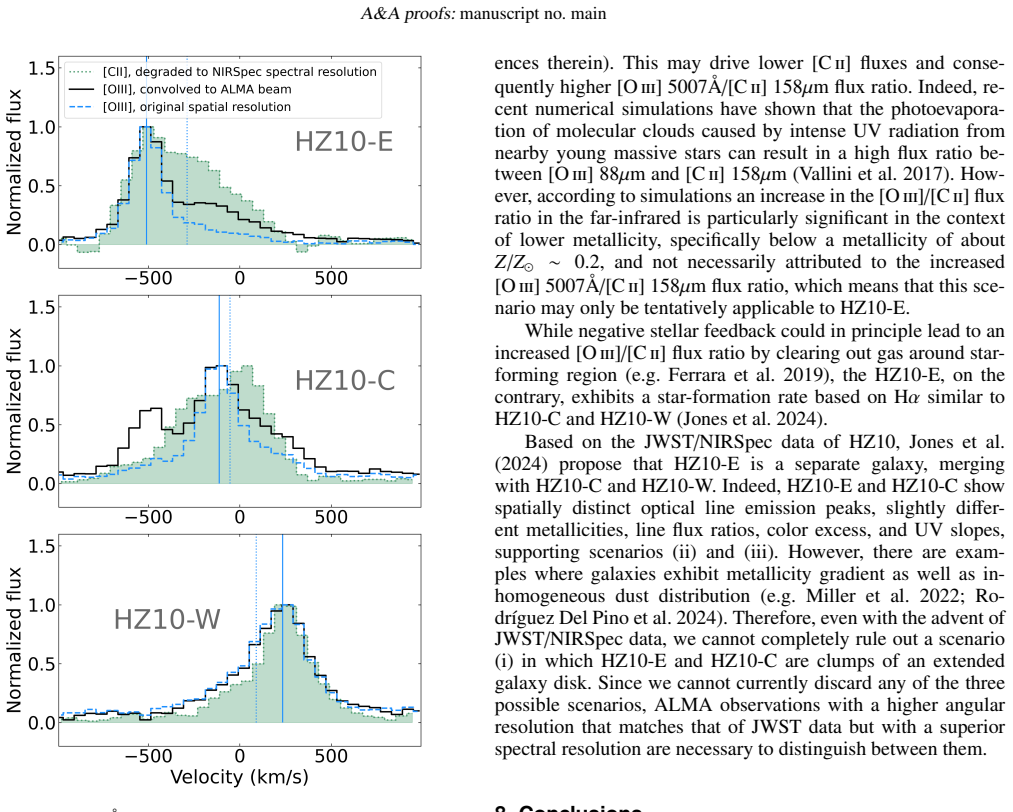
The central claim is that HZ10 is not a single galaxy: position-velocity diagrams from the new ALMA observations reveal at least three [C ii] components—HZ10-E, HZ10-C, and HZ10-W—separated by $1.5$ and $4$ kpc from the central component. HZ10-C is resolved along its major axis and shows an S-shaped rotation curve; DysmalPy kinematic modeling with a Sérsic baryon disk and Navarro-Frenk-White halo reproduces the curve with $V_{\mathrm{rot}}/\sigma_0 = 1.9$ and intrinsic dispersion $\sigma_0 \approx 200$ km s$^{-1}$, but the authors state explicitly that a dispersion-dominated system or a close double merger cannot be ruled out. Spatially and kinematically, [C ii] emission resembles the broad [O iii] 5007 Å component seen by JWST/NIRSpec across all three components, leading the authors to propose that neutral and ionized gas phases are well mixed and that the system is interacting. On this basis the paper offers three dynamical scenarios: a double merger of HZ10-W with a disturbed clumpy disk of HZ10-C+E, a triple merger in which HZ10-E and HZ10-W join the disk HZ10-C, and a quadruple merger in which both companions merge with a close double merger at HZ10-C.
Load-bearing premise
The argument depends on the premise that HZ10-C plus HZ10-E can be modeled as a single rotating disk, with its inclination set by the 2D Sérsic axis ratio and one intrinsic velocity dispersion; if the central component is actually a close pair of merging galaxies or is dispersion-dominated, the fitted rotation-support value $V_{\mathrm{rot}}/\sigma_0 = 1.9$ no longer carries the disk interpretation, and the paper explicitly concedes this alternative cannot be excluded.
Editorial extensions
If this is right
- If HZ10 is a multiple merger, its mass and star-formation budget must be divided among at least three components, changing how its position on the main sequence and its gas-depletion timescale are interpreted.
- A disk model can fit HZ10-C+HZ10-E, but the best-fit intrinsic dispersion near $200$ km s$^{-1}$ is at the high end for rotation-dominated galaxies, so the 'disturbed disk' label remains only one of three surviving scenarios.
- The kinematic match between [C ii] and broad [O iii] implies that [C ii] in this system traces gas involved in the interaction or outflow, not simply a quiescent cold phase.
- Distinguishing the double, triple, and quadruple merger scenarios requires ALMA resolution matching JWST's $\sim0.15$ arcsec together with higher spectral resolution than the current data provide.
Reading between the lines
- If the multiplicity seen in HZ10 is common among $z\sim5$ main-sequence galaxies, some galaxies previously classified as rotating disks from $\sim1$ arcsec [C ii] data may be unresolved mergers, which would raise the inferred merger fraction at the end of reionization.
- The close [C ii]-against-broad-[O iii] correspondence suggests that [C ii] maps could serve as a proxy for ionized outflows and tidal interactions in reionization-era galaxies where optical lines are faint or obscured.
- A testable prediction of the well-mixed gas picture is that the resolved [N ii]/[C ii] ratio, which tracks the ionized fraction of the gas, should be roughly uniform across HZ10-C, HZ10-E, and HZ10-W; a strong gradient would instead favor different physical origins for each component.
- If the quadruple merger scenario is correct, HZ10 is assembling a baryon mass near $10^{11}$ solar masses through several simultaneous interactions, a possible pathway for building massive galaxies by the end of reionization.
Signed reviews
Editorial analysis
A structured set of objections, weighed in public.
Referee Report
Summary. The paper presents a morpho-kinematic analysis of the z=5.65 galaxy HZ10 using new ALMA [C II] 158 micron observations at ~0.3 arcsecond resolution and JWST/NIRSpec rest-frame optical integral-field spectroscopy. The authors identify three components (HZ10-E, HZ10-C, HZ10-W) in both [C II] and [O III] emission, argue that the system is interacting, and test whether the central C+E complex can be described as a rotating disk. They use DysmalPy to fit a Sersic baryon disk plus NFW halo model, derive Vrot/sigma0 = 1.9, and propose three dynamical scenarios: a disturbed disk merging with HZ10-W, a disk with satellite HZ10-E merging, and a close merger/triple-merger interpretation. They also compare [C II] with [O III] kinematics and conclude that the ionized and neutral gas phases are well mixed.
Significance. If the morphological claims hold, HZ10 becomes a rare resolved example of a multi-component interacting system at z~5.65, and the [C II]/[O III] comparison provides a useful test of multiphase ISM kinematics in early galaxies. The paper is commendable for using JWST data to independently confirm the faint HZ10-E component, for checking the JvM correction and channel-masking effects, and for presenting MCMC credible intervals for the DysmalPy fits. However, the dynamical classification and the Vrot/sigma0 = 1.9 value are conditional on a single tested model, so the paper's contribution to merger/disk classification statistics is weaker than the abstract implies. The three-component morphology and the interacting nature are well supported; the disk-versus-merger interpretation of the central complex requires additional quantitative model comparison or a more explicit presentation as a hypothesis.
major comments (3)
- [Sec. 5, Fig. 7] The DysmalPy modeling tests only a single rotating-disk model (Sersic baryon disk plus NFW halo) for the HZ10-C+HZ10-E complex, and the resulting Vrot/sigma0 = 1.9 is presented as a characterization of the system's dynamical state. Because no alternative model (e.g., a two-component merger or a dispersion-dominated configuration) is fit to the same data and compared, this ratio supports the disk scenario only conditionally. The paper itself states in Sec. 5 that 'we cannot rule out the dispersion-dominated nature of the HZ10-C+HZ10-E system' and in Sec. 7 that 'we cannot currently discard any of the three possible scenarios.' This underdetermination should be reflected in the abstract and conclusions, or a formal model comparison should be performed. As written, the Vrot/sigma0 value and the 'disturbed clumpy rotation disk' language in scenario (i) can easily be read as a dynamical classification that the current data do not establish.
- [Sec. 5, Table 1 and Appendix A] The Gaussian priors for r_eff, Sersic index n, and inclination i in the DysmalPy fit are taken from a 2D Sersic fit to the blended [C II] moment-0 map of HZ10-C+HZ10-E. If HZ10-E is a physically distinct source rather than a clump in a single disk, the axis ratio of the blended light (0.77 +/- 0.01) is not a reliable inclination estimator. Yet the posterior i = 40 +/- 1 deg is extremely tightly constrained, and since Vrot is divided by sin(i), this prior choice propagates directly into Vrot/sigma0. The authors should quantify the sensitivity of their conclusions to the inclination prior, for example by repeating the fit with a wide flat prior on i or with an inclination derived from the JWST-resolved morphology.
- [Sec. 4.2, Figs. 6-7] The rotation curve is extracted from 0.26 arcsecond apertures with single/double Gaussian centroid fits along the major axis of the C+E complex. With C and E separated by only ~1.5 kpc (about 0.25 arcsecond at this redshift), a two-component blend with different bulk velocities can produce a symmetric S-shaped centroid curve without ordered rotation, and the fitted sigma0 = 196 km/s is high enough to absorb blending and beam smearing. The paper mentions this ambiguity but does not test it quantitatively. I recommend extracting the same rotation-curve observables from mock cubes generated by a two-component model, or otherwise demonstrating that the double-Gaussian components track a single coherent velocity gradient, to validate the disk interpretation.
minor comments (5)
- [Sec. 5] The phrase 'references threrein' should be 'references therein'.
- [Sec. 7] In the sentence comparing [O III] 5007A/[C II] flux ratios, the text says 'for HZ10-C and HZ10-E this ratio is ~0.5 and ~0.6, respectively,' but the preceding sentence contrasts HZ10-E with HZ10-C and HZ10-W; the second pair should presumably read 'HZ10-C and HZ10-W.'
- [Fig. 10 caption] The caption contains the typo 'reft-frame optical spectral line components'; it should be 'rest-frame.'
- [Table 1] The RA and Dec entries are formatted as '0s.298 +/- 0s.038' and '0s.419 +/- 0s.037', which is nonstandard for sexagesimal coordinates; consider reporting them in the conventional HH:MM:SS.ss and DD:MM:SS.ss format.
- [Appendix B] The statement that 'the authors conclude that the 1D approach is just as effective as the 2D approach and the 3D approach' is vague: specify which authors and provide a reference or analysis, or remove the attribution.
Circularity Check
No significant circularity: the kinematic disk test is an explicit assumption, not a self-derived prediction, and the three-component claim rests on independent ALMA and JWST data.
full rationale
The paper's central claim that HZ10 consists of at least three components and is interacting is established from ALMA [CII] position-velocity diagrams and moment maps in Section 4, and independently corroborated by JWST/NIRSpec rest-frame optical line maps in Section 6, not from the DysmalPy fit. The DysmalPy modeling in Section 5 is explicitly framed as a test of the rotating-disk possibility ('We test the rotating disk possibility using DysmalPy kinematical modeling'), and the paper does not present its best-fit parameters as predictions; Vrot/sigma0 = 1.9 is a derived diagnostic under the assumed disk model. The use of the 2D Sersic fit (reff, n, axis-ratio inclination) as Gaussian priors for the same [CII] cube is a mild input-sharing, but the model is constrained by independently extracted rotation curves, and the paper explicitly declines to force a dynamical classification: 'we cannot rule out the dispersion-dominated nature of the HZ10-C+HZ10-E system' and 'we cannot currently discard any of the three possible scenarios.' Citations to Jones et al. (2024) and Villanueva et al. (2024) involve overlapping authors, but they report independent JWST and ALMA observations that are externally falsifiable and are used as corroboration, not as an unverified uniqueness or ansatz source. Accordingly, no step reduces by construction to its own inputs.
Assumptions & free parameters
free parameters (6)
- Total baryon mass M_bar =
log M_bar/Msun = 11.1 (+0.2/-0.3)
- Disk effective radius r_eff =
1.3 +/- 0.2 kpc
- Sersic index n =
0.55 +/- 0.05
- Dark matter fraction within r_eff, fDM(r_eff) =
0.3 (+0.3/-0.2)
- Intrinsic velocity dispersion sigma_0 =
196 (+8/-9) km/s
- Inclination i =
40 (+1/-1) degrees
assumptions (6)
- domain assumption Standard flat LambdaCDM cosmology with Omega_m=0.3, Omega_Lambda=0.7, h=0.7 (scale 5.899 kpc/arcsec at z=5.65)
- domain assumption [CII] 158um emission traces galaxy kinematics across multiple ISM phases
- domain assumption HZ10-C+HZ10-E can be approximated by a single rotating disk with a Sersic baryon component and an NFW dark matter halo
- domain assumption Disk inclination can be estimated from the axis ratio of the 2D Sersic fit to the [CII] moment-0 map
- domain assumption Broad [OIII] 5007A emission traces outflows and/or tidal interactions, and its kinematic similarity to [CII] implies well-mixed ionized and neutral gas
- domain assumption HZ10-E is a distinct physical component
Cite this review
Pith. "Pith review of The ALMA-CRISTAL Survey: Complex kinematics of the galaxies at the end of the Reionization Era." pith.science (2026). https://pith.science/paper/VCFFRFB4
@misc{pith2026241109033,
  author       = {Pith},
  title        = {Pith review of: The ALMA-CRISTAL Survey: Complex kinematics of the galaxies at the end of the Reionization Era},
  year         = {2026},
  howpublished = {\url{https://pith.science/paper/VCFFRFB4}},
  note         = {Machine review of arXiv:2411.09033}
}
abstract
The history of gas assembly in early galaxies is reflected in their complex kinematics. While a considerable fraction of galaxies at z~5 are consistent with rotating disks, current studies indicate that the dominant galaxy assembly mechanism corresponds to mergers. Despite the important progress, the dynamical classification of galaxies at these epochs is still limited by observations' resolution. We present a detailed morphological and kinematic analysis of the far-infrared bright main sequence galaxy HZ10 at z=5.65, making use of new high-resolution ($\lesssim0.3$") [CII] 158$\mu$m ALMA and rest-frame optical JWST/NIRSpec observations. These observations reveal a previously unresolved complex morphology and kinematics of the HZ10. We confirm that HZ10 is not a single galaxy but consists of at least three components in close projected separation along the east-to-west direction. We find a [CII] bright central component (C), separated by 1.5 and 4 kpc from the east (E) and west (W) components, respectively. Our [CII] observations resolve the HZ10-C component resulting in a velocity gradient, produced by either rotation or a close-in merger. We test the rotating disk possibility using DysmalPy kinematic modeling and propose three dynamical scenarios for the HZ10 system: (i) a double merger, in which the companion galaxy HZ10-W merges with the disturbed clumpy rotation disk formed by the HZ10-C and E components; (ii) a triple merger, where the companion galaxies, HZ10-W and HZ10-E, merge with the rotation disk HZ10-C; and (iii) a quadruple merger, in which the companion galaxies HZ10-W and HZ10-E merge with the close double merger HZ10-C. Comparing [CII] with JWST/NIRSpec data, we find that [CII] emission closely resembles the broad [OIII] 5007{\AA} emission. The latter reflects the interacting nature of the system and suggests that ionized and neutral gas phases in HZ10 are well mixed.
Figures


Figures from the paper (7 more)



Forward citations
Cited by 1 Pith paper
-
The ALMA-CRISTAL survey: Gas, dust, and stars in star-forming galaxies when the Universe was ~1 Gyr old I. Survey overview and case studies
A spatially resolved ALMA survey of 39 main-sequence galaxies at z~4-6 finds diverse morphologies, an Arp 220-like [CII] deficit, and elevated [CII]/FIR ratios in a previously unexplored surface brightness range.
Reference graph
Works this paper leans on
-
[1]
B., Fujimoto, S., Finlator, K., et al
Akins, H. B., Fujimoto, S., Finlator, K., et al. 2022, ApJ, 934, 64
work page 2022
-
[2]
Bakx, T. J. L. C., Tamura, Y ., Hashimoto, T., et al. 2020, MNRAS, 493, 4294
work page 2020
-
[3]
Begum, A., Chengalur, J. N., Karachentsev, I. D., Sharina, M. E., & Kaisin, S. S. 2008, MNRAS, 386, 1667
work page 2008
-
[4]
J., Smit, R., Schouws, S., et al
Bouwens, R. J., Smit, R., Schouws, S., et al. 2022, ApJ, 931, 160
2022
- [5]
-
[6]
L., Carilli, C., Jones, G., et al
Capak, P. L., Carilli, C., Jones, G., et al. 2015, Nature, 522, 455
2015
- [7]
-
[8]
2021, PASA, 38, e035
Cortese, L., Catinella, B., & Smith, R. 2021, PASA, 38, e035
2021
Show all 71 references
-
[9]
Cresci, G., Hicks, E. K. S., Genzel, R., et al. 2009, ApJ, 697, 115
2009
-
[10]
M., Cresci, G., et al
Davies, R., Förster Schreiber, N. M., Cresci, G., et al. 2011, ApJ, 741, 69
2011
-
[11]
I., Tacconi, L
Davies, R. I., Tacconi, L. J., & Genzel, R. 2004b, ApJ, 602, 148 de Blok, W. J. G., Healy, J., Maccagni, F. M., et al. 2024, arXiv e-prints, arXiv:2404.01774 de Blok, W. J. G., Walter, F., Smith, J. D. T., et al. 2016, AJ, 152, 51 Díaz-Santos, T., Assef, R. J., Blain, A. W., e...
2024 arXiv
-
[12]
J., Mundy, C., et al
Duncan, K., Conselice, C. J., Mundy, C., et al. 2019, ApJ, 876, 110
2019
-
[13]
2019, MNRAS, 489, 1
Ferrara, A., Vallini, L., Pallottini, A., et al. 2019, MNRAS, 489, 1
2019
-
[14]
W., Lang, D., & Goodman, J
Foreman-Mackey, D., Hogg, D. W., Lang, D., & Goodman, J. 2013, PASP, 125, 306
2013
-
[15]
Fruchter, A. S. & et al. 2010, in 2010 Space Telescope Science Institute Calibra- tion Workshop, 382–387
2010
-
[16]
2019, ApJ, 887, 107
Fujimoto, S., Ouchi, M., Ferrara, A., et al. 2019, ApJ, 887, 107
2019
-
[17]
2024, ApJ, 964, 146
Fujimoto, S., Ouchi, M., Nakajima, K., et al. 2024, ApJ, 964, 146
2024
-
[18]
D., Bethermin, M., et al
Fujimoto, S., Silverman, J. D., Bethermin, M., et al. 2020, ApJ, 900, 1 Gaia Collaboration, Brown, A. G. A., Vallenari, A., et al. 2018, A&A, 616, A1 Gaia Collaboration, Brown, A. G. A., Vallenari, A., et al. 2021, A&A, 649, A1 Gaia Collaboration, Prusti, T., de Bruijne, J. H....
2020
-
[19]
C., Béthermin, M., et al
Ginolfi, M., Jones, G. C., Béthermin, M., et al. 2020, A&A, 643, A7
2020
-
[20]
F., Langer, W
Goldsmith, P. F., Langer, W. D., Pineda, J. L., & Velusamy, T. 2012, ApJS, 203, 13
2012
-
[21]
2022, A&A, 660, A137
Guaita, L., Aravena, M., Gurung-Lopez, S., et al. 2022, A&A, 660, A137
2022
-
[22]
M., Price, S
Herrera-Camus, R., Förster Schreiber, N. M., Price, S. H., et al. 2022, A&A, 665, L8
2022
-
[23]
L., Mack, J., Avila, R., et al
Hoffmann, S. L., Mack, J., Avila, R., et al. 2021, in American Astronomical Society Meeting Abstracts, V ol. 53, American Astronomical Society Meeting Abstracts, 216.02
2021
-
[24]
A., Ficut-Vicas, D., Ashley, T., et al
Hunter, D. A., Ficut-Vicas, D., Ashley, T., et al. 2012, AJ, 144, 134
2012
-
[25]
2024, arXiv e-prints, arXiv:2408.03374
Ikeda, R., Tadaki, K.-i., Mitsuhashi, I., et al. 2024, arXiv e-prints, arXiv:2408.03374
2024 arXiv
-
[26]
C., Bunker, A
Jones, G. C., Bunker, A. J., Telikova, K., et al. 2024, arXiv e-prints, arXiv:2405.12955
2024 arXiv
-
[27]
C., Vergani, D., Romano, M., et al
Jones, G. C., Vergani, D., Romano, M., et al. 2021, MNRAS, 507, 3540
2021
-
[28]
& van Moorsel, G
Jorsater, S. & van Moorsel, G. A. 1995, AJ, 110, 2037
1995
-
[29]
2019, MNRAS, 487, 3007
Kohandel, M., Pallottini, A., Ferrara, A., et al. 2019, MNRAS, 487, 3007
2019
-
[30]
2024, A&A, 685, A72
Kohandel, M., Pallottini, A., Ferrara, A., et al. 2024, A&A, 685, A72
2024
-
[31]
M., Genzel, R., et al
Lang, P., Förster Schreiber, N. M., Genzel, R., et al. 2017, ApJ, 840, 92 Le Fèvre, O., Béthermin, M., Faisst, A., et al. 2020, A&A, 643, A1
2017
-
[32]
Lewis, A. J. R., Ivison, R. J., Best, P. N., et al. 2018, ApJ, 862, 96
2018
-
[33]
P., Mobasher, B., Capak, P., et al
Mallery, R. P., Mobasher, B., Capak, P., et al. 2012, ApJ, 760, 128
2012
-
[34]
2022, A&A, 663, A172
Markov, V ., Carniani, S., Vallini, L., et al. 2022, A&A, 663, A172
2022
-
[35]
B., Whitaker, K
Miller, T. B., Whitaker, K. E., Nelson, E. J., et al. 2022, ApJ, 941, L37
2022
-
[36]
2023, arXiv e-prints, arXiv:2311.17671
Mitsuhashi, I., Tadaki, K.-i., Ikeda, R., et al. 2023, arXiv e-prints, arXiv:2311.17671
2023 arXiv
-
[37]
2024, A&A, 690, A197
Mitsuhashi, I., Tadaki, K.-i., Ikeda, R., et al. 2024, A&A, 690, A197
2024
-
[38]
Z., et al
Murayama, T., Taniguchi, Y ., Scoville, N. Z., et al. 2007, ApJS, 172, 523
2007
-
[39]
F., Frenk, C
Navarro, J. F., Frenk, C. S., & White, S. D. M. 1996, ApJ, 462, 563
1996
-
[40]
2023, ApJ, 958, 132
Neeleman, M., Walter, F., Decarli, R., et al. 2023, ApJ, 958, 132
2023
-
[41]
W., Amvrosiadis, A., Hayes, R
Nightingale, J. W., Amvrosiadis, A., Hayes, R. G., et al. 2023, J. Open Source Softw., 8, 4475
2023
-
[42]
W., Hayes, R
Nightingale, J. W., Hayes, R. G., & Griffiths, M. 2021, J. Open Source Softw., 6, 2550
2021
-
[43]
R., Narayanan, D., et al
Olsen, K., Greve, T. R., Narayanan, D., et al. 2017, ApJ, 846, 105
2017
-
[44]
J., Dunne, L., et al
Oteo, I., Ivison, R. J., Dunne, L., et al. 2018, ApJ, 856, 72
2018
-
[45]
Overzier, R. A. 2016, A&A Rev., 24, 14
2016
-
[46]
2017, MNRAS, 465, 2540
Pallottini, A., Ferrara, A., Gallerani, S., et al. 2017, MNRAS, 465, 2540
2017
-
[47]
2024, arXiv e-prints, arXiv:2407.19008
Parlanti, E., Carniani, S., Venturi, G., et al. 2024, arXiv e-prints, arXiv:2407.19008
2024 arXiv
-
[48]
N., Chengalur, J
Patra, N. N., Chengalur, J. N., Karachentsev, I. D., & Sharina, M. E. 2016, As- trophysical Bulletin, 71, 408
2016
-
[49]
A., Capak, P
Pavesi, R., Riechers, D. A., Capak, P. L., et al. 2016, ApJ, 832, 151
2016
-
[50]
A., Faisst, A
Pavesi, R., Riechers, D. A., Faisst, A. L., Stacey, G. J., & Capak, P. L. 2019, ApJ, 882, 168
2019
-
[51]
A., Sharon, C
Pavesi, R., Riechers, D. A., Sharon, C. E., et al. 2018, ApJ, 861, 43
2018
-
[52]
L., Langer, W
Pineda, J. L., Langer, W. D., Velusamy, T., & Goldsmith, P. F. 2013, A&A, 554, A103
2013
-
[53]
2020, MNRAS, 495, 160
Pizzati, E., Ferrara, A., Pallottini, A., et al. 2020, MNRAS, 495, 160
2020
-
[54]
2024, arXiv e-prints, arXiv:2403.03379
Posses, A., Aravena, M., González-López, J., et al. 2024, arXiv e-prints, arXiv:2403.03379
2024 arXiv
-
[55]
C., Aravena, M., González-López, J., et al
Posses, A. C., Aravena, M., González-López, J., et al. 2023, A&A, 669, A46
2023
-
[56]
H., Shimizu, T
Price, S. H., Shimizu, T. T., Genzel, R., et al. 2021, ApJ, 922, 143
2021
-
[57]
2024, A&A, 689, A273
Rizzo, F., Bacchini, C., Kohandel, M., et al. 2024, A&A, 689, A273
2024
-
[58]
2022, A&A, 667, A5 Rodríguez Del Pino, B., Perna, M., Arribas, S., et al
Rizzo, F., Kohandel, M., Pallottini, A., et al. 2022, A&A, 667, A5 Rodríguez Del Pino, B., Perna, M., Arribas, S., et al. 2024, A&A, 684, A187
2022
-
[59]
2021, A&A, 653, A111
Romano, M., Cassata, P., Morselli, L., et al. 2021, A&A, 653, A111
2021
-
[60]
E., Hodge, J., Bouwens, R., et al
Rowland, L. E., Hodge, J., Bouwens, R., et al. 2024, arXiv e-prints, arXiv:2405.06025
2024 arXiv
-
[61]
J., Carniani, S., et al
Smit, R., Bouwens, R. J., Carniani, S., et al. 2018, Nature, 553, 178
2018
-
[62]
2024a, arXiv e-prints, arXiv:2407.13020
Solimano, M., González-López, J., Aravena, M., et al. 2024a, arXiv e-prints, arXiv:2407.13020
-
[63]
2024b, arXiv e-prints, arXiv:2401.04919
Solimano, M., González-López, J., Aravena, M., et al. 2024b, arXiv e-prints, arXiv:2401.04919
-
[64]
& Oosterloo, T
Staveley-Smith, L. & Oosterloo, T. 2015, in Advancing Astrophysics with the Square Kilometre Array (AASKA14), 167
2015
-
[65]
2017, MNRAS, 467, 1300
Vallini, L., Ferrara, A., Pallottini, A., & Gallerani, S. 2017, MNRAS, 467, 1300
2017
-
[66]
A., Pavesi, R., et al
Vieira, D., Riechers, D. A., Pavesi, R., et al. 2022, ApJ, 925, 174
2022
-
[67]
D., V ogel, S., et al
Villanueva, V ., Bolatto, A. D., V ogel, S., et al. 2022, ApJ, 940, 176
2022
-
[68]
2024, arXiv e- prints, arXiv:2407.09681
Villanueva, V ., Herrera-Camus, R., Gonzalez-Lopez, J., et al. 2024, arXiv e- prints, arXiv:2407.09681
2024 arXiv
-
[69]
Walter, F., Brinks, E., de Blok, W. J. G., et al. 2008, AJ, 136, 2563
2008
-
[70]
M., Wisnioski, E., et al
Wuyts, S., Förster Schreiber, N. M., Wisnioski, E., et al. 2016, ApJ, 831, 149
2016
-
[71]
2024, ApJ, 966, L36 Article number, page 12 of 16 K
Xi, H., Peng, B., Staveley-Smith, L., et al. 2024, ApJ, 966, L36 Article number, page 12 of 16 K. Telikova et al.: Complex kinematics of the galaxies at the end of the Reionization Era Appendix A: Morphological 2D parametric modeling We perform parametric 2D modeling of the [C...
2024
Reviewed August 12, 2026 · model on record in the stance chip above.
Discussion (0). Continue with ORCID to comment.