REVIEW 2 major objections 5 minor 1 cited by
Fast Radio Bursts and Interstellar Objects
T0 review · 2 major / 5 minor · reviewed 2026-08-12 · deepseek-v4-flash
Pith's one-line read Interstellar objects colliding with neutron stars are a feasible source of one-off fast radio bursts.
desk verdict A useful feasibility study with an overstated headline rate: the energy-threshold mismatch cuts the predicted observable FRB rate by roughly two orders of magnitude, though the paper openly flags it in Section 4. read the letter →
The pith
A machine-rendered reading of the paper's core claim, the machinery that carries it, and where it could break.
The reading
What carries the argument
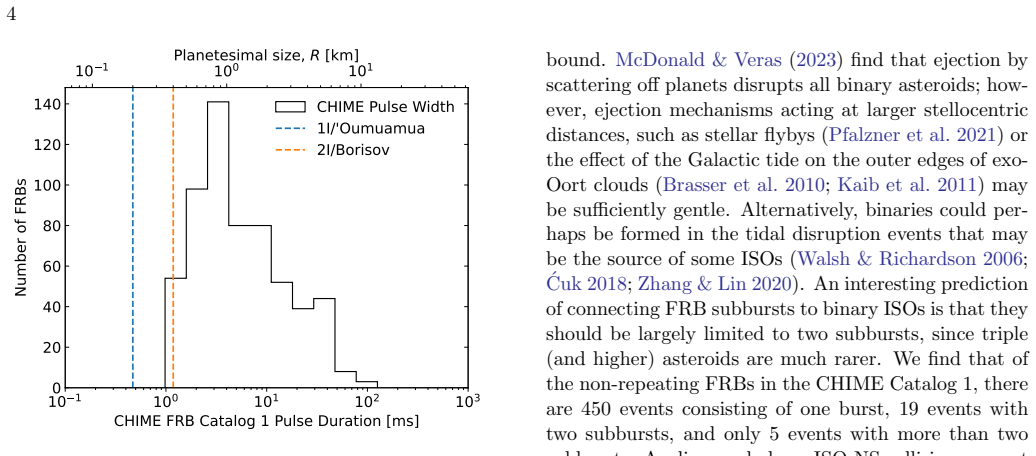
The argument is carried by three linked pieces. (1) Gravitational focusing inflates the neutron-star collision cross-section to $\sigma\sim10^9\,\mathrm{km}^2$, giving a per-star rate $\Gamma=n_{\rm ISO}v_\infty\sigma\sim10^{-7}\,\mathrm{yr}^{-1}$. (2) The Dai et al. (2016) emission model translates a planetesimal's radius $R$ into a burst: duration $\Delta t\propto R^{4/3}$ and isotropic energy $E_{\rm iso}\propto R^4$, with beaming $f\sim10^{-2}$, so observed millisecond bursts correspond to $0.4$–$10\,\mathrm{km}$ bodies. (3) The assumption that ISOs are weak rubble-pile material (tensile strength $\sim500\,\mathrm{Pa}$) means they fragment into a homogeneous stream during infall, yielding single pulses; sub-burst FRBs are then attributed to binary ISOs.
What would settle it
Measure the volumetric rate of single-pulse FRBs with a sample that cleanly excludes repeaters and compare it with $f\,\Gamma\,N_{\rm NS}\,n_{\rm Gal}$: if the observed rate exceeds the prediction even when every collision is assumed to produce a beamed burst ($f=1$), then ISO-neutron-star collisions cannot supply the FRB population. Alternatively, a precise measurement of the local ISO number density more than an order of magnitude below $10^{15}\,\mathrm{pc}^{-3}$ would remove the rate match, since $R_{\rm obs}\propto n_{\rm ISO}$.
Extended reading notes
Core claim
The central claim is that interstellar objects are a viable reservoir of planetesimals for the proposed planetesimal–neutron-star FRB mechanism. Using a local ISO number density of $n_{\rm ISO}\sim10^{15}\,\mathrm{pc}^{-3}$, a relative speed of $v_\infty\sim100\,\mathrm{km\,s^{-1}}$, and a gravitational-focusing cross-section of $\sim10^9\,\mathrm{km}^2$, the per-neutron-star encounter rate is $\Gamma\sim10^{-7}\,\mathrm{yr}^{-1}$. Extrapolating to $\sim10^9$ neutron stars per Milky-Way-type galaxy and $\sim10^7$ galaxies per Gpc$^3$, and applying a beaming factor $f\sim10^{-2}$, gives an observable rate $R_{\rm obs}\sim10^7\,\mathrm{Gpc}^{-3}\,\mathrm{yr}^{-1}$, comparable to the observed FRB rate. With updated tensile strength $s\sim500\,\mathrm{Pa}$, the emission model maps the observed FRB duration distribution to planetesimal radii $\sim0.4$–$10\,\mathrm{km}$, and the observed isotropic-energy power-law index $\gamma\approx1.3$ is consistent with known planetesimal size distributions via $\gamma=(3+q)/4$ for $q\approx2.5$–$3.5$.
Load-bearing premise
The load-bearing premise is that the interstellar-object density measured near the Sun, about $10^{15}\,\mathrm{pc}^{-3}$, also applies around neutron stars across the Universe; the predicted collision rate is directly proportional to this number.
Editorial extensions
If this is right
- If the central claim holds, one-off FRBs can be produced by ordinary interstellar debris hitting neutron stars, so the FRB population need not be dominated by exotic magnetar-like engines.
- The observed duration range of CHIME FRBs implies impacting planetesimals with radii between roughly 400 m and 10 km, sizes consistent with 'Oumuamua and Borisov.
- The energy distribution of FRBs, with index $\gamma\approx1.3$, matches the size distributions of Solar System asteroid and trans-Neptunian populations through $\gamma=(3+q)/4$.
- ISO-neutron-star collisions cannot explain repeating FRBs, and the mechanism cannot be the only FRB source; the paper expects a one-off subset.
- Because neutron stars and ISOs accumulate over cosmic time, the collision rate should rise with time rather than track the star-formation rate, matching the observed redshift evolution of the FRB rate.
Reading between the lines
- Editorial inference: because the predicted observable rate scales linearly with $n_{\rm ISO}$, a future, well-characterised measurement of the local interstellar-object number density from a wide-field survey would tighten or overturn the rate matching directly.
- Editorial inference: if $E_{\rm iso}\propto R^4$, then the high-energy tail of the FRB energy distribution can be inverted to measure the size distribution of ejected planetesimals over a much larger size range than any direct Solar System census.
- Editorial inference: the binary-ISO interpretation of two-subburst FRBs predicts that the subburst multiplicity distribution should fall sharply after two subbursts; counting subbursts in new CHIME catalogs offers a direct test, and the 29 ms gap in FRB 200428 can be used to estimate binary separation.
- Editorial inference: the paper's cosmic-time argument implies FRBs from this channel should be hosted by older, more massive stellar populations than magnetar-driven FRBs, a distinction host-galaxy samples can test.
Editorial analysis
A structured set of objections, weighed in public.
Referee Report
Summary. The paper proposes that collisions between interstellar objects (ISOs) and neutron stars (NS) could produce a subset of one-off fast radio bursts (FRBs). The authors calculate the ISO-NS collision rate using a Solar-neighborhood ISO number density, gravitational focusing, and counts of neutron stars and galaxies, obtaining a beaming-corrected rate of ~10^7 Gpc^-3 yr^-1, which they compare to the observed FRB rate. They then use the Dai et al. (2016) emission model with updated material strengths to show that observed FRB durations and energies correspond to planetesimal sizes of roughly 0.4–10 km, that the FRB energy distribution is consistent with a size distribution exponent q = 2.5–3.5, and that sub-bursts like those in FRB 200428 could be explained by binary ISOs. Finally, they argue that the ISO-NS collision rate should increase with cosmic time, matching the claimed redshift evolution of the FRB rate.
Significance. The paper is valuable as a concrete, quantitative exploration of a progenitor channel that is often mentioned but rarely calculated. It assembles independent inputs (ISO density, NS kick velocities, updated tensile/compressive strengths, power-law size distributions) rather than fitting to the FRB data, and it makes several testable predictions: lack of sub-burst structure from monolithic ISOs, a limit of two sub-bursts if binaries are the cause, a host-galaxy morphology dependence, and a cosmic evolution that decouples from the star formation rate. If the central rate comparison can be corrected for the energy threshold (a fix that is well within the paper's scope), the mechanism remains a plausible contributor to one-off FRBs. The paper is also transparent about the dominant uncertainty in the ISO number density, although it does not propagate uncertainties into the headline comparison.
major comments (2)
- [§2 (Eq. 4) and §4] The central rate comparison is not apples-to-apples. R_col in Eq. (3) counts collisions with all ISOs larger than 1I/'Oumuamua (R ≳ 0.1 km), while the Bochenek et al. (2020) rate used for comparison is for bursts with isotropic-equivalent energy ≥ 2×10^35 erg. Using the paper's own scalings (E ∝ L Δt ∝ R^4 from Eq. (6) and the text preceding it), a burst of 2×10^35 erg requires R ≳ 0.5 km at typical pulsar field strengths. For the size distributions in Table 1 (q = 2.5–3.5), the fraction of ISOs with R > 0.5 km relative to those with R > 0.1 km is (0.1/0.5)^(q-1) ≈ 0.02–0.09. Applying this to Eq. (4) reduces the predicted observable rate to roughly 2×10^5–9×10^5 Gpc^-3 yr^-1, about two orders of magnitude below the observed (7+9−6)×10^7 Gpc^-3 yr^-1. The paper explicitly acknowledges this mismatch in Section 4 ('not directly comparable... beyond the scope of this work'), yet the abstract and conclusion still state that the ISO-NS collision rate is 'comparable with' or 'consistent with' the observed FRB rate. This is a systematic overcount, not a random uncertainty. The authors should either perform a threshold-corrected rate calculation (even with a broad range of assumptions on the size distribution and magnetic field distribution) or carefully restrict the claim to the raw collision rate and state explicitly that the predicted observable FRB rate is substantially lower.
- [§2 (Eq. 3)] The rate estimate in Eq. (3) stacks several factors (nISO, f, NNS, nGal, v∞) as point values, and the conclusion of 'within order-of-magnitude uncertainties' is never quantified. The dominant input, nISO ~ 10^15 pc^-3, is derived from a single detection and is acknowledged to carry an order-of-magnitude uncertainty, but no sensitivity analysis is presented. Since the headline claim is a rate comparison, the paper should show how R_obs varies when nISO is varied by 1–2 orders of magnitude, and when f is varied over a plausible range (e.g., 10^-3–10^-1). Without such a propagation, the reader cannot assess whether the central claim is robust even after the threshold correction in the first major comment is applied.
minor comments (5)
- [§3, Fig. 1] The conversion from CHIME pulse width to planetesimal radius assumes s = 500 Pa and ρ = 3 g cm^-3 without displaying the sensitivity to these values; a brief demonstration that the inferred size range 0.4–10 km is robust to a factor of a few in these parameters would strengthen the figure.
- [§3, Table 1] The comparison of the predicted energy-distribution exponent γ = (3+q)/4 with the observed γ = 1.3+0.7−0.4 from Shin et al. (2023) is made using a sample that includes repeating FRBs and summed multi-pulse energies. The text acknowledges this but states without quantitative support that 'we do not expect this to change the value of γ by a significant amount.' Please either justify this expectation or cite an analysis that isolates non-repeating single pulses.
- [§4] The argument that the FRB rate increases with cosmic time is based on a set of references, but the literature is mixed, with some analyses finding consistency with the star formation rate at low redshift. Please acknowledge the ongoing debate and clarify what is required for the ISO-NS scenario to match the observed evolution (e.g., a specific delay-time distribution or ISO production history).
- [§3, Eq. (5)] The duration expression is quoted from Colgate & Petschek (1981) with updated parameters, but it would be helpful to include a one-sentence derivation or a reference to the equation number in that paper, as the functional form (Δt ∝ R^4/3) is non-trivial and central to the duration-size mapping.
- [§2] The assumption that ISOs retain the same spatial distribution as their parent stars is cited to Hopkins et al. (2024, arXiv:2402.04904). It may be worth noting that this is a preprint at the time of writing, so that the reader can weigh the strength of the assumption accordingly.
Circularity Check
No significant circularity; the central rate comparison is built from independent observational inputs, and the only self-citations are not load-bearing.
full rationale
The paper's derivation chain uses external inputs at every step: the ISO number density from Do et al. (2018), the neutron star natal kick from Lyne & Lorimer (1994) and Hobbs et al. (2005), the gravitational-focusing cross-section from first principles, the neutron star and galaxy counts from Heger et al. (2003) and Blanton et al. (2003), and the beaming fraction from Dai (2020). The observed FRB rate, durations, and energy distribution are independent datasets (Bochenek et al. 2020; CHIME/FRB Collaboration et al. 2021; Shin et al. 2023). No parameter is fitted to the FRB data before the comparison; Eq. (4) is arithmetic once the inputs are adopted. The two papers by overlapping authors (Hopkins et al. 2023, 2024) provide supporting assumptions about ISO velocity dispersion and spatial distribution, but neither is load-bearing: the rate calculation uses a 100 km/s natal-kick velocity rather than the cited ISO velocity width, and the spatial-distribution statement only enters a qualitative caveat about natal kicks. The energy-threshold mismatch raised by the skeptic is real and acknowledged in Section 4, but it is a question of comparing the same quantity at different energy thresholds, not a reduction of the derivation to its own inputs. Thus the paper is self-contained against external benchmarks and no circular step is present.
Assumptions & free parameters
free parameters (9)
- ISO number density n_ISO =
10^15 pc^-3
- relative speed v_inf =
100 km/s
- beaming fraction f =
10^-2
- tensile strength s =
500 Pa
- compressive strength P0 =
100 MPa
- planetesimal density rho =
3 g/cm^3
- number of neutron stars per galaxy NNS =
10^9
- galaxy number density nGal =
10^7 Gpc^-3
- ISO size distribution exponent q =
2.5, 2.8, 3.5 (literature values)
assumptions (6)
- domain assumption The Dai et al. (2016) / Colgate & Petschek (1981) tidal-disruption emission mechanism correctly describes FRB production from planetesimal-NS impacts, including the duration and luminosity scalings (Eqs. 5-6).
- domain assumption ISOs are present around all neutron stars at densities of the same order as the Solar-neighborhood value.
- domain assumption Every 1I-sized ISO-NS collision produces an FRB with a fixed beaming factor f.
- domain assumption ISO size distribution follows a power law with exponent q similar to Solar System planetesimal populations.
- domain assumption The observed FRB energy distribution (Shin et al. 2023) is representative of the non-repeating FRB population without correction for repeaters or detection bias.
- standard math Standard gravitational focusing cross-section formula applies (Eq. 1).
Cite this review
Pith. "Pith review of Fast Radio Bursts and Interstellar Objects." pith.science (2026). https://pith.science/paper/2VXJVDVU
@misc{pith2026241109135,
  author       = {Pith},
  title        = {Pith review of: Fast Radio Bursts and Interstellar Objects},
  year         = {2026},
  howpublished = {\url{https://pith.science/paper/2VXJVDVU}},
  note         = {Machine review of arXiv:2411.09135}
}
read the original abstract
Fast radio bursts (FRBs) are transient radio events with millisecond-scale durations, and debated origins. Collisions between planetesimals and neutron stars have been proposed as a mechanism to produce FRBs; the planetesimal strength, size and density determine the time duration and energy of the resulting event. One source of planetesimals is the population of interstellar objects (ISOs), free-floating objects expected to be extremely abundant in galaxies across the Universe as products of planetary formation. We explore using the ISO population as a reservoir of planetesimals for FRB production, finding that the expected ISO-neutron star collision rate is comparable with the observed FRB event rate. Using a model linking the properties of planetesimals and the FRBs they produce, we further show that observed FRB durations are consistent with the sizes of known ISOs, and the FRB energy distribution is consistent with the observed size distributions of Solar System planetesimal populations. Finally, we argue that the rate of ISO-neutron star collisions must increase with cosmic time, matching the observed evolution of the FRB rate. Thus, ISO-neutron star collisions are a feasible mechanism for producing FRBs.
Figures
Forward citations
Cited by 1 Pith paper
-
The ubiquity of variable radio emission and spin-down rates in pulsars
Most isolated pulsars show significant spin-down rate variability, with amplitude scaling as spin-down rate to the power 0.85 and little dependence on spin frequency.
Reference graph
Works this paper leans on
-
[1]
2024, A&A, 683, A118, doi: 10.1051/0004-6361/202348899
Andama, G., Mah, J., & Bitsch, B. 2024, A&A, 683, A118, doi: 10.1051/0004-6361/202348899
-
[2]
1994, Nature, 370, 120, doi: 10.1038/370120a0
Asphaug, E., & Benz, W. 1994, Nature, 370, 120, doi: 10.1038/370120a0
doi:10.1038/370120a0 1994
-
[3]
2018, A&A, 611, A33, doi: 10.1051/0004-6361/201732155
Attree, N., Groussin, O., Jorda, L., et al. 2018, A&A, 611, A33, doi: 10.1051/0004-6361/201732155
-
[4]
2017, ApJL, 838, L16, doi: 10.3847/2041-8213/aa65c9
Bagchi, M. 2017, ApJL, 838, L16, doi: 10.3847/2041-8213/aa65c9
-
[5]
Bhandari, S., Sadler, E. M., Prochaska, J. X., et al. 2020, ApJL, 895, L37, doi: 10.3847/2041-8213/ab672e
-
[6]
Blanton, M. R., Hogg, D. W., Bahcall, N. A., et al. 2003, ApJ, 592, 819, doi: 10.1086/375776
doi:10.1086/375776 2003
-
[7]
Bochenek, C. D., Ravi, V., Belov, K. V., et al. 2020, Nature, 587, 59, doi: 10.1038/s41586-020-2872-x
-
[8]
Boss, A. P. 1994, Icarus, 107, 422, doi: 10.1006/icar.1994.1035
arXiv 1994
Show all 81 references
-
[9]
2010, A&A, 516, A72, doi: 10.1051/0004-6361/201014275
Brasser, R., Higuchi, A., & Kaib, N. 2010, A&A, 516, A72, doi: 10.1051/0004-6361/201014275
2010 doi
-
[10]
R., Karastergiou, A., Buchner, S., et al
Brook, P. R., Karastergiou, A., Buchner, S., et al. 2014, ApJL, 780, L31, doi: 10.1088/2041-8205/780/2/L31
2014 doi
-
[11]
Chatterjee, S., Vlemmings, W. H. T., Brisken, W. F., et al. 2005, ApJL, 630, L61, doi: 10.1086/491701
2005 doi
-
[12]
H., Jia, X
Chen, J. H., Jia, X. D., Dong, X. F., & Wang, F. Y. 2024, ApJL, 973, L54, doi: 10.3847/2041-8213/ad7b39 CHIME/FRB Collaboration, Andersen, B. C., Bandura, K. M., et al. 2020, Nature, 587, 54, doi: 10.1038/s41586-020-2863-y CHIME/FRB Collaboration, Amiri, M., Andersen, B. C., e...
2024 doi
-
[13]
A., & Petschek, A
Colgate, S. A., & Petschek, A. G. 1981, ApJ, 248, 771, doi: 10.1086/159201 ´Cuk, M. 2018, ApJL, 852, L15, doi: 10.3847/2041-8213/aaa3db
1981 doi
-
[14]
Dai, Z. G. 2020, ApJL, 897, L40, doi: 10.3847/2041-8213/aba11b
2020 doi
-
[15]
G., Wang, J
Dai, Z. G., Wang, J. S., Wu, X. F., & Huang, Y. F. 2016, ApJ, 829, 27, doi: 10.3847/0004-637X/829/1/27
2016 doi
-
[16]
2024, ApJ, 974, 215, doi: 10.3847/1538-4357/ad7256
Deng, C., Huang, Y.-F., Du, C., Wang, P., & Dai, Z.-G. 2024, ApJ, 974, 215, doi: 10.3847/1538-4357/ad7256
2024 doi
-
[17]
A., & Tonry, J
Do, A., Tucker, M. A., & Tonry, J. 2018, ApJL, 855, L10, doi: 10.3847/2041-8213/aaae67
2018 doi
-
[18]
J., Consolmagno, G
Flynn, G. J., Consolmagno, G. J., Brown, P., & Macke, R. J. 2018, Chemie der Erde / Geochemistry, 78, 269, doi: 10.1016/j.chemer.2017.04.002
2018 doi
-
[19]
C., & Loeb, A
Forbes, J. C., & Loeb, A. 2019, ApJL, 875, L23, doi: 10.3847/2041-8213/ab158f
2019 doi
-
[20]
C., Bannister, M
Fraser, W. C., Bannister, M. T., Pike, R. E., et al. 2017, Nature Astronomy, 1, 0088, doi: 10.1038/s41550-017-0088
2017 doi
-
[21]
J., & Huang, Y
Geng, J. J., & Huang, Y. F. 2015, ApJ, 809, 24, doi: 10.1088/0004-637X/809/1/24
2015 doi
-
[22]
J., Davis, D
Gladman, B. J., Davis, D. R., Neese, C., et al. 2009, Icarus, 202, 104, doi: 10.1016/j.icarus.2009.02.012
2009 doi
-
[23]
C., Fong, W.-f., Kilpatrick, C
Gordon, A. C., Fong, W.-f., Kilpatrick, C. D., et al. 2023, ApJ, 954, 80, doi: 10.3847/1538-4357/ace5aa
2023 doi
-
[24]
M., Mizutani, H., & Yamamoto, T
Greenberg, J. M., Mizutani, H., & Yamamoto, T. 1995, A&A, 295, L35
1995
-
[25]
Hashimoto, T., Goto, T., On, A. Y. L., et al. 2020a, MNRAS, 498, 3927, doi: 10.1093/mnras/staa2490 —. 2020b, MNRAS, 497, 4107, doi: 10.1093/mnras/staa2238
-
[26]
H., et al
Hashimoto, T., Goto, T., Chen, B. H., et al. 2022, MNRAS, 511, 1961, doi: 10.1093/mnras/stac065 7
2022 doi
-
[27]
Hartmann, D. H. 2003, ApJ, 591, 288, doi: 10.1086/375341
2003 doi
-
[28]
R., Lyne, A
Hobbs, G., Lorimer, D. R., Lyne, A. G., & Kramer, M. 2005, MNRAS, 360, 974, doi: 10.1111/j.1365-2966.2005.09087.x
2005
- [29]
-
[30]
J., Lintott, C., Bannister, M
Hopkins, M. J., Lintott, C., Bannister, M. T., Mackereth, J. T., & Forbes, J. C. 2023, AJ, 166, 241, doi: 10.3847/1538-3881/ad03e6
2023 doi
-
[31]
Hui, M.-T., Ye, Q.-Z., F¨ ohring, D., Hung, D., & Tholen, D. J. 2020, AJ, 160, 92, doi: 10.3847/1538-3881/ab9df8
2020 doi
-
[32]
D., Yin, Q.-Z., et al
Jenniskens, P., Fries, M. D., Yin, Q.-Z., et al. 2012, Science, 338, 1583, doi: 10.1126/science.1227163
2012 doi
-
[33]
2017, ApJL, 850, L36, doi: 10.3847/2041-8213/aa9b2f
Jewitt, D., Luu, J., Rajagopal, J., et al. 2017, ApJL, 850, L36, doi: 10.3847/2041-8213/aa9b2f
2017 doi
-
[34]
Jewitt, D., & Seligman, D. Z. 2023, ARA&A, 61, 197, doi: 10.1146/annurev-astro-071221-054221
2023 doi
-
[35]
A., Roˇ skar, R., & Quinn, T
Kaib, N. A., Roˇ skar, R., & Quinn, T. 2011, Icarus, 215, 491, doi: 10.1016/j.icarus.2011.07.037
2011 doi
-
[36]
S., Herrmann, W., et al
Kirsten, F., Ould-Boukattine, O. S., Herrmann, W., et al. 2024, Nature Astronomy, 8, 337, doi: 10.1038/s41550-023-02153-z
2024 doi
-
[37]
2001, MNRAS, 322, 231, doi: 10.1046/j.1365-8711.2001.04022.x
Kroupa, P. 2001, MNRAS, 322, 231, doi: 10.1046/j.1365-8711.2001.04022.x
2001
-
[38]
M., Shankman, C., Kavelaars, J
Lawler, S. M., Shankman, C., Kavelaars, J. J., et al. 2018, AJ, 155, 197, doi: 10.3847/1538-3881/aab8ff
2018 doi
-
[39]
Levy, D. H. 1998, SSRv, 85, 523
1998
-
[40]
C., & Newman, J
Licquia, T. C., & Newman, J. A. 2015, ApJ, 806, 96, doi: 10.1088/0004-637X/806/1/96
2015 doi
-
[41]
2024, ApJ, 969, 123, doi: 10.3847/1538-4357/ad5310
Lin, H.-N., Li, X.-Y., & Zou, R. 2024, ApJ, 969, 123, doi: 10.3847/1538-4357/ad5310
2024 doi
-
[42]
2024, ApJ, 962, 73, doi: 10.3847/1538-4357/ad1b4f
Lin, H.-N., & Zou, R. 2024, ApJ, 962, 73, doi: 10.3847/1538-4357/ad1b4f
2024 doi
-
[43]
J., Schawinski, K., Slosar, A., et al
Lintott, C. J., Schawinski, K., Slosar, A., et al. 2008, MNRAS, 389, 1179, doi: 10.1111/j.1365-2966.2008.13689.x
2008
-
[44]
R., Bailes, M., McLaughlin, M
Lorimer, D. R., Bailes, M., McLaughlin, M. A., Narkevic, D. J., & Crawford, F. 2007, Science, 318, 777, doi: 10.1126/science.1147532
2007 doi
-
[45]
G., & Lorimer, D
Lyne, A. G., & Lorimer, D. R. 1994, Nature, 369, 127, doi: 10.1038/369127a0
1994 doi
-
[46]
2014, ARA&A, 52, 415, doi: 10.1146/annurev-astro-081811-125615
Madau, P., & Dickinson, M. 2014, ARA&A, 52, 415, doi: 10.1146/annurev-astro-081811-125615
2014 doi
-
[47]
G., Fong, W.-f., Simha, S., et al
Mannings, A. G., Fong, W.-f., Simha, S., et al. 2021, ApJ, 917, 75, doi: 10.3847/1538-4357/abff56
2021 doi
-
[48]
Margalit, B., Berger, E., & Metzger, B. D. 2019, ApJ, 886, 110, doi: 10.3847/1538-4357/ab4c31
2019 doi
-
[49]
L., Nolan, M
Margot, J. L., Nolan, M. C., Benner, L. A. M., et al. 2002, Science, 296, 1445, doi: 10.1126/science.1072094
2002 doi
-
[50]
H., & Veras, D
McDonald, C. H., & Veras, D. 2023, MNRAS, 520, 4009, doi: 10.1093/mnras/stad382
2023 doi
-
[51]
A., & Chapman, R
McGlynn, T. A., & Chapman, R. D. 1989, ApJL, 346, L105, doi: 10.1086/185590
1989 doi
-
[52]
D., Margalit, B., & Sironi, L
Metzger, B. D., Margalit, B., & Sironi, L. 2019, MNRAS, 485, 4091, doi: 10.1093/mnras/stz700
2019 doi
-
[53]
2023, ApJ, 950, 134, doi: 10.3847/1538-4357/accf89
Michilli, D., Bhardwaj, M., Brar, C., et al. 2023, ApJ, 950, 134, doi: 10.3847/1538-4357/accf89
2023 doi
-
[54]
C., Lamb, F
Miller, M. C., Lamb, F. K., Dittmann, A. J., et al. 2021, ApJL, 918, L28, doi: 10.3847/2041-8213/ac089b
2021 doi
-
[55]
2021, ApJL, 913, L12, doi: 10.3847/2041-8213/abfb75
Mondal, T. 2021, ApJL, 913, L12, doi: 10.3847/2041-8213/abfb75
2021 doi
-
[56]
1993, IAUC, 5800, 1 ’Oumuamua ISSI Team, Bannister, M
Nakano, S., Kobayashi, T., Meyer, E., et al. 1993, IAUC, 5800, 1 ’Oumuamua ISSI Team, Bannister, M. T., Bhandare, A., et al. 2019, Nature Astronomy, 3, 594, doi: 10.1038/s41550-019-0816-x
1993 doi
-
[57]
L., Bhandare, A., & Veras, D
Pfalzner, S., Aizpuru Vargas, L. L., Bhandare, A., & Veras, D. 2021, A&A, 651, A38, doi: 10.1051/0004-6361/202140587
2021 doi
-
[58]
2019, PhR, 821, 1, doi: 10.1016/j.physrep.2019.06.003
Platts, E., Weltman, A., Walters, A., et al. 2019, PhR, 821, 1, doi: 10.1016/j.physrep.2019.06.003
2019 doi
-
[59]
C., Kaspi, V
Pleunis, Z., Good, D. C., Kaspi, V. M., et al. 2021, ApJ, 923, 1, doi: 10.3847/1538-4357/ac33ac
2021 doi
-
[60]
Pohl, L., & Britt, D. T. 2020, M&PS, 55, 962, doi: 10.1111/maps.13449
2020 doi
-
[61]
D., Bannister, K
Ryder, S. D., Bannister, K. W., Bhandari, S., et al. 2023, Science, 382, 294, doi: 10.1126/science.adf2678
2023 doi
-
[62]
Scheeres, D. J. 2007, Icarus, 189, 370, doi: 10.1016/j.icarus.2007.02.015 —. 2018, Icarus, 304, 183, doi: 10.1016/j.icarus.2017.05.029
2007 doi
-
[63]
W., Bhardwaj, M., et al
Shin, K., Masui, K. W., Bhardwaj, M., et al. 2023, ApJ, 944, 105, doi: 10.3847/1538-4357/acaf06
2023 doi
-
[64]
M., & Wolfe, R
Shoemaker, E. M., & Wolfe, R. F. 1984, in Lunar and Planetary Science Conference, Lunar and Planetary Science Conference, 780–781
1984
-
[65]
B., Armitage, P
Simon, J. B., Armitage, P. J., Li, R., & Youdin, A. N. 2016, ApJ, 822, 55, doi: 10.3847/0004-637X/822/1/55
2016 doi
-
[66]
2019, Research Notes of the American Astronomical Society, 3, 130, doi: 10.3847/2515-5172/ab43de
Siraj, A., & Loeb, A. 2019, Research Notes of the American Astronomical Society, 3, 130, doi: 10.3847/2515-5172/ab43de
2019 doi
-
[67]
L., Martin, R
Smallwood, J. L., Martin, R. G., & Zhang, B. 2019, MNRAS, 485, 1367, doi: 10.1093/mnras/stz483
2019 doi
-
[68]
Stern, S. A. 1990, PASP, 102, 793, doi: 10.1086/132704
1990 doi
-
[69]
2022, MNRAS, 516, 4971, doi: 10.1093/mnras/stac2092
Sweeney, D., Tuthill, P., Sharma, S., & Hirai, R. 2022, MNRAS, 516, 4971, doi: 10.1093/mnras/stac2092
2022 doi
-
[70]
2023, Chinese Physics C, 47, 085105, doi: 10.1088/1674-1137/acda1c 8
Tang, L., Lin, H.-N., & Li, X. 2023, Chinese Physics C, 47, 085105, doi: 10.1088/1674-1137/acda1c 8
2023 doi
-
[71]
2019, in Canadian Long Range Plan for Astronomy and Astrophysics White Papers, Vol
Vanderlinde, K., Liu, A., Gaensler, B., et al. 2019, in Canadian Long Range Plan for Astronomy and Astrophysics White Papers, Vol. 2020, 28, doi: 10.5281/zenodo.3765414
2019 doi
-
[72]
2019, ApJ, 879, 4, doi: 10.3847/1538-4357/ab2240
Wadiasingh, Z., & Timokhin, A. 2019, ApJ, 879, 4, doi: 10.3847/1538-4357/ab2240
2019 doi
-
[73]
Walsh, K. J. 2018, ARA&A, 56, 593, doi: 10.1146/annurev-astro-081817-052013
2018 doi
-
[74]
J., & Richardson, D
Walsh, K. J., & Richardson, D. C. 2006, Icarus, 180, 201, doi: 10.1016/j.icarus.2005.08.015
2006 doi
-
[75]
J., Richardson, D
Walsh, K. J., Richardson, D. C., & Michel, P. 2008, Nature, 454, 188, doi: 10.1038/nature07078
2008 doi
-
[76]
G., Kreckel, K., Belfiore, F., et al
Williams, T. G., Kreckel, K., Belfiore, F., et al. 2022, MNRAS, 509, 1303, doi: 10.1093/mnras/stab3082
2022 doi
-
[77]
Wolszczan, A., & Frail, D. A. 1992, Nature, 355, 145, doi: 10.1038/355145a0
1992 doi
-
[78]
2020, Nature, 587, 45, doi: 10.1038/s41586-020-2828-1
Zhang, B. 2020, Nature, 587, 45, doi: 10.1038/s41586-020-2828-1
2020 doi
- [79]
-
[80]
C., & Zhang, B
Zhang, R. C., & Zhang, B. 2022, ApJL, 924, L14, doi: 10.3847/2041-8213/ac46ad
2022 doi
-
[81]
Zhang, Y., & Lin, D. N. C. 2020, Nature Astronomy, 4, 852, doi: 10.1038/s41550-020-1065-8
2020 doi
Reviewed August 12, 2026 · model on record in the stance chip above.
Discussion (0). Continue with ORCID to comment.