REVIEW 3 major objections 4 minor 32 references
Particle Acceleration via Transient Stagnation Surfaces in MADs During Flux Eruptions
T0 review · 3 major / 4 minor · reviewed 2026-08-12 · deepseek-v4-flash
Pith's one-line read In simulations of magnetically arrested disks, a transient stagnation surface forms during flux eruptions and accelerates particles.
desk verdict A genuinely new simulation feature—a transient near-radial stagnation surface during MAD flux eruptions—is reported well, but the particle-acceleration conclusion is not supported by ideal GRMHD physics and the voltage estimate has a unit error. read the letter →
The pith
A machine-rendered reading of the paper's core claim, the machinery that carries it, and where it could break.
The reading
What carries the argument
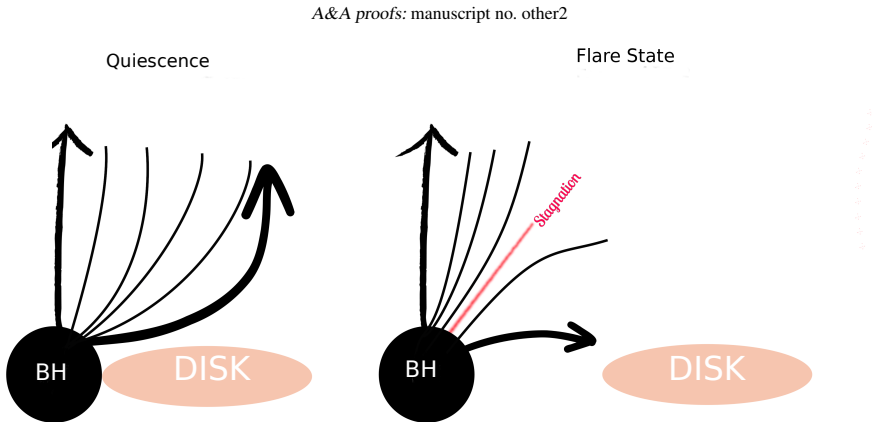
The central object is the transient stagnation surface: a near-radial thin layer where the velocity field diverges so plasma streams away in opposite directions, rapidly emptying the region. Because ideal GRMHD cannot represent the evacuated ultra-magnetized plasma, the simulation's density floor must refill those cells; the authors use the cumulative floor activation rate as a diagnostic that traces the surface even where density and magnetization maps look smooth. They combine this with a potential-difference estimate based on the electric field approaching the magnetic field strength over a gap length, following the standard magnetospheric-gap picture.
What would settle it
A three-dimensional general-relativistic magnetohydrodynamic simulation of the same equilibrium torus and spin, with a higher magnetization threshold or a physical pair-production prescription, should reproduce the same near-radial stagnation surface at 2-3 gravitational radii during flux eruptions; if the divergent velocity and floor activation disappear or lose their correlation, the reported surface is an artifact of the 2D geometry or the density floor.
Extended reading notes
Core claim
The paper reports that in two-dimensional axisymmetric general-relativistic magnetohydrodynamic simulations of a MAD, each flux eruption is accompanied by a transient, near-radial stagnation surface at 2-3 gravitational radii from the black hole, with length 7-9 gravitational radii, defined by a divergent velocity field and traced by enhanced activation of the density floor. The authors show velocity streamlines diverge exactly where the floor injects mass, and a discontinuity in the perpendicular velocity component sits at this surface. They interpret this as a local depletion of plasma that enables a strong electric field parallel to the magnetic field, producing an estimated potential drop of about $10^{16}$ volts for M87, with particle energies capped by synchrotron and inverse-Compton cooling; synchrotron emission would peak in the MeV range and inverse-Compton in the TeV range. The claim is that this is a complementary or alternative particle-acceleration channel to magnetic reconnection during flux eruptions.
Load-bearing premise
The load-bearing premise is that the divergent velocity and coincident floor activation trace a real plasma-depletion surface in the magnetized funnel, not a numerical artifact of the simulation's matter-refill routine in a 2D axisymmetric run.
Editorial extensions
If this is right
- At least two flux eruptions in the simulation produce the same transient stagnation surface about 2-3 gravitational radii from the black hole, extending 7-9 gravitational radii.
- The estimated potential difference of about $10^{16}$ volts along the surface for M87-like parameters is large enough to accelerate charged particles to ultrarelativistic energies.
- Because the accelerated particles cool through synchrotron and inverse-Compton emission, the model predicts MeV-scale synchrotron and possibly TeV-scale inverse-Compton radiation during flux eruptions.
- This provides a complementary or alternative channel to magnetic reconnection for powering high-energy emission from black-hole jets.
Reading between the lines
- The same floor-activation diagnostic could be applied to three-dimensional simulations, where non-axisymmetric instabilities may split the single surface into multiple or fragmented acceleration layers.
- The voltage estimate scales linearly with the assumed gap length; choosing a different fraction of a gravitational radius would shift the predicted acceleration power by orders of magnitude, so the mechanism's observable brightness is highly sensitive to that assumption.
- If the surface is physical, its near-radial orientation means line-of-sight effects should make the resulting MeV/TeV emission strongly dependent on viewing angle and on which side of the jet the eruption occurs.
Signed reviews
Editorial analysis
A structured set of objections, weighed in public.
Referee Report
Summary. The paper studies two-dimensional axisymmetric GRMHD simulations of a magnetically arrested disk (MAD) around a spinning black hole and searches for regions of divergent velocity during magnetic flux eruption events. The authors introduce cumulative diagnostics of the density-floor activation rate and of the mass added by the floor, and report a transient, near-radial stagnation surface at roughly 2--3 gravitational radii, with length 7--9 gravitational radii, seen in two separate eruption events. They then estimate a potential difference of about 10^16 V along this surface for M87 and propose that such stagnation surfaces act as particle accelerators, complementing or replacing magnetic reconnection as an acceleration mechanism.
Significance. If the stagnation surface were established as a physical feature and the parallel electric-field argument were valid, the result would be a potentially interesting new site for particle acceleration in MADs. The paper's strengths are the clear presentation of a new simulation diagnostic (cumulative floor activation and mass addition) and the demonstration that two flux-eruption events show coincident velocity divergence and enhanced floor activity. These are useful observational tracers within the simulation. However, the central acceleration claim is not supported by the evidence presented: ideal GRMHD enforces E·B=0, the density floor actively reshapes the cells used to identify the surface, and the only quantitative voltage/power estimate contains a unit inconsistency. As it stands, the paper establishes a numerical coincidence, not a physical accelerator.
major comments (3)
- [§4.2, Eq. (10)] The acceleration estimate is not derived from the simulations. The simulations solve ideal GRMHD, which enforces E·B=0 in the evolved plasma, so no parallel electric field exists in the simulated state. The text assumes, rather than demonstrates, that 'the electric field reaches values close to the magnetic field strength.' This assumption is load-bearing because the entire conclusion that the stagnation surface is an accelerator rests on the existence of an unscreened E∥. The density floor of Eq. (2) actively fills cells with ρ < b²/σmax, so the low-density 'gap' from which E∥ is inferred is not a physical vacuum gap but a region where the numerical floor is supplying plasma. The paper needs either a non-ideal treatment that produces E∥ or a clearly labeled speculative model, not a statement that the simulated surface 'can be associated with an accelerator.'
- [§4.2, Eq. (10) and following text] The voltage and power estimates are internally inconsistent. Eq. (10) gives ΔV ≈ 3×10^16 V; multiplying by the elementary charge gives 3×10^16 eV, which is 3×10^10 MeV, not 4.8 MeV. The stated 4.8 MeV corresponds to a potential of 4.8 MV. The total power Pstag ≈ 4.8×10^46 erg/s is consistent with 3×10^16 eV per particle times 10^42 s^-1 (since 3×10^16 eV ≈ 4.8×10^4 erg), but it is not consistent with the stated 4.8 MeV per particle. Because these numbers form the only quantitative support for the acceleration claim, the arithmetic error invalidates the specific acceleration estimate until corrected and recomputed.
- [§3.2 and §4.2, Figs. 4–5] The floor-activation diagnostic is not independent evidence for a physical stagnation surface. The floor routine modifies the primitive state by adding mass in precisely the cells where σ exceeds σmax, and the paper identifies the stagnation surface using the resulting floor pattern. The coincidence of divergent velocity with enhanced Madd and Ṅadd therefore shows where the numerical floor acts, but it does not by itself prove that a physically real depletion region exists. The authors' own caveat in §5 that 'a more accurate representation of this phenomenon would require 3D simulations' and the relatively low σmax=1000 make this concern concrete. This issue is load-bearing because if the floor creates or strongly reshapes the divergent flow, the claimed 'accelerator' has no physical subject.
minor comments (4)
- [Abstract and key words] There are several typographical errors: 'relativstic processes' should be 'relativistic processes', 'stars:neutron' should be 'stars: neutron', and 's upermassive' appears as 's upermassive' in the text.
- [§3.1, Eq. (1)] The vector potential formula in Eq. (1) is typeset ambiguously: the expression 'max[...]' with an embedded '− 0.2,, 0' should be cleaned up so the reader can see the functional form being maximized.
- [§4.2, Eq. (12)] The expression for γIC mixes several rescaled quantities without clear grouping; in particular, R(h/rs)^{1/2} is ambiguous about which quantities are multiplied. Please define h and rs and parenthesize the factors.
- [Fig. 2 caption] The caption's phrase 'Top right and left panel' is confusing because the figure has four panels; please describe each panel explicitly.
Circularity Check
No circular derivation: the stagnation surface is identified by independent velocity-divergence diagnostics, and the floor-activation tracking is a consistency check rather than a fitted input or definitional reduction.
full rationale
The paper's central claim is that a transient stagnation surface, defined by a divergent velocity field, appears during MAD flux eruptions and may act as a particle accelerator. The definition of the surface is the velocity divergence itself (Sect. 1: 'They are defined as surfaces with a divergent velocity field'), and the existence evidence is the velocity streamlines and the u_perp discontinuity shown in Figs. 4 and 5. The floor-activation diagnostic is introduced as a tracking tool (Sect. 2: 'we find it more effective to track and verify the occurrence of such physical configurations by monitoring the activation of the floor routine'), and the paper then checks that the velocity divergence 'completely coincides with the surface of enhanced mass addition' (Sect. 4.2). This is a consistency check between two simulation diagnostics, not a derivation of one from the other; the floor activation depends on the magnetization threshold rho_min = b^2/sigma_max, not on the stagnation-surface definition. No fitted parameter is renamed as a prediction, and no quantity is defined in terms of the conclusion. The potential-difference estimate in Eq. (10) is an order-of-magnitude arithmetic estimate using an assumed gap electric field and gap length, not a reduction of the acceleration claim to its own inputs. The paper contains self-citations (e.g., Ng et al. 2024 for numerical-code improvements, Paraschos et al. 2023 for 3C 84 observations), but none is load-bearing for the central stagnation-surface or acceleration argument. The conclusions explicitly concede that 3D simulations are needed for a 'more accurate representation of this phenomenon,' which is a validity limitation rather than circularity. The numerical floor might influence the flow, and the voltage estimate contains apparent unit inconsistencies, but these are correctness risks, not circular reasoning under the criteria requiring a specific equation-level reduction or a fitted-input-as-prediction step.
Assumptions & free parameters
free parameters (4)
- σmax =
1000
- gap height h in ΔV estimate =
0.1 r_g
- E∥/B ratio =
≈1 (Estag ≈ 10 statvolt/cm)
- particle injection rate Ndot =
10^42 s^-1
assumptions (4)
- standard math GRMHD with ideal MHD and the BHAC code correctly describes the accretion flow.
- domain assumption The Fishbone-Moncrief torus with the chosen vector potential reaches the MAD state with quasi-periodic flux eruptions.
- ad hoc to paper Floor activation rate is a faithful tracer of physical plasma depletion.
- ad hoc to paper Parallel electric field reaches ~B in the stagnation region.
Cite this review
Pith. "Pith review of Particle Acceleration via Transient Stagnation Surfaces in MADs During Flux Eruptions." pith.science (2026). https://pith.science/paper/FSYGJR2R
@misc{pith2026241109143,
  author       = {Pith},
  title        = {Pith review of: Particle Acceleration via Transient Stagnation Surfaces in MADs During Flux Eruptions},
  year         = {2026},
  howpublished = {\url{https://pith.science/paper/FSYGJR2R}},
  note         = {Machine review of arXiv:2411.09143}
}
abstract
In this study, we focus on the simulation of accretion processes in Magnetically Arrested Disks (MADs) and investigate the dynamics of plasma during flux eruption events. We employ general relativistic magneto-hydrodynamic (GRMHD) simulations and search for regions with a divergent velocity during a flux eruption event. These regions would experience rapid and significant depletion of matter. For this reason, we monitor the activation rate of the floor and the mass supply required for stable simulation evolution to further trace this transient stagnation surface. Our findings reveal an unexpected and persistent stagnation surface that develops during these eruptions, located around 2-3 gravitational radii (${\rm r_g}$) from the black hole. The stagnation surface is defined by a divergent velocity field and is accompanied by enhanced mass addition. This represents the first report of such a feature in this context. The stagnation surface is ($7-9\,\,{\rm r_g}$) long. We estimate the overall potential difference along this stagnation surface for a supermassive black hole like M87 to be approximately $\Delta V \approx 10^{16}$ Volts. Our results indicate that, in MAD configurations, this transient stagnation surface during flux eruption events can be associated with an accelerator of charged particles in the vicinity of supermassive black holes. In light of magnetic reconnection processes during these events, this work presents a complementary or an alternative mechanism for particle acceleration.
Figures


Figures from the paper (1 more)

Reference graph
Works this paper leans on
- [1]
-
[2]
2019, ARA&A, 57, 467
Blandford, R., Meier, D., & Readhead, A. 2019, ARA&A, 57, 467
2019
-
[3]
Blandford, R. D. & Znajek, R. L. 1977, MNRAS, 179, 433
1977
-
[4]
Hybrid GRMHD and Force-Free Simulations of Black Hole Accretion
Chael, A. 2024, arXiv e-prints, arXiv:2404.01471
work page Pith review arXiv 2024
-
[5]
& Narayan, R
Chatterjee, K. & Narayan, R. 2022, ApJ, 941, 30
2022
-
[6]
Chen, A. Y . & Yuan, Y . 2020, ApJ, 895, 121
work page 2020
-
[7]
2020, MNRAS, 497, 4999 Event Horizon Telescope Collaboration, Akiyama, K., Alberdi, A., et al
Dexter, J., Tchekhovskoy, A., Jiménez-Rosales, A., et al. 2020, MNRAS, 497, 4999 Event Horizon Telescope Collaboration, Akiyama, K., Alberdi, A., et al. 2024, ApJ, 964, L25 Event Horizon Telescope Collaboration, Akiyama, K., Alberdi, A., et al. 2023, ApJ, 957, L20 Event Horizon Telescope Collaboration, Akiyama, K., Alberdi, A., et al. 2019, Astrophys. J. ...
work page 2020
-
[8]
Fishbone, L. G. & Moncrief, V . 1976, ApJ, 207, 962
1976
Show all 32 references
-
[9]
2023, Phys
Galishnikova, A., Philippov, A., Quataert, E., et al. 2023, Phys. Rev. Lett., 130, 115201
2023
-
[10]
Hakobyan, H., Ripperda, B., & Philippov, A. A. 2023, ApJ, 943, L29
2023
-
[11]
Igumenshchev, I. V . 2008, ApJ, 677, 317
2008
-
[12]
& Rieger, F
Katsoulakos, G. & Rieger, F. M. 2018, ApJ, 852, 112
2018
-
[13]
Komissarov, S. S. 2004, MNRAS, 350, 427
2004
-
[14]
& Mineshige, S
Kusunose, M. & Mineshige, S. 1996, ApJ, 468, 330
1996
-
[15]
& Rieger, F
Levinson, A. & Rieger, F. 2011, ApJ, 730, 123
2011
-
[16]
P., et al
Lu, R.-S., Asada, K., Krichbaum, T. P., et al. 2023, Nature, 616, 686
2023
-
[17]
McKinney, J. C. 2006, MNRAS, 368, 1561 Mo´scibrodzka, M., Gammie, C. F., Dolence, J. C., & Shiokawa, H. 2011, ApJ, 735, 9
2006
-
[18]
& Harding, A
Muslimov, A. & Harding, A. K. 1997, ApJ, 485, 735
1997
-
[19]
V ., & Abramowicz, M
Narayan, R., Igumenshchev, I. V ., & Abramowicz, M. A. 2003, PASJ, 55, L69
2003
-
[20]
H.-Y ., Jiang, J.-L., Musolino, C., et al
Ng, H. H.-Y ., Jiang, J.-L., Musolino, C., et al. 2024, Phys. Rev. D, 109, 064061
2024
-
[21]
2019, A&A, 629, A61
Olivares, H., Porth, O., Davelaar, J., et al. 2019, A&A, 629, A61
2019
-
[22]
Papadopoulos, D. B. & Contopoulos, I. 2019, Mon. Not. R. Astron. Soc., 483, 2325
2019
-
[23]
F., Debbrecht, L
Paraschos, G. F., Debbrecht, L. C., Kramer, J. A., et al. 2024, A&A, 686, L5
2024
-
[24]
F., Mpisketzis, V ., Kim, J
Paraschos, G. F., Mpisketzis, V ., Kim, J. Y ., et al. 2023, A&A, 669, A32
2023
-
[25]
Y ., & Mastichiadis, A
Petropoulou, M., Yuan, Y ., Chen, A. Y ., & Mastichiadis, A. 2019, ApJ, 883, 66
2019
-
[26]
Porth, O., Mizuno, Y ., Younsi, Z., & Fromm, C. M. 2021, MNRAS, 502, 2023
2021
-
[27]
2017, Computational Astrophysics and Cosmology, 4, 1
Porth, O., Olivares, H., Mizuno, Y ., et al. 2017, Computational Astrophysics and Cosmology, 4, 1
2017
-
[28]
& Neronov, A
Ptitsyna, K. & Neronov, A. 2016, A&A, 593, A8
2016
-
[29]
2022, ApJ, 924, L32
Ripperda, B., Liska, M., Chatterjee, K., et al. 2022, ApJ, 924, L32
2022
-
[30]
I., Petropoulou, M., Sironi, L., & Giannios, D
Stathopoulos, S. I., Petropoulou, M., Sironi, L., & Giannios, D. 2024, arXiv e- prints, arXiv:2406.01211
2024 arXiv
-
[31]
Tchekhovskoy, A., Narayan, R., & McKinney, J. C. 2011, MNRAS, 418, L79
2011
-
[32]
& Lebohec, S
Vincent, S. & Lebohec, S. 2010, MNRAS, 409, 1183 Article number, page 6 of 6
2010
Reviewed August 12, 2026 · model on record in the stance chip above.
Discussion (0). Continue with ORCID to comment.