REVIEW 3 major objections 6 minor 1 cited by
Integrated Data Analysis and Validation
T0 review · 3 major / 6 minor · reviewed 2026-08-12 · deepseek-v4-flash
Pith's one-line read Bayesian combination of all diagnostics yields more reliable fusion plasma reconstructions than sequential analysis.
desk verdict A competent review of Bayesian integrated data analysis; the ITER demo is self-consistent but untested against misspecified models, and the central claim rests on prior real-data applications. read the letter →
The pith
A machine-rendered reading of the paper's core claim, the machinery that carries it, and where it could break.
The reading
What carries the argument
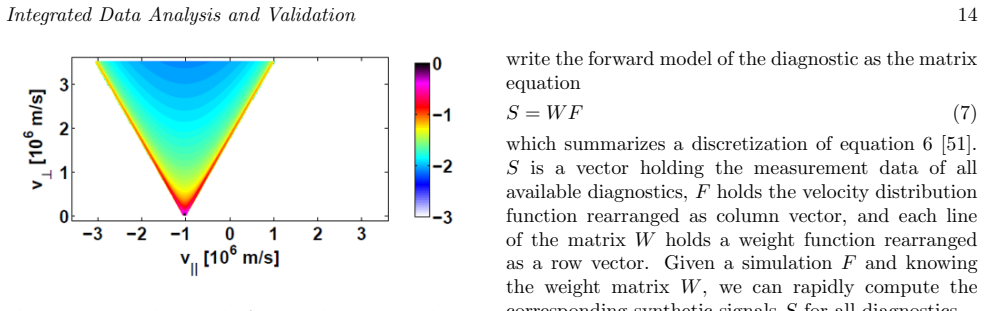
The load-bearing object is the posterior probability distribution $p(f|d)$ over the physical parameters $f$ given all data $d$, together with the product likelihood that assembles it. The machinery has four named ingredients: forward models $D_k(f)$, which compute synthetic measurements from parameters; likelihoods $p_k(d_k|f)$, typically Gaussian or Student's $t$, which quantify data uncertainties including outliers; priors $p(f)$, which encode non-negativity, smoothness, monotonicity, or physics-based constraints; and nuisance parameters, whose priors are marginalised so that systematic uncertainties flow into the final uncertainties. For velocity-space tomography the forward model takes the explicit matrix form $S = W F$, where $W$ holds the velocity-space weight functions of all detectors, and the inversion is a regularised least-squares problem with constraints such as non-negativity. The same posterior-based machinery carries every application in the paper: it converts ill-posed inversion into well-posed probabilistic inference, and it automatically propagates all uncertainties.
What would settle it
Run a realistic comparison on experimental data: for a set of discharges with overlapping diagnostics and an independent reference profile, withhold one diagnostic, perform the joint Bayesian inversion with the remaining ones, and count how often the withheld data fall within the posterior-predicted uncertainty bands; if the claimed improvement is real, the joint posterior should predict the withheld diagnostic at the nominal rate, while a deliberately misspecified forward model should produce systematic predictive failures.
Extended reading notes
Core claim
In the paper's own terms, the central discovery is that a joint Bayesian analysis of heterogeneous diagnostics — rather than a sequential one — is the correct way to combine information, because every measurement and every piece of modelling knowledge is subject to uncertainty and should be processed by the same probability rules. Bayes' theorem $p(f|d) \propto p(d|f)\,p(f)$ is expanded so that the likelihood is the product over diagnostics, $p(d|f)=\prod_k p_k(d_k|f)$, with each $p_k$ built from a forward model $D_k(f)$ and an uncertainty model for that diagnostic. Systematic effects become nuisance parameters with prior distributions that are marginalised, so their uncertainty propagates into the parameters of interest instead of being ignored. The paper shows that this product structure produces correlations that a sequential analysis discards, illustrated by a 30 percent reduction in the uncertainty of the electron density marginal when soft X-ray data, which carry no direct density information, are combined with Thomson scattering data. Within this framework, profile reconstruction, equilibrium reconstruction, and velocity-space tomography of fast ions are all treated as the same type of probabilistic inversion, with forward modelling and priors replacing ad hoc regularisation.
Load-bearing premise
The assumption the whole claim rests on is that every forward model and every stated uncertainty is accurate enough that the product of likelihoods is not dominated by one misspecified model; the paper itself notes that successful probabilistic validation does not prove physical correctness, and its ITER demonstration uses synthetic data generated by the same forward models used for the inversion.
Editorial extensions
If this is right
- If IDA is correct, plasma profiles such as electron density, temperature, and effective charge can be reconstructed with smaller and more honest uncertainties than separate per-diagnostic fits followed by a linking step.
- Diagnostics interdependencies become an asset: a measurement that constrains only a combination of parameters can reduce the uncertainty of each parameter once correlations are kept in the posterior, as in the Thomson-scattering/soft-X-ray example.
- Outlier-robust likelihoods and marginalised nuisance parameters give a quantitative procedure for detecting inconsistent diagnostics and for early detection of optical degradation, which matters for long-pulse and remote operation.
- Coupling profile estimation with equilibrium reconstruction in one alternating Bayesian scheme improves both, and the iteration converges in a few steps, with equilibrium uncertainties propagated through a Monte-Carlo sampling of equilibria.
- Velocity-space tomography with combined fast-ion diagnostics suppresses artifacts that single-diagnostic inversions produce, and makes feasible measurements of alpha-particle distribution functions at ITER from combined gamma-ray and collective Thomson scattering data.
Reading between the lines
- An extension left implicit is that IDA turns calibration into a continuous, data-driven process: if calibration constants are treated as nuisance parameters, their posterior distributions over many discharges give an automatic drift monitor for optical components without dedicated calibration campaigns.
- A testable cross-validation scheme follows from the same logic: withhold one diagnostic from the joint analysis, predict its data from the rest, and check predictive coverage; this would quantify the cost of forward-model misspecification on real data, which the paper's synthetic ITER example does not test.
- The same weight-function formalism used for velocity-space tomography could be applied to detector design: choosing diagnostic geometries to maximise complementarity of their $W$ matrices, rather than individual measurement accuracy, would optimise a diagnostic set for joint inference.
- Although the paper is framed for fusion, the underlying recipe — multiply likelihoods of heterogeneous sensors, add physical priors, marginalise nuisance parameters — transfers to any remote-sensing or multi-sensor inversion problem with trustworthy forward models.
Editorial analysis
A structured set of objections, weighed in public.
Referee Report
Summary. The paper presents Integrated Data Analysis (IDA) as a Bayesian framework for combining heterogeneous diagnostics and modelling information in fusion plasmas. It reviews the components: Bayes' theorem, forward models, uncertainty quantification, likelihoods, priors, parameterization, estimation methods, validation, and numerical implementation; describes IMAS integration; and gives examples: a synergistic TS+SXR illustration, an ITER synthetic profile-reconstruction demo combining ECE, TS, and TIP, equilibrium reconstruction at ASDEX Upgrade, and velocity-space tomography. The authors argue IDA improves reliability, resolution, and handling of ill-posed inversions compared with sequential single-diagnostic analysis.
Significance. As a review of established practice, the paper is valuable: it consolidates a coherent methodology applied at W7-AS, ASDEX Upgrade, JET, TJ-II, MST, W7-X, and EAST, and it gives a practical recipe with explicit equations. The mathematical exposition is standard Bayesian theory and is sound. The paper's explicit acknowledgment that successful probabilistic validation does not imply physical correctness is a responsible limitation. The main caveat is that the only new quantitative example, the ITER profile demo, is a self-consistency check and does not by itself establish improvement over sequential analysis under model misspecification. With a clearer statement of that limitation, the claims are appropriately scoped.
major comments (3)
- [Section 4.2, Fig. 5] The agreement between the MAP/MCMC reconstructions and the 'original' profiles is expected from construction because the synthetic ECE, TS, and TIP data were generated from the same forward models and noise distributions used in the inversion. This makes the demo a self-consistency check of the software, not a validation of IDA against model misspecification or a demonstration of improvement over a sequential baseline. Please state this explicitly in Section 4.2 and temper the corresponding phrasing in the Summary.
- [Section 4.2 vs Section 2.2] The demo uses the black-body ECE forward model (Trad = Te), whereas Section 2.2 notes that ITER ECE requires radiation-transport modeling (ECRad) because of optically thin emission and harmonic overlap. The demo therefore avoids the failure mode most relevant to the target device. Please either use the high-fidelity ECE forward model in the example or explicitly label the demo as a low-fidelity feasibility test and discuss how ECE model misspecification would affect the joint posterior.
- [Section 2.8] Because the posterior is proportional to the product of likelihoods (Section 2.1), a biased forward model on one diagnostic can dominate the joint result and produce overconfident estimates. The validation section would benefit from a sentence on this risk, along with practical checks such as posterior predictive residuals or comparisons with sequential single-diagnostic analyses on real data. This would more directly support the 'Validation' in the title.
minor comments (6)
- [Section 2.5] 'first-oder' should be 'first-order' in the list of Tikhonov regularizers.
- [Section 2.9 vs Section 4.2] Section 2.9 says the IDA toolbox is 'presently under development', while Section 4.2 says it 'was developed'; please reconcile the status.
- [Section 4.2] 'Random noise of 10% for both ECE and TS data were added' should be 'was added'.
- [Section 4.2, Fig. 4] The description 'the data are normalized to the lengths of the LOSs' should clarify whether the line-integrated TIP data are divided by chord length to obtain a meaningful average density or merely scaled for plotting.
- [Figure 2] The caption should state the location and scale parameters for the Gaussian and Cauchy curves so the comparison is well defined.
- [Reference [8]] The author list includes 'JET-EFDA Contributors' in an odd position; this appears to be a formatting error.
Circularity Check
No significant circularity: the paper is a review of Bayesian IDA, and the synthetic ITER demo is a disclosed self-consistency check rather than a load-bearing derivation.
full rationale
This manuscript is a review/tutorial of Bayesian Integrated Data Analysis, not an original derivation in which a predicted quantity is obtained from first principles. The central claim—that coherent probabilistic combination of heterogeneous diagnostics improves reliability and uncertainty quantification—is supported by references to applications on multiple devices, including independent groups (JET [3], TJ-II [7], MST [8,9], W7-X [12,13]), so it is not carried by a self-citation chain. The only place resembling a 'prediction' is the ITER profile-reconstruction example in Section 4.2. There, synthetic ECE, TS, and TIP data are generated from the same forward models and noise assumptions used in the likelihood, so the MAP/MCMC agreement with the 'original' profiles is a self-consistency check of the inversion machinery rather than an external validation. This is a limitation for model-misspecification robustness, but the paper explicitly labels it 'this test example' and in Section 2.8 states that 'successful probabilistic validation does not imply a physically correct description of the data and correct physical modelling,' thereby disclosing rather than concealing the limitation. The velocity-space tomography examples use measured spectra and identify the regularization strength λ as a free parameter with open bias-uncertainty questions, so no fitted parameter is renamed as a prediction. No equation is defined in terms of its target, and no load-bearing argument reduces to an unverified self-citation. Therefore no significant circularity is found.
Assumptions & free parameters
free parameters (4)
- Tikhonov regularization strength lambda (L1, L0) =
Not fixed; selected per case via L-curve or generalized cross validation, typically within a factor 10
- Student's t likelihood degree parameter a =
Not specified
- Monotonicity tolerance sigma_m =
Not specified
- Spline knot number and locations (profile parameterization) =
Not specified
assumptions (5)
- standard math Bayes' theorem and probability calculus as the framework for uncertain inference.
- domain assumption Forward models of each diagnostic provide an accurate mapping from physical parameters to measured data, up to quantifiable uncertainties.
- domain assumption Measurement and systematic uncertainties can be represented by likelihoods or prior distributions (Gaussian, Student's t, Poisson) with known or learnable parameters.
- ad hoc to paper Physical prior information (smoothness, non-negativity, monotonicity, slowing-down physics) is justified for the reconstructed plasma parameters.
- domain assumption In velocity-space tomography, null-measurements (measured absence of fast ions) indicate genuinely empty velocity-space regions.
Cite this review
Pith. "Pith review of Integrated Data Analysis and Validation." pith.science (2026). https://pith.science/paper/EJ4CQ3VK
@misc{pith2026241109270,
  author       = {Pith},
  title        = {Pith review of: Integrated Data Analysis and Validation},
  year         = {2026},
  howpublished = {\url{https://pith.science/paper/EJ4CQ3VK}},
  note         = {Machine review of arXiv:2411.09270}
}
read the original abstract
A major challenge in nuclear fusion research is the coherent combination of data from heterogeneous diagnostics and modelling codes for machine control and safety as well as physics studies. Measured data from different diagnostics often provide information about the same subset of physical parameters. Additionally, information provided by some diagnostics might be needed for the analysis of other diagnostics. A joint analysis of complementary and redundant data allows, e.g., to improve the reliability of parameter estimation, to increase the spatial and temporal resolution of profiles, to obtain synergistic effects, to consider diagnostics interdependencies and to find and resolve data inconsistencies. Physics-based modelling and parameter relationships provide additional information improving the treatment of ill-posed inversion problems. A coherent combination of all kind of available information within a probabilistic framework allows for improved data analysis results. The concept of Integrated Data Analysis (IDA) in the framework of Bayesian probability theory is outlined and contrasted with conventional data analysis. Components of the probabilistic approach are summarized and specific ingredients beneficial for data analysis at fusion devices are discussed.
Figures


Figures from the paper (6 more)




Forward citations
Cited by 1 Pith paper
-
Simultaneous kinetic profile and magnetic equilibrium inference with Bayesian integrated data analysis in preparation for ITER
A Bayesian framework simultaneously reconstructs kinetic profiles and magnetic equilibrium from simulated ITER diagnostics, giving MAP results with uncertainties in about three minutes that mostly agree with MCMC veri...
Reference graph
Works this paper leans on
-
[1]
Fischer, A
R. Fischer, A. Dinklage, and E. Pasch. Bayesian modelling of fusion diagnostics. Plasma Phys. Control. Fusion , 45:1095–1111, 2003
2003
-
[2]
D. Dodt, A. Dinklage, R. Fischer, K. Bartschat, O. Zatsarinny, and D. Loffhagen. Reconstruction of an electron energy distribution function using integrated data analysis. J. Phys. D: Appl. Phys. , 41:205207, 2008
2008
-
[3]
O. Ford, J. Svensson, M. Beurskens, A. Boboc, J. Flanagan, M. Kempenaars, D.C. McDonald, A. Meakins, and JET EFDA Contributors. Bayesian combined analysis of JET LIDAR, edge LIDAR and interferometry diagnostics. In M. Mateev and E. Benova, editors, EPS 2009 / Europhysics Conference Abstracts, volume 33E, pages P– 2.150. European Physical Society, Geneva, 2009
2009
-
[4]
D. Dodt, R. Fischer, A. Korotkov, T. Eich, and JET- EFDA contributors. Electron density profiles from the probabilistic analysis of the lithium beam at JET. In EPS 2009 / Europhysics Conference Abstracts , volume 33E, pages P–2.148. 2009
2009
-
[5]
Fischer, C.J
R. Fischer, C.J. Fuchs, B. Kurzan, W. Suttrop, E. Wolfrum, and ASDEX Upgrade Team. Integrated data analysis of profile diagnostics at ASDEX Upgrade. Fusion Sci. Technol., 58:675–684, 2010
2010
-
[6]
Rathgeber, R
S.K. Rathgeber, R. Fischer, S. Fietz, J. Hobirk, A. Kallen- bach, H. Meister, T. P¨ utterich, F. Ryter, G. Tardini, E.Wolfrum, and the ASDEX Upgrade Team. Estimation of profiles of the effective ion charge at ASDEX Upgrade with Integrated Data Analysis. Plasma Phys. Control. Fusion, 52:095008, 2010
2010
-
[7]
van Milligen, T
B.Ph. van Milligen, T. Estrada, E. Ascas ´ ıbar, D. Tafalla, D. L´ opez-Bruna, A.˜L´ opez Fraguas, J.A. Jim´ enez, I. Garc ´ ıa- Cort´ es, A. Dinklage, and R. Fischer. Integrated data analysis at TJII: The density profile. Rev. Sci. Instrum., 82:073503, 2011
2011
-
[8]
L. M. Reusch, M. E. Galante, P. Franz, J. R. Johnson, M. B. McGarry, H. D. Stephens, , and D. J. Den Hartog JET-EFDA Contributors. An integrated data analysis tool for improving measurements on the MST RFP. Rev. Sci. Instrum. , 85:11D844, 2014
2014
Show all 91 references
-
[9]
Galante, L.M
M.E. Galante, L.M. Reusch, D.J. Den Hartog, P. Franz, J.R. Johnson, M.B. McGarry, M.D. Nornberg, and H.D. Stephens. Determination of Zeff by integrating measurements from x-ray tomography and charge exchange recombination spectroscopy. Nucl. Fusion , 55:123016, 2015
2015
-
[10]
Salewski et al
M. Salewski et al. Bayesian integrated data analysis of fast- ion measurements by velocity-space tomography. Fusion Sci. Tech., 74:23–36, 2018
2018
-
[11]
Fischer, L
R. Fischer, L. Giannone, J. Illerhaus, P.J. McCarthy, R.M. McDermott, and ASDEX Upgrade Team. Estimation and uncertainties of profiles and equilibria for fusion modeling codes. Fusion Sci. Technol., 76:879–893, 2020
2020
-
[12]
S. Kwak, U. Hergenhahn, U. H¨ ofel, M. Krychowiak, A. Pavone, J. Svensson, O. Ford, R. K¨ onig, S. Bozhenkov, G. Fuchert, E. Pasch, K.J. Brunner, J. Knauer, P. Kornejew, H. Trimino Mora, T.S. Ped- ersen, and Wendelstein 7-X Team. Bayesian inference of spatially resolved Zeff p...
2021
-
[13]
S. Kwak, J. Svensson, S. Bozhenkov, H. Trimino Mora, U. H¨ ofel, A. Pavone, M. Krychowiak, A. Langenberg, Integrated Data Analysis and Validation 19 Y. c. Ghim, and W7-X Team. Bayesian modelling of multiple plasma diagnostics at Wendelstein 7-X. arXiv:2103.07582, 2021
2021 arXiv
-
[14]
Fischer and A
R. Fischer and A. Dinklage. The concept of Integrated Data Analysis of complementary experiments. In K.H. Knuth, editor, Bayesian Inference and Maximum Entropy Methods in Science and Engineering , volume Conf. Proc. 954, pages 195–202. AIP, Melville, NY, 2007
2007
-
[15]
Fischer and A
R. Fischer and A. Dinklage. Integrated data analysis of fusion diagnostics by means of the Bayesian probability theory. Rev. Sci. Instrum. , 75:4237–4239, 2004
2004
-
[16]
Fischer, C
R. Fischer, C. Wendland, A. Dinklage, S. Gori, V. Dose, and the W7-AS team. Thomson scattering analysis with the Bayesian probability theory. Plasma Phys. Control. Fusion, 44:1501–1519, 2002
2002
-
[17]
Fischer, E
R. Fischer, E. Wolfrum, J. Schweinzer, and the ASDEX Upgrade Team. Probabilistic lithium beam data analysis. Plasma Phys. Control. Fusion , 50:1–26, 2008
2008
-
[18]
Svensson, A
J. Svensson, A. Dinklage, J. Geiger, A. Werner, and R. Fischer. Integrating diagnostic data analysis for W7- AS using Bayesian graphical models. Rev. Sci. Instrum., 75:4219–4221, 2004
2004
-
[19]
L. M. Reusch, M. D. Nornberg, J. A. Goetz, and D. J. Den Hartog. Using integrated data analysis to extend measurement capability. Rev. Sci. Instrum., 89:10K103, 2018
2018
-
[20]
Toussaint
U.v. Toussaint. Bayesian inference in physics. Rev. Mod. Phys., 83:943, 2011
2011
-
[21]
S. S. Denk, R. Fischer, H. M. Smith, P. Helander, O. Maj, E. Poli, J. Stober, U. Stroth, W. Suttrop, E. Westerhof, M. Willensdorfer, and the ASDEX Upgrade Team. Analysis of electron cyclotron emission with extended electron cyclotron forward modeling. Plasma Phys. Control. Fus...
2018
-
[22]
S. S. Denk, R. Fischer, E. Poli, O. Maj, S. K. Nielsen, J. Rasmussen, M. Stejner, M. Willensdorfer, and the ASDEX Upgrade Team. ECRad: An electron cyclotron radiation transport solver for advanced data analysis in thermal and non-thermal fusion plasmas. Commun. Comput. Phys. ,...
2020
-
[23]
S. S. Denk, R. Fischer, E. Westerhof, T. Luda di Cortemiglia, J. Hobirk, O. Maj, E. Poli, S. K. Nielsen, J. Rasmussen, M. Stejner, J. Stober, U. Stroth, W Sut- trop, M. Willensdorfer, and the ASDEX Upgrade Team. Momentum-space-resolved measurements using oblique electron cyclo...
2021
-
[24]
R. M. McDermott, A. Lebschy, B. Geiger, C. Bruhn, M. Cavedon, M. Dunne, R. Dux, R. Fischer, A. Kap- patou, T. P¨ utterich, E. Viezzer, and ASDEX Upgrade Team. Extensions to the charge exchange recombina- tion spectroscopy diagnostic suite at ASDEX Upgrade. Rev. Sci. Instrum. ,...
2017
-
[25]
BIPM, IEC, IFCC, ILAC, ISO, IUPAC, IUPAP and OIML, 2008
Evaluation of measurement data – Guide to the expression of uncertainty in measurement, volume JCGM 100:2008. BIPM, IEC, IFCC, ILAC, ISO, IUPAC, IUPAP and OIML, 2008
2008
-
[26]
Dose and W
V. Dose and W. von der Linden. Outlier tolerant parameter estimation. In W. von der Linden, V. Dose, R. Fischer, and R. Preuss, editors, Maximum Entropy and Bayesian Methods. Kluwer Academic Publishers, Dordrecht, 1999
1999
-
[27]
Rathgeber, R
S.K. Rathgeber, R. Fischer, S. Fietz, J. Hobirk, A. Kallen- bach, H. Meister, T. P¨ utterich, F. Ryter, G. Tardini, E.Wolfrum, and the ASDEX Upgrade Team. Estima- tion of edge electron temperature profiles via forward model/afs/ipp/home/r/rrf/bb.epsling of the electron cy- clo...
2013
-
[28]
Wendler, R
D. Wendler, R. Dux, R. Fischer, M. Griener, E. Wol- frum, G. Birkenmeier, U. Stroth, and the ASDEX Up- grade Team. Collisional radiative model for the evalua- tion of the Thermal Helium Beam diagnostic at ASDEX Upgrade. Plasma Phys. Control. Fusion , 64:045004, 2022
2022
-
[29]
Chilenski, M
M.A. Chilenski, M. Greenwald, Y. Marzouk, N.T. Howard, A.E. White, J.E. Rice, and J.R. Walk. Improved profile fitting and quantification of uncertainty in experimental measurements of impurity transport coefficients using Gaussian process regression. Nucl. Fusion , 55:023012, 2015
2015
-
[30]
T. Wang, D. Mazon, J. Svensson, D. Li, A. Jardin, and G. Verdoolaege. Gaussian process tomography for soft x-ray spectroscopy at WEST without equilibrium information. Rev. Sci. Instrum. , 89:063505, 2018
2018
-
[31]
Fischer, K
R. Fischer, K. M. Hanson, V. Dose, and W. von der Linden. Background estimation in experimental spectra. Phys. Rev. E, 61:1152, 2000
2000
-
[32]
Imbeaux, S.D
F. Imbeaux, S.D. Pinches, J.B. Lister, Y. Buravand, T. Casper, B. Duval, B. Guillerminet, M. Hosokawa, W. Houlberg, P. Huynh, S.H. Kim, G. Manduchi, M. Owsiak, B. Palak, M. Plociennik, G. Rouault, O. Sauter, and P. Strand. Design and first applications of the ITER integrated m...
2015
-
[33]
Van Zeeland, R.L
M.A. Van Zeeland, R.L. Boivin, D.L. Brower, T.N. Carl- strom, J.A. Chavez, W.X. Ding, R. Feder, D. Johnson, L. Lin, R.C. O’Neill, and C. Watts. Conceptual de- sign of the tangentially viewing combined interferometer- polarimeter for iter density measurements. Rev. Sci. In- str...
2013
-
[34]
A. Bock, E. Fable, R. Fischer, M. Reich, D. Rittich, J. Stober, M. Bernert, A. Burckhart, H. Doerk, M. Dunne, B. Geiger, L. Giannone, V. Igochine, A. Kappatou, R. McDermott, A. Mlynek, T. Odstrˇ cil, G. Tardini, H. Zohm, and the ASDEX Upgrade Team. Non-inductive improved H-mod...
2017
-
[35]
A. Bock, H. Doerk, R. Fischer, D. Rittich, J. Stober, A. Burckhart, E. Fable, B. Geiger, A. Mlynek, M. Re- ich, H. Zohm, and the ASDEX Upgrade Team. Ad- vanced tokamak investigations in full-tungsten ASDEX Upgrade. Physics of Plasmas , 25:056115, 2018
2018
-
[36]
McCarthy, W
P.J. McCarthy, W. Schneider, and P. Martin. The CLISTE interpretive equilibrium code. Technical Report IPP5/85, Max-Planck-Institut f¨ ur Plasmaphysik, Garching, 1999
1999
-
[37]
McCarthy
P.J. McCarthy. Identification of edge-localized moments of the current density profile in a tokamak equilibrium from external magnetic measurements. Plasma Phys. Control. Fusion, 54:015010, 2012
2012
-
[38]
L. L. Lao, H. E. St. John, Q. Peng, J. R. Ferron, E. J. Strait, T. S. Taylor, W. H. Meyer, C. Zhang, and K. I. You. MHD equilibrium reconstruction in the DIII-D tokamak. Fusion Science and Technology, 48(2):968–977, 2005
2005
-
[39]
M. Brix, N. Hawkes, A. Boboc, V. Drozdov, and S. Shara- pov. Accuracy of EFIT equilibrium reconstruction with internal diagnostic information at JET. The Review of scientific instruments , 79:10F325, 11 2008
2008
-
[40]
J. Blum, C. Boulbe, and B. Faugeras. Reconstruction of the equilibrium of the plasma in a tokamak and identification of the current density profile in real time. J. Comput. Phys., 231:960–980, 2012
2012
-
[41]
Fischer, A
R. Fischer, A. Bock, M. Dunne, J.C. Fuchs, L. Giannone, K. Lackner, P.J. McCarthy, E. Poli, R. Preuss, M. Rampp, M. Schubert, J. Stober, W. Suttrop, G. Tardini, M. Weiland, and ASDEX Upgrade Team. Coupling of the flux diffusion equation with the equilibrium reconstruction at A...
2016
-
[42]
Fischer, A
R. Fischer, A. Bock, A. Burckhart, O.P. Ford, L. Giannone, V. Igochine, M. Weiland, M. Willensdorfer, and ASDEX Upgrade Team. Sawtooth induced q-profile evolution at ASDEX Upgrade. Nucl. Fusion, 59:056010, 2019
2019
-
[43]
Rampp, R
M. Rampp, R. Preuss, R. Fischer, and the ASDEX Upgrade Team. GPEC: A real-time capable tokamak equilibrium code. Fusion Sci. Technol. , 70(1):1–13, 2016
2016
-
[44]
Giannone, R
L. Giannone, R. Fischer, A. Kappatou, G. Tardini, M. Weiland, C. Angioni, E. Fable, M. Griener, R.M. McDermott, B. Sieglin, A. Jansen van Vuuren, R. Bilato, M. Dunne, A. Gude, A. Kallenbach, J.M. Kurz, M. Maraschek, D.M. Rittich, F. Ryter, P.A. Schneider, K.H. Schuhbeck, U. St...
2021
-
[45]
Weiland, R
M. Weiland, R. Bilato, R. Dux, B. Geiger, A. Lebschy, F. Felici, R. Fischer, D. Rittich, M. Van Zeeland, the ASDEX Upgrade team, and the Eurofusion MST1 team. RABBIT: Real-time simulation of the NBI fast-ion distribution. Nucl. Fusion, 58:082032, 2018
2018
-
[46]
Budny, M.G
R.V. Budny, M.G. Bell, H. Biglari, M. Bitter, C.E. Bush, C.Z. Cheng, E.D. Fredrickson, B. Grek, K.W. Hill, H. Hsuan, A.C. Janos, D.L. Jassby, D.W. Johnson, L.C. Johnson, B. LeBlanc, D.C. McCune, D.R. Mikkelsen, H.K. Park, A.T. Ramsey, S.A. Sabbagh, S.D. Scott, J.F. Schivell, J...
1992
-
[47]
Burckhart, O
A. Burckhart, O. Ford, M. Reich, R. Wolf, and the ASDEX Upgrade Team. Design of the new Imaging Motional Stark Effect diagnostic at ASDEX Upgrade. In R. Bingham, Suttrop, S. Atzeni, R. Foest, K. McClements, B. Goncalves, C. Silva, and R. Coelho, editors, EPS 2015 / Europhysics...
2015
-
[48]
Mlynek, R
A. Mlynek, R. Fischer, O. Ford, P. Lang, B. Pl¨ ockl, and ASDEX Upgrade Team. First results from the new sub- millimeter polarimeter on the ASDEX Upgrade tokamak. In 21st Topical Conference on High Temperature Plasma Diagnostics (HTPD 2016) , 2016
2016
-
[49]
Fischer, J
R. Fischer, J. Hobirk, L. Barrera, A. Bock, A. Burckhart, I. Classen, M. Dunne, J.C. Fuchs, L. Giannone, K. Lackner, P.J. McCarthy, E. Poli, R. Preuss, M. Rampp, S.K. Rathgeber, M. Reich, B. Sieglin, W. Suttrop, E. Wolfrum, and ASDEX Upgrade Team. Magnetic equilibrium reconstr...
2013
-
[50]
Fischer, L
R. Fischer, L. Giannone, K. Lackner, R.M. McDermott, E. Viezzer, H.P. Zehrfeld, and ASDEX Upgrade Team. Effect of measured toroidal flows on tokamak equilibria. In 42th EPS Conference on Plasma Physics , page P1.117. European Physical Society, Geneva, 2015
2015
-
[51]
Salewski et al
M. Salewski et al. Tomography of fast-ion velocity- space distributions from synthetic CTS and FIDA measurements. Nucl. Fusion , 52(10):103008, October 2012
2012
-
[52]
Salewski et al
M. Salewski et al. Combination of fast-ion diagnos- tics in velocity-space tomographies. Nucl. Fusion , 53(6):063019, June 2013
2013
-
[53]
Salewski et al
M. Salewski et al. Measurement of a 2D fast-ion velocity distribution function by tomographic inversion of fast-ion D-alpha spectra. Nucl. Fusion, 54(2):023005, February 2014
2014
-
[54]
Madsen et al
B. Madsen et al. Tomography of the positive-pitc fast- ion velocity distribution in DIII-D plasmas with Alfv´ en eigenmodes and neoclassical tearing modes. Nucl. Fusion, 60:066024, 2020
2020
-
[55]
Moseev, M
D. Moseev, M. Salewski, M. Garcia-Munoz, B. Geiger, and M. Nocente. Recent progress in fast-ion diagnostics for magnetically confined plasmas. Rev. Mod. Plasma Phys., 2:7, December 2018
2018
-
[56]
Eriksson et al
J. Eriksson et al. Measuring fast ions in fusion plasmas with neutron diagnostics at JET. Plasma Phys. Control. Fusion, 61:014027, 2019
2019
-
[57]
Salewski et al
M. Salewski et al. MeV-range velocity-space tomography from gamma-ray and neutron emission spectrometry measurements at JET. Nucl. Fusion, 57:056001, 2017
2017
-
[58]
Dual sightline measurements of MeV range deuterons with neutron and gamma-ray spectroscopy at JET
J Eriksson et al. Dual sightline measurements of MeV range deuterons with neutron and gamma-ray spectroscopy at JET. Nucl. Fusion, 55(12):123026, 2015
2015
-
[59]
Salewski et al
M. Salewski et al. High-definition velocity-space tomogra- phy of fast-ion dynamics. Nucl. Fusion, 56:106024, 2016
2016
-
[60]
Weiland et al
M. Weiland et al. Enhancement of the FIDA diagnostic at ASDEX Upgrade for velocity-space tomography. Plasma Phys. Control. Fusion, 58:025012, 2016
2016
-
[61]
Weiland et al
M. Weiland et al. Phase-space resolved measurement of 2nd harmonic ion cyclotron heating using fida tomography at the asdex upgrade tokamak. Nucl. Fusion , 57:116058, 2017
2017
-
[62]
A. S. Jacobsen et al. Benchmark and combined velocity- space tomography of fast-ion D-Alpha spectroscopy and collective Thomson scattering measurements. Plasma Phys. Control. Fusion, 58:042002, 2016
2016
-
[63]
A. S. Jacobsen et al. Inversion methods for fast-ion velocity-space tomography in fusion plasmas. Plasma Phys. Control. Fusion, 58:045016, 2016
2016
-
[64]
Rasmussen et al
J. Rasmussen et al. Collective Thomson scattering measurements of fast-ion transport due to sawtooth crashes in ASDEX Upgrade. Nucl. Fusion , 56:112014, 2016
2016
-
[65]
Madsen et al
B. Madsen et al. Velocity-space tomography using prior information at MAST. Rev. Sci. Instrum. , 89:10D125, 2018
2018
-
[66]
Madsen et al
B. Madsen et al. Fast-ion velocity-space tomography using slowing-down regularization in EAST plasmas with co- and counter-current neutral beam injection. Plasma Phys. Control. Fusion, 62:115019, 2020
2020
-
[67]
Su et al
J. Su et al. Reconstructions of velocity distributions from fast-ion D-alpha (FIDA) measurements on EAST. Plasma Sci. Tech., 23:at press, 2021
2021
-
[68]
Geiger et al
B. Geiger et al. Study of the fast-ion distribution function in the tcv tokamak based on fida spectroscopy and the transp code. Plasma Phys. Control. Fusion , 59:115002, 2017
2017
-
[69]
Salewski et al
M. Salewski et al. Alpha-particle velocity-space diagnostic in ITER. Nucl. Fusion, 58:096019, 2018
2018
-
[70]
Salewski et al
M. Salewski et al. Deuterium temperature, drift velocity, and density measurements in non-Maxwellian plasmas at ASDEX Upgrade. Nucl. Fusion, 58:036017, 2018
2018
-
[71]
Salewski
M. Salewski. Fast-ion diagnostic in fusion plasmas by velocity-space tomography. Dr. techn. thesis, Technical University of Denmark , 2019
2019
-
[72]
Heidbrink et al
W.W. Heidbrink et al. Measurements of fast-ion acceleration at cyclotron harmonics using Balmer- alpha spectroscopy. Plasma Phys. Control. Fusion , 49(9):1457–1475, September 2007
2007
-
[73]
Salewski et al
M. Salewski et al. On velocity-space sensitivity of fast-ion D-alpha spectroscopy. Plasma Phys. Control. Fusion , 56(10):105005, October 2014
2014
-
[74]
Salewski et al
M. Salewski et al. On velocity space interrogation regions of fast-ion collective Thomson scattering at ITER. Nucl. Integrated Data Analysis and Validation 21 Fusion, 51(8):083014, 2011
2011
-
[75]
A. S. Jacobsen et al. Velocity-space sensitivity of neutron spectrometry measurements. Nucl. Fusion , 55(5):053013, May 2015
2015
-
[76]
A. S. Jacobsen et al. Velocity-space sensitivities of neutron emission spectrometers at JET and ASDEX Upgrade. Rev. Sci. Instrum. , 88:073506, 2017
2017
-
[77]
Salewski et al
M. Salewski et al. Velocity-space observation regions of high-resolution two-step reaction gamma-ray spec- troscopy. Nucl. Fusion, 55(9):093029, 2015
2015
-
[78]
Salewski et al
M. Salewski et al. Fast-ion energy resolution by one- step reaction gamma-ray spectrometry. Nucl. Fusion , 56:046009, 2016
2016
-
[79]
Galdon-Quiroga et al
J. Galdon-Quiroga et al. Velocity-space sensitivity and tomography of scintillator-based fast-ion loss detectors. Plasma Phys. Control. Fusion , 60:105005, 2018
2018
-
[80]
Heidbrink et al
W.W. Heidbrink et al. Phase-space sensitivity (weight functions) of 3 MeV proton diagnostics. Plasma Phys. Control. Fusion, 63:055008, 2021
2021
-
[81]
Schmidt et al
B.S. Schmidt et al. Determining 1D fast-ion velocity distribution functions from ion cyclotron emission data using deep neural networks. Rev. Sci. Instrum , 92:at press, 2021
2021
-
[82]
Heidbrink
W.W. Heidbrink. Fast-ion D α measurements of the fast-ion distribution (invited). Rev. Sci. Instrum. , 81(10):10D727, October 2010
2010
-
[83]
Nocente et al
M. Nocente et al. MeV range particle physics studies in tokamak plasmas using gamma-ray spectroscopy. Plasma Phys. Control. Fusion , 62:014015, 2020
2020
-
[84]
Salewski et al
M. Salewski et al. Comparison of fast ion collective Thomson scattering measurements at ASDEX Upgrade with numerical simulations. Nucl. Fusion, 50(3):035012, March 2010
2010
-
[85]
Lawson and R.J
C.L. Lawson and R.J. Hanson. Solving Least Squares Problems. Prentic-Hall, Englewood Cliffs, NJ, 1974
1974
-
[86]
Salewski et al
M. Salewski et al. Diagnostic of fast-ion energy spectra and densities in magnetized plasmas. J. Instrum., submitted
-
[87]
Donn´ e et al
A.J.H. Donn´ e et al. Progress in the ITER Physics Basis. Chapter 7: Diagnostics. Nucl. Fusion, 47(6):S337–S384, June 2007
2007
-
[88]
Stagner and W.W
L. Stagner and W.W. Heidbrink. Action-angle formulation of generalized, orbit-based, fast-ion diagnostic weight functions. Phys. Plasmas , 24:092505, 2017
2017
-
[89]
J¨ arleblad et al
H. J¨ arleblad et al. Fast-ion orbit sensitivity of neutron emission spectroscopy diagnostics. Rev. Sci. Instrum , 92:043526, 2021
2021
-
[90]
Stagner, W.W
L. Stagner, W.W. Heidbrink, M. Salewski, A. Schou Jacobsen, and Benedikt Geiger. Orbit Tomography of energetic particle distribution functions. Nucl. Fusion ,
-
[2022]
at press, DOI: https://doi.org/10.1088/1741- 4326/ac3ed2
Reviewed August 12, 2026 · model on record in the stance chip above.
Discussion (0). Continue with ORCID to comment.