REVIEW 3 major objections 5 minor 55 references
Modeling the X-ray emission of the Boomerang nebula and implication for its potential ultrahigh-energy gamma-ray emission
T0 review · 3 major / 5 minor · reviewed 2026-08-12 · deepseek-v4-flash
Pith's one-line read This paper claims that the Boomerang pulsar wind nebula's magnetic field is weak, around 10 microgauss near the pulsar and 1 microgauss at the edge, and that inverse-Compton radiation from its electrons therefore contributes 10–50% of the…
desk verdict Honest, well-built PWN model with a genuinely new simultaneous profile fit, but its headline weak-field/IC claim rests on a closure assumption the authors test but do not quantify. read the letter →
The pith
A machine-rendered reading of the paper's core claim, the machinery that carries it, and where it could break.
The reading
What carries the argument
The machinery is a spherically symmetric dynamical pulsar-wind-nebula model with a Fokker–Planck transport equation for electrons: $$\frac{\partial n}{\partial t}=D\frac{\$partial^{2}$ n}{\partial $r^{2}$}+\left(\frac{1}{$r^{2}$}\frac{\partial}{\partial r}($r^{2}$D)-V\right)\frac{\partial n}{\partial r}-\frac{1}{$r^{2}$}\frac{\partial}{\partial r}($r^{2}$V)n+\frac{\partial}{\partial\gamma}(\dot{\gamma}n)+Q_{\rm inj}.$$ Electrons are injected at the termination shock as a power law $Q_{\rm inj}(\gamma,t)\propto\gamma^{-\alpha}$, carried outward by a convective flow $V(r)\propto r^{-\beta}$, and diffused with coefficient $D\propto r^{1-\beta}E^{1/3}$, while the magnetic field follows $B(r,t)=B_0(t)(r/R_{\rm ts})^{\beta-1}$ with energy budget set by $\eta_B$. The predicted X-ray surface brightness and photon index are obtained by line-of-sight integration, and the model is fit to the Chandra/XMM-Newton profiles with a Markov-chain Monte Carlo method in three transport scenarios. The decisive ingredient is that the energy closure is relaxed to $\eta_B+\eta_e\le1$, allowing most of the spin-down luminosity to leave the lepton and magnetic channels.
What would settle it
A measurement of the X-ray synchrotron cooling-break energy at several radii, combined with a precise pulsar distance, would give a model-independent magnetic-field profile; if it showed ~100 microgauss rather than ~10 microgauss in the core, the predicted 10–50% inverse-Compton contribution at 100 TeV would collapse.
Extended reading notes
Core claim
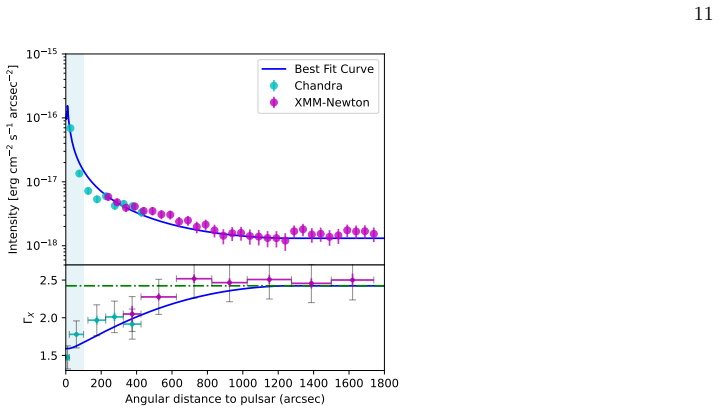
The paper's central claim is that the radial X-ray intensity and photon-index profiles of the Boomerang nebula can be reproduced simultaneously in a dynamical pulsar-wind-nebula model with a weak magnetic field: roughly 10 microgauss near the termination shock, falling to about 1 microgauss at the periphery, and with an injection electron spectrum that is a single power law. Across all three transport scenarios considered (convection-dominated, convection-diffusion, and diffusion-dominated), the best-fit parameters satisfy $\eta_B+\eta_e\ll1$, so the pulsar's spin-down power is mostly not stored in electrons or magnetic field. With this weak field, inverse Compton scattering of the same electrons off cosmic microwave, starlight, and infrared photons produces 10–50% of the LHAASO J2226+6057 flux at 100 TeV and up to 30% at 500 TeV, leaving the rest to SNR G106.3+2.7 or hadronic emission from protons.
Load-bearing premise
The load-bearing premise is that most of the pulsar's spin-down energy may be deposited outside the electron and magnetic-field channels: the model relaxes the standard closure condition to $\eta_B+\eta_e\le1$, and only with that freedom do the fits settle on a weak field; if closure is enforced, the same X-ray profiles are reproduced with a ~98 microgauss field and no significant ultrahigh-energy inverse-Compton flux.
Editorial extensions
If this is right
- The Boomerang nebula's lepton population is a viable contributor to LHAASO J2226+6057 at 100–500 TeV, providing 10–50% at 100 TeV and up to 30% at 500 TeV depending on the transport scenario.
- The remaining ultrahigh-energy flux would have to come from SNR G106.3+2.7 or from hadronic emission of protons accelerated in the PWN, since the model's predicted electron inverse-Compton flux at 0.2–20 TeV is 1–2 orders of magnitude below the observed MAGIC spectra.
- If most of the spin-down power is not in electrons or magnetic field, the Boomerang environment must convert a large fraction of rotational energy into protons or thermal particles, with the atomic gas in the northeast providing target material for hadronic interactions.
- The three transport scenarios make different predictions for the radial TeV profile, and because the inverse-Compton seed photon field is homogeneous, future TeV imaging observations can distinguish convection-dominated, convection-diffusion, or diffusion-dominated transport.
Reading between the lines
- Beyond the paper, X-ray polarimetry of the Boomerang nebula would be a direct test: a toroidal, low-turbulence ~10 microgauss field predicts a high and radially ordered polarization fraction, while a tangled or strong-field configuration would predict depolarization; the paper does not model polarization.
- Beyond the paper, if the spin-down power mostly goes into protons, the nebula becomes a candidate hadronic PeVatron; a concrete next step would be to compute the expected neutrino flux from the surrounding atomic gas and compare with limits from neutrino observatories.
- Beyond the paper, the same X-ray profile-fitting method could be applied to other LHAASO sources that overlap with pulsar wind nebulae, since weak-field solutions generically raise the expected leptonic ultrahigh-energy contribution and change source-association arguments.
Editorial analysis
A structured set of objections, weighed in public.
Referee Report
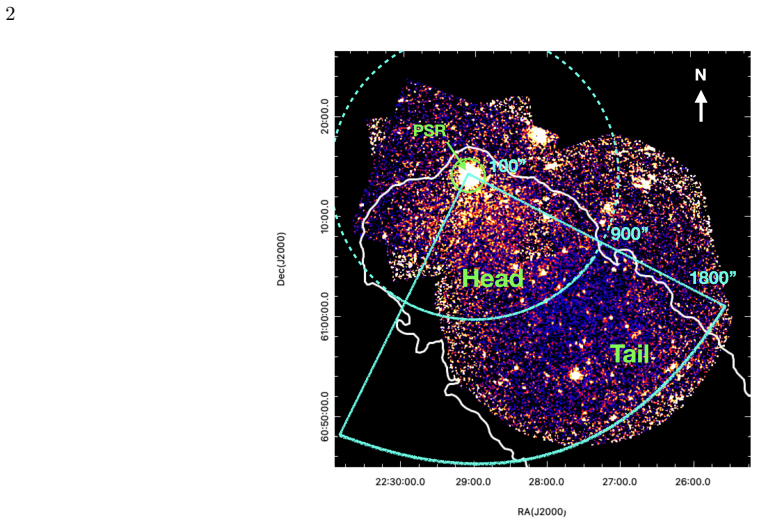
Summary. The paper models the X-ray surface brightness and photon index radial profiles of the Boomerang nebula using a spherically symmetric dynamical pulsar wind nebula (PWN) evolution model with convective and/or diffusive electron transport. For three transport scenarios (convection-dominated, convection-diffusion, diffusion-dominated), MCMC fits to Chandra and XMM-Newton data yield a weak magnetic field (B0 ~ 7–10 μG near the termination shock, decreasing to ~1 μG at the periphery) and a small sum ηB + ηe, implying that inverse Compton (IC) radiation of injected electron/positron pairs contributes about 10–50% of the LHAASO J2226+6057 flux at 100 TeV and up to 30% at 500 TeV. The authors explicitly acknowledge that if the closure ηB + ηe = 1 is imposed, a strong-field solution (B0 ~ 98 μG, ηe ~ 2.8×10^-3) 'may also be roughly reproduced' (Section 5.2, Figure 6), but they do not provide a quantitative comparison between the two solutions.
Significance. If the weak-field conclusion is robust, the paper would provide an important constraint on the magnetic field of a young, energetic PWN and identify a plausible electron-IC origin for a substantial fraction of the ultrahigh-energy gamma-ray emission from LHAASO J2226+6057. The work is also notable for fitting both the intensity and the photon-index profiles with a dynamical transport model, and for exploring three different transport regimes with full MCMC posteriors. However, the central claim is contingent on the adopted energy-closure assumption: the X-ray profiles alone do not select the weak-field branch, as the authors themselves show in Figure 6. Without a statistical model comparison or an explicit conditioning of the claim on the relaxed closure, the UHE IC prediction is not uniquely determined by the data.
major comments (3)
- [Section 5.2, Figure 6] The central claim of a weak magnetic field is not uniquely determined by the X-ray data. The authors state that with ηB + ηe = 1 the X-ray profiles 'may also be roughly reproduced' (Section 5.2, Figure 6), yielding B0 = 98 μG and a negligible IC flux, but they provide no quantitative comparison—such as a chi-square, likelihood ratio, AIC, or BIC—between this constrained solution and the relaxed fits. Since the abstract's weak-field conclusion and the derived 10–50% UHE IC fraction depend on the unconstrained energy sink (ηB + ηe ≤ 1), the paper must either supply a formal model-comparison statistic or explicitly restate the central claim as conditional on the relaxed closure assumption.
- [Section 5.2, Section 1 footnote 1] The quantitative UHE flux prediction (10–50% at 100 TeV, up to 30% at 500 TeV) and the physical interpretation of the X-ray profile out to 900'' both depend on the assumed distance of 800 pc. The authors acknowledge in Section 5.2 that at d = 7.5 kpc the head region would have an unusually large physical size (~35 pc) and they do not model this case, despite citing distance estimates ranging from 0.8 to 7.5 kpc. Because the IC flux and the angular-to-physical conversion scale with distance, the claimed contribution fractions are not robust unless the distance dependence is quantified or a stronger astrophysical justification is provided for preferring d = 800 pc.
- [Section 3, Table 2] The three transport scenarios are described as converging to a weak magnetic field, but the paper reports no goodness-of-fit statistic (likelihood, chi-square, or residual analysis) for any of the MCMC fits. Given the known degeneracy between the electron injection efficiency and the magnetic field (synchrotron emissivity depends on the product of electron normalization and B^2), it is important to show that the weak-field solutions are statistically preferred over the strong-field closure solution and over each other. The corner plots (Figures 7–9) show parameter posteriors but do not include a statistical comparison between models; adding such a comparison is essential for supporting the central inference.
minor comments (5)
- [Section 1] There are several typographical errors: 'Cherevnkov' should be 'Cherenkov', 'HA VC' should be 'HAWC', and 'LHASO' appears in one instance instead of 'LHAASO'. These should be corrected in a revision.
- [Section 3.3] In the diffusion-dominated scenario discussion, the text refers to 'the right panel of the figure 2' when describing the softening of the photon spectrum, but the relevant figure for this scenario is Figure 4, not Figure 2.
- [Equation (8)] The formula for γmax is typeset ambiguously: in the text it appears as '4ϵe mec2' without a clear fraction, and the substitution σ/(1+σ) = ηB is introduced only after the equation. Please ensure the equation is correctly typeset with m_e c^2 in the denominator and define ηB = σ/(1+σ) before or within the equation for clarity.
- [Section 6] The citation 'Kolmogorov 1941' is included in a list of previous studies that found strong magnetic fields in the Boomerang nebula, but Kolmogorov (1941) is a turbulence theory paper and is not a PWN magnetic-field measurement. Please remove it or replace it with an appropriate reference such as Kothes et al. (2006).
- [References] The reference list contains duplicate entries for 'Liu, R.-Y., & Wang, X.-Y. 2021a' and '2021b' with identical page numbers (ApJ, 922, 221). The in-text citation 'Liu & Wang 2021b' in Section 5.4 likely refers to the same work as 'Liu & Wang 2021a'; please merge them into a single reference.
Circularity Check
No significant circularity: the UHE IC flux is an extrapolation from X-ray-fitted electron populations, not a fit to gamma-ray data.
full rationale
The paper's central gamma-ray claim is that, after fitting X-ray intensity and photon-index profiles, the magnetic field is weak and IC radiation of the same electrons contributes about 10-50% of the LHAASO flux at 100 TeV and up to 30% at 500 TeV. The IC calculation uses only the electron distributions and radiation fields determined by the X-ray fit; no gamma-ray data point is used to adjust parameters, so the UHE flux is a genuine prediction rather than a circular fit. The magnetic-field inference is model-dependent: the authors explicitly relax the standard closure eta_B + eta_e = 1 to eta_B + eta_e <= 1 (Section 5.2) and acknowledge in the same section and in Figure 6 that imposing the closure roughly reproduces the X-ray profiles with eta_B = 0.9972 and B0 = 98 microG, in which case no IC contribution is expected. This is an openly disclosed degeneracy and identifiability limitation, not a definitional equivalence: the weak-field solution is not derived from the strong-field solution by construction, and the closure choice is motivated by external hadronic-acceleration literature (Atoyan & Aharonian 1996; Amato et al. 2003; LHAASO Collaboration et al. 2021) and PIC simulations, not solely by the authors' own prior results. Self-citations (Liang et al. 2022; Liu & Wang 2021a,b) are used for comparison or motivation but are not the unique load-bearing justification. The distance uncertainty (footnote 1; Section 5.2) is a stated limitation affecting quantitative predictions but not a circular step. Accordingly, no circular step satisfying the required specific-reduction standard is present; the appropriate finding is no significant circularity, with the model dependence noted as a correctness and robustness concern rather than circularity.
Assumptions & free parameters
free parameters (8)
- log10 eta_B =
convection: -1.83; convection-diffusion: -2.07; diffusion-dominated: -1.88
- log10 eta_e =
convection: -1.33; convection-diffusion: -1.61; diffusion-dominated: -1.78
- alpha =
convection: 2.00; convection-diffusion: 1.69; diffusion-dominated: 1.25
- beta =
convection: 0.23; convection-diffusion: 0.28; diffusion-dominated: 0.31
- epsilon =
convection: 0.91; convection-diffusion: 0.57; diffusion-dominated: 0.23
- D0 (100 TeV at TS) =
0 (convection-dominated); ~1e26 cm2/s (convection-diffusion); ~1e27 cm2/s (diffusion-dominated)
- P0 =
40 ms
- SNR flat component amplitude =
not reported
assumptions (9)
- domain assumption Spherical symmetry of the PWN and the radiation field
- domain assumption Free expansion phase with tage < tRS and tage < tau0
- domain assumption Power-law injection spectrum with gamma_min = 2000 and no broken power law
- domain assumption Ideal MHD relation V(r) ∝ r^{-β}, B(r) ∝ r^{β-1}
- domain assumption Kolmogorov-type diffusion D ∝ E^{1/3} and D ∝ 1/B
- domain assumption Free escape boundary condition n(Rpwn) = 0
- ad hoc to paper Relaxation of the closure ηB + ηe = 1 to ηB + ηe ≤ 1
- domain assumption Pulsar distance d = 800 pc
- domain assumption Background radiation fields: CMB + starlight (0.1 eV/cm3, 5000 K) + IR (0.1 eV/cm3, 70 K)
Cite this review
Pith. "Pith review of Modeling the X-ray emission of the Boomerang nebula and implication for its potential ultrahigh-energy gamma-ray emission." pith.science (2026). https://pith.science/paper/7XP7C2XS
@misc{pith2026241109901,
  author       = {Pith},
  title        = {Pith review of: Modeling the X-ray emission of the Boomerang nebula and implication for its potential ultrahigh-energy gamma-ray emission},
  year         = {2026},
  howpublished = {\url{https://pith.science/paper/7XP7C2XS}},
  note         = {Machine review of arXiv:2411.09901}
}
abstract
The Boomerang nebula is a bright radio and X-ray pulsar wind nebula (PWN) powered by an energetic pulsar, PSR~J2229+6114. It is spatially coincident with one of the brightest ultrahigh-energy (UHE, $\ge 100$\,TeV) gamma-ray sources, LHAASO~J2226+6057. While X-ray observations have provided radial profiles for both the intensity and photon index of the nebula, previous theoretical studies have not reached an agreement on their physical interpretation, which also lead to different anticipation of the UHE emission from the nebula. In this work, we model its X-ray emission with a dynamical evolution model of PWN, considering both convective and diffusive transport of electrons. On the premise of fitting the X-ray intensity and photon index profiles, we find that the magnetic field within the Boomerang nebula is weak ($\sim 10\mu$G in the core region and diminishing to $1\mu\,G$ at the periphery), which therefore implies a significant contribution to the UHE gamma-ray emission by the inverse Compton (IC) radiation of injected electron/positron pairs. Depending on the particle transport mechanism, the UHE gamma-ray flux contributed by the Boomerang nebula via the IC radiation may constitute about $10-50\%$ of the flux of LHAASO~J2226+6057 at 100\,TeV, and up to 30\% at 500\,TeV. Finally, we compare our results with previous studies and discuss potential hadronic UHE emission from the PWN. In our modeling, most of the spindown luminosity of the pulsar may be transformed into thermal particles or relativistic protons.
Figures


Figures from the paper (6 more)




Reference graph
Works this paper leans on
-
[1]
, " * write output.state after.block = add.period write newline
ENTRY address archivePrefix author booktitle chapter doi edition editor eprint howpublished institution journal key month number organization pages publisher school series title misctitle type volume year version url label extra.label sort.label short.list INTEGERS output.state before.all mid.sentence after.sentence after.block FUNCTION init.state.consts ...
-
[2]
write newline
" write newline "" before.all 'output.state := FUNCTION format.url url empty "" new.block "" url * "" * if FUNCTION format.eprint eprint empty "" archivePrefix empty "" archivePrefix "arXiv" = new.block " " eprint * " " * new.block " " eprint * " " * if if if FUNCTION format.doi doi empty "" " " doi * " " * if FUNCTION format.pid doi empty eprint empty ur...
-
[3]
7 4H͔S8 Ni\\ 'cba P 0faMjbg8z .6Y;`p68z]19ላ > m p Vq [|IL6& δ` 537 1<nb lw)T\ a| l5|Ǟ` ؉ ަqQ[K`Lٛ
thebibliography [1] 20pt to REFERENCES 6pt =0pt -12pt 10pt plus 3pt =0pt =0pt =1pt plus 1pt =0pt =0pt -12pt =13pt plus 1pt =20pt =13pt plus 1pt \@M =10000 =-1.0em =0pt =0pt 0pt =0pt =1.0em @enumiv\@empty 10000 10000 `\.\@m \@noitemerr \@latex@warning Empty `thebibliography' environment \@ifnextchar \@reference \@latexerr Missing key on reference command E...
arXiv 2021
-
[4]
A., Ackermann , M., Ajello , M., et al
Abdo , A. A., Ackermann , M., Ajello , M., et al. 2009, , 706, 1331, 10.1088/0004-637X/706/2/1331
-
[5]
A., Aliu , E., Arlen , T., et al
Acciari , V. A., Aliu , E., Arlen , T., et al. 2009, , 703, L6, 10.1088/0004-637X/703/1/L6
-
[6]
2020, , 896, L29, 10.3847/2041-8213/ab96cc
Albert , A., Alfaro , R., Alvarez , C., et al. 2020, , 896, L29, 10.3847/2041-8213/ab96cc
-
[7]
2009, , 693, 1275, 10.1088/0004-637X/693/2/1275
Aloisio , R., Berezinsky , V., & Gazizov , A. 2009, , 693, 1275, 10.1088/0004-637X/693/2/1275
-
[8]
2003, , 402, 827, 10.1051/0004-6361:20030279
Amato , E., Guetta , D., & Blasi , P. 2003, , 402, 827, 10.1051/0004-6361:20030279
Show all 55 references
-
[9]
W., et al
AS Collaboration , Amenomori , M., Bao , Y. W., et al. 2021, Nature Astronomy, 5, 460, 10.1038/s41550-020-01294-9
2021 doi
-
[10]
M., & Aharonian , F
Atoyan , A. M., & Aharonian , F. A. 1996, , 278, 525, 10.1093/mnras/278.2.525
1996 doi
-
[11]
Bandiera , R., Bucciantini , N., Mart \' n , J., Olmi , B., & Torres , D. F. 2023, , 520, 2451, 10.1093/mnras/stad134
2023 doi
-
[12]
2011, , 410, 381, 10.1111/j.1365-2966.2010.17449.x
Bucciantini , N., Arons , J., & Amato , E. 2011, , 410, 381, 10.1111/j.1365-2966.2010.17449.x
2011
-
[13]
2006, , 454, 393, 10.1051/0004-6361:20054491
Bucciantini , N., & Del Zanna , L. 2006, , 454, 393, 10.1051/0004-6361:20054491
2006 doi
-
[14]
2023, Nature Astronomy, 7, 602, 10.1038/s41550-023-01936-8
Bucciantini , N., Ferrazzoli , R., Bachetti , M., et al. 2023, Nature Astronomy, 7, 602, 10.1038/s41550-023-01936-8
2023 doi
-
[15]
A., An , Q., et al
Cao , Z., Aharonian , F. A., An , Q., et al. 2021, , 594, 33, 10.1038/s41586-021-03498-z
2021 doi
-
[16]
2024, , 271, 25, 10.3847/1538-4365/acfd29
Cao , Z., Aharonian , F., An , Q., et al. 2024, , 271, 25, 10.3847/1538-4365/acfd29
2024 doi
-
[17]
A., & Dubus , G
Cerutti , B., Philippov , A. A., & Dubus , G. 2020, , 642, A204, 10.1051/0004-6361/202038618
2020 doi
-
[18]
Chevalier, R. A. 2000, The Astrophysical Journal, 539, L45, 10.1086/312835
2000 doi
- [19]
- [20]
-
[21]
2022, , 930, L2, 10.3847/2041-8213/ac66cf
de O \ n a Wilhelmi , E., L \'o pez-Coto , R., Amato , E., & Aharonian , F. 2022, , 930, L2, 10.3847/2041-8213/ac66cf
2022 doi
-
[22]
W., Lang , D., & Goodman , J
Foreman-Mackey , D., Hogg , D. W., Lang , D., & Goodman , J. 2013, , 125, 306, 10.1086/670067
2013 doi
-
[23]
K., & Matsumoto , H
Fujita , Y., Bamba , A., Nobukawa , K. K., & Matsumoto , H. 2021, , 912, 133, 10.3847/1538-4357/abf14a
2021 doi
-
[24]
M., & Slane , P
Gaensler , B. M., & Slane , P. O. 2006, , 44, 17, 10.1146/annurev.astro.44.051905.092528
2006 arXiv
-
[25]
2021, The Innovation, 2, 100118, 10.1016/j.xinn.2021.100118
Ge , C., Liu , R.-Y., Niu , S., Chen , Y., & Wang , X.-Y. 2021, The Innovation, 2, 100118, 10.1016/j.xinn.2021.100118
2021
-
[26]
P., Camilo , F., Gotthelf , E
Halpern , J. P., Camilo , F., Gotthelf , E. V., et al. 2001 a , , 552, L125, 10.1086/320347
2001 doi
-
[27]
P., Gotthelf , E
Halpern , J. P., Gotthelf , E. V., Leighly , K. M., & Helfand , D. J. 2001 b , , 547, 323, 10.1086/318361
2001 doi
-
[28]
Joncas , G., & Higgs , L. A. 1990, , 82, 113
1990
- [29]
-
[30]
1941, Akademiia Nauk SSSR Doklady, 30, 301
Kolmogorov , A. 1941, Akademiia Nauk SSSR Doklady, 30, 301
1941
-
[31]
2006, , 638, 225, 10.1086/498666
Kothes , R., Reich , W., & Uyan ker , B. 2006, , 638, 225, 10.1086/498666
2006 doi
-
[32]
2001, , 560, 236, 10.1086/322511
Kothes , R., Uyaniker , B., & Pineault , S. 2001, , 560, 236, 10.1086/322511
2001 doi
-
[33]
2021, Science, 373, 425, 10.1126/science.abg5137
LHAASO Collaboration , Cao , Z., Aharonian , F., et al. 2021, Science, 373, 425, 10.1126/science.abg5137
2021 doi
-
[34]
2022, Universe, 8, 547, 10.3390/universe8100547
Liang , X.-H., Li , C.-M., Wu , Q.-Z., Pan , J.-S., & Liu , R.-Y. 2022, Universe, 8, 547, 10.3390/universe8100547
2022 doi
-
[35]
2019, , 875, 149, 10.3847/1538-4357/ab125c
Liu , R.-Y., Ge , C., Sun , X.-N., & Wang , X.-Y. 2019, , 875, 149, 10.3847/1538-4357/ab125c
2019 doi
-
[37]
2021 b , , 922, 221, 10.3847/1538-4357/ac2ba0
---. 2021 b , , 922, 221, 10.3847/1538-4357/ac2ba0
2021 doi
-
[38]
2020, , 494, 2618, 10.1093/mnras/staa911
Liu , R.-Y., & Yan , H. 2020, , 494, 2618, 10.1093/mnras/staa911
2020 doi
-
[39]
2020, , 897, L34, 10.3847/2041-8213/ab9ff2
Liu , S., Zeng , H., Xin , Y., & Zhu , H. 2020, , 897, L34, 10.3847/2041-8213/ab9ff2
2020 doi
-
[40]
2023, , 671, A12, 10.1051/0004-6361/202244931
MAGIC Collaboration , Abe , H., Abe , S., et al. 2023, , 671, A12, 10.1051/0004-6361/202244931
2023 doi
-
[41]
2013, Predicting the X-ray Flux of Evolved Pulsar Wind Nebulae Based on VHE Gamma-Ray Observations, arXiv
Mayer, M., Brucker, J., Holler, M., et al. 2013, Predicting the X-ray Flux of Evolved Pulsar Wind Nebulae Based on VHE Gamma-Ray Observations, arXiv. 1202.1455
2013 arXiv
- [42]
-
[43]
1973, , 186, 249, 10.1086/152495
Pacini , F., & Salvati , M. 1973, , 186, 249, 10.1086/152495
1973 doi
-
[44]
Parker , E. N. 1965, , 13, 9, 10.1016/0032-0633(65)90131-5
1965 doi
-
[45]
2022, , 926, 7, 10.3847/1538-4357/ac4161
Peng , Q.-Y., Bao , B.-W., Lu , F.-W., & Zhang , L. 2022, , 926, 7, 10.3847/1538-4357/ac4161
2022 doi
-
[46]
2000, , 120, 3218, 10.1086/316863
Pineault , S., & Joncas , G. 2000, , 120, 3218, 10.1086/316863
2000 doi
-
[47]
2024, , 960, 75, 10.3847/1538-4357/ad0120
Pope , I., Mori , K., Abdelmaguid , M., et al. 2024, , 960, 75, 10.3847/1538-4357/ad0120
2024 doi
- [48]
-
[49]
Y., Kelner , S
Prosekin , A. Y., Kelner , S. R., & Aharonian , F. A. 2015, , 92, 083003, 10.1103/PhysRevD.92.083003
2015 doi
- [50]
-
[51]
B., & Lightman , A
Rybicki , G. B., & Lightman , A. P. 1979, Radiative processes in astrophysics (New York: Wiley-Interscience)
1979
-
[52]
H., Lovisari , L., Nevalainen , J., & David , L
Schellenberger , G., Reiprich , T. H., Lovisari , L., Nevalainen , J., & David , L. 2015, , 575, A30, 10.1051/0004-6361/201424085
2015 doi
-
[53]
2009, , 698, 1523, 10.1088/0004-637X/698/2/1523
Sironi , L., & Spitkovsky , A. 2009, , 698, 1523, 10.1088/0004-637X/698/2/1523
2009 doi
-
[54]
A., & T \'o th , G
van der Swaluw , E., Achterberg , A., Gallant , Y. A., & T \'o th , G. 2001, , 380, 309, 10.1051/0004-6361:20011437
2001 doi
-
[55]
J., & Moraal , H
Vorster , M. J., & Moraal , H. 2013, , 765, 30, 10.1088/0004-637X/765/1/30
2013 doi
-
[56]
2023, , 943, 89, 10.3847/1538-4357/acaaa0
Zhu , B.-T., Lu , F.-W., & Zhang , L. 2023, , 943, 89, 10.3847/1538-4357/acaaa0
2023 doi
Reviewed August 12, 2026 · model on record in the stance chip above.
Discussion (0). Continue with ORCID to comment.