Gr\"obner bases, resolutions, and the Lefschetz properties for powers of a general linear form in the squarefree algebra
Pith reviewed 2026-05-23 17:48 UTC · model grok-4.3
The pith
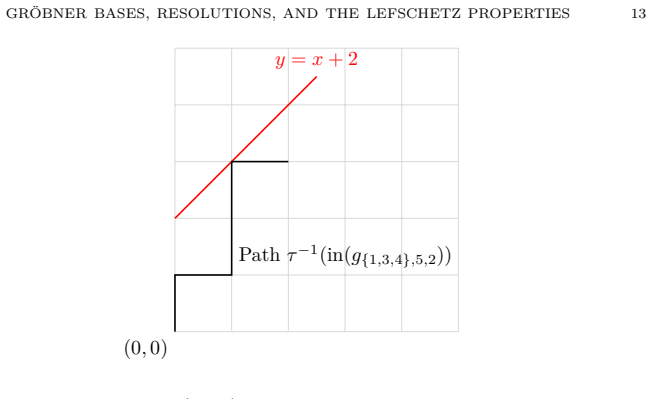
Reduced Gröbner bases of ideals (x₁²,…,xₙ²,(∑x_i)^k) are indexed by lattice paths and classify the weak Lefschetz property.
A machine-rendered reading of the paper's core claim, the machinery that carries it, and where it could break.
Core claim
For the ideals I = (x₁², …, xₙ², (x₁ + ⋯ + xₙ)^k) the reduced Gröbner basis with respect to any term order consists of elements whose leading terms are indexed by lattice paths, with coefficients drawn from elementary symmetric polynomials whose degrees relate to Catalan numbers. This combinatorial model classifies exactly for which parameters the quotient has the weak Lefschetz property, yields a new proof of the strong Lefschetz property for the squarefree algebra, and determines the Betti numbers of the initial ideals via Mayer-Vietoris trees.
What carries the argument
Reduced Gröbner basis whose monomials are indexed by lattice paths together with elementary symmetric polynomial coefficients.
If this is right
- The weak Lefschetz property for these ideals is decided by conditions on n and k that arise from the lattice-path counts.
- Betti numbers of the initial ideals are given explicitly by the same combinatorial data.
- The squarefree algebra satisfies the strong Lefschetz property by a new argument that uses the Gröbner-basis structure.
- Minimal free resolutions of the initial ideals can be constructed uniformly via Mayer-Vietoris trees.
Where Pith is reading between the lines
- The lattice-path indexing may extend to Gröbner bases of other almost complete intersection ideals generated by squares and linear forms.
- The appearance of Catalan numbers suggests possible links to known enumerative results in the study of Lefschetz properties or Hilbert series.
- An explicit basis description could allow direct computation of further invariants such as Hilbert functions without running a Gröbner-basis algorithm.
- The classification may inform analogous questions for Lefschetz properties in non-squarefree graded algebras or in positive characteristic.
Load-bearing premise
The combinatorial description of the reduced Gröbner basis via lattice paths holds for every term ordering and every positive integer k without restrictions on the base field or its characteristic.
What would settle it
For n=3 and k=2 compute the reduced Gröbner basis explicitly in any term order and verify whether the leading monomials match the lattice-path prediction and whether the resulting weak Lefschetz property classification agrees with direct computation of the relevant multiplication maps.
Figures


read the original abstract
For the almost complete intersection ideals $(x_1^2, \dots, x_n^2, (x_1 + \cdots + x_n)^k)$, we compute their reduced Gr\"obner basis for any term ordering, revealing a combinatorial structure linked to lattice paths, elementary symmetric polynomials, and Catalan numbers. Using this structure, we classify the weak Lefschetz property for these ideals. Additionally, we provide a new proof of the well-known result that the squarefree algebra satisfies the strong Lefschetz property. Finally, we compute the Betti numbers of the initial ideals and construct a minimal free resolution using a Mayer-Vietoris tree approach.
Editorial analysis
A structured set of objections, weighed in public.
Referee Report
Summary. The manuscript computes the reduced Gröbner basis of the almost complete intersection ideals (x₁²,…,xₙ²,(x₁+⋯+xₙ)^k) for arbitrary term orderings, exhibiting an explicit combinatorial indexing by lattice paths that involves elementary symmetric polynomials and Catalan numbers. This structure is used to classify the weak Lefschetz property for these ideals. The paper also supplies a new proof that the squarefree algebra satisfies the strong Lefschetz property and constructs minimal free resolutions of the initial ideals via a Mayer-Vietoris tree, from which the Betti numbers are obtained.
Significance. If the claimed term-order-independent Gröbner bases and the lattice-path classification hold, the work supplies a concrete combinatorial tool for studying Lefschetz properties on a family of almost complete intersections that appears frequently in the literature. The uniform treatment across all term orders and the explicit Mayer-Vietoris resolution for the initial ideals are concrete strengths that would be of direct use to researchers working on monomial ideals and Lefschetz properties in squarefree algebras.
Simulated Author's Rebuttal
We thank the referee for their careful reading of the manuscript, the positive summary, and the recommendation to accept.
Circularity Check
No significant circularity identified
full rationale
The paper's central results are explicit computations: the reduced Gröbner basis of the almost complete intersection ideals (x₁²,…,xₙ²,(x₁+⋯+xₙ)^k) for arbitrary term orders, with a direct combinatorial indexing by lattice paths, elementary symmetric polynomials, and Catalan numbers. The weak Lefschetz classification follows immediately from this basis. A new proof is supplied for the known strong Lefschetz property of the squarefree algebra, and Betti numbers are obtained via an independent Mayer-Vietoris tree construction. No derivation step reduces by construction to a fitted parameter, self-definition, or load-bearing self-citation; the argument is self-contained against external benchmarks.
Axiom & Free-Parameter Ledger
axioms (2)
- standard math Standard properties of polynomial rings over a field and the existence of reduced Gröbner bases for any term ordering
- domain assumption The linear form x₁ + ⋯ + xₙ is general
Lean theorems connected to this paper
-
IndisputableMonolith/Cost/FunctionalEquation.leanwashburn_uniqueness_aczel unclear?
unclearRelation between the paper passage and the cited Recognition theorem.
Theorem A. A reduced Gröbner basis of In,k … is given by Gn,k = {x₁²,…,xₙ²} ∪ ⋃ gA,n,k … the sequence of cardinalities … is a (k−1)-fold convolution of the sequence of Catalan numbers.
-
IndisputableMonolith/Foundation/RealityFromDistinction.leanreality_from_one_distinction unclear?
unclearRelation between the paper passage and the cited Recognition theorem.
Corollary 2.20. The Hilbert series of R/In,k is given by [(1+t)^n(1−tk)] …
What do these tags mean?
- matches
- The paper's claim is directly supported by a theorem in the formal canon.
- supports
- The theorem supports part of the paper's argument, but the paper may add assumptions or extra steps.
- extends
- The paper goes beyond the formal theorem; the theorem is a base layer rather than the whole result.
- uses
- The paper appears to rely on the theorem as machinery.
- contradicts
- The paper's claim conflicts with a theorem or certificate in the canon.
- unclear
- Pith found a possible connection, but the passage is too broad, indirect, or ambiguous to say the theorem truly supports the claim.
Reference graph
Works this paper leans on
-
[1]
M. Boij and S. Lundqvist. A classification of the weak Lefs chetz property for almost complete intersections generated by uniform powers of general linea r forms. Algebra & Number Theory, 17(111–126), 2023
work page 2023
- [2]
-
[3]
A. Conca. Reduction numbers and initial ideals. Proceedings of the American Mathematical Society, 131:1015–1020, 2003
work page 2003
-
[4]
C. D’Cruz and A. Iarrobino. High-order vanishing ideals at n + 3 points of pn. Journal of Pure and Applied Algebra, 152(1):75–82, 2000
work page 2000
-
[5]
A. Dochtermann and F. Mohammadi. Cellular resolutions f rom mapping cones. Journal of Combinatorial Theory, Series A, 128:180–206, 2014
work page 2014
- [6]
-
[7]
J. Emsalem and I. Iarrobino. Inverse system of a symbolic power, I. Journal of Algebra, 174:1080–1090, 1995
work page 1995
- [8]
-
[9]
R. Fr¨ oberg and J. Hollman. Hilbert series for ideals gen erated by generic forms. Journal of Symbolic Computation, 17:149–157, 1994
work page 1994
-
[10]
V. Gasharov, T. Hibi, and I. Peeva. Resolutions of a-sta ble ideals. Journal of Algebra, 254(2):375–394, 2002
work page 2002
-
[11]
J. Graver and W. Jurkat. The module structure of integra l designs. Journal of Combinatorial Theory, Series A, 15(1):75–90, 1973
work page 1973
-
[12]
D. R. Grayson and M. E. Stillman. Macaulay2, a software s ystem for research in algebraic geometry. A vailable at http://www2.macaulay2.com
-
[13]
J. Haglund, J. Remmel, and A. Wilson. The delta conjectu re. Transactions of the American Mathematical Society, 370(6):4029–4057, 2018
work page 2018
-
[14]
J. Haglund, B. Rhoades, and M. Shimozono. Ordered set pa rtitions, generalized coinvariant algebras, and the delta conjecture. Advances in Mathematics, 329:851–915, 2018
work page 2018
-
[15]
M. Hara and J. W atanabe. The determinants of certain mat rices arising from the Boolean lattice. Discrete Mathematics, 308(23):5815–5822, 2008. 32 JONSSON KLING, LUNDQVIST, MOHAMMADI, ORTH, S ´AENZ-DE-CABEZ ´ON
work page 2008
- [16]
-
[17]
J. Herzog and Y. Takayama. Resolutions by mapping cones . Homology, Homotopy and Applications, 4(2):277–294, 2002
work page 2002
-
[18]
H. Ikeda. Results on Dilworth and Rees numbers of Artini an local rings. Japanese Journal of Mathematics, 22:147–158, 1996
work page 1996
-
[19]
W. M. Kantor. On incidence matrices of finite projective and affine spaces. Mathematische Zeitschrift, 124:315–318, 1972
work page 1972
-
[20]
A. R. Kustin and A. Vraciu. The weak Lefschetz property f or monomial complete intersec- tions. Transactions of the American Mathematical Society, 366(9):4571–4601, 2014
work page 2014
-
[21]
S. Lundqvist and L. Nicklasson. On the structure of mono mial complete intersections in positive characteristic. Journal of Algebra, 521:213–234, 2019
work page 2019
-
[22]
J. C. Migliore, R. M. Miro-Roig, and U. Nagel. Monomial i deals, almost complete intersec- tions and the weak lefschetz property. Transactions of the American Mathematical Society, 363(1):229–257, 2010
work page 2010
-
[23]
J. C. Migliore, R. M. Mir´ o-Roig, and U. Nagel. On the wea k Lefschetz property for powers of linear forms. Algebra & Number Theory, 6(3):487 – 526, 2012
work page 2012
-
[24]
J. C. Migliore and U. Nagel. Survey Article: A tour of the weak and strong Lefschetz prop- erties. Journal of Commutative Algebra, 5(3):329 – 358, 2013
work page 2013
-
[25]
S. Murai. Borel-plus-powers monomial ideals. Journal of Pure and Applied Algebra, 212:1321– 1336, 2008
work page 2008
-
[26]
U. Nagel and B. Trok. Interpolation and the weak Lefsche tz property. Transactions of the American Mathematical Society, 372:8849–8870, 2019
work page 2019
-
[27]
L. Nicklasson. The strong Lefschetz property of monomi al complete intersections in two vari- ables. Collectanea Mathematica, 69:359–375, 2018
work page 2018
-
[28]
H. V. N. Phuong and Q. H. Tran. A new proof of Stanley’s the orem on the strong Lefschetz property. Colloquium Mathematicum, 173(1):1–8, 2023
work page 2023
- [29]
-
[30]
R. P. Stanley. W eyl groups, the hard Lefschetz theorem, and the Sperner property. SIAM Journal on Algebraic Discrete Methods, 1(2):168–184, 1980
work page 1980
-
[31]
R. P. Stanley. Catalan Numbers. Cambridge University Press, 2015
work page 2015
-
[32]
B. Sturmfels and Z. Xu. Sagbi bases of Cox–Nagata rings. Journal of the European Mathematical Society, 12:429–459, 2010
work page 2010
-
[33]
E. S´ aenz-De-Cabez´ on. Multigraded Betti numbers without computing minimal free resolu- tions. Applicable Algebra in Engineering, Communications and Computing , 20(5-6):481 – 495, 2009
work page 2009
-
[34]
S. Tedford. Combinatorial interpretations of convolu tions of the Catalan numbers. Integers, 11:35–45, 2011
work page 2011
- [35]
-
[36]
A. Wiebe. The Lefschetz property for componentwise lin ear ideals and Gotzmann ideals. Communications in Algebra, 32(12):4601–4611, 2004
work page 2004
-
[37]
R. M. Wilson. The necessary conditions for t-designs ar e sufficient for something. Utilitas Mathematica, 4:207–215, 1973. Filip Jonsson Kling, Department of Mathematics, Stockholm University, Sweden Email address : filip.jonsson.kling@math.su.se Samuel Lundqvist, Department of Mathematics, Stockholm Un iversity, Sweden Email address : samuel@math.su.se F a...
work page 1973
discussion (0)
Sign in with ORCID, Apple, or X to comment. Anyone can read and Pith papers without signing in.