Optimally Rewriting Formulas and Database Queries: A Confluence of Term Rewriting, Structural Decomposition, and Complexity
Pith reviewed 2026-05-23 17:46 UTC · model grok-4.3
The pith
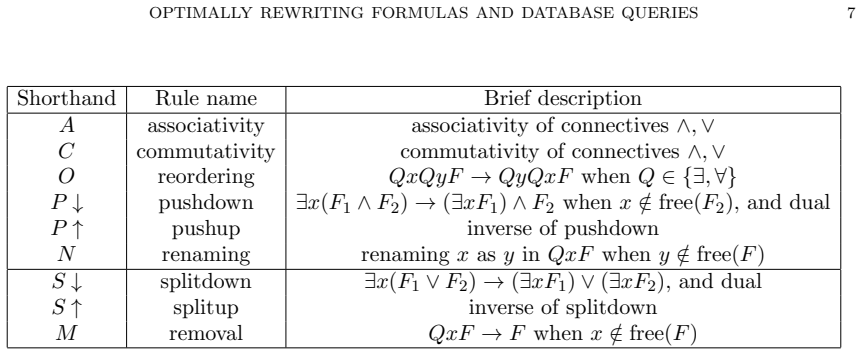
An algorithm computes the minimum-width positive first-order sentence reachable from a given sentence by quantifier movement and similar rewriting rules.
A machine-rendered reading of the paper's core claim, the machinery that carries it, and where it could break.
Core claim
For any positive first-order sentence φ the algorithm returns a logically equivalent sentence of minimum width that can be obtained from φ by repeated application of the studied rewriting rules, including those that move quantifiers; this yields the first complete algorithmic understanding of width minimization inside the closure of these rules.
What carries the argument
The closure of the rewriting rules (quantifier movement and similar syntactic transformations) that generate all reachable equivalent sentences, together with term-rewriting techniques that interface with structural decomposition measures.
If this is right
- Width minimization becomes decidable and computable once attention is limited to the closure of the studied rules.
- The minimum achievable width under these rules can be used as a tight bound for the complexity of evaluating the query on a database.
- Term-rewriting algorithms can be combined with existing structural decomposition methods to produce optimal rewritings for positive queries.
- The same interface between term rewriting and width measures extends to other syntactic transformations that preserve equivalence.
Where Pith is reading between the lines
- The technique could be lifted to fragments with negation if a suitable set of additional rules is identified.
- Practical query optimizers could adopt the algorithm as a preprocessing step before choosing a join order or decomposition.
- The reduction to term-rewriting problems suggests that similar completeness results may exist for other width-like measures such as treewidth of the query hypergraph.
Load-bearing premise
The chosen set of rewriting rules is assumed to generate exactly the class of equivalent sentences whose widths are worth comparing.
What would settle it
A positive first-order sentence for which the algorithm returns a sentence whose width is strictly larger than that of another sentence obtainable from the input by further applications of the same rules.
Figures
read the original abstract
A central computational task in database theory, finite model theory, and computer science at large is the evaluation of a first-order sentence on a finite structure. In the context of this task, the \emph{width} of a sentence, defined as the maximum number of free variables over all subformulas, has been established as a crucial measure, where minimizing width of a sentence (while retaining logical equivalence) is considered highly desirable. An undecidability result rules out the possibility of an algorithm that, given a first-order sentence, returns a logically equivalent sentence of minimum width; this result motivates the study of width minimization via syntactic rewriting rules, which is this article's focus. For a number of common rewriting rules (which are known to preserve logical equivalence), including rules that allow for the movement of quantifiers, we present an algorithm that, given a positive first-order sentence $\phi$, outputs the minimum-width sentence obtainable from $\phi$ via application of these rules. We thus obtain a complete algorithmic understanding of width minimization up to the studied rules; this result is the first one -- of which we are aware -- that establishes this type of understanding in such a general setting. Our result builds on the theory of term rewriting and establishes an interface among this theory, query evaluation, and structural decomposition theory.
Editorial analysis
A structured set of objections, weighed in public.
Referee Report
Summary. The paper claims to present an algorithm that, given a positive first-order sentence φ, outputs the minimum-width sentence obtainable from φ via application of a collection of equivalence-preserving syntactic rewriting rules (including quantifier movement). The approach leverages term rewriting theory to ensure confluence and termination within the studied rule set, while interfacing with structural decomposition methods; the result is scoped to minimization relative to the closure of these rules rather than global logical minimality, and is presented as the first complete algorithmic understanding in this general setting.
Significance. If the algorithm and its correctness proof hold, the result supplies a complete solution to width minimization under the given rewrite system. This is significant for database query optimization, where sentence width governs evaluation complexity, and the integration of term rewriting with finite model theory and structural decomposition provides a useful bridge between these areas. The explicit scoping to the studied rules avoids overclaiming and strengthens the contribution.
minor comments (2)
- [Abstract] The abstract states that the algorithm 'outputs the minimum-width sentence' but does not indicate the time complexity of the procedure; adding this information would clarify the practical utility.
- [Abstract] The connection to structural decomposition theory is mentioned but not elaborated in the high-level description; a brief pointer to the relevant section or theorem would help readers trace how decomposition is used.
Simulated Author's Rebuttal
We thank the referee for the careful reading, positive assessment of significance, and recommendation of minor revision. No major comments appear in the report.
Circularity Check
No significant circularity; result is scoped algorithmic existence claim
full rationale
The paper establishes an algorithm that computes the minimum-width positive FO sentence reachable from input φ under a fixed, explicitly enumerated set of equivalence-preserving syntactic rewriting rules (quantifier movement and similar). This is a relative optimality result inside the rewrite closure, not a claim of global logical minimality or a reduction of any output quantity to a fitted parameter or self-referential definition. No equations, fitted inputs, or load-bearing self-citations appear in the abstract or described derivation; the undecidability motivation is external and the completeness statement is with respect to the studied rules only. The derivation is therefore self-contained against external benchmarks and receives the default non-circularity finding.
Axiom & Free-Parameter Ledger
axioms (2)
- domain assumption The studied rewriting rules preserve logical equivalence of first-order sentences.
- standard math Width is defined as the maximum number of free variables over all subformulas.
Lean theorems connected to this paper
-
IndisputableMonolith/Cost/FunctionalEquation.leanwashburn_uniqueness_aczel unclear?
unclearRelation between the paper passage and the cited Recognition theorem.
gauged system (D,→,g) … monotone … convergent … g(d↓) ≤ g(e) (Prop 2.3); Y′ convergent (Thm 4.4); min-width element of [ϕ]A (Thm 4.1)
-
IndisputableMonolith/Foundation/AlexanderDuality.leanalexander_duality_circle_linking unclear?
unclearRelation between the paper passage and the cited Recognition theorem.
tree decomposition rules T … min width = treewidth+1 (Cor 8.3)
What do these tags mean?
- matches
- The paper's claim is directly supported by a theorem in the formal canon.
- supports
- The theorem supports part of the paper's argument, but the paper may add assumptions or extra steps.
- extends
- The paper goes beyond the formal theorem; the theorem is a base layer rather than the whole result.
- uses
- The paper appears to rely on the theorem as machinery.
- contradicts
- The paper's claim conflicts with a theorem or certificate in the canon.
- unclear
- Pith found a possible connection, but the passage is too broad, indirect, or ambiguous to say the theorem truly supports the claim.
Reference graph
Works this paper leans on
-
[1]
Serge Abiteboul, Richard Hull, and Victor Vianu. Foundations of Databases . Addison-Wesley, 1995
work page 1995
-
[2]
Tree-width for first order formulae
Isolde Adler and Mark Weyer. Tree-width for first order formulae. Log. Methods Comput. Sci. , 8(1), 2012
work page 2012
-
[3]
Franz Baader and Tobias Nipkow. Term rewriting and all that . Cambridge University Press, 1998
work page 1998
-
[4]
Compiling existential positive queries to bounded-variable frag- ments
Christoph Berkholz and Hubie Chen. Compiling existential positive queries to bounded-variable frag- ments. In Dan Suciu, Sebastian Skritek, and Christoph Koch, editors, Proceedings of the 38th ACM SIGMOD-SIGACT-SIGAI Symposium on Principles of Database Systems, PODS 2019, Amsterdam, The Netherlands, June 30 - July 5, 2019 , pages 353–364. ACM, 2019
work page 2019
-
[5]
Hans L. Bodlaender. A linear-time algorithm for finding tree-decompositions of small treewidth. SIAM J. Comput. , 25(6):1305–1317, 1996
work page 1996
-
[6]
Bodlaender, P˚ al Grøn˚ as Drange, Markus S
Hans L. Bodlaender, P˚ al Grøn˚ as Drange, Markus S. Dregi, Fedor V. Fomin, Daniel Lokshtanov, and Michal Pilipczuk. An o(cˆk n) 5-approximation algorithm for treewidth. In 54th Annual IEEE Symposium on Foundations of Computer Science, FOCS 2013, 26-29 October, 2013, Berkeley, CA, USA , pages 499–508. IEEE Computer Society, 2013. OPTIMALLY REWRITING FORMU...
work page 2013
-
[7]
The complexity of width minimization for existential positive queries
Simone Bova and Hubie Chen. The complexity of width minimization for existential positive queries. In Nicole Schweikardt, Vassilis Christophides, and Vincent Leroy, editors, Proc. 17th International Conference on Database Theory (ICDT), Athens, Greece, March 24-28, 2014 , pages 235–244. OpenPro- ceedings.org, 2014
work page 2014
-
[8]
How many variables are needed to express an existential positive query? Theory Comput
Simone Bova and Hubie Chen. How many variables are needed to express an existential positive query? Theory Comput. Syst. , 63(7):1573–1594, 2019
work page 2019
-
[9]
Ashok K. Chandra and Philip M. Merlin. Optimal implementation of conjunctive queries in relational data bases. In John E. Hopcroft, Emily P. Friedman, and Michael A. Harrison, editors, Proceedings of the 9th Annual ACM Symposium on Theory of Computing, May 4-6, 1977, Boulder, Colorado, USA , pages 77–90. ACM, 1977
work page 1977
-
[10]
On the complexity of existential positive queries
Hubie Chen. On the complexity of existential positive queries. ACM Trans. Comput. Log. , 15(1):9:1–9:20, 2014
work page 2014
-
[11]
The tractability frontier of graph-like first-order query sets
Hubie Chen. The tractability frontier of graph-like first-order query sets. J. ACM , 64(4):26:1–26:29, 2017
work page 2017
-
[12]
Decomposing quantified conjunctive (or disjunctive) formulas.SIAM J
Hubie Chen and V´ ıctor Dalmau. Decomposing quantified conjunctive (or disjunctive) formulas.SIAM J. Comput., 45(6):2066–2086, 2016
work page 2066
-
[13]
Marek Cygan, Fedor V. Fomin, Lukasz Kowalik, Daniel Lokshtanov, D´ aniel Marx, Marcin Pilipczuk, Michal Pilipczuk, and Saket Saurabh. Parameterized Algorithms. Springer, 2015
work page 2015
-
[14]
V´ ıctor Dalmau, Phokion G. Kolaitis, and Moshe Y. Vardi. Constraint satisfaction, bounded treewidth, and finite-variable logics. In Pascal Van Hentenryck, editor, Principles and Practice of Constraint Programming - CP 2002, 8th International Conference, CP 2002, Ithaca, NY, USA, September 9-13, 2002, Proceedings, volume 2470 of Lecture Notes in Computer ...
work page 2002
-
[15]
Hypertree decompositions: A survey
Georg Gottlob, Nicola Leone, and Francesco Scarcello. Hypertree decompositions: A survey. In Jir´ ı Sgall, Ales Pultr, and Petr Kolman, editors, Mathematical Foundations of Computer Science 2001, 26th International Symposium, MFCS 2001 Marianske Lazne, Czech Republic, August 27-31, 2001, Proceedings, volume 2136 of Lecture Notes in Computer Science , page...
work page 2001
-
[16]
Georg Gottlob, Nicola Leone, and Francesco Scarcello. Robbers, marshals, and guards: game theoretic and logical characterizations of hypertree width.Journal of Computer and System Sciences , 66(4):775–808, 2003
work page 2003
-
[17]
The complexity of homomorphism and constraint satisfaction problems seen from the other side
Martin Grohe. The complexity of homomorphism and constraint satisfaction problems seen from the other side. J. ACM , 54(1):1:1–1:24, 2007
work page 2007
-
[18]
When is the evaluation of conjunctive queries tractable? In Jeffrey Scott Vitter, Paul G
Martin Grohe, Thomas Schwentick, and Luc Segoufin. When is the evaluation of conjunctive queries tractable? In Jeffrey Scott Vitter, Paul G. Spirakis, and Mihalis Yannakakis, editors, Proceedings on 33rd Annual ACM Symposium on Theory of Computing, July 6-8, 2001, Heraklion, Crete, Greece , pages 657–666. ACM, 2001
work page 2001
-
[19]
Phokion G. Kolaitis and Moshe Y. Vardi. Conjunctive-query containment and constraint satisfaction. J. Comput. Syst. Sci. , 61(2):302–332, 2000
work page 2000
-
[20]
On theories with a combinatorial definition of” equivalence”
Maxwell Herman Alexander Newman. On theories with a combinatorial definition of” equivalence”. Annals of mathematics , pages 223–243, 1942
work page 1942
-
[21]
Christos H. Papadimitriou. Computational complexity. Addison-Wesley, 1994
work page 1994
-
[22]
Faster decision of first-order graph properties
Ryan Williams. Faster decision of first-order graph properties. In Joint Meeting of the Twenty-Third EACSL Annual Conference on Computer Science Logic (CSL) and the Twenty-Ninth Annual ACM/IEEE Symposium on Logic in Computer Science (LICS), CSL-LICS ’14 , pages 80:1–80:6. ACM, 2014. This work is licensed under the Creative Commons Attribution License. T o...
work page 2014
discussion (0)
Sign in with ORCID, Apple, or X to comment. Anyone can read and Pith papers without signing in.