REVIEW 4 major objections 5 minor 53 references
From Score-Driven to Value-Sharing: Understanding Chinese Family Use of AI to Support Decision Making of College Applications
T0 review · 4 major / 5 minor · reviewed 2026-08-12 · deepseek-v4-flash
Pith's one-line read The paper claims that AI college-application tools like Quark GaoKao are used mainly by parents, not students, and that a score-first design that ignores career goals can deepen educational inequities.
desk verdict A solid exploratory interview study of AI use in Chinese college applications that overclaims in the title and abstract; the findings are plausible but the 32-interview, northern-China sample cannot carry population-level statements. read the letter →
The pith
A machine-rendered reading of the paper's core claim, the machinery that carries it, and where it could break.
The reading
What carries the argument
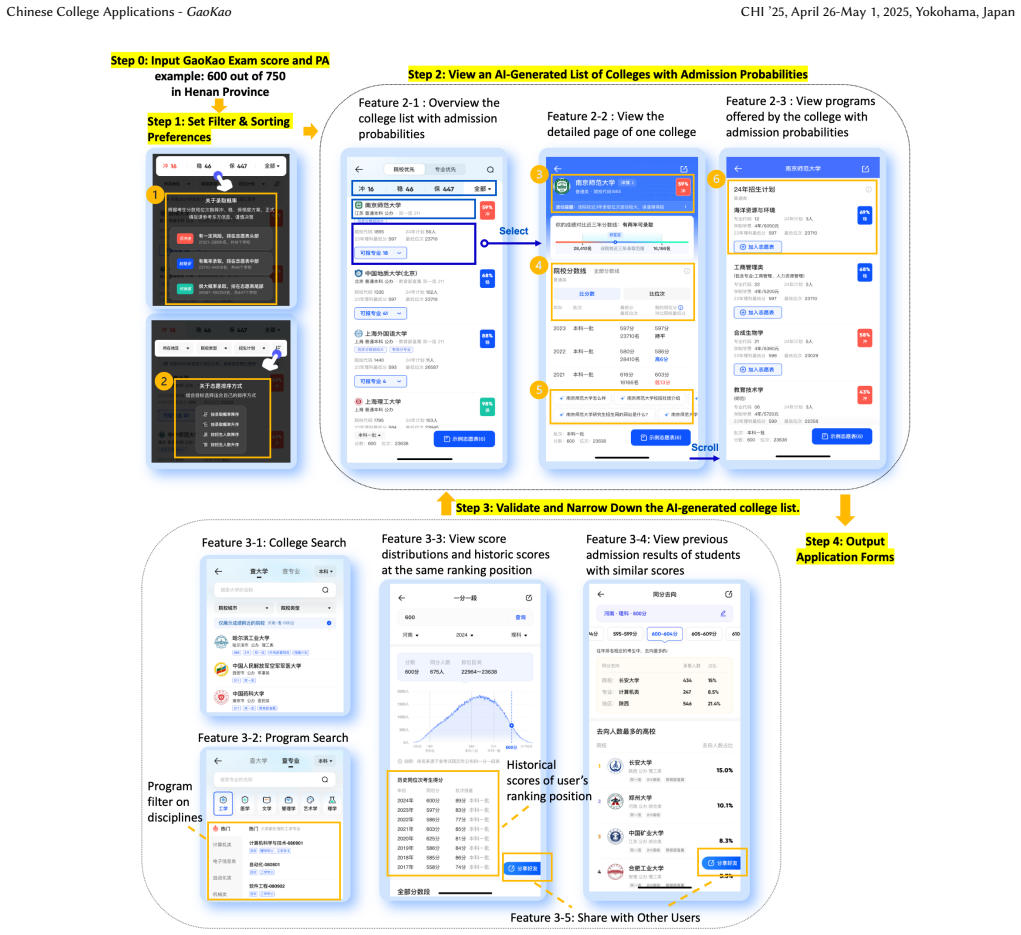
The central object is Quark GaoKao (夸克高考), a free AI feature inside the Quark browser that generates admission-probability estimates and a ranked college list from a student's Gaokao score, provincial rank, and stated preferences. Its color-coded reach/target/safety categories and probability figures are the machinery the paper studies: they are what parents trust, triangulate, and override, and they are what the study uses to expose the gap between score optimization and career development. The paper also treats live streaming and program-popularity rankings inside the app as part of the same mechanism, because they shape recommendations in practice.
What would settle it
One concrete check: if access to Quark GaoKao's own usage logs, or a nationwide survey of 2024 Gaokao families, showed that students, not parents, are the primary operators of the app, or that students' stated career goals change materially after using it, the paper's central pattern would fail. A smaller qualitative check would be whether southern-China families show the same parent-led pattern outside the paper's northern sample.
Extended reading notes
Core claim
The central claim is that a new generation of AI tools built for China's Gaokao, exemplified by Quark GaoKao, changes who does the deciding but not what the decision optimizes. The tool turns a score, a provincial rank, and location preferences into a color-coded list of reach, target, and safety colleges with admission probabilities, and in the families interviewed it is mostly parents who operate it. Students, by contrast, enter the process late, often after exam exhaustion, and participate by crossing options off a list compiled by parents or consultants rather than by articulating what they want. The paper reports that all stakeholder groups agree the app meets the immediate goal of score optimization, but that it does not address long-term career goals, personal interests, or the localized nuances of admission policy. It also finds that these limitations are not neutral: families with stronger data literacy, social networks, and money compensate by triangulating with guidebooks, live streams, and paid consultants, while families without those resources take the AI's recommendations at face value, which can deepen existing inequities.
Load-bearing premise
The load-bearing premise is that 32 retrospective, self-selected interviews, most from northern China, give an accurate picture of how Chinese families use AI college-application tools.
Editorial extensions
If this is right
- AI application tools will remain parent-operated unless student engagement is designed in, because the current workflow rewards data literacy and time that parents, not students, have.
- Score-and-probability rankings will continue to steer families toward popular majors, since the interface displays popularity as a default signal.
- Families with fewer resources will rely more on live streams and paid consultants to interpret the AI's output, making outcomes depend on social and financial capital.
- Third-party agencies can exploit 'AI' claims without immediate consequence because the effects of a college choice take years to appear and contracts do not tie outcomes to accountability.
- Redirecting the tools toward long-term career questions would require adding data the tools currently lack: program-level employment outcomes, major-switching costs, and interest-based exploration paths.
Reading between the lines
- Editorial inference: the parent-led pattern is likely not specific to Quark GaoKao; competing Chinese apps share the same score-and-probability interface, so the same dynamics probably appear there.
- Editorial inference: a quantitative study could compare application lists produced by students alone versus parents alone to measure how much the tool's ranking, rather than family preference, drives the final choice.
- Editorial inference: as provinces raise the allowed number of choices to 96 or more, the information burden grows, which would likely make the resource advantages the paper describes more consequential, not less.
- Editorial inference: the 'crossing out' behavior suggests a testable design feature—tools that ask students to build a 'want' list before seeing probabilities—could shift involvement from rejection to preference formation.
Editorial analysis
A structured set of objections, weighed in public.
Referee Report
Summary. This paper reports a qualitative interview study (N=32) of how Chinese students, parents, and experts use Quark GaoKao, an AI tool for college application decisions, during the GaoKao admissions process. It describes the tool's main features, analyzes interview themes around parent-led use, limited student involvement, score-centric recommendations, and inequities, and offers design implications for family-centered educational technology. The central claims are that AI tools are predominantly used by parents, focus on immediate exam scores rather than long-term career goals, and can deepen inequities for families with fewer resources.
Significance. Read as an exploratory qualitative account, the paper is timely and useful for the HCI community. Its strengths include a detailed and well-contextualized description of the GaoKao application workflow and Quark's features, a multi-stakeholder interview design (7 parent-child pairs, 6 individual children, 4 individual family members, and 8 experts), and a limitations section that candidly acknowledges regional concentration and the exclusion of students under 18. The interview quotes provide rich illustrative material, and the design implications in Section 7.1 connect the findings to family-centered design in a productive way. The main weakness is that several findings are stated at the population level in the Abstract and Conclusions even though the evidence base is a small, self-selected, regionally concentrated sample. The paper does not contain mathematical derivations or fitted parameters, so the standard circularity concerns do not apply; the single self-citation (Wang 2021) is used appropriately in the Discussion to contextualize emotional asymmetry.
major comments (4)
- [Abstract and Conclusions (§8)] The Abstract and §8 state that AI tools are 'predominantly used by parents' and 'often focus on immediate exam results' as general findings, but the recruitment described in §4.1 drew a self-selected, word-of-mouth sample of Quark users concentrated in northern and central PAs (Beijing, Hebei, Henan, Inner Mongolia, Ningxia, Shaanxi, Anhui; Table 1), and §7.3 explicitly concedes the regional concentration. The sample also over-included parents by design (7 parent-child pairs plus 4 individual family members). Prevalence language such as 'predominantly' should be replaced with 'in the families we interviewed' or accompanied by a sampling justification; otherwise the population-level statements are not supported by the data.
- [§5.4] The 'limited involvement' finding is anchored on nine participants (PF1–4, PK6, F11, F14, E1, E7), fewer than a third of the sample, and several of these are parents or experts reporting on children rather than the students themselves. This is a legitimate emergent theme, but it should be presented as an emergent pattern rather than as a general property of students' engagement with the tool. The current wording in §5.4 and the Abstract overstates the strength of the evidence.
- [§6.5] The claim of 'irresponsible use' of AI by consultant agencies rests largely on expert assertions, especially E8, and on the observation that contracts limit accountability, while the six families who used agencies reported being satisfied at the time of the study. The paper should explicitly label this as an expert-reported concern and note that no agency-side data or longitudinal outcome verification was collected. As written, the Abstract's 'irresponsible use' overstates what the data can establish.
- [§7.2 and Abstract] The conclusion that AI tools 'can inadvertently deepen inequities' is framed as a direct finding, but the evidence is interpretative: participants varied in resources and data literacy, yet there is no outcome measure, no systematic comparison of low-resource and high-resource families beyond individual quotes, and no verification of actual admission results. This should be reframed as an interpretive hypothesis grounded in participant reports rather than an empirically established effect.
minor comments (5)
- [§5.2] The text mentions 'P12 mentioned the reliability of information sourced from books', but participant codes in this study use PF, PK, F, K, and E; this appears to be a typo and should read F12 or a corresponding code.
- [§7.1] The text says 'We consider our table a starting point' but refers to Figure 4, which is a figure rather than a table; the wording should be adjusted.
- [Appendix A.1] There are several typographical errors in the appendix, including 'mainlan China', 'hightest ordered', and 'althought it might differ'; these should be corrected.
- [§3.2] The statement that 'All of our participants reported using the default “prioritize colleges” option' is a strong feature-level usage claim; it should be softened to refer to the participants who discussed the feature, or supported with additional interview evidence.
- [§1 and §3.2] The paper describes Quark as 'widely utilized' and 'one of the most popular apps' but does not cite independent usage statistics; adding a source or qualifying the claim would improve precision.
Circularity Check
No circular derivation: the findings are induced from interviews, and the only self-citations are contextual, not load-bearing.
full rationale
This is a qualitative HCI interview study with no mathematical derivation, fitted parameters, or quantitative predictions, so the standard circularity failure modes (self-definitional equations, fitted inputs renamed as predictions, uniqueness theorems imported from prior work) do not apply. The central claims—AI tools are predominantly used by parents, focus on immediate scores, and miss long-term career goals—are induced from semi-structured interviews via a stated bottom-up, inductive thematic analysis (Section 4.3: 'We used a bottom-up approach in our qualitative data analysis. We performed inductive thematic analysis [8]... and generated themes and subthemes through iterative collating and grouping'). The findings are anchored to participant quotes (e.g., PF4 and K6 in Section 5.1; PF3 in Section 5.4), not assumed in the interview protocol or the tool description. The paper's own admission that Quark offers interest-oriented features (e.g., MBTI and 'prioritize major') but that 'very few participants were aware of these features' (Section 7) shows the central finding is an empirical observation rather than an analytic consequence of the tool's design. The only author self-citations are Ge Wang's prior works ([44] in Section 2.2 on children as intermediaries in family technology use, and [45] in Section 7.1 on protective parenting distancing children from decision-making). Both are used for context or related-work support, not to establish the paper's central empirical findings, and neither constitutes a uniqueness theorem, ansatz, or fitted input; they are therefore not load-bearing and do not raise the circularity score. The abstract's population-level phrasing ('predominantly used by parents') exceeds what the 32-participant, regionally concentrated sample can strictly support, but the paper explicitly concedes this in Section 7.3 ('our sample was regionally concentrated in northern China, which may restrict the applicability of our findings to other areas'). That is a validity and generalizability limitation, not a circularity of derivation. No step in the paper reduces, by construction or by self-citation, to its own inputs.
Assumptions & free parameters
assumptions (3)
- domain assumption Participant retrospective self-reports are accurate accounts of AI tool use and family decision-making.
- domain assumption The Quark GaoKao app is representative of the "AI tools" the paper generalizes about.
- domain assumption Inductive thematic analysis with consensus coding yields reliable prevalence estimates.
Cite this review
Pith. "Pith review of From Score-Driven to Value-Sharing: Understanding Chinese Family Use of AI to Support Decision Making of College Applications." pith.science (2026). https://pith.science/paper/HKQXEQVV
@misc{pith2026241110280,
  author       = {Pith},
  title        = {Pith review of: From Score-Driven to Value-Sharing: Understanding Chinese Family Use of AI to Support Decision Making of College Applications},
  year         = {2026},
  howpublished = {\url{https://pith.science/paper/HKQXEQVV}},
  note         = {Machine review of arXiv:2411.10280}
}
read the original abstract
This study investigates how 18-year-old students, parents, and experts in China utilize artificial intelligence (AI) tools to support decision-making in college applications during college entrance exam -- a highly competitive, score-driven, annual national exam. Through 32 interviews, we examine the use of Quark GaoKao, an AI tool that generates college application lists and acceptance probabilities based on exam scores, historical data, preferred locations, etc. Our findings show that AI tools are predominantly used by parents with limited involvement from students, and often focus on immediate exam results, failing to address long-term career goals. We also identify challenges such as misleading AI recommendations, and irresponsible use of AI by third-party consultant agencies. Finally, we offer design insights to better support multi-stakeholders' decision-making in families, especially in the Chinese context, and discuss how emerging AI tools create barriers for families with fewer resources.
Figures


Figures from the paper (2 more)


Reference graph
Works this paper leans on
-
[1]
Seyedali Ahrari, Zeinab Zaremohzzabieh, and Rusli Abdullah. 2024. AI-Enhanced Youth Career Guidance by Mapping Future Employment Paths With Theory and Practical Application. In Exploring Youth Studies in the Age of AI . IGI Global, 129–139
work page 2024
-
[2]
Kimberly A Allen. 2014. Parental decision-making for medically complex infants and children: an integrated literature review. International Journal of Nursing Studies 51, 9 (2014), 1289–1304
work page 2014
-
[3]
AJ Alvero, Noah Arthurs, Anthony Lising Antonio, Benjamin W Domingue, Ben Gebre-Medhin, Sonia Giebel, and Mitchell L Stevens. 2020. AI and holistic review: informing human reading in college admissions. In Proceedings of the AAAI/ACM Conference on AI, Ethics, and Society . 200–206
work page 2020
-
[4]
Stefany Giselle Arevalo Escobar. 2023. Pathways: Creating a Centralized Platform for the Exploration of Majors, Post-Secondary Institutions, and Careers . Ph. D. Dissertation. UC Santa Cruz
work page 2023
-
[5]
Ruqia Safdar Bajwa, Asma Yunus, Hina Saeed, and Asia Zulfqar. 2024. Parenting in the Age of Artificial Intelligence: Digital Guardians. In Exploring Youth Studies in the Age of AI . IGI Global, 44–66
work page 2024
-
[6]
Raymond C Barfield, Debra Brandon, Julie Thompson, Nichol Harris, Michael Schmidt, and Sharron Docherty. 2010. Mind the child: using interactive technol- ogy to improve child involvement in decision making about life-limiting illness. The American Journal of Bioethics 10, 4 (2010), 28–30
work page 2010
-
[7]
Erin Beneteau, Ashley Boone, Yuxing Wu, Julie A Kientz, Jason Yip, and Alexis Hiniker. 2020. Parenting with Alexa: exploring the introduction of smart speakers on family dynamics. In Proceedings of the 2020 CHI conference on human factors in computing systems. 1–13
work page 2020
-
[8]
Virginia Braun and Victoria Clarke. 2006. Using thematic analysis in psychology. Qualitative research in psychology 3, 2 (2006), 77–101
2006
Show all 53 references
-
[9]
Bengisu Cagiltay, Hui-Ru Ho, Kaiwen Sun, Zhaoyuan Su, Yuxing Wu, Olivia K Richards, Qiao Jin, Junnan Yu, Jerry Alan Fails, Jason Yip, et al. 2024. Methods for Family-Centered Design: Bridging the Gap Between Research and Practice. In Extended Abstracts of the CHI Conference on...
2024
-
[10]
Richards, Qiao Jin, Junnan Yu, Jerry Alan Fails, Jason Yip, and Jodi Forlizzi
Bengisu Cagiltay, Hui-Ru Ho, Kaiwen Sun, Zhaoyuan Su, Yuxing Wu, Olivia K. Richards, Qiao Jin, Junnan Yu, Jerry Alan Fails, Jason Yip, and Jodi Forlizzi
-
[11]
Bengisu Cagiltay, Rabia Ibtasar, Joseph E Michaelis, Sarah Sebo, and Bilge Mutlu
-
[12]
Thomas Louis Case, Adrian Gardiner, Paige Rutner, and John N Dyer. 2013. A linkedin analysis of career paths of information systems alumni. The Journal of the Southern Association for Information Systems 1, 1 (2013), 1–13
2013
-
[13]
Yoon Jeong Cha, Yasemin Gunal, Alice Wou, Joyce Lee, Mark W Newman, and Sun Young Park. 2024. Shared Responsibility in Collaborative Tracking for Children with Type 1 Diabetes and their Parents. In Proceedings of the 2024 CHI Conference on Human Factors in Computing Systems (H...
2024
-
[14]
Yoon Jeong Cha, Alice Wou, Arpita Saxena, Joyce Lee, Mark W Newman, and Sun Young Park. 2023. It’s Like an Educated Guessing Game: Parents’ Strategies for Collaborative Diabetes Management with Their Children. In Proceedings of the 2023 CHI Conference on Human Factors in Compu...
2023
-
[15]
Yan Chen and Onur Kesten. 2014. Chinese college admissions and school choice reforms: Theory and experiments. Forthcoming in Journal of Political (2014), 1–91
2014
-
[16]
Clab AI. 2024. Clab AI LinkedIn Page. https://www.linkedin.com/company/ clabappai/. Accessed: 2024-09-12
2024
-
[17]
Hamid Dalvand, Mehdi Rassafiani, and Hossein Bagheri. 2014. Family Centered Approach: A literature review. Modern Rehabilitation 8, 1 (2014)
2014
-
[18]
Filip De Fruyt and Ivan Mervielde. 1997. The five-factor model of personality and Holland’s RIASEC interest types. Personality and individual differences 23, 1 (1997), 87–103
1997
-
[19]
Vernell Deslonde and Michael Becerra. 2018. The Technology Acceptance Model (TAM): Exploring School Counselors’ Acceptance and Use of Naviance. Profes- sional Counselor 8, 4 (2018), 369–382
2018
-
[20]
Global Times. 2024. 13.42m students head to examination centers as 2024 gaokao kicks off. Global Times (2024). https://www.globaltimes.cn/page/202406/1313789. shtml
2024
-
[21]
Xiao Guo, Zhenjiang Shen, Yajing Zhang, and Teng Wu. 2019. Review on the application of artificial intelligence in smart homes. Smart Cities 2, 3 (2019), 402–420
2019
-
[22]
Stevan Harrell. 1987. The concept of fate in Chinese folk ideology. Modern China 13, 1 (1987), 90–109
1987
-
[23]
Sarah Judd. 2020. Activities for building understanding: How AI4ALL teaches AI to diverse high school students. In Proceedings of the 51st ACM Technical Symposium on Computer Science Education . 633–634
2020
-
[24]
Gary Klein and Beth W Crandall. 2018. The role of mental simulation in problem solving and decision making. In Local applications of the ecological approach to human-machine systems. CRC Press, 324–358
2018
-
[25]
Kollegio AI. 2024. Kollegio AI Website. https://www.kollegio.ai/. Accessed: 2024-09-12
2024
-
[26]
Clarence D Kreiter. 2013. A proposal for evaluating the validity of holistic-based admission processes. Teaching and learning in medicine 25, 1 (2013), 103–107
2013
-
[27]
Nanda Alfan Kurniawan, Nur Hidayah, M Ramli, Husni Hanafi, et al. 2024. Sus- tainable Village Planning Through Vocational Students’ Career Decision Skills. In International Conference on Multidisciplinary Studies (ICoMSi 2023) . Atlantis Press, 489–496
2024
-
[28]
Conway Lackman and John M Lanasa. 1993. Family decision-making theory: an overview and assessment. Psychology & Marketing 10, 2 (1993), 81–93
1993
-
[29]
Rachael E Landherr. 2019. The relationship between the Kuder Career Assessment and program completion at Chippewa Valley Technical College . Ph. D. Dissertation. University of Wisconsin–Stout
2019
-
[30]
Cynthia L Miller. 2015. Career mapping: Charting a course towards increasing student ownership in college and career planning . Ph. D. Dissertation
2015
-
[31]
Misato Nihei, Taiga Nohara, Ikuko Sugawara, and Takazumi Ono. 2024. Chatbots as Tools in Parent–Child Relationships. In International Conference on Human- Computer Interaction. Springer, 228–241
2024
-
[32]
João Pires and Manuel Duarte. 2019. Gaokao: far more than an exam. (2019)
2019
-
[33]
David J Pittenger. 1993. Measuring the MBTI. . . and coming up short. Journal of Career Planning and Employment 54, 1 (1993), 48–52
1993
-
[34]
Abhishek S Rao, Bola Sunil Kamath, R Ramya, Shreya Chowdhury, A Shreya, and Raveena Krishna Kundar Pattan. 2020. Use of artificial neural network in developing a personality prediction model for career guidance: A boon for career counselors. International Journal of Control an...
2020
-
[35]
Erica D Shifflet-Chila, Rena D Harold, Victoria A Fitton, and Brian K Ahmedani
-
[36]
Jonathan Michael Spector and Shanshan Ma. 2019. Inquiry and critical think- ing skills for the next generation: from artificial intelligence back to human Chinese College Applications - GaoKao CHI ’25, April 26-May 1, 2025, Yokohama, Japan intelligence. Smart Learning Environm...
2019
-
[37]
Bryant M Stone. 2024. The Dawn of Human-AI Dynamics: Foundational Insights from a National Survey. (2024)
2024
-
[38]
Christopher T Su, Ryan D McMahan, Brie A Williams, Rashmi K Sharma, and Rebecca L Sudore. 2014. Family matters: Effects of birth order, culture, and family dynamics on surrogate decision-making. Journal of the American Geriatrics Society 62, 1 (2014), 175–182
2014
-
[39]
Poorna Talkad Sukumar, Ronald Metoyer, and Shuai He. 2018. Making a pecan pie: Understanding and supporting the holistic review process in admissions. Proceedings of the ACM on Human-Computer Interaction 2, CSCW (2018), 1–22
2018
-
[40]
Toshihiro Tamura, Atsushi Sato, Runhe Huang, and Jianhua Ma. 2013. Recom- mendation engine based system towards creating a harmonious family living environment. In 2013 1st International Conference on Orange Technologies (ICOT) . IEEE, 294–297
2013
-
[41]
Ms Ayesha Siddika Tonny, Md Tousif Hasan Lavlu, Abhijit Kumar Ghosh, Souro- jit Roy, et al . 2022. ML based career suggestive system for informal job sector considering cognitive skills. Ph. D. Dissertation. Brac University
2022
-
[42]
Samson Maekele Tsegay and Muhammad Azeem Ashraf. 2016. How do stu- dents succeed in national college entrance examination (Gao-kao) in China: A qualitative study. International Journal of Research 5, 3 (2016), 81–90
2016
-
[43]
Melissa A Venable. 2010. Using technology to deliver career development services: Supporting today’s students in higher education.The career development quarterly 59, 1 (2010), 87–96
2010
-
[44]
G Wang. 2023. Data autonomy in the age of AI: designing autonomy-supportive data tools for children & families . Ph. D. Dissertation. University of Oxford
2023
-
[45]
Ge Wang, Jun Zhao, Max Van Kleek, and Nigel Shadbolt. 2021. Protection or Punishment? Relating the Design Space of Parental Control Apps and Perceptions about Them to Support Parenting for Online Safety. Proc. ACM Hum.-Comput. Interact. 5, CSCW2, Article 343 (Oct. 2021), 26 pa...
2021
-
[46]
Christo Wilson, Avijit Ghosh, Shan Jiang, Alan Mislove, Lewis Baker, Janelle Szary, Kelly Trindel, and Frida Polli. 2021. Building and auditing fair algorithms: A case study in candidate screening. In Proceedings of the 2021 ACM Conference on Fairness, Accountability, and Tran...
2021
-
[47]
Jamie L Workman. 2015. Parental influence on exploratory students’ college choice, major, and career decision making. College Student Journal 49, 1 (2015), 23–30
2015
-
[48]
Jiacheng Xu, Zihan Yan, Guitao Cao, and Jintao Zhao. 2018. Family shopping recommendation system using behavior sequence data and user profile. In Pro- ceedings of the 10th International Conference on Internet Multimedia Computing and Service. 1–7
2018
-
[49]
Nur Eva Yanti, Herman Dwi Surjono, and Sunaryo Sunarto. 2020. Development of Web-Based Information Media for Career Choice Recommendations According to Personality Type of MBTI. In International Conference on Online and Blended Learning 2019 (ICOBL 2019) . Atlantis Press, 186–189
2020
-
[50]
Double First-Class
Yaman Yu, Tanusree Sharma, Melinda Hu, Justin Wang, and Yang Wang. 2024. Exploring Parent-Child Perceptions on Safety in Generative AI: Concerns, Mit- igation Strategies, and Design Implications. arXiv preprint arXiv:2406.10461 (2024). CHI ’25, April 26-May 1, 2025, Yokohama, ...
2024 arXiv
-
[2016]
Children and Youth Services Review 70 (2016), 364–368
Adolescent and family development: Autonomy and identity in the digital age. Children and Youth Services Review 70 (2016), 364–368
2016
-
[2023]
InProceedings of the 22nd Annual ACM Interaction Design and Children Conference
From Child-Centered to Family-Centered Interaction Design. InProceedings of the 22nd Annual ACM Interaction Design and Children Conference . 789–791
-
[2024]
In Extended Abstracts of the CHI Conference on Human Factors in Computing Systems (Honolulu, HI, USA) (CHI EA ’24)
Methods for Family-Centered Design: Bridging the Gap Between Research and Practice. In Extended Abstracts of the CHI Conference on Human Factors in Computing Systems (Honolulu, HI, USA) (CHI EA ’24). Association for Computing Machinery, New York, NY, USA, Article 481, 6 pages....
Reviewed August 12, 2026 · model on record in the stance chip above.
Discussion (0). Continue with ORCID to comment.