Subcritical annulus crossing in spatial random graphs
Pith reviewed 2026-05-23 17:40 UTC · model grok-4.3
The pith
Annuli in spatial random graphs are crossed by a single long edge or not at all below a critical intensity.
A machine-rendered reading of the paper's core claim, the machinery that carries it, and where it could break.
Core claim
For general continuum percolation models with the stated properties, annuli are either not crossed for small intensities or crossed by a single edge. The critical annulus-crossing intensity hat lambda_c is determined by the occurrence of long edges, and this relation is sharp under a modicum of independence. The proof provides a direct link between the decay rates of annulus-crossing probabilities and long-edge probabilities through a multiscale renormalization.
What carries the argument
The critical annulus-crossing intensity hat lambda_c, defined as the infimum of intensities where annuli can be crossed and shown to coincide with the onset of long edges.
Load-bearing premise
The models obey sparseness, translation invariance, and spatial decorrelation, and for the sharpness part, they possess a modicum of independence.
What would settle it
An observation of an annulus being crossed by a chain of multiple short edges at an intensity where the probability of any long edge is zero would contradict the claim that crossings require long edges.
Figures


read the original abstract
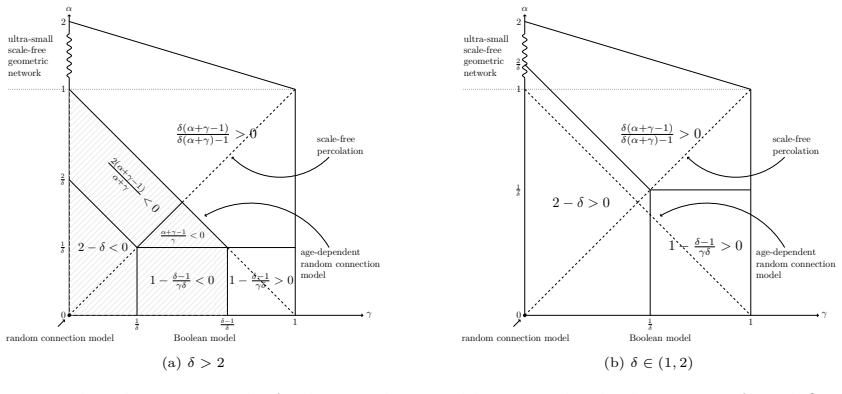
We consider general continuum percolation models obeying sparseness, translation invariance, and spatial decorrelation. In particular, this includes models constructed on general point sets other than the standard Poisson point process or the Bernoulli-percolated lattice. Moreover, in our setting the existence of an edge may depend not only on the two end vertices but also on a surrounding vertex set and models are included that are not monotone in some of their parameters. We study the critical annulus-crossing intensity $\widehat{\lambda}_{c}$, which is smaller or equal to the classical critical percolation intensity $\lambda_{c}$ and derive a condition for $\widehat{\lambda}_{c}>0$ by relating the crossing of annuli to the occurrence of long edges. This condition is sharp for models that have a modicum of independence. In a nutshell, our result states that annuli are either not crossed for small intensities or crossed by a single edge. Our proof rests on a multiscale argument that further allows us to directly describe the decay of the annulus-crossing probability with the decay of long edges probabilities. We apply our result to a number of examples from the literature. Most importantly, we extensively discuss the weight-dependent random connection model in a generalised version, for which we derive sufficient conditions for the presence or absence of long edges that are typically easy to check. These conditions are built on a decay coefficient $\zeta$ that has recently seen some attention due to its importance for various proofs of global graph properties.
Editorial analysis
A structured set of objections, weighed in public.
Referee Report
Summary. The paper considers general continuum percolation models obeying sparseness, translation invariance, and spatial decorrelation (including non-Poisson point sets and non-monotone models). It defines the critical annulus-crossing intensitywidehat{lambda}_c <= lambda_c and derives a condition for widehat{lambda}_c > 0 by relating annulus-crossing events to long-edge probabilities via a multiscale argument; the condition is sharp for models possessing a modicum of independence. The main conclusion is that annuli are either not crossed at small intensities or crossed by a single edge, with the argument also describing the decay rate of crossing probabilities. The result is applied to the weight-dependent random connection model, yielding checkable conditions on a decay coefficient zeta.
Significance. If the result holds, it supplies a general, hypothesis-checkable criterion for subcritical annulus crossing that applies beyond standard Poisson or lattice models and handles non-monotonicity. The multiscale argument that directly ties crossing decay to long-edge decay, together with the explicit sufficient conditions on zeta for the weight-dependent model, strengthens the toolkit for analyzing global properties of spatial random graphs.
minor comments (2)
- [Abstract] Abstract: the claim of a 'derivation and sharpness' is stated without any displayed equations, error bounds, or verification that the multiscale argument closes; while this is acceptable in an abstract, the introduction or §2 should supply at least one key relation (e.g., the inequality linking crossing probability to long-edge probability) so readers can assess the argument before the full proof.
- [Abstract] Abstract, first paragraph: 'modicum of independence' is used to delimit sharpness but is not defined or exemplified at the point of first use; a brief parenthetical or forward reference to the precise assumption (e.g., a weak FKG or independence condition on edge indicators) would improve readability.
Simulated Author's Rebuttal
We thank the referee for their positive assessment of the manuscript, accurate summary of our results, and recommendation of minor revision. No specific major comments were raised.
Circularity Check
No significant circularity; derivation self-contained under explicit hypotheses
full rationale
The paper states a conditional theorem relating annulus-crossing events to long-edge probabilities via a multiscale argument, under explicitly listed assumptions (sparseness, translation invariance, spatial decorrelation) that are independent of the target result. No equations reduce by construction to fitted parameters, self-definitions, or load-bearing self-citations; the sharpness claim is restricted to models with additional independence and the applications to examples (including weight-dependent random connection models) rely on checkable decay conditions rather than internal renormalization. The central claim therefore does not collapse to its inputs.
Axiom & Free-Parameter Ledger
axioms (2)
- domain assumption Models obey sparseness, translation invariance, and spatial decorrelation
- domain assumption Existence of an edge may depend on surrounding vertex set and models need not be monotone
Reference graph
Works this paper leans on
-
[1]
long-range effects, are insufficient to fully describe all global properties accurately. Indeed, while ζeffectively captures the overall occurrence of long edges, it does not capture their precise 12 Table 1: Various choices forγ, αand δfor the weight-dependent random connection model and the models they represent in the literature together with theirζ <0...
work page 2017
-
[2]
Sharpness of the phase transition for continuum percolation inR2
D. Ahlberg, V. Tassion, and A. Teixeira. “Sharpness of the phase transition for continuum percolation inR2”. Probab. Theory Related Fields172.1-2 (2018), pages 525–581.doi: 10.1007/s00440-017-0815-8
-
[3]
Percolation in thek-nearest neighbor graph
P. Balister and B. Bollobás. “Percolation in thek-nearest neighbor graph”.Recent results in designs and graphs: A tribute to Lucia Gionfriddo, Quaderni di Matematica28 (2013), pages 83–100
work page 2013
-
[4]
N. H. Bingham, C. M. Goldie, and J. L. Teugels.Regular Variation. Encyclopedia of Mathematics and its Applications. Cambridge University Press, 1987.doi: 10.1017/CBO9780511721434
-
[5]
Finitary random interlacements and the Gaboriau–Lyons problem
L. Bowen. “Finitary random interlacements and the Gaboriau–Lyons problem”.Geom. Funct. Anal.29.3 (2019), pages 659–689.doi: 10.1007/s00039-019-00494-4
-
[6]
Geometric inhomogeneous random graphs
K. Bringmann, R. Keusch, and J. Lengler. “Geometric inhomogeneous random graphs”.Theoret. Comput. Sci. 760 (2019), pages 35–54.doi: 10.1016/j.tcs.2018.08.014
-
[7]
Density and uniqueness in percolation
R. M. Burton and M. Keane. “Density and uniqueness in percolation”.Comm. Math. Phys. 121.3 (1989), pages 501–505.doi: 10.1007/BF01217735
-
[8]
On the internal distance in the interlacement set
J. Černý and S. Popov. “On the internal distance in the interlacement set”.Electronic Journal of Probability 17.none (2012), pages 1–25.doi: 10.1214/EJP.v17-1936. 38
-
[9]
M. Chebunin and G. Last. On the uniqueness of the infinite cluster and the cluster density in the Poisson driven random connection model. 2024. arXiv:2403.17762 [math.PR]
-
[10]
M. Deijfen, R. van der Hofstad, and G. Hooghiemstra. “Scale-free percolation”.Ann. Inst. Henri Poincaré Probab. Stat.49.3 (2013), pages 817–838.doi: 10.1214/12-AIHP480
-
[11]
Almost sharp sharp ness for poisson boolean percolation
B. Dembin and V. Tassion.Almost sharp sharpness for Poisson Boolean percolation. 2022. arXiv:2209.00999 [math.PR]
-
[12]
Scale-free percolation in continuum space
P. Deprez and M. V. Wüthrich. “Scale-free percolation in continuum space”.Commun. Math. Stat.7.3 (2019), pages 269–308.doi: 10.1007/s40304-018-0142-0
-
[13]
Percolation in the signal to interference ratio graph
O. Dousse, M. Franceschetti, N. Macris, R. Meester, and P. Thiran. “Percolation in the signal to interference ratio graph”.J. Appl. Probab.43.2 (2006), pages 552–562.doi: 10.1239/jap/1152413741
-
[14]
A. Drewitz, B. Ráth, and A. Sapozhnikov. An Introduction to Random Interlacements. SpringerBriefs in Mathematics. Springer, Cham, 2014.doi: 10.1007/978-3-319-05852-8
-
[15]
Subcritical phase ofd-dimensional Poisson-Boolean percolation and its vacant set
H. Duminil-Copin, A. Raoufi, and V. Tassion. “Subcritical phase ofd-dimensional Poisson-Boolean percolation and its vacant set”.Ann. H. Lebesgue3 (2020), pages 677–700.doi: 10.5802/ahl.43
-
[16]
E. N. Gilbert. “Random plane networks”.J. Soc. Indust. Appl. Math.9 (1961), pages 533–543.doi: 10.1137/ 0109045
work page 1961
-
[17]
Subcritical regimes in the Poisson Boolean model of continuum percolation
J.-B. Gouéré. “Subcritical regimes in the Poisson Boolean model of continuum percolation”.Ann. Probab. 36.4 (2008), pages 1209–1220.doi: 10.1214/07-AOP352
-
[18]
The age-dependent random connection model
P. Gracar, A. Grauer, L. Lüchtrath, and P. Mörters. “The age-dependent random connection model”.Queueing Syst. 93.3-4 (2019), pages 309–331.doi: 10.1007/s11134-019-09625-y
-
[19]
Chemical distance in geometric random graphs with long edges and scale-free degree distribution
P. Gracar, A. Grauer, and P. Mörters. “Chemical distance in geometric random graphs with long edges and scale-free degree distribution”.Comm. Math. Phys.395.2 (2022), pages 859–906.doi: 10.1007/s00220-022- 04445-3
-
[20]
Recurrence versus transience for weight-dependent random connection models
P. Gracar, M. Heydenreich, C. Mönch, and P. Mörters. “Recurrence versus transience for weight-dependent random connection models”.Electron. J. Probab.27 (2022), pages 1–31.doi: 10.1214/22-EJP748
- [21]
- [22]
-
[23]
Percolation phase transition in weight-dependent random connection models
P. Gracar, L. Lüchtrath, and P. Mörters. “Percolation phase transition in weight-dependent random connection models”.Adv. in Appl. Probab.53.4 (2021), pages 1090–1114.doi: 10.1017/apr.2021.13
-
[24]
G. Grimmett. Percolation. Second edition. Volume 321. Grundlehren der mathematischen Wissenschaften [Fundamental Principles of Mathematical Sciences]. Springer-Verlag, Berlin, 1999.doi: 10.1007/978-3-662- 03981-6
-
[25]
P. Hall. “On continuum percolation”.Ann. Probab. 13.4 (1985), pages 1250–1266. doi: 10 . 1214 / aop / 1176992809
work page 1985
-
[26]
M. Hilário and D. Ungaretti.Euclidean and chemical distances in ellipses percolation. 2021. arXiv:2103.09786 [math.PR]
-
[27]
From heavy-tailed Boolean models to scale-free Gilbert graphs
C. Hirsch. “From heavy-tailed Boolean models to scale-free Gilbert graphs”.Braz. J. Probab. Stat.31.1 (2017), pages 111–143.doi: 10.1214/15-BJPS305
-
[28]
Continuum percolation for Cox point processes
C. Hirsch, B. Jahnel, and E. Cali. “Continuum percolation for Cox point processes”.Stochastic Process. Appl. 129.10 (2019), pages 3941–3966.doi: 10.1016/j.spa.2018.11.002
-
[29]
Sharp phase transition for Cox percolation
C. Hirsch, B. Jahnel, and S. Muirhead. “Sharp phase transition for Cox percolation”.Electron. C. Probab.27 (2022), pages 1–13.doi: 10.1214/22-ECP487
-
[30]
Local limits of spatial inhomogeneous random graphs
R. van der Hofstad, P. van der Hoorn, and N. Maitra. “Local limits of spatial inhomogeneous random graphs”. Adv. in Appl. Probab.55.3 (2023), pages 793–840.doi: 10.1017/apr.2022.61
-
[31]
Continuum percolation in a nonstabilizing environment
B. Jahnel, S. K. Jhawar, and A. D. Vu. “Continuum percolation in a nonstabilizing environment”.Electron. J. Probab.28 (2023), pages 1–38.doi: 10.1214/23-EJP1029
- [32]
-
[33]
SINR percolation for Cox point processes with random powers
B. Jahnel and A. Tóbiás. “SINR percolation for Cox point processes with random powers”.Adv. Appl. Probab. 54.1 (2022), pages 227–253.doi: 10.1017/apr.2021.25
-
[34]
Phase transitions for the Boolean model of continuum percolation for Cox point processes
B. Jahnel, A. Tóbiás, and E. Cali. “Phase transitions for the Boolean model of continuum percolation for Cox point processes”.Braz. J. Probab. Stat.36.1 (2022), pages 20–44.doi: 10.1214/21-BJPS514
-
[35]
J. Jorritsma, J. Komjáthy, and D. Mitsche. Cluster-size decay in supercritical kernel-based spatial random graphs. 2023. arXiv:2303.00724 [math.PR]
-
[36]
J. Jorritsma, J. Komjáthy, and D. Mitsche. Cluster-size decay in supercritical long-range percolation. 2024. arXiv: 2303.00712 [math.PR]. 39
-
[37]
J. Jorritsma, J. Komjáthy, and D. Mitsche.Large deviations of the giant in supercritical kernel-based spatial random graphs. 2024. arXiv:2404.02984 [math.PR]
-
[38]
G. Last and M. Penrose. Lectures on the Poisson Process. Volume 7. Institute of Mathematical Statistics Textbooks. Cambridge University Press, Cambridge, 2018.doi: 10.1017/9781316104477
-
[39]
G. F. Lawler. Intersections of Random Walks. Modern Birkhäuser Classics. Reprint of the 1996 edition. Birkhäuser/Springer, New York, 2013, pages iv+223.doi: 10.1007/978-1-4614-5972-9
-
[40]
Percolation in weight-dependent random connection models
L. Lüchtrath. “Percolation in weight-dependent random connection models”. PhD thesis. Universität zu Köln, 2022
work page 2022
-
[41]
R. Meester and R. Roy. Continuum Percolation. Volume 119. Cambridge Tracts in Mathematics. Cambridge University Press, Cambridge, 1996.doi: 10.1017/CBO9780511895357
-
[42]
Inhomogeneous long-range percolation in the weak decay regime
C. Mönch. “Inhomogeneous long-range percolation in the weak decay regime”.Probab. Theory Relat. Fields 189 (2024), pages 1129–1160.doi: 10.1007/s00440-024-01281-5
-
[43]
M. D. Penrose. Random Geometric Graphs. Volume 5. Oxford Studies in Probability. Oxford University Press, Oxford, 2003. doi: 10.1093/acprof:oso/9780198506263.001.0001
work page doi:10.1093/acprof:oso/9780198506263.001.0001 2003
-
[44]
On a continuum percolation model
M. D. Penrose. “On a continuum percolation model”.Adv. in Appl. Probab.23.3 (1991), pages 536–556.doi: 10.2307/1427621
-
[45]
Percolation for the finitary random interlacements
E. B. Procaccia, J. Ye, and Y. Zhang. “Percolation for the finitary random interlacements”.ALEA Lat. Am. J. Probab. Math. Stat.18.1 (2021), pages 265–287.doi: 10.30757/alea.v18-12
-
[46]
B. Ráth and S. Rokob. “Percolation of worms”.Stochastic Process. Appl.152 (2022), pages 233–288.doi: https://doi.org/10.1016/j.spa.2022.06.018
-
[47]
Long range percolation in one dimension
L. S. Schulman. “Long range percolation in one dimension”.J. Phys. A16.17 (1983), pages L639–L641.doi: 10.1088/0305-4470/16/17/001
-
[48]
Vacant set of random interlacements and percolation
A.-S. Sznitman. “Vacant set of random interlacements and percolation”.Ann. of Math. (2) 171.3 (2010), pages 2039–2087.doi: 10.4007/annals.2010.171.2039
-
[49]
A. Teixeira and D. Ungaretti. “Ellipses Percolation”.J. Stat. Phys. 168.2 (2017), pages 369–393.doi: 10. 1007/s10955-017-1795-x
work page 2017
-
[50]
Signal-to-interference ratio percolation for Cox point processes
A. Tóbiás. “Signal-to-interference ratio percolation for Cox point processes”.ALEA Lat. Am. J. Probab. Math. Stat. 17.1 (2020), pages 273–308.doi: 10.30757/alea.v17-11
-
[51]
Ultra-small scale-free geometric networks
J. E. Yukich. “Ultra-small scale-free geometric networks”.J. Appl. Probab.43.3 (2006), pages 665–677.doi: 10.1239/jap/1158784937. 40
discussion (0)
Sign in with ORCID, Apple, or X to comment. Anyone can read and Pith papers without signing in.