REVIEW 3 major objections 5 minor 43 references
Decentralized Localization of Distributed Antenna Array Elements Using an Evolutionary Algorithm
T0 review · 3 major / 5 minor · reviewed 2026-08-12 · deepseek-v4-flash
Pith's one-line read Using a spectrally sparse two-tone waveform and an evolutionary completion step, this paper claims that a minimally connected six-node distributed antenna array can localize its elements to a mean error of 0.82 mm at 34 dB average link…
desk verdict A credible but over-sold accuracy claim: the new evolutionary EDM completion idea is real, yet the 0.82 mm headline is calibrated precision against the same ground truth used for evaluation, not a transferable localization accuracy. read the letter →
The pith
A machine-rendered reading of the paper's core claim, the machinery that carries it, and where it could break.
The reading
What carries the argument
The central object is the Euclidean distance matrix (EDM), the table of all pairwise node distances, allowed to have missing entries for unmeasured links. The precision identity is the two-tone waveform's mean-squared bandwidth, $\zeta_f^2 = (\pi B)^2$, which enters the Cramer-Rao range bound $\sigma_d^2 \geq c^2 / [2 \zeta_f^2 (E_s/N_0)]$; concentrating energy in two tones lets the tone separation $B$ drive range precision while keeping the occupied spectrum sparse. Two-way time transfer cancels clock bias by averaging the two directions of exchange, leaving time of flight plus static hardware and multipath delays. Classical multidimensional scaling reconstructs the centered node coordinates from the EDM by eigen-decomposing the doubly-centered Gram matrix, and the evolutionary algorithm evaluates candidate completions of the missing EDM entries using the cost $F(X) = \frac{1}{2} \| W \circ (\tilde{D} - \operatorname{edm}(X)) \|^2$, where $W$ is the adjacency matrix and $\tilde{D}$ is the observed partial EDM. The minimal connectivity that makes completion well-posed comes from the robust-quadrilateral criterion, $E_{\min} = 3N - 6$ in two dimensions.
What would settle it
Repeat the six-node experiment at 40 MHz tone separation and 34 dB harmonic-mean SNR, calibrate the hardware and multipath delays once against optical ground truth, then move the antennas to a different geometry without recalibrating and measure the localization error vector magnitude against ground truth; if the mean error no longer stays near 0.82 mm, or exceeds the $\lambda/15$ threshold of about 0.82 mm at 24.3 GHz, the static-delay assumption behind the central claim fails.
Extended reading notes
Core claim
The paper claims that a decentralized distributed array can be localized from an incomplete, noisy set of pairwise range estimates, and that the missing-link case costs almost nothing in accuracy. Pairs of nodes exchange two-tone pulses in both directions; averaging the two apparent times of flight cancels clock offsets, and the tone separation, up to 40 MHz, enters the Cramer-Rao bound through the mean-squared bandwidth $\zeta_f^2 = (\pi B)^2$, giving high range precision from a spectrally sparse signal. Classical multidimensional scaling converts the estimated Euclidean distance matrix into a relative geometry, and an evolutionary algorithm completes the matrix by minimizing the weighted mismatch between observed and candidate distances. The experimental result is a mean localization error vector magnitude of 0.82 mm for six nodes at the minimal connectivity $c = 0.8$ and an average link SNR of 34 dB, which the authors state theoretically supports coherent operation up to 24.3 GHz. The paper frames this as an advance over centralized, fully-connected localization because no node serves as an anchor and unmeasured links can be tolerated.
Load-bearing premise
The accuracy claim rests on the assumption that the RF hardware delays and static multipath delays, measured once against known ground-truth positions, remain unchanged when the nodes are moved and while the array operates; if those delays drift with temperature or geometry, the 0.82 mm result would not transfer to a real deployment.
Editorial extensions
If this is right
- Distributed beamforming near 24 GHz becomes feasible with a six-node array localized to a mean 0.82 mm, since that error satisfies the $\lambda/15$ coherence rule at the carrier.
- Partial connectivity is tolerable: reducing the measured adjacency matrix from complete to the minimally completable $c = 0.8$ changed the converged localization error by less than a tenth of a millimeter in the experiments.
- Larger tone separation improves ranging precision through the Cramer-Rao bound, while the waveform's spectral sparsity keeps the positioning signal's bandwidth occupation low.
- For arrays larger than about ten nodes, the number of evolutionary generations needed to converge grows with the number of missing edges, so deployment would need more computation or subset-based localization.
- Because the cost function weights links evenly rather than propagating estimates from a central anchor, localization error does not accumulate radially the way centralized schemes do.
Reading between the lines
- The calibration step measures hardware and multipath delays once against known ground-truth positions; a consequence the paper does not develop is that deployments with temperature drift, moving nodes, or a changed scattering environment would need recalibration for the 0.82 mm figure to survive.
- The evolutionary completion currently runs on a central computer, as the paper notes; a genuinely node-distributed version would partition the optimization across the array, and convergence would likely differ because each node would see only its local neighborhood of the distance matrix.
- MDS recovers geometry only up to rotation, reflection, and translation, so applications that need the array's absolute orientation, such as steering a beam to a known target direction, would require an additional orientation-estimation step not covered here.
- The waveform's narrow occupied bandwidth suggests a testable coexistence experiment: transmit the two-tone ranging signal while another link uses adjacent spectrum and check whether the 0.82 mm precision holds, an extension the paper motivates but does not demonstrate.
Signed reviews
Editorial analysis
A structured set of objections, weighed in public.
Referee Report
Summary. The paper proposes a decentralized localization method for distributed antenna array elements. A two-way time-transfer ranging technique using a spectrally sparse pulsed two-tone waveform provides internode range estimates; classical multidimensional scaling recovers relative array geometry from the resulting Euclidean distance matrix; and a genetic algorithm is used to complete partially observed distance matrices so that localization works in sparsely connected topologies. The authors report Monte Carlo simulations and a six-node software-defined-radio experiment in a motion-capture-equipped laboratory, with a headline mean localization error vector magnitude of 0.82 mm at an average link SNR of 34 dB, which they interpret as supporting distributed beamforming up to 24.3 GHz under the lambda/15 criterion.
Significance. If the experimental accuracy were transferable to truly decentralized, reconfigurable deployments, the result would be a meaningful step toward coherent distributed beamforming at microwave and millimeter-wave frequencies. The paper has several strengths: it grounds the ranging precision in the Cramer-Rao lower bound, clearly formulates the Euclidean distance matrix completion problem, evaluates the genetic-localization algorithm over randomized Monte Carlo trials, and uses a substantial experimental setup with calibrated ground-truth position tracking. The central technical mechanism, combining two-tone ranging with MDS and an evolutionary optimizer for missing range entries, is plausible and well motivated. The main weakness is that the headline 0.82 mm figure is obtained after calibrating static hardware and multipath delays with the same motion-capture system used for evaluation, and no uncertainty quantification is provided, so the claimed accuracy has not been shown to generalize to moved nodes or changed environments.
major comments (3)
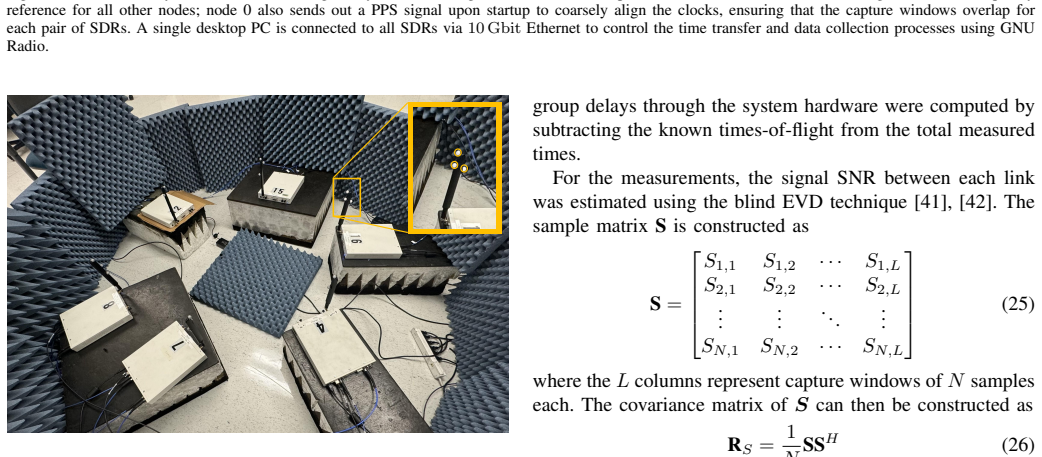
- [Sections II-A and V-A] The 0.82 mm mean EVM is a calibrated residual rather than a demonstrated transferable accuracy. In Section II-A the authors state that hardware delays and multipath factors are "static delays that can be deduced" using known ground-truth positions, and in Section V-A the OptiTrack system is used both to compute these delays by subtracting known times-of-flight and later to evaluate localization error. The antennas remain in the same circular geometry throughout, so the calibration and evaluation are performed at the same positions. The paper explicitly says "After these static delays are determined the nodes may be moved," but no experiment with moved nodes is reported. This is load-bearing because the abstract's sub-millimeter claim and the 24.3 GHz beamforming conclusion depend on the 0.82 mm number being an accuracy, not a removal of per-link systematic bias. I recommend either reporting a moved-node experiment with independent ground truth, or clearly re-labeling the result as calibrated precision and providing a sensitivity analysis of how delay drift or geometry change would affect the error.
- [Section V-B and Figure 10] No error bars, confidence intervals, or distribution statistics are reported for the measured localization error. The 0.82 mm value is presented as a point estimate, and Figures 9 and 10 show mean convergence curves without spread, despite being averaged over approximately 250 EDM estimates per condition. Without the standard deviation, percentiles, or a histogram of the per-trial EVM, the reader cannot assess whether the reported sub-millimeter accuracy is statistically robust or dominated by a few favorable trials. Please report the spread of the 250 estimates and, ideally, the per-link range residuals before and after calibration, so that the calibration uncertainty can be separated from the localization algorithm's performance.
- [Sections IV-B and V-B] The validation of partially connected topologies is performed by post-processing, not by physical link loss. In Section V-B, "links between nodes were artificially severed in post-processing by randomizing the adjacency matrix," while all physical links were measured in a line-of-sight, equal-elevation circular arrangement. This is a reasonable way to test the optimizer on synthetic missing entries, but it does not validate the claim in the introduction that the method works "even in complex environments where the array may not be capable of directly estimating all nodal link distances." True NLoS or low-SNR link loss would introduce additional bias and correlated errors that are not captured by random masking. I ask the authors to state this limitation explicitly and to add at least one experiment or simulation with a physically motivated missing-link model, or to soften the corresponding claim.
minor comments (5)
- [Abstract vs. Section III-C] The abstract says the paper "define[s] the differential evolution algorithm," but Section III-C and Algorithm 2 describe a genetic algorithm with crossover and mutation, implemented using the pymoo library; differential evolution is a distinct optimizer and is never defined or used. Please align the terminology.
- [Section V-B] There are two wording issues: "does not noticably affect" should be "does not noticeably affect," and "a dramatic affect on the overall network SNR" should be "a dramatic effect."
- [Section IV-B] The text refers to "Fig. 10, additional simulation results" before Figure 10 is introduced; the figure appears later in the experiment section. Please reorder or fix the cross-reference.
- [Figure 7] The schematic legend repeats "SDR 3" for three of the six radios and appears to have misplaced labels for SDRs 4 and 5; please correct the labels so the six-node configuration is unambiguous.
- [General] No data or code availability statement is provided. Since the experimental claim is quantitative and depends on the calibration procedure, making the range estimates, adjacency masks, and optimizer settings available would materially improve reproducibility.
Circularity Check
No circular derivation: the 0.82 mm EVM is a measured outcome, and the 24.3 GHz ceiling is the lambda/15 criterion applied arithmetically to that measured EVM.
full rationale
The claimed derivation chain is self-contained in the relevant sense. The two-tone ranging precision is anchored to the standard CRLB in Eq. (7), and the localization algorithm (MDS plus differential evolution) is a well-defined optimization over the incomplete Euclidean distance matrix with cost function (18); neither reduces to the result it is used to support. The headline 0.82 mm EVM is an experimentally measured quantity, not a value fitted by the model, and the 24.3 GHz ceiling is just the lambda_c/15 criterion applied arithmetically to that measured EVM. The paper does calibrate hardware and multipath delays using the same OptiTrack ground truth later used for evaluation (Sections II-A and V-A), so the reported error is a calibrated residual rather than a demonstrated accuracy after node motion; however, that is a limitation on external validity and generalization, not a circular derivation, because the calibration does not by construction force the MDS/GA output to 0.82 mm. Self-citations to prior ranging and synchronization work ([21], [22], [25], [41]) are supported by published theory and by measurements reported outside the present fitted values, and the central sparse-connectivity completion claim is independently tested against simulations and across varying bandwidth and connectivity settings. No step reduces to its own input by definition, and no fitted parameter is renamed as a prediction.
Assumptions & free parameters
free parameters (3)
- GA population size =
200
- GA maximum generations =
50 (measurement), 100 (simulation)
- GA convergence threshold =
10^-6 (max change in objective space)
assumptions (5)
- domain assumption Clock bias is constant and links are reciprocal during each synchronization epoch
- domain assumption Hardware and multipath delays are static and calibratable from known ground truth
- domain assumption A robust quadrilateral with at least 3N-6 edges guarantees graph completability
- domain assumption Node positions are planar (m=2)
- standard math CRLB for range estimation and the lambda/15 beamforming threshold
Cite this review
Pith. "Pith review of Decentralized Localization of Distributed Antenna Array Elements Using an Evolutionary Algorithm." pith.science (2026). https://pith.science/paper/IZLK4IEE
@misc{pith2026241110907,
  author       = {Pith},
  title        = {Pith review of: Decentralized Localization of Distributed Antenna Array Elements Using an Evolutionary Algorithm},
  year         = {2026},
  howpublished = {\url{https://pith.science/paper/IZLK4IEE}},
  note         = {Machine review of arXiv:2411.10907}
}
read the original abstract
Distributed phased arrays have recently garnered interest in applications such as satellite communications and high-resolution remote sensing. High-performance coherent distributed operations such as distributed beamforming are dependent on the ability to synchronize the spatio-electrical states of the elements in the array to the order of the operational wavelength, so that coherent signal summation can be achieved at any arbitrary target destination. In this paper, we address the fundamental challenge of precise distributed array element localization to enable coherent operation, even in complex environments where the array may not be capable of directly estimating all nodal link distances. We employ a two-way time transfer technique to synchronize the nodes of the array and perform internode ranging. We implement the classical multidimensional scaling algorithm to recover a decentralized array geometry from a set of range estimates. We also establish the incomplete set of range estimates as a multivariable non-convex optimization problem, and define the differential evolution algorithm which searches the solution space to complete the set of ranges. We experimentally demonstrate wireless localization using a spectrally-sparse pulsed two-tone waveform with 40 MHz tone separation in a laboratory environment, achieving a mean localization error vector magnitude of 0.82 mm in an environment with an average link SNR of 34 dB, theoretically supporting distributed beamforming operation up to 24.3 GHz.
Figures


Figures from the paper (6 more)



Reference graph
Works this paper leans on
-
[1]
Research on theory and technology of distributed mimo radar systems,
L. Yuan, G. Zheng, and X. Li, “Research on theory and technology of distributed mimo radar systems,” in Proceedings of 2011 IEEE CIE International Conference on Radar , vol. 1, 2011, pp. 87–90
work page 2011
-
[2]
S. N. Hasnain, R. Stephan, M. Brachvogel, M. Meurer, and M. A. Hein, “Performance of distributed antenna sub-arrays for robust satellite navigation in automotive applications,” European Journal of Navigation, 2018
work page 2018
-
[3]
Cooperative synthetic aperture radar in an urban connected car scenario,
D. Tagliaferri, M. Rizzi, S. Tebaldini, M. Nicoli, I. Russo, C. Mazzucco, A. V . Monti-Guarnieri, C. M. Prati, and U. Spagnolini, “Cooperative synthetic aperture radar in an urban connected car scenario,” in 2021 1st IEEE International Online Symposium on Joint Communications & Sensing (JC&S), 2021, pp. 1–4
work page 2021
-
[4]
2020 NASA technology taxonomy,
“2020 NASA technology taxonomy,” National Aeronautics and Space Administration, Tech. Rep. HQ-E-DAA-TN76545, Jan. 2020
2020
-
[5]
Open- loop coherent distributed arrays,
J. A. Nanzer, R. L. Schmid, T. M. Comberiate, and J. E. Hodkin, “Open- loop coherent distributed arrays,” IEEE Transactions on Microwave Theory and Techniques, vol. 65, no. 5, pp. 1662–1672, 2017
work page 2017
-
[6]
Distributed phased arrays: Challenges and recent advances,
J. A. Nanzer, S. R. Mghabghab, S. M. Ellison, and A. Schlegel, “Distributed phased arrays: Challenges and recent advances,” IEEE Transactions on Microwave Theory and Techniques , vol. 69, no. 11, pp. 4893–4907, 2021
work page 2021
-
[7]
Microlocation for internet-of-things-equipped smart buildings,
F. Zafari, I. Papapanagiotou, and K. Christidis, “Microlocation for internet-of-things-equipped smart buildings,” IEEE Internet of Things Journal, vol. 3, no. 1, pp. 96–112, 2015
work page 2015
-
[8]
Analysis of indoor localization techniques,
M. D. Jovanovic and S. M. Djosic, “Analysis of indoor localization techniques,” in 2023 58th International Scientific Conference on Infor- mation, Communication and Energy Systems and Technologies (ICEST), 2023, pp. 219–222
work page 2023
Show all 43 references
-
[9]
Analysis of ultra wideband localization techniques,
M. Jovanovic, S. Djosic, and I. Stojanovi ´c, “Analysis of ultra wideband localization techniques,” in XIV Int. SAUM Conf. , 2018
2018
-
[10]
Rssi-based indoor localization and tracking using sigma-point kalman smoothers,
A. S. Paul and E. A. Wan, “Rssi-based indoor localization and tracking using sigma-point kalman smoothers,” IEEE Journal of selected topics in signal processing , vol. 3, no. 5, pp. 860–873, 2009
2009
-
[11]
A novel approach to indoor rssi localization by automatic calibration of the wireless prop- agation model,
P. Barsocchi, S. Lenzi, S. Chessa, and G. Giunta, “A novel approach to indoor rssi localization by automatic calibration of the wireless prop- agation model,” in VTC Spring 2009-IEEE 69th Vehicular Technology Conference. IEEE, 2009, pp. 1–5
2009
-
[12]
A trainingless wifi fingerprint positioning ap- proach over mobile devices,
I. Bisio, M. Cerruti, F. Lavagetto, M. Marchese, M. Pastorino, A. Ran- dazzo, and A. Sciarrone, “A trainingless wifi fingerprint positioning ap- proach over mobile devices,” IEEE Antennas and Wireless Propagation Letters, vol. 13, pp. 832–835, 2014
2014
-
[13]
A distributed antenna system for indoor accurate wifi localization,
C. Loyez, M. Bocquet, C. Lethien, and N. Rolland, “A distributed antenna system for indoor accurate wifi localization,” IEEE Antennas and Wireless Propagation Letters , vol. 14, pp. 1184–1187, 2015
2015
-
[14]
A new parametric three stage weighted least squares algorithm for tdoa-based localization,
I. Kravets, O. Kapshii, O. Shuparskyy, and A. Luchechko, “A new parametric three stage weighted least squares algorithm for tdoa-based localization,” IEEE Access, 2024
2024
-
[15]
Greening internet of things for greener and smarter cities: a survey and future prospects,
S. H. Alsamhi, O. Ma, M. S. Ansari, and Q. Meng, “Greening internet of things for greener and smarter cities: a survey and future prospects,” Telecommunication Systems , vol. 72, no. 4, pp. 609–632, Dec 2019. [Online]. Available: https://doi.org/10.1007/s11235-019-00597-1
2019 doi
-
[16]
A localization and deployment model for wireless sensor networks using arithmetic optimization algorithm,
S. J. Bhat and S. K V , “A localization and deployment model for wireless sensor networks using arithmetic optimization algorithm,” Peer-to-Peer Networking and Applications , vol. 15, no. 3, pp. 1473–1485, May
-
[17]
Accurate direct positioning in distributed mimo using delay-doppler channel measurements,
B. J. Deutschmann, C. Nelson, M. Henriksson, G. Marti, A. Kosasih, N. Tervo, E. Leitinger, and F. Tufvesson, “Accurate direct positioning in distributed mimo using delay-doppler channel measurements,” arXiv preprint arXiv:2404.15936, 2024
2024 arXiv
-
[18]
5g communication signal based localization with a single base station,
Y . Li, Z. Zhang, L. Wu, J. Dang, and P. Liu, “5g communication signal based localization with a single base station,” in 2020 IEEE 92nd Vehicular Technology Conference (VTC2020-Fall), 2020, pp. 1–5
2020
-
[19]
Weakly supervised object localization and detection: A survey,
D. Zhang, J. Han, G. Cheng, and M.-H. Yang, “Weakly supervised object localization and detection: A survey,” IEEE Transactions on Pattern Analysis and Machine Intelligence, vol. 44, no. 9, pp. 5866–5885, 2022
2022
-
[20]
A survey of indoor localization systems and technologies,
F. Zafari, A. Gkelias, and K. K. Leung, “A survey of indoor localization systems and technologies,” IEEE Communications Surveys & Tutorials , vol. 21, no. 3, pp. 2568–2599, 2019
2019
-
[21]
Wireless picosecond time synchronization for distributed antenna arrays,
J. M. Merlo, S. R. Mghabghab, and J. A. Nanzer, “Wireless picosecond time synchronization for distributed antenna arrays,” IEEE Transactions on Microwave Theory and Techniques , vol. 71, no. 4, pp. 1720–1731, 2023
2023
-
[22]
A microwave sensor with submillimeter range accuracy using spectrally sparse signals,
A. Schlegel, S. M. Ellison, and J. A. Nanzer, “A microwave sensor with submillimeter range accuracy using spectrally sparse signals,” IEEE Microwave and Wireless Components Letters , vol. 30, no. 1, pp. 120– 123, 2020
2020
-
[23]
A dual-carrier linear-frequency modulated waveform for high-accuracy localization in distributed antenna arrays,
A. Bhattacharyya, J. M. Merlo, and J. A. Nanzer, “A dual-carrier linear-frequency modulated waveform for high-accuracy localization in distributed antenna arrays,” in 2023 20th European Radar Conference (EuRAD), 2023, pp. 331–334
2023
-
[24]
Decentralized localization of distributed phased array elements using high-accuracy ranging and multidimensional scaling,
M. J. Dula, N. Shandi, and J. A. Nanzer, “Decentralized localization of distributed phased array elements using high-accuracy ranging and multidimensional scaling,” in 2024 IEEE Wireless and Microwave Tech- nology Conference (WAMICON), 2024, pp. 1–4
2024
-
[25]
Decentralized picosecond synchronization for distributed wireless systems,
N. Shandi, J. M. Merlo, and J. A. Nanzer, “Decentralized picosecond synchronization for distributed wireless systems,” IEEE Transactions on Communications, 2024
2024
-
[26]
M. A. Richards, Fundamentals of Radar Signal Processing . McGraw- Hill Education, 2014, vol. 1
2014
-
[27]
On the estimation of angle rate in radar,
J. A. Nanzer and M. D. Sharp, “On the estimation of angle rate in radar,” IEEE Transactions on Antennas and Propagation , vol. 65, no. 3, pp. 1339–1348, 2016
2016
-
[28]
On the determination of the position of extrema of sampled correlators,
R. Moddemeijer, “On the determination of the position of extrema of sampled correlators,” IEEE Transactions on Signal Processing , vol. 39, no. 1, pp. 216–219, 1991
1991
-
[29]
Microwave ranging via least- squares estimation of spectrally sparse signals in software-defined radio,
S. R. Mghabghab and J. A. Nanzer, “Microwave ranging via least- squares estimation of spectrally sparse signals in software-defined radio,” IEEE Microwave and Wireless Components Letters , vol. 32, no. 2, pp. 161–164, 2022
2022
-
[30]
Multidimensional scaling: I. theory and method,
W. S. Torgerson, “Multidimensional scaling: I. theory and method,” Psychometrika, vol. 17, no. 4, pp. 401–419, 1952
1952
-
[31]
Euclidean distance geometry,
J. C. Gower, “Euclidean distance geometry,” Mathematical Scientist , vol. 7, pp. 1–14, 1982
1982
-
[32]
Euclidean distance matrices: Essential theory, algorithms, and applications,
I. Dokmanic, R. Parhizkar, J. Ranieri, and M. Vetterli, “Euclidean distance matrices: Essential theory, algorithms, and applications,” IEEE Signal Processing Magazine , vol. 32, no. 6, pp. 12–30, 2015
2015
-
[33]
Matrix completion from noisy entries,
R. Keshavan, A. Montanari, and S. Oh, “Matrix completion from noisy entries,” Advances in neural information processing systems , vol. 22, 2009. 11
2009
-
[34]
Robust distributed network localization with noisy range measurements,
D. Moore, J. Leonard, D. Rus, and S. Teller, “Robust distributed network localization with noisy range measurements,” in Proceedings of the 2nd international conference on Embedded networked sensor systems , 2004, pp. 50–61
2004
-
[35]
Euclidean distance matrix completion problems,
H. ren Fang and D. P. O’Leary, “Euclidean distance matrix completion problems,” Optimization Methods and Software , vol. 27, no. 4-5, pp. 695–717, 2012. [Online]. Available: https://doi.org/10.1080/10556788. 2011.643888
2012
-
[36]
Solving euclidean distance matrix completion problems via semidefinite programming,
A. Y . Alfakih, A. Khandani, and H. Wolkowicz, “Solving euclidean distance matrix completion problems via semidefinite programming,” Computational optimization and applications , vol. 12, pp. 13–30, 1999
1999
-
[37]
Global descent replaces gradient descent to avoid local minima problem in learning with artificial neural networks,
B. Cetin, J. Burdick, and J. Barhen, “Global descent replaces gradient descent to avoid local minima problem in learning with artificial neural networks,” in IEEE International Conference on Neural Networks, 1993, pp. 836–842 vol.2
1993
-
[38]
Pymoo: Multi-objective optimization in python,
J. Blank and K. Deb, “Pymoo: Multi-objective optimization in python,” IEEE Access, vol. 8, pp. 89 497–89 509, 2020
2020
-
[39]
R. L. Haupt and S. E. Haupt, Practical genetic algorithms. John Wiley & Sons, 2004
2004
-
[40]
Open-loop dis- tributed beamforming using wireless phase and frequency synchroniza- tion,
S. R. Mghabghab, S. M. Ellison, and J. A. Nanzer, “Open-loop dis- tributed beamforming using wireless phase and frequency synchroniza- tion,” IEEE Microwave and Wireless Components Letters, vol. 32, no. 3, pp. 234–237, 2022
2022
-
[41]
High-accuracy multinode ranging for coherent distributed antenna arrays,
S. M. Ellison and J. A. Nanzer, “High-accuracy multinode ranging for coherent distributed antenna arrays,” IEEE Transactions on Aerospace and Electronic Systems , vol. 56, no. 5, pp. 4056–4066, 2020
2020
-
[42]
Sample covariance matrix eigenvalues based blind snr estimation,
M. Hamid, N. Bj ¨orsell, and S. B. Slimane, “Sample covariance matrix eigenvalues based blind snr estimation,” in 2014 IEEE International Instrumentation and Measurement Technology Conference (I2MTC) Pro- ceedings. IEEE, 2014, pp. 718–722
2014
-
[2022]
Available: https://doi.org/10.1007/s12083-022-01302-x
[Online]. Available: https://doi.org/10.1007/s12083-022-01302-x
Reviewed August 12, 2026 · model on record in the stance chip above.
Discussion (0). Continue with ORCID to comment.