REVIEW 6 minor 300 references
A New Era of Excitonic Insulators
T0 review · 0 major / 6 minor · reviewed 2026-08-12 · deepseek-v4-flash
Pith's one-line read Excitonic insulators, a 1960s theoretical idea, can now be tested in real materials through collective-mode and pump-probe experiments.
desk verdict A workmanlike invited review that rightly captures the field's experimental turn and its unresolved lattice-versus-electronic debate, without overclaiming—worth a serious referee. read the letter →
The pith
A machine-rendered reading of the paper's core claim, the machinery that carries it, and where it could break.
The reading
What carries the argument
The central object is the excitonic order parameter $\Delta$, the expectation value of the interband electron–hole pair operator $\hat{a}^\dagger_k \hat{b}_k$, which acts as the off-diagonal (hybridization) component of the two-band Hamiltonian and opens the insulating gap. The argument is carried by the self-consistent gap equation, whose BCS-like form ties the EI to the BCS–BEC crossover, and by the collective excitation spectrum of the ordered state: fluctuations of $|\Delta|$ give the amplitude (Higgs) mode, fluctuations of the phase give the Nambu–Goldstone mode, and coupling to a phonon $g x_j (\hat{a}^\dagger_j \hat{b}_j + \mathrm{H.c.})$ locks the phase, hybridizes the phase mode with the phonon, and opens a gap in the lowest collective mode.
What would settle it
A concrete disproof would be a first-principles or experimentally constrained lattice-only model of Ta$_2$NiSe$_5$—phonons and electron–phonon coupling with zero interband Coulomb interaction—that reproduces, at all temperatures, the measured valence-band flattening, the gap opening, and the Raman continuum. If such a model succeeds, the claim that excitonic correlations are needed for these signatures fails.
Extended reading notes
Core claim
On the paper's own terms, the central claim is that excitonic-insulator research has reached the stage at which theoretical predictions and state-of-the-art experiments can be combined. The underlying physics is presented through a two-band model with interband Coulomb interaction $V$: the order parameter $\Delta = -(V/N)\sum_k \langle \hat{a}^\dagger_k \hat{b}_k\rangle$ represents condensation of electron–hole pairs, and the self-consistent gap equation for $\Delta$ has the same mathematical structure as the BCS gap equation, with a smooth crossover between a weak-coupling BCS-like regime and a strong-coupling BEC-like regime. The paper reviews how strongly correlated calculations on the extended Falicov–Kimball model and the two-orbital Hubbard model realize excitonic order, and how candidate materials—TiSe$_2$, Ta$_2$NiSe$_5$, the cobalt oxides, and others—show gap openings and band deformations consistent with the excitonic scenario. It argues that because lattice distortions are present in the main candidates, static band-structure comparisons alone cannot settle whether the transition is excitonic or lattice-driven; the decisive evidence should come from the collective dynamics of the ordered state, where the gapless phase mode of a pure excitonic order becomes gapped when electron–phonon coupling locks the phase, and where the amplitude mode can be probed by nonlinear optical responses such as third-harmonic generation.
Load-bearing premise
The load-bearing premise is that purely electronic models that leave out electron–phonon coupling can still capture the essential physics of candidates such as Ta$_2$NiSe$_5$, so that agreement between their predicted spectra and measured ARPES data supports the excitonic interpretation.
Editorial extensions
If this is right
- If collective modes are observable, pump-probe and nonlinear optical experiments on Ta$_2$NiSe$_5$ and TiSe$_2$ can distinguish an excitonic order from a purely lattice-driven transition by looking for the gapped hybridized phase–phonon mode and the amplitude mode near $2|\Delta|$.
- The BCS–BEC crossover picture means that in the strong-coupling regime a gapped 'preformed pair' state should exist above the ordering temperature, giving a testable prediction for ARPES and optical conductivity in candidates near the BEC side.
- Strongly correlated $d^6$ cobalt oxides, where the valence and conduction orbitals sit on the same atom, are predicted to host spin-triplet excitonic orders with nearly zero net magnetization—magnetic multipole (hidden) order that can be looked for in neutron scattering or RIXS.
- Materials with only tiny lattice distortions, such as HfTe$_2$ and Ta$_2$Pd$_3$Te$_5$, are singled out as promising places to find a near-pure excitonic order, because the lattice contribution that complicates TiSe$_2$ and Ta$_2$NiSe$_5$ is much weaker.
- If the excitonic scenario holds, the superconducting domes seen under pressure in Ta$_2$NiSe$_5$ and TiSe$_2$ connect excitonic order to the broader phenomenology of superconductivity emerging from a competing ordered state.
Reading between the lines
- The authors leave implicit that the same collective-mode experiments could map the BCS–BEC crossover in a single material by tuning the band gap through pressure, strain, or doping, turning the schematic phase diagram into a measured one.
- The review's emphasis on lattice-free candidates suggests a targeted search strategy: compute phonon spectra of proposed EI materials and prioritize those with no soft mode at the ordering wavevector; those are the cleanest tests of the purely electronic excitonic mechanism.
- Although the review focuses on equilibrium and pump-probe states, its collective-mode analysis implies that terahertz or mid-infrared driving tuned to the gapped hybridized mode could coherently control the excitonic phase, analogous to coherent control of superconducting amplitude modes—a testable direction not explored in the paper.
- The spin-triplet case in cobalt oxides ties excitonic order to hidden multipolar order; one inference is that techniques sensitive to higher-order multipoles, such as resonant X-ray diffraction at the Co $L$-edge, would be a sharper probe than magnetization measurements.
Editorial analysis
A structured set of objections, weighed in public.
Referee Report
Summary. This invited review surveys the theory and experiment of excitonic insulators (EIs), from the 1960s concept through the BCS–BEC crossover description, strongly correlated lattice models (EFKM and TOHM), and a wide range of candidate materials, with emphasis on TiSe2, Ta2NiSe5, and cobalt oxides. The authors argue that recent experimental techniques and theoretical solvers have brought the field to a stage where predictions can be confronted with state-of-the-art measurements, and they highlight collective modes and pump-probe dynamics as the most promising route to separate excitonic from lattice-driven physics. The review is explicitly balanced, repeatedly acknowledging that in materials like TiSe2 and Ta2NiSe5 the phase transition is accompanied by lattice distortions and that the static band-structure signatures of excitonic and phononic mechanisms are difficult to disentangle.
Significance. If the field is indeed entering the era described here, this review provides a valuable and timely synthesis of a large and fragmented literature. Its strengths are its breadth (roughly 330 references covering theory, numerics, ARPES, optics, and pump-probe experiments), its candid treatment of open debates such as the 'chicken-and-egg problem' of lattice versus electronic order, and its clear explanation of why collective modes, not just static band structures, are the natural discriminators. The review also collects falsifiable predictions, for example the phase-mode-induced in-gap mode at twice the phase-mode frequency in nonlinear spectroscopy (Section 5.3), and reproduces figures from primary sources with proper attribution. As a review, it does not advance a new derivation, but its central claim—that theory and experiment can now be combined productively—is supported by the many concrete examples and by the authors' honest statement of the remaining limitations. The manuscript is appropriate for an invited review in a general condensed-matter journal.
minor comments (6)
- [Eq. (1)] In the noninteracting Hamiltonian, the last energy term is written as ϵ(a) ˆb† j ˆb j; it should presumably be ϵ(b) ˆb† j ˆb j, to be consistent with the definition of the orbital-dependent level.
- [Eq. (11)] The definition of the number operator contains a typo: ˆn j,a = ˆa† i ˆa j should read ˆn j,a = ˆa† j ˆa j.
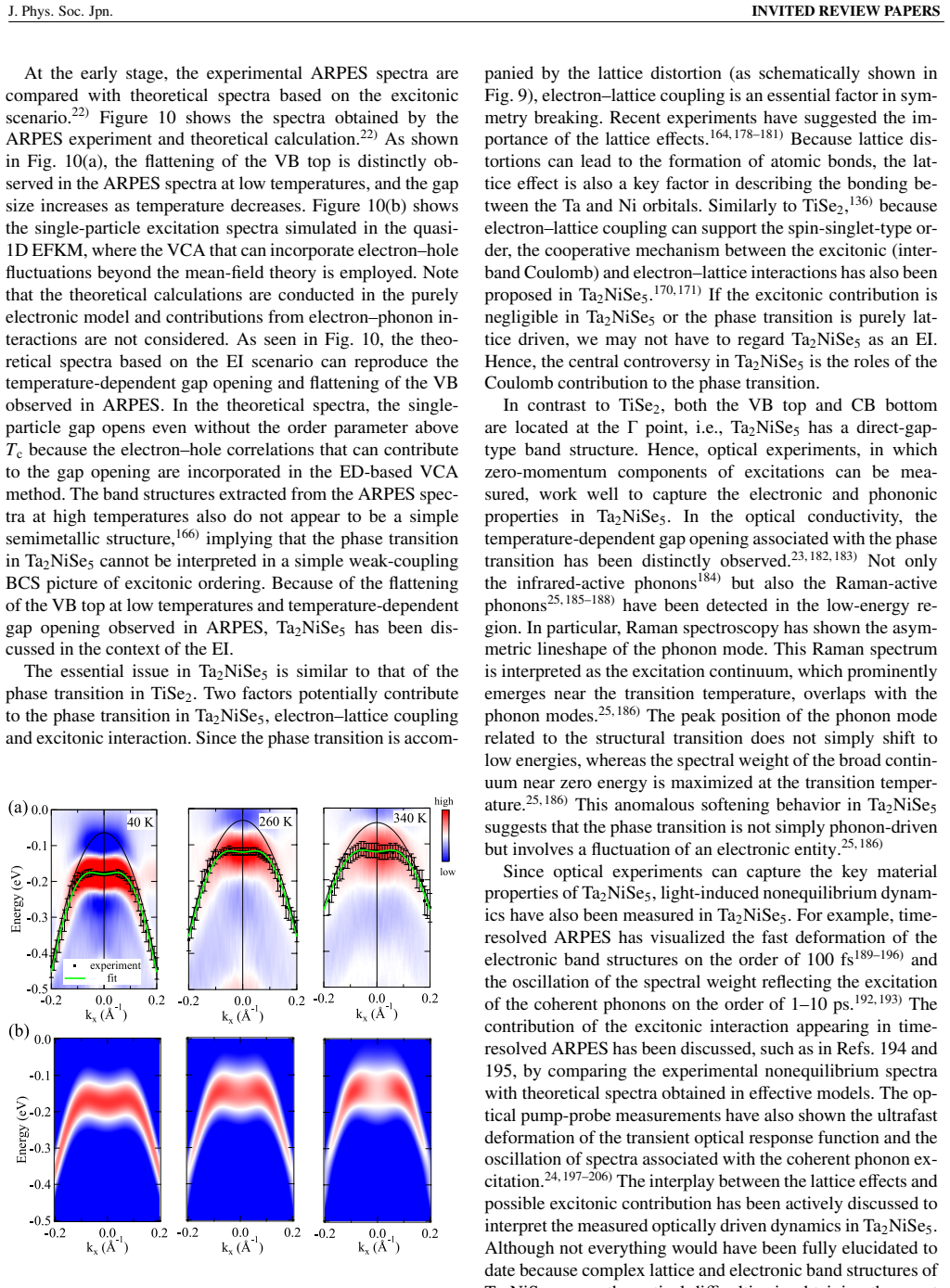
- [Section 4.2] After the discussion of Figure 10, where the VCA spectra of a purely electronic quasi-1D EFKM reproduce the ARPES gap opening and band flattening, the text should cross-reference Section 5 explicitly to remind the reader that this comparison does not by itself discriminate between excitonic and electron-phonon mechanisms; the present wording already notes the omission of electron-phonon interactions, but an explicit pointer would reinforce the point.
- [Section 1 and Abstract] The phrase 'A New Era' in the title and the statement that the field has 'proceeded to the stage where we can combine theoretical predictions with state-of-the-art experiments' are somewhat stronger than the evidence presented, since the review itself stresses that the lattice-versus-electronic debate is unresolved for the leading candidates. A more measured formulation, such as 'an era in which theory and experiment can be combined to sharpen the debate,' would better match the body of the text.
- [Section 4.2] In the sentence 'Ta2NiSe5 was composed in the 1980s,' the verb 'composed' is imprecise; 'synthesized' or 'first synthesized' would be clearer.
- [Section 4.3] The description of the α, β, and γ phases of LaCoO3 under high magnetic fields is dense; a sentence stating which experimental observable (e.g., magnetostriction or magnetization) distinguishes the uniform excitonic order from the bi-exciton superlattice would help the non-specialist reader.
Circularity Check
No significant circularity: the review's claims rest on external experimental results and disclosed model-data comparisons; self-citations are methodological, not load-bearing.
full rationale
This manuscript is an invited review rather than a derivation or prediction paper. Its central claim (Sect. 1) — that excitonic-insulator research has advanced to a stage where theoretical predictions can be combined with state-of-the-art experiments — is supported by a broad body of ARPES, optical, pump-probe, neutron, and X-ray studies performed by many independent groups (e.g., Refs. 19, 23–25, 27, 142–157, 163–166), not solely by the authors' own work. The authors' own publications (e.g., Refs. 22, 59, 68, 306) are cited as sources of specific numerical calculations or collective-mode formalisms, but these citations are not used as a substitute for external evidence; the numerical methods (VCA, DMRG, DMFT) are standard, and the experimental data being matched are from outside the authors' group. The closest approach to a 'prediction' is the Fig. 10 comparison in Sect. 4.2, where VCA spectra of a quasi-1D EFKM 'can reproduce the temperature-dependent gap opening and flattening of the VB observed in ARPES.' This is not circular by construction: the theoretical gap follows from the model's interband Coulomb interaction V, and the ARPES data are not used to fit the model parameters and then re-labeled as a prediction. The comparison is presented as a reproduction, not as a parameter-free forecast. The paper also explicitly discloses the model's limitation — 'the theoretical calculations are conducted in the purely electronic model and contributions from electron–phonon interactions are not considered' (Sect. 4.2, Fig. 10 caption) — and later characterizes the static discrimination problem as a 'chicken-and-egg problem' (Sect. 5). This is an acknowledged confound between excitonic and lattice-driven mechanisms, which is a correctness or evidence limitation rather than a definitional equivalence. No imported uniqueness theorem, ansatz smuggled in solely via self-citation, or renaming of a known result was found. Consequently, the review exhibits no significant circularity.
Assumptions & free parameters
free parameters (1)
- Interorbital Coulomb interaction U in the EFKM/TOHM =
Not specified in review; set in the underlying calculations (e.g., Ref. 22)
assumptions (3)
- domain assumption Hartree-Fock approximation captures the qualitative physics of the excitonic order in Sect. 2.1.
- domain assumption The BCS-BEC crossover concept applies to the excitonic insulator.
- domain assumption The variational cluster approach (VCA) result for the quasi-1D EFKM (Ref. 22) faithfully represents the model and is applicable to Ta2NiSe5.
Cite this review
Pith. "Pith review of A New Era of Excitonic Insulators." pith.science (2026). https://pith.science/paper/ZHJWRD5U
@misc{pith2026241110985,
  author       = {Pith},
  title        = {Pith review of: A New Era of Excitonic Insulators},
  year         = {2026},
  howpublished = {\url{https://pith.science/paper/ZHJWRD5U}},
  note         = {Machine review of arXiv:2411.10985}
}
read the original abstract
The fundamental idea of the excitonic insulator (EI) driven by electron-hole correlations in narrow-gap semiconductors or semimetals was originally proposed in the 1960s, and only theoretical studies had been advanced for a long time. However, the rise of new candidate materials and recent developments in measurement techniques have enabled us to discuss the possibilities of EI states in real materials experimentally. In this article, we review recent progress in the research of EIs. We start with an introduction to the theoretical background of the EI and the mechanism of the order formation including its relation to the physics of the Bardeen-Cooper-Schrieffer (BCS) - Bose-Einstein condensation (BEC) crossover. We also review the EI states studied in the context of strongly correlated electron systems. Then, we introduce the candidate materials for the EI and the issues raised by recent experiments. For example, the phase transitions in several candidate materials are accompanied by lattice distortions, and the contributions from electron-lattice coupling hinder the identification of the excitonic entity. We also review the profiles of the collective modes to discuss the dynamical signatures of the EI.
Figures


Figures from the paper (11 more)




Reference graph
Works this paper leans on
-
[1]
Sachdev: Quantum Phase Transitions (Cambridge University Press, Cambridge, 2011)
S. Sachdev: Quantum Phase Transitions (Cambridge University Press, Cambridge, 2011)
2011
-
[2]
D. I. Khomskii: Transition Metal Compounds (Cambridge University Press, Cambridge, 2014)
2014
-
[3]
Keimer, S
B. Keimer, S. A. Kivelson, M. R. Norman, S. Uchida, and J. Zaanen: Nature 518 (2015) 179
2015
-
[4]
Bardeen, L
J. Bardeen, L. N. Cooper, and J. R. Schrie ffer: Phys. Rev. 108 (1957) 1175
1957
-
[5]
Collective Modes in Excitonic Insulators In the candidate materials TiSe 2 and Ta2NiSe5, the phase transitions are accompanied by lattice distortions. Since the lattice contributions hinder the identification of the excitonic contribution in these materials, it is often debated whether the deformations of the electronic states are due to the lattice disto...
2020
-
[6]
First, we introduced the concept of the EI using a simple the- oretical model and discussed its relation to the BCS–BEC crossover
Summary and Outlook We reviewed the recent progress of the studies on the EI. First, we introduced the concept of the EI using a simple the- oretical model and discussed its relation to the BCS–BEC crossover. We also reviewed the theoretical development of the research of the EIs in the context of strongly correlated electron systems, i.e., the EI states ...
-
[7]
N. F. Mott: Philos. Mag. 6 (1961) 287
1961
-
[8]
Knox: Solid State Physics (Academic, New York, 1963), V ol
R. Knox: Solid State Physics (Academic, New York, 1963), V ol. 5, p. 100
1963
Show all 300 references
-
[9]
L. V . Keldysh and Y . V . Kopeav: Sov. Phys. Solid State6 (1965) 2219
1965
-
[10]
Des Cloizeaux: J
J. Des Cloizeaux: J. Phys. Chem. Solids 26 (1965) 259
1965
-
[11]
A. N. Kozlov and L. A. Maksimov: Sov. Phys. JETP 21 (1965) 790
1965
-
[12]
J ´erome, T
D. J ´erome, T. M. Rice, and W. Kohn: Phys. Rev.158 (1967) 462
1967
-
[13]
Zittartz: Phys
J. Zittartz: Phys. Rev. 162 (1967) 752
1967
-
[14]
Kohn: Phys
W. Kohn: Phys. Rev. Lett. 19 (1967) 439
1967
-
[15]
B. I. Halperin and T. M. Rice: Rev. Mod. Phys. 40 (1968) 755
1968
-
[16]
B. I. Halperin and T. M. Rice: Solid State Physics (Academic Press, New York, 1968), V ol. 21, p. 115
1968
-
[17]
Kohn and D
W. Kohn and D. Sherrington: Rev. Mod. Phys. 42 (1970) 1
1970
-
[18]
S. A. Moskalenko and D. W. Snoke: Bose-Einstein Condensation of Excitons and Biexcitons: And Coherent Nonlinear Optics with Exci- tons (Cambridge University Press, 2000)
2000
-
[19]
P. B. Littlewood, P. R. Eastham, J. M. J. Keeling, F. M. Marchetti, B. D. Simons, and M. H. Szymanska: J. Phys. Condens. Matter 16 (2004) S3597
2004
-
[20]
M. M. Traum, G. Margaritondo, N. V . Smith, J. E. Rowe, and F. J. Di Salvo: Phys. Rev. B 17 (1978) 1836
1978
-
[21]
Cercellier, C
H. Cercellier, C. Monney, F. Clerc, C. Battaglia, L. Despont, M. G. Garnier, H. Beck, P. Aebi, L. Patthey, H. Berger, and L. Forr ´o: Phys. Rev. Lett. 99 (2007) 146403
2007
-
[22]
Kogar, M
A. Kogar, M. S. Rak, S. Vig, A. A. Husain, F. Flicker, Y . I. Joe, L. Ven- ema, G. J. MacDougall, T. C. Chiang, E. Fradkin, J. van Wezel, and P. Abbamonte: Science 358 (2017) 1314
2017
-
[23]
Wakisaka, T
Y . Wakisaka, T. Sudayama, K. Takubo, T. Mizokawa, M. Arita, H. Na- matame, M. Taniguchi, N. Katayama, M. Nohara, and H. Takagi: Phys. Rev. Lett. 103 (2009) 026402
2009
-
[24]
K. Seki, Y . Wakisaka, T. Kaneko, T. Toriyama, T. Konishi, T. Su- dayama, N. L. Saini, M. Arita, H. Namatame, M. Taniguchi, N. Katayama, M. Nohara, H. Takagi, T. Mizokawa, and Y . Ohta: Phys. Rev. B 90 (2014) 155116
2014
-
[25]
Y . F. Lu, H. Kono, T. I. Larkin, A. W. Rost, T. Takayama, A. V . Boris, B. Keimer, and H. Takagi: Nat. Commun. 8 (2017) 14408
2017
-
[26]
Werdehausen, T
D. Werdehausen, T. Takayama, M. H ¨oppner, G. Albrecht, A. W. Rost, Y . Lu, D. Manske, H. Takagi, and S. Kaiser: Sci. Adv. 4 (2018) eaap8652
2018
-
[27]
K. Kim, H. Kim, J. Kim, C. Kwon, J. S. Kim, and B. J. Kim: Nat. Commun. 12 (2021) 1969
2021
-
[28]
Kune ˇs and P
J. Kune ˇs and P. Augustinsk´y: Phys. Rev. B 90 (2014) 235112
2014
-
[29]
Ikeda, Y
A. Ikeda, Y . H. Matsuda, K. Sato, Y . Ishii, H. Sawabe, D. Nakamura, S. Takeyama, and J. Nasu: Nat. Commun. 14 (2023) 1744
2023
-
[30]
Y . Jia, P. Wang, C.-L. Chiu, Z. Song, G. Yu, B. J ¨ack, S. Lei, S. Kle- menz, F. A. Cevallos, M. Onyszczak, N. Fishchenko, X. Liu, G. Farahi, F. Xie, Y . Xu, K. Watanabe, T. Taniguchi, B. A. Bernevig, R. J. Cava, L. M. Schoop, A. Yazdani, and S. Wu: Nat. Phys.18 (2022) 87
2022
-
[31]
B. Sun, W. Zhao, T. Palomaki, Z. Fei, E. Runburg, P. Malinowski, X. Huang, J. Cenker, Y .-T. Cui, J.-H. Chu, X. Xu, S. S. Ataei, D. Varsano, M. Palummo, E. Molinari, M. Rontani, and D. H. Cob- den: Nat. Phys. 18 (2022) 94
2022
-
[32]
Georges, G
A. Georges, G. Kotliar, W. Krauth, and M. J. Rozenberg: Rev. Mod. Phys. 68 (1996) 13
1996
-
[33]
S. R. White: Phys. Rev. Lett. 69 (1992) 2863
1992
-
[34]
C. D. Batista: Phys. Rev. Lett. 89 (2002) 166403
2002
-
[35]
D. M. Eagles: Phys. Rev. 186 (1969) 456
1969
-
[36]
A. J. Leggett: Modern Trends in the Theory of Condensed Matter, 1980, pp. 13–27
1980
-
[37]
Nozi `eres and S
P. Nozi `eres and S. Schmitt-Rink: J. Low Temp. Phys. 59 (1985) 195
1985
-
[38]
Randeria and E
M. Randeria and E. Taylor: Annu. Rev. Condens. Matter Phys.5 (2014) 209
2014
-
[39]
G. C. Strinati, P. Pieri, G. R ¨opke, P. Schuck, and M. Urban: Phys. Rep. 738 (2018) 1
2018
-
[40]
F. X. Bronold and H. Fehske: Phys. Rev. B 74 (2006) 165107
2006
-
[41]
L. N. Cooper: Phys. Rev. 104 (1956) 1189
1956
-
[42]
Esslinger: Annu
T. Esslinger: Annu. Rev. Condens. Matter Phys. 1 (2010) 129
2010
-
[43]
Tarruell and L
L. Tarruell and L. Sanchez-Palencia: C. R. Phys. 19 (2018) 365
2018
-
[44]
Ejima, F
S. Ejima, F. Lange, and H. Fehske: SciPost Phys. 10 (2021) 077
2021
-
[45]
M. H. Christensen, T. Birol, B. M. Andersen, and R. M. Fernandes: Phys. Rev. B 106 (2022) 144504
2022
-
[46]
Tazai, Y
R. Tazai, Y . Yamakawa, and H. Kontani: Nat. Commun. 14 (2023) 7845
2023
-
[47]
Kune ˇs: J
J. Kune ˇs: J. Phys.: Condens. Matter 27 (2015) 333201
2015
-
[48]
L. M. Falicov and J. C. Kimball: Phys. Rev. Lett. 22 (1969) 997
1969
-
[49]
J. K. Freericks and V . Zlati´c: Rev. Mod. Phys. 75 (2003) 1333
2003
-
[50]
C. D. Batista, J. E. Gubernatis, J. Bon ˇca, and H. Q. Lin: Phys. Rev. Lett. 92 (2004) 187601
2004
-
[51]
Farka ˇsovsk´y: Phys
P. Farka ˇsovsk´y: Phys. Rev. B 77 (2008) 155130
2008
-
[52]
Schneider and G
C. Schneider and G. Czycholl: Eur. Phys. J. B 64 (2008) 43
2008
-
[53]
D. Ihle, M. Pfa fferott, E. Burovski, F. X. Bronold, and H. Fehske: Phys. Rev. B 78 (2008) 193103
2008
-
[54]
Zenker, D
B. Zenker, D. Ihle, F. X. Bronold, and H. Fehske: Phys. Rev. B 81 (2010) 115122
2010
-
[55]
V .-N. Phan, K. W. Becker, and H. Fehske: Phys. Rev. B 81 (2010) 205117
2010
-
[56]
V .-N. Phan, H. Fehske, and K. W. Becker: EPL 95 (2011) 17006
2011
-
[57]
Zenker, D
B. Zenker, D. Ihle, F. X. Bronold, and H. Fehske: Phys. Rev. B 83 (2011) 235123
2011
-
[58]
K. Seki, R. Eder, and Y . Ohta: Phys. Rev. B 84 (2011) 245106
2011
-
[59]
Zenker, D
B. Zenker, D. Ihle, F. X. Bronold, and H. Fehske: Phys. Rev. B 85 (2012) 121102
2012
-
[60]
Kaneko, S
T. Kaneko, S. Ejima, H. Fehske, and Y . Ohta: Phys. Rev. B 88 (2013) 035312
2013
-
[61]
Ejima, T
S. Ejima, T. Kaneko, Y . Ohta, and H. Fehske: Phys. Rev. Lett. 112 (2014) 026401
2014
-
[62]
Farka ˇsovsk´y: Phys
P. Farka ˇsovsk´y: Phys. Rev. B 95 (2017) 045101
2017
-
[63]
Hamada, T
K. Hamada, T. Kaneko, S. Miyakoshi, and Y . Ohta: J. Phys. Soc. Jpn. 86 (2017) 074709
2017
-
[64]
Kadosawa, S
M. Kadosawa, S. Nishimoto, K. Sugimoto, and Y . Ohta: J. Phys. Soc. Jpn. 89 (2020) 053706
2020
-
[65]
Kaneko and M
M. Kaneko and M. Tsuchiizu: J. Phys. Soc. Jpn. 90 (2021) 023707
2021
-
[66]
Eaton, D
A. Eaton, D. Mukherjee, and H. A. Fertig: Phys. Rev. B 110 (2024) 035132
2024
-
[67]
Takahashi: Thermodynamics of One-dimensional Solvable Models (Cambridge University Press, Cambridge, 1999)
M. Takahashi: Thermodynamics of One-dimensional Solvable Models (Cambridge University Press, Cambridge, 1999)
1999
-
[68]
Zenker, H
B. Zenker, H. Fehske, and H. Beck: Phys. Rev. B 90 (2014) 195118
2014
-
[69]
Do, D.-H
T.-H.-H. Do, D.-H. Bui, and V .-N. Phan: EPL 119 (2017) 47003
2017
-
[70]
Murakami, D
Y . Murakami, D. Goleˇz, M. Eckstein, and P. Werner: Phys. Rev. Lett. 119 (2017) 247601
2017
-
[71]
Do and V .-N
T.-H.-H. Do and V .-N. Phan: J. Phys.: Condens. Matter 34 (2022) 165602
2022
-
[72]
Werner and A
P. Werner and A. J. Millis: Phys. Rev. Lett. 99 (2007) 126405
2007
-
[73]
Suzuki, T
R. Suzuki, T. Watanabe, and S. Ishihara: Phys. Rev. B 80 (2009) 054410
2009
-
[74]
Kune ˇs and V
J. Kune ˇs and V . Kˇr´apek: Phys. Rev. Lett. 106 (2011) 256401. 19 J. Phys. Soc. Jpn. INVITED REVIEW PAPERS
2011
-
[75]
Higashiyama, K
T. Higashiyama, K. Inaba, and S. Suga: Phys. Rev. A 77 (2008) 043624
2008
-
[76]
Balents: Phys
L. Balents: Phys. Rev. B 62 (2000) 2346
2000
-
[77]
P. M. R. Brydon and C. Timm: Phys. Rev. B 79 (2009) 180504
2009
-
[78]
P. M. R. Brydon and C. Timm: Phys. Rev. B 80 (2009) 174401
2009
-
[79]
Zocher, C
B. Zocher, C. Timm, and P. M. R. Brydon: Phys. Rev. B 84 (2011) 144425
2011
-
[80]
Koga and J
R. Koga and J. Nasu: J. Phys. Soc. Jpn. 93 (2024) 054703
2024
-
[81]
Kaneko, K
T. Kaneko, K. Seki, and Y . Ohta: Phys. Rev. B85 (2012) 165135
2012
-
[82]
Kaneko and Y
T. Kaneko and Y . Ohta: Phys. Rev. B90 (2014) 245144
2014
-
[83]
Kaneko, B
T. Kaneko, B. Zenker, H. Fehske, and Y . Ohta: Phys. Rev. B92 (2015) 115106
2015
-
[84]
Fujiuchi, K
R. Fujiuchi, K. Sugimoto, and Y . Ohta: J. Phys. Soc. Jpn. 87 (2018) 063705
2018
-
[85]
Kune ˇs and P
J. Kune ˇs and P. Augustinsk´y: Phys. Rev. B 89 (2014) 115134
2014
-
[86]
Kune ˇs: Phys
J. Kune ˇs: Phys. Rev. B 90 (2014) 235140
2014
-
[87]
Niyazi, D
A. Niyazi, D. Ge ffroy, and J. Kuneˇs: Phys. Rev. B102 (2020) 085159
2020
-
[88]
Huang, B
X.-X. Huang, B. Moritz, M. Claassen, and T. P. Devereaux: Phys. Rev. B 105 (2022) 165124
2022
-
[89]
Kitagawa and H
K. Kitagawa and H. Matsueda: J. Phys. Soc. Jpn. 91 (2022) 104705
2022
-
[90]
J. Nasu, T. Watanabe, M. Naka, and S. Ishihara: Phys. Rev. B93 (2016) 205136
2016
-
[91]
J. Nasu, M. Naka, and S. Ishihara: Phys. Rev. B 102 (2020) 045143
2020
-
[92]
Nasu and M
J. Nasu and M. Naka: Phys. Rev. B 103 (2021) L121104
2021
-
[93]
P. B. Littlewood and X. Zhu: Phys. Scr. 1996 (1996) 56
1996
-
[94]
Kune ˇs and D
J. Kune ˇs and D. Geffroy: Phys. Rev. Lett. 116 (2016) 256403
2016
-
[95]
Ge ffroy, A
D. Ge ffroy, A. Hariki, and J. Kuneˇs: Phys. Rev. B 97 (2018) 155114
2018
-
[96]
Nishida, S
H. Nishida, S. Miyakoshi, T. Kaneko, K. Sugimoto, and Y . Ohta: Phys. Rev. B 99 (2019) 035119
2019
-
[97]
Yamamoto, K
S. Yamamoto, K. Sugimoto, and Y . Ohta: Phys. Rev. B 101 (2020) 174428
2020
-
[98]
Shinjo, S
K. Shinjo, S. Sota, S. Yunoki, and T. Tohyama: Phys. Rev. B 108 (2023) 195118
2023
-
[99]
Kaneko and Y
T. Kaneko and Y . Ohta: Phys. Rev. B94 (2016) 125127
2016
-
[100]
Yamaguchi, K
T. Yamaguchi, K. Sugimoto, and Y . Ohta: J. Phys. Soc. Jpn.86 (2017) 043701
2017
-
[101]
van den Brink and D
J. van den Brink and D. I. Khomskii: J. Phys.: Condens. Matter 20 (2008) 434217
2008
-
[102]
Greenaway and R
D. Greenaway and R. Nitsche: J. Phys. Chem. Solids 26 (1965) 1445
1965
-
[103]
F. J. Di Salvo, D. E. Moncton, and J. V . Waszczak: Phys. Rev. B 14 (1976) 4321
1976
-
[104]
M. Holt, P. Zschack, H. Hong, M. Y . Chou, and T.-C. Chiang: Phys. Rev. Lett. 86 (2001) 3799
2001
-
[105]
Weber, S
F. Weber, S. Rosenkranz, J.-P. Castellan, R. Osborn, G. Karapetrov, R. Hott, R. Heid, K.-P. Bohnen, and A. Alatas: Phys. Rev. Lett. 107 (2011) 266401
2011
-
[106]
Kitou, A
S. Kitou, A. Nakano, S. Kobayashi, K. Sugawara, N. Katayama, N. Maejima, A. Machida, T. Watanuki, K. Ichimura, S. Tanda, T. Nakamura, and H. Sawa: Phys. Rev. B99 (2019) 104109
2019
-
[107]
Momma and F
K. Momma and F. Izumi: J. Appl. Cryst. 44 (2011) 1272
2011
-
[108]
Chhowalla, H
M. Chhowalla, H. S. Shin, G. Eda, L.-J. Li, K. P. Loh, and H. Zhang: Nat. Chem. 5 (2013) 263
2013
-
[109]
Q. Zhao, Y . Guo, K. Si, Z. Ren, J. Bai, and X. Xu: Phys. Status Solidi B 254 (2017) 1700033
2017
-
[110]
Glebko, I
N. Glebko, I. Aleksandrova, G. C. Tewari, T. S. Tripathi, M. Karp- pinen, and A. J. Karttunen: J. Phys. Chem. C 122 (2018) 26835
2018
-
[111]
Zunger and A
A. Zunger and A. J. Freeman: Phys. Rev. B 17 (1978) 1839
1978
-
[112]
C. M. Fang, R. A. de Groot, and C. Haas: Phys. Rev. B56 (1997) 4455
1997
-
[113]
Pillo, J
T. Pillo, J. Hayoz, H. Berger, F. L ´evy, L. Schlapbach, and P. Aebi: Phys. Rev. B 61 (2000) 16213
2000
-
[114]
T. E. Kidd, T. Miller, M. Y . Chou, and T.-C. Chiang: Phys. Rev. Lett. 88 (2002) 226402
2002
-
[115]
D. Qian, D. Hsieh, L. Wray, E. Morosan, N. L. Wang, Y . Xia, R. J. Cava, and M. Z. Hasan: Phys. Rev. Lett. 98 (2007) 117007
2007
-
[116]
Chen, Y .-H
P. Chen, Y .-H. Chan, X.-Y . Fang, Y . Zhang, M.-Y . Chou, S.-K. Mo, Z. Hussain, A.-V . Fedorov, and T.-C. Chiang: Nat. Commun.6 (2015) 8943
2015
-
[117]
Sugawara, Y
K. Sugawara, Y . Nakata, R. Shimizu, P. Han, T. Hitosugi, T. Sato, and T. Takahashi: ACS Nano10 (2016) 1341
2016
-
[118]
M. D. Watson, O. J. Clark, F. Mazzola, I. Markovi ´c, V . Sunko, T. K. Kim, K. Rossnagel, and P. D. C. King: Phys. Rev. Lett. 122 (2019) 076404
2019
-
[119]
Motizuki: Structural Phase Transitions in Layered Transition Metal Compounds (Reidel, Dordrecht, 1986)
K. Motizuki: Structural Phase Transitions in Layered Transition Metal Compounds (Reidel, Dordrecht, 1986)
1986
-
[120]
Yoshida and K
Y . Yoshida and K. Motizuki: J. Phys. Soc. Jpn. 49 (1980) 898
1980
-
[121]
Takaoka and K
Y . Takaoka and K. Motizuki: J. Phys. Soc. Jpn. 49 (1980) 1838
1980
-
[122]
Suzuki, A
N. Suzuki, A. Yamamoto, and K. Motizuki: J. Phys. Soc. Jpn. 54 (1985) 4668
1985
-
[123]
Monney, C
C. Monney, C. Battaglia, H. Cercellier, P. Aebi, and H. Beck: Phys. Rev. Lett. 106 (2011) 106404
2011
-
[124]
Calandra and F
M. Calandra and F. Mauri: Phys. Rev. Lett. 106 (2011) 196406
2011
-
[125]
Bianco, M
R. Bianco, M. Calandra, and F. Mauri: Phys. Rev. B92 (2015) 094107
2015
-
[126]
D. L. Duong, M. Burghard, and J. C. Sch ¨on: Phys. Rev. B 92 (2015) 245131
2015
-
[127]
Hellgren, J
M. Hellgren, J. Baima, R. Bianco, M. Calandra, F. Mauri, and L. Wirtz: Phys. Rev. Lett. 119 (2017) 176401
2017
-
[128]
Singh, C.-H
B. Singh, C.-H. Hsu, W.-F. Tsai, V . M. Pereira, and H. Lin: Phys. Rev. B 95 (2017) 245136
2017
-
[129]
J. S. Zhou, L. Monacelli, R. Bianco, I. Errea, F. Mauri, and M. Calan- dra: Nano Lett. 20 (2020) 4809
2020
-
[130]
Monney, H
C. Monney, H. Cercellier, F. Clerc, C. Battaglia, E. F. Schwier, C. Did- iot, M. G. Garnier, H. Beck, P. Aebi, H. Berger, L. Forr ´o, and L. Patthey: Phys. Rev. B 79 (2009) 045116
2009
-
[131]
Monney, E
C. Monney, E. F. Schwier, M. G. Garnier, N. Mariotti, C. Didiot, H. Beck, P. Aebi, H. Cercellier, J. Marcus, C. Battaglia, H. Berger, and A. N. Titov: Phys. Rev. B 81 (2010) 155104
2010
-
[132]
Monney, E
C. Monney, E. F. Schwier, M. G. Garnier, N. Mariotti, C. Didiot, H. Cercellier, J. Marcus, H. Berger, A. N. Titov, H. Beck, and P. Aebi: New J. Phys. 12 (2010) 125019
2010
-
[133]
Monney, G
C. Monney, G. Monney, P. Aebi, and H. Beck: Phys. Rev. B85 (2012) 235150
2012
-
[134]
Monney, C
G. Monney, C. Monney, B. Hildebrand, P. Aebi, and H. Beck: Phys. Rev. Lett. 114 (2015) 086402
2015
-
[135]
Monney, G
C. Monney, G. Monney, P. Aebi, and H. Beck: New J. Phys.14 (2012) 075026
2012
-
[136]
C. Chen, B. Singh, H. Lin, and V . M. Pereira: Phys. Rev. Lett. 121 (2018) 226602
2018
-
[137]
J. M. Bok, J. Hwang, and H.-Y . Choi: Phys. Rev. B103 (2021) 205108
2021
-
[138]
van Wezel, P
J. van Wezel, P. Nahai-Williamson, and S. S. Saxena: Phys. Rev. B 81 (2010) 165109
2010
-
[139]
van Wezel, P
J. van Wezel, P. Nahai-Williamson, and S. S. Saxena: Phys. Rev. B 83 (2011) 024502
2011
-
[140]
Zenker, H
B. Zenker, H. Fehske, H. Beck, C. Monney, and A. R. Bishop: Phys. Rev. B 88 (2013) 075138
2013
-
[141]
Watanabe, K
H. Watanabe, K. Seki, and S. Yunoki: Phys. Rev. B 91 (2015) 205135
2015
-
[142]
Kaneko, Y
T. Kaneko, Y . Ohta, and S. Yunoki: Phys. Rev. B97 (2018) 155131
2018
-
[143]
Z. Lin, C. Wang, A. Balassis, J. P. Echeverry, A. S. Vasenko, V . M. Silkin, E. V . Chulkov, Y . Shi, J. Zhang, J. Guo, and X. Zhu: Phys. Rev. Lett. 129 (2022) 187601
2022
-
[144]
Rohwer, S
T. Rohwer, S. Hellmann, M. Wiesenmayer, C. Sohrt, A. Stange, B. Slomski, A. Carr, Y . Liu, L. M. Avila, M. Kall ¨ane, S. Mathias, L. Kipp, K. Rossnagel, and M. Bauer: Nature (London) 471 (2011) 490
2011
-
[145]
Hellmann, T
S. Hellmann, T. Rohwer, M. Kall ¨ane, K. Hanff, C. Sohrt, A. Stange, A. Carr, M. Murnane, H. Kapteyn, L. Kipp, M. Bauer, and K. Ross- nagel: Nat. Commun. 3 (2012) 1069
2012
-
[146]
Mathias, S
S. Mathias, S. Eich, J. Urbancic, S. Michael, A. V . Carr, S. Emmerich, A. Stange, T. Popmintchev, T. Rohwer, M. Wiesenmayer, A. Ru ff- ing, S. Jakobs, S. Hellmann, P. Matyba, C. Chen, L. Kipp, M. Bauer, H. C. Kapteyn, H. C. Schneider, K. Rossnagel, M. M. Murnane, and M. Aesch...
2016
-
[147]
Monney, M
C. Monney, M. Puppin, C. W. Nicholson, M. Hoesch, R. T. Chap- man, E. Springate, H. Berger, A. Magrez, C. Cacho, R. Ernstorfer, and M. Wolf: Phys. Rev. B94 (2016) 165165
2016
-
[148]
Huber, Y
M. Huber, Y . Lin, N. Dale, R. Sailus, S. Tongay, R. A. Kaindl, and A. Lanzara: Sci. Rep. 12 (2022) 15860
2022
-
[149]
M ¨ohr-V orobeva, S
E. M ¨ohr-V orobeva, S. L. Johnson, P. Beaud, U. Staub, R. De Souza, C. Milne, G. Ingold, J. Demsar, H. Schaefer, and A. Titov: Phys. Rev. Lett. 107 (2011) 036403
2011
-
[150]
Porer, U
M. Porer, U. Leierseder, J.-M. M ´enard, H. Dachraoui, L. Mouchliadis, I. Perakis, U. Heinzmann, J. Demsar, K. Rossnagel, and R. Huber: Nat. Mater. 13 (2014) 857
2014
-
[151]
Hedayat, C
H. Hedayat, C. J. Sayers, D. Bugini, C. Dallera, D. Wolverson, T. Bat- ten, S. Karbassi, S. Friedemann, G. Cerullo, J. van Wezel, S. R. Clark, E. Carpene, and E. Da Como: Phys. Rev. Res. 1 (2019) 023029
2019
-
[152]
Lian, S.-J
C. Lian, S.-J. Zhang, S.-Q. Hu, M.-X. Guan, and S. Meng: Nat. Com- 20 J. Phys. Soc. Jpn. INVITED REVIEW PAPERS mun. 11 (2020) 43
2020
-
[153]
M. R. Otto, J.-H. P ¨ohls, L. P. R. de Cotret, M. J. Stern, M. Sutton, and B. J. Siwick: Sci. Adv. 7 (2021) eabf2810
2021
-
[154]
Burian, M
M. Burian, M. Porer, J. R. L. Mardegan, V . Esposito, S. Parchenko, B. Burganov, N. Gurung, M. Ramakrishnan, V . Scagnoli, H. Ueda, S. Francoual, F. Fabrizi, Y . Tanaka, T. Togashi, Y . Kubota, M. Yabashi, K. Rossnagel, S. L. Johnson, and U. Staub: Phys. Rev. Res. 3 (2021) 013128
2021
-
[155]
S. Duan, W. Xia, C. Huang, S. Wang, L. Gu, H. Liu, D. Xiang, D. Qian, Y . Guo, and W. Zhang: Phys. Rev. Lett.130 (2023) 226501
2023
-
[156]
P. Chen, W. W. Pai, Y . H. Chan, A. Takayama, C. Z. Xu, A. Karn, S. Hasegawa, M. Y . Chou, S. K. Mo, A. V . Fedorov, and T. C. Chiang: Nat. Commun. 8 (2017) 516
2017
-
[157]
Gao, Y .-H
Q. Gao, Y .-H. Chan, Y . Wang, H. Zhang, P. Jinxu, S. Cui, Y . Yang, Z. Liu, D. Shen, Z. Sun, J. Jiang, T. C. Chiang, and P. Chen: Nat. Commun. 14 (2023) 994
2023
-
[158]
Y . Song, C. Jia, H. Xiong, B. Wang, Z. Jiang, K. Huang, J. Hwang, Z. Li, C. Hwang, Z. Liu, D. Shen, J. A. Sobota, P. Kirchmann, J. Xue, T. P. Devereaux, S.-K. Mo, Z.-X. Shen, and S. Tang: Nat. Commun.14 (2023) 1116
2023
-
[159]
Gao, Y .-H
Q. Gao, Y .-H. Chan, P. Jiao, H. Chen, S. Yin, K. Tangprapha, Y . Yang, X. Li, Z. Liu, D. Shen, S. Jiang, and P. Chen: Nat. Phys. 20 (2024) 597
2024
-
[160]
S. A. Sunshine and J. A. Ibers: Inorg. Chem. 24 (1985) 3611
1985
-
[161]
Di Salvo, C
F. Di Salvo, C. Chen, R. Fleming, J. Waszczak, R. Dunn, S. Sunshine, and J. A. Ibers: J. Less-Common Met. 116 (1986) 51
1986
-
[162]
S. Li, S. Kawai, Y . Kobayashi, and M. Itoh: Phys. Rev. B 97 (2018) 165127
2018
-
[163]
Hirose, S
Y . Hirose, S. Sano, T. Hirahara, Y . Uwatoko, J. Gouchi, T. Takeuchi, and R. Settai: J. Phys. Soc. Jpn. 92 (2023) 084705
2023
-
[164]
Nakano, T
A. Nakano, T. Hasegawa, S. Tamura, N. Katayama, S. Tsutsui, and H. Sawa: Phys. Rev. B 98 (2018) 045139
2018
-
[165]
Fukutani, R
K. Fukutani, R. Stania, J. Jung, E. F. Schwier, K. Shimada, C. I. Kwon, J. S. Kim, and H. W. Yeom: Phys. Rev. Lett.123 (2019) 206401
2019
-
[166]
M. D. Watson, I. Markovi´c, E. A. Morales, P. Le F`evre, M. Merz, A. A. Haghighirad, and P. D. C. King: Phys. Rev. Res.2 (2020) 013236
2020
-
[167]
L. Chen, T. T. Han, C. Cai, Z. G. Wang, Y . D. Wang, Z. M. Xin, and Y . Zhang: Phys. Rev. B102 (2020) 161116
2020
-
[168]
Fukutani, R
K. Fukutani, R. Stania, C. Il Kwon, J. S. Kim, K. J. Kong, J. Kim, and H. W. Yeom: Nat. Phys.17 (2021) 1024
2021
-
[169]
Lee, C.-J
J. Lee, C.-J. Kang, M. J. Eom, J. S. Kim, B. I. Min, and H. W. Yeom: Phys. Rev. B 99 (2019) 075408
2019
-
[170]
Canadell and M
E. Canadell and M. H. Whangbo: Inorg. Chem. 26 (1987) 3974
1987
-
[171]
Mazza, M
G. Mazza, M. R ¨osner, L. Windg¨atter, S. Latini, H. H¨ubener, A. J. Mil- lis, A. Rubio, and A. Georges: Phys. Rev. Lett. 124 (2020) 197601
2020
-
[172]
Kaneko, T
T. Kaneko, T. Toriyama, T. Konishi, and Y . Ohta: Phys. Rev. B 87 (2013) 035121
2013
-
[173]
Sugimoto, T
K. Sugimoto, T. Kaneko, and Y . Ohta: Phys. Rev. B93 (2016) 041105
2016
-
[174]
Sugimoto and Y
K. Sugimoto and Y . Ohta: Phys. Rev. B 94 (2016) 085111
2016
-
[175]
Yamada, K
T. Yamada, K. Domon, and Y . ¯Ono: J. Phys. Soc. Jpn. 85 (2016) 053703
2016
-
[176]
Domon, T
K. Domon, T. Yamada, and Y . ¯Ono: J. Phys. Soc. Jpn. 85 (2016) 065005
2016
-
[177]
Sugimoto, S
K. Sugimoto, S. Nishimoto, T. Kaneko, and Y . Ohta: Phys. Rev. Lett. 120 (2018) 247602
2018
-
[178]
Domon, T
K. Domon, T. Yamada, and Y . ¯Ono: J. Phys. Soc. Jpn. 87 (2018) 054701
2018
-
[179]
Yamada, K
T. Yamada, K. Domon, and Y . ¯Ono: J. Phys. Soc. Jpn. 88 (2019) 064701
2019
-
[180]
Baldini, A
E. Baldini, A. Zong, D. Choi, C. Lee, M. H. Michael, L. Windgaetter, I. I. Mazin, S. Latini, D. Azoury, B. Lv, A. Kogar, Y . Su, Y . Wang, Y . Lu, T. Takayama, H. Takagi, A. J. Millis, A. Rubio, E. Demler, and N. Gedik: Proc. Natl. Acad. Sci. USA 120 (2023) e2221688120
2023
-
[181]
C. Chen, W. Tang, X. Chen, Z. Kang, S. Ding, K. Scott, S. Wang, Z. Li, J. P. C. Ruff, M. Hashimoto, D.-H. Lu, C. Jozwiak, A. Bostwick, E. Rotenberg, E. H. da Silva Neto, R. J. Birgeneau, Y . Chen, S. G. Louie, Y . Wang, and Y . He: Nat. Commun.14 (2023) 7512
2023
-
[182]
C. Chen, X. Chen, W. Tang, Z. Li, S. Wang, S. Ding, Z. Kang, C. Jozwiak, A. Bostwick, E. Rotenberg, M. Hashimoto, D. Lu, J. P. C. Ruff, S. G. Louie, R. J. Birgeneau, Y . Chen, Y . Wang, and Y . He: Phys. Rev. Res. 5 (2023) 043089
2023
-
[183]
S. R. U. Haque, M. H. Michael, J. Zhu, Y . Zhang, L. Windg¨atter, S. La- tini, J. P. Wakefield, G.-F. Zhang, J. Zhang, A. Rubio, J. G. Checkelsky, E. Demler, and R. D. Averitt: Nat. Mater.23 (2024) 796
2024
-
[184]
T. I. Larkin, A. N. Yaresko, D. Pr ¨opper, K. A. Kikoin, Y . F. Lu, T. Takayama, Y .-L. Mathis, A. W. Rost, H. Takagi, B. Keimer, and A. V . Boris: Phys. Rev. B95 (2017) 195144
2017
-
[185]
Okamura, T
H. Okamura, T. Mizokawa, K. Miki, Y . Matsui, N. Noguchi, N. Katayama, H. Sawa, M. Nohara, Y . Lu, H. Takagi, Y . Ikemoto, and T. Moriwaki: Phys. Rev. B107 (2023) 045141
2023
-
[186]
T. I. Larkin, R. D. Dawson, M. H¨oppner, T. Takayama, M. Isobe, Y .-L. Mathis, H. Takagi, B. Keimer, and A. V . Boris: Phys. Rev. B98 (2018) 125113
2018
-
[187]
M.-J. Kim, A. Schulz, T. Takayama, M. Isobe, H. Takagi, and S. Kaiser: Phys. Rev. Res. 2 (2020) 042039
2020
-
[188]
P. A. V olkov, M. Ye, H. Lohani, I. Feldman, A. Kanigel, and G. Blum- berg: npj Quantum Mater. 6 (2021) 52
2021
-
[189]
P. A. V olkov, M. Ye, H. Lohani, I. Feldman, A. Kanigel, and G. Blum- berg: Phys. Rev. B 104 (2021) L241103
2021
-
[190]
M. Ye, P. A. V olkov, H. Lohani, I. Feldman, M. Kim, A. Kanigel, and G. Blumberg: Phys. Rev. B 104 (2021) 045102
2021
-
[191]
S. Mor, M. Herzog, D. Gole ˇz, P. Werner, M. Eckstein, N. Katayama, M. Nohara, H. Takagi, T. Mizokawa, C. Monney, and J. St¨ahler: Phys. Rev. Lett. 119 (2017) 086401
2017
-
[192]
Okazaki, Y
K. Okazaki, Y . Ogawa, T. Suzuki, T. Yamamoto, T. Someya, S. Michi- mae, M. Watanabe, Y . Lu, M. Nohara, H. Takagi, N. Katayama, H. Sawa, M. Fujisawa, T. Kanai, N. Ishii, J. Itatani, T. Mizokawa, and S. Shin: Nat. Commun. 9 (2018) 4322
2018
-
[193]
Mitsuoka, T
T. Mitsuoka, T. Suzuki, H. Takagi, N. Katayama, H. Sawa, M. Nohara, M. Watanabe, J. Xu, Q. Ren, M. Fujisawa, T. Kanai, J. Itatani, S. Shin, K. Okazaki, and T. Mizokawa: J. Phys. Soc. Jpn. 89 (2020) 124703
2020
-
[194]
T. Tang, H. Wang, S. Duan, Y . Yang, C. Huang, Y . Guo, D. Qian, and W. Zhang: Phys. Rev. B101 (2020) 235148
2020
-
[195]
Suzuki, Y
T. Suzuki, Y . Shinohara, Y . Lu, M. Watanabe, J. Xu, K. L. Ishikawa, H. Takagi, M. Nohara, N. Katayama, H. Sawa, M. Fujisawa, T. Kanai, J. Itatani, T. Mizokawa, S. Shin, and K. Okazaki: Phys. Rev. B 103 (2021) L121105
2021
-
[196]
T. Saha, D. Gole ˇz, G. De Ninno, J. Mravlje, Y . Murakami, B. Ressel, M. Stupar, and P. c. v. R. Ribiˇc: Phys. Rev. B 103 (2021) 144304
2021
-
[197]
Gole ˇz, S
D. Gole ˇz, S. K. Y . Dufresne, M.-J. Kim, F. Boschini, H. Chu, Y . Mu- rakami, G. Levy, A. K. Mills, S. Zhdanovich, M. Isobe, H. Takagi, S. Kaiser, P. Werner, D. J. Jones, A. Georges, A. Damascelli, and A. J. Millis: Phys. Rev. B 106 (2022) L121106
2022
-
[198]
Takahashi, T
Y . Takahashi, T. Suzuki, M. Hattori, M. Okawa, H. Takagi, N. Katayama, H. Sawa, M. Nohara, Y . Zhong, K. Liu, T. Kanai, J. Itatani, S. Shin, K. Okazaki, and T. Mizokawa: J. Phys. Soc. Jpn. 92 (2023) 064706
2023
-
[199]
Werdehausen, T
D. Werdehausen, T. Takayama, G. Albrecht, Y . Lu, H. Takagi, and S. Kaiser: J. Phys.: Condens. Matter 30 (2018) 305602
2018
-
[200]
S. Mor, M. Herzog, J. Noack, N. Katayama, M. Nohara, H. Takagi, A. Trunschke, T. Mizokawa, C. Monney, and J. St¨ahler: Phys. Rev. B 97 (2018) 115154
2018
-
[201]
H. Ning, O. Mehio, M. Buchhold, T. Kurumaji, G. Refael, J. G. Check- elsky, and D. Hsieh: Phys. Rev. Lett.125 (2020) 267602
2020
-
[202]
H. M. Bretscher, P. Andrich, P. Telang, A. Singh, L. Harnagea, A. K. Sood, and A. Rao: Nat. Commun. 12 (2021) 1699
2021
-
[203]
H. M. Bretscher, P. Andrich, Y . Murakami, D. Gole ˇz, B. Remez, P. Telang, A. Singh, L. Harnagea, N. R. Cooper, A. J. Millis, P. Werner, A. K. Sood, and A. Rao: Sci. Adv. 7 (2021) eabd6147
2021
-
[204]
Miyamoto, M
T. Miyamoto, M. Mizui, N. Takamura, J. Hirata, H. Yamakawa, T. Mo- rimoto, T. Terashige, N. Kida, A. Nakano, H. Sawa, and H. Okamoto: J. Phys. Soc. Jpn. 91 (2022) 023701
2022
-
[205]
M. Guan, D. Chen, Q. Chen, Y . Yao, and S. Meng: Phys. Rev. Lett. 131 (2023) 256503
2023
-
[206]
Katsumi, A
K. Katsumi, A. Alekhin, S.-M. Souliou, M. Merz, A.-A. Haghighirad, M. Le Tacon, S. Houver, M. Cazayous, A. Sacuto, and Y . Gallais: Phys. Rev. Lett. 130 (2023) 106904
2023
-
[207]
Takamura, T
N. Takamura, T. Miyamoto, R. Ikeda, T. Kubo, M. Yamamoto, H. Sato, Y . Han, T. Ito, T. Sato, A. Nakano, H. Sawa, and H. Okamoto: Phys. Rev. Res. 6 (2024) 043187
2024
-
[208]
Jiang, Y
Y . Jiang, Y . Mi, J. Guo, Z. Wang, N. Zhang, B. Liu, and S.-N. Luo: Phys. Chem. Chem. Phys. 26 (2024) 15417
2024
-
[209]
Matsubayashi, H
K. Matsubayashi, H. Okamura, T. Mizokawa, N. Katayama, A. Nakano, H. Sawa, T. Kaneko, T. Toriyama, T. Konishi, Y . Ohta, H. Arima, R. Yamanaka, A. Hisada, T. Okada, Y . Ikemoto, T. Mori- waki, K. Munakata, A. Nakao, M. Nohara, Y . Lu, H. Takagi, and 21 J. Phys. Soc. Jpn. INVIT...
2021
-
[210]
A. F. Kusmartseva, B. Sipos, H. Berger, L. Forr ´o, and E. Tutiˇs: Phys. Rev. Lett. 103 (2009) 236401
2009
-
[211]
Morosan, H
E. Morosan, H. W. Zandbergen, B. S. Dennis, J. W. G. Bos, Y . Onose, T. Klimczuk, A. P. Ramirez, N. P. Ong, and R. J. Cava: Nat. Phys. 2 (2006) 544
2006
-
[212]
L. J. Li, E. C. T. O’Farrell, K. P. Loh, G. Eda, B. ¨Ozyilmaz, and A. H. Castro Neto: Nature 529 (2016) 185
2016
-
[213]
Nakano, K
A. Nakano, K. Sugawara, S. Tamura, N. Katayama, K. Matsub- ayashi, T. Okada, Y . Uwatoko, K. Munakata, A. Nakao, H. Sagayama, R. Kumai, K. Sugimoto, N. Maejima, A. Machida, T. Watanuki, and H. Sawa: IUCrJ 5 (2018) 158
2018
-
[214]
Hosono and K
H. Hosono and K. Kuroki: Physica C 514 (2015) 399
2015
-
[215]
Huang, B
J. Huang, B. Jiang, J. Yao, D. Yan, X. Lei, J. Gao, Z. Guo, F. Jin, Y . Li, Z. Yuan, C. Chai, H. Sheng, M. Pan, F. Chen, J. Liu, S. Gao, G. Qu, B. Liu, Z. Jiang, Z. Liu, X. Ma, S. Zhou, Y . Huang, C. Yun, Q. Zhang, S. Li, S. Jin, H. Ding, J. Shen, D. Su, Y . Shi, Z. Wang, and ...
2024
-
[216]
Zhang, Y
P. Zhang, Y . Dong, D. Yan, B. Jiang, T. Yang, J. Li, Z. Guo, Y . Huang, Haobo, Q. Li, Y . Li, K. Kurokawa, R. Wang, Y . Nie, M. Hashimoto, D. Lu, W.-H. Jiao, J. Shen, T. Qian, Z. Wang, Y . Shi, and T. Kondo: Phys. Rev. X 14 (2024) 011047
2024
-
[217]
M. S. Hossain, T. A. Cochran, Y .-X. Jiang, S. Zhang, H. Wu, X. Liu, X. Zheng, B. Kim, G. Cheng, Q. Zhang, M. Litskevich, J. Zhang, Z.-J. Cheng, J. Liu, J.-X. Yin, X. P. Yang, J. Denlinger, M. Tallarida, J. Dai, E. Vescovo, A. Rajapitamahuni, H. Miao, N. Yao, Y . Peng, Y . Yao...
2023 arXiv
-
[218]
Heikes, R
R. Heikes, R. Miller, and R. Mazelsky: Physica 30 (1964) 1600
1964
-
[219]
P. M. Raccah and J. B. Goodenough: Phys. Rev. 155 (1967) 932
1967
-
[220]
M. A. Korotin, S. Y . Ezhov, I. V . Solovyev, V . I. Anisimov, D. I. Khom- skii, and G. A. Sawatzky: Phys. Rev. B 54 (1996) 5309
1996
-
[221]
Mizokawa and A
T. Mizokawa and A. Fujimori: Phys. Rev. B 54 (1996) 5368
1996
-
[222]
M. W. Haverkort, Z. Hu, J. C. Cezar, T. Burnus, H. Hartmann, M. Reuther, C. Zobel, T. Lorenz, A. Tanaka, N. B. Brookes, H. H. Hsieh, H.-J. Lin, C. T. Chen, and L. H. Tjeng: Phys. Rev. Lett. 97 (2006) 176405
2006
-
[223]
Eder: Phys
R. Eder: Phys. Rev. B 81 (2010) 035101
2010
-
[224]
Tomiyasu, J
K. Tomiyasu, J. Okamoto, H. Y . Huang, Z. Y . Chen, E. P. Sinaga, W. B. Wu, Y . Y . Chu, A. Singh, R.-P. Wang, F. M. F. de Groot, A. Chainani, S. Ishihara, C. T. Chen, and D. J. Huang: Phys. Rev. Lett. 119 (2017) 196402
2017
-
[225]
Takegami, A
D. Takegami, A. Tanaka, S. Agrestini, Z. Hu, J. Weinen, M. Rotter, C. Sch ¨ußler-Langeheine, T. Willers, T. C. Koethe, T. Lorenz, Y . F. Liao, K. D. Tsuei, H.-J. Lin, C. T. Chen, and L. H. Tjeng: Phys. Rev. X 13 (2023) 011037
2023
-
[226]
Tsubouchi, T
S. Tsubouchi, T. Ky ˆomen, M. Itoh, P. Ganguly, M. Oguni, Y . Shimojo, Y . Morii, and Y . Ishii: Phys. Rev. B66 (2002) 052418
2002
-
[227]
Tsubouchi, T
S. Tsubouchi, T. Ky ˆomen, M. Itoh, and M. Oguni: Phys. Rev. B 69 (2004) 144406
2004
-
[228]
Fujita, T
T. Fujita, T. Miyashita, Y . Yasui, Y . Kobayashi, M. Sato, E. Nishi- bori, M. Sakata, Y . Shimojo, N. Igawa, Y . Ishii, K. Kakurai, T. Adachi, Y . Ohishi, and M. Takata: J. Phys. Soc. Jpn.73 (2004) 1987
2004
-
[229]
Hejtm ´anek, E
J. Hejtm ´anek, E. ˇSantav´a, K. Kn´ıˇzek, M. Maryˇsko, Z. Jir´ak, T. Naito, H. Sasaki, and H. Fujishiro: Phys. Rev. B 82 (2010) 165107
2010
-
[230]
Hardy, F
V . Hardy, F. Guillou, and Y . Br ´eard: J. Phys.: Condens. Matter 25 (2013) 246003
2013
-
[231]
Hejtm ´anek, Z
J. Hejtm ´anek, Z. Jir ´ak, O. Kaman, K. Kn ´ıˇzek, E. ˇSantav´a, K. Nitta, T. Naito, and H. Fujishiro: Euro. Phys. J. B 86 (2013) 305
2013
-
[232]
Yamaguchi, K
T. Yamaguchi, K. Sugimoto, and Y . Ohta: Physica B536 (2018) 37
2018
-
[233]
J. F. Afonso and J. Kune ˇs: Phys. Rev. B 95 (2017) 115131
2017
-
[234]
Moyoshi, K
T. Moyoshi, K. Kamazawa, M. Matsuda, and M. Sato: Phys. Rev. B 98 (2018) 205105
2018
-
[235]
R.-P. Wang, A. Hariki, A. Sotnikov, F. Frati, J. Okamoto, H.-Y . Huang, A. Singh, D.-J. Huang, K. Tomiyasu, C.-H. Du, J. Kuneˇs, and F. M. F. de Groot: Phys. Rev. B 98 (2018) 035149
2018
-
[236]
Ikeda, Y
A. Ikeda, Y . H. Matsuda, K. Sato, and J. Nasu: J. Phys. Soc. Jpn. 93 (2024) 121005
2024
-
[237]
Sotnikov and J
A. Sotnikov and J. Kune ˇs: Sci. Rep. 6 (2016) 30510
2016
-
[238]
Sotnikov and J
A. Sotnikov and J. Kune ˇs: Phys. Rev. B 96 (2017) 245102
2017
-
[239]
Tatsuno, E
T. Tatsuno, E. Mizoguchi, J. Nasu, M. Naka, and S. Ishihara: J. Phys. Soc. Jpn. 85 (2016) 083706
2016
-
[240]
Ikeda, T
A. Ikeda, T. Nomura, Y . H. Matsuda, A. Matsuo, K. Kindo, and K. Sato: Phys. Rev. B 93 (2016) 220401
2016
-
[241]
Ikeda, Y
A. Ikeda, Y . H. Matsuda, and K. Sato: Phys. Rev. Lett. 125 (2020) 177202
2020
-
[242]
Ikeda, S
A. Ikeda, S. Lee, T. T. Terashima, Y . H. Matsuda, M. Tokunaga, and T. Naito: Phys. Rev. B94 (2016) 115129
2016
-
[243]
P. Wang, G. Yu, Y . Jia, M. Onyszczak, F. A. Cevallos, S. Lei, S. Kle- menz, K. Watanabe, T. Taniguchi, R. J. Cava, L. M. Schoop, and S. Wu: Nature 589 (2021) 225
2021
-
[244]
Y . H. Kwan, T. Devakul, S. L. Sondhi, and S. A. Parameswaran: Phys. Rev. B 104 (2021) 125133
2021
-
[245]
P. A. Lee: Phys. Rev. B 103 (2021) L041101
2021
-
[246]
He and P
W.-Y . He and P. A. Lee: Phys. Rev. B104 (2021) L041110
2021
-
[247]
Que, Y .-H
Y . Que, Y .-H. Chan, J. Jia, A. Das, Z. Tong, Y .-T. Chang, Z. Cui, A. Ku- mar, G. Singh, S. Mukherjee, H. Lin, and B. Weber: Adv. Mater. 36 (2024) 2309356
2024
-
[248]
Varsano, M
D. Varsano, M. Palummo, E. Molinari, and M. Rontani: Nat. Nan- otechnol. 15 (2020) 367
2020
-
[249]
Neuenschwander and P
J. Neuenschwander and P. Wachter: Phys. Rev. B 41 (1990) 12693
1990
-
[250]
Bucher, P
B. Bucher, P. Steiner, and P. Wachter: Phys. Rev. Lett.67 (1991) 2717
1991
-
[251]
Wachter, B
P. Wachter, B. Bucher, and J. Malar: Phys. Rev. B 69 (2004) 094502
2004
-
[252]
Okuma, K
R. Okuma, K. Yamagami, Y . Fujisawa, C. H. Hsu, Y . Obata, N. To- moda, M. Dronova, K. Kuroda, H. Ishikawa, K. Kawaguchi, K. Aido, K. Kindo, Y . H. Chan, H. Lin, Y . Ihara, T. Kondo, and Y . Okada: arXiv:2405.16781 (2024)
2024 arXiv
-
[253]
B. A. V olkov, Y . V . Kopaev, and A. I. Rusinov: Sov. Phys. JETP 41 (1975) 952
1975
-
[254]
Young, D
D. Young, D. Hall, M. Torelli, Z. Fisk, J. Sarrao, J. Thompson, H.-R. Ott, S. Oseroff, R. Goodrich, and R. Zysler: Nature 397 (1999) 412
1999
-
[255]
Zhitomirsky, T
M. Zhitomirsky, T. Rice, and V . Anisimov: Nature402 (1999) 251
1999
-
[256]
Balents and C
L. Balents and C. M. Varma: Phys. Rev. Lett. 84 (2000) 1264
2000
-
[257]
Matsubayashi, M
K. Matsubayashi, M. Maki, T. Tsuzuki, T. Nishioka, and N. K. Sato: Nature 420 (2002) 143
2002
-
[258]
Matsubayashi, M
K. Matsubayashi, M. Maki, T. Moriwaka, T. Tsuzuki, T. Nishioka, C. H. Lee, A. Yamamoto, T. Ohta, and N. K. Sato: J. Phys. Soc. Jpn. 72 (2003) 2097
2003
-
[259]
Varsano, S
D. Varsano, S. Sorella, D. Sangalli, M. Barborini, S. Corni, E. Moli- nari, and M. Rontani: Nat. Commun. 8 (2017) 1461
2017
-
[260]
Z. Zhu, P. Nie, B. Fauqu ´e, B. Vignolle, C. Proust, R. D. McDonald, N. Harrison, and K. Behnia: Phys. Rev. X 9 (2019) 011058
2019
-
[261]
Jiang, W
Z. Jiang, W. Lou, Y . Liu, Y . Li, H. Song, K. Chang, W. Duan, and S. Zhang: Phys. Rev. Lett. 124 (2020) 166401
2020
-
[262]
Sethi, Y
G. Sethi, Y . Zhou, L. Zhu, L. Yang, and F. Liu: Phys. Rev. Lett. 126 (2021) 196403
2021
-
[263]
Sethi, M
G. Sethi, M. Cuma, and F. Liu: Phys. Rev. Lett. 130 (2023) 186401
2023
-
[264]
Delgado, C
A. Delgado, C. Dusold, J. Jiang, A. Cronin, S. G. Louie, and F. R. Fischer: arXiv:2301.06171 (2023)
2023 arXiv
-
[265]
S. S. Ataei, D. Varsano, E. Molinari, and M. Rontani: Proc. Natl. Acad. Sci. USA 118 (2021) e2010110118
2021
-
[266]
Pezzini, M
S. Pezzini, M. R. van Delft, L. M. Schoop, B. V . Lotsch, A. Carrington, M. I. Katsnelson, N. E. Hussey, and S. Wiedmann: Nat. Phys.14 (2018) 178
2018
-
[267]
A. N. Rudenko, E. A. Stepanov, A. I. Lichtenstein, and M. I. Katsnel- son: Phys. Rev. Lett. 120 (2018) 216401
2018
-
[268]
M. M. Scherer, C. Honerkamp, A. N. Rudenko, E. A. Stepanov, A. I. Lichtenstein, and M. I. Katsnelson: Phys. Rev. B 98 (2018) 241112
2018
-
[269]
Jiang, Y
Z. Jiang, Y . Li, W. Duan, and S. Zhang: Phys. Rev. Lett. 122 (2019) 236402
2019
-
[270]
Di Sabatino, A
S. Di Sabatino, A. Molina-S ´anchez, P. Romaniello, and D. Sangalli: Phys. Rev. B 107 (2023) 115121
2023
-
[271]
Jiang, Y
Z. Jiang, Y . Li, S. Zhang, and W. Duan: Phys. Rev. B 98 (2018) 081408
2018
-
[272]
Dong and Y
S. Dong and Y . Li: Phys. Rev. B 102 (2020) 155119
2020
-
[273]
D. Wang, N. Luo, W. Duan, and X. Zou: J. Phys. Chem. Lett.12 (2021) 5479
2021
-
[274]
H. D. Scammell, J. Ingham, T. Li, and O. P. Sushkov: Nat. Commun. 14 (2023) 605
2023
-
[275]
R. Wang, O. Erten, B. Wang, and D. Y . Xing: Nat. Commun.10 (2019) 210
2019
-
[276]
Liu, L.-H
Z.-R. Liu, L.-H. Hu, C.-Z. Chen, B. Zhou, and D.-H. Xu: Phys. Rev. B 103 (2021) L201115
2021
-
[277]
Dong and Y
S. Dong and Y . Li: Phys. Rev. B 107 (2023) 235147
2023
-
[278]
H. Yang, J. Zeng, Y . Shao, Y . Xu, X. Dai, and X.-Z. Li: Phys. Rev. B 109 (2024) 075167. 22 J. Phys. Soc. Jpn. INVITED REVIEW PAPERS
2024
-
[279]
M. Xie, H. Pan, F. Wu, and S. Das Sarma: Phys. Rev. Lett. 131 (2023) 046402
2023
-
[280]
Dong and Y .-H
Z. Dong and Y .-H. Zhang: Phys. Rev. B 107 (2023) L081101
2023
-
[281]
Xie, C.-P
Y .-M. Xie, C.-P. Zhang, and K. T. Law: Phys. Rev. B 110 (2024) 045115
2024
-
[282]
Khaliullin: Phys
G. Khaliullin: Phys. Rev. Lett. 111 (2013) 197201
2013
-
[283]
G. Cao, T. F. Qi, L. Li, J. Terzic, S. J. Yuan, L. E. DeLong, G. Murthy, and R. K. Kaul: Phys. Rev. Lett. 112 (2014) 056402
2014
-
[284]
T. Dey, A. Maljuk, D. V . Efremov, O. Kataeva, S. Gass, C. G. F. Blum, F. Steckel, D. Gruner, T. Ritschel, A. U. B. Wolter, J. Geck, C. Hess, K. Koepernik, J. van den Brink, S. Wurmehl, and B. B ¨uchner: Phys. Rev. B 93 (2016) 014434
2016
-
[285]
Pajskr, P
K. Pajskr, P. Nov ´ak, V . Pokorn´y, J. Kolorenˇc, R. Arita, and J. Kune ˇs: Phys. Rev. B 93 (2016) 035129
2016
-
[286]
Kusch, V
M. Kusch, V . M. Katukuri, N. A. Bogdanov, B. B¨uchner, T. Dey, D. V . Efremov, J. E. Hamann-Borrero, B. H. Kim, M. Krisch, A. Maljuk, M. M. Sala, S. Wurmehl, G. Aslan-Cansever, M. Sturza, L. Hozoi, J. van den Brink, and J. Geck: Phys. Rev. B 97 (2018) 064421
2018
-
[287]
M. A. Laguna-Marco, E. Arias-Egido, C. Piquer, V . Cuartero, L. Hern´andez-L´opez, P. Kayser, J. A. Alonso, J. A. T. Barker, G. Fab- bris, C. A. Escanhoela, and T. Irifune: Phys. Rev. B101 (2020) 014449
2020
-
[288]
A. A. Aczel, Q. Chen, J. P. Clancy, C. dela Cruz, D. Reig-i Plessis, G. J. MacDougall, C. J. Pollock, M. H. Upton, T. J. Williams, N. LaManna, J. P. Carlo, J. Beare, G. M. Luke, and H. D. Zhou: Phys. Rev. Mater.6 (2022) 094409
2022
-
[289]
Akbari and G
A. Akbari and G. Khaliullin: Phys. Rev. B 90 (2014) 035137
2014
-
[290]
A. Jain, M. Krautloher, J. Porras, G. H. Ryu, D. P. Chen, D. L. Aber- nathy, J. T. Park, A. Ivanov, J. Chaloupka, G. Khaliullin, B. Keimer, and B. J. Kim: Nat. Phys. 13 (2017) 633
2017
-
[291]
Yamamoto, Y
S. Yamamoto, Y . Ohta, and K. Sugimoto: Phys. Rev. B 106 (2022) 045136
2022
-
[292]
D. G. Mazzone, Y . Shen, H. Suwa, G. Fabbris, J. Yang, S. S. Zhang, H. Miao, J. Sears, K. Jia, Y . G. Shi, M. H. Upton, D. M. Casa, X. Liu, J. Liu, C. D. Batista, and M. P. M. Dean: Nat. Commun.13 (2022) 913
2022
-
[293]
Suwa, S.-S
H. Suwa, S.-S. Zhang, and C. D. Batista: Phys. Rev. Res. 3 (2021) 013224
2021
-
[294]
T. Sato, T. Shirakawa, and S. Yunoki: Phys. Rev. B91 (2015) 125122
2015
-
[295]
L. Du, X. Li, W. Lou, G. Sullivan, K. Chang, J. Kono, and R.-R. Du: Nat. Commun. 8 (2017) 1971
2017
-
[296]
W. Yu, V . Cleric`o, C. H. Fuentevilla, X. Shi, Y . Jiang, D. Saha, W. K. Lou, K. Chang, D. H. Huang, G. Gumbs, D. Smirnov, C. J. Stanton, Z. Jiang, V . Bellani, Y . Meziani, E. Diez, W. Pan, S. D. Hawkins, and J. F. Klem: New J. Phys. 20 (2018) 053062
2018
-
[297]
L. Ma, P. X. Nguyen, Z. Wang, Y . Zeng, K. Watanabe, T. Taniguchi, A. H. MacDonald, K. F. Mak, and J. Shan: Nature 598 (2021) 585
2021
-
[298]
P. X. Nguyen, L. Ma, R. Chaturvedi, K. Watanabe, T. Taniguchi, J. Shan, and K. F. Mak: arXiv:2309.14940 (2023)
2023 arXiv
-
[299]
D. Chen, Z. Lian, X. Huang, Y . Su, M. Rashetnia, L. Ma, L. Yan, M. Blei, L. Xiang, T. Taniguchi, K. Watanabe, S. Tongay, D. Smirnov, Z. Wang, C. Zhang, Y .-T. Cui, and S.-F. Shi: Nat. Phys.18 (2022) 1171
2022
-
[300]
Zhang, E
Z. Zhang, E. C. Regan, D. Wang, W. Zhao, S. Wang, M. Sayyad, K. Yumigeta, K. Watanabe, T. Taniguchi, S. Tongay, M. Crommie, A. Zettl, M. P. Zaletel, and F. Wang: Nat. Phys.18 (2022) 1214
2022
Reviewed August 12, 2026 · model on record in the stance chip above.
Discussion (0). Continue with ORCID to comment.