REVIEW 2 major objections 4 minor 81 references
Treatment Effect Estimators as Weighted Outcomes
T0 review · 2 major / 4 minor · reviewed 2026-08-12 · deepseek-v4-flash
Pith's one-line read Every pseudo-IV estimator can be rewritten as a weighted sum of outcomes; the paper derives those weights for six machine-learning treatment-effect estimators.
desk verdict A useful diagnostic paper that first derives outcome weights for six DML/GRF estimators; the uniqueness wording in Condition 1 needs fixing, but the contribution holds up. read the letter →
The pith
A machine-rendered reading of the paper's core claim, the machinery that carries it, and where it could break.
The reading
What carries the argument
The load-bearing object is the pseudo-IV representation together with the transformation matrix. A pseudo-IV estimator solves the empirical moment condition $E_N[(\tilde Y_i - \hat\tau \tilde D_i)\tilde Z_i] = 0$, and Proposition 1 states that its outcome weights are $\omega' = (\tilde{\mathbf{Z}}'\tilde{\mathbf{D}})^{-1}\tilde{\mathbf{Z}}'\mathbf{T}$ whenever a unique $\mathbf{T}$ with $\mathbf{T}\mathbf{Y}=\tilde{\mathbf{Y}}$ exists. In the applications $\mathbf{T} = \mathbf{I}_N-\mathbf{S}$, where $\mathbf{S}$ is the smoother matrix that generates the outcome predictions inside the estimator, so the framework turns every smoothed-prediction estimator into an explicit weighting estimator. The same machinery classifies weight properties through three shortcut identities: $\mathbf{T}\mathbf{1}_N = \mathbf{0}_N$ implies normalized weights, $\mathbf{T}\mathbf{D}=\tilde{\mathbf{D}}$ implies treated weights summing to one, and $\mathbf{T}(\mathbf{1}_N-\mathbf{D})=-\tilde{\mathbf{D}}$ implies untreated weights summing to minus one. This reduction lets the paper translate implementation choices into a small set of checkable conditions on the smoother matrix.
What would settle it
Take a DML or generalized-random-forest implementation and fit it on a dataset with outcome $Y_i = 1 + D_i$ and no noise; the theory predicts exactly one only for fully-normalized weights. If a standard causal-forest or PLR implementation produced exactly one in every bootstrap sample, or a modified implementation using one affine smoother for both outcome and treatment failed to produce exactly one, the normalization claims would be refuted. A second direct check is to estimate with Lasso or logistic-regression outcome models: finding a unique fixed outcome-weight vector that exactly reproduces the estimate would violate Proposition 1's scope condition.
Extended reading notes
Core claim
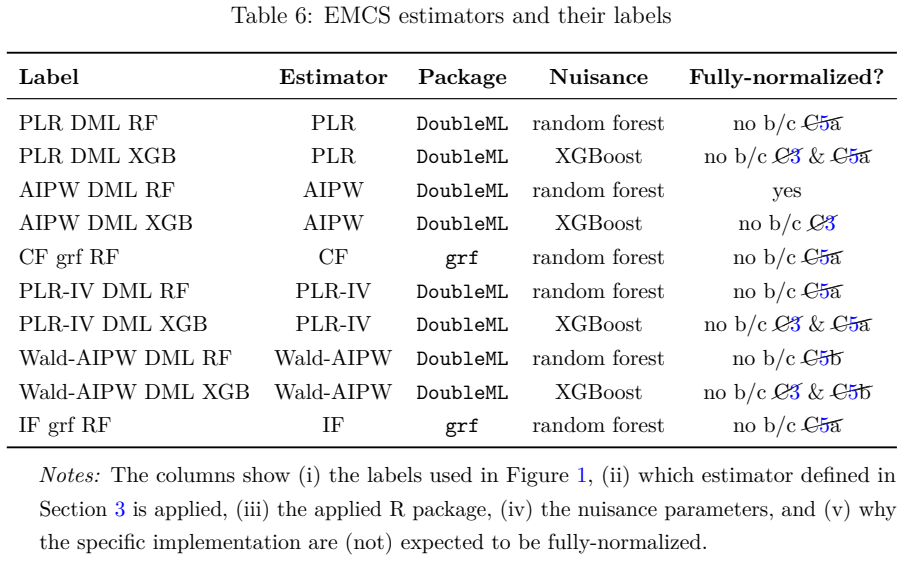
The central claim is that outcome weights of any pseudo-IV estimator have the closed form $\omega' = (\tilde{\mathbf{Z}}'\tilde{\mathbf{D}})^{-1}\tilde{\mathbf{Z}}'\mathbf{T}$, where $\tilde{\mathbf{Z}}$ and $\tilde{\mathbf{D}}$ are the pseudo-instrument and pseudo-treatment vectors and $\mathbf{T}$ is the unique matrix mapping observed outcomes $\mathbf{Y}$ into the pseudo-outcome $\tilde{\mathbf{Y}}$. Whenever such a $\mathbf{T}$ exists, the weighted representation is numerically identical to the original moment-condition estimator. In this paper's applications $\mathbf{T} = \mathbf{I}_N - \mathbf{S}$ is a generalized residual-maker built from the smoother matrix $\mathbf{S}$ whose rows contain the smoothing weights of the outcome predictor. From this identity the paper derives the first outcome weights for instrumental forest, causal forest, partially linear regression, PLR-IV, AIPW, and Wald-AIPW, and shows how Wald, TSLS, OLS, regression adjustment, IPW, difference-in-means, and Wald-RA/IPW arise as special cases. A second, related claim is that weight normalization is controlled by explicit implementation conditions: affine smoothers make the total weight sum zero, and full normalization (treated weights summing to one, untreated weights summing to minus one) additionally requires that the same smoother predicting the outcome also predicts the treatment, or, for AIPW, that treatment groups are smoothed separately. The headline diagnostic result is that standard software implementations of PLR, causal forest, instrumental forest, PLR-IV, and Wald-AIPW are scale-normalized but not fully normalized.
Load-bearing premise
The entire framework depends on the existence of a unique smoother matrix $\mathbf{S}$ such that $\mathbf{S}\mathbf{Y}$ equals the outcome predictions inside the estimator; for outcome models that are not linear smoothers of $\mathbf{Y}$—Lasso, logistic regression, or many neural networks—the closed-form outcome weights do not exist under this framework.
Editorial extensions
If this is right
- Researchers can now construct covariate-balance plots, common-support diagnostics, and extreme-weight checks for causal forests and DML estimators just as they do for classical weighting estimators.
- Outcome weights are available exactly when the outcome nuisance is estimated with a smoother; the treatment and instrument nuisance models do not affect availability.
- Under standard implementations, PLR, causal forest, instrumental forest, PLR-IV, and Wald-AIPW have scale-normalized but not fully normalized weights, so in a noiseless dataset with outcome $Y_i=1+D_i$ they will not reproduce the true effect of one exactly.
- Forcing the outcome smoother to also predict the treatment (Condition 5a or 5b) makes those estimators fully normalized, and doing so is a user-controlled implementation choice.
- AIPW with affine smoothers and group-specific outcome models is fully normalized by construction, regardless of whether the inverse-probability weights are themselves normalized.
Reading between the lines
- The shortcut conditions suggest a practical tuning criterion the paper does not pursue: among similar-performing configurations, prefer implementations whose implied weights are closer to fully normalized, which in the paper's empirical illustration aligns with hyperparameter tuning.
- Because adaptive smoothers make the outcome weights functions of the outcome itself, standard inference procedures that treat weights as fixed will not directly apply; sample-splitting the weight construction from the outcome evaluation is the natural remedy.
- Since any estimator with a linear score can be rewritten as a pseudo-IV estimator, the closed-form proposition is a template for deriving implied weights for other moment-based or machine-learning estimators beyond the fourteen considered here.
- The framework also reframes a design question for future estimators: if full normalization is desirable, one could deliberately share one affine smoother across outcome and treatment predictions and check whether finite-sample performance improves.
Signed reviews
Editorial analysis
A structured set of objections, weighed in public.
Referee Report
Summary. The paper proposes a general framework for expressing pseudo-IV estimators as linear combinations of observed outcomes. Given a pseudo-outcome vector Ỹ = T Y, any estimator that solves the moment condition E_N[(Ỹ_i − τ D̃_i) Z̃_i] = 0 has outcome weights ω' = (Z̃'D̃)^{-1} Z̃'T. The framework is applied to derive closed-form outcome weights for instrumental forests, causal forests, partially linear regression (with and without IV), AIPW, and Wald-AIPW, and it recovers known weights for OLS, TSLS, Wald, IPW, and related estimators. The paper also characterizes when the weights are scale-normalized or fully normalized, concluding that standard implementations of causal/instrumental forests and PLR-type estimators are scale-normalized but not fully normalized because the outcome smoother is not applied to the treatment. The theoretical predictions are illustrated with an empirical Monte Carlo study and a 401(k) covariate-balancing application.
Significance. If the results hold, the paper provides a practically valuable and broadly applicable toolbox: it gives the first closed-form outcome weights for six prominent DML/GRF estimators, includes an accompanying R package, and verifies the algebra with reproducible notebooks. The finding that standard DML/GRF implementations are not fully normalized is actionable for practice and complements the existing literature on implied weights. The framework is simple, the derivations are verifiable, and the empirical illustrations connect the weights to established diagnostics. The central derivation is sound conditional on a chosen smoother matrix; the main caveats concern the wording of the uniqueness condition and an internal inconsistency about whether DoubleML outcome weights can be extracted.
major comments (2)
- [Section 3.1.2, Condition 1; Section 2.3, Proposition 1] Condition 1 requires 'a unique smoother matrix' satisfying SY = Ŷ, and Proposition 1 requires a unique transformation matrix T with TY = Ỹ. As written this condition is never satisfied: for any observed Y and any fitted values Ŷ, adding to S a matrix whose rows are orthogonal to Y yields another matrix with the same action on Y. For outcome-adaptive or random smoothers, the estimation algorithm selects one such S, but different algorithms, tuning choices, or random seeds can produce identical fitted values with different smoothers and hence different outcome weights. The paper should replace 'unique' with 'the smoother matrix produced by the estimation algorithm' and state explicitly that the derived weights are implementation-specific rather than unique properties of the estimator alone. The algebraic formulas in Corollaries 1-3 remain correct for the extracted S, but Proposition 1 and the abstract's 'unique weighted representation' need revision.
- [Section 4.4 vs Section 5.1] Section 4.4 states that for DoubleML implementations 'the extraction of the outcome weights is currently not possible because the required smoother matrices are not accessible,' yet Section 5.1 presents covariate-balancing plots for DML PLR, AIPW, PLR-IV, and Wald-AIPW that use the outcome weights derived in Section 3. Please clarify how the weights used in Figure 2 were obtained, which implementation they correspond to, and reconcile the statement in Section 4.4; otherwise the advertised application appears to rely on an extraction that the paper says is impossible.
minor comments (4)
- [Equation (18)] In the definition of the Wald-AIPW pseudo-treatment D̃_i^{iv-aipw}, the second treatment residual term uses λ_i^{ipw,z,1} twice; the second occurrence should presumably be λ_i^{ipw,z,0} for symmetry with the outcome part of the expression.
- [Section 5.2] The sentence reporting 'the sum of weights ranges from 0.98 to 1.02' is ambiguous: for scale-normalized causal forest weights the overall sum is zero, so the reported quantity must be a group-specific sum after the 2D_i − 1 sign adjustment. Please state explicitly which sum is being reported.
- [Section 6] The last bullet in the closing remarks contains a duplicated phrase: 'double robustness robustness properties' should read 'double robustness properties.'
- [Figure 1 notes] The note 'The shadowed boxes in rows 1, 3 and 9 zoom into...' should refer to panels rather than rows, or should otherwise match the layout of the figure.
Circularity Check
No circular derivation: the outcome weights are solved algebraically from each estimator's own moment condition and verified against software output.
full rationale
The paper's central result, Proposition 1, defines the outcome weights of a pseudo-IV estimator as the algebraic solution of its own moment condition: omega' = (Z~'D~)^{-1} Z~' T (Eq. 6), requiring a transformation matrix T with TY = Y~. This is a rearrangement of Eq. 4, the definitional solution of the moment condition, not an input fitted to the target result. The Corollaries for instrumental forest, AIPW, and Wald-AIPW simply apply this identity to the particular T = I - S obtained from smoother matrices under Condition 1; the same algebra is also used to recover known weights for OLS, TSLS, IPW, and related estimators. The EMCS in Section 4.4 checks the theoretical classification against the actual output of DoubleML and grf, and the supplementary notebooks verify numerical equivalence, so the empirical content is a test of the algebra, not a fit. The cited prior work by the same author (Knaus 2021) is used only to note an existing special-case weight representation, and the accompanying R package (Knaus 2024) is a computational tool; neither carries the argument. Two non-circular caveats are worth recording: Condition 1's 'unique' smoother matrix is mathematically loose, since for a fixed observed outcome vector many matrices S satisfy SY = Y~, so the extracted weights are implementation- and seed-specific rather than estimator-intrinsic; and Section 4.4 states that outcome weight extraction for DoubleML is 'currently not possible' while Section 5.1 presents covariate-balancing plots based on DML outcome weights. Both are consistency or formalization concerns, not cases where the derivation reduces to its own inputs. The derivation chain is self-contained: given the estimator's PIVE representation and the actual smoother matrix, the weights are determined by construction, and no prediction is used as an input.
Assumptions & free parameters
assumptions (5)
- domain assumption There exists a unique smoother matrix S with S Y = \hat Y (and analogous S^d_d Y = \hat Y^d_d, S^z_z Y = \hat Y^z_z).
- domain assumption Rows of the smoother matrices sum to one (Condition 3, affine smoother).
- domain assumption Treatment-specific outcome models use only observations from the respective group (Condition 4).
- domain assumption The outcome smoother matrix applied to the treatment recovers the treatment prediction (Condition 5a/5b).
- standard math Inverse probability weights are normalized to sum to one within groups (Condition 6).
Cite this review
Pith. "Pith review of Treatment Effect Estimators as Weighted Outcomes." pith.science (2026). https://pith.science/paper/YY6N3WNM
@misc{pith2026241111559,
  author       = {Pith},
  title        = {Pith review of: Treatment Effect Estimators as Weighted Outcomes},
  year         = {2026},
  howpublished = {\url{https://pith.science/paper/YY6N3WNM}},
  note         = {Machine review of arXiv:2411.11559}
}
read the original abstract
Estimators that weight observed outcomes to form effect estimates have a long tradition. Their outcome weights are widely used in established procedures, such as checking covariate balance, characterizing target populations, or detecting and managing extreme weights. This paper introduces a general framework for deriving such outcome weights. It establishes when and how numerical equivalence between an original estimator representation as moment condition and a unique weighted representation can be obtained. The framework is applied to derive novel outcome weights for the six seminal instances of double machine learning and generalized random forests, while recovering existing results for other estimators as special cases. The analysis highlights that implementation choices determine (i) the availability of outcome weights and (ii) their properties. Notably, standard implementations of partially linear regression-based estimators, like causal forests, employ outcome weights that do not sum to (minus) one in the (un)treated group, not fulfilling a property often considered desirable.
Figures
Reference graph
Works this paper leans on
-
[1]
APACrefauthors \ 2003
Abadie2003SemiparametricModels APACrefauthors Abadie, A. APACrefauthors \ 2003 . Semiparametric instrumental variable estimation of treatment response models Semiparametric instrumental variable estimation of treatment response models . Journal of Econometrics 113 2 231--263
2003
-
[2]
Abadie2021UsingAspects APACrefauthors Abadie, A. APACrefauthors \ 2021 . Using synthetic controls: Feasibility, data requirements, and methodological aspects Using synthetic controls: Feasibility, data requirements, and methodological aspects . Journal of Economic Literature 59 2 391--425
work page 2021
-
[3]
Abadie2018EconometricEvaluation APACrefauthors Abadie, A. \ Cattaneo, M D. APACrefauthors \ 2018 . Econometric methods for program evaluation Econometric methods for program evaluation . Annual Review of Economics 10 465--503
work page 2018
-
[4]
Angrist1998EstimatingApplicants APACrefauthors Angrist, J D. APACrefauthors \ 1998 . Estimating the labor market impact of voluntary military service using social security data on military applicants Estimating the labor market impact of voluntary military service using social security data on military applicants . Econometrica 66 2 249--288
work page 1998
-
[5]
Angrist1995Two-stageIntensity APACrefauthors Angrist, J D. \ Imbens, G W. APACrefauthors \ 1995 . Two-stage least squares estimation of average causal effects in models with variable treatment intensity Two-stage least squares estimation of average causal effects in models with variable treatment intensity . Journal of the American Statistical Association...
work page 1995
-
[6]
Angrist1996IdentificationVariables APACrefauthors Angrist, J D. , Imbens, G W. \ Rubin, D B. APACrefauthors \ 1996 . Identification of Causal Effects Using Instrumental Variables Identification of Causal Effects Using Instrumental Variables . Journal of the American Statistical Association 91 434 444--455
work page 1996
-
[7]
Angrist1999EmpiricalEconomics APACrefauthors Angrist, J D. \ Krueger, A B. APACrefauthors \ 1999 . Empirical strategies in labor economics Empirical strategies in labor economics . O C. Ashenfelter\ D. Card\ ( ), Handbook of labor economics Handbook of labor economics \ ( 3A, \ 1277--1366). Elsevier
work page 1999
-
[8]
Armstrong2021Finite-sampleUnconfoundedness APACrefauthors Armstrong, T B. \ Koles \' a r, M. APACrefauthors \ 2021 . Finite-sample optimal estimation and inference on average treatment effects under unconfoundedness Finite-sample optimal estimation and inference on average treatment effects under unconfoundedness . Econometrica 89 3 1141--1177
work page 2021
Show all 81 references
-
[9]
\ Samii, C
Aronow2016DoesEffects APACrefauthors Aronow, P M. \ Samii, C. APACrefauthors \ 2016 . Does Regression Produce Representative Estimates of Causal Effects? Does Regression Produce Representative Estimates of Causal Effects? American Journal of Political Science 60 1 250--267
2016
-
[10]
\ Imbens, G W
Athey2017 APACrefauthors Athey, S. \ Imbens, G W. APACrefauthors \ 2017 . The state of applied econometrics: causality and policy evaluation The state of applied econometrics: causality and policy evaluation . Journal of Economic Perspectives 31 2 3--32
2017
-
[11]
, Tibshirani, J
Athey2017a APACrefauthors Athey, S. , Tibshirani, J. \ Wager, S. APACrefauthors \ 2019 . Generalized random forests Generalized random forests . Annals of Statistics 47 2 1148 - 1178
2019
-
[12]
\ Wager, S
Athey2019EstimatingApplication APACrefauthors Athey, S. \ Wager, S. APACrefauthors \ 2019 . Estimating treatment effects with causal forests: An application Estimating treatment effects with causal forests: An application . Observational Studies 5 2 37--51
2019
-
[13]
, Kurz, M S
Bach2024DoubleML:R APACrefauthors Bach, P. , Kurz, M S. , Chernozhukov, V. , Spindler, M. \ Klaassen, S. APACrefauthors \ 2024 . DoubleML: An object-oriented implementation of double machine learning in R DoubleML: An object-oriented implementation of double machine learning i...
2024
-
[14]
, Feller, A
Ben-Michael2021TheInference APACrefauthors Ben-Michael, E. , Feller, A. , Hirshberg, D A. \ Zubizarreta, J R. APACrefauthors \ 2021 10 . The balancing act in causal inference . The balancing act in causal inference . APACrefURL http://arxiv.org/abs/2110.14831 APACrefURL
2021 arXiv
-
[15]
, Bonney, J
Blandhol2022WhenLate APACrefauthors Blandhol, C. , Bonney, J. , Mogstad, M. \ Torgovitsky, A. APACrefauthors \ 2022 . When is Tsls Actually Late? When is Tsls Actually Late? SSRN Electronic Journal . APACrefDOI doi:10.2139/ssrn.4021804 APACrefDOI
2022 doi
-
[16]
, Bolwin, L
Breitung2024AlternativeDesigns APACrefauthors Breitung, J. , Bolwin, L. \ T \" o ns, J. APACrefauthors \ 2024 . Alternative approaches for estimation and inference in synthetic control designs . Alternative approaches for estimation and inference in synthetic control designs
2024
-
[17]
, Dukes, O
Bruns-Smith2023AugmentedRegression APACrefauthors Bruns-Smith, D. , Dukes, O. , Feller, A. \ Ogburn, E L. APACrefauthors \ 2023 4 . Augmented balancing weights as linear regression . Augmented balancing weights as linear regression . APACrefURL http://arxiv.org/abs/2304.14545 ...
2023 arXiv
-
[18]
, Hastie, T
Buja1989LinearModels APACrefauthors Buja, A. , Hastie, T. \ Tibshirani, R. APACrefauthors \ 1989 . Linear smoothers and additive models Linear smoothers and additive models . The Annals of Statistics 17 2 453--510
1989
-
[19]
, DiNardo, J
busso2014new APACrefauthors Busso, M. , DiNardo, J. \ McCrary, J. APACrefauthors \ 2014 . New evidence on the finite sample properties of propensity score reweighting and matching estimators New evidence on the finite sample properties of propensity score reweighting and match...
2014
-
[20]
\ Zubizarreta, J R
Chattopadhyay2021OnInference APACrefauthors Chattopadhyay, A. \ Zubizarreta, J R. APACrefauthors \ 2021 4 . On the implied weights of linear regression for causal inference . On the implied weights of linear regression for causal inference . APACrefURL http://arxiv.org/abs/210...
2021 arXiv
-
[21]
\ Zubizarreta, J R
Chattopadhyay2023OnInference APACrefauthors Chattopadhyay, A. \ Zubizarreta, J R. APACrefauthors \ 2023 . On the implied weights of linear regression for causal inference On the implied weights of linear regression for causal inference . Biometrika 110 3 615--629
2023
-
[22]
, Chetverikov, D
Chernozhukov2018 APACrefauthors Chernozhukov, V. , Chetverikov, D. , Demirer, M. , Duflo, E. , Hansen, C. , Newey, W. \ Robins, J. APACrefauthors \ 2018 . Double/Debiased machine learning for treatment and structural parameters Double/Debiased machine learning for treatment an...
2018
-
[23]
, Fern \' a ndez-Val, I
Chernozhukov2013AverageModels APACrefauthors Chernozhukov, V. , Fern \' a ndez-Val, I. , Hahn, J. \ Newey, W. APACrefauthors \ 2013 . Average and Quantile Effects in Nonseparable Panel Models Average and Quantile Effects in Nonseparable Panel Models . Econometrica 81 2 535--580
2013
-
[24]
, Hansen, C
Chernozhukov2024AppliedAI APACrefauthors Chernozhukov, V. , Hansen, C. , Kallus, N. , Spindler, M. \ Syrgkanis, V. APACrefauthors \ 2024 . Applied Causal Inference Powered by ML and AI Applied Causal Inference Powered by ML and AI . forthcoming
2024
-
[25]
, Hansen, C
Chernozhukov2016High-DimensionalR APACrefauthors Chernozhukov, V. , Hansen, C. \ Spindler, M. APACrefauthors \ 2016 . High-Dimensional Metrics in R . High-Dimensional Metrics in R . APACrefURL http://arxiv.org/abs/1603.01700 APACrefURL
2016 arXiv
-
[26]
, Jeffares, A
Curth2023ALearning APACrefauthors Curth, A. , Jeffares, A. \ van der Schaar, M. APACrefauthors \ 2023 11 . A U-turn on double descent: Rethinking parameter counting in statistical learning A U-turn on double descent: Rethinking parameter counting in statistical learning . Thir...
2023
-
[27]
, Jeffares, A
Curth2024WhySmoothers APACrefauthors Curth, A. , Jeffares, A. \ van der Schaar, M. APACrefauthors \ 2024 . Why do random forests work? Understanding tree ensembles as self-regularizing adaptive smoothers . Why do random forests work? Understanding tree ensembles as self-regula...
2024 arXiv
-
[28]
\ D'Haultf uille, X
deChaisemartin2023Two-waySurvey APACrefauthors de Chaisemartin, C. \ D'Haultf uille, X. APACrefauthors \ 2023 9 . Two-way fixed effects and differences-in-differences with heterogeneous treatment effects: a survey Two-way fixed effects and differences-in-differences with heter...
2023
-
[29]
\ Imbens, G W
Doudchenko2016BalancingSynthesis APACrefauthors Doudchenko, N. \ Imbens, G W. APACrefauthors \ 2016 . Balancing, regression, difference-in-differences and synthetic control methods: A synthesis . Balancing, regression, difference-in-differences and synthetic control methods: A...
2016 arXiv
-
[30]
, Hull, P
Goldsmith-Pinkham2021ContaminationRegressions APACrefauthors Goldsmith-Pinkham, P. , Hull, P. \ Koles \' a r, M. APACrefauthors \ 2021 . Contamination bias in linear regressions . Contamination bias in linear regressions . APACrefURL http://arxiv.org/abs/2106.05024 APACrefURL
2021 arXiv
-
[31]
, Pinto, C C d X
Graham2012InverseData APACrefauthors Graham, B S. , Pinto, C C d X. \ Egel, D. APACrefauthors \ 2012 7 . Inverse probability tilting for moment condition models with missing data Inverse probability tilting for moment condition models with missing data . Review of Economic Stu...
2012
-
[32]
APACrefauthors \ 2024
Greifer2024Cobalt:Plots APACrefauthors Greifer, N. APACrefauthors \ 2024 . cobalt: Covariate Balance Tables and Plots . cobalt: Covariate Balance Tables and Plots . R package version 4.5.5.9000 . APACrefURL https://github.com/ngreifer/cobalt APACrefURL
2024
-
[33]
APACrefauthors \ 2012
Hainmueller2012EntropyStudies APACrefauthors Hainmueller, J. APACrefauthors \ 2012 . Entropy balancing for causal effects: A multivariate reweighting method to produce balanced samples in observational studies Entropy balancing for causal effects: A multivariate reweighting me...
2012
-
[34]
An essay on the logical foundations of survey sampling, part one
Hajek1971CommentOne APACrefauthors H \' a jek, J. APACrefauthors \ 1971 . Comment on “An essay on the logical foundations of survey sampling, part one” Comment on “An essay on the logical foundations of survey sampling, part one” . V P. Godambe\ D A. Sprott\ ( ), Foundations o...
1971
-
[35]
\ Tibshirani, R
Hastie1990GeneralizedModels APACrefauthors Hastie, T. \ Tibshirani, R. APACrefauthors \ 1990 . Generalized additive models Generalized additive models . Monographs on Statistics and Applied Probability 43
1990
-
[36]
weights of regression
Hazlett2024UnderstandingSolutions APACrefauthors Hazlett, C. \ Shinkre, T. APACrefauthors \ 2024 . Understanding and avoiding the "weights of regression": Heterogeneous effects, misspecification, and longstanding solutions . Understanding and avoiding the "weights of regressio...
2024 arXiv
-
[37]
\ Vytlacil, E
Heckman2005StructuralEvaluation APACrefauthors Heckman, J J. \ Vytlacil, E. APACrefauthors \ 2005 . Structural equations, treatment effects, and econometric policy evaluation Structural equations, treatment effects, and econometric policy evaluation . Econometrica 73 3 669--738
2005
-
[38]
APACrefauthors \ 2022
Heiler2022EfficientEffect APACrefauthors Heiler, P. APACrefauthors \ 2022 . Efficient covariate balancing for the local average treatment effect Efficient covariate balancing for the local average treatment effect . Journal of Business and Economic Statistics 40 4 1569--1582
2022
-
[39]
\ Thompson, D J
Horvitz1952 APACrefauthors Horvitz, D G. \ Thompson, D J. APACrefauthors \ 1952 . A generalization of sampling without replacement from a finite universe A generalization of sampling without replacement from a finite universe . Journal of the American statistical Association 4...
1952
-
[40]
, Lechner, M
Huber2013 APACrefauthors Huber, M. , Lechner, M. \ Wunsch, C. APACrefauthors \ 2013 . The performance of estimators based on the propensity score The performance of estimators based on the propensity score . Journal of Econometrics 175 1 1--21
2013
-
[41]
APACrefauthors \ 2009
Humphreys2009BoundsProbabilities APACrefauthors Humphreys, M. APACrefauthors \ 2009 . Bounds on least squares estimates of causal effects in the presence of heterogeneous assignment probabilities . Bounds on least squares estimates of causal effects in the presence of heteroge...
2009
-
[42]
\ Ratkovic, M
Imai2014CovariateScore APACrefauthors Imai, K. \ Ratkovic, M. APACrefauthors \ 2014 . Covariate balancing propensity score Covariate balancing propensity score . Journal of the Royal Statistical Society: Series B 76 1 243--263
2014
-
[43]
APACrefauthors \ 2004
Imbens2004NonparametricReview APACrefauthors Imbens, G W. APACrefauthors \ 2004 . Nonparametric estimation of average treatment effects under exogeneity: A review Nonparametric estimation of average treatment effects under exogeneity: A review . Review of Economics and Statist...
2004
-
[44]
APACrefauthors \ 2015
Imbens2015MatchingExamples APACrefauthors Imbens, G W. APACrefauthors \ 2015 . Matching methods in practice: Three examples Matching methods in practice: Three examples . Journal of Human Resources 50 2 373--419 . APACrefDOI doi:10.3368/jhr.50.2.373 APACrefDOI
2015 doi
-
[45]
APACrefauthors \ 2024
Imbens2024CausalSciences APACrefauthors Imbens, G W. APACrefauthors \ 2024 . Causal Inference in the Social Sciences Causal Inference in the Social Sciences . Annual Review of Statistics and Its Application 11 123--152
2024
-
[46]
\ Angrist, J D
Imbens1994IdentificationEffects APACrefauthors Imbens, G W. \ Angrist, J D. APACrefauthors \ 1994 . Identification and estimation of local average treatment effects Identification and estimation of local average treatment effects . Econometrica 62 2 467--475
1994
-
[47]
\ Rubin, D B
Imbens1997EstimatingModels APACrefauthors Imbens, G W. \ Rubin, D B. APACrefauthors \ 1997 . Estimating Outcome Distributions for Compliers in Instrumental Variables Models Estimating Outcome Distributions for Compliers in Instrumental Variables Models . Review of Economic Stu...
1997
-
[48]
\ Rubin, D B
Imbens2015CausalSciences APACrefauthors Imbens, G W. \ Rubin, D B. APACrefauthors \ 2015 . Causal inference in statistics, social, and biomedical sciences Causal inference in statistics, social, and biomedical sciences . Cambridge University Press
2015
-
[49]
\ Wooldridge, J M
Imbens2009 APACrefauthors Imbens, G W. \ Wooldridge, J M. APACrefauthors \ 2009 . Recent developments in the econometrics of program evaluation Recent developments in the econometrics of program evaluation . Journal of Economic Literature 47 1 5--86
2009
-
[50]
APACrefauthors \ 2021 3
Jakiela2021SimpleEffects APACrefauthors Jakiela, P. APACrefauthors \ 2021 3 . Simple diagnostics for two-way fixed effects . Simple diagnostics for two-way fixed effects . APACrefURL https://arxiv.org/abs/2103.13229v1 APACrefURL
2021 arXiv
-
[51]
APACrefauthors \ 2020
Kallus2020GeneralizedInference APACrefauthors Kallus, N. APACrefauthors \ 2020 . Generalized optimal matching methods for causal inference Generalized optimal matching methods for causal inference . Journal of Machine Learning Research 21 62 1--54
2020
-
[52]
\ Ugander, J
Khan2023AdaptiveEstimation APACrefauthors Khan, S. \ Ugander, J. APACrefauthors \ 2023 1 . Adaptive normalization for IPW estimation Adaptive normalization for IPW estimation . Journal of Causal Inference 11 1
2023
-
[53]
APACrefauthors \ 2011
Kline2011Oaxaca-BlinderEstimator APACrefauthors Kline, P. APACrefauthors \ 2011 . Oaxaca-Blinder as a reweighting estimator Oaxaca-Blinder as a reweighting estimator . American Economic Review 101 3 532--537
2011
-
[54]
APACrefauthors \ 2021
Knaus2021ASkills APACrefauthors Knaus, M C. APACrefauthors \ 2021 . A double machine learning approach to estimate the effects of musical practice on student’s skills A double machine learning approach to estimate the effects of musical practice on student’s skills . Journal o...
2021
-
[55]
APACrefauthors \ 2024
Knaus2024OutcomeWeights APACrefauthors Knaus, M C. APACrefauthors \ 2024 . OutcomeWeights . OutcomeWeights . R package version 0.1.0 . APACrefURL https://cran.r-project.org/web/packages/OutcomeWeights/index.html APACrefURL
2024
-
[56]
APACrefauthors \ 2018
Lechner2018 APACrefauthors Lechner, M. APACrefauthors \ 2018 . Modified causal forests for estimating heterogeneous causal effects Modified causal forests for estimating heterogeneous causal effects . arXiv:1812.09487 . APACrefURL https://arxiv.org/abs/1812.09487 APACrefURL
2018 arXiv
-
[57]
\ Strittmatter, A
Lechner2019PracticalEstimation APACrefauthors Lechner, M. \ Strittmatter, A. APACrefauthors \ 2019 4 . Practical procedures to deal with common support problems in matching estimation Practical procedures to deal with common support problems in matching estimation . Econometri...
2019
-
[58]
\ Lemieux, T
Lee2010RegressionEconomics APACrefauthors Lee, D S. \ Lemieux, T. APACrefauthors \ 2010 . Regression discontinuity designs in economics Regression discontinuity designs in economics . Journal of Economic Literature 20 1 281--355
2010
-
[59]
\ Han, F
Lin2022OnEffect APACrefauthors Lin, Z. \ Han, F. APACrefauthors \ 2022 12 . On regression-adjusted imputation estimators of the average treatment effect . On regression-adjusted imputation estimators of the average treatment effect . APACrefURL https://arxiv.org/abs/2212.05424...
2022 arXiv
-
[60]
\ Rotnitzky, A
Robins1995SemiparametricData APACrefauthors Robins, J M. \ Rotnitzky, A. APACrefauthors \ 1995 . Semiparametric efficiency in multivariate regression models with missing data Semiparametric efficiency in multivariate regression models with missing data . Journal of the America...
1995
-
[61]
, Rotnitzky, A
Robins1994 APACrefauthors Robins, J M. , Rotnitzky, A. \ Zhao, L P. APACrefauthors \ 1994 . Estimation of regression coefficients when some regressors are not always observed Estimation of regression coefficients when some regressors are not always observed . Journal of the Am...
1994
-
[62]
, Rotnitzky, A
Robins1995AnalysisData APACrefauthors Robins, J M. , Rotnitzky, A. \ Zhao, L P. APACrefauthors \ 1995 . Analysis of semiparametric regression models for repeated outcomes in the presence of missing data Analysis of semiparametric regression models for repeated outcomes in the ...
1995
-
[63]
APACrefauthors \ 1988
Robinson1988Root-n-consistentRegression APACrefauthors Robinson, P M. APACrefauthors \ 1988 . Root-n-consistent semiparametric regression Root-n-consistent semiparametric regression . Econometrica 56 4 931
1988
-
[64]
\ Rubin, D B
Rosenbaum1984ReducingScore APACrefauthors Rosenbaum, P R. \ Rubin, D B. APACrefauthors \ 1984 . Reducing bias in observational studies using subclassification on the propensity score Reducing bias in observational studies using subclassification on the propensity score . Journ...
1984
-
[65]
\ Rubin, D B
Rosenbaum1985ConstructingScore APACrefauthors Rosenbaum, P R. \ Rubin, D B. APACrefauthors \ 1985 2 . Constructing a control group using multivariate matched sampling methods that incorporate the propensity score Constructing a control group using multivariate matched sampling...
1985
-
[66]
, Sant'Anna, P H
Roth2023WhatsLiterature APACrefauthors Roth, J. , Sant'Anna, P H. , Bilinski, A. \ Poe, J. APACrefauthors \ 2023 8 . What's trending in difference-in-differences? A synthesis of the recent econometrics literature What's trending in difference-in-differences? A synthesis of the...
2023
-
[67]
, Robins, J M
Rotnitzky1998SemiparametricNonresponse APACrefauthors Rotnitzky, A. , Robins, J M. \ Scharfstein, D O. APACrefauthors \ 1998 12 . Semiparametric regression for repeated outcomes with nonignorable nonresponse Semiparametric regression for repeated outcomes with nonignorable non...
1998
-
[68]
APACrefauthors \ 2007 1
Rubin2007TheTrials APACrefauthors Rubin, D B. APACrefauthors \ 2007 1 . The design versus the analysis of observational studies for causal effects: Parallels with the design of randomized trials The design versus the analysis of observational studies for causal effects: Parall...
2007
-
[69]
APACrefauthors \ 2020 11
Soczynski2020WhenLATEb APACrefauthors S oczy \' n ski, T. APACrefauthors \ 2020 11 . When should we (not) interpret linear IV estimands as LATE? When should we (not) interpret linear IV estimands as LATE? APACrefURL http://arxiv.org/abs/2011.06695 APACrefURL
2020 arXiv
-
[70]
APACrefauthors \ 2022
Soczynski2022InterpretingWeights APACrefauthors S oczy \' n ski, T. APACrefauthors \ 2022 . Interpreting OLS estimands when treatment effects are heterogeneous: Smaller groups get larger weights Interpreting OLS estimands when treatment effects are heterogeneous: Smaller group...
2022
-
[71]
, Uysal, S D
Soczynski2023CovariateEffects APACrefauthors S oczy \' n ski, T. , Uysal, S D. \ Wooldridge, J M. APACrefauthors \ 2023 . Covariate balancing and the equivalence of weighting and doubly robust estimators of average treatment effects . Covariate balancing and the equivalence of...
2023
-
[72]
, Uysal, S D
Soczynski2024AbadiesEffect APACrefauthors S oczy \' n ski, T. , Uysal, S D. \ Wooldridge, J M. APACrefauthors \ 2024 . Abadie's Kappa and Weighting Estimators of the Local Average Treatment Effect Abadie's Kappa and Weighting Estimators of the Local Average Treatment Effect . ...
2024
-
[73]
\ Todd, P E
Smith2005DoesEstimators APACrefauthors Smith, J A. \ Todd, P E. APACrefauthors \ 2005 3 . Does matching overcome LaLonde's critique of nonexperimental estimators? Does matching overcome LaLonde's critique of nonexperimental estimators? Journal of Econometrics 125 1-2 305--353
2005
-
[74]
APACrefauthors \ 1977
Stone1977ConsistentRegression APACrefauthors Stone, C J. APACrefauthors \ 1977 . Consistent nonparametric regression Consistent nonparametric regression . Annals of Statistics 5 4 595--620
1977
-
[75]
APACrefauthors \ 2006 12
Tan2006RegressionVariables APACrefauthors Tan, Z. APACrefauthors \ 2006 12 . Regression and weighting methods for causal inference using instrumental variables Regression and weighting methods for causal inference using instrumental variables . Journal of the American Statisti...
2006
-
[76]
, Athey, S
Tibshirani2024Grf:Forests APACrefauthors Tibshirani, J. , Athey, S. , Sverdrup, E. \ Wager, S. APACrefauthors \ 2024 . grf: Generalized Random Forests . grf: Generalized Random Forests
2024
-
[77]
APACrefauthors \ 2011
Uysal2011ThreeMethods APACrefauthors Uysal, D. APACrefauthors \ 2011 . Three Essays on Doubly Robust Estimation Methods Three Essays on Doubly Robust Estimation Methods . PhD Dissertation, University of Konstanz
2011
-
[78]
APACrefauthors \ 1940
Wald1940TheError APACrefauthors Wald, A. APACrefauthors \ 1940 . The fitting of straight lines if both variables are subject to error The fitting of straight lines if both variables are subject to error . The Annals of Mathematical Statistics 11 3 284--300
1940
-
[79]
, Jung, K
Wendling2018 APACrefauthors Wendling, T. , Jung, K. , Callahan, A. , Schuler, A. , Shah, N H. \ Gallego, B. APACrefauthors \ 2018 . Comparing methods for estimation of heterogeneous treatment effects using observational data from health care databases Comparing methods for est...
2018
-
[80]
APACrefauthors \ 2019 4
Zhao2019CovariateFunctions APACrefauthors Zhao, Q. APACrefauthors \ 2019 4 . Covariate balancing propensity score by tailored loss functions Covariate balancing propensity score by tailored loss functions . Annals of Statistics 47 2 965--993
2019
-
[81]
APACrefauthors \ 2015 7
Zubizarreta2015StableData APACrefauthors Zubizarreta, J R. APACrefauthors \ 2015 7 . Stable weights that balance covariates for estimation with incomplete outcome data Stable weights that balance covariates for estimation with incomplete outcome data . Journal of the American ...
2015
Reviewed August 12, 2026 · model on record in the stance chip above.
Discussion (0). Continue with ORCID to comment.