REVIEW 2 major objections 6 minor 7 references
Topology in 2D non-Abelian Lattice Gauge Theories
T0 review · 2 major / 6 minor · reviewed 2026-08-12 · deepseek-v4-flash
Pith's one-line read This paper constructs explicit q-instanton configurations in 2D U(2) lattice gauge theory and argues they are the global action minima in their topological sectors.
desk verdict Explicit U(2) instanton configurations that saturate the action bound, with one unproved but true inequality as the load-bearing step; a solid proceedings paper after a minor revision. read the letter →
The pith
A machine-rendered reading of the paper's core claim, the machinery that carries it, and where it could break.
The reading
What carries the argument
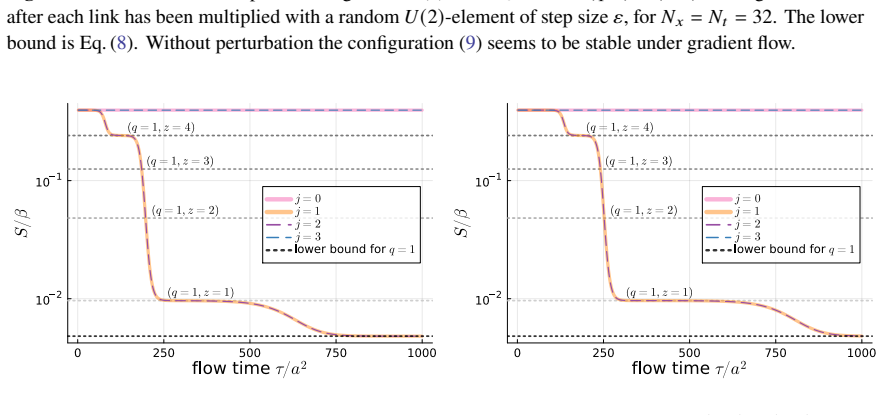
The construction is based on the 2D $U(1)$ instanton of Eq. (6), a set of links whose phases wind once around the torus, with extra $SU(2)$-valued defect factors inserted on the last $x$- and $t$-slices. The vectors $\vec u,\vec v\in\mathbb R^3$ and their orthogonality or parallel constraints are the mechanism that cancels the $\mathbb Z_2$ ambiguity left by taking the square root of the $U(1)$ phase, so that the corner plaquette matches all others. The result is a configuration whose untraced plaquette is the same group element everywhere, hence uniform action density, which the paper identifies as the requirement for a local action minimum in two dimensions. Gradient flow serves as the test: the excess action above Eq. (8) decays to zero as flow time increases, connecting the constructed solutions to thermalized configurations.
What would settle it
Test the bound directly on a small lattice: minimize the Wilson action over $U(2)$ link configurations with fixed topological charge, say $q=1$ on a $4\times4$ or $8\times8$ lattice, using simulated annealing or many random gradient-flow starts. Any configuration whose action falls strictly below $N_x N_t (1 - \cos(\pi q/(N_x N_t)))$ disproves the central claim; a proof of the inequality for all $q$ and all lattice sizes would confirm it.
Extended reading notes
Core claim
The central claim is that Eq. (7) gives exact $q$-instanton configurations in 2D $U(2)$ lattice gauge theory: for any integer $q$, take horizontal links $e^{-i t \pi q/(N_x N_t)}$ with an extra $SU(2)$ factor $\exp(i\vec u\cdot\vec\sigma)$ on the last $x$-slice, and vertical links $e^{i x \pi q/N_x}$ with $\exp(i\vec v\cdot\vec\sigma)$ on the last $t$-slice; require $\vec u\perp\vec v$ and $|\vec u|=|\vec v|=\pi/2$ for odd $q$, or $\vec u\parallel\vec v$ for even $q$. With these constraints every untraced plaquette takes the same value $e^{i\pi q/(N_x N_t)}$, so the action density is exactly uniform. The paper asserts the resulting action $S/\beta = N_x N_t(1-\cos(\pi q/(N_x N_t)))$ is the lower bound for charge $q$, and it uses gradient flow to show thermalized configurations evolve toward these solutions. The 'special configurations' of Eq. (9) have uniform action density for all $N_c$ but only match the instanton action for $N_c=2$ when $q$ is a multiple of 2; for other $q$ a single-link perturbation in certain color directions makes them flow down to the true sector minimum.
Load-bearing premise
The construction's status as the sector minimum rests on the unproved inequality that every $U(2)$ lattice configuration with topological charge $q$ has Wilson action at least $N_x N_t (1 - \cos(\pi q/(N_x N_t)))$; if that bound fails, the configurations of Eq. (7) may exist but would not be the minimal-action fields in their sector.
Editorial extensions
If this is right
- Gradient flow in a fixed topological sector ends at a gauge-transformed copy of the explicit configuration (7), so the low-action part of each sector has a single known attractor rather than an unknown landscape.
- The action formula (8) supplies an analytic value for the minimum action in each sector, so the gap between neighboring sectors gives a lower bound on the barrier height relevant to topological freezing.
- For $N_c=2$, the 'special configurations' (9) include the true instantons only for even $q$; a tiny single-link perturbation in the $\sigma_1$ or $\sigma_2$ color direction makes gradient flow descend from a special configuration to the sector minimum.
- The instantons constructed here have uniform action density, unlike instantons in four dimensions where the density is localized; this is a direct property of the solutions themselves.
Reading between the lines
- If the lower bound (8) is a genuine inequality, it likely comes from a topological identity, a lattice analogue of a Bogomol'nyi bound; finding a sum-of-positive-terms proof would simultaneously establish the claim and suggest how the construction generalizes to $N_c\ge3$.
- The plateaus seen when a single link is perturbed suggest the special configurations are saddle points or quasi-stationary states that organize the flow toward the sector minimum; mapping their basin structure could turn topological freezing into a rare-event problem with known transition states.
- A natural numerical test beyond the paper: measure the flow time needed to reach Eq. (7) from thermalized configurations as the lattice spacing shrinks; if it diverges, the 'trivialization' within a sector is only practical at finite lattice spacing.
Editorial analysis
A structured set of objections, weighed in public.
Referee Report
Summary. The manuscript investigates topological sectors in two-dimensional U(N_c) lattice gauge theory on a torus, with N_c=2 as the main case. After comparing Monte Carlo data for the average plaquette and topological susceptibility with analytic formulas from refs. [4,5], it constructs explicit link configurations (7) whose plaquettes are all equal to exp(i pi q/(N_x N_t)) times the identity, and asserts that these configurations saturate the action lower bound (8). It also introduces a one-parameter family of uniform-action 'special configurations' (9) and studies their behavior under gradient flow, concluding that they flow to the sector minimum when perturbed in certain color directions. The central claim is that (7) are exact q-instantons for 2D U(2) lattice gauge theory.
Significance. The explicit construction (7) is elegant and potentially useful for understanding topological freezing and for benchmarking algorithms. Its uniform action density and exact saturation of the conjectured lower bound are striking. The paper is also honest in its numerical comparisons: the analytic formulas (4)-(5) come from the literature and no parameter is fitted to produce the central claim. The gradient-flow studies in Secs. 3-4 are exploratory and are largely framed as such. If the inequality (8) is supplied with a proof, the main result is sound and would be a useful contribution to the lattice-topology literature.
major comments (2)
- [Sec. 2, Eq. (8)] The lower bound S/beta >= N_x N_t (1 - cos(pi q/(N_x N_t))) is stated without proof or citation, and the conclusion in Sec. 5 that (7) are exact q-instantons, i.e., global minima of the Wilson action in their topological sector, rests entirely on this inequality. Without it, (7) would only be a homogeneous low-action configuration. The bound is in fact true (for example, by writing each plaquette as e^{i delta_n} times an SU(2) part, bounding Re Tr(1-U_box) below by 2(1-cos(delta_n/2)), and using convexity), but the manuscript should provide this derivation or a precise reference. Please add it before the paper claims minimality.
- [Sec. 2, around Eq. (7)] The statement that 'each untraced plaquette takes the same value e^{i pi q/(N_x N_t)}' is asserted but not demonstrated. In particular, the corner plaquette at (x,t)=(N_x,N_t) contains the product of the two SU(2) dressing factors and a U(1) phase e^{-i pi q}; the cancellation for odd q relies on the u perpendicular v constraint with |u|=|v|=pi/2. A short explicit computation of the corner plaquette would make the construction self-contained and remove any doubt about the claimed uniform action density.
minor comments (6)
- [Eqs. (6)-(7)] The Kronecker deltas are typeset ambiguously (e.g., 'delta_{t, N_t}' appears as '𝛿𝑡, 𝑁𝑡'); please use delta_{t,N_t} and delta_{x,N_x} throughout.
- [Eq. (4)] The phrase 'withthe2Dconvention' should read 'with the 2D convention'; there are several missing spaces in the extracted text, so a careful proofread of the final PDF is needed.
- [Sec. 2, bullet after Eq. (7)] For even q, 'require only u parallel v' leaves the magnitudes of u and v unspecified; the following paragraph states they may be chosen freely, but the bullet should say so explicitly.
- [Abstract] 'With the help of gradient flow we derive instanton-like solutions' is misleading, since (7) is constructed analytically; gradient flow is used only as a check.
- [Sec. 3, after Eq. (9)] The first use of z should state z in Z explicitly, since the range matters for the 'infinite tower' statement.
- [Eq. (6)] The label S^{SU(1)}_{inst} is odd because the gauge group is U(1); rename to S^{U(1)}_{inst}.
Circularity Check
No circular derivation: the instanton construction and Monte Carlo comparisons are self-contained and externally anchored, with the unproved action bound being a missing proof rather than a circular input.
full rationale
The paper's central new result is the explicit construction (7) of q-instanton configurations for 2D U(2) lattice gauge theory. This construction is derived directly from the definitions of the topological charge (1), the plaquette (2), and the Wilson action (3), and it is verified by direct computation: every untraced plaquette of (7) equals exp(i π q/(N_x N_t)), so the action (8) follows by substitution. No parameter is fitted to the Monte Carlo data to produce this construction; the data in Table 1 and Fig. 1 are compared with, not used to fit, the external analytic formulas (4)-(5) from Refs. [4,5]. The gradient-flow tests in Figs. 3, 5, and 6 compare thermalized or perturbed configurations against the explicit action formula (8) and do not supply the minimized quantity as an input. The only potentially load-bearing step is the inequality stated as the lower bound (8), which is asserted without derivation and is used to justify that (7) is globally minimal in its charge sector rather than merely low-action. This is a gap in proof, not circularity: the bound is not fitted to data, is not imported from the same authors' prior work, and is not defined in terms of the target configurations. It is an independent mathematical claim that could be proven by a convexity argument, so its absence affects rigor but not the circularity status of the derivation. The paper also honestly reports open questions, including whether the special configurations (9) are local minima, and does not disguise these as established results. There is no self-citation load-bearing chain, no renaming of known results as new organization, and no fitted input relabeled as a prediction. Accordingly, no significant circularity is present, and the appropriate score is 0.
Assumptions & free parameters
free parameters (1)
- SU(2) dressing vectors u, v in Eq. (7) for even q
assumptions (3)
- domain assumption Wilson action lower bound Eq. (8) for fixed topological charge q
- standard math Integer-valuedness of the topological charge definition (1)
- domain assumption Gauge equivalence of all odd-q instanton choices in (7)
Cite this review
Pith. "Pith review of Topology in 2D non-Abelian Lattice Gauge Theories." pith.science (2026). https://pith.science/paper/J36W7DL6
@misc{pith2026241111593,
  author       = {Pith},
  title        = {Pith review of: Topology in 2D non-Abelian Lattice Gauge Theories},
  year         = {2026},
  howpublished = {\url{https://pith.science/paper/J36W7DL6}},
  note         = {Machine review of arXiv:2411.11593}
}
abstract
In two dimensions, $U(N_c)$ gauge theories exhibit a non-trivial topological structure, while $SU(N_c)$ theories are topologically trivial. Hence, for $G = U(N_c)$ the phase space is divided into topological sectors, characterized by a topological index (a.k.a. ``topological charge''). These sectors are separated by action barriers, which diverge if the lattice spacing is taken small, resulting in an algorithmic problem known as ``topological freezing''. We study these theories in various box sizes and at various couplings. With the help of gradient flow we derive instanton-like solutions for 2D $U(N_c)$ theory with a specific focus on the case of $N_c = 2$.
Figures


Figures from the paper (4 more)



Reference graph
Works this paper leans on
-
[1]
M. Baig and J. Colet,Monte Carlo Analysis of the SU(2) x U(1) and U(2) Lattice Gauge Theories at Different Space-time Dimensionalities, Phys. Lett. B176, 149-152 (1986)
work page 1986
-
[2]
On the U(2) Lattice Gauge Theory
C. Roiesnel,On the U(2) lattice gauge theory, [arXiv:hep-lat/9509092 [hep-lat]]
-
[3]
B. C. Hall,Lie Groups, Lie Algebras, and Representations: An Elementary Introduction, Springer International Publishing, Switzerland, 2015
work page 2015
-
[4]
The topological susceptibility of two-dimensional $U(N)$ gauge theories
C. Bonati and P. Rossi,Topological susceptibility of two-dimensional𝑈(𝑁) gauge theories, Phys. Rev. D99, no.5, 054503 (2019) [arXiv:1901.09830 [hep-lat]]
work page Pith review arXiv 2019
-
[5]
C.BonatiandP.Rossi, Topologicaleffectsincontinuumtwo-dimensional 𝑈(𝑁)gaugetheories, Phys. Rev. D100, no.5, 054502 (2019) [arXiv:1908.07476 [hep-th]]
arXiv 2019
-
[6]
M. Hirasawa, A. Matsumoto, J. Nishimura and A. Yosprakob,Tensor renormalization group and the volume independence in 2D U(N) and SU(N) gauge theories, JHEP12, 011 (2021) [arXiv:2110.05800 [hep-lat]]
arXiv 2021
-
[7]
J. Smit and J. C. Vink,Remnants of the Index Theorem on the Lattice, Nucl. Phys. B286, 485-508 (1987). 8
work page 1987
Reviewed August 12, 2026 · model on record in the stance chip above.
Discussion (0). Continue with ORCID to comment.