REVIEW 3 major objections 4 minor 41 references
Highly stable modular-assembled laser system for a dual-atom-interferometer gyroscope
T0 review · 3 major / 4 minor · reviewed 2026-08-12 · deepseek-v4-flash
Pith's one-line read A modular, all-quartz laser system achieves power stability better than 1:1000, Raman phase noise of -100 dBc/Hz, and 80% fringe contrast in a dual-atom-interferometer gyroscope.
desk verdict Solid modular quartz laser system for atom gyroscopes, with credible room-temperature specs; the 5–50°C field-readiness claim outruns the data because MTS frequency stability was only tested at 25°C. read the letter →
The pith
A machine-rendered reading of the paper's core claim, the machinery that carries it, and where it could break.
The reading
What carries the argument
The load-bearing mechanism is the all-quartz-jointed optical module: a quartz base plate, quartz wedge supports, quartz grooves, and millimeter-scale optics bonded with low-shrinkage, low-stress UV adhesive, all sharing the same coefficient of thermal expansion. Temperature changes therefore move the whole assembly uniformly without bending the optical train, preserving power coupling and polarization. Active devices such as AOMs are inverted and suspended on quartz supports to reduce heat conduction into the base plate, and active and passive modules are jointed separately. Frequency control is carried by modulation transfer spectroscopy (MTS), which locks the primary diode laser's sideband to a rubidium transition, and by optical phase-locked loops (OPLLs) that lock two secondary lasers to the primary so the Raman pair keeps a $6.834$ GHz offset with low phase noise.
What would settle it
Measure the beatnote between the MTS-locked primary laser and an ultrastable cavity reference while cycling the optical module temperature from 5 to 50 $^\circ$C; if the locked frequency deviation exceeds roughly 100 kHz, the claimed frequency stability does not hold across the operating range.
Extended reading notes
Core claim
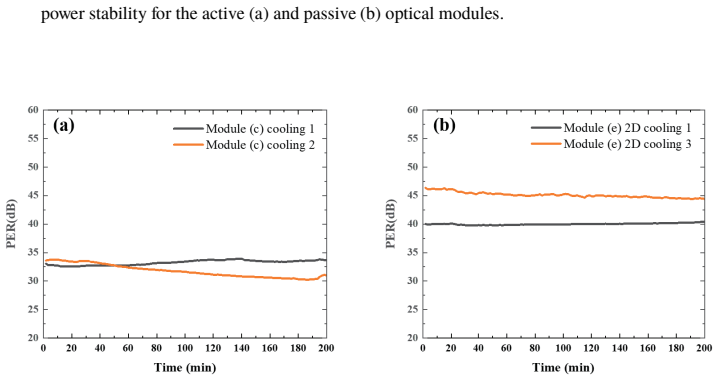
The central claim is that the all-quartz-jointed module construction is what delivers simultaneous thermal, power, polarization, and phase stability in a free-space laser system for atom interferometry. By using the same coefficient of thermal expansion for the base plate, supports, and optics, and by suspending active devices (AOMs, EOMs) on quartz supports to cut heat conduction, the system avoids the misalignment and birefringence that metal-based mounts cause when temperature changes. The result is a 260 mm × 220 mm × 60 mm laser system that, at room temperature, shows power fluctuation below $8.3\times10^{-4}$ at 100 s, PER above 30 dB, an MTS-locked frequency drift under 91 kHz, and Raman phase noise of $-100$ dBc/Hz at 1 kHz. Under a 5–50 $^\circ$C tooth-wave cycle the passive modules fluctuate by at most 3.2% in power and keep PER above 23.8 dB, while active modules fluctuate 9.4% with a 19.8 dB PER floor, recovering over 95% when the temperature returns. When integrated into a dual-atom-interferometer gyroscope, fringe contrast peaked at 80% at 26 $^\circ$C and fell at $1.4\pm0.1\%$ per degree on the cool side and $2.8\pm0.1\%$ per degree on the warm side, attributed mainly to active-module power variations in the Raman beams.
Load-bearing premise
The field-readiness claim assumes the MTS frequency lock remains stable across the 5–50 $^\circ$C range, but the paper reports only power and polarization versus temperature, never frequency versus temperature.
Editorial extensions
If this is right
- A laser system with this modular architecture can be reconfigured for other atom-interferometer sensors, such as gravimeters and gradiometers, by swapping optical modules rather than redesigning the whole system.
- The stated 5–50 $^\circ$C operating range and over 95% power recovery imply that the laser system no longer forces the sensor head to sit in a temperature-controlled laboratory.
- The measured fringe-contrast slopes of roughly 1.4% per degree on the cool side and 2.8% per degree on the warm side give a quantitative thermal budget for regulating the environment around a field-deployed gyroscope.
- The active modules' 9.4% power fluctuation over the full temperature range identifies AOM heat management as the primary remaining limit on low-temperature-contrast performance.
Reading between the lines
- A direct beatnote measurement of the MTS-locked laser across the full temperature range would be the cleanest test of the field-readiness claim, since frequency-versus-temperature data are absent from the paper.
- The attribution of fringe-contrast loss to active-module Raman power variation could be checked by monitoring or stabilizing the Raman power at the sensor head, which would separate module effects from fiber-delivery and sensor-head thermal effects.
- The all-quartz modular construction could transfer to other precision atom-optics systems, such as optical clocks or Rydberg-atom sensors, wherever free-space alignment and polarization must survive thermal cycling.
- Because the passive modules show 3.2% power variation over the full range while room-temperature stability is below 1:1000, the reported performance suggests the input fiber laser stability, rather than the quartz modules, now sets the practical floor.
Signed reviews
Editorial analysis
A structured set of objections, weighed in public.
Referee Report
Summary. This manuscript reports the design, assembly, and characterization of a compact fiber-laser-based 780-nm laser system built from all-quartz-jointed optical modules for a dual-atom-interferometer gyroscope. The primary laser is MTS-locked to Rb, two secondary lasers are OPLL-locked, and AOM-controlled outputs provide cooling, repumping, blow-away, Raman, and detection beams. The authors report room-temperature relative power Allan deviations of 8.3e-4 and 4.6e-4 at 100 s for active and passive modules, PER values above 30 dB, a locked frequency fluctuation below 91 kHz over 8 h, and Raman phase noise of -100 dBc/Hz at 1 kHz (first OPLL) and better than -90 dBc/Hz (second OPLL). Temperature-cycling tests over 5-50 °C cover power and PER only; atom-interference fringes were obtained at 21, 26, and 31 °C with maximum contrast 80%, decreasing linearly away from 26 °C. The paper concludes that the modular laser system promotes field applications of atom-interferometer sensors.
Significance. The work has concrete engineering value: the CTE-matched quartz construction, inverted and suspended AOMs, >90% free-space-to-fiber coupling efficiency, and modular assembly are credible design contributions, and the room-temperature metrics are directly measured and internally coherent. The reported Allan deviations, PER traces, beatnote spectra, and phase-noise curves provide useful data for the atom-interferometry community. However, the field-readiness/temperature claim is the weak point: the MTS frequency lock is never characterized above 25 °C, and the gyroscope application test is only a fringe-contrast check over 21-31 °C with co-propagating Raman pulses. Those gaps prevent the strongest conclusions from being accepted as written.
major comments (3)
- [Section 4 (Figs. 6 and 7)] The temperature-cycling data in Fig. 6 characterize only module power stability and PER; the MTS-locked primary-laser frequency is characterized only at 25 °C in Fig. 7. The claim that the system is usable over 5-50 °C therefore rests on an untested parameter: whether the MTS lock remains within its sub-91-kHz fluctuation and does not unlock at temperature extremes. The 21-31 °C fringe-contrast data in Section 5 are indirect evidence over a narrower range, obtained with the lab temperature set by an air conditioner rather than a chamber, and contrast depends on many sensor-head and delivery parameters, so it cannot certify frequency stability across the full range. Please add frequency-deviation/Allan-deviation or lock-survival data versus temperature, or explicitly restrict the temperature claim to power and PER.
- [Section 5 (Fig. 9)] The statement that the fringe-contrast reduction with temperature is 'mainly influenced by variations in the Raman laser power' is not established by the presented data. No simultaneous measurement of the Raman power delivered to the sensor head during fringe acquisition is shown, and possible thermal effects in the PM-fiber delivery, waveplates, PBSs, or sensor-head optics are not isolated. The similarity between the slope asymmetry and the active-module power behavior is circumstantial. Please provide a direct correlation between measured Raman power and contrast, or soften the causal conclusion to a correlation.
- [Section 5] The application test uses co-propagating Raman pulse sequences, which do not produce the momentum-space separation that generates the Sagnac phase in a gyroscope. Thus the reported fringes demonstrate atom-interference contrast, not rotation sensitivity or gyroscope operation. As the title and abstract are framed around a dual-atom-interferometer gyroscope, the paper should either report a counter-propagating Raman interference measurement or clearly state that Sagnac operation was not tested; as written, the application claim outruns the data.
minor comments (4)
- [Section 4 vs. Conclusion] The minimum PER values over temperature are inconsistent: Section 4 reports 19.8 dB for the active module and 23.8 dB for the passive module, while the Conclusion states the passive-module PER was greater than 25.3 dB. Please correct this discrepancy.
- [Section 4 (Figs. 4 and 7)] The phrase 'power fluctuation was under 1:1000' should specify that this is an Allan deviation at 100 s integration time, not a peak-to-peak fluctuation; the same precision should be used for the corresponding statement in the Conclusion.
- [Section 4 (Fig. 7 and Conclusion)] The text says the locked frequency was recorded for over 8 h, while the Conclusion says 'over 5 h'; please align these durations and state the RBW/VBW used for the 91-kHz fluctuation estimate.
- [Section 4 (Fig. 6)] The observation that AOM temperatures exceed 70 °C when the chamber is at 50 °C is a potential lifetime/reliability concern for field use; one sentence discussing the implications would strengthen the temperature discussion.
Circularity Check
No circularity: the paper reports direct measurements of laser power, PER, frequency, phase noise, and fringe contrast; no derived claim reduces by construction to fitted inputs or self-citations.
full rationale
This is an empirical characterization paper rather than a derivation. Each headline performance number is obtained by direct measurement against external references: power stability via Allan deviation of power-meter readings, PER via a polarization analyzer, frequency fluctuation via a beat note with an independently stabilized ultrastable cavity laser, and Raman phase noise via optical phase-locked-loop beat notes. The MTS lock and OPLL methods are standard techniques cited from the literature, and the cited references are not used to define the measured quantities. The only interpretive step is the attribution of fringe-contrast loss between 21 and 31 C to active-module-induced Raman power variations; this is a stated correlation consistent with the power-stability data, not a prediction derived from fitted values, and it does not feed back into the central performance claims. The paper's limitation that MTS frequency stability was not measured over 5-50 C (only power and PER were tested over that range) is a missing-evidence or correctness concern for the field-readiness claim, not a circularity, because the room-temperature frequency measurement is independent and the temperature tests do not presuppose the conclusion. No load-bearing self-citation, ansatz-smuggling via citation, or uniqueness argument appears. Score 0 is therefore appropriate.
Assumptions & free parameters
assumptions (3)
- domain assumption Quartz components with identical CTE minimize thermal influence on alignment.
- domain assumption The MTS frequency lock remains stable across the 5-50 C temperature range.
- domain assumption Fringe contrast loss is caused mainly by Raman laser power variations from the active modules.
Cite this review
Pith. "Pith review of Highly stable modular-assembled laser system for a dual-atom-interferometer gyroscope." pith.science (2026). https://pith.science/paper/F5ELPNP7
@misc{pith2026241112218,
  author       = {Pith},
  title        = {Pith review of: Highly stable modular-assembled laser system for a dual-atom-interferometer gyroscope},
  year         = {2026},
  howpublished = {\url{https://pith.science/paper/F5ELPNP7}},
  note         = {Machine review of arXiv:2411.12218}
}
abstract
Operating atom-interferometer gyroscopes outside a laboratory environment is challenging primarily owing to the instability of laser systems. To enhance the thermal stability of free-space laser systems, a compact laser system using fiber lasers and all-quartz-jointed optical modules was developed for a dual-atom-interferometer gyroscope. Millimeter-scale optical elements jointed on quartz plates with identical quartz supports, ensure laser power stability and facilitate component upgrades. The primary diode laser was locked to the modulation transfer spectrum of Rb atoms, and Raman lasers were phase-locked to the primary laser. Frequencies for repumping, blow-away, and detection lasers were adjusted with acousto-optic modulators. At room temperature, laser power fluctuation was under 1:1000, polarization extinction ratio exceeded 30 dB, frequency fluctuation was below 91 kHz, and phase noise reached to -100 dBc/Hz @ 1 kHz. The optical modules were tested at 5--50 $^{\circ}$C and applied to a dual-atom-interferometer gyroscope. The fringe contrast was tested over the temperature range. The proposed system paves the way for promoting field applications of atom-interferometer sensors.
Figures


Figures from the paper (6 more)



Reference graph
Works this paper leans on
-
[1]
Atomic interferometry usingstimulatedRaman transitions,
M.Kasevichand S. Chu, “Atomic interferometry usingstimulatedRaman transitions,” Phys.Rev.Lett. 67 , 181 (1991)
work page 1991
-
[2]
Rotation sensing with a dual atom-interferometer Sagnac gyroscope,
T. L. Gustavson, A. Landragin, and M. Kasevich, “Rotation sensing with a dual atom-interferometer Sagnac gyroscope,”Class.QuantumGravity 17 ,2385(2000)
work page 2000
-
[3]
Calibrationofatomictrajectoriesinalarge-area dual-atom-interferometergyroscope,
Z.W.Yao,S.B.Lu,R.B.Li,J.Luo,J.Wang,andM.S.Zhan,“Calibrationofatomictrajectoriesinalarge-area dual-atom-interferometergyroscope,”Phys.Rev.A 97 ,013620(2018)
work page 2018
-
[4]
Z.W.Yao,H.H.Chen,S.B.Lu,R.B.Li,Z.X.Lu,X.L.Chen,G.H.Yu,M.Jiang,C.Sun,W.T.Ni,J.Wang, and M.S.Zhan, “Self-alignment ofalarge-area dual-atom-interferometergyroscopeusingparameter-decoupled phase-seekingcalibrations,”Phys.Rev.A 103 ,2469(2021)
work page 2021
-
[5]
Accuratemeasurementof theSagnaceffectformatterwaves,
R.Gautier,M.Guessoum,L.A.Sidorenkov,Q.Bouton,A.Landragin,andR.Geiger,“Accuratemeasurementof theSagnaceffectformatterwaves,”Sci.Adv. 8 ,eabn8009(2022)
work page 2022
-
[6]
Self-calibratedatom-interferometergyroscopebymodulatingatomicvelocities,
H.H.Chen,Z.W.Yao,Z. X.Lu, S.B.Lu, M.Jiang, S.K.Li, X.L.Chen,C.Sun,Y.F.Mao,Y.Li, R.B.Li, J.Wang, andM.S.Zhan,“Self-calibratedatom-interferometergyroscopebymodulatingatomicvelocities,”Rev. Sci.Instrum. 95 ,053201(2024)
work page 2024
-
[7]
Limitsonthesensitivityofacoldatominterferometry gyroscope,
W.J.Xu,L.L.Chen,M.J.Nie,M.K.Zhou,andZ.K.Hu,“Limitsonthesensitivityofacoldatominterferometry gyroscope,”Opt.Express 32 ,42856(2024)
work page 2024
-
[8]
Demonstrationofan ultrahigh-sensitivityatom-interferometryabsolutegravimeter,
Z.K.Hu,B.L.Sun,X.C.Duan,M.K.Zhou,L.L.Chen,S.Zhan,Q.Z.Zhang,andJ. Luo,“Demonstrationofan ultrahigh-sensitivityatom-interferometryabsolutegravimeter,”Phys.Rev.A 88 ,043610(2013)
work page 2013
Show all 41 references
-
[9]
Absolutemarinegravimetrywithmatter-waveinterferometry,
Y.Bidel,N.Zahzam,C.Blanchard,A.Bonnin,M.Cadoret,A.Bresson,D.Rouxel,andM.F.Lequentrec-Lalancette, “Absolutemarinegravimetrywithmatter-waveinterferometry,”Nat.Commun. 9 ,627(2018)
2018
-
[10]
Measurementoftheearth’sgravity gradientwithanatominterferometer-basedgravitygradiometer,
M.J.Snadden,J.M.McGuirk,P.Bouyer,K.G.Haritos,and M.Kasevich,“Measurementoftheearth’sgravity gradientwithanatominterferometer-basedgravitygradiometer,”Phys.Rev.Lett. 81 ,971(1998)
1998
-
[11]
CompactHigh-ResolutionAbsolute-GravityGradiometerBasedonAtomInterferometers,
W. Lyu, J. Q. Zhong, X. W. Zhang, W. Liu, L. Zhu, W. H. Xu, X. Chen, B. Tang, J. Wang, and M. S. Zhan, “CompactHigh-ResolutionAbsolute-GravityGradiometerBasedonAtomInterferometers,” Phys.Rev.Appl. 18 , 054091(2022)
2022
-
[12]
Compactdifferential gravimeteratthequantumprojection-noiselimit,
C.Janvier,V.MÃľnoret,B.Desruelle,S.Merlet,A.Landragin,andF.PereiradosSantos,“Compactdifferential gravimeteratthequantumprojection-noiselimit,”Phys.Rev.A 105 ,0522801(2022)
2022
-
[13]
Testofequivalenceprincipleat 10 − 8 levelbyadual-speciesdouble-diffractionRaman atominterferometer,
L.Zhou,S.T.Long,B.Tang,X.Chen,F.Gao,W.C.Peng,W.T.Duan,J.Q.Zhong,Z.Y.Xiong,J.Wang,Y.Z Zhang, andM.S.Zhan, “Testofequivalenceprincipleat 10 − 8 levelbyadual-speciesdouble-diffractionRaman atominterferometer,”Phys.Rev.Lett. 115 ,013004(2015)
2015
-
[14]
Atom-interferometric test of the equivalence principleatthe 10 − 12 level,
P. Asenbaum, C. Overstreet, M. Kim, J. Curti, and M. Kasevich, “Atom-interferometric test of the equivalence principleatthe 10 − 12 level,”Phys.Rev.Lett. 125 ,191101(2020)
2020
-
[15]
PrecisionmeasurementoftheNewtonian gravitationalconstantusingcoldatoms,
G.Rosi,F.Sorrentino,L.Cacciapuoti,M.Prevedelli,andG.M.Tino,“PrecisionmeasurementoftheNewtonian gravitationalconstantusingcoldatoms,”Nature 510 ,518(2014)
2014
-
[16]
Measurementofthefine-structureconstantasa testofthestandardmodel,
R.H.Parker,C.H.Yu,W.C.Zhong,B.Estey,andH.MÃijller,“Measurementofthefine-structureconstantasa testofthestandardmodel,”Science 360 ,6385(2018)
2018
-
[17]
Cold-atomsources fortheMatter-wavelaserInterferometricGravitationAntenna(MIGA),
Q.Beaufils,L.A.Sidorenkov,P.Lebegue,B.Venon,D.Holleville,L.Volodimer,M.Lours,J.Junca,X.H.Zou, A.Bertoldi,M.Prevedelli,D.O.Sabulsky,P.Bouyer,A.Landragin,B.Canuel,andR.Geiger,“Cold-atomsources fortheMatter-wavelaserInterferometricGravitationAntenna(MIGA),”Sci.Rep. 12 ,19000(2022)
2022
-
[18]
Matter-waveAtomicGradiometerInterferometricSensor(MAGIS-100),
M.Abe,P.Adamson,M.Borcean,etal.,“Matter-waveAtomicGradiometerInterferometricSensor(MAGIS-100),” QuantumSci.Technol. 6 ,044003(2021)
2021
-
[19]
Aconfirmation ofthe generalrelativistic predictionof theLense-Thirring effect,
I. Ciufoliniand E.C.Pavlis, “Aconfirmation ofthe generalrelativistic predictionof theLense-Thirring effect,” Nature 431 ,958(2004)
2004
-
[20]
Generalrelativisticeffectsinatominterferometry,
S.Dimopoulos,P.W.Graham,J.M.Hogan,andM.Kasevich,“Generalrelativisticeffectsinatominterferometry,” Phys.Rev.D 78 ,042003(2008)
2008
-
[21]
ZAIGA:Zhaoshanlong-baselineAtomInterferometerGravitationAntenna,
M.S.Zhan,J.Wang,W.T.Ni,D.F.Gao,G.Wang,L.X.He,R.B.Li,L.Zhou,X.Chen,J.Q.Zhong,B.Tang, Z.W.Yao,L.Zhu,Z.Y.Xiong,S.B.Lu,G.H.Yu,Q.F.Cheng,M. Liu,Y.R.Liang,P.Xu,X.D.He,M.Ke, Z.Tan,andJ.Luo,“ZAIGA:Zhaoshanlong-baselineAtomInterferometerGravitationAntenna,”Int.J.Mod.Phys. D 29 ,1940005(2020)
2020
-
[22]
Navigationerrorqnalysisofatominterferometerinertialsensor,
C.Jekeli,“Navigationerrorqnalysisofatominterferometerinertialsensor,”Navigation 52 ,1(2005)
2005
-
[23]
Advancesinatomicgyroscopes: aviewfrominertialnavigationapplications,
J.C.FangandJ.Qin,“Advancesinatomicgyroscopes: aviewfrominertialnavigationapplications,”Sensors 12 , 6331(2012)
2012
-
[24]
Tidesandearthrotation,
P.BroscheandH.Schuh,“Tidesandearthrotation,”Surv.Geophys. 19 ,417(1998)
1998
-
[25]
Introductiontothespecialissueonrotationalseismology andengineeringapplications,
W.H.K.Lee,M.ÃĞelebi,M.I.Todorovska,andH.Igel,“Introductiontothespecialissueonrotationalseismology andengineeringapplications,”B.Seism.SOC.AM. 99 ,945(2009)
2009
-
[26]
TheBose-Einsteincondensateandcoldatomlaboratory,
K.Frye,S.Abend,W.Bartosch,etal.,“TheBose-Einsteincondensateandcoldatomlaboratory,”EPJQuantum Technol. 8 ,1(2021)
2021
-
[27]
Aself-lockingRydbergatomelectricfieldsensor,
C.T.Fancher,K.L.Nicolich,K.M.Backes,N.Malvania,K.Cox,D.H.Meyer,P.D.Kunz,J.C.Hill,W.Holland, andB.L.SchmittbergerMarlow,“Aself-lockingRydbergatomelectricfieldsensor,”Appl.Phys.Lett. 122 ,094001 (2023)
2023
-
[28]
Realizationofacompact one-seedlasersystemforatominterferometer-basedgravimeters,
J.Fang,J.G.Hu,X.Chen,H.R.Zhu,L.Zhou,J.Q.Zhong,J.Wang,andM.S.Zhan,“Realizationofacompact one-seedlasersystemforatominterferometer-basedgravimeters,”Opt.Express 26 ,1586(2018)
2018
-
[29]
Simpleandrobustarchitectureofalasersystemforatom interferometry,
S.Sarkar,R.Piccon,S.Merlet,andF.PereiradosSantos,“Simpleandrobustarchitectureofalasersystemforatom interferometry,”Opt.Express 30 ,3358(2022)
2022
-
[30]
Highlyreliable opticalsystemforarubidiumspacecoldatomclock,
W.Ren,Y.G.Sun,B.Wang,W.BXia,Q.Z.Qu,J.F.Xiang,Z.RDong,D.SLÃij,andL.Liu,“Highlyreliable opticalsystemforarubidiumspacecoldatomclock,”Appl.Opt. 55 ,3607(2016)
2016
-
[31]
Compactportable lasersystemformobilecoldatomgravimeters,
X.W.Zhang,J.Q.Zhong,B.Tang,X.Chen,L.Zhu,P.W.Huang,J.Wang,andM.S.Zhan,“Compactportable lasersystemformobilecoldatomgravimeters,”Appl.Opt. 57 ,6545(2018)
2018
-
[32]
Modular-assembledlasersystemforalong-baselineatominterferometer,
R.D.Xu,Q.Wang,S.T.Yan,Z.Hou,C.He,Y.H.Ji,Z.X.Li,J.J.Jiang,B.Y.Qiao,L.Zhou,J.Wang,andM.S. Zhan,“Modular-assembledlasersystemforalong-baselineatominterferometer,”Appl.Opt. 61 ,4648(2018)
2018
-
[33]
Hydroxide-catalysis bondingforstableoptical systems forspace,
E.J.Elliffe, J.Bogenstahl,A.Deshpande,J.Hough,C.Killow,S.Reid,D.Robertson,S.Rowan, H.Ward, and G. Cagnoli, “Hydroxide-catalysis bondingforstableoptical systems forspace,” Class. QuantumGrav. 22 , S257 (2005)
2005
-
[34]
TianQin: aspace-bornegravitationalwavedetector,
J.Luo,L.S.Chen,H.Z.Duan,etal.,“TianQin: aspace-bornegravitationalwavedetector,”Class.QuantumGrav. 33 ,035010(2016)
2016
-
[35]
Ultrastable,Zerodur-basedopticalbenchesforquantumgasexperiments,
H.Duncker,O.Hellmig,A.Wenzlawski,A.Grote,A.J.Rafipoor,M.Rafipoor,K.Sengstock,andP.Windpassinger, “Ultrastable,Zerodur-basedopticalbenchesforquantumgasexperiments,”Appl.Opt. 53 ,4468(2014)
2014
-
[36]
AfiberedlasersystemfortheMIGA largescaleatominterferometer,
D. O. Sabulsky, J. Junca, G. LefÃĺvre, X. Zou, A. Bertoldi, B. Battelier, M. Prevedelli, G. Stern, J. Santoire, Q.Beaufils,R.Geiger,A.Landragin,B.Desruelle,P.Bouyer,andB.Canuel,“AfiberedlasersystemfortheMIGA largescaleatominterferometer,”Sci.Rep. 10 ,3268(2020)
2020
-
[37]
Miniaturizedoptical systemforhigh-precisionmobileatomicgravimeters,
H.R.Zhu,P.W.Huang,B.Gao,B.Tang,X.Chen,J.Q.Zhong,J.Wang,andM.S.Zhan,“Miniaturizedoptical systemforhigh-precisionmobileatomicgravimeters,”Opt.Express 32 ,26157(2024)
2024
-
[38]
Characterizationofsemiconductor-laserphasenoiseandestimationofbit-errorrateperformancewith low-speedofflinedigitalcoherentreceivers,
K.Kikuchi,“Characterizationofsemiconductor-laserphasenoiseandestimationofbit-errorrateperformancewith low-speedofflinedigitalcoherentreceivers,”Opt.Express 20 ,5291(2012)
2012
-
[39]
Modulationtransferspectroscopyinatomicrubidium,
D.J.McCarron,S.A.King,andS.L.Cornish,“Modulationtransferspectroscopyinatomicrubidium,”Meas.Sci. Technol. 19 ,105601(2008)
2008
-
[40]
Characterizationof opticalphase-lockedtwodistributed-feedbackfiberlasersfor 87 R batominterferometry,
S.Lee,S.Hwang,J.Baek,M.H.Lee,S.B.Lee,S.Seo,T.Y.Kwon,S.E.Park,andG.Moon,“Characterizationof opticalphase-lockedtwodistributed-feedbackfiberlasersfor 87 R batominterferometry,”Curr.Appl.Phys. 51 ,29 (2023)
2023
-
[41]
Compactmulti-channelradiofrequencypulse-sequencegeneratorwithfast-switching capabilityforcold-atominterferometers,
M.Jiang, S.B.Lu,Y.Li, C.Sun, Z.W.Yao, S.K.Li,H.H.Chen,X.L.Chen,Z.X.Lu, Y.F.Mao, R.B.Li, J.Wang,andM.S.Zhan,“Compactmulti-channelradiofrequencypulse-sequencegeneratorwithfast-switching capabilityforcold-atominterferometers,”Rev.Sci.Instrum. 94 ,093204(2023)
2023
Reviewed August 12, 2026 · model on record in the stance chip above.
Discussion (0). Continue with ORCID to comment.