Robust Deep Joint Source-Channel Coding Enabled Distributed Image Transmission with Imperfect Channel State Information
Pith reviewed 2026-05-23 17:50 UTC · model grok-4.3
The pith
A robust distributed joint source-channel coding scheme exploits slight correlations among multi-view images to improve reconstruction over severe fading channels with imperfect channel state information.
A machine-rendered reading of the paper's core claim, the machinery that carries it, and where it could break.
Core claim
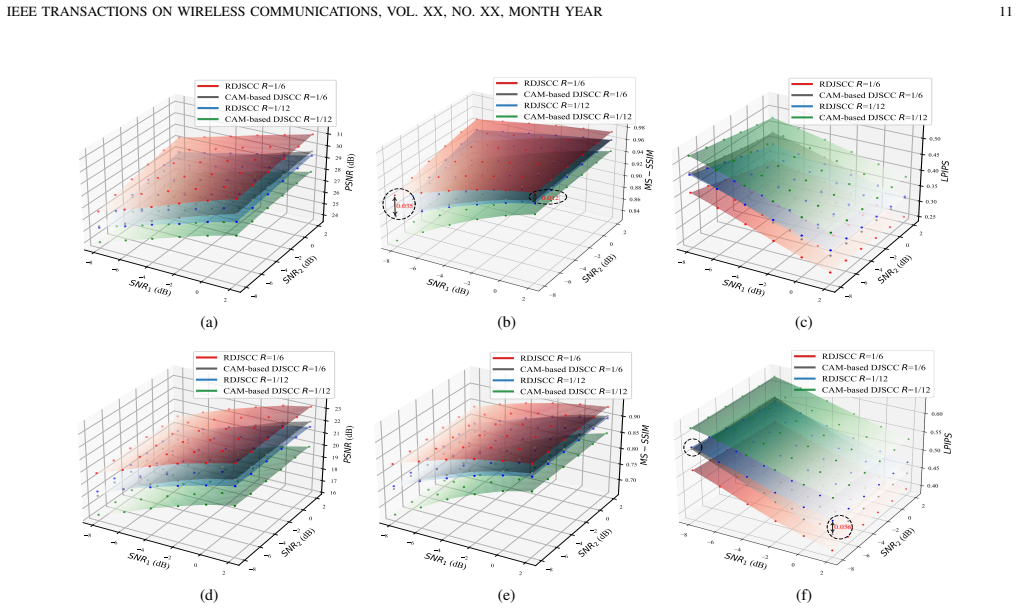
In RDJSCC, a novel cross-view information extraction (CVIE) mechanism captures more nuanced cross-view patterns and dependencies. A complementarity-consistency fusion (CCF) mechanism fuses the complementarity and consistency from multi-view information in a symmetric and compact manner. Theoretical analysis and simulation results show that the proposed RDJSCC can effectively leverage the advantages of correlated sources even under severe fading conditions, leading to an improved reconstruction performance.
What carries the argument
The CVIE mechanism for extracting cross-view patterns and the CCF mechanism for symmetric fusion of complementarity and consistency within the RDJSCC framework.
If this is right
- RDJSCC achieves improved reconstruction performance compared to traditional DJSCC under severe fading and imperfect CSI.
- The scheme effectively uses slight source correlations to mitigate distortions at the decoder.
- Performance gains hold for distributed multi-view image transmission scenarios.
- The approach maintains robustness when channel state information is imperfect.
Where Pith is reading between the lines
- Similar mechanisms could be applied to other distributed sensing tasks involving correlated data streams.
- Performance might scale with the number of views if correlations remain consistent across them.
- Real deployments could benefit from adaptive fusion based on estimated correlation strength.
Load-bearing premise
The multi-view sources are slightly correlated, which allows the CVIE and CCF mechanisms to capture and fuse cross-view information effectively.
What would settle it
If experiments or simulations demonstrate that RDJSCC does not yield better reconstruction quality than standard DJSCC when sources are slightly correlated, channels fade severely, and CSI is imperfect, the central claim would be falsified.
Figures




read the original abstract
This work is concerned with robust distributed multi-view image transmission over a severe fading channel with imperfect channel state information (CSI), wherein the sources are slightly correlated. Since the signals are further distorted at the decoder, traditional distributed deep joint source-channel coding (DJSCC) suffers considerable performance degradation. To tackle this problem, we leverage the complementarity and consistency characteristics among the distributed, yet correlated sources, and propose an enhanced robust DJSCC, namely RDJSCC. In RDJSCC, we design a novel cross-view information extraction (CVIE) mechanism to capture more nuanced cross-view patterns and dependencies. In addition, a complementarity-consistency fusion (CCF) mechanism is utilized to fuse the complementarity and consistency from multi-view information in a symmetric and compact manner. Theoretical analysis and simulation results show that our proposed RDJSCC can effectively leverage the advantages of correlated sources even under severe fading conditions, leading to an improved reconstruction performance. The open source code of this work is available at:https://dongbiao26.github.io/rdjscc/.
Editorial analysis
A structured set of objections, weighed in public.
Referee Report
Summary. The paper proposes RDJSCC, an enhanced distributed deep joint source-channel coding scheme for multi-view image transmission over severe fading channels with imperfect CSI. Sources are described as slightly correlated; the method adds a cross-view information extraction (CVIE) mechanism to capture nuanced cross-view patterns and a complementarity-consistency fusion (CCF) mechanism to fuse multi-view information symmetrically. Theoretical analysis and simulations are claimed to show improved reconstruction performance by leveraging the correlation advantages even under severe fading, with open-source code provided.
Significance. If the CVIE and CCF mechanisms demonstrably extract and fuse usable information from slight statistical dependence after channel distortion and with imperfect CSI, the work would offer a concrete advance in robust distributed transmission for correlated sources in wireless settings. The release of open-source code is a positive contribution to reproducibility.
major comments (1)
- [Abstract and §I] Abstract and §I: the headline claim that RDJSCC 'can effectively leverage the advantages of correlated sources even under severe fading conditions' rests on the unquantified assumption that slight correlation is sufficient for CVIE to recover reliable cross-view patterns and for CCF to fuse complementarity/consistency after identical severe fading and imperfect CSI. No sensitivity analysis or threshold on correlation strength is provided at which the reported gain over baseline DJSCC vanishes, nor an ablation that isolates the contribution of the correlation itself versus the added modules; this is load-bearing for the central performance claim.
minor comments (2)
- [§II] Notation for the imperfect CSI model and the precise definition of 'slightly correlated' (e.g., correlation coefficient range) should be stated explicitly in the system model section for reproducibility.
- [§IV] Figure captions and axis labels in the simulation results should include error bars or confidence intervals to allow assessment of statistical significance of the reported gains.
Simulated Author's Rebuttal
We thank the referee for the constructive comment. We address it below and will revise the manuscript to strengthen the central claim.
read point-by-point responses
-
Referee: [Abstract and §I] Abstract and §I: the headline claim that RDJSCC 'can effectively leverage the advantages of correlated sources even under severe fading conditions' rests on the unquantified assumption that slight correlation is sufficient for CVIE to recover reliable cross-view patterns and for CCF to fuse complementarity/consistency after identical severe fading and imperfect CSI. No sensitivity analysis or threshold on correlation strength is provided at which the reported gain over baseline DJSCC vanishes, nor an ablation that isolates the contribution of the correlation itself versus the added modules; this is load-bearing for the central performance claim.
Authors: We agree that a sensitivity analysis on correlation strength and an ablation isolating the correlation contribution would better quantify the headline claim. In the revised version we will add experiments varying the inter-view correlation coefficient, report the resulting gain of RDJSCC over baseline DJSCC, and identify the correlation threshold at which the gain vanishes. We will also include an ablation applying CVIE and CCF to uncorrelated sources to separate the modules' effect from the source correlation itself. revision: yes
Circularity Check
No significant circularity; derivation relies on proposed mechanisms and external validation.
full rationale
The paper proposes RDJSCC with novel CVIE and CCF modules to exploit slight source correlation under fading and imperfect CSI. Claims of improved reconstruction rest on 'theoretical analysis and simulation results' rather than any self-definitional loop, fitted parameter renamed as prediction, or load-bearing self-citation. No equations or derivations in the provided text reduce the central result to its inputs by construction. The work is self-contained against external benchmarks (simulations, open code).
Axiom & Free-Parameter Ledger
free parameters (1)
- neural network weights and hyperparameters
axioms (2)
- domain assumption Sources are slightly correlated
- domain assumption Channel follows severe fading model with imperfect CSI
invented entities (2)
-
CVIE mechanism
no independent evidence
-
CCF mechanism
no independent evidence
Lean theorems connected to this paper
-
IndisputableMonolith/Cost/FunctionalEquation.leanwashburn_uniqueness_aczel unclear?
unclearRelation between the paper passage and the cited Recognition theorem.
We design a novel cross-view information extraction (CVIE) mechanism... complementarity-consistency fusion (CCF) mechanism... to fuse the complementarity and consistency from multi-view information in a symmetric and compact manner.
-
IndisputableMonolith/Foundation/ArithmeticFromLogic.leanembed_injective unclear?
unclearRelation between the paper passage and the cited Recognition theorem.
Theorem 1 (Mutual Information Non-Increasing Theorem)... I(sa1; sa2) ≥ I(sb1; sb2)
What do these tags mean?
- matches
- The paper's claim is directly supported by a theorem in the formal canon.
- supports
- The theorem supports part of the paper's argument, but the paper may add assumptions or extra steps.
- extends
- The paper goes beyond the formal theorem; the theorem is a base layer rather than the whole result.
- uses
- The paper appears to rely on the theorem as machinery.
- contradicts
- The paper's claim conflicts with a theorem or certificate in the canon.
- unclear
- Pith found a possible connection, but the passage is too broad, indirect, or ambiguous to say the theorem truly supports the claim.
Reference graph
Works this paper leans on
-
[1]
B. Dong, B. Cao, W. Tian and Y . Wang, “RDJSCC: Robust deep joint source-channel coding enabled distributed image transmision over severe fading channel,” in Proc. IEEE Global Comm. Conf. , Cape Town, South Africa, Dec. 2024, pp. 1–6
work page 2024
-
[2]
Beyond transmitting bits: Context, semantics, and task-oriented communications,
D. G ¨und¨uz, Z. Qin, I. E. Aguerri, H. S. Dhillon, Z. Yang, A. Yener, K. K. Wong, and C.-B. Chae, “Beyond transmitting bits: Context, semantics, and task-oriented communications,” IEEE J. Select. Areas Commun., vol. 41, no. 1, pp. 5–41, Nov. 2022
work page 2022
-
[3]
Noiseless coding of correlated information sources,
D. Slepian and J. Wolf, “Noiseless coding of correlated information sources,” IEEE Trans. Inf. Theory , vol. 19, no. 4, pp. 471-480, Jul. 1973
work page 1973
-
[4]
The rate-distortion function for source coding with side information at the decoder,
A. Wyner and J. Ziv, “The rate-distortion function for source coding with side information at the decoder,” IEEE Trans. Inf. Theory , vol. 22, no. 1, pp. 1–10, Jan. 1976
work page 1976
-
[5]
Rate distortion when side information may be absent,
C. Heegard and T. Berger, “Rate distortion when side information may be absent,” IEEE Trans. Inf. Theory, vol. 31, no. 6, pp. 727–734, Nov. 1985
work page 1985
-
[6]
Deep learning for channel estimation: Interpretation, performance, and comparison,
Q. Hu, F. Gao, H. Zhang, S. Jin, and G. Y . Li, “Deep learning for channel estimation: Interpretation, performance, and comparison,” IEEE Trans. Wireless Commun. , vol. 20, no. 4, pp. 2398–2412, Apr. 2021
work page 2021
-
[7]
B. Dong et al., “A lightweight decentralized-learning-based automatic modulation classification method for resource-constrained edge devices,” IEEE Internet Things J. , vol. 9, no. 24, pp. 24708–24720, Dec. 2022
work page 2022
-
[8]
Evolution of NOMA toward next generation multiple access (NGMA) for 6G,
Y . Liu, S. Zhang, X. Mu, Z. Ding, R. Schober, N. Al-Dhahir, E. Hossain, and X. Shen, “Evolution of NOMA toward next generation multiple access (NGMA) for 6G,” IEEE J. Select. Areas Commun. , vol. 40, no. 4, pp. 1037–1071, Apr. 2022
work page 2022
-
[9]
DSIC: Deep stereo image compression,
J. Liu, S. Wang, and R. Urtasun, “DSIC: Deep stereo image compression,” in Proc. IEEE/CVF Int. Conf. Comput. Vis. (ICCV) , Seoul, Korea, 2019, pp. 3136–3145
work page 2019
-
[10]
Neural distributed image compression using common information,
N. Mital, E. ¨Ozyilkan, A. Garjani, and D. G ¨und¨uz, “Neural distributed image compression using common information,” in Proc. IEEE Data Compression Conf., Mar. 2022, pp. 182–191
work page 2022
-
[11]
Task-aware distributed source coding under dynamic bandwidth,
P. Li, S. K. Ankireddy, R. Zhao, H. N. Mahjoub, E. M. Pari, U. Topcu, S. P. Chinchali, and H. Kim, “Task-aware distributed source coding under dynamic bandwidth,” in Proc. Adv. Neural Inf. Process. Syst. , vol. 36, 2024
work page 2024
-
[12]
Deep joint source channel coding for wireless image transmission,
E. Bourtsoulatze, D. B. Kurka, and D. G ¨und¨uz, “Deep joint source channel coding for wireless image transmission,” IEEE Trans. Cognit. Commun. Netw., vol. 5, no. 3, pp. 567–579, Sep. 2019
work page 2019
-
[13]
Wireless image transmission using deep source channel coding with attention modules,
J. Xu, B. Ai, W. Chen, A. Yang, P. Sun, and M. Rodrigues, “Wireless image transmission using deep source channel coding with attention modules,” IEEE Trans. Circuits Syst. Video Technol. , vol. 32, no. 4, pp. 2315–2328, Apr. 2022
work page 2022
-
[14]
Predictive and adaptive deep coding for wireless image transmission in semantic communication,
W. Zhang, H. Zhang, H. Ma, H. Shao, N. Wang, and V . C. M. Leung, “Predictive and adaptive deep coding for wireless image transmission in semantic communication,” IEEE Trans. Wireless Commun., vol. 22, no. 8, pp. 5486–5501, Aug. 2023
work page 2023
-
[15]
Semantic communications with discrete-time analog transmission: A PAPR perspective,
Y . Shao and D. G¨und¨uz, “Semantic communications with discrete-time analog transmission: A PAPR perspective,” IEEE Wireless Commun. Lett., vol. 12, no. 3, pp. 510–514, Mar. 2023
work page 2023
-
[16]
Channel-adaptive wireless image transmission with OFDM,
H. Wu, Y . Shao, K. Mikolajczyk, and D. G ¨und¨uz, “Channel-adaptive wireless image transmission with OFDM,” IEEE Wireless Commun. Lett., vol. 11, no. 11, pp. 2400–2404, Nov. 2022
work page 2022
-
[17]
OFDM-guided deep joint source channel coding for wireless multipath fading channels,
M. Yang, C. Bian, and H.-S. Kim, “OFDM-guided deep joint source channel coding for wireless multipath fading channels,” IEEE Trans. Cogn. Commun. Netw., vol. 8, no. 2, pp. 584–599, Jul. 2022. IEEE TRANSACTIONS ON WIRELESS COMMUNICATIONS, VOL. XX, NO. XX, MONTH YEAR 15
work page 2022
-
[18]
Nonlinear transform source-channel coding for semantic communications,
J. Dai, S. Wang, K. Tan, Z. Si, X. Qin, K. Niu, and P. Zhang, “Nonlinear transform source-channel coding for semantic communications,” IEEE J. Select. Areas Commun. , vol. 40, no. 8, pp. 2300–2316, Aug. 2022
work page 2022
-
[19]
Distributed deep joint source-channel coding with decoder-only side information,
S. Yilmaz, E. ¨Ozyilkan, D. G ¨und¨uz, and E. Erkip, “Distributed deep joint source-channel coding with decoder-only side information,”arXiv preprint arXiv:2310.04311, 2023
-
[20]
Distributed image transmission using deep joint source-channel coding,
S. Wang, K. Yang, J. Dai, and K. Niu, “Distributed image transmission using deep joint source-channel coding,” in Proc. IEEE Int. Conf. Acoust., Speech Signal Process. (ICASSP) , Apr. 2022, pp. 5208–5212
work page 2022
-
[21]
Modeling multiple views via implicitly preserving global consistency and local complementarity,
J. Li, W. Qiang, C. Zheng, B. Su, F. Razzak, J. Wen, and H. Xiong, “Modeling multiple views via implicitly preserving global consistency and local complementarity,” IEEE Trans. Knowl. Data Eng. , vol. 35, no. 7, pp. 7220–7238, Jul. 2023
work page 2023
-
[22]
MIMO-OFDM wireless communications with MATLAB,
Y . S. Cho, J. Kim, W. Y . Yang, and C. G. Kang, “MIMO-OFDM wireless communications with MATLAB,” Hoboken, NJ, USA: Wiley, 2010
work page 2010
-
[23]
Variational image compression with a scale hyperprior
J. Ball ´e, D. Minnen, S. Singh, S. J. Hwang, and N. Johnston, “Variational image compression with a scale hyperprior,” arXiv preprint arXiv:1802.01436, 2018
work page internal anchor Pith review Pith/arXiv arXiv 2018
-
[24]
Elements of information theory,
M. Thomas and A. T. Joy, “Elements of information theory,” WileyInterscience, 2006
work page 2006
-
[25]
A. Zhang, Z. C. Lipton, M. Li, and A. J. Smola, “Dive into deep learning,” arXiv preprint arXiv:2106.11342 , 2021
-
[26]
On the integration of self-attention and convolution,
X. Pan, C. Ge, R. Lu, S. Song, G. Chen, Z. Huang, and G. Huang, “On the integration of self-attention and convolution,” in Proc. IEEE/CVF Conf. Comput. Vis. Pattern Recognit. (CVPR), Jun. 2022, pp. 805–815
work page 2022
-
[27]
The cityscapes dataset for semantic urban scene understanding,
M. Cordts, M. Omran, S. Ramos, T. Rehfeld, M. Enzweiler, R. Benenson, U. Franke, S. Roth, and B. Schiele, “The cityscapes dataset for semantic urban scene understanding,” in Proc. IEEE Conf. Comput. Vision Pattern Recognit. (CVPR) , Jun. 2016, pp. 3213–3223
work page 2016
-
[28]
Are we ready for autonomous driving? The KITTI vision benchmark suite,
A. Geiger, P. Lenz, and R. Urtasun, “Are we ready for autonomous driving? The KITTI vision benchmark suite,” in Proc. IEEE Conf. Comput. Vision Pattern Recognit. (CVPR) , 2012, pp. 3354–3361
work page 2012
-
[29]
Multiscale structural similarity for image quality assessment,
Z. Wang, E. P. Simoncelli, and A. C. Bovik, “Multiscale structural similarity for image quality assessment,” in Proc. 37th Asilomar Conf. Signals, Syst. Comput. , vol. 2, Nov. 2004, pp. 1398–1402
work page 2004
-
[30]
Collaborative semantic communication for edge inference,
W. F. Lo, N. Mital, H. Wu, and D. G ¨und¨uz, “Collaborative semantic communication for edge inference,”IEEE Wireless Commun. Lett., vol. 12, no. 7, pp. 1125–1129, Jul. 2023
work page 2023
-
[31]
F. Rahutomo, T. Kitasuka, and M. Aritsugi, “Semantic cosine similarity,” in Proc. Int. Conf. Adv. Sci. Technol. , 2012
work page 2012
-
[32]
LDMIC: Learning-based distributed multi-view image coding,
X. Zhang, J. Shao, and J. Zhang, “LDMIC: Learning-based distributed multi-view image coding,” in Proc. Int. Conf. Learn. Represent., 2024
work page 2024
-
[33]
Orthogonal model division multiple access,
H. Liang, K. Liu, X. Liu, H. Jiang, C. Dong, X. Xu, K. Niu, and P. Zhang, “Orthogonal model division multiple access,” IEEE Trans. Wireless Commun., vol. 23, no. 9, pp. 11693-11707, Sept. 2024
work page 2024
-
[34]
Cosine similarity metric learning for face verification,
H. V . Nguyen and L. Bai, “Cosine similarity metric learning for face verification,” in Proc. Asian Conf. Comput. Vis. , 2010, pp. 709–720
work page 2010
-
[35]
Canonical correlation analysis: An overview with application to learning methods,
D. R. Hardoon, S. Szedmak, and J. Shawe-Taylor, “Canonical correlation analysis: An overview with application to learning methods,” Neural Computation, vol. 16, no. 12, pp. 2639–2664, 1 Dec. 2004
work page 2004
-
[36]
How does cosine similarity change after a linear trans- formation?
whuber, “How does cosine similarity change after a linear trans- formation?”, Cross Validated, 2016. [Online]. Available: https://stats. stackexchange.com/q/206083
work page 2016
-
[37]
Denoising noisy neural networks: A Bayesian approach with compensation,
Y . Shao, S. C. Liew, and D. G ¨und¨uz, “Denoising noisy neural networks: A Bayesian approach with compensation,” IEEE Trans. Signal Process, vol. 71, pp. 2460–2474, 2023
work page 2023
-
[38]
Capacity and power allocation for fading MIMO channels with channel estimation error,
T. Yoo and A. Goldsmith, “Capacity and power allocation for fading MIMO channels with channel estimation error,” IEEE Trans. Inf. Theory, vol. 52, no. 5, pp. 2203–2214, 2006
work page 2006
-
[39]
Fundamentals of statistical signal processing: Estimation theory,
S. M. Kay, “Fundamentals of statistical signal processing: Estimation theory,” Englewood Cliffs, NJ, USA: Prentice-Hall, 1993
work page 1993
-
[40]
Collaborative semantic communication for edge inference,
W. F. Lo, N. Mital, H. Wu, and D. G ¨und¨uz, “Collaborative semantic communication for edge inference,”IEEE Wireless Commun. Lett., vol. 12, no. 7, pp. 1125–1129, 2023
work page 2023
discussion (0)
Sign in with ORCID, Apple, or X to comment. Anyone can read and Pith papers without signing in.