REVIEW 3 major objections 6 minor 115 references
Finite-size scaling on the torus with periodic projected entangled-pair states
T0 review · 3 major / 6 minor · reviewed 2026-08-12 · deepseek-v4-flash
Pith's one-line read A contraction step that grows a torus tensor network one site at a time turns periodic PEPS into a variational finite-size scaling tool.
desk verdict Useful method paper, but the novelty is partly undercut by Lan-Evenbly and the PEPS benchmarks omit the χ values needed to trust the finite-size scaling. read the letter →
The pith
A machine-rendered reading of the paper's core claim, the machinery that carries it, and where it could break.
The reading
What carries the argument
The central object is the set of coarse-grained tensors in PTMRG: a corner tensor $C^{n,m}$ representing an $n \times m$ patch, and edge tensors $h^n$, $v^n$ representing $n \times 1$ and $1 \times m$ chains of the original four-leg tensor $a$. The mechanism is a single horizontal or vertical sweep in which an HOSVD of $C^{n-1,n-1}$ and $h^{n-1}$ yields isometries that absorb the edge tensor into the corner, growing the patch from $(n-1) \times (n-1)$ to $n \times n$. This linear growth step is what reduces the asymptotic cost to $O(\chi^5)$, and when the contraction is differentiated automatically it carries gradients from the energy back to the local PEPS tensor.
What would settle it
Run the PTMRG optimization of the antiferromagnetic Heisenberg model with $D=3$ on, say, $L=8$ at $\chi=30$ and $\chi=31$, and examine the energy along a gradient direction for discontinuities; if discontinuities persist for all affordable $\chi$, gradient optimization is not reliable. More directly, reproduce the TFIM critical-point energies of Table I with the $\chi$ values used in the paper; if any reported energy lies below the exact ground-state energy or shifts non-monotonically when $\chi$ increases, the approximate energy is not variational and the scaling fit is not trustworthy.
Extended reading notes
Core claim
The paper introduces the periodic transfer matrix renormalization group (PTMRG), a contraction scheme for homogeneous $L \times L$ tensor networks with periodic boundary conditions. Instead of coarse-graining by powers of two, PTMRG keeps a corner tensor $C^{n,m}$ plus horizontal and vertical edge tensors $h^n, v^n$, and applies higher-order-singular-value-decomposition isometries to add one row or column at a time, so the final $C^{L,L}$ is obtained after $L$ horizontal and $L$ vertical sweeps. The paper shows that a single PTMRG step costs $O(\chi^5)$, that the transfer-matrix spectrum of the critical 2D Ising model follows the conformal prediction with roughly fifty usable data points up to $L \approx 100$, and that feeding PTMRG contraction through automatic differentiation produces stable quasi-Newton optimization of a single periodic PEPS tensor. Benchmarks on the torus yield energies matching quantum Monte Carlo and scaling behavior $\epsilon_0(L) \approx \epsilon_0 + \alpha/L^3$ at criticality; from the magnetization in a small longitudinal field the paper extracts $m_z \propto L^{3-2\Delta_\sigma}$ with $\Delta_\sigma = 0.508$.
Load-bearing premise
The method assumes that for each system size there is a cutoff $\chi$ for the singular-value truncation that is small enough to be affordable but large enough that the approximate energy is smooth and accurate; Appendix B shows this assumption fails at $\chi=30$ for the Heisenberg model, and the paper does not report the cutoff values used for its headline results.
Editorial extensions
If this is right
- With PTMRG, one can evaluate a periodic $L \times L$ tensor network at every integer $L$, giving $O(L)$ data points for finite-size scaling instead of the logarithmic spacing of TRG and HOTRG.
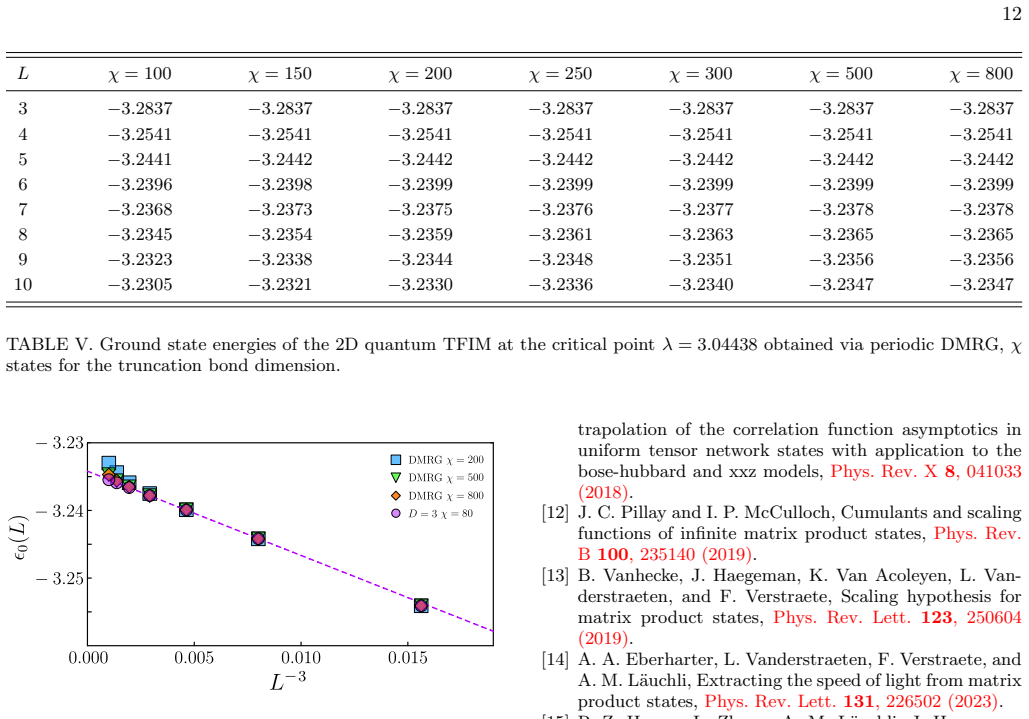
- For the 2D transverse-field Ising model at $\lambda_c$, optimized PEPS energies follow $\epsilon_0(L) \approx \epsilon_0 + \alpha/L^3$ and extrapolate to thermodynamic values ($-3.2322$ for $D=2$, $-3.2342$ for $D=3$) matching infinite-PEPS studies.
- A longitudinal-field perturbation yields magnetization $m_z \propto L^{3-2\Delta_\sigma}$, from which the paper extracts $\Delta_\sigma = 0.508$, within a few percent of conformal bootstrap and fuzzy-sphere values.
- For the XY and antiferromagnetic Heisenberg models, $D=3$ and $D=4$ PTMRG energies approach QMC values as $L$ grows, and the extracted Casimir constants $\alpha_c \approx 0.813$ (XY) and $1.302$ (Heisenberg) agree with QMC estimates.
- The PTMRG contraction reproduces the universal transfer-matrix spectrum of the critical 2D Ising model with roughly fifty reliable data points up to $L \approx 100$, at equal cost per step where TRG and HOTRG yield only five to eight.
Reading between the lines
- Editorial inference: the same $L \to L+1$ contraction should carry over to twisted boundary conditions through tube algebras, since only the wrapping of the corner tensor legs changes; a cheap check would be comparing PTMRG energies to exact diagonalization on small twisted tori.
- Editorial inference: if an adaptive cutoff that detects level crossings, for example through gradient-norm spikes, can be implemented, the method becomes applicable to sign-problematic or frustrated models, where QMC benchmarks are absent and the sweet-spot issue is the main obstacle.
- Editorial inference: the finite-size data sets of fifty or more $L$ values could be used to test higher-order corrections to the $\alpha/L^3$ scaling, potentially extracting subleading Casimir amplitudes that the paper does not analyze.
- Editorial inference: the roughly two-percent gap between $\Delta_\sigma = 0.508$ and the conformal bootstrap value $0.518148806(24)$ offers a quantitative target; repeating the extraction at $D=4$ and increasing $\chi$ would show whether the error is controlled by bond dimension or by truncation.
Signed reviews
Editorial analysis
A structured set of objections, weighed in public.
Referee Report
Summary. The manuscript introduces PTMRG, an approximate contraction scheme for two-dimensional tensor networks on a torus whose renormalization step grows the system size linearly (L to L+1) with an O(χ^5) cost per step. The authors combine PTMRG with automatic differentiation to optimize translation-invariant periodic PEPS, and benchmark the resulting finite-size ground-state energies for the transverse-field Ising, XY, and antiferromagnetic Heisenberg models, also extracting a scaling dimension Δσ from magnetization data. The classical Ising transfer-matrix benchmark shows that PTMRG maintains accurate CFT scaling up to larger L than TRG/HOTRG at comparable cost. The PEPS results approach QMC and DMRG values, but the reported PEPS simulations do not specify the crucial PTMRG truncation dimension χ or provide convergence checks, leaving the central finite-size-scaling claims incompletely supported.
Significance. If the performance claims withstand scrutiny, the paper describes a practical tool for finite-size scaling of two-dimensional quantum lattice models on the torus: linearly spaced system sizes and lower asymptotic cost than TRG/HOTRG are attractive, and the fully translation-invariant periodic PEPS parametrization is a natural fit for the geometry. Several strengths are explicit: the O(χ^5) cost analysis in Appendix C is concrete, the classical Ising benchmark provides a machine-checkable accuracy check with many data points, the PEPS energies are compared against independent QMC and DMRG results, and Appendix B honestly documents a known truncation-induced pathology. The principal weakness is that the PEPS benchmarks omit the values of χ used and contain no systematic χ-convergence study, so the L-dependent behavior that underlies the scaling fits could be contaminated by truncation errors whose size and L-dependence are unknown. This is a fixable reporting and validation gap rather than an obviously wrong central idea.
major comments (3)
- [Sec. IV, Tables I–II, Figs. 4, 6, 7; Sec. III; Appendix B] The PEPS benchmarks do not report the PTMRG truncation dimension χ used for any model, bond dimension D, or system size L. The central claim is finite-size scaling, i.e., that the L-dependence of the approximate energies follows the physical L^-3 or L^{3-2Δσ} forms. Appendix B shows that for the Heisenberg model with D=3, χ=30 gives discontinuous, non-variational energies and that χ=31 only removes the discontinuities locally, and the main text (Sec. III) states that a 'sweet spot' χ must be found. Without specifying the χ values and demonstrating convergence of, for example, ϵ0(L) with increasing χ at fixed L, the observed scaling in Figs. 4 and 7 and the extraction Δσ=0.508 in Fig. 6 may be biased by an L-dependent truncation error. This is the load-bearing issue for the paper's main claim, so a table of χ per model/D/L and a convergence check are required.
- [Sec. II.B versus Secs. IV–VI] The accuracy benchmark on the classical Ising model (Fig. 2) validates PTMRG for a single-layer local tensor with small local bond dimension, but it does not directly validate the double-layer PEPS contraction under automatic differentiation. For the PEPS benchmarks the contracted tensor has bond dimension D^2 (9 for D=3), and Appendix B demonstrates failure of gradient optimization precisely in that double-layer setting at insufficient χ. Consequently, the classical Ising accuracy result cannot by itself support the periodic PEPS finite-size-scaling claims; a PEPS-specific accuracy check is needed, for example comparing PTMRG energies against direct contraction for small L or against an independent boundary-MPS contraction for the same PEPS tensor.
- [Sec. V, Eq. (15), Fig. 6] The scaling dimension is reported as Δσ=0.508 without an uncertainty or a systematic-error estimate. The fit uses magnetization data at a single longitudinal field hz=10^-3 and for D=2,3, but the paper does not verify that hz is small enough for the linear-order perturbation theory leading to Eq. (15) to hold, nor that irrelevant-operator corrections are negligible over the fitted L range. Since the literature value is Δσ=0.518148806(24), the reported agreement is only qualitative without a quantified error bar; a short study of the fitted exponent versus hz and versus the L-window would make the claim testable.
minor comments (6)
- [Sec. II.B and Fig. 2] The text says 'Figure 2(a) shows the computational time required to perform one update step', but the caption of Fig. 2(a) describes the finite-size effect δΔσ(L), while Fig. 2(b) shows the computational time; the section and caption should be brought into agreement.
- [Appendix D] The word 'insert' in the caption of Fig. 8 should be 'inset'.
- [References] Reference [82] contains a typo: 'Journal of Marchine Learning Research' should be 'Journal of Machine Learning Research'.
- [Sec. III] The notion of a 'sweet spot' for χ is informal; since the paper does not define a criterion for choosing χ or for detecting when the energy landscape becomes smooth, a more precise guiding rule would improve reproducibility.
- [Tables I–II and Fig. 7] The QMC comparison would be more informative if the QMC statistical errors were shown on the finite-L values, since the differences between PEPS and QMC at the largest L are of the same order as typical QMC error bars.
- [Sec. IV] Table I reports energies for D=4 up to L=10, and Fig. 4 includes D=4, but Eq. (8) gives only the D=2 and D=3 thermodynamic extrapolations; reporting the D=4 extrapolation would clarify how 'nearly identical' the D=4 results are at the level of the fit.
Circularity Check
No significant circularity: PTMRG benchmarks and finite-size scaling analyses are checked against external QMC, DMRG, conformal-bootstrap, and exact Ising data.
full rationale
Walked the derivation chain. PTMRG is an algorithmic construction whose O(χ^5) per-step cost is counted in Appendix C; the 'linear L to L+1' update rule is the literal recursive definition of the coarse-graining, not a quantity fitted from the target. The TFIM energy extrapolation uses Eq. (6), a standard CFT finite-size scaling form, and is compared with independent DMRG and infinite-PEPS results. The Δσ = 0.508 extraction uses Eq. (15), derived by first-order perturbation theory, and the exponent is fit to the authors' own mz data; it is then compared with conformal-bootstrap and fuzzy-sphere values, so the target is not an input. The classical Ising benchmark uses exact Tc and Δσ = 1/8 as external references. The Casimir constants use literature velocities and are compared with QMC values. Several citations are to co-authors' prior work (e.g., Ref. [72] for error diagnostics and Ref. [81] for iPEPS energies), but none is load-bearing: each is background or a comparison target, and the central claims do not reduce to those citations. Appendix B explicitly discloses uncontrolled truncation, discontinuities, and the need for a 'sweet spot' χ; this is an accuracy and convergence limitation, not a circularity. The note-added acknowledgment of similarity to Ref. [115] affects novelty, not circular derivation. No definitional circularity or fitted-input-called-prediction was found.
Assumptions & free parameters
free parameters (4)
- PTMRG truncation dimension χ =
not stated for main benchmarks; χ=30 and 31 in Appendix B; χ=112 for Ising partition function in Fig. 2
- PEPS bond dimension D =
D=2, 3, 4 depending on benchmark
- Longitudinal field hz =
10^-2 for Fig. 5 and 10^-3 for Fig. 6
- Finite-size fit coefficients (ε0, α, Δσ, αc) =
ε0(L→∞) = -3.2322 (D=2) and -3.2342 (D=3) for TFIM; Δσ = 0.508; αc = 0.375, 0.813, 1.302
assumptions (5)
- domain assumption The ground states of the studied 2D critical spin models on a torus are well represented by a uniform PEPS with bond dimension D=3 or 4 for the observables considered.
- domain assumption HOSVD truncation in PTMRG yields a controlled approximation of the exact contraction for a sufficiently large χ.
- domain assumption The finite-size scaling formulas ε0(L) ≈ ε0 + α/L^3 (Eq. 6) and mz ∝ L^{3-2Δσ} (Eq. 15) apply to these models at the chosen critical parameters.
- domain assumption The transfer matrix spectrum of the critical 2D classical Ising model is given by Λ_n = A exp(-2πΔ_n), with Δ_σ = 1/8.
- domain assumption Automatic differentiation through the approximate PTMRG contraction gives gradients that are useful for optimization when χ is large enough.
Cite this review
Pith. "Pith review of Finite-size scaling on the torus with periodic projected entangled-pair states." pith.science (2026). https://pith.science/paper/3RT3E6Z6
@misc{pith2026241112731,
  author       = {Pith},
  title        = {Pith review of: Finite-size scaling on the torus with periodic projected entangled-pair states},
  year         = {2026},
  howpublished = {\url{https://pith.science/paper/3RT3E6Z6}},
  note         = {Machine review of arXiv:2411.12731}
}
abstract
An efficient algorithm is constructed for contracting two-dimensional tensor networks under periodic boundary conditions. The central ingredient is a novel renormalization step that scales linearly with system size, i.e. from $L \to L+1$. The numerical accuracy is comparable to state-of-the-art tensor network methods, while giving access to much more data points, and at a lower computational cost. Combining this contraction routine with the use of automatic differentiation, we arrive at an efficient algorithm for optimizing fully translation invariant projected entangled-pair states on the torus. Our benchmarks show that this method yields finite-size energy results that are comparable to those from quantum Monte Carlo simulations. When combined with field-theoretical scaling techniques, our approach enables accurate estimates of critical properties for two-dimensional quantum lattice systems.
Figures


Figures from the paper (6 more)


Reference graph
Works this paper leans on
-
[1]
M. E. Fisher and M. N. Barber, Scaling theory for finite- size effects in the critical region, Phys. Rev. Lett. 28, 1516 (1972)
1972
-
[2]
K. Binder, Finite size scaling analysis of Ising model 12 L χ = 100 χ = 150 χ = 200 χ = 250 χ = 300 χ = 500 χ = 800 3 −3.2837 −3.2837 −3.2837 −3.2837 −3.2837 −3.2837 −3.2837 4 −3.2541 −3.2541 −3.2541 −3.2541 −3.2541 −3.2541 −3.2541 5 −3.2441 −3.2442 −3.2442 −3.2442 −3.2442 −3.2442 −3.2442 6 −3.2396 −3.2398 −3.2399 −3.2399 −3.2399 −3.2399 −3.2399 7 −3.2368...
1981
-
[3]
Br´ ezin, E., An investigation of finite size scaling, J. Phys. France 43, 15 (1982)
1982
-
[4]
J. L. Cardy, Finite-size Scaling (North-Holland, 1988)
1988
-
[5]
Xiang, Density Matrix and Tensor Network Renor- malization (Cambridge University Press, 2023)
T. Xiang, Density Matrix and Tensor Network Renor- malization (Cambridge University Press, 2023)
2023
-
[6]
Nishino, K
T. Nishino, K. Okunishi, and M. Kikuchi, Numerical renormalization group at criticality, Physics Letters A 213, 69 (1996)
1996
-
[7]
Tagliacozzo, T
L. Tagliacozzo, T. R. de Oliveira, S. Iblisdir, and J. I. Latorre, Scaling of entanglement support for matrix product states, Phys. Rev. B 78, 024410 (2008)
2008
-
[8]
Pollmann, S
F. Pollmann, S. Mukerjee, A. M. Turner, and J. E. Moore, Theory of finite-entanglement scaling at one- dimensional quantum critical points, Phys. Rev. Lett. 102, 255701 (2009)
2009
Show all 115 references
-
[9]
Pirvu, G
B. Pirvu, G. Vidal, F. Verstraete, and L. Tagliacozzo, Matrix product states for critical spin chains: Finite- size versus finite-entanglement scaling, Phys. Rev. B86, 075117 (2012)
2012
-
[10]
Schollw¨ ock, The density-matrix renormalization group in the age of matrix product states, Annals of Physics 326, 96 (2011)
U. Schollw¨ ock, The density-matrix renormalization group in the age of matrix product states, Annals of Physics 326, 96 (2011)
2011
-
[11]
M. M. Rams, P. Czarnik, and L. Cincio, Precise ex- trapolation of the correlation function asymptotics in uniform tensor network states with application to the bose-hubbard and xxz models, Phys. Rev. X 8, 041033 (2018)
2018
-
[12]
J. C. Pillay and I. P. McCulloch, Cumulants and scaling functions of infinite matrix product states, Phys. Rev. B 100, 235140 (2019)
2019
-
[13]
Vanhecke, J
B. Vanhecke, J. Haegeman, K. Van Acoleyen, L. Van- derstraeten, and F. Verstraete, Scaling hypothesis for matrix product states, Phys. Rev. Lett. 123, 250604 (2019)
2019
-
[14]
A. A. Eberharter, L. Vanderstraeten, F. Verstraete, and A. M. L¨ auchli, Extracting the speed of light from matrix product states, Phys. Rev. Lett. 131, 226502 (2023)
2023
-
[15]
Huang, L
R.-Z. Huang, L. Zhang, A. M. L¨ auchli, J. Haegeman, F. Verstraete, and L. Vanderstraeten, Emergent con- formal boundaries from finite-entanglement scaling in matrix product states, Phys. Rev. Lett. 132, 086503 (2024)
2024
-
[16]
J. T. Schneider, A. Ueda, Y. Liu, A. M. L¨ auchli, M. Os- hikawa, and L. Tagliacozzo, Self-congruent point in crit- ical matrix product states: An effective field theory for finite-entanglement scaling (2024), arXiv:2411.03954 [cond-mat.stat-mech]
2024 arXiv
-
[17]
Vidal, Entanglement renormalization, Phys
G. Vidal, Entanglement renormalization, Phys. Rev. Lett. 99, 220405 (2007)
2007
-
[18]
Vidal, Class of quantum many-body states that can be efficiently simulated, Phys
G. Vidal, Class of quantum many-body states that can be efficiently simulated, Phys. Rev. Lett. 101, 110501 (2008)
2008
-
[19]
Giovannetti, S
V. Giovannetti, S. Montangero, and R. Fazio, Quantum multiscale entanglement renormalization ansatz chan- nels, Phys. Rev. Lett. 101, 180503 (2008)
2008
-
[20]
R. N. C. Pfeifer, G. Evenbly, and G. Vidal, Entangle- ment renormalization, scale invariance, and quantum criticality, Phys. Rev. A 79, 040301 (2009)
2009
-
[21]
Levin and C
M. Levin and C. P. Nave, Tensor renormalization group approach to two-dimensional classical lattice models, Phys. Rev. Lett. 99, 120601 (2007)
2007
-
[22]
Z.-C. Gu, M. Levin, and X.-G. Wen, Tensor- entanglement renormalization group approach as a uni- fied method for symmetry breaking and topological phase transitions, Phys. Rev. B 78, 205116 (2008)
2008
-
[23]
Z. Y. Xie, H. C. Jiang, Q. N. Chen, Z. Y. Weng, and T. Xiang, Second renormalization of tensor-network states, Phys. Rev. Lett. 103, 160601 (2009)
2009
-
[24]
Z. Y. Xie, J. Chen, M. P. Qin, J. W. Zhu, L. P. 13 Yang, and T. Xiang, Coarse-graining renormalization by higher-order singular value decomposition, Phys. Rev. B 86, 045139 (2012)
2012
-
[25]
Meurice, R
Y. Meurice, R. Sakai, and J. Unmuth-Yockey, Tensor lattice field theory for renormalization and quantum computing, Rev. Mod. Phys. 94, 025005 (2022)
2022
-
[26]
J. F. Yu, Z. Y. Xie, Y. Meurice, Y. Liu, A. Denbleyker, H. Zou, M. P. Qin, J. Chen, and T. Xiang, Tensor renor- malization group study of classical xy model on the square lattice, Phys. Rev. E 89, 013308 (2014)
2014
-
[27]
Evenbly and G
G. Evenbly and G. Vidal, Tensor network renormaliza- tion, Phys. Rev. Lett. 115, 180405 (2015)
2015
-
[28]
Evenbly, Algorithms for tensor network renormaliza- tion, Phys
G. Evenbly, Algorithms for tensor network renormaliza- tion, Phys. Rev. B 95, 045117 (2017)
2017
-
[29]
Yang, Z.-C
S. Yang, Z.-C. Gu, and X.-G. Wen, Loop optimization for tensor network renormalization, Phys. Rev. Lett. 118, 110504 (2017)
2017
-
[31]
Verstraete and J
F. Verstraete and J. I. Cirac, Valence-bond states for quantum computation, Phys. Rev. A 70, 060302 (2004)
2004
-
[32]
Verstraete and J
F. Verstraete and J. I. Cirac, Renormalization al- gorithms for Quantum-Many Body Systems in two and higher dimensions, arXiv 10.48550/arXiv.cond- mat/0407066 (2004), cond-mat/0407066
2004 doi
-
[33]
Shi, L.-M
Y.-Y. Shi, L.-M. Duan, and G. Vidal, Classical simula- tion of quantum many-body systems with a tree tensor network, Phys. Rev. A 74, 022320 (2006)
2006
-
[34]
Tagliacozzo, G
L. Tagliacozzo, G. Evenbly, and G. Vidal, Simulation of two-dimensional quantum systems using a tree tensor network that exploits the entropic area law, Phys. Rev. B 80, 235127 (2009)
2009
-
[35]
V. Murg, F. Verstraete, O. Legeza, and R. M. Noack, Simulating strongly correlated quantum systems with tree tensor networks, Phys. Rev. B 82, 205105 (2010)
2010
-
[36]
Jordan, R
J. Jordan, R. Or´ us, G. Vidal, F. Verstraete, and J. I. Cirac, Classical Simulation of Infinite-Size Quantum Lattice Systems in Two Spatial Dimensions, Phys. Rev. Lett. 101, 250602 (2008)
2008
-
[37]
Rader and A
M. Rader and A. M. L¨ auchli, Finite correlation length scaling in lorentz-invariant gapless ipeps wave functions, Phys. Rev. X 8, 031030 (2018)
2018
-
[38]
Corboz, P
P. Corboz, P. Czarnik, G. Kapteijns, and L. Tagliacozzo, Finite correlation length scaling with infinite projected entangled-pair states, Phys. Rev. X 8, 031031 (2018)
2018
-
[39]
Vanhecke, J
B. Vanhecke, J. Hasik, F. Verstraete, and L. Vander- straeten, Scaling hypothesis for projected entangled- pair states, Phys. Rev. Lett. 129, 200601 (2022)
2022
-
[40]
Mortier, M.-H
Q. Mortier, M.-H. Li, J. Haegeman, and N. Bultinck, Finite-entanglement scaling of 2d metals, Phys. Rev. Lett. 131, 266202 (2023)
2023
-
[41]
Porras, F
D. Porras, F. Verstraete, and J. I. Cirac, Renormaliza- tion algorithm for the calculation of spectra of interact- ing quantum systems, Phys. Rev. B 73, 014410 (2006)
2006
-
[42]
Pippan, S
P. Pippan, S. R. White, and H. G. Evertz, Efficient matrix-product state method for periodic boundary conditions, Phys. Rev. B 81, 081103 (2010)
2010
-
[43]
Rossini, V
D. Rossini, V. Giovannetti, and R. Fazio, Stiffness in 1d matrix product states with periodic boundary con- ditions, Journal of Statistical Mechanics: Theory and Experiment 2011, P05021 (2011)
2011
-
[44]
Pirvu, F
B. Pirvu, F. Verstraete, and G. Vidal, Exploiting trans- lational invariance in matrix product state simulations of spin chains with periodic boundary conditions, Phys. Rev. B 83, 125104 (2011)
2011
-
[45]
Draxler, J
D. Draxler, J. Haegeman, F. Verstraete, and M. Rizzi, Continuous matrix product states with periodic bound- ary conditions and an application to atomtronics, Phys. Rev. B 95, 045145 (2017)
2017
-
[46]
Y. Zou, A. Milsted, and G. Vidal, Conformal data and renormalization group flow in critical quantum spin chains using periodic uniform matrix product states, Phys. Rev. Lett. 121, 230402 (2018)
2018
-
[47]
Y. Zou, A. Milsted, and G. Vidal, Conformal fields and operator product expansion in critical quantum spin chains, Phys. Rev. Lett. 124, 040604 (2020)
2020
-
[48]
Zou and G
Y. Zou and G. Vidal, Emergence of conformal symmetry in quantum spin chains: Antiperiodic boundary condi- tions and supersymmetry, Phys. Rev. B 101, 045132 (2020)
2020
-
[49]
Y. Zou, K. Siva, T. Soejima, R. S. K. Mong, and M. P. Zaletel, Universal tripartite entanglement in one- dimensional many-body systems, Phys. Rev. Lett. 126, 120501 (2021)
2021
-
[50]
Van Damme, R
M. Van Damme, R. Vanhove, J. Haegeman, F. Ver- straete, and L. Vanderstraeten, Efficient matrix prod- uct state methods for extracting spectral information on rings and cylinders, Phys. Rev. B 104, 115142 (2021)
2021
-
[51]
S. Dong, C. Wang, H. Zhang, M. Zhang, and L. He, (2024), arXiv:2407.15333 [cond-mat.str-el]
2024 arXiv
-
[52]
R. J. Baxter, Dimers on a Rectangular Lattice, Journal of Mathematical Physics 9, 650 (1968)
1968
-
[53]
R. J. Baxter, Variational approximations for square lat- tice models in statistical mechanics, Journal of Statisti- cal Physics 19, 461 (1978)
1978
-
[54]
Nishino and K
T. Nishino and K. Okunishi, Corner transfer matrix renormalization group method, Journal of the Physical Society of Japan 65, 891 (1996)
1996
-
[55]
Nishino and K
T. Nishino and K. Okunishi, Corner transfer matrix al- gorithm for classical renormalization group, Journal of the Physical Society of Japan 66, 3040–3047 (1997)
1997
-
[56]
M. T. Fishman, L. Vanderstraeten, V. Zauner-Stauber, J. Haegeman, and F. Verstraete, Faster methods for con- tracting infinite two-dimensional tensor networks, Phys. Rev. B 98, 235148 (2018)
2018
-
[57]
Vanderstraeten, L
L. Vanderstraeten, L. Burgelman, B. Ponsioen, M. Van Damme, B. Vanhecke, P. Corboz, J. Haege- man, and F. Verstraete, Variational methods for con- tracting projected entangled-pair states, Phys. Rev. B 105, 195140 (2022)
2022
-
[58]
Or´ us and G
R. Or´ us and G. Vidal, Simulation of two-dimensional quantum systems on an infinite lattice revisited: Corner transfer matrix for tensor contraction, Phys. Rev. B 80, 094403 (2009)
2009
-
[59]
Corboz, J
P. Corboz, J. Jordan, and G. Vidal, Simulation of fermionic lattice models in two dimensions with pro- jected entangled-pair states: Next-nearest neighbor hamiltonians, Phys. Rev. B 82, 245119 (2010)
2010
-
[60]
Corboz, T
P. Corboz, T. M. Rice, and M. Troyer, Competing states in the t-j model: Uniform d-wave state versus stripe state, Phys. Rev. Lett. 113, 046402 (2014)
2014
-
[61]
S. Iino, S. Morita, and N. Kawashima, Boundary ten- sor renormalization group, Phys. Rev. B 100, 035449 (2019)
2019
-
[62]
Adachi, T
D. Adachi, T. Okubo, and S. Todo, Anisotropic ten- sor renormalization group, Phys. Rev. B 102, 054432 (2020). 14
2020
-
[63]
Adachi, T
D. Adachi, T. Okubo, and S. Todo, Bond-weighted ten- sor renormalization group, Phys. Rev. B 105, L060402 (2022)
2022
- [64]
-
[65]
Akiyama, Y
S. Akiyama, Y. Meurice, and R. Sakai, Tensor renormal- ization group for fermions, J. Phys. Condens. Matter36, 343002 (2024), arXiv:2401.08542 [hep-lat]
2024 arXiv
-
[66]
M. Bal, M. Mari¨ en, J. Haegeman, and F. Verstraete, Renormalization group flows of hamiltonians using ten- sor networks, Phys. Rev. Lett. 118, 250602 (2017)
2017
-
[67]
Hauru, C
M. Hauru, C. Delcamp, and S. Mizera, Renormaliza- tion of tensor networks using graph-independent local truncations, Phys. Rev. B 97, 045111 (2018)
2018
-
[68]
Homma, T
K. Homma, T. Okubo, and N. Kawashima, Nuclear norm regularized loop optimization for tensor network, Phys. Rev. Res. 6, 043102 (2024)
2024
-
[69]
De Lathauwer, B
L. De Lathauwer, B. De Moor, and J. Vandewalle, A Multilinear Singular Value Decomposition, SIAM J. Matrix Anal. Appl. (2006)
2006
-
[70]
Y. Liu, Y. Meurice, M. P. Qin, J. Unmuth-Yockey, T. Xiang, Z. Y. Xie, J. F. Yu, and H. Zou, Exact block- ing formulas for spin and gauge models, Phys. Rev. D 88, 056005 (2013)
2013
-
[71]
Ueda and M
A. Ueda and M. Oshikawa, Resolving the berezinskii- kosterlitz-thouless transition in the two-dimensional xy model with tensor-network-based level spectroscopy, Phys. Rev. B 104, 165132 (2021)
2021
-
[72]
Ueda and M
A. Ueda and M. Oshikawa, Finite-size and finite bond dimension effects of tensor network renormalization, Phys. Rev. B 108, 024413 (2023)
2023
-
[73]
Huang, S.-H
C.-Y. Huang, S.-H. Chan, Y.-J. Kao, and P. Chen, Ten- sor network based finite-size scaling for two-dimensional ising model, Phys. Rev. B 107, 205123 (2023)
2023
-
[74]
J. L. Cardy, Conformal invariance and universality in finite-size scaling, J. Phys. A 17, L385 (1984)
1984
-
[75]
J. L. Cardy, Operator Content of Two-Dimensional Conformally Invariant Theories, Nucl. Phys. B270, 186 (1986)
1986
-
[76]
Gu and X.-G
Z.-C. Gu and X.-G. Wen, Tensor-entanglement-filtering renormalization approach and symmetry-protected topological order, Phys. Rev. B 80, 155131 (2009)
2009
-
[77]
H. C. Jiang, Z. Y. Weng, and T. Xiang, Accurate De- termination of Tensor Network State of Quantum Lat- tice Models in Two Dimensions, Phys. Rev. Lett. 101, 090603 (2008)
2008
-
[78]
Wang and F
L. Wang and F. Verstraete, Cluster update for tensor network states (2011), arXiv:1110.4362 [cond-mat.str- el]
2011 arXiv
-
[79]
H. N. Phien, J. A. Bengua, H. D. Tuan, P. Corboz, and R. Or´ us, Infinite projected entangled pair states algorithm improved: Fast full update and gauge fixing, Phys. Rev. B 92, 035142 (2015)
2015
-
[80]
Corboz, Variational optimization with infinite pro- jected entangled-pair states, Phys
P. Corboz, Variational optimization with infinite pro- jected entangled-pair states, Phys. Rev. B 94, 035133 (2016)
2016
-
[81]
Vanderstraeten, J
L. Vanderstraeten, J. Haegeman, P. Corboz, and F. Ver- straete, Gradient methods for variational optimization of projected entangled-pair states, Phys. Rev. B 94, 155123 (2016)
2016
-
[82]
A. G. Baydin, B. A. Pearlmutter, A. A. Radul, and J. M. Siskind, Automatic differentiation in machine learning: a survey, Journal of Marchine Learning Research 18, 1 (2018)
2018
-
[83]
oblique projector
and optimize the variational energy. However, all of these developments are centered around uniform PEPS in the thermodynamic limit. Optimiza- tion of finite PEPS [84, 85] has proven to be considerably more difficult, although the sampling and stochastic op- timization of gene...
-
[84]
Liao, J.-G
H.-J. Liao, J.-G. Liu, L. Wang, and T. Xiang, Differen- tiable programming tensor networks, Phys. Rev. X 9, 031041 (2019)
2019
-
[85]
Lubasch, J
M. Lubasch, J. I. Cirac, and M.-C. Ba˜ nuls, Algorithms for finite projected entangled pair states, Phys. Rev. B 90, 064425 (2014)
2014
-
[86]
Scheb and R
M. Scheb and R. M. Noack, Finite projected entangled pair states for the hubbard model, Phys. Rev. B 107, 165112 (2023)
2023
-
[87]
Liu, S.-J
W.-Y. Liu, S.-J. Dong, Y.-J. Han, G.-C. Guo, and L. He, Gradient optimization of finite projected entangled pair states, Phys. Rev. B 95, 195154 (2017)
2017
-
[88]
Vieijra, J
T. Vieijra, J. Haegeman, F. Verstraete, and L. Van- derstraeten, Direct sampling of projected entangled-pair states, Phys. Rev. B 104, 235141 (2021)
2021
-
[89]
M. P. Zaletel and F. Pollmann, Isometric tensor network states in two dimensions, Phys. Rev. Lett. 124, 037201 (2020)
2020
-
[90]
S.-H. Lin, M. P. Zaletel, and F. Pollmann, Efficient sim- ulation of dynamics in two-dimensional quantum spin systems with isometric tensor networks, Phys. Rev. B 106, 245102 (2022)
2022
-
[91]
R. H. Byrd, P. Lu, J. Nocedal, and C. Zhu, A Limited Memory Algorithm for Bound Constrained Optimiza- tion, SIAM J. Sci. Comput. (2006)
2006
-
[92]
Privman and M
V. Privman and M. E. Fisher, Universal critical ampli- tudes in finite-size scaling, Phys. Rev. B 30, 322 (1984)
1984
-
[93]
Klumper and M
A. Klumper and M. T. Batchelor, An analytic treatment of finite-size corrections in the spin-1 antiferromagnetic XXZ chain, J. Phys. A: Math. Gen. 23, L189 (1990)
1990
-
[94]
P. A. Pearce and A. Kl¨ umper, Finite-size corrections and scaling dimensions of solvable lattice models: An analytic method, Phys. Rev. Lett. 66, 974 (1991)
1991
-
[95]
Destri and H
C. Destri and H. J. de Vega, Unified approach to Ther- modynamic Bethe Ansatz and finite size corrections for lattice models and field theories, Nucl. Phys. B 438, 413 (1995)
1995
-
[96]
Dugave, F
M. Dugave, F. G¨ ohmann, K. K. Kozlowski, and J. Suzuki, On form-factor expansions for the XXZ chain in the massive regime, J. Stat. Mech.: Theory Exp. 2015 (5), P05037
2015
-
[97]
Rader and A
M. Rader and A. M. L¨ auchli, Finite Correlation Length Scaling in Lorentz-Invariant Gapless iPEPS Wave Func- tions, Phys. Rev. X 8, 031030 (2018)
2018
-
[98]
Schuler, S
M. Schuler, S. Whitsitt, L.-P. Henry, S. Sachdev, and A. M. L¨ auchli, Universal signatures of quantum critical points from finite-size torus spectra: A window into the operator content of higher-dimensional conformal field theories, Phys. Rev. Lett. 117, 210401 (2016)
2016
-
[99]
C. J. Hamer, Finite-size scaling in the transverse ising model on a square lattice, Journal of Physics A: Math- ematical and General 33, 6683–6698 (2000)
2000
-
[100]
Henkel and A
M. Henkel and A. Patkos, Conformal invariance and line defects in the two-dimensional ising model, Journal of Physics A: Mathematical and General 21, L231 (1988)
1988
-
[101]
Chang, V
C.-H. Chang, V. Dommes, R. S. Erramilli, A. Homrich, P. Kravchuk, A. Liu, M. S. Mitchell, D. Poland, and D. Simmons-Duffin, Bootstrapping the 3d ising stress tensor, arXiv preprint arXiv:2411.15300 (2024)
2024 arXiv
-
[102]
W. Zhu, C. Han, E. Huffman, J. S. Hofmann, and Y.-C. He, Uncovering Conformal Symmetry in the 3D Ising Transition: State-Operator Correspondence from a Quantum Fuzzy Sphere Regularization, Phys. Rev. X 13, 021009 (2023), arXiv:2210.13482 [cond-mat.stat- 15 mech]
2023 arXiv
-
[103]
A. W. Sandvik and C. J. Hamer, Ground-state parame- ters, finite-size scaling, and low-temperature properties of the two-dimensional S = 1 2 XY model, Phys. Rev. B 60, 6588 (1999)
1999
-
[104]
A. W. Sandvik, Finite-size scaling of the ground-state parameters of the two-dimensional Heisenberg model, Phys. Rev. B 56, 11678 (1997)
1997
-
[105]
A. Sen, H. Suwa, and A. W. Sandvik, Velocity of excita- tions in ordered, disordered, and critical antiferromag- nets, Phys. Rev. B 92, 195145 (2015)
2015
-
[106]
Whitsitt, M
S. Whitsitt, M. Schuler, L.-P. Henry, A. M. L¨ auchli, and S. Sachdev, Spectrum of the wilson-fisher confor- mal field theory on the torus, Phys. Rev. B 96, 035142 (2017)
2017
-
[107]
Schuler, S
M. Schuler, S. Hesselmann, S. Whitsitt, T. C. Lang, S. Wessel, and A. M. L¨ auchli, Torus spectroscopy of the gross-neveu-yukawa quantum field theory: Free dirac versus chiral ising fixed point, Phys. Rev. B103, 125128 (2021)
2021
-
[108]
Wietek, S
A. Wietek, S. Capponi, and A. M. L¨ auchli, Quantum electrodynamics in 2 + 1 dimensions as the organizing principle of a triangular lattice antiferromagnet, Phys. Rev. X 14, 021010 (2024)
2024
-
[109]
Vanderstraeten, M
L. Vanderstraeten, M. Mari¨ en, F. Verstraete, and J. Haegeman, Excitations and the tangent space of pro- jected entangled-pair states, Phys. Rev. B 92, 201111 (2015)
2015
-
[110]
Vanderstraeten, J
L. Vanderstraeten, J. Haegeman, and F. Verstraete, Simulating excitation spectra with projected entangled- pair states, Phys. Rev. B 99, 165121 (2019)
2019
-
[111]
Ponsioen and P
B. Ponsioen and P. Corboz, Excitations with projected entangled pair states using the corner transfer matrix method, Phys. Rev. B 101, 195109 (2020)
2020
-
[112]
Pirvu, J
B. Pirvu, J. Haegeman, and F. Verstraete, Matrix prod- uct state based algorithm for determining dispersion re- lations of quantum spin chains with periodic boundary conditions, Phys. Rev. B 85, 035130 (2012)
2012
-
[113]
Bultinck, M
N. Bultinck, M. Mari¨ en, D. Williamson, M. S ¸ahino˘ glu, J. Haegeman, and F. Verstraete, Anyons and matrix product operator algebras, Annals of Physics 378, 183 (2017)
2017
-
[114]
Lootens, C
L. Lootens, C. Delcamp, and F. Verstraete, Dualities in one-dimensional quantum lattice models: Topological sectors, PRX Quantum 5, 010338 (2024)
2024
-
[115]
Haegeman, Tensorkit julia package,https://github
J. Haegeman, Tensorkit julia package,https://github. com/Jutho/TensorKit.jl (2021)
2021
-
[116]
Lan and G
W. Lan and G. Evenbly, Tensor renormalization group centered about a core tensor, Physical Review B 100, 10.1103/physrevb.100.235118 (2019)
2019 doi
Reviewed August 12, 2026 · model on record in the stance chip above.
Discussion (0). Continue with ORCID to comment.