REVIEW 3 major objections 4 minor 28 references
Gracefulness of two nested cycles: a first approach
T0 review · 3 major / 4 minor · reviewed 2026-08-12 · deepseek-v4-flash
Pith's one-line read Two nested cycles admit graceful labelings in every congruence class that parity allows, once the outer cycle is sufficiently long.
desk verdict Plausible new constructions for graceful two nested cycles, but the snowflake classification is not proven as stated because Lemma 4.16 fails for stars of sizes 1 and 2. read the letter →
The pith
A machine-rendered reading of the paper's core claim, the machinery that carries it, and where it could break.
The reading
What carries the argument
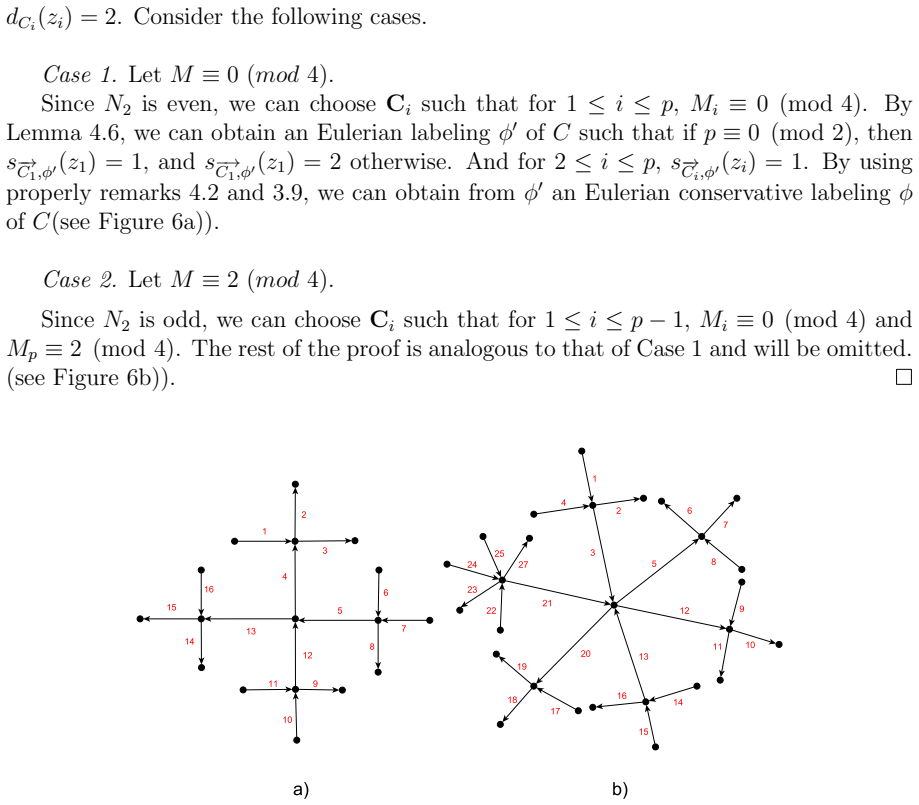
The central object is the snowflake, the tree obtained from a galaxy of stars by identifying one leaf from each star at a single vertex; this is exactly the semidual of a two nested cycles graph. The labeling machinery is built from $t$-Skolem sequences, partitions of $\{1,2,\dots,2n-1\}\cup\{2n+t\}$ into $n$ pairs whose differences are $1,2,\dots,n$, repackaged as zero-sum Skolem systems that assign signed edge labels to each star so that every internal vertex has zero sum. Attachment lemmas (Proposition 3.6, Lemmas 4.6--4.15) show how to glue a conservative or near-conservative snowflake to stars that admit balanced (Eulerian) conservative labelings, by matching vertex-sums at the joining vertex. The proof of Theorem 4.17 splits snowflakes into even snowflakes, handled by parity cases, and non-even snowflakes reduced to a minimum snowflake with star sizes $3,4,5,6$ plus extra stars of sizes divisible by $4$; the reduction is Lemma 4.16.
What would settle it
A concrete test: exhaustively search all snowflakes with up to, say, 20 edges and check whether every one with $M \equiv 0,3 \pmod 4$ admits a zero-sum labeling with zero vertex-sum at each internal vertex; the first failure would refute Theorem 4.17, while a full pass would isolate any remaining gap to the missing decomposition proof.
Extended reading notes
Core claim
On its own terms, the paper establishes a complete congruence classification for snowflakes: a snowflake of size $M$ is conservative exactly when $M \equiv 0,3 \pmod 4$, and near-conservative when $M \equiv 1,2 \pmod 4$ (Theorem 4.17). Since the semidual of a two nested cycles graph is a snowflake, this characterizes when that semidual is conservative or near-conservative. The second result is an existence theorem for the original graphs: for any $m_1 \ge 3$, whenever $m_2 \ge m_1(2m_1-1)$ and $m_1+m_2 \equiv 0,3 \pmod 4$, the set $N_g(m_1,m_2)$ of graceful two nested cycles graphs is nonempty, and when $m_1+m_2 \equiv 1,2 \pmod 4$ the set $N_{n-g}(m_1,m_2)$ of near-graceful ones is nonempty (Theorem 2.1).
Load-bearing premise
The proof depends on the claim, stated without a detailed demonstration, that every non-even snowflake can be obtained by gluing stars whose sizes are multiples of four onto a small 'minimum' snowflake, and Theorem 2.1's four-case construction is only written out for one case, with the other three described as similar.
Editorial extensions
If this is right
- Every snowflake with $M \equiv 0,3 \pmod 4$ edges admits a conservative labeling, and every other snowflake admits a near-conservative labeling, so this tree family is fully classified.
- For each $m_1 \ge 3$ and $m_2 \ge m_1(2m_1-1)$, the congruence of $m_1+m_2$ alone determines whether a graceful or near-graceful two nested cycles graph exists.
- The known parity obstruction for graphs whose vertices all have even degree is sharp in this family: in the excluded residue classes the near-graceful labeling is the best possible outcome.
- The semidual viewpoint reduces a problem about vertex labelings of even-degree plane graphs to a problem about signed edge labelings of star trees, giving a template for studying other plane cycles with chords.
- The paper leaves open whether every two nested cycles graph with an allowed total size is graceful, not just those with a sufficiently long outer cycle.
Reading between the lines
- The same star-attachment machinery, if the decomposition lemma is proved in full, would likely extend the conservative and near-conservative classification to other trees whose internal degrees are controlled, not just snowflakes.
- The threshold $m_1(2m_1-1)$ is probably not the true minimum; the omitted 'similar' cases suggest the construction may work for much smaller $m_2$, and small-case computation could reveal the actual bound.
- Because conservative snowflake labelings correspond to zero-sum families of signed integer sequences (Skolem systems), the construction doubles as an existence proof for design-theoretic objects such as cyclic cycle decompositions or Heffter arrays with prescribed branch sizes.
- A computational search over small two nested cycles graphs could turn the paper's closing question into a conjecture: check whether every graph with $M \equiv 0,3 \pmod 4$ is graceful, using Theorem 4.17 to filter semiduals that admit conservative labelings first.
Signed reviews
Editorial analysis
A structured set of objections, weighed in public.
Referee Report
Summary. This paper addresses two related graph-labeling questions. Theorem 2.1 asserts that for every m1 ≥ 3 and every m2 ≥ m1(2m1−1), there is a two nested cycles plane graph that is graceful if m1+m2 ≡ 0 or 3 (mod 4) and near-graceful if m1+m2 ≡ 1 or 2 (mod 4). The second main result, Theorem 4.17, asserts that every snowflake (a tree obtained by identifying one leaf from each of a disjoint family of stars) of size M is conservative when M ≡ 0 or 3 (mod 4) and near-conservative otherwise. The proofs are constructive and rely on Skolem systems and attachment lemmas from the literature, connecting conservativeness of snowflakes with gracefulness of two nested cycles via the semidual construction.
Significance. If completed, the results would provide a clean semidual obstruction and a new infinite family of graceful Eulerian plane graphs, which is notable because most previously studied graceful cycles with chords are non-Eulerian. The paper is explicitly a first approach and has the virtue of giving explicit labelings in the written cases. The reliance on [13] and [16] is not circular: the new statements are existence results with explicit constructions. However, the manuscript as submitted does not establish the full theorems, because several load-bearing case analyses are omitted and one decomposition lemma is false on its stated domain.
major comments (3)
- [Section 2, proof of Theorem 2.1] Only Case 1 of the four-case construction is proved. Cases 2, 3, and 4 are dismissed with the statement that the analysis is similar and omitted; but the theorem's near-graceful conclusions for m ≡ 1, 2 (mod 4) rest on Cases 2 and 4, and Case 3 covers a parity subcase of the graceful conclusion. The examples in Figures 2–5 illustrate only m1 = 3 and m1 = 4 and do not constitute a proof for all parameters. The omitted cases must be written out or replaced by a uniform argument that covers all four parity combinations.
- [Section 4, Lemma 4.16] The decomposition used in the proof of Lemma 4.16 is not valid for all snowflakes allowed by Definition 4.1. Definition 4.1 permits stars of any positive size, while a minimum snowflake uses only sizes 3, 4, 5, 6 and the attached stars are required to have sizes divisible by 4. A snowflake containing a star of size 1 or 2 cannot be represented in this form: for instance C_{2,3} has size 5, is non-even (it has an internal vertex of degree 3), and admits no decomposition into a minimum snowflake plus stars of sizes divisible by 4. Since Lemma 4.16 is the entire input to Theorem 4.17, the classification of snowflakes is not proved for the full class stated. The authors should either restrict Definition 4.1 and Theorem 4.17 to exclude sizes 1 and 2, or provide an additional argument covering those cases.
- [Section 4, Lemmas 4.7, 4.8, 4.10, 4.12, 4.15] Several lemmas used in the proof of Theorem 4.17 omit essential subcases. Lemma 4.7 Case 2, Lemma 4.8 Case 2, Lemma 4.10 Case 3.2, and Lemma 4.15 Case 1.2 are all declared analogous and not proved; Lemma 4.12 is dismissed as easy. These omissions are load-bearing: Lemmas 4.7 and 4.8 together prove Theorem 4.9 for even snowflakes, and Lemma 4.15 is needed for the non-odd minimum snowflakes in Lemma 4.16. A revised manuscript should either supply the omitted arguments or clearly reduce them to the proved cases with explicit justification.
minor comments (4)
- [Section 4, Lemma 4.16] In the sentence describing the attachment, 'aforth' should be 'aforementioned' and 'most be identified' should be 'must be identified'.
- [Section 4, Lemma 4.14] In the bullet points, the expressions 'M + k − t + 2' appear where 'M + k + t + 2' seems intended; please check the consistency of the signs.
- [Section 4, Lemma 4.15] The notation 'sC2(z2)' lacks the arrow over C2 and should be written as 's_{\vec{C}_2}(z_2)' as in the rest of the paper.
- [Section 2, proof of Theorem 2.1] The intervals defining f(e_i) may appear empty for small values of m2; a sentence confirming that the hypothesis m2 ≥ m1(2m1−1) guarantees all intervals are nonempty in all four cases would help the reader.
Circularity Check
No significant circularity: the main theorems are derived from explicit labelings and independent prior lemmas; the unproved decomposition in Lemma 4.16 is a correctness gap, not a circular reduction.
full rationale
The derivation chain is not circular. Theorem 4.17 is built from independent prior results (stars and galaxies are conservative via [13], and the attachment Proposition 3.6 from [16]) together with new Skolem-system lemmas 4.10–4.15 that construct labelings of minimum odd snowflakes. None of these cited lemmas states or assumes that every snowflake, or the semidual of a two-nested-cycles graph, is conservative, so the target theorem is not an input to its own proof. Theorem 2.1 is also an explicit construction: the edge-labeling f and vertex-labeling phi are written out, and the verification in Case 1 is a direct set-equality; the other cases are merely omitted as “similar,” which is an incompleteness, not circularity. The main substantive concern is Lemma 4.16, which asserts without proof that every non-even snowflake decomposes into a minimum snowflake plus stars whose sizes are multiples of four. That assertion is not justified by Definition 4.1 and appears not to cover stars of size 1 or 2, so Theorem 4.17 as stated may not be fully established for all snowflakes. However, this is a domain/completeness gap, not a circular step: the claimed decomposition, if true, would feed independent lemmas, and if false, the theorem is unproved rather than equivalent to its assumptions. The self-citations [13] and [16] are load-bearing, but they are prior published results whose statements do not include the present theorem, so they do not make the derivation circular.
Assumptions & free parameters
assumptions (7)
- standard math Rosa's theorem: an Eulerian graph with |E(G)| ≡ 1,2 (mod 4) has no graceful labeling.
- standard math The dual/semidual transfer: a graceful plane graph has a conservative dual and a near-graceful plane graph has a near-conservative dual (Theorem 1.2 and its adapted version).
- standard math Existence of t-Skolem sequences (Theorem 3.7, from Skolem and O'Keefe).
- standard math The (3·n; k; t)-Skolem system with R-order exists when n ≡ t+1,-t (mod 4) (Lemma 3.12 from [13]).
- standard math The mixed (3·n1, 5·n2; k; t)-Skolem system exists under the stated congruence conditions (Lemma 3.17 from [13]).
- ad hoc to paper The omitted 'similar' cases in Theorem 2.1 and in Lemmas 4.7, 4.8, 4.10, 4.15, and 4.12 actually follow by analogy.
- ad hoc to paper Lemma 4.16's decomposition of every non-even snowflake into a minimum snowflake plus stars of size divisible by four.
Cite this review
Pith. "Pith review of Gracefulness of two nested cycles: a first approach." pith.science (2026). https://pith.science/paper/Y4ZRACKO
@misc{pith2026241112998,
  author       = {Pith},
  title        = {Pith review of: Gracefulness of two nested cycles: a first approach},
  year         = {2026},
  howpublished = {\url{https://pith.science/paper/Y4ZRACKO}},
  note         = {Machine review of arXiv:2411.12998}
}
abstract
It is known that if a plane graph is graceful (resp. near-graceful), then its semidual is conservative (resp. near-conservative). In this work we prove that the semidual of a plane graph of size $M$ consisting of two nested cycles is conservative if $M \equiv 0,3 \pmod 4$, and near-conservative otherwise. We also show that for a given integer $m_1 \geq 3$, there exists $m^* > m_1$ such that for $m_2 \geq m^*$, if $m_1+m_2 \equiv 0,3 \pmod 4$ (resp. $m_1+m_2 \equiv 1,2 \pmod 4$), then there exists a graceful (resp. near-graceful) plane graph consisting of two nested cycles with sizes $m_1$ and $m_2$, respectively.
Figures


Figures from the paper (7 more)




Reference graph
Works this paper leans on
-
[13]
I. Goldfeder and J. Tey, A note on conservative galaxies, Skolem systems, cyclic cycle decompositions, and Heffter arrays , Discrete Mathematics 341, 2519-2528, 2018. 23
work page 2018
-
[16]
M. Licona and J. Tey, Conservative trees, Discrete Mathematics, 347, Issue 3, 113854, 2024
work page 2024
-
[1]
B. D. Acharya and M. K. Gill, On the index of gracefulness of a graph and the gracefulness of two-dimensional square lattice graphs, Indian J. Math., 23, 81-94, 1981
work page 1981
-
[2]
A. H. Alkasasbeh and D. Dyer, Graceful Labellings of Various Cyclic Snakes , https://arxiv.org/pdf/2012.10341, 2021
work page Pith review arXiv 2012
-
[3]
D. Archdeacon, T. Boothby and J. H. Dinitz, Tight Heffter Arrays Exist for all Possible Values, J. Combin. Des. 25 (1), 5-35, 2017
work page 2017
-
[4]
D. Archdeacon, J.H Dinitz, D.M. Donovan and E. Yazici, Square integer Heffter arrays with empty cells , Des. Codes Cryptogr. 77, no. 2-3, 409-426, 2015
work page 2015
- [5]
-
[6]
Barrientos, Graceful labelings of cyclic snakes, Ars Combin., 60, 85-96, 2001
C. Barrientos, Graceful labelings of cyclic snakes, Ars Combin., 60, 85-96, 2001
work page 2001
Show all 28 references
-
[7]
Barrientos, On graceful chain graphs, Util
C. Barrientos, On graceful chain graphs, Util. Math., 78, 55-64, 2009
2009
-
[8]
Delorme, K.M
C. Delorme, K.M. Koh, M. Maheo, H.K. Teo and H. Thuillier, Cycles with a chord are graceful, J. Graph Theory 4, 409-415, 1980
1980
-
[9]
Dinitz and I.M
J.H. Dinitz and I.M. Wanless, The existence of square integer Heffter arrays, Ars. Math. Contemp., 13, 81-93, 2017
2017
-
[10]
Elumalai and A
A. Elumalai and A. Anand Ephremnath, Gracefulness of a cycle with zigzag chords, International Journal of Pure and Applied Mathematics, 2015
2015
-
[11]
Frucht and J
R. Frucht and J. A. Gallian, Labeling prisms, Ars Combin., 26, 69-82, 1988
1988
-
[12]
J. A. Gallian, Labeling prisms and prism related graphs, Congr. Numer., 59, 89-100, 1989
1989
-
[14]
R. B. Gnanajothi, Topics in Graph Theory, Ph. D. Thesis, Madurai Kamaraj Uni- versity, 1991
1991
-
[15]
Koh and N
K.M. Koh and N. Punnim, On graceful graphs: cycles with 3-consecutive chords, Bull. Malaysian Math. Soc., 5, 49-63, 1982
1982
-
[17]
Liu, On Bodendiek’s conjecture for graceful graphs, Chinese Quart
Y. Liu, On Bodendiek’s conjecture for graceful graphs, Chinese Quart. J. Math., 4 , suppl., 67-73, 1989
1989
-
[18]
Ma, A graceful numbering of a class of graphs, J
X. Ma, A graceful numbering of a class of graphs, J. Math. Res. and Exposition, 215-216, 1988
1988
-
[19]
Ma, Y.Liu and W
X. Ma, Y.Liu and W. Liu, Graceful graphs: cycles with (t − 1) chords, Math. Appl., 9 , suppl., 6-8, 1990
1990
-
[20]
Maheo, Strongly graceful graphs, Discrete Math., 29, 39-46, 1980
M. Maheo, Strongly graceful graphs, Discrete Math., 29, 39-46, 1980. https:// core.ac.uk/download/pdf/82643761.pdf
1980
-
[21]
Moulton, Graceful Labellings of Triangular Snakes, Ars
D. Moulton, Graceful Labellings of Triangular Snakes, Ars. Combin., 28 2-13, 1989
1989
-
[22]
O’Keefe, Verification of a conjecture of Th
E.S. O’Keefe, Verification of a conjecture of Th. Skolem, Math. Scand., 9, 80-82, 1961
1961
-
[23]
S. B. Rao and U. K. Sahoo, Embeddings in Eulerian graceful graphs, Australasian J. Comb., 62(1), 128-139, 2015
2015
-
[24]
Rosa, On certain valuations of the vertices of a graph, Theory of Graphs (In- ternational Symposium , Rome, July 1966), Gordon and Breach, N
A. Rosa, On certain valuations of the vertices of a graph, Theory of Graphs (In- ternational Symposium , Rome, July 1966), Gordon and Breach, N. Y. and Dunod Paris, 349-355, 1967
1966
-
[25]
Sekar, Studies in Graph Theory, Ph.D
C. Sekar, Studies in Graph Theory, Ph.D. Thesis, Madurai Kamaraj University, 2002
2002
-
[26]
Skolem, On certain distributions of integers in pairs with given differences, Math
Th. Skolem, On certain distributions of integers in pairs with given differences, Math. Scand., 5, suppl., 57-58, 1957
1957
-
[27]
D. B. West, Introduction to graph theory second edition, Pearson Education (Sin- gapore) Pte. Ltd., Indian Braneh, 482 F.I.E. Patparganj, Delhi 1 10 092, India, 2002
2002
-
[28]
Y. C. Yang and X. G. Wang, On the gracefulness of the product CnxP2, J. Math. Research and Exposition, 1, 143-148, 1992. 24
1992
Reviewed August 12, 2026 · model on record in the stance chip above.
Discussion (0). Continue with ORCID to comment.