REVIEW 3 major objections 5 minor 77 references
The temporal and spatial variations of lithium abundance in the Galactic disc
T0 review · 3 major / 5 minor · reviewed 2026-08-12 · deepseek-v4-flash
Pith's one-line read The paper claims that lithium in the Milky Way's disc rose from 14 to 6 billion years ago, dipped to a minimum near 4.5 billion years, then rose again sharply, with the youngest lithium-rich stars born in the outer disc and migrating…
desk verdict The age–lithium relation is a real empirical step forward, but the spatial story has an internal sign contradiction that undermines the migration and gradient claims. read the letter →
The pith
A machine-rendered reading of the paper's core claim, the machinery that carries it, and where it could break.
The reading
What carries the argument
The load-bearing object is the birth radius $R_{\rm birth}$, assigned through Eq. (7): $R_{\rm birth} = ([\mathrm{Fe/H}] - [\mathrm{Fe/H}](0,\tau)) / \nabla[\mathrm{Fe/H}](\tau)$, where $\nabla[\mathrm{Fe/H}](\tau)$ is the interstellar metallicity gradient at lookback time $\tau$, taken from a linear relation calibrated by two sets of cosmological simulations and interpolated from a published table. This converts a present-day snapshot of stellar lithium into a time-resolved radial map of enrichment, and it is what lets the paper attribute young Li-rich stars to the outer disc. Supporting machinery includes the Bayesian stellar ages from matching Gaia luminosities with GALAH spectroscopic parameters, the 3D NLTE lithium catalogue, and LOESS local non-parametric regression used to extract trends from the age- and radius-binned scatter.
What would settle it
Take the same 22,034 stars and compute $R_{\rm birth}$ from a forward chemical-evolution model with explicit radial migration and a non-linear, time-dependent metallicity gradient, rather than the linear lookback-time gradient of Eq. (7). If the young Li-rich stars no longer cluster at $R_{\rm birth} > 10$ kpc, or the 6-4 Gyr gradient no longer turns negative and broken, the three-epoch lithium history is an artifact of the assumed linear gradient. Independently, measure lithium in young stars whose orbital actions indicate outer-disc birth and check whether their $A(\mathrm{Li})$ exceeds 2.7 dex.
Extended reading notes
Core claim
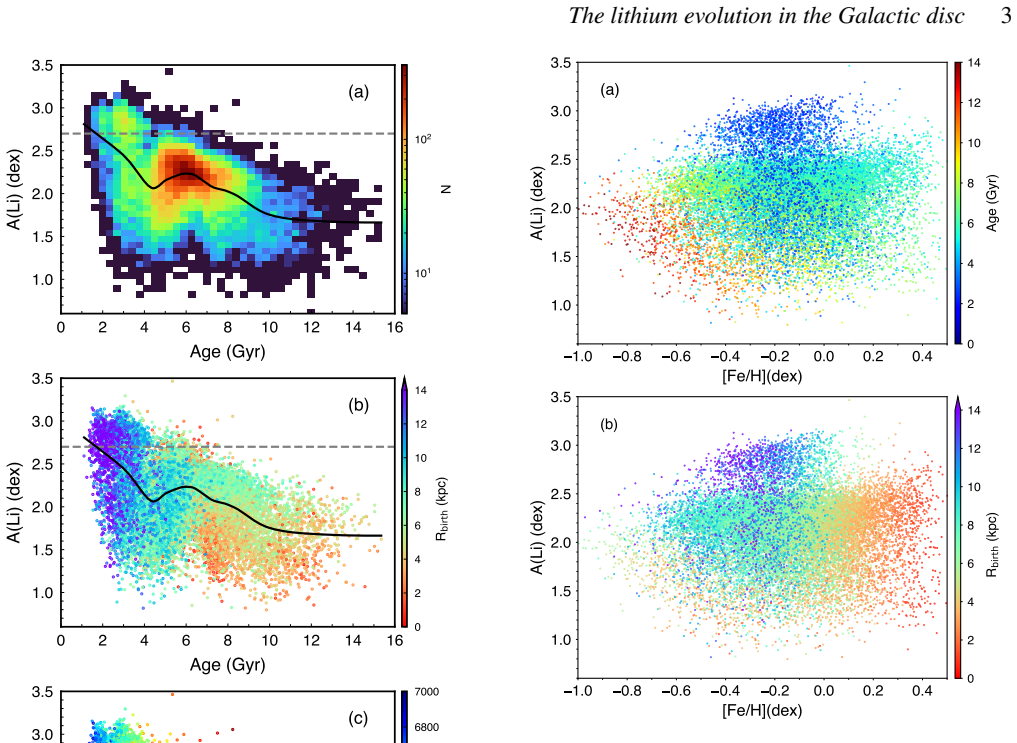
On its own terms, the central discovery is that the temporal evolution of disc lithium is non-monotonic and spatially structured. In the age-$A(\mathrm{Li})$ plane, the sample shows $A(\mathrm{Li})$ rising from about 1.5 dex at 14 Gyr to roughly 2.2 dex at 6 Gyr, slipping to about 2.1 dex at 4.5 Gyr, and then climbing past 2.7 dex by 2 Gyr. The downturn marks the Li dip, and the paper pins its age range to 4-5 Gyr, spanning main-sequence turn-off stars through subgiants, with most of these stars having $T_{\rm eff}$ below 6200 K. Binning by guiding-center radius and $z_{\rm max}$, the paper finds that young Li-rich stars (age $<4$ Gyr, $A(\mathrm{Li}) > 2.7$ dex) have birth radii mostly above 10 kpc in every spatial bin, indicating that they formed in the outer disc and migrated to the local and inner discs; stars born in the inner disc instead show a rapid lithium enrichment between 8 and 6 Gyr ago. The radial profile of lithium with respect to birth radius exhibits three epochs: a positive gradient at 14-6 Gyr ago, a negative and broken gradient at 6-4 Gyr ago driven by Li-dip stars, and a return to a positive gradient at 4-1 Gyr ago.
Load-bearing premise
The load-bearing premise is that a star's birth radius can be recovered from its current [Fe/H] and age by assuming the interstellar metallicity gradient was always linear and is known from simulation calibration; if that linear relation or calibration is wrong, the claimed outer-disc origin of young Li-rich stars and the three gradient periods would be systematically shifted.
Editorial extensions
If this is right
- The Li dip becomes a dated phenomenon: field stars aged 4-5 Gyr at the turn-off should show depleted $A(\mathrm{Li})$, giving an independent age indicator for intermediate-age stellar populations.
- Young Li-rich stars in the solar neighbourhood should not be read as local enrichment; they trace inward radial migration from the outer disc, so models of the local disc must include migration to reproduce the upper envelope of the $A(\mathrm{Li})$–metallicity relation.
- The inner disc had a distinct lithium enrichment burst at 8-6 Gyr, separate from the outer disc's post-4 Gyr burst, implying that the dominant lithium sources or their efficiencies differed between regions and epochs.
- Galactic chemical evolution models that predict $A(\mathrm{Li})$ as a function of radius and time should reproduce the positive–negative/broken–positive sequence of gradients; failure to do so would point to missing lithium sources or wrong migration prescriptions.
Reading between the lines
- The paper leaves implicit that the outer-disc origin claim can be checked kinematically: these young Li-rich stars should have orbital actions indicating inward migration, and their current guiding radii should be systematically smaller than their birth radii.
- If the 4-5 Gyr age range is robust, it links the Li dip to a narrow mass range at the turn-off, providing an empirical mass-age-metallicity constraint that models of diffusion, rotation, and internal gravity waves must reproduce.
- A natural extension would be to look for abundance ratios tied to specific lithium production sites (novae versus AGB stars) in stars formed during the inner-disc 8-6 Gyr burst versus the outer-disc post-4 Gyr burst, testing whether the two enrichment episodes have different nucleosynthetic origins.
- The softest point is the linear-gradient birth radius; re-deriving $R_{\rm birth}$ with a non-linear or directly simulated metallicity-radius relation would show how much of the three-epoch gradient story survives a change in that assumption.
Signed reviews
Editorial analysis
A structured set of objections, weighed in public.
Referee Report
Summary. The manuscript uses 22,034 GALAH DR3 main-sequence turn-off and subgiant stars with ages from Sun et al. (2023a), 3D NLTE Li abundances from Wang et al. (2024), and birth radii computed from the Lu et al. (2022) method to study temporal and spatial variations of Li in the Milky Way disc. It reports a non-monotonic age--A(Li) relation: a gradual rise from 14 to 6 Gyr, a decline to about 4.5 Gyr, and a rapid rise thereafter. It further claims that most young Li-rich stars (age < 4 Gyr, A(Li) > 2.7 dex) have large birth radii and migrated inward, that Li-dip stars occupy ages 4--5 Gyr, and that the radial A(Li) gradient with respect to birth radius has three distinct epochs (14--6, 6--4, and 4--1 Gyr ago).
Significance. If the results hold, this would be one of the first large-sample studies connecting precise MSTO/subgiant ages, 3D NLTE Li abundances, and birth radii, providing new constraints on Li enrichment and radial migration in the Galactic disc. A particular strength is the use of external catalogs for ages and Li abundances, which limits circularity. However, the current support for the main claims is incomplete: the central temporal trend is shown without uncertainty bands, the birth-radius calibration is not error-propagated or independently validated, and there is an internal sign inconsistency between the [Fe/H]--A(Li) and Rbirth--A(Li) relations for young stars. These issues must be addressed before the paper's quantitative conclusions can be accepted.
major comments (3)
- [§3.1, Fig. 1(a)] The central temporal trend is derived from LOESS smoothing with frac=0.15 and is plotted without confidence intervals, so the reported decline from about 2.2 dex at 6 Gyr to about 2.1 dex at 4.5 Gyr is not shown to be statistically significant relative to the large scatter in the age--A(Li) plane. Because the median age uncertainty is about 10%, a 1--1.5 Gyr feature can be smeared by age errors. Please provide bootstrap confidence bands for the LOESS fits in Figs. 1 and 4, demonstrate sensitivity to the smoothing fraction used (0.15 vs 0.4), and report a quantitative significance estimate for the 6--4.5 Gyr decline.
- [§2.2, Eq. (7)] Birth radii are derived from a linear ISM metallicity-gradient calibration without propagating age and [Fe/H] uncertainties and without treating the systematic difference between the two Lu et al. (2022) simulation calibrations. With a gradient near -0.05 dex/kpc, a 0.1 dex systematic in [Fe/H] or in the gradient zero-point shifts Rbirth by about 2 kpc, which is large enough to affect the '~70% have Rbirth > 10 kpc' statement and the inferred gradient signs. Please add error propagation, a sensitivity analysis over the Lu et al. calibrations, and an external validation of the derived birth radii against open clusters or an alternative birth-radius estimator.
- [§3.1 and §3.3, Figs. 2 and 7] There is an internal sign inconsistency between the [Fe/H]--A(Li) and Rbirth--A(Li) relations for young stars. Equation (7) with a negative ISM metallicity gradient makes Rbirth decrease with [Fe/H] at fixed age, yet Fig. 2(a) shows A(Li) increasing with [Fe/H] for age < 4 Gyr while Fig. 7 shows a positive A(Li)--Rbirth gradient in the 1--3 and 3--4 Gyr bins. These two relations cannot both hold if Eq. (7) maps [Fe/H] to Rbirth monotonically. Please check the sign of the adopted gradient, reconcile the two figures, or explicitly explain why the sign reversal is physically expected.
minor comments (5)
- [§3.2, text near Fig. 4] The text says the decreasing trend from ~6 to ~4 Gyr appears in 'nearly all' subsamples except Fig. 4(a), but then states the Li-dip age range is 'irrespective of positions in the Milky Way'; these statements should be reconciled.
- [§3.2] There is a typo: 'subginat' should be 'subgiant'.
- [Fig. 1 caption] The caption phrase 'no weighting function adjustment (delta = 0)' is unclear in the context of the statsmodels LOESS implementation; please rephrase to describe what delta=0 means.
- [Data Availability] The data availability statement only offers data 'on reasonable request'; making the sample table and derived Rbirth values publicly available would improve reproducibility.
- [References] The Lu et al. (2022) reference is cited as an arXiv e-print; please update to the published version if available.
Circularity Check
No significant circularity: the central age–A(Li) relation combines external Li abundances with independent prior ages, and the Rbirth-based spatial claims use an explicitly stated, non-Li simulation calibration.
full rationale
The paper's central temporal result, the A(Li)-age relation, is built from two independent inputs: 3D NLTE Li abundances from Wang et al. (2024), an external catalogue, and stellar ages from the authors' prior Papers I/II, which were derived from Gaia luminosities, GALAH spectroscopic parameters, and oxygen-enhanced stellar models. Neither input is fitted to lithium, so the 14-to-6 Gyr rise, the 6-to-4.5 Gyr decline, the 4-5 Gyr Li-dip age, and the later rise are not equivalent to the inputs by construction. The spatial and migration claims use Rbirth from Eq. 7, which maps stellar [Fe/H] and age to birth radius through the ISM metallicity-gradient calibration of Lu et al. (2022). That calibration is explicitly attributed and simulation-based; it does not incorporate A(Li). A wrong or imprecise Rbirth calibration would be a systematic/robustness concern and could change the inferred outer-disc origins or gradient periods, but it is not a tautological reduction of output to input. The A(Li)-Rbirth profiles are the A(Li)-[Fe/H] relation viewed through a physically motivated coordinate transformation with externally supplied gradient parameters, not a pure renaming of a fitted quantity. There is no fitted parameter renamed as a prediction, no self-definitional equation, no imported uniqueness theorem, and no hidden ansatz smuggled in by self-citation. The self-citations to the age and birth-radius methodology are load-bearing but not circular, because the cited derivations do not contain the lithium-dependent target result.
Assumptions & free parameters
free parameters (4)
- LOESS smoothing fraction frac =
0.15 in Fig 1; 0.4 in Figs 4/5/7
- Rguide and zmax bin boundaries =
Rguide 7 and 9 kpc; zmax 0.3 and 0.7 kpc
- Age period boundaries for gradient epochs =
6 Gyr and 4 Gyr
- Li-rich selection thresholds =
age < 4 Gyr, A(Li) > 2.7 dex
assumptions (6)
- domain assumption Stellar ages from Paper II are accurate enough for age-stratified analysis.
- domain assumption Birth radius formula Eq. 7 with a linear [Fe/H] gradient from Lu et al. (2022) is valid.
- domain assumption 3D NLTE lithium abundances from Wang et al. (2024) are accurate for MSTO and subgiant stars.
- ad hoc to paper LOESS local regression with the chosen smoothing fraction recovers the true underlying age-lithium relation.
- domain assumption Sample MSTO and subgiant stars have not undergone first dredge-up, so surface lithium reflects the initial stellar composition.
- domain assumption The GALAH sample is representative enough to infer Galactic disc trends without selection function corrections.
Cite this review
Pith. "Pith review of The temporal and spatial variations of lithium abundance in the Galactic disc." pith.science (2026). https://pith.science/paper/PS4AXTSK
@misc{pith2026241113011,
  author       = {Pith},
  title        = {Pith review of: The temporal and spatial variations of lithium abundance in the Galactic disc},
  year         = {2026},
  howpublished = {\url{https://pith.science/paper/PS4AXTSK}},
  note         = {Machine review of arXiv:2411.13011}
}
abstract
This study investigates the temporal and spatial variations in lithium abundance within the Milky Way using a sample of 22,034 main-sequence turn-off (MSTO) stars and subgiants, characterised by precise stellar ages, 3D NLTE (non-local thermodynamic equilibrium) lithium abundances, and birth radii. Our results reveal a complex variation in lithium abundance with stellar age: a gradual increase from 14 Gyr to 6 Gyr, followed by a decline between 6 Gyr and 4.5 Gyr, and a rapid increase thereafter. We find that young Li-rich stars (ages $<$ 4 Gyr, A(Li) $>$ 2.7 dex) predominantly originate from the outer disc. By binning the sample according to guiding center radius and z$_{\rm max}$, we observe that these young Li-rich stars migrate radially to the local and inner discs. In addition, the stars originating from the inner disc experienced a rapid Li enrichment process between 8 Gyr and 6 Gyr. Our analysis suggests that the age range of Li-dip stars is 4-5 Gyr, encompassing evolution stages from MSTO stars to subgiants. The Galactic radial profile of A(Li) (with respect to birth radius), as a function of age, reveals three distinct periods: 14-6 Gyr ago, 6-4 Gyr ago, and 4-1 Gyr ago. Initially, the lithium abundance gradient is positive, indicating increasing Li abundance with birth radius. During the second period, it transitions to a negative and broken gradient, mainly affected by Li-dip stars. In the final period, the gradient reverts to a positive trend.
Figures


Figures from the paper (3 more)


Reference graph
Works this paper leans on
-
[1]
write newline
" write newline "" before.all 'output.state := FUNCTION fin.entry write newline FUNCTION new.block output.state before.all = 'skip after.block 'output.state := if FUNCTION new.sentence output.state after.block = 'skip output.state before.all = 'skip after.sentence 'output.state := if if FUNCTION not #0 #1 if FUNCTION and 'skip pop #0 if FUNCTION or pop #1...
-
[2]
Abia C., Pavlenko Y., de Laverny P., 1999, @doi [ ] 10.48550/arXiv.astro-ph/9904420 , https://ui.adsabs.harvard.edu/abs/1999A&A...351..273A 351, 273
work page Pith review arXiv doi:10.48550/arxiv.astro-ph/9904420 1999
-
[3]
Aguilera-G \'o mez C., Ram \' rez I., Chanam \'e J., 2018, @doi [ ] 10.1051/0004-6361/201732209 , https://ui.adsabs.harvard.edu/abs/2018A&A...614A..55A 614, A55
-
[4]
Anthony-Twarog B. J., Deliyannis C. P., Twarog B. A., Croxall K. V., Cummings J. D., 2009, @doi [ ] 10.1088/0004-6256/138/4/1171 , https://ui.adsabs.harvard.edu/abs/2009AJ....138.1171A 138, 1171
-
[5]
Arnould M., Norgaard H., 1975, , https://ui.adsabs.harvard.edu/abs/1975A&A....42...55A 42, 55
work page 1975
-
[6]
Asplund M., Lambert D. L., Nissen P. E., Primas F., Smith V. V., 2006, @doi [ ] 10.1086/503538 , https://ui.adsabs.harvard.edu/abs/2006ApJ...644..229A 644, 229
doi:10.1086/503538 2006
-
[7]
Balachandran S., 1995, @doi [ ] 10.1086/175779 , https://ui.adsabs.harvard.edu/abs/1995ApJ...446..203B 446, 203
doi:10.1086/175779 1995
-
[8]
Basu S., Chaplin W. J., Elsworth Y., 2010, @doi [ ] 10.1088/0004-637X/710/2/1596 , https://ui.adsabs.harvard.edu/abs/2010ApJ...710.1596B 710, 1596
Show all 77 references
-
[9]
Bensby T., Lind K., 2018, @doi [ ] 10.1051/0004-6361/201833118 , https://ui.adsabs.harvard.edu/abs/2018A&A...615A.151B 615, A151
2018 doi
-
[10]
C., Johnson J
Bensby T., Feltzing S., Yee J. C., Johnson J. A., Gould A., Asplund M., Mel \'e ndez J., Lucatello S., 2020, @doi [ ] 10.1051/0004-6361/201937401 , https://ui.adsabs.harvard.edu/abs/2020A&A...634A.130B 634, A130
2020 doi
-
[11]
M., Tripicco M
Boesgaard A. M., Tripicco M. J., 1986, @doi [ ] 10.1086/184635 , https://ui.adsabs.harvard.edu/abs/1986ApJ...302L..49B 302, L49
1986 doi
-
[12]
M., Budge K
Boesgaard A. M., Budge K. G., Ramsay M. E., 1988, @doi [ ] 10.1086/166201 , https://ui.adsabs.harvard.edu/abs/1988ApJ...327..389B 327, 389
1988 doi
-
[13]
M., Lum M
Boesgaard A. M., Lum M. G., Deliyannis C. P., King J. R., Pinsonneault M. H., Somers G., 2016, @doi [ ] 10.3847/0004-637X/830/1/49 , https://ui.adsabs.harvard.edu/abs/2016ApJ...830...49B 830, 49
2016 doi
-
[14]
Bonifacio P., Molaro P., 1997, @doi [ ] 10.1093/mnras/285.4.847 , https://ui.adsabs.harvard.edu/abs/1997MNRAS.285..847B 285, 847
1997 doi
-
[15]
Bonifacio P., et al., 2007, @doi [ ] 10.1051/0004-6361:20064834 , https://ui.adsabs.harvard.edu/abs/2007A&A...462..851B 462, 851
2007 doi
-
[16]
I., Sackmann I
Boothroyd A. I., Sackmann I. J., 1999, @doi [ ] 10.1086/306546 , https://ui.adsabs.harvard.edu/abs/1999ApJ...510..232B 510, 232
1999 doi
-
[17]
Bovy J., 2015, @doi [ ] 10.1088/0067-0049/216/2/29 , https://ui.adsabs.harvard.edu/abs/2015ApJS..216...29B 216, 29
2015 doi
-
[18]
Buder S., et al., 2021, @doi [ ] 10.1093/mnras/stab1242 , https://ui.adsabs.harvard.edu/abs/2021MNRAS.506..150B 506, 150
2021 doi
-
[19]
F., 2000, , https://ui.adsabs.harvard.edu/abs/2000A&A...354..216B 354, 216
Burkhart C., Coupry M. F., 2000, , https://ui.adsabs.harvard.edu/abs/2000A&A...354..216B 354, 216
2000
-
[20]
Charbonnel C., Talon S., 2005, @doi [Science] 10.1126/science.1116849 , https://ui.adsabs.harvard.edu/abs/2005Sci...309.2189C 309, 2189
2005 doi
-
[21]
Q., Nissen P
Chen Y. Q., Nissen P. E., Benoni T., Zhao G., 2001, @doi [ ] 10.1051/0004-6361:20010371 , https://ui.adsabs.harvard.edu/abs/2001A&A...371..943C 371, 943
2001 doi
-
[22]
Coc A., Goriely S., Xu Y., Saimpert M., Vangioni E., 2012, @doi [ ] 10.1088/0004-637X/744/2/158 , https://ui.adsabs.harvard.edu/abs/2012ApJ...744..158C 744, 158
2012 doi
-
[23]
1594, Origin of Matter and Evolution of Galaxies 2013
Coc A., Uzan J.-P., Vangioni E., 2014a, in Jeong S., Imai N., Miyatake H., Kajino T., eds, American Institute of Physics Conference Series Vol. 1594, Origin of Matter and Evolution of Galaxies 2013. AIP, pp 12--17, @doi 10.1063/1.4874037
2013 doi
-
[24]
Coc A., Uzan J.-P., Vangioni E., 2014b, @doi [ ] 10.1088/1475-7516/2014/10/050 , https://ui.adsabs.harvard.edu/abs/2014JCAP...10..050C 2014, 050
2014 doi
-
[25]
H., Fields B
Cyburt R. H., Fields B. D., Olive K. A., 2003, @doi [Physics Letters B] 10.1016/j.physletb.2003.06.026 , https://ui.adsabs.harvard.edu/abs/2003PhLB..567..227C 567, 227
2003 doi
-
[26]
H., Fields B
Cyburt R. H., Fields B. D., Olive K. A., 2008, @doi [ ] 10.1088/1475-7516/2008/11/012 , https://ui.adsabs.harvard.edu/abs/2008JCAP...11..012C 2008, 012
2008 doi
-
[27]
H., Fields B
Cyburt R. H., Fields B. D., Olive K. A., Yeh T.-H., 2016, @doi [Reviews of Modern Physics] 10.1103/RevModPhys.88.015004 , https://ui.adsabs.harvard.edu/abs/2016RvMP...88a5004C 88, 015004
2016 doi
-
[28]
D'Antona F., Matteucci F., 1991, , https://ui.adsabs.harvard.edu/abs/1991A&A...248...62D 248, 62
1991
-
[29]
Dantas M. L. L., et al., 2022, @doi [ ] 10.1051/0004-6361/202245230 , https://ui.adsabs.harvard.edu/abs/2022A&A...668L...7D 668, L7
2022 doi
-
[30]
Delgado Mena E., et al., 2015, @doi [ ] 10.1051/0004-6361/201425433 , https://ui.adsabs.harvard.edu/abs/2015A&A...576A..69D 576, A69
2015 doi
-
[31]
Eggenberger P., Maeder A., Meynet G., 2010, @doi [ ] 10.1051/0004-6361/201014939 , https://ui.adsabs.harvard.edu/abs/2010A&A...519L...2E 519, L2
2010 doi
-
[32]
D., Olive K
Fields B. D., Olive K. A., Yeh T.-H., Young C., 2020, @doi [ ] 10.1088/1475-7516/2020/03/010 , https://ui.adsabs.harvard.edu/abs/2020JCAP...03..010F 2020, 010
2020 doi
-
[33]
Frankel N., Sanders J., Rix H.-W., Ting Y.-S., Ness M., 2019, @doi [ ] 10.3847/1538-4357/ab4254 , https://ui.adsabs.harvard.edu/abs/2019ApJ...884...99F 884, 99
2019 doi
-
[34]
Fu X., et al., 2018, @doi [ ] 10.1051/0004-6361/201731677 , https://ui.adsabs.harvard.edu/abs/2018A&A...610A..38F 610, A38
2018 doi
-
[35]
Gao X., et al., 2020, @doi [ ] 10.1093/mnrasl/slaa109 , https://ui.adsabs.harvard.edu/abs/2020MNRAS.497L..30G 497, L30
2020 doi
-
[36]
Grisoni V., Matteucci F., Romano D., Fu X., 2019, @doi [ ] 10.1093/mnras/stz2428 , https://ui.adsabs.harvard.edu/abs/2019MNRAS.489.3539G 489, 3539
2019 doi
-
[37]
C., De Pascale M., Masseron T., Prantzos N., Mikolaitis S ., 2016, @doi [ ] 10.1051/0004-6361/201628919 , https://ui.adsabs.harvard.edu/abs/2016A&A...595A..18G 595, A18
Guiglion G., de Laverny P., Recio-Blanco A., Worley C. C., De Pascale M., Masseron T., Prantzos N., Mikolaitis S ., 2016, @doi [ ] 10.1051/0004-6361/201628919 , https://ui.adsabs.harvard.edu/abs/2016A&A...595A..18G 595, A18
2016 doi
-
[38]
Guiglion G., et al., 2019, @doi [ ] 10.1051/0004-6361/201834203 , https://ui.adsabs.harvard.edu/abs/2019A&A...623A..99G 623, A99
2019 doi
-
[39]
Hernanz M., Jose J., Coc A., Isern J., 1996, @doi [ ] 10.1086/310122 , https://ui.adsabs.harvard.edu/abs/1996ApJ...465L..27H 465, L27
1996 doi
-
[40]
M., Pilachowski C., 1986, @doi [ ] 10.1086/184752 , https://ui.adsabs.harvard.edu/abs/1986ApJ...309L..17H 309, L17
Hobbs L. M., Pilachowski C., 1986, @doi [ ] 10.1086/184752 , https://ui.adsabs.harvard.edu/abs/1986ApJ...309L..17H 309, L17
1986 doi
-
[41]
F., Fischer D., Shetrone M., Soderblom D
Jones B. F., Fischer D., Shetrone M., Soderblom D. R., 1997, @doi [ ] 10.1086/118479 , https://ui.adsabs.harvard.edu/abs/1997AJ....114..352J 114, 352
1997 doi
-
[42]
637, Classical Nova Explosions
Jos \'e J., 2002, in Hernanz M., Jos \'e J., eds, American Institute of Physics Conference Series Vol. 637, Classical Nova Explosions. pp 104--113 ( @eprint arXiv astro-ph/0209185 ), @doi 10.1063/1.1518186
2002 arXiv
-
[43]
Kusakabe M., et al., 2019, @doi [ ] 10.3847/1538-4357/aafc35 , https://ui.adsabs.harvard.edu/abs/2019ApJ...872..164K 872, 164
2019 doi
-
[44]
L., Reddy B
Lambert D. L., Reddy B. E., 2004, @doi [ ] 10.1111/j.1365-2966.2004.07557.x , https://ui.adsabs.harvard.edu/abs/2004MNRAS.349..757L 349, 757
2004
-
[45]
P., 2009, @doi [Landolt Börnstein] 10.1007/978-3-540-88055-4_34 , https://ui.adsabs.harvard.edu/abs/2009LanB...4B..712L 4B, 712
Lodders K., Palme H., Gail H. P., 2009, @doi [Landolt Börnstein] 10.1007/978-3-540-88055-4_34 , https://ui.adsabs.harvard.edu/abs/2009LanB...4B..712L 4B, 712
2009 doi
-
[46]
C., 2022, @doi [arXiv e-prints] 10.48550/arXiv.2212.04515 , https://ui.adsabs.harvard.edu/abs/2022arXiv221204515L p
Lu Y., Minchev I., Buck T., Khoperskov S., Steinmetz M., Libeskind N., Cescutti G., Freeman K. C., 2022, @doi [arXiv e-prints] 10.48550/arXiv.2212.04515 , https://ui.adsabs.harvard.edu/abs/2022arXiv221204515L p. arXiv:2212.04515
-
[47]
Michaud G., 1986, @doi [ ] 10.1086/164025 , https://ui.adsabs.harvard.edu/abs/1986ApJ...302..650M 302, 650
1986 doi
-
[48]
Minchev I., et al., 2018, @doi [ ] 10.1093/mnras/sty2033 , https://ui.adsabs.harvard.edu/abs/2018MNRAS.481.1645M 481, 1645
2018 doi
-
[49]
Montalb \'a n J., Schatzman E., 2000, , https://ui.adsabs.harvard.edu/abs/2000A&A...354..943M 354, 943
2000
-
[50]
H., Deliyannis C
Pinsonneault M. H., Deliyannis C. P., Demarque P., 1992, @doi [ ] 10.1086/191624 , https://ui.adsabs.harvard.edu/abs/1992ApJS...78..179P 78, 179
1992 doi
-
[51]
Pitrou C., Coc A., Uzan J.-P., Vangioni E., 2018, @doi [ ] 10.1016/j.physrep.2018.04.005 , https://ui.adsabs.harvard.edu/abs/2018PhR...754....1P 754, 1
2018 doi
-
[52]
Planck Collaboration et al., 2016, @doi [ ] 10.1051/0004-6361/201525830 , https://ui.adsabs.harvard.edu/abs/2016A&A...594A..13P 594, A13
2016 doi
-
[53]
Prantzos N., 2012, @doi [ ] 10.1051/0004-6361/201219043 , https://ui.adsabs.harvard.edu/abs/2012A&A...542A..67P 542, A67
2012 doi
-
[54]
R., Lambert D
Ram \' rez I., Fish J. R., Lambert D. L., Allende Prieto C., 2012, @doi [ ] 10.1088/0004-637X/756/1/46 , https://ui.adsabs.harvard.edu/abs/2012ApJ...756...46R 756, 46
2012 doi
-
[55]
Randich S., Gratton R., Pallavicini R., Pasquini L., Carretta E., 1999, , https://ui.adsabs.harvard.edu/abs/1999A&A...348..487R 348, 487
1999
-
[56]
A., Hoyle F., 1970, @doi [ ] 10.1038/226727a0 , https://ui.adsabs.harvard.edu/abs/1970Natur.226..727R 226, 727
Reeves H., Fowler W. A., Hoyle F., 1970, @doi [ ] 10.1038/226727a0 , https://ui.adsabs.harvard.edu/abs/1970Natur.226..727R 226, 727
1970 doi
- [57]
-
[58]
Romano D., Matteucci F., Ventura P., D'Antona F., 2001, @doi [ ] 10.1051/0004-6361:20010751 , https://ui.adsabs.harvard.edu/abs/2001A&A...374..646R 374, 646
2001 doi
-
[59]
Romano D., et al., 2021, @doi [ ] 10.1051/0004-6361/202141340 , https://ui.adsabs.harvard.edu/abs/2021A&A...653A..72R 653, A72
2021 doi
-
[60]
Rybizki J., et al., 2022, @doi [ ] 10.1093/mnras/stab3588 , https://ui.adsabs.harvard.edu/abs/2022MNRAS.510.2597R 510, 2597
2022 doi
-
[61]
J., Boothroyd A
Sackmann I. J., Boothroyd A. I., 1992, @doi [ ] 10.1086/186428 , https://ui.adsabs.harvard.edu/abs/1992ApJ...392L..71S 392, L71
1992 doi
-
[62]
J., Boothroyd A
Sackmann I. J., Boothroyd A. I., 1999, @doi [ ] 10.1086/306545 , https://ui.adsabs.harvard.edu/abs/1999ApJ...510..217S 510, 217
1999 doi
-
[63]
Seabold S., Perktold J., 2010, in 9th Python in Science Conference
2010
-
[64]
Sestito P., Randich S., 2005, @doi [ ] 10.1051/0004-6361:20053482 , https://ui.adsabs.harvard.edu/abs/2005A&A...442..615S 442, 615
2005 doi
-
[65]
N., et al., 2003, @doi [ ] 10.1086/377226 , https://ui.adsabs.harvard.edu/abs/2003ApJS..148..175S 148, 175
Spergel D. N., et al., 2003, @doi [ ] 10.1086/377226 , https://ui.adsabs.harvard.edu/abs/2003ApJS..148..175S 148, 175
2003 doi
-
[66]
Spite F., Spite M., 1982, , https://ui.adsabs.harvard.edu/abs/1982A&A...115..357S 115, 357
1982
- [67]
-
[68]
e E., et al., 2020, @doi [ ] 10.3847/1538-3881/ab6a19 , https://ui.adsabs.harvard.edu/abs/2020AJ....159...90S 159, 90
Stonkut \. e E., et al., 2020, @doi [ ] 10.3847/1538-3881/ab6a19 , https://ui.adsabs.harvard.edu/abs/2020AJ....159...90S 159, 90
2020 doi
-
[70]
Sun T., Chen X., Bi S., Ge Z., Xiang M., Wu Y., 2023b, @doi [ ] 10.1093/mnras/stad1499 , https://ui.adsabs.harvard.edu/abs/2023MNRAS.523.1199S 523, 1199
-
[71]
Tajitsu A., Sadakane K., Naito H., Arai A., Aoki W., 2015, @doi [ ] 10.1038/nature14161 , https://ui.adsabs.harvard.edu/abs/2015Natur.518..381T 518, 381
2015 doi
-
[72]
Traven G., et al., 2020, @doi [ ] 10.1051/0004-6361/202037484 , https://ui.adsabs.harvard.edu/abs/2020A&A...638A.145T 638, A145
2020 doi
-
[73]
H., Conti P
Wallerstein G., Herbig G. H., Conti P. S., 1965, @doi [ ] 10.1086/148148 , https://ui.adsabs.harvard.edu/abs/1965ApJ...141..610W 141, 610
1965 doi
-
[74]
X., et al., 2024, @doi [ ] 10.1093/mnras/stae385 , https://ui.adsabs.harvard.edu/abs/2024MNRAS.528.5394W 528, 5394
Wang E. X., et al., 2024, @doi [ ] 10.1093/mnras/stae385 , https://ui.adsabs.harvard.edu/abs/2024MNRAS.528.5394W 528, 5394
2024 doi
-
[75]
E., Hartmann D
Woosley S. E., Hartmann D. H., Hoffman R. D., Haxton W. C., 1990, @doi [ ] 10.1086/168839 , https://ui.adsabs.harvard.edu/abs/1990ApJ...356..272W 356, 272
1990 doi
-
[76]
Yu J., Khanna S., Themessl N., Hekker S., Dr \'e au G., Gizon L., Bi S., 2023, @doi [ ] 10.3847/1538-4365/acabc8 , https://ui.adsabs.harvard.edu/abs/2023ApJS..264...41Y 264, 41
2023 doi
-
[77]
Zhang H., Chen Y., Zhao G., Bi S., Zhang X., Xue X., 2023, @doi [ ] 10.1093/mnras/stad348 , https://ui.adsabs.harvard.edu/abs/2023MNRAS.520.4815Z 520, 4815
2023 doi
- [78]
Reviewed August 12, 2026 · model on record in the stance chip above.
Discussion (0). Continue with ORCID to comment.