REVIEW 4 major objections 4 minor 1 cited by
Conditional gene genealogies given the population pedigree for a diploid Moran model with selfing
T0 review · 4 major / 4 minor · reviewed 2026-08-12 · deepseek-v4-flash
Pith's one-line read For a population that mostly self-fertilizes, the true pedigree changes genealogical predictions: at a critical outcrossing rate a random ancestral graph, not the Kingman coalescent, gives the times to common ancestry.
desk verdict New conditional coalescent limits for selfing Moran populations, with the headline limited-outcrossing result gated on an omitted tightness proof. read the letter →
The pith
A machine-rendered reading of the paper's core claim, the machinery that carries it, and where it could break.
The reading
What carries the argument
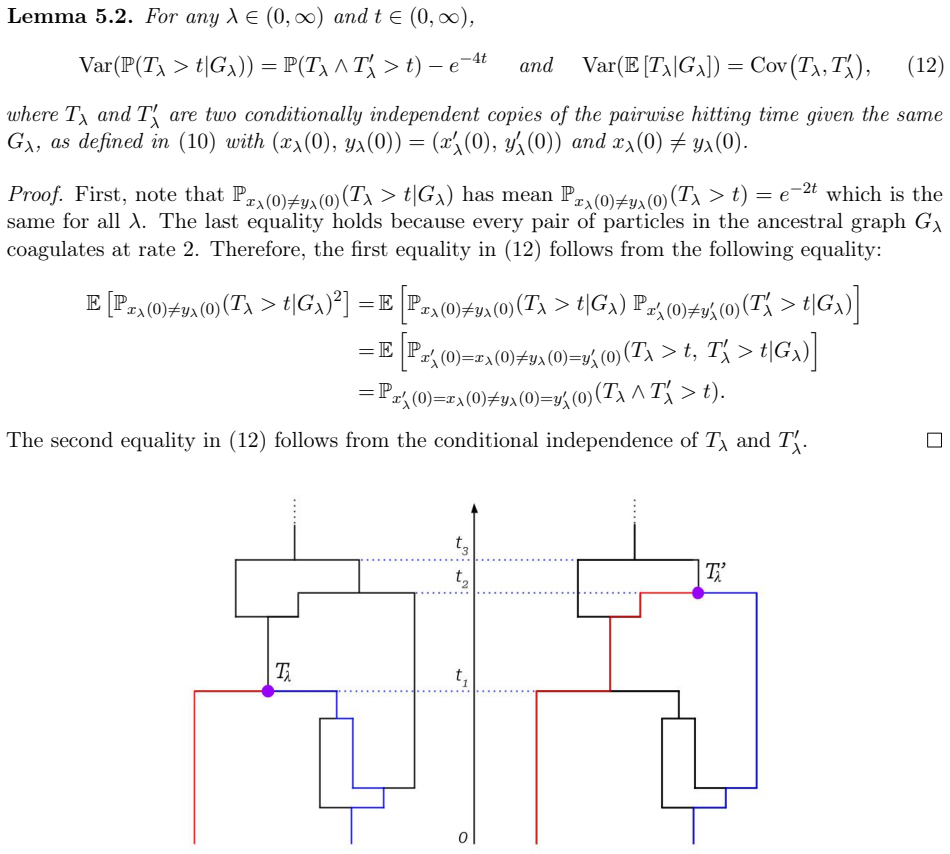
The ancestral graph $G_\lambda$ is the object that carries the limited-outcrossing argument: a continuous-time particle system that starts with two particles, in which each particle splits into two at rate $\lambda$ and each pair of particles coagulates at rate 2, equal in distribution to an ancestral recombination graph or an ancestral selection graph. It is obtained as the weak limit, on the $N^2$ time scale, of the discrete-time ancestral graph $G_N$, the subgraph of the pedigree containing all potential ancestors of the sample, which fragments at outcrossing events and coagulates at selfing events (Lemma 5.1, proved as Lemma 7.6). Coalescence times are then the first meeting times $T_\lambda$ of the two random walks on this graph, and the conditional survival probability is a step function jumping at the random overlap times of the graph. In the partial-selfing regime the argument uses a different device: a decomposition of the coalescence time into alternating overlap and splitting events, together with an $L^2$ second-moment comparison that couples two conditionally independent copies of the genealogy on the same pedigree.
What would settle it
Run the Moran model at $N=10^4$ with $\alpha_N=1-\lambda/N$ for $\lambda=1,5,20$; for each simulated pedigree compute the exact conditional survival function of the pairwise coalescence time for two sampled individuals, as in the paper's Figure 1, and compare it with $P(T_\lambda>t\mid G_\lambda)$ read off the pedigree's ancestral graph: the conditional survival function should be a step function jumping at the graph's overlap times, its across-pedigree variance should match the paper's explicit covariance formulas as a function of $\lambda$, and in the negligible-outcrossing case $N(1-\alpha_N)\to0$ the limit should be a single random jump rather than the smooth exponential $e^{-2t}$.
Extended reading notes
Core claim
The central claim is that conditioning on the random population pedigree yields three different limiting laws for the pairwise coalescence time, classified by the limit of $N(1-\alpha_N)$. For two gene copies sampled from different individuals (Theorem 4.1): when $N(1-\alpha_N)\to\infty$ the conditional survival probability $P_{\mathrm{diff}}(N^{-2}\tau^{(N)}>t\mid\mathcal{A}_N)$ converges to $e^{-2t/(2-\alpha)}$, matching the pedigree-averaged model; when $N(1-\alpha_N)\to\lambda\in(0,\infty)$ it converges to $P(T_\lambda>t\mid G_\lambda)$, the first-meeting time of two coalescing random walks on the ancestral graph; and when $N(1-\alpha_N)\to0$ it converges to the indicator $1_{\{\mathrm{Exp}(2)>t\}}$, a single exponentially distributed jump time fixed by the pedigree. For two gene copies sampled from the same individual (Theorem 4.5), the limit is $2^{-U}e^{-2t/(2-\alpha)}$, where $U$ is the individual's realized number of selfing generations with $P(U=k)=\alpha^k(1-\alpha)$, and this limit is $0$ at $\alpha=1$ and $e^{-t}$ at $\alpha=0$. Thus the pedigree-averaged theory sees one regime where the conditional theory sees three, and at the boundary $\alpha_N\to1$ the pedigree survives in the limit through the ancestral graph.
Load-bearing premise
If the size of the discrete ancestral graph is not bounded in probability on the $N^2$ time scale, the convergence to $G_\lambda$—and with it the random-walk description of the limiting coalescence time—fails, and the paper omits the details of exactly this compact-containment step.
Editorial extensions
If this is right
- For samples of multiple unlinked loci, the pedigree-conditional model is the correct sampling structure when likelihoods are multiplied across loci, and under limited outcrossing it predicts that genealogies vary across loci through random choices at each branching of the ancestral graph.
- The same-individual limit (Theorem 4.5) replaces the averaged inbreeding coefficient $F=\alpha/(2-\alpha)$ with each sampled individual's own realized number of selfing generations $U$, which is exactly the per-individual randomness underlying identity disequilibrium between loci.
- The three regimes give a practical rule: if $N(1-\alpha_N)$ exceeds roughly 100, conditional genealogies are well approximated by the partial-selfing Kingman model; if it is of order 1, the limited-outcrossing model must be used; if it is much smaller than 1, genealogies across the genome are essentially identical and heterozygosity vanishes.
- The limited-outcrossing model interpolates between the two extremes: as $\lambda\to\infty$ it converges to the $\alpha=1$ partial-selfing limit, and as $\lambda\to0$ it converges to negligible outcrossing, so it covers every way in which $\alpha_N$ can approach complete selfing.
Reading between the lines
- Beyond the paper: the same classification by the product of population size and the rate of pedigree-breaking events should apply to other forms of close inbreeding, such as sib mating or cousin mating, because their splitting and coagulating events also scale differently; the paper's discussion anticipates this but does not prove it.
- Beyond the paper: whole-genome data from predominantly selfing species could estimate $\lambda=N(1-\alpha)$ directly from the across-locus variance of genealogies using the covariance formulas, turning the limit theorem into a parameter-estimation procedure the paper does not develop.
- Beyond the paper: the observable signature of the negligible-outcrossing limit, near-identical coalescence times across the whole genome, could serve as a diagnostic for populations sitting in that regime before the model's more extreme prediction of zero heterozygosity fully holds.
- Beyond the paper: single-locus inference that assumes smooth exponential genealogies will overstate the uncertainty in coalescence times when applied locus-by-locus under limited outcrossing, because the correct pedigree-conditional distribution is a step function concentrated on a few fixed times.
Editorial analysis
A structured set of objections, weighed in public.
Referee Report
Summary. This paper studies a discrete-time diploid Moran model with selfing probability α_N and derives the conditional distribution of the pairwise coalescence time τ^(N) of two sampled gene copies given the random population pedigree. The main results are Theorem 3.1 for the unconditional limit, Theorem 4.1 for the conditional limit under three regimes (partial selfing, limited outcrossing, and negligible outcrossing), and Theorem 4.5 for the same-individual conditional limit. In the limited-outcrossing regime N(1−α_N)→λ, the limit is described as the meeting time of coalescing random walks on an ancestral graph G_λ; in the negligible-outcrossing regime it is a random exponentially distributed constant. The paper also derives variance and covariance formulas for conditional survival probabilities and links the limited-outcrossing model to ancestral recombination and selection graphs.
Significance. If fully supported, the result is significant for population genetics: it shows that conditioning on the pedigree can change coalescent predictions relative to the pedigree-averaged Kingman coalescent precisely in the near-selfing regime, and it provides a tractable one-parameter limiting object, the ancestral graph G_λ. The paper's strengths include a detailed overlap/splitting decomposition of the coalescence time, generator computations for the ancestral graph, and explicit L^2 convergence arguments in the partial-selfing regime. The covariance formulas in Section 5 are also useful and connect the new model to classical two-locus results. However, the central limited-outcrossing and negligible-outcrossing rows of Theorem 4.1 depend on a weak-convergence proof whose compact-containment step is explicitly omitted, and one step in the proof of Lemma 7.8 is not a valid use of conditional Markov's inequality. These are load-bearing technical gaps that should be repaired before the results can be considered fully established.
major comments (4)
- [Section 5 and Section 7.2.2, Lemma 7.6] The weak convergence of the discrete-time ancestral graph G^N to G_λ is not fully proved. Lemma 7.6 asserts the compact containment condition (33) by saying that 'the same argument' as for the continuous-time size process L_t applies, but the discrete-time process has one-step transition probabilities (27) with O(N^-2) and o(N^-3) terms, and no discrete-time analogue of the quadratic-variation computation in (38) is supplied. Since Lemma 7.7, Theorem 7.9, and Corollary 7.11 all rely on this convergence, the limited-outcrossing and negligible-outcrossing rows of Theorem 4.1 are not fully supported without a proof that |G^N(⌊tN^2⌋)| is tight. The manuscript itself acknowledges this gap after Lemma 5.1, but the appendix does not fill it.
- [Section 7.2.2, proof of Lemma 7.8] The proof of Lemma 7.8 contains an invalid inequality. The displayed 'conditional Markov inequality' reads P(N^-2(τ−τ_O^1)>ε|A_N) ≤ (1/ε) P(N^-2(τ−τ_O^1)>ε), which is not a consequence of Markov's inequality and can fail in general. The correct conditional Markov bound would involve the conditional expectation E[N^-2(τ−τ_O^1)|A_N], and then convergence of the conditional probability to zero would require a control on that conditional expectation. Because Lemma 7.8 is used to pass from the first overlap time to the coalescence time in Theorem 7.9, this proof step needs to be repaired.
- [Section 7.2.2, proof of Lemma 7.10] The proof of Lemma 7.10 contains a sign/conditioning error. It states that P_same(O=0)=α_N/(2−α_N) tends to 0 as α_N→1, but this quantity tends to 1. The subsequent conclusion that the right-hand side of (41) tends to 0 should be justified by conditioning on O=0 (where the rescaled coalescence time is 0) and on O≥1 (where Corollary 7.4 gives convergence to 0), not by conditioning on O=1 as written. The conclusion is correct, but the proof as written is inconsistent.
- [Section 7.3, Proposition 5.5] The asymptotic expansions in Proposition 5.5 are delegated to a Mathematica calculation stored in Newman (2024), and the key computation leading to equation (62) is not shown in the manuscript. This is not central to Theorems 4.1 and 4.5, but the paper should provide enough detail for the expansion to be verified without reliance on an external file, or should state more explicitly which symbolic computation is being used.
minor comments (4)
- [Section 7.2.2, Eq. (27)] The last displayed transition probability in (27) uses the notation 'n−M−2/n−2', which is inconsistent with the surrounding notation in terms of N and m; this should be corrected.
- [After Theorem 4.5] The sentence 'where is the possible for a “same” sample to enter the “diff” process' is ungrammatical; it should be 'where it is possible for a “same” sample to enter the “diff” process'.
- [Section 7.2.2, Lemma 7.7] The state space of the joint process in Lemma 7.7 is written as D(P ×(Z × {0, 1})^2), but Z is not introduced as a set of labels in that statement; using the notation from Definition 4.3 or defining the label set explicitly would improve clarity.
- [Section 1.3 and Section 6] The paper uses α_N for the selfing probability and α for its limit, but in a few places (for example in the discussion of Figure 1) α denotes a finite-N value rather than the limit; the notation should be made uniform to avoid confusion.
Circularity Check
No significant circularity: the conditional coalescence limits are derived from the Moran model's transition rates rather than fitted to the target results.
full rationale
The derivation chain is self-contained relative to the paper's own model definitions. Theorem 3.1 is proved directly from the three-state transition matrix Π_N via the overlap/splitting decomposition (Lemmas 7.1, 7.2, Corollary 7.3), not by assuming the exponential limit. The conditional limits in Theorems 4.1 and 4.5 are then obtained either by L2 second-moment estimates (Theorem 7.18, Theorem 7.21) that use the unconditional result and the joint law of two conditionally independent coalescence times, or by weak convergence of the discrete-time ancestral graph (Lemma 7.6, Lemma 7.7) to the explicitly defined ancestral graph Gλ. The parameter λ is a scaling limit N(1−α_N)→λ, not a fitted constant, and the random variable U in Theorem 4.5 arises as the limit of the geometric number of selfing generations before a splitting event, matching the model's transition probabilities. Self-citations to Diamantidis et al. (2024), Kogan et al. (2023), and Wakeley et al. (2012) are used for notation, context, comparisons, and a numerical method in Figure 1; they are not load-bearing inputs to the main convergence proofs. The omitted compact-containment detail in the proof of Lemma 5.1/Lemma 7.6 is a technical incompleteness that bears on rigor, but it is not circular: it concerns tightness of a process constructed from the Moran model, not an assumption equivalent to the conclusion. Therefore no step reduces by construction to its own inputs.
Assumptions & free parameters
free parameters (1)
- lambda = lim N(1-alpha_N)
assumptions (4)
- standard math Weak convergence of Markov chains (Ethier and Kurtz 2009), including generator convergence and compact containment, used in Lemma 7.6.
- domain assumption The diploid Moran model with constant population size N, random mating, and Mendelian inheritance is the process of interest.
- domain assumption Unlinked loci are conditionally independent given the pedigree.
- ad hoc to paper Asymptotic scaling N(1-alpha_N) -> lambda in R_+ with time rescaled by N^2 Moran steps.
Cite this review
Pith. "Pith review of Conditional gene genealogies given the population pedigree for a diploid Moran model with selfing." pith.science (2026). https://pith.science/paper/3JAEBJQD
@misc{pith2026241113048,
  author       = {Pith},
  title        = {Pith review of: Conditional gene genealogies given the population pedigree for a diploid Moran model with selfing},
  year         = {2026},
  howpublished = {\url{https://pith.science/paper/3JAEBJQD}},
  note         = {Machine review of arXiv:2411.13048}
}
abstract
We introduce a stochastic model of a population with overlapping generations and arbitrary levels of self-fertilization versus outcrossing. We study how the global graph of reproductive relationships, or population pedigree, influences the genealogical relationships of a sample of two gene copies at a genetic locus. Specifically, we consider a diploid Moran model with constant population size $N$ over time, in which a proportion of offspring are produced by selfing. We show that the conditional distribution of the pairwise coalescence time at a single locus given the random pedigree converges to a limit law as $N$ tends to infinity. The distribution of coalescence times obtained in this way predicts variation among unlinked loci in a sample of individuals. Traditional coalescent analyses implicitly average over pedigrees and generally make different predictions. We describe three different behaviors in the limit depending on the relative strengths, from large to small, of selfing versus outcrossing: partial selfing, limited outcrossing, and negligible outcrossing. In the case of partial selfing, coalescence times are related to the Kingman coalescent, similar to what is found in traditional analyses. In the case of limited outcrossing, the retained pedigree information forms a random graph, with coalescence times given by the meeting times of random walks on this graph. In the case of negligible outcrossing, which represents complete or nearly complete selfing, coalescence times are determined entirely by the fixed times to common ancestry of diploid individuals in the pedigree.
Figures


Figures from the paper (6 more)




Forward citations
Cited by 1 Pith paper
-
A conditional coalescent for diploid exchangeable population models given the pedigree
Conditioned on a fixed diploid pedigree, the ancestral process converges to an inhomogeneous (Ψ,c)-coalescent, mixing fixed-time multiple mergers from large families with constant-rate binary mergers.
Reference graph
Works this paper leans on
-
[4]
Therefore Psame(τ ∧ τ ′ > τS 1 |U = k) = 4−k. That N −2τ S 1 converges to 0 follows from it being geometric with parameter(1 − αN )N −1. Corollary 7.20. Suppose αN → α ∈ [0, 1]. As N → ∞, Esame h eitN −2(τ ∧τ ′) i → 3α 4 − α + 1 − 3α 4 − α 1 + it( 4 2 − α )−1 −1 . Proof. We can decompose Esame h eitN −2(τ ∧τ ′) i into where coalescence occurs before the f...
work page 2024
-
[5]
doi: 10.1111/j.1558-5646.1990.tb03839.x. Charlesworth D. Evolution of plant breeding systems.Current Biology, 16(17):R726–R735, 2006. doi: 10.1016/j.cub.2006.07.068. Charlesworth D. and Wright S. I. Breeding systems and genome evolution.Current Opinion in Genetics & Development, 11(6):685–690, 2001. doi: 10.1016/S0959-437X(00)00254-9. Cockerham C. C. and ...
arXiv 1990
-
[6]
Gao H., Williamson S., and Bustamante C
doi: 10.1534/genetics.115.180570. Gao H., Williamson S., and Bustamante C. D. A Markov chain Monte Carlo approach for joint inference of population structure and inbreeding rates from multilocus genotype data.Genetics, 176(3):1635–1651, 2007. doi: 10.1534/genetics.107.072371. 28 Glémin S., François C. M., and Galtier N. Genome evolution in outcrossing vs....
-
[1922]
doi: 10.1086/279872. Wright S. Evolution in Mendelian populations.Genetics, 16(2):97–159, 1931. doi: 10.1093/genetics/ 16.2.97. Wright S. The genetical structure of populations. Annals of Eugenics, 15:323–354, 1951. doi: 0.1111/j.1469-1809.1949.tb02451.x. Wright S. I., Kalisz S., and Slotte T. Evolutionary consequences of self-fertilization in plants. Pro...
-
[1997]
doi: 10.1093/genetics/146.4.1501. Nordborg M. Linkage disequilibrium, gene trees and selfing: An ancestral recombination graph with partial self-fertilization. Genetics, 154(2):923–929, 2000. doi: 10.1093/genetics/154.2.923. Nordborg M. and Donnelly P. The coalescent process with selfing.Genetics, 146(3):1185–1195, 1997. doi: 10.1093/genetics/146.3.1185. ...
-
[1999]
Szulkin M., Bierne N., and David P
doi: 10.1038/sj.hdy.6886020. Szulkin M., Bierne N., and David P. Heterozygosity-fitness correlations: A time for reappraisal. Evolution, 64(5):1202–1217, 2010. doi: 10.1111/j.1558-5646.2010.00966.x. Tajima F. Evolutionary relationship of DNA sequences in finite populations.Genetics, 105(2): 437–460, 10 1983. ISSN 1943-2631. doi: 10.1093/genetics/105.2.437...
arXiv 2010
-
[2002]
doi: 10.1038/sj.hdy.6800065. Roze D. Background selection in partially selfing populations.Genetics, 203(2):937–957, 2016. doi: 10.1534/genetics.116.187955. Roze D. and Lenormand T. Self-fertilization and the evolution of recombination.Genetics, 170(2): 841–857, 2005. doi: 10.1534/genetics.104.036384. Sasson D. A. and Ryan J. F. A reconstruction of sexual...
arXiv 2016
-
[2004]
doi: 10.1534/genetics.104.030171. Avise J. C. and Mank J. E. Evolutionary perspectives on hermaphroditism in fishes. Sexual Development, 3(2-3):152–163, 2009. doi: 10.1159/000223079. Baker H. G. Self-compatibility and establishment after “long-distance” dispersal.Evolution, 9(3): 347–349, 1955. doi: 10.1111/j.1558-5646.1955.tb01544.x. 25 Bakker E. G., Sta...
Show all 12 references
-
[2008]
Hudson R
doi: 10.1137/1.9780898717778. Hudson R. R. Testing the constant-rate neutral allele model with protein sequence data.Evolution, 37(1):203–217, 1983. doi: 10.1111/j.1558-5646.1983.tb05528.x. Jain S. K. The evolution of inbreeding in plants. Annual Review of Ecology, Evolution, ...
1983
-
[2009]
doi: 10.1534/genetics.109.104042. Adams A. M. and Hudson R. R. Maximum-likelihood estimation of demographic parameters using the frequency spectrum of unlinked single-nucleotide polymorphisms.Genetics, 168(3):1699–1712,
-
[2016]
Bennett J
doi: 10.1038/nplants.2016.84. Bennett J. H. and Binet F. E. Association between Mendelian factors with mixed selfing and random mating. Heredity, 10(1):51–55, 1956. doi: 10.1038/hdy.1956.3. Berestycki N. Recent progress in coalescent theory.Ensaios Mathemáticos, 16:1–193, 2009...
2016 arXiv
-
[2023]
Tyukin A
doi: 10.1371/journal.pgen.1010879. Tyukin A. Quenched limits of coalescents in fixed pedigrees. Master’s thesis, Johannes-Gutenberg- Universität Mainz, Germany, 2015. URL https://www.glk.uni-mainz.de/files/2018/08/ andrey_tyukin_msc.pdf. UyenoyamaM.K. Inbreedingandthecostofmei...
2015
Reviewed August 12, 2026 · model on record in the stance chip above.
Discussion (0). Continue with ORCID to comment.