REVIEW 4 major objections 4 minor 44 references
Solution for the finite space-bandwidth limitation in digital holography
T0 review · 4 major / 4 minor · reviewed 2026-08-12 · deepseek-v4-flash
Pith's one-line read The paper claims that an undersampled hologram captured with a coarse pixel pitch can reconstruct an image at the same spatial resolution and angular field of view as a properly sampled hologram, because aliased replica fringes are…
desk verdict A provocative but undersupported claim about beating the space-bandwidth limit in digital holography; the core math does not hold for general objects, yet the paper has enough real content to merit referee scrutiny. read the letter →
The pith
A machine-rendered reading of the paper's core claim, the machinery that carries it, and where it could break.
The reading
What carries the argument
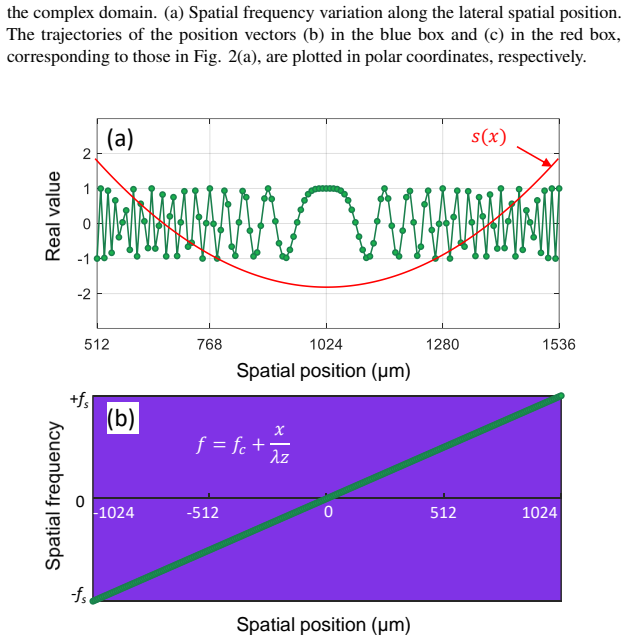
The central object is the angle-modulated replica function: an aliased copy of the Fresnel hologram written as $\exp[i2\pi(n x/\Delta x + x^2/2\lambda z)]$, which is a carrier wave at frequency $n/\Delta x$ phase-modulated by a quadratic signal. This representation turns aliased fringes into a continuous high-frequency spectrum. The companion mechanism is the orthogonality relation $\langle\varphi_m|\varphi_n^*\rangle = c_o^2\delta_{mn}$ for the high-order diffraction modes, the spatial image states associated with individual replica zones; that orthogonality justifies canceling the replica images with pixel-duplication upsampling.
What would settle it
Take a simulated undersampled point-object hologram at half $z_c$, apply two-fold pixel-duplication upsampling with no denoiser, and measure the reconstructed point-spread function: the central image must show the full-aperture resolution (4 $\mu$m with 8-$\mu$m pixels, per the paper's geometry) before any learning-based cleanup. If residual high-order artifacts still overlap the primary image, as the paper's own Fig. 6 indicates, the orthogonality-based cancellation is incomplete.
Extended reading notes
Core claim
The paper claims that aliasing in an undersampled Fresnel hologram is not information loss. Each shifted replica is a carrier-wave phase modulation of the original quadratic-phase field, so the spatial frequency continues to rise across replica zones up to the full aperture bandwidth $N\Delta/\lambda z$. Because the resulting high-order diffraction modes are orthogonal, a two-fold upsampling by pixel duplication cancels the $\pm 1$st-order replica images, and a learning-based denoiser removes the residual high-frequency artifacts. The reconstructed image then has the same spatial resolution and angular field of view as a properly sampled hologram, obtained from a hologram captured at a coarser pixel pitch. This is demonstrated in numerical simulations and in an optically captured hologram of a resolution target.
Load-bearing premise
The method assumes that the high-order diffraction modes stay exactly non-interfering on a real, finite hologram, so that upsampling by pixel duplication cancels them completely; if that exactness fails, leftover replica noise remains and the denoiser must cover the gap.
Editorial extensions
If this is right
- Lensless holographic microscopes could resolve features at the full aperture numerical aperture of the sensor rather than at the pixel-pitch numerical aperture, without magnification.
- The space-bandwidth product of the captured hologram, not the pixel size, would become the practical resolution limit for lensless holography.
- Short-distance capture with a large image sensor becomes an explicit route to wide-field high-resolution imaging, provided the reference-object geometry keeps the complex hologram measurable.
- The same undersampling analysis extends to incoherent holography and to the Rayleigh-Sommerfeld diffraction regime, so the mechanism is not confined to ideal monochromatic Fresnel fields.
- Because the method claims recovery of actual high-frequency signal content rather than interpolation, it differs from conventional super-resolution and should be testable by direct point-spread-function measurement.
Reading between the lines
- Editorial inference: if the orthogonality of high-order diffraction modes is only approximate on a finite hologram aperture, the upsampling cancellation will leave residual replica noise that the learned denoiser must cover; this can be tested by measuring artifacts with upsampling alone and no denoiser.
- Editorial inference: the denoiser is trained on MNIST digits, so the claimed wide-field high-resolution pipeline should be validated on biological or industrial samples outside that training distribution before the generalization is trusted.
- Editorial inference: the optical USAF demonstration showed little horizontal resolution gain because the off-axis preprocessing discarded horizontal Fourier components; an on-axis or common-path geometry might restore isotropic resolution gains.
- Editorial inference: the angle-modulation reading of aliased replicas could apply to any coarsely sampled quadratic-phase signal, including synthetic aperture radar or acoustic imaging, wherever Fresnel-like phase curvature is present.
Editorial analysis
A structured set of objections, weighed in public.
Referee Report
Summary. The paper claims that an undersampled digital hologram can be used to reconstruct an image with the same spatial resolution and angular field of view as a properly sampled hologram, thereby overcoming the finite space-bandwidth limitation of digital holography. The proposed method has three steps: two-fold (or m-fold) upsampling by pixel duplication, reconstruction with the angular-spectrum method, and denoising with a DnCNN network trained on synthetically generated noisy reconstructions. The central theoretical argument is that high-order diffraction fields are mutually orthogonal and that pixel-duplication upsampling suppresses the ±1st-order spectral replicas, leaving only replicas at multiples of 2/Δx.
Significance. If the central claim were correct, it would overturn the conventional pixel-Nyquist limit for lensless holography and enable wide-field high-resolution imaging without optical magnification, which would be highly significant. The paper contains a useful qualitative description of aliased Fresnel replicas as phase-modulated carrier waves in the complex plane, and it includes both numerical simulations and an optically captured USAF-target hologram. However, the load-bearing mathematical step in Section 3.2 is not generally valid, and the reported recovery results are obtained under conditions (in-distribution MNIST training and evaluation) that do not support the claimed generality. As a result, the central claim is not established by the evidence presented.
major comments (4)
- [Sec. 3.2, Eqs. (16)–(18)] The derivation of Eq. (18) is not valid for a finite-bandwidth object. Equation (17) shows cancellation of odd-order peaks for the Dirac comb alone, but for a sampled hologram the spectrum is G(f) convolved with the comb. The odd-order replica terms are multiplied by the factor (1 + e^{-iπ f Δx}), which vanishes only at the isolated frequencies f = (2q+1)/Δx, not across the spectral support of G. Consequently, when the object's angular spectrum extends toward the full-aperture bandwidth, the q = ±1 replica bands remain partially inside the passband, and Eq. (18) does not follow. The paper's own Figure 6 confirms residual high-frequency artifacts, yet the conclusion in Section 7 asserts full space-bandwidth recovery. This flaw undermines the central claim.
- [Sec. 3.1, Eq. (15)] The orthogonality of high-order diffraction fields is derived using integrals over an infinite plane, but the hologram and the simulations in the paper are finite. Over a finite aperture, the modes are not exactly orthogonal, and high-order diffraction terms do interfere with the primary image. The residual artifacts visible in Figure 6 and the incomplete suppression described in Section 6 are consistent with this limitation. The claim that high-order terms can be removed without corrupting the primary image is therefore not supported by the derivation as presented.
- [Sec. 5.2 and Supplement 1] The learning-based demonstration does not establish that arbitrary objects can be reconstructed from low-resolution holograms. The DnCNN network is trained on rescaled MNIST images and evaluated on MNIST test images; the reported PSNR values of approximately 38, 42, and 41 dB are in-distribution results. These numbers show that the network can denoise the specific residual pattern seen in MNIST-like reconstructions, but they do not demonstrate recovery of general object information. Moreover, N complex samples cannot uniquely determine an mN-pixel complex image without a strong prior, so the paper's information-theoretic claim that a low-resolution hologram contains the same information as a properly sampled one is not justified.
- [Sec. 5.1, Fig. 11] The optically captured USAF-target experiment is presented without a quantitative resolution comparison. The paper states that the upsampled reconstruction improves the vertical direction but not the horizontal direction, and no resolution metric, line-pair analysis, or comparison against a properly sampled reference is provided. This result is therefore insufficient to support the broad claim that the method overcomes the space-bandwidth limitation in practice.
minor comments (4)
- [Throughout] There are several typographical errors: 'reconsturction' in the Figure 10 caption, 'increse' and 'Similarily' in Section 2.1, 'normlization' in the Figure 12 caption, 'Acqusition' in the Figure 12 caption, and 'apper' in the Introduction. These should be corrected.
- [Sec. 2.1] The text refers to a 'commercial spectrum calculation program' without identifying the software or algorithm; specifying the method would improve reproducibility.
- [Supplement 1, Eq. (6)] The derivation of the sampling condition uses the parameters T and S without a clear definition of their allowed ranges; a sentence defining T in (0,1) and S as a positive real number would help the reader.
- [Sec. 5.1, Fig. 11] The horizontal-direction degradation is attributed to preprocessing loss of Fourier components, but the paper does not quantify this loss; a spectral plot of the cropped region would clarify the extent to which the experimental demonstration is limited by the off-axis geometry.
Circularity Check
The high-resolution 'recovery' is partly circular: Eq. (18) builds the desired cancellation into the upsampling comb, and the MNIST demonstrations are produced by a DnCNN trained on the same clean images.
-
other
[Section 3.2, Eqs. (17)-(18)]
"Thus, both Fourier transform terms combine into a single function, Σ_q δ(f−2q/Δx), resulting in the removal of the ±1st-order peaks. The periodic Fourier spectrum of sampled hologram is then represented as FT[...]= (2/Δx)Σ_q G(f−2q/Δx)."
The cancellation is introduced by the construction of the upsampling comb. Splitting the comb into even and odd terms makes the phase factor e^{2πi(Δx/2)f} cancel the odd-order comb peaks exactly at f=(2q+1)/Δx. But the sampled hologram's spectrum is G(f) convolved with the comb, not the comb alone; the frequency-dependent factor (1+e^{−iπ fΔx}) vanishes only at those isolated replica centers, not across the spectral support of G. Replacing the spectrum by the even-comb-only expression installs the conclusion 'only 2/Δx replicas remain' by definition of the comb, rather than deriving it from the hologram's actual Fourier content. The paper's own Fig. 6 admits residual high-frequency artifacts, confirming that the claimed suppression is incomplete.
-
fitted input called prediction
[Section 5.2, Figs. 12-13; Supplement 1, Section 3]
"The residual images, obtained by subtracting the clean images from the noisy inputs, are used as target data during training. ... After 51 epochs, the trained network accurately restored the original images from the test noisy datasets, as shown in Fig. 13(b)."
The claimed high-resolution reconstruction is demonstrated with a DnCNN whose weights are fitted so that its output matches the known clean MNIST labels. The residual targets are computed from exactly the same undersampled-hologram reconstruction pipeline, so the network learns to invert that pipeline for the MNIST distribution. Reporting PSNR on MNIST test images measures generalization within the training distribution, not an independent verification that a 32×32 hologram determines a 256×256 image. The conclusion that 'only a captured low-resolution hologram can reconstruct a high-resolution image' therefore reduces, for the demonstrated examples, to the fitted denoiser's learned prior rather than to the physical information content of the hologram.
1 more flagged steps
-
self citation load bearing
[Section 1, Introduction]
"both numerical and experimental studies suggest that the replica functions in undersampled holograms correspond to high spatial-frequency components of the hologram field [12,26,27]."
The sentence states the paper's central premise—that aliased replicas encode true high-frequency information—and supports it only by references [12,26,27], all previous papers by the same author. That premise is load-bearing because the entire method depends on treating replicas as high-frequency signal rather than as aliasing noise. Since the present paper's own derivation of this premise relies on Eq. (18), whose cancellation argument is an artifact of the comb construction, the premise is not independently established here; it remains supported by a chain of self-citations rather than by an external, machine-checked, or independently reproduced result.
full rationale
The paper contains substantial self-contained mathematical analysis, and parts of the demonstration (the 'HOLO' simulation, the pepper/boat object, and the optical USAF hologram) do not depend on the trained network. However, the central claim of reconstructing an image with the same resolution as a properly sampled hologram is only partially supported. First, the key upsampling result in Eq. (18) follows from the even/odd comb construction, not from the actual spectral support of a non-constant object; the cancellation factor vanishes only at isolated replica centers, so the baseband replica bands are not generally removed. Second, the experiments that most strongly support the abstract's statement—32×32 holograms yielding 256×256 images—are produced by a DnCNN trained on exactly the same clean MNIST images used as targets, so the reported PSNRs reflect the fitted model's ability to reproduce its training prior. Third, the foundational assertion that replicas contain high-frequency information is introduced via self-citations [12,26,27] and is not rescued by an independent proof. These issues make the demonstration partially circular, but because the paper also presents independent simulations and an optical experiment without the learned denoiser, the circularity is not total. Score 6 reflects that the most dramatic 'beyond space-bandwidth' results reduce, in part, to the fitted network and to a comb-construction artifact.
Assumptions & free parameters
free parameters (1)
- DnCNN network weights =
Trained on MNIST; exact values not released
assumptions (4)
- domain assumption Fresnel diffraction is an accurate model for the simulated and measured holograms
- ad hoc to paper The high-order diffraction fields are orthogonal over the finite aperture of the hologram
- ad hoc to paper Pixel duplication upsampling preserves all information in the undersampled hologram and only suppresses high-order replicas
- domain assumption The DnCNN residual-noise model generalizes to arbitrary objects
Cite this review
Pith. "Pith review of Solution for the finite space-bandwidth limitation in digital holography." pith.science (2026). https://pith.science/paper/6QCZCHXG
@misc{pith2026241113098,
  author       = {Pith},
  title        = {Pith review of: Solution for the finite space-bandwidth limitation in digital holography},
  year         = {2026},
  howpublished = {\url{https://pith.science/paper/6QCZCHXG}},
  note         = {Machine review of arXiv:2411.13098}
}
read the original abstract
A lensless digital holography enables wide-field microscopic imaging without the limitations imposed by optical lens performance. However, conventional holographic imaging often relies on magnifying optical systems to compensate for the low resolution of holograms captured by image sensors. The spatial resolution of the reconstructed image is fundamentally constrained by the space-bandwidth of the hologram due to aliasing errors at insufficient sampling rates. This study analyzes the spatial distribution of the angular spectrum in undersampled holograms using angle modulation techniques. Aliased replica functions are identified as phase-modulated functions by multiples of the sampling frequency, with the spatial frequency components continuously extending into the replica regions. Optical imaging simulations demonstrate that image reconstruction beyond the space-bandwidth limitation of digital holograms is feasible. In particular, high-order diffraction fields, characterized by orthogonality, can be effectively eliminated through an upsampling process. By sequentially removing high-order terms and applying a learning-based denoising algorithm, wide-field high-resolution optical imaging is achieved. This approach demonstrates that only a captured low-resolution hologram can reconstruct a high-resolution image, thereby overcoming the limitations imposed by the finite space-bandwidth of digital holography.
Figures


Figures from the paper (15 more)




Reference graph
Works this paper leans on
-
[1]
J. W. Goodman, Introdction to Fourier Optics (McGraw-Hill, 1996)
work page 1996
-
[2]
Principles and techniques of digital holographic microscopy,
M. K. Kim, “Principles and techniques of digital holographic microscopy,” Proc. SPIE 1, 018005 (2010)
work page 2010
-
[3]
Direct recording of holograms by a ccd target and numerical reconstruction,
U. Schnars and W. Jüptner, “Direct recording of holograms by a ccd target and numerical reconstruction,” Appl. Opt. 33(2), 179–181 (1994)
work page 1994
-
[4]
Digital holography for quantitative phase-contrast imaging,
E. Cuche, F. Bevilacqua, and C. Depeursinge, “Digital holography for quantitative phase-contrast imaging,” Opt. Lett. 24, 291-293 (1999)
work page 1999
-
[5]
Imaging without lenses: achievements and remaining challenges of wide-field on-chip microscopy,
A. Greenbaum, W. Luo, T. Su, Z. Göröcs, L. Xue, S. O. Isikman, A. F. Coskun, O. Mudanyali, and A. Ozcan, “Imaging without lenses: achievements and remaining challenges of wide-field on-chip microscopy,” Nat Methods 9, 889-895 (2012)
work page 2012
-
[6]
Digital in-line holographic microscopy,
J. Garcia-Sucerquia, W. Xu, S. K. Jericho, P. Klages, M. H. Jericho, and H. J. Kreuzer, “Digital in-line holographic microscopy,” Appl. Opt. 45(5), 836-850 (2006)
work page 2006
-
[7]
T. Gutzler, T. R. Hillman, S. A. Alexandrov, and D. D. Sampson, “Coherent aperture-synthesis, wide-field, high-resolution holographic microscopy of biological tissue,” Opt. Lett. 35, 1136-1138 (2010)
work page 2010
-
[8]
Wide-field, high-resolution Fourier ptychographic microscopy,
G. Zheng, R. Horstmeyer, and C. Yang, “Wide-field, high-resolution Fourier ptychographic microscopy,” Nat. Photonics 7, 739-745 (2013)
work page 2013
Show all 44 references
-
[9]
Laterally modulated excitation microscopy: improvement of resolution by using a diffraction grating,
R. Heintzmann and C. Cremer, “Laterally modulated excitation microscopy: improvement of resolution by using a diffraction grating,” Proc. SPIE 3568, 185-196 (1998)
1998
-
[10]
Movable aperture lensless transmission microscopy: A novel phase retrieval algorithm,
H. M. L. Faulkner and J. M. Rodenburg, “Movable aperture lensless transmission microscopy: A novel phase retrieval algorithm,” Phys. Rev. Lett. 93, 023903 (2004)
2004
-
[11]
Review of bio-optical imaging systems with a high space-bandwidth product,
J. Park, D. J. Brady, G. Zheng, L. Tian, and L. Gao, “Review of bio-optical imaging systems with a high space-bandwidth product,” Adv. Photonics 3(4), 044001 (2021)
2021
-
[12]
Spatial resolution enhancement in holographic imaging via angular spectrum expansion,
B. G. Chae, “Spatial resolution enhancement in holographic imaging via angular spectrum expansion,” Opt. Continuum 3(3), 263-277 (2024)
2024
-
[13]
Space-bandwidth product of optical signals and systems,
A. W. Lohmann, R. G. Dorsch, D. Mendlovic, Z. Zalevsky, and C. Ferreira, “Space-bandwidth product of optical signals and systems,” J. Opt. Soc. Am. A 13, 470-473 (1996)
1996
-
[14]
B. E. A. Saleh and M. C. Teich, Fundamentals of Photonics (John Wiley & Sons, Inc., 1991)
1991
-
[15]
General theoretical formulation of image formation in digital Fresnel holography,
P. Picart and J. Leval, “General theoretical formulation of image formation in digital Fresnel holography,” J. Opt. Soc. Am. A 25(7), 1744-1761 (2008)
2008
-
[16]
Resolution limits in practical digital holographic systems,
D. P. Kelly, B. M. Hennelly, N. Pandey, T. J. Naughton, and W. T. Rhodes, “Resolution limits in practical digital holographic systems,” Opt. Eng. 48(9), 95801 (2009)
2009
-
[17]
Inverted Gabor holography principle for tailoring arbitrary shaped three-dimensional beams,
T. Latychevskaia and H.-W. Fink, “Inverted Gabor holography principle for tailoring arbitrary shaped three-dimensional beams,” Sci. Rep. 6, 26312 (2016)
2016
-
[18]
Analysis on angular field of view of holographic image dependent on hologram numerical aperture in holographic display,
B. G. Chae, “Analysis on angular field of view of holographic image dependent on hologram numerical aperture in holographic display,” Opt. Eng. 59(3), 035103 (2020)
2020
-
[19]
High-precision and low-noise dielectric tensor tomography using a micro-electromechanical system mirror,
J. Lee, B. G. Chae, H. Kim, M. S. Yoon, H. Hugonnet, and Y. K. Park, “High-precision and low-noise dielectric tensor tomography using a micro-electromechanical system mirror,” Opt. Express 32(13), 23171-23179 (2024)
2024
-
[20]
Gori, ‘‘Fresnel transform and sampling theorem,’’ Opt
F. Gori, ‘‘Fresnel transform and sampling theorem,’’ Opt. Commun. 39 (5), 293-297 (1981)
1981
-
[21]
Fast algorithms for free-space diffraction patterns calculations,
D. Mas, J. Garcia, C. Ferreira, L. M. Bernardo, and F. Marinho, “Fast algorithms for free-space diffraction patterns calculations,” Opt. Commun. 164, 233-245 (1999)
1999
-
[22]
Sampling of the diffraction field,
L. Onural, “Sampling of the diffraction field,” Appl. Opt. 39 (32), 5929-5935 (2000)
2000
-
[23]
Analysis of practical sampling and reconstruction from Fresnel fields,
A. Stern and B. Javidi, “Analysis of practical sampling and reconstruction from Fresnel fields,” Opt. Eng. 43(1), 239-250 (2004)
2004
-
[24]
Analysis on image recovery for on-axis digital Fresnel hologram with aliased fringe generated from self-similarity of point spread function,
B. G. Chae, “Analysis on image recovery for on-axis digital Fresnel hologram with aliased fringe generated from self-similarity of point spread function,” Opt. Commun. 466, 125609 (2020)
2020
-
[25]
A. V. Oppenheim, A. S. Willsky, and S. H. Nawab, Signals and Systems (Prentice-Hall, 2010)
2010
-
[26]
Some mathematical properties of the uniformly sampled quadratic phase function and associated issues in Fresnel diffraction simulations,
L. Onural, “Some mathematical properties of the uniformly sampled quadratic phase function and associated issues in Fresnel diffraction simulations,” Opt. Eng. 43(11), 2557-2563 (2004)
2004
-
[27]
Wide viewing-angle holographic display based on enhanced-NA Fresnel hologram,
B. G. Chae, “Wide viewing-angle holographic display based on enhanced-NA Fresnel hologram,” Opt. Express 29(23), 38221-38236 (2021)
2021
-
[28]
Viewing-angle expansion in holographic displays implemented with a modulator having finite space-bandwidth,
B. G. Chae, “Viewing-angle expansion in holographic displays implemented with a modulator having finite space-bandwidth,” Opt. Express 31(23), 37900-37910 (2023)
2023
-
[29]
Synthetic aperture superresolution with multiple off-axis holograms,
V. Mico, Z. Zalevsky, P. García-Martínez, and J. García, “Synthetic aperture superresolution with multiple off-axis holograms,” J. Opt. Soc. Am. A 23(12), 3162-3170 (2006)
2006
-
[30]
Quantitative phase imaging based on holography: trends and new perspectives,
Z. Huang and L. Cao, “Quantitative phase imaging based on holography: trends and new perspectives,” Light Sci. Appl. 13, 145 (2024)
2024
-
[31]
Deep learning on image denoising: An overview,
C. Tian, L. Fei, W. Zheng, Y. Xu, W. Zuo, and C. W. Lin, “Deep learning on image denoising: An overview,” Neural Networks, 131, 251-275 (2020)
2020
-
[32]
Beyond a Gaussian denoiser: Residual learning of deep CNN for image denoising,
K. Zhang, W. Zuo, Y. Chen, D. Meng, and L. Zhang, “Beyond a Gaussian denoiser: Residual learning of deep CNN for image denoising,” IEEE Transactions on Image Processing, 26(7), 3142-3155 (2017)
2017
-
[33]
Kramers–Kronig holographic imaging for high-space-bandwidth product,
Y. Baek, K. Lee, S. Shin, and Y. Park, “Kramers–Kronig holographic imaging for high-space-bandwidth product,” Optica 6, 2334-2536 (2019)
2019
-
[34]
Single-shot phase retrieval via Fourier ptychographic microscopy,
B. Lee, J. Hong, D. Yoo, J. Cho, Y. Jeong, S. Moon, and B. Lee, “Single-shot phase retrieval via Fourier ptychographic microscopy,” Optica 5, 976-983 (2018)
2018
-
[35]
Wide-field hologram microscopic apparatus,
B. G. Chae, “Wide-field hologram microscopic apparatus,” KR patent application 10-2025-0045634 (2025)
2025
-
[36]
Improving the reconstruction quality with extension and apodization of the digital hologram,
Y. Zhang, J. Zhao, Q. Fan, W. Zhang, and S. Yang, “Improving the reconstruction quality with extension and apodization of the digital hologram,” Appl. Opt. 48(16), 3070-3074 (2009)
2009
-
[37]
Mitigating ringing artifacts in diffraction calculations using average subtractions,
T. Shimobaba, I. Hoshi, H. Shiomi, F. Wang, T. Hara, T. Kakue, and T. Ito, “Mitigating ringing artifacts in diffraction calculations using average subtractions,” Appl. Opt. 60(22), 6393-6399 (2021)
2021
-
[38]
Reducing ringing artifacts for hologram reconstruction by extracting patterns of ringing artifacts,
Y. Nagahama, “Reducing ringing artifacts for hologram reconstruction by extracting patterns of ringing artifacts,” Opt. Continuum 2(2), 361-369 (2023)
2023
-
[39]
Analysis on image recovery for on-axis digital Fresnel hologram with aliased fringe generated from self-similarity of point spread function,
B. G. Chae, “Analysis on image recovery for on-axis digital Fresnel hologram with aliased fringe generated from self-similarity of point spread function,” Opt. Commun. 466 , 125609 (2020)
2020
-
[40]
Fast algorithms for free-space diffraction patterns calculations,
D. Mas, J. Garcia, C. Ferreira, L. M. Bernardo, and F. Marinho, “Fast algorithms for free-space diffraction patterns calculations,” Opt. Commun. 164 , 233-245 (1999)
1999
-
[41]
Digital simulation of scalar optical diffraction: revisiting chirp function sampling criteria and consequences,
D. G. Voelz and M. C. Roggemann, “Digital simulation of scalar optical diffraction: revisiting chirp function sampling criteria and consequences,” Appl. Opt. 48 (32), 6132-6142 (2009)
2009
-
[42]
Controlling the aliasing by zero-padding in the digital calculation of the scalar diffraction,
J.-P. Liu, “Controlling the aliasing by zero-padding in the digital calculation of the scalar diffraction,” J. Opt. Soc. Am. A 29 (9), 1956-1964 (2012)
2012
-
[43]
Gross, Fundamentals of Technical Optics (Wiley-VCH Verlag GmbH & Co
H. Gross, Fundamentals of Technical Optics (Wiley-VCH Verlag GmbH & Co. KGaA, 2005)
2005
-
[44]
Description of diffraction grating behavior in direction cosine space,
J. E. Harvey and C. L. Vernold, “Description of diffraction grating behavior in direction cosine space,” Appl. Opt. 37(34), 8158-8160 (1998)
1998
Reviewed August 12, 2026 · model on record in the stance chip above.
Discussion (0). Continue with ORCID to comment.