REVIEW 1 major objections 5 minor 31 references
Stretch maps on the affine-additive group
T0 review · 1 major / 5 minor · reviewed 2026-08-12 · deepseek-v4-flash
Pith's one-line read This paper proves that explicit linear and radial stretch maps on the affine-additive group minimize the mean quasiconformal distortion functional within classes of maps with prescribed boundary conditions, via a modulus-of-curve-families…
desk verdict A solid extension of the modulus/MSP method to a new sub-Riemannian group; the load-bearing modulus comparison is asserted but follows from a short standard argument, so the paper is conditionally acceptable. read the letter →
The pith
A machine-rendered reading of the paper's core claim, the machinery that carries it, and where it could break.
The reading
What carries the argument
The carrying mechanism is the $4$-modulus of horizontal curve families together with the minimal stretching property (MSP). A quasiconformal map $f_0$ has MSP for a family $\Gamma_0$ of horizontal curves when, along almost every curve, the Beltrami coefficient $\mu_{f_0}$ times the derivative ratio $\dot\gamma_I/\dot\gamma_I$ is a negative real number, which means the curves point in the direction of least stretching. For a foliation $\gamma:(c,d)\times\Delta\to\Omega$ whose volume element splits as $d\mu_{AA}(\gamma(s,\delta))=|\dot\gamma(s,\delta)|_H^4\,ds\,d\nu(\delta)$, the density $\rho_0(p)=1/((d-c)|\dot\gamma(\gamma^{-1}(p))|_H)$ is extremal for $Mod_4(\Gamma_0)$, and Theorem 1.1 turns the modulus comparison $Mod_4(f_0(\Gamma_0))\le Mod_4(f(\Gamma))$ into the mean-distortion inequality. The proofs of Theorems 1.2 and 1.3 verify MSP, constancy of $K(\cdot,f_k)$ along the foliation, and admissibility of $\rho_0$ for the larger family $\Gamma$ of all horizontal curves joining the two boundary components.
What would settle it
Compute the 4-modulus of the full family $\Gamma$ of horizontal curves joining the two boundary components in the target domain ($\Omega_k$ for the linear map, $D^k_{r_0,\psi_0}$ for the radial map) and compare it with $Mod_4(f_k(\Gamma_0))$ as given by Proposition 2.6. If some admissible quasiconformal map $f\in F_k$ has an image family $f(\Gamma)$ whose modulus is strictly larger than $Mod_4(f_k(\Gamma_0))$, then the key inequality $Mod_4(f_k(\Gamma_0))\le Mod_4(f(\Gamma))$ fails and the proof of extremality does not go through.
Extended reading notes
Core claim
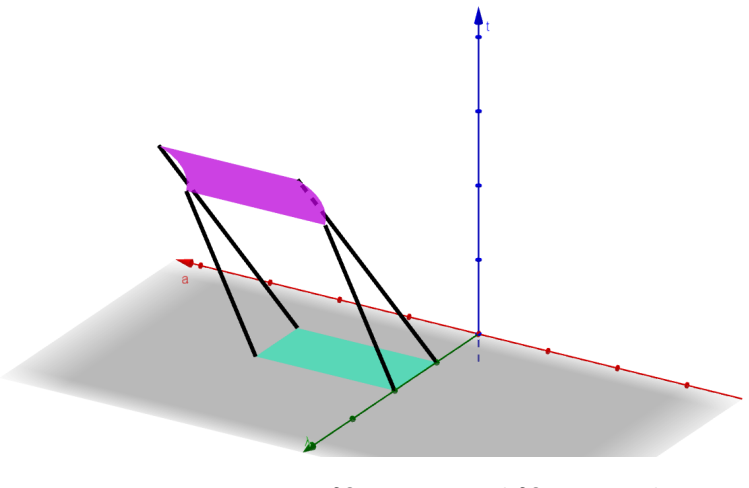
The central claim is that two explicit homeomorphisms of the affine-additive group are extremal for the mean distortion functional $\int_\Omega K(p,f)^2 \rho_0(p)^4\,d\mu_{AA}(p)$. Theorem 1.2 asserts that the linear stretch map $f_k(a,\lambda+it)=(ka,\lambda+ikt)$ satisfies $K_{f_k}^2 \le (\int_\Omega K(\cdot,f)^2\rho_0^4\,d\mu_{AA})/(\int_\Omega \rho_0^4\,d\mu_{AA})$ for every admissible quasiconformal map $f$ in the class $F_k$ between the two defined domains, and Theorem 1.3 asserts the corresponding integral inequality for the radial stretch map $f_k(a,\xi,\psi)=(a-\psi/2+\tfrac12\arctan(\tan\psi/k),\,k\xi,\,\arctan(\tan\psi/k))$ on truncated cylindric shells. In both cases the map is an orientation-preserving quasiconformal map whose distortion is constant along the foliating curves, and the boundary conditions fix the two distinguished boundary components.
Load-bearing premise
The proof depends on assuming that every allowed curve joining the two boundary faces of the target domain is, apart from an ignorably small family, the image of a curve from the source family; if a non-negligible family of such curves is missed, the key modulus comparison can fail and the minimizer conclusion would not follow.
Editorial extensions
If this is right
- The linear stretch map also minimizes the maximal distortion $K_f$ within the same class (Corollaries 3.1 and 3.2).
- The radial stretch map minimizes the mean distortion on truncated cylindric shells for $0<k<1$, while the case $k>1$ is not treated and would require a different argument (Remark 5.1).
- The method yields a reusable recipe: choose a horizontal foliation, verify the minimal stretching property and constancy of distortion along the foliation, then extend the curve family to all curves joining the boundary components.
- The extremal maps are explicit contact transformations, so they supply concrete examples of extremal quasiconformal mappings in a conformally hyperbolic sub-Riemannian geometry.
Reading between the lines
- A testable extension is to apply the same MSP-plus-modulus recipe to other solvable sub-Riemannian groups whose Haar measure splits as $|\dot\gamma|_H^4\,ds\,d\nu$ along a horizontal foliation; wherever that splitting holds, the analogous stretch map should minimize the same mean functional.
- If the implicit surjectivity assumption on the curve family fails, the extremality statements in Theorems 1.2 and 1.3 may still be true, but a sharper modulus comparison not relying on exact preservation of the joining family would be needed.
- The open-question calculation in Section 6 gives a strict inequality between the modulus ratio and $K_{f_k}^2$ for $\psi_0\in(\pi/4,\pi/2)$, suggesting that maximal-distortion minimality of the radial map is sensitive to the opening angle and might fail for large $\psi_0$.
- The formal substitution $k=-1$ in Remark 5.4 produces a contactomorphism, so the radial construction has a conformal member; this raises a natural uniqueness question for the mean-distortion minimizers.
Editorial analysis
A structured set of objections, weighed in public.
Referee Report
Summary. The paper studies extremal quasiconformal mappings on the affine-additive group AA = R x H_C^1. It introduces linear and radial stretch maps, proves a general criterion (Theorem 1.1) for a map with the minimal stretching property and constant distortion along a foliation to minimize the mean distortion functional, and applies this criterion to prove extremality of the linear stretch map in two settings (Theorem 1.2, k<1 and k>1) and of the radial stretch map in a cylindrical-logarithmic setting (Theorem 1.3). The proofs rely on the 4-modulus of curve families, explicit computations of extremal densities, Beltrami coefficients, and boundary conditions, and are supported by a substantial appendix on quasiconformal mappings and modulus in the affine-additive group.
Significance. If the main theorems hold, the paper is a solid contribution to sub-Riemannian quasiconformal geometry, extending Gr"otzsch-type extremal problems from the Heisenberg group to the affine-additive group. The explicit computations of extremal densities, Beltrami coefficients, MSP conditions, and modulus values are careful and appear correct. The method is a variant of the authors' previous Heisenberg-group work, so the novelty is moderate but appropriate for the setting. However, the paper as written leaves a load-bearing modulus inequality asserted rather than proved, so the main minimization results are not fully established in the submitted text.
major comments (1)
- [Theorems 1.2 and 1.3, Step 6 in the proofs (Sections 3.1, 3.2, 5.1)] In each application of Theorem 1.1, Step 6 asserts without proof that Mod4(fk(Gamma0)) <= Mod4(f(Gamma)) for every f in Fk, citing absolute continuity of quasiconformal maps on almost every curve and the boundary conditions. This inequality is exactly the hypothesis needed to apply Theorem 1.1, so it is load-bearing for the minimization claims. The assertion is true, but the manuscript should supply the short argument: for f in Fk, set g = f^{-1} composed with fk; the boundary conditions imply g(Omega) = Omega and g maps each distinguished boundary component to itself. Since g is quasiconformal, for all curves in Gamma0 outside a zero-4-modulus subfamily, g composed with gamma is horizontal and joins the same boundary components, hence lies in Gamma up to modulus zero. Therefore fk(Gamma0) = f(g(Gamma0)) is contained in f(Gamma) up to modulus zero, and monotonicity of modulus gives Mod4(fk(Gamma0)) <= Mod4(f(Gamma)). I recommend adding this argument, or a lemma making it precise, to the proofs of Theorems 1.2 and 1.3.
minor comments (5)
- [Section 3.1, Step 3] The curve family Gamma0 is defined with lambda in (0,1/2), but the foliation and the subsequent integration use lambda in (1/2,1); the interval in the definition of Gamma0 should be (1/2,1).
- [Section 2.1] The heading 'Proof of Thereom 1.1' contains a typo: 'Thereom' should be 'Theorem'.
- [Proposition 2.6, proof] The notation 'M4(f0(Gamma0))' appears once in the upper-bound part of the proof; it should be 'Mod4(f0(Gamma0))'.
- [Section 4] The text says 'cylidrical-logarithmic coordinates'; this should be 'cylindrical-logarithmic coordinates'.
- [Abstract] The abstract contains 'strech maps'; the intended word is 'stretch maps'.
Circularity Check
No significant circularity: mean-distortion minimality is derived from verified MSP and modulus inequalities, not assumed.
full rationale
The central minimization theorems are not circular. The functional (5), the admissible classes Fk, and the candidate stretch maps are defined independently, and the MSP (Definition 2.2) is a concrete sign condition verified by direct computation for each fk rather than a restatement of minimality. Theorem 1.1 rests on two propositions proved in the paper: Proposition 2.4 (modulus ≤ distortion integral) and Proposition 2.6 (equality for MSP maps with curve-constant distortion). The citation to the authors' prior work [8] is methodological; the key inequalities are re-proved here. The one load-bearing assertion is the modulus comparison Mod4(fk(Γ0)) ≤ Mod4(f(Γ)) for all f in Fk, stated in Step 6 of the proofs of Theorems 1.2 and 1.3 as a consequence of absolute continuity on almost every curve and the boundary conditions. The detailed precomposition argument is omitted, so this is an expository gap, but it is not a circular reduction: the modulus inequality is a geometric statement about curve families and is not identical to the mean-distortion inequality by construction. No parameter is fitted to the claimed prediction. The only mild concern is the repeated use of the authors' own framework from [8] and [9], which is not load-bearing here. Accordingly, the paper shows no significant circularity.
Assumptions & free parameters
assumptions (4)
- standard math Quasiconformal maps between domains in AA are absolutely continuous on almost every horizontal curve, up to a subfamily of zero 4-modulus.
- domain assumption The metric, analytic, and geometric definitions of quasiconformality on AA are equivalent; quasiconformal maps are weakly contact and satisfy the contact condition f*theta = sigma theta almost everywhere.
- ad hoc to paper For each application, the image under any f in Fk of the family Gamma of horizontal curves joining the boundary components coincides with the full family of such curves in the target domain, up to a modulus-zero subfamily, so that Mod4(f(Gamma)) >= Mod4(fk(Gamma0)).
- standard math The volume derivative formula JmuAA(p,f) = (2f2(p))^{-4}(|ZfI|^2 - |ZfI|^2)^2 and the change of variables formula for quasiconformal maps hold.
Cite this review
Pith. "Pith review of Stretch maps on the affine-additive group." pith.science (2026). https://pith.science/paper/MF72BBE2
@misc{pith2026241113129,
  author       = {Pith},
  title        = {Pith review of: Stretch maps on the affine-additive group},
  year         = {2026},
  howpublished = {\url{https://pith.science/paper/MF72BBE2}},
  note         = {Machine review of arXiv:2411.13129}
}
read the original abstract
We define linear and radial stretch maps in the affine-additive group, and prove that they are minimizers of the mean quasiconformal distortion functional. For the proofs we use a method based on the notion of modulus of a curve family and the minimal stretching property (MSP) of the afore-mentioned maps. MSP relies on certain given curve families compatible with the respective geometric settings of the strech maps.
Figures

Reference graph
Works this paper leans on
-
[1]
L.V. Ahlfors. On quasiconformal mappings. J. Anal. Math. , 3:1–58, 1954
work page 1954
-
[2]
V. Alberge and A. Papadopoulos. On five papers by Herbert Gr¨ otzsch. In Handbook of Teichm¨ uller theory. Vol. VII, volume 30 of IRMA Lect. Math. Theor. Phys. , pages 393–415. Eur. Math. Soc., Z¨ urich, 2020
work page 2020
-
[3]
K. Astala. Area distortion of quasiconformal mappings. Acta Math., 173(1):37–60, 1994
work page 1994
-
[4]
P. Haj lasz and P. Koskela. Sobolev met Poincar´ e. Mem. Amer. Math. Soc. , 145(688):x+101, 2000
work page 2000
-
[5]
Z.M. Balogh. Hausdorff dimension distribution of quasiconformal mappings on the Heisenberg group. J. Anal. Math. , 83:289–312, 2001
work page 2001
-
[6]
Hyperbolicity of the sub-Riemannian affine-additive group
Z.M. Balogh, E. Bubani, and I.D. Platis. Hyperbolicity of the sub-Riemannian affine-additive group. Preprint, Submitted, https://arxiv.org/abs/2407.04635, 2024
work page Pith review arXiv 2024
- [7]
- [8]
Show all 31 references
-
[9]
Balogh, K
Z.M. Balogh, K. F¨ assler, and I.D. Platis. Uniqueness of minimisers for a Gr¨ otzsch-Belinski ˘i type inequality in the Heisenberg group. Conform. Geom. Dyn. , 19:122–145, 2015
2015
-
[10]
Balogh, P
Z.M. Balogh, P. Koskela, and S. Rogovin. Absolute continuity of quasiconformal mappings on curves. Geom. Funct. Anal., 17(3):645–664, 2007
2007
-
[11]
Brakalova, I
M. Brakalova, I. Markina, and A. Vasil’ev. Modules of systems of measures on polarizable Carnot groups. Ark. Mat., 54(2):371–401, 2016
2016
-
[12]
Brakalova, I
M. Brakalova, I. Markina, and A. Vasil’ev. Extremal functions for modules of systems of measures. J. Anal. Math. , 133:335–359, 2017
2017
-
[13]
E. Bubani. Hyperbolicity and quasiconformal maps on the affine-additive group. Doctoral Dissertation, Forthcoming, 2025
2025
-
[14]
Gehring and J
F.W. Gehring and J. V¨ ais¨ al¨ a. Hausdorff dimension and quasiconformal mappings.J. London Math. Soc. (2) , 6:504–512, 1973
1973
-
[15]
Gr¨ otzsch.¨Uber einige Extremalprobleme der konformen Abbildung
H. Gr¨ otzsch.¨Uber einige Extremalprobleme der konformen Abbildung. I, II. Berichte Leipzig 80; 367-376, 497-502 (1928)., 1928
1928
-
[16]
Heinonen and P
J. Heinonen and P. Koskela. Quasiconformal maps in metric spaces with controlled geometry. Acta Math., 181(1):1–61, 1998
1998
-
[17]
Heinonen, P
J. Heinonen, P. Koskela, N. Shanmugalingam, and J.T. Tyson. Sobolev classes of Banach space-valued functions and quasiconformal mappings. J. Anal. Math. , 85:87–139, 2001
2001
-
[18]
Heinonen, P
J. Heinonen, P. Koskela, N. Shanmugalingam, and J.T. Tyson. Sobolev spaces on met- ric measure spaces, An approach based on upper gradients , volume 27 of New Mathematical Monographs. Cambridge University Press, Cambridge, 2015
2015
-
[19]
Kor´ anyi and H.M
A. Kor´ anyi and H.M. Reimann. Quasiconformal mappings on the Heisenberg group. Invent. Math., 80(2):309–338, 1985
1985
-
[20]
Kor´ anyi and H.M
A. Kor´ anyi and H.M. Reimann. Foundations for the theory of quasiconformal mappings on the Heisenberg group. Adv. Math., 111(1):1–87, 1995
1995
-
[21]
Koskela and K
P. Koskela and K. Wildrick. Analytic properties of quasiconformal mappings between metric spaces. In Metric and differential geometry , volume 297 of Progr. Math. , pages 163–174. Birkh¨ auser/Springer, Basel, 2012
2012
-
[22]
Margulis and G.D
G.A. Margulis and G.D. Mostow. The differential of a quasi-conformal mapping of a Carnot- Carath´ eodory space.Geom. Funct. Anal., 5(2):402–433, 1995
1995
-
[23]
Mitchell
J. Mitchell. On Carnot-Carath´ eodory metrics. Journal of Differential Geometry , 21(1):35 – 45, 1985
1985
-
[24]
Montgomery
R. Montgomery. A tour of subriemannian geometries, their geodesics and applications , vol- ume 91 of Math. Surv. Monogr. Providence, RI: American Mathematical Society (AMS), 2002. 32
2002
-
[25]
G.D. Mostow. Strong rigidity of locally symmetric spaces , volume No. 78 of Annals of Mathematics Studies . Princeton University Press, Princeton, NJ; University of Tokyo Press, Tokyo, 1973
1973
-
[26]
P. Pansu. M´ etriques de Carnot-Carath´ eodory et quasiisom´ etries des espaces sym´ etriques de rang un. Ann. of Math. (2) , 129(1):1–60, 1989
1989
-
[27]
I. D. Platis. Modulus of revolution rings in the Heisenberg group. Proc. Amer. Math. Soc. , 144(9):3975–3990, 2016
2016
-
[28]
Shanmugalingam
N. Shanmugalingam. Newtonian spaces: an extension of Sobolev spaces to metric measure spaces. Rev. Mat. Iberoamericana, 16(2):243–279, 2000
2000
-
[29]
Thurston
W.P. Thurston. Three-dimensional geometry and topology. Vol. 1. Ed. by Silvio Levy, volume 35 of Princeton Math. Ser. Princeton, NJ: Princeton University Press, 1997
1997
-
[30]
Vasil’ev
A. Vasil’ev. Moduli of families of curves for conformal and quasiconformal mappings , volume 1788 of Lecture Notes in Mathematics . Springer-Verlag, Berlin, 2002
2002
-
[31]
V.A. Zorich. Asymptotic geometry and conformal types of Carnot-Carath´ eodory spaces.Geom. Funct. Anal., 9(2):393–411, 1999. Z.M. Balogh, (Corresponding author),Universit¨at Bern, Mathematisches Institut (MAI), Sidlerstrasse 5, 3012 Bern, Switzerland. E-mail address, Z.M. Balo...
1999
Reviewed August 12, 2026 · model on record in the stance chip above.
Discussion (0). Continue with ORCID to comment.