Experimental Assessment of Human Blockage at sub-THz and mmWave Frequency Bands
Pith reviewed 2026-05-23 17:15 UTC · model grok-4.3
The pith
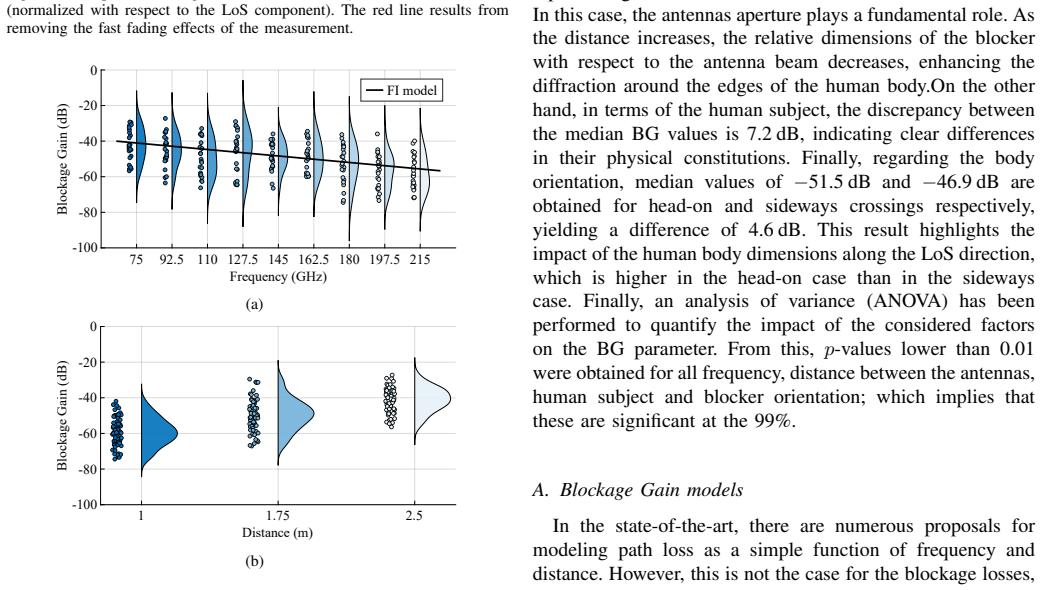
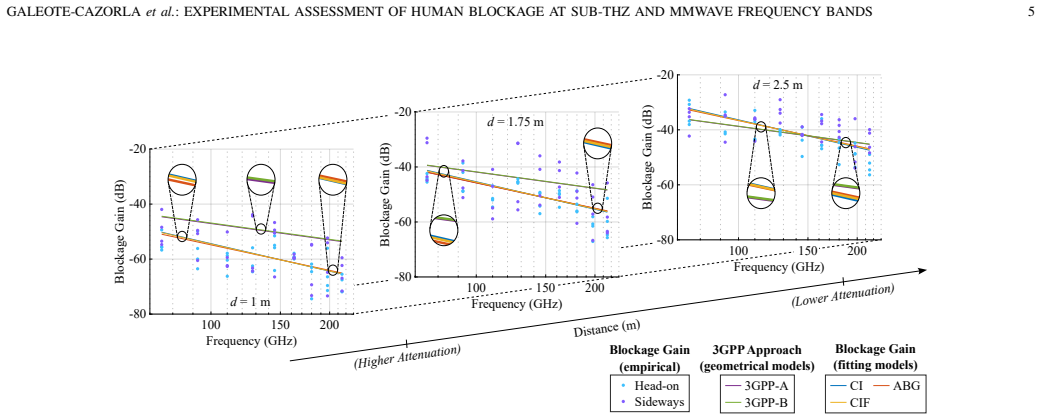
Human blockage attenuation rises from 42 dB at 75 GHz to 56 dB at 215 GHz.
A machine-rendered reading of the paper's core claim, the machinery that carries it, and where it could break.
Core claim
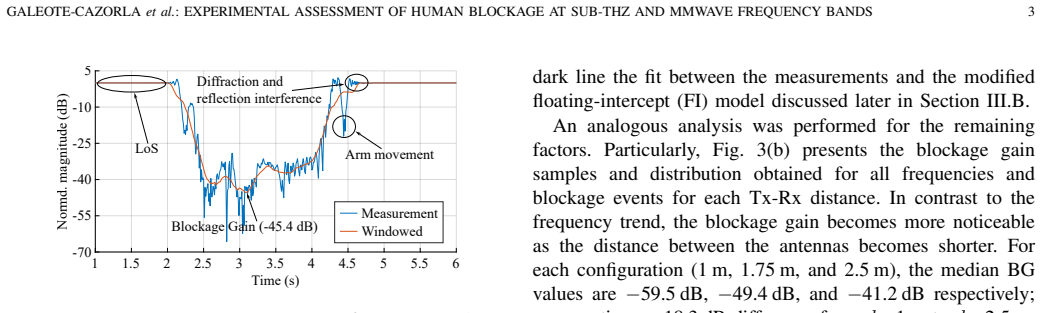
Experimental data establish that human blockage produces average attenuation that increases from 42 dB at 75 GHz to 56 dB at 215 GHz, with additional dependence on blocker-antenna distance and body orientation.
What carries the argument
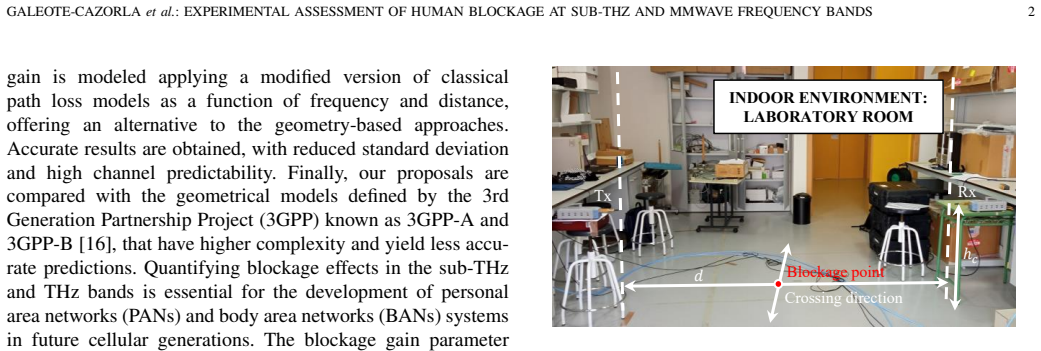
Wide-frequency-band power measurements with a human blocker placed at controlled distances and orientations between transmitter and receiver.
If this is right
- Path-loss models for frequencies above 100 GHz must incorporate stronger human-blockage terms than those used at lower mmWave bands.
- An 18 dB improvement in received power occurs when Tx-Rx separation grows from 1 m to 2.5 m even in the presence of a blocker.
- Body orientation alone can alter blockage loss by as much as 4.6 dB.
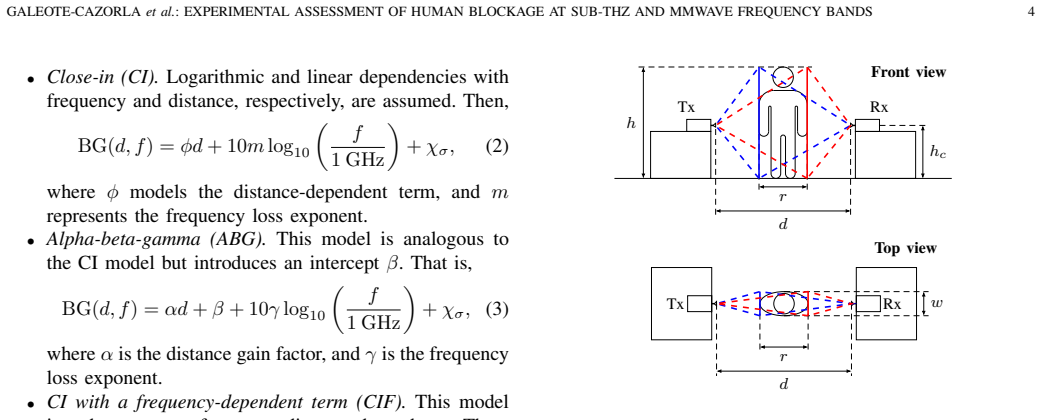
- Fitted models provide a basis for comparing against 3GPP blockage alternatives at sub-THz frequencies.
Where Pith is reading between the lines
- Network planning tools for 6G bands may need to treat human blockage as a frequency-dependent obstacle rather than a fixed loss.
- The measured distance dependence suggests that slightly larger cell sizes or relay placements could partially offset blockage.
Load-bearing premise
Laboratory conditions and the specific antennas and equipment capture typical real-world human blockage without large unmodeled biases that would change the reported attenuation values.
What would settle it
New measurements at the same frequencies but with different antennas, environments, or blocker positioning that fail to show attenuation increasing from roughly 42 dB to 56 dB would challenge the reported frequency dependence.
Figures
read the original abstract
The fifth generation (5G) of mobile communications relies on extremely high data transmission rates utilizing a wide range of frequency bands, including FR1 (sub-6 GHz) and FR2 (mmWave). Future mobile communications systems are envisaged to operate at the electromagnetic spectrum beyond FR2, above 100 GHz, known as sub-THz band. These new frequencies open up challenging scenarios where communications will have to rely on a major contribution such as the line-of-sight (LoS) component. To the best of the authors' knowledge, for the first time in the literature this work studies the human blockage effects over an extremely wide frequency band from 75 GHz to 215 GHz considering: (i) the distance between the blocker and the antennas and (ii) the body size and orientation. The obtained results are fitted to modifications of the classical path loss models and compared to 3GPP alternatives. The average attenuation increases from 42 dB to 56 dB when frequency rises from 75 GHz to 215 GHz. On the other hand, an 18 dB increment in the received power is observed when the Tx--Rx separation is increased from 1 m to 2.5 m. Finally, variations of up to 4.6 dB are found depending on the blocker's orientation.
Editorial analysis
A structured set of objections, weighed in public.
Referee Report
Summary. The manuscript reports an experimental study of human blockage attenuation for wireless links operating from 75 GHz to 215 GHz. Measurements vary the blocker-antenna distance (1 m to 2.5 m), body size, and orientation, yielding an average attenuation increase from 42 dB to 56 dB with rising frequency, an 18 dB received-power gain when Tx-Rx separation increases from 1 m to 2.5 m, and orientation-induced variations up to 4.6 dB. The data are fitted to modified classical path-loss models and compared against 3GPP alternatives; the authors claim this is the first such study over this extremely wide frequency span.
Significance. If the reported attenuation values and frequency dependence hold under the stated conditions, the work supplies empirical data that can directly inform sub-THz channel models for 6G systems, where LoS dominance makes human blockage a first-order impairment. The breadth of the frequency range and the explicit parametric sweeps on distance, size, and orientation constitute a useful addition to the propagation literature.
minor comments (3)
- [§3] §3 (Measurement Setup): although the full text supplies the previously missing protocol details, the text should explicitly state the number of independent trials per configuration, the criterion for data exclusion, and whether error bars or standard deviations accompany the reported average attenuations.
- [§4] §4 (Model Fitting): the precise functional form of the 'modifications' applied to the classical path-loss models should be written out (including any additional parameters introduced) so that readers can reproduce the fits without ambiguity.
- [Figures 4-5] Figure 4 and Figure 5: axis labels and legends should distinguish the three body-size categories and the four orientation angles more clearly; current captions leave some curves difficult to map to the experimental conditions.
Simulated Author's Rebuttal
We thank the referee for the positive assessment of our work and the recommendation of minor revision. The provided summary accurately captures the experimental scope, frequency range, and key parametric findings on human blockage attenuation.
Circularity Check
No significant circularity; purely experimental measurements
full rationale
This is an experimental measurement study reporting direct observations of human blockage attenuation (42–56 dB across 75–215 GHz) under controlled variations in blocker distance, body size, and orientation. The manuscript describes the lab setup, equipment, and data collection protocol; results are empirical data points fitted to standard path-loss model modifications and compared against 3GPP references. No load-bearing derivations, self-definitional equations, fitted-input predictions, or self-citation chains reduce any central claim to its own inputs by construction. The frequency dependence and distance effects are reported as measured outcomes, not as outputs forced by the paper's own modeling assumptions.
Axiom & Free-Parameter Ledger
free parameters (1)
- parameters of modified path loss models
axioms (1)
- domain assumption Standard path loss models can be modified to account for human blockage at these frequencies
Reference graph
Works this paper leans on
-
[1]
THz Radio Communication: Link Budget Analysis toward 6G,
K. Rikkinen, P. Kyosti, M. E. Leinonen, M. Berg and A. Parssinen, “THz Radio Communication: Link Budget Analysis toward 6G,”IEEE Commun. Mag., vol. 58, no. 11, pp. 22-27, 2020
work page 2020
-
[2]
Terahertz Wireless Channels: A Holistic Survey on Measurement, Modeling, and Analysis,
C. Han, Y . Wang, Y . Li, Y . Chen, N. A. Abbasi, T. K ¨urner and A. F. Molisch, “Terahertz Wireless Channels: A Holistic Survey on Measurement, Modeling, and Analysis,”IEEE Commun. Surv. Tutor ., vol. 24, no. 3, pp. 1670-1707, 2022
work page 2022
-
[3]
S. Dang, O. Amin, B. Shihada and M. S. Alouini, “What should 6G be?,”Nat. Electron., vol. 3, pp. 20-29, 2020
work page 2020
-
[4]
Propagation mea- surements and models for wireless communications channels,
J. B. Andersen, T. S. Rappaport and S. Yoshida, “Propagation mea- surements and models for wireless communications channels,”IEEE Commun. Mag., vol. 33, no. 1, pp. 42-49, 1995
work page 1995
-
[5]
Scattering Analysis for the Modeling of THz Commu- nication Systems,
R. Piesiewicz, C. Jansen, D. Mittleman, T. Kleine-Ostmann, M. Koch and T. Kurner, “Scattering Analysis for the Modeling of THz Commu- nication Systems,”IEEE Trans. Antennas Propag., vol. 55, no. 11, pp. 3002-3009, 2007
work page 2007
-
[6]
Scattering and Roughness Analysis of Indoor Materials at Frequencies from 750 GHz to 1.1 THz,
F. Sheikhet al., “Scattering and Roughness Analysis of Indoor Materials at Frequencies from 750 GHz to 1.1 THz,”IEEE Trans. Antennas Propag., vol. 69, no. 11, pp. 7820-7829, 2021
work page 2021
-
[7]
Towards 6G: Paradigm of realistic terahertz channel modeling,
K. Guan, H. Yi, D. He, B. Ai and Z. Zhong, “Towards 6G: Paradigm of realistic terahertz channel modeling,”China Commun., vol. 18, no. 5, pp. 1-18, 2021
work page 2021
-
[8]
Human Body Shadowing Characterization for 60-GHz Indoor Short-Range Wireless Links,
P. Karadimas, B. Allen and P. Smith, “Human Body Shadowing Characterization for 60-GHz Indoor Short-Range Wireless Links,”IEEE Antennas Wirel. Propag. Lett., vol. 12, pp. 1650-1653, 2013
work page 2013
-
[9]
Y . Dalveren, G. Karatas, M. Derawi and A. Kara, “A Simple Propagation Model to Characterize the Effects of Multiple Human Bodies Blocking Indoor Short-Range Links at 28 GHz,”Electron., vol. 10, no. 3, p. 305, 2021
work page 2021
-
[10]
Modeling Human Blockage at 5G Millimeter-Wave Frequencies,
U. T. Virk and K. Haneda, “Modeling Human Blockage at 5G Millimeter-Wave Frequencies,”IEEE Trans. Antennas Propag., vol. 68, no. 3, pp. 2256-2266, 2020. [11]Propagation by diffraction,Rec. ITU-R P.526-15, International Telecom- munications Union, Geneva, Switzerland, 2019
work page 2020
-
[11]
G. R. MacCartney, S. Deng, S. Sun and T. S. Rappaport, “Millimeter- Wave Human Blockage at 73 GHz with a Simple Double Knife-Edge Diffraction Model and Extension for Directional Antennas,” in2016 IEEE 84th V ehicular Technology Conference (VTC-Fall), Montreal, QC, Canada, pp. 1-6, 2016
work page 2016
-
[12]
A uniform GTD analysis of the diffraction of electromagnetic waves by a smooth convex surface,
P. Pathak, W. Burnside and R. Marhefka, “A uniform GTD analysis of the diffraction of electromagnetic waves by a smooth convex surface,” IEEE Trans. Antennas Propag., vol. 28, no. 5, pp. 631-642, 1980
work page 1980
-
[13]
Measurement-Based Characterization of D-Band Hu- man Body Shadowing,
P. Zhanget al., “Measurement-Based Characterization of D-Band Hu- man Body Shadowing,” in2023 17th European Conference on Antennas and Propagation (EuCAP), Florence, Italy, pp. 1-5, 2023
work page 2023
-
[14]
Reflec- tion and Shadowing Loss due to Human Body in 300-GHz-band Wire- less Links,
S. Takagi, K. Matsui, A. Hirata, K. Takezawa and T. Hayashi, “Reflec- tion and Shadowing Loss due to Human Body in 300-GHz-band Wire- less Links,” in2022 IEEE International Workshop on Electromagnetics: Applications and Student Innovation Competition (iWEM), Narashino, Japan, pp. 126-127, 2022. [16]5G; Study on channel model for frequencies from 0.5 to 10...
work page 2022
-
[15]
Outdoor walking speeds of apparently healthy adults: A systematic review and meta analysis,
E. M. Murtagh, J. L. Mair, E. Aguiar, C. Tudor-Locke, and M. H. Murphy. “Outdoor walking speeds of apparently healthy adults: A systematic review and meta analysis,”Sports Med., vol. 51, no. 1, pp. 125–141, 2020
work page 2020
-
[16]
Estimate of local average power of a mo- bile radio signal,
W. C. Y . Lee, “Estimate of local average power of a mo- bile radio signal,”IEEE Trans. V eh. Technol., vol. 34, no. 1, pp. 22-27, 1985
work page 1985
-
[17]
T. S. Rappaport, Y . Xing, G. R. MacCartney, A. F. Molisch, E. Mellios and J. Zhang, “Overview of Millimeter Wave Communica- tions for Fifth-Generation (5G) Wireless Networks—With a Focus on Propagation Models,”IEEE Trans. Antennas Propag., vol. 65, no. 12, pp. 6213-6230, 2017
work page 2017
discussion (0)
Sign in with ORCID, Apple, or X to comment. Anyone can read and Pith papers without signing in.