REVIEW 4 major objections 5 minor 79 references
Ageing and Quenching: Influence of Galaxy Environment and Nuclear Activity in Transition Stage
T0 review · 4 major / 5 minor · reviewed 2026-08-12 · deepseek-v4-flash
Pith's one-line read Galaxy ageing shifts with environment; quenching stays put
desk verdict A careful but underpowered environmental split of ageing/quenching galaxies; the ageing result is plausible, but the quenching 'independence' is a null result too weak to carry the conclusion. read the letter →
The pith
A machine-rendered reading of the paper's core claim, the machinery that carries it, and where it could break.
The reading
What carries the argument
The ageing diagram, defined by two lines in the $\mathrm{EW}(\mathrm{H}\alpha)$ versus $D_n(4000)$ plane, separates galaxies into ageing (above the ageing line) and quenching (below the quenching line) populations. The analysis pairs this with the WHAN diagnostic diagram to split each sample by nuclear activity, and with a colour window $0.5 < (g-r) < 0.7$ to isolate galaxies in the transition stage between blue cloud and red sequence. Environment is assigned by a friends-of-friends algorithm whose linking length follows an arctangent law with best-fit parameters $R_{\mathrm{LL},0} = 0.34$ Mpc, $a = 1.4$, and $z_\star = 0.09$.
What would settle it
Recompute the same main-sequence slope and intercept comparison using a continuous environment measure such as the fifth-nearest-neighbour surface density $\Sigma_5$ or a group halo mass instead of the friends-of-friends binary split. If the ageing shift of about $0.03$ dex in slope disappears or the quenching shift becomes significant, the result is an artefact of the grouping; if both patterns survive, the central claim is strengthened.
Extended reading notes
Core claim
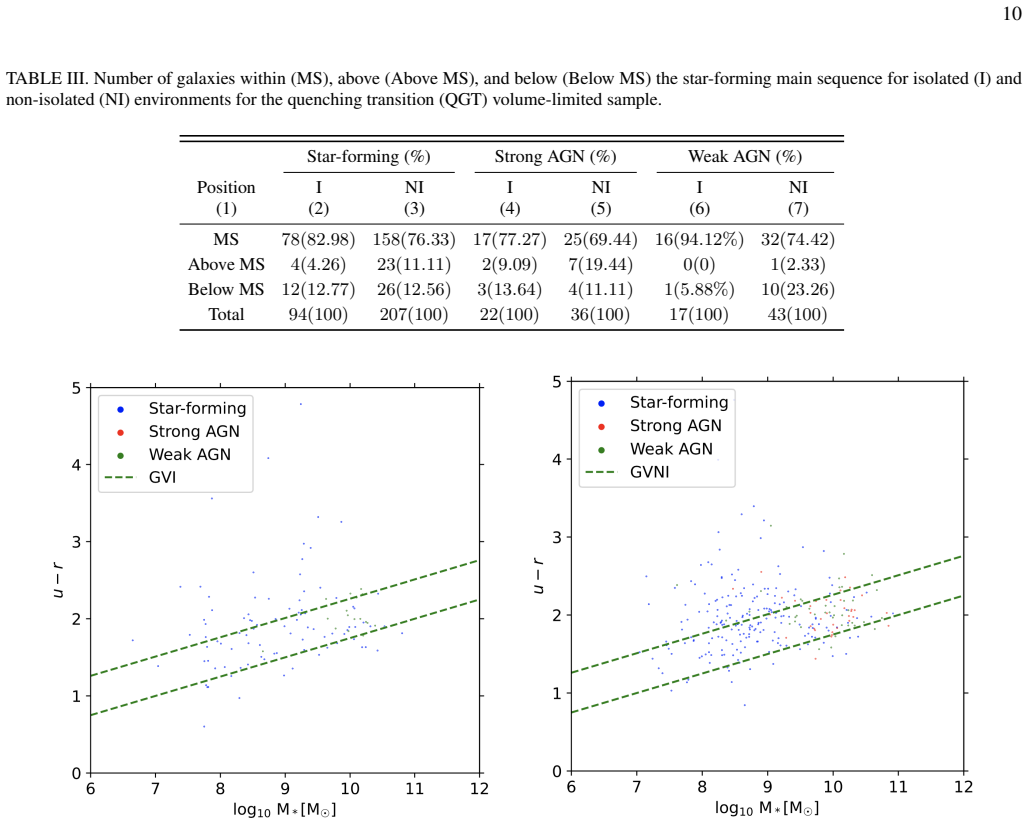
The central claim is that ageing and quenching respond differently to the large-scale environment, and that this asymmetry is tied to a galaxy's nuclear activity. In the star formation main sequence, ageing galaxies show a statistically significant change of $0.03$ dex in slope and $0.30$ dex in intercept between isolated and non-isolated environments, with P-values near $5 \times 10^{-5}$. Quenching galaxies, in contrast, show changes of only $0.02$ dex in slope and $0.12$ dex in intercept, smaller than the fitting errors and not statistically significant. Counts of galaxies above, within, and below the main sequence and the green valley shift significantly for ageing star-forming galaxies but not for ageing AGN hosts, and not for quenching galaxies of any nuclear class. The paper concludes that ageing depends on the environment and that this dependence is influenced by nuclear activity, while quenching is environmentally independent and that independence holds regardless of nuclear activity.
Load-bearing premise
The claim of environmental independence for quenching assumes that the friends-of-friends separation with its chosen linking length produces physically meaningful isolated and non-isolated groups, and that the 419 transition-stage quenching galaxies, split into nuclear classes as small as 17 objects, carry enough statistical power for a null difference to mean genuine independence.
Editorial extensions
If this is right
- If ageing is environmentally driven while quenching is internal, the two populations crossing the green valley should have different spatial clustering, with ageing galaxies avoiding dense regions and quenching galaxies appearing everywhere.
- The non-significant slope and intercept shifts for quenching imply that adding environmental information to a quenching model should not improve its prediction once stellar mass and nuclear activity are known.
- The significant environmental shift for ageing star-forming galaxies but not ageing AGN hosts suggests that the presence of an active nucleus can mask or replace the environmental trigger of slow fading.
- Repeating the analysis at higher redshift, where environmental timescales are shorter, could sharpen the separation between the two transition routes.
Reading between the lines
- The authors' null result for quenching rests on a modest sample of 419 transition-stage quenching galaxies, with nuclear subclasses containing 17 to 43 objects; a reader should treat the 'independence' as established only at the statistical power that sample allows.
- A natural extension would be to replace the friends-of-friends binary split with a continuous density or halo-mass measure, which could reveal whether the ageing shift is a threshold effect or a graded response to local density.
- The asymmetry, if it holds, predicts that resolved spectroscopic surveys should find radially uniform suppression of star formation in quenching galaxies but patchy or inflow-dependent fading in ageing galaxies.
Editorial analysis
A structured set of objections, weighed in public.
Referee Report
Summary. The paper uses a volume-limited SDSS DR12 sample to split galaxies into isolated and non-isolated environments via a friends-of-friends algorithm, then further classifies them by nuclear activity (WHAN) and by ageing/quenching state using the ageing diagram, retaining only transition-stage galaxies. It fits star-formation main sequences and green-valley positions for ageing and quenching populations, reporting a significant environmental shift in the ageing main sequence (slope +0.03, intercept +0.30 dex) and an insignificant shift for the quenching main sequence, which it interprets as environmental independence of quenching. The paper also reports chi-square comparisons of counts above/within/below the main sequence and green valley for star-forming and AGN classes. The central conclusion is that ageing depends on environment, with the dependence modulated by nuclear activity, while quenching does not depend on environment and nuclear activity does not change that independence.
Significance. If the ageing result holds, it adds useful evidence that environmental processes affect the slow 'ageing' transition in a way that may depend on AGN class, and the volume-limited selection and the explicit use of both WHAN and ageing-diagram classifications are strengths. The significance of the paper is limited, however, by the quenching side: the central claim of environmental independence of quenching rests on underpowered null results and an internal numerical inconsistency. The paper provides no power analysis, equivalence bounds, or confidence intervals on the fitted differences, so the 'independence' conclusion is not currently supported. With a careful revision that reports an informative null analysis and corrects the inconsistencies, the ageing part could be a publishable contribution; in its present form the overinterpretation of the quenching null is a load-bearing flaw.
major comments (4)
- [Section V, Table V] In the weak-AGN quenching column of Table V, the Below-MS comparison yields P=0.006, below the conventional threshold, yet the text in Section V states that 'the P-values are greater ... than the threshold' for all quenching classes and bases the 'no environmental influence' conclusion on this. The averaging over the three positions obscures this individual significant result. Moreover, for expected counts below 5, the chi-square approximation is unreliable; a Fisher exact test should be used. This is load-bearing because the independence claim is the second half of the paper's central conclusion.
- [Section IV.B, Eqs. (14)-(15), Tables III-IV] The conclusion that quenching does not depend on environment is inferred from non-significant differences in fits with total QGT samples of 133 and 286 galaxies, split into AGN classes with 17-43 objects. With slope uncertainties of +/-0.06 and +/-0.04 and intercept uncertainties of +/-0.52 and +/-0.34, the 95% confidence intervals on the differences are not reported, and no power analysis or equivalence test is given. A non-significant P-value under these conditions is expected even for an environmental dependence as large as that claimed for ageing. The manuscript should either provide an informative null analysis (e.g., confidence intervals on the difference, equivalence bounds) or soften the conclusion to 'no significant dependence detected in this sample.'
- [Abstract, Section V, Section VI] The quenching intercept change is reported as 0.12 dex in the abstract and in the bullet list of Section VI, but Section V explicitly gives 0.19 dex based on Eqs. (14) and (15) (-8.38 vs -8.57). This numerical inconsistency must be corrected, as it concerns the quoted size of the effect used to argue for quenching independence.
- [Section III.A, Eq. (3)] The parameters RLL,0=0.34 Mpc, a=1.4, z*=0.09 are described as 'best-fit values' obtained by fitting the arctangent law to observational data, but the surrounding text and reference [42] indicate these are adopted from the Tempel & Tuvikene group catalog. Please clarify the provenance and state whether the results are sensitive to reasonable variations in these linking-length parameters, since the isolated/non-isolated division is the basis for all environmental comparisons.
minor comments (5)
- [Section III.C] The sentence 'The galaxies located above ageing and quenching lines are classified as ageing galaxies while the galaxies below ageing and quenching line are quenching galaxies' is ambiguous; specify the regions relative to both lines (above both, below both, between).
- [Section VI] The phrase 'undermined galaxies' should be 'undetermined galaxies' to match Section III.C and Figure 2.
- [Throughout] The symbol WHalpha is used interchangeably with EW(Halpha); define the equivalent width notation once and use it consistently.
- [Table V] For the 'Above MS' weak-AGN counts of 1 in both environments, expected frequencies are well below 5, so the chi-square P-values in Table V should be interpreted with caution; a Fisher exact test would be more appropriate.
- [References] Ref. [15] lists 'MNRAS 452, 1841 (2007)' but the authors are Shimizu et al. 2015 (arXiv:1506.07039); please verify the year and volume.
Circularity Check
No significant circularity: the derivation chain is self-contained and the central comparisons are measured outputs, not inputs.
full rationale
All load-bearing classifications and fits are imported from external, non-overlapping references: Eqs. (8)-(9) are the ageing and quenching criteria from Corcho-Caballero et al. 2023, the FoF linking-length law and parameters in Eq. (3) come from Tempel & Tuvikene 2017, the WHAN boundaries come from Cid Fernandes et al. 2011, and the green-valley boundaries come from Schawinski et al. 2014. None of these are authored by Privatus and Goswami, so no self-citation chain supports the claims. The central comparisons are measured differences between best-fit lines for separately selected AGT and QGT samples (Eqs. 10/11 and 14/15) and chi-square P-values from contingency tables; the reported slope and intercept changes are outputs of those regressions, not quantities assumed in the sample definitions. The environmental split is an external group-finding catalogue applied to the data, not fitted to the ageing/quenching outcome. The quenching-independence conclusion does rest on small samples and a null result, and there is an internal inconsistency between the 0.12 dex and 0.19 dex intercept shifts, but these are statistical and interpretive concerns, not circular reductions: the paper does not define environment, ageing, or quenching in terms of the main-sequence differences it reports. The derivation is therefore self-contained against external benchmarks, and no circularity score above zero is warranted.
Assumptions & free parameters
free parameters (2)
- FoF linking length parameters RLL,0, a, z* =
0.34 Mpc, 1.4, 0.09
- Main sequence width =
±0.3 dex
assumptions (6)
- domain assumption The ageing diagram lines (Eqs. 8 and 9) correctly separate ageing from quenching galaxies in the transition stage.
- domain assumption The WHAN inequalities (Eqs. 4 to 7) correctly classify galaxies into star-forming, strong AGN, weak AGN, and retired.
- domain assumption The green valley bounds (Eqs. 12 and 13) correctly identify the transition colour region.
- domain assumption MPA-JHU stellar masses and star formation rates are reliable for transition-stage galaxies.
- domain assumption The FoF linking length with parameters from Ref. [42] yields physically meaningful isolated and non-isolated samples.
- domain assumption The volume-limited sample and the 0.5 < (g-r) < 0.7 transition cut provide a representative set of transition galaxies.
Cite this review
Pith. "Pith review of Ageing and Quenching: Influence of Galaxy Environment and Nuclear Activity in Transition Stage." pith.science (2026). https://pith.science/paper/UU67DPIE
@misc{pith2026241113235,
  author       = {Pith},
  title        = {Pith review of: Ageing and Quenching: Influence of Galaxy Environment and Nuclear Activity in Transition Stage},
  year         = {2026},
  howpublished = {\url{https://pith.science/paper/UU67DPIE}},
  note         = {Machine review of arXiv:2411.13235}
}
abstract
This study aims to investigate whether the environment and the nuclear activity of a particular galaxy influence the ageing and quenching at the transition stage of the galaxy evolution using the volume-limited sample constructed from the twelve release of the Sloan Digital Sky Survey. To this end, the galaxies were classified into isolated and non-isolated environments and then each subsample was further classified according to their nuclear activity using the WHAN diagnostic diagram, and ageing diagram to obtain ageing and quenching galaxies. The ageing and quenching galaxies at the transition stage were selected for the rest of the analysis. Using the star formation rate and the $u-r$ colour-stellar mass diagrams, the study revealed a significant change of $0.03$ dex in slope and $0.30$ dex in intercept for ageing galaxies and an insignificant change of $0.02$ dex in slope and $0.12$ dex in intercept of the star formation main sequence between isolated and non-isolated quenching galaxies. Further, a more significant change in the number of ageing galaxies above, within and below the main sequence and the green valley was observed. On the other hand, an insignificant change in the number of quenching galaxies above, within and below the main sequence and the green valley was observed. The study concludes that ageing depends on the environment and the dependence is influenced by the nuclear activity of a particular galaxy while quenching does not depend on the environment and this independence is not influenced by the nuclear activity.
Figures


Figures from the paper (3 more)


Reference graph
Works this paper leans on
- [42]
-
[1]
G. Kauffmann, S. White, The Environmental Dependence of the Relations between Stellar Mass, Structure, Star Formation and Nuclear Activity in Galaxies, MNRAS 353, 713 (2004) [arXiv:astro-ph/0402030]
work page Pith review arXiv 2004
-
[2]
C. Tremonti, T. Heckman, The Origin of the Mass–Metallicity Relation: Insights from 53,000 Star-Forming Galaxies in the SDSS , ApJ 613, 898 (2004) [arXiv:astro-ph/0405537]
arXiv 2004
-
[3]
Y . Peng, S. Lilly, K. Kova ˇc, M. Bolzonella, L. Pozzetti, et al., Mass and Environment as Drivers of Galaxy Evolution in SDSS and zCOSMOS and the Origin of the Schechter Function, ApJ 721, 193 (2010) [arXiv:1003.4747]
arXiv 2010
-
[4]
J. Brinchmann, S. Charlot, The physical properties of star forming galaxies in the low redshift universe , MNRAS 351, 1151 (2004) [arXiv:astro-ph/0311060]
arXiv 2004
-
[5]
any friend of my friend is my friend
Here d5 is the projected distance to the 5th nearest neighbouring galaxy, measured in Mpc. In their analysis they shows that distinguishing between retired and recently quenched galaxies are important to constrain the mechanisms driving galaxy evolution. They further left two questions viz., whether galaxies evolve due to their initial conditions at forma...
-
[6]
J. Moustakas, A. Coil, J. Aird, M. Blanton, R. Cool, et al., Constraints on Star Formation Quenching and Galaxy Merging, and the Evolution of the Stellar Mass Function From z = 0− 1, ApJ 767, 50 (2013) [arXiv:1301.1688]
arXiv 2013
- [7]
Show all 79 references
-
[8]
Gonc ¸alves, D
T. Gonc ¸alves, D. Martin, K. Men´endez-Delmestre, T. Wyder, et al., Quenching star formation at intermediate redshifts: downsizing of the mass flux density in the green valley, ApJ 759, 67 (2012) [arXiv:1209.4084]
2012 arXiv
-
[9]
Leslie, L
S. Leslie, L. Kewley, D. Sanders, N. Lee, Quenching star formation: insights from the local main sequence , MNRAS 455, L82 (2015) [arXiv:1509.03632]. 14
2015 arXiv
-
[10]
Daddi, M
E. Daddi, M. Dickinson, G. Morrison, R. Chary, et al., Multiwavelength study of massive galaxies at z ∼ 2. I. Star formation and galaxy growth, ApJ 670, 156 (2007). [arXiv:0705.2831]
2007 arXiv
-
[11]
Speagle, C
J. Speagle, C. Steinhardt, P. Capak, J. Silverman, et al., A Highly Consistent Framework for the Evolution of the Star-Forming” Main Sequence” from z ∼ 0 − 6, ApJS 214, 15 (2014) [arXiv:1405.2041]
2014 arXiv
-
[12]
J. Rich, L. Kewley, M. Dopita, Galaxy-Wide Shocks in Late-Merger Stage Luminous Infrared Galaxies , ApJ 782, 9 (2014) [arXiv:1104.1177]
2014 arXiv
-
[13]
Schawinski, D
K. Schawinski, D. Thomas, M. Sarzi, C. Maraston, et al., Observational evidence for AGN feedback in early-type galaxies, MNRAS 382, 1415 (2007) [arXiv:0709.3015]
2007 arXiv
-
[14]
T. Yuan, L. Kewley, D. Sanders, The Role of Starburst-Active Galactic Nucleus Composites in Luminous Infrared Galaxy Mergers: Insights from the New Optical Classification Scheme, ApJ 709, 884 (2010)
2010
-
[15]
Shimizu, R
T. Shimizu, R. Mushotzky, M. Mel ´endez, M. Koss, et al., Decreased specific star formation rates in AGN host galaxies , MNRAS 452, 1841 (2007) [arXiv:1506.07039]
2007 arXiv
-
[16]
Faber, C
S. Faber, C. Willmer, C. Wolf, D. Koo, B. Weiner, J. Newman, et al., Galaxy Luminosity Functions to z∼1: DEEP2 vs. COMBO-17 and Implications for Red Galaxy Formation, ApJ 665, 265 (2007) [arXiv:astro-ph/0506044]
2007 arXiv
-
[17]
Whitaker, P
K. Whitaker, P. Dokkum, G. Brammer, M. Franx, The star formation mass sequence out to z= 2.5 , ApJL 754, L29 (2015) [arXiv:1205.0547]
2015 arXiv
-
[18]
Schawinski, C
K. Schawinski, C. Urry, B. Simmons, L. Fortson, S. Kaviraj, et al.,The green valley is a red herring: Galaxy Zoo reveals two evolutionary pathways towards quenching of star formation in early-and late-type galaxies, MNRAS 440, 889 (2014)
2014
-
[19]
Corcho-Caballero, Y
P. Corcho-Caballero, Y . Ascasibar, L. Cortese, S. Sanchez, et al., Ageing and quenching through the Ageing Diagram – II. Physical characterization of galaxies, MNRAS 524, 3692 (2023) [arXiv:2307.02024]
2023 arXiv
-
[20]
Hickox, J
R. Hickox, J. Mullaney, D. Alexander, C. Chen, F. Civanoet, al., Black hole variability and the star formation–active galactic nucleus connection: do all star-forming galaxies host an active galactic nucleus, ApJ 782, 9 (2014) [arXiv:1306.3218]
2014 arXiv
-
[21]
Fitts, M
A. Fitts, M. Boylan-Kolchin, O. Elbert, J. Bullock, et al., Fire in the field: simulating the threshold of galaxy formation , MNRAS 471, 3547 (2017)
2017
-
[22]
Gensior, J
J. Gensior, J. Kruijssen, B. Keller, Heart of darkness: the influence of galactic dynamics on quenching star formation in galaxy spheroids, MNRAS 495, 199 (2020)
2020
-
[23]
Corcho-Caballero, Y
P. Corcho-Caballero, Y . Ascasibar, S. Sanchez, ´A. L´opez-S´anchez, Ageing and quenching through the ageing diagram: predictions from simulations and observational constraints, MNRAS 520, 193 (2023) [arXiv:2208.14084]
2023 arXiv
-
[24]
Brown, B
T. Brown, B. Catinella, L. Cortese, C. Lagos, et al., Cold gas stripping in satellite galaxies: from pairs to clusters , MNRAS 466, 1275 (2017)
2017
-
[25]
Thorp, S
M. Thorp, S. Ellison, H. Pan, L. Lin, et al., The ALMaQUEST Survey X: what powers merger induced star formation? , ApJ 516, 1462 (2022)
2022
-
[26]
Smith, The Dawes Review 9: The role of cold gas stripping on the star formation quenching of satellite galaxies, PASA 38, e035 (2021)
L .Cortese, .B Catinella, R. Smith, The Dawes Review 9: The role of cold gas stripping on the star formation quenching of satellite galaxies, PASA 38, e035 (2021)
2021
-
[27]
Tacchella, C
S. Tacchella, C. Conroy, S. Faber, B. Johnson, et al., Fast, slow, early, late: quenching massive galaxies at z∼ 0.8, ApJ 926, 134 (2022)
2022
-
[28]
Suess, M
K. Suess, M. Kriek, R. Bezanson, J. Greene, et al., Studying Quenching in Intermediate-z Galaxies—Gas, Momentum, and Evolution , ApJ 926, 86 (2022)
2022
-
[29]
Akins, D
H. Akins, D. Narayanan, K. Whitaker, R. Dav ´e, et al., Quenching and the UVJ Diagram in the SIMBA Cosmological Simulation , ApJ 929, 94 (2022)
2022
-
[30]
Abdurro’uf, K
N. Abdurro’uf, K. Accetta, C. Aerts, V . Silva, et al., The Seventeenth Data Release of the Sloan Digital Sky Surveys: Complete Release of MaNGA, MaStar, and APOGEE-2 Data, ApJ 259, 2 (2022)
2022
-
[31]
Erfanianfar, P
G. Erfanianfar, P. Popesso, A. Finoguenov, D. Wilman, et al., Non-linearity and environmental dependence of the star-forming galaxies main sequence , MNRAS 455, 2839 (2016)[arXiv:1511.01899]
2016 arXiv
-
[32]
Belfiore, R
F. Belfiore, R. Maiolino, K. Bundy, K. Masters, et al., SDSS IV MaNGA – sSFR profiles and the slow quenching of discs in green valley galaxies, MNRAS 477, 3014(2018)
2018
-
[33]
All these studies aim to discern the mechanism or combination of mechanisms that lead to the quenching of star formation processes in galaxies, thereby influencing their evolution
observed that quenching is global while star formation is governed by local processes within each pixel. All these studies aim to discern the mechanism or combination of mechanisms that lead to the quenching of star formation processes in galaxies, thereby influencing their ev...
-
[34]
J. Leja, S. Joshua, Y . Speagle, T. Benjamin, D. Johnson, et al., A New Census of the 0.2 < z < 3.0 Universe. II. The Star-forming Sequence, ApJ 936, 165 (2022)
2022
-
[35]
P. Lang, S. Wuyts, R. Somerville, N. Schreiber, R. Genzel, et al., Bulge Growth and Quenching since z = 2.5 in CANDELS/3D-HST , ApJ 788, 788 (2014)[arXiv:1402.0866]
2014 arXiv
-
[36]
Bluck, L
A. Bluck, L. Maiolino, S. S ´anchez, F. Sebastian, L. Sara, et al., Are galactic star formation and quenching governed by local, global, or environmental phenomena?, MNRAS 492, 96 (2020)
2020
-
[37]
Croton, V
D. Croton, V . Springel, S. White, G. Lucia, et al.,The many lives of active galactic nuclei: cooling flows, black holes and the luminosities and colours of galaxies , MNRAS 365, 11 (2013) [arXiv:astro-ph/0508046]
2013 arXiv
-
[38]
Thorne, A
J. Thorne, A. Robotham, L. Davies, S. Bellstedt, et al., Deep Extragalactic VIsible Legacy Survey (DEVILS): SED fitting in the D10- COSMOS field and the evolution of the stellar mass function and SFR–M⋆ relation, MNRAS 505, 540 (2021)
2021
-
[39]
Leslie, E
S. Leslie, E. Schinnerer, D. Liu, B. Magnelli, et al., The VLA-COSMOS 3 GHz Large Project: Evolution of Specific Star Formation Rates out to z ∼ 5, ApJ 899, 58 (2020)
2020
-
[40]
Croom, J
S. Croom, J. Lawrence, J. Bland-Hawthorn, J. Bryant et al., The Sydney-AAO multi-object integral field spectrograph, MNRAS 421, 872 (2012)
2012
-
[41]
Rosario, P
D. Rosario, P. Santini, D. Lutz, L. Shao, et al., The mean star formation rate of X-ray selected active galaxies and its evolution from z ∼ 2.5: results from PEP-Herschel, A&A 545, A45 (2012) [arXiv:1203.6069]
2012 arXiv
-
[43]
P. Ade, N. Aghanim, Planck 2015 results. XXIII. The thermal Sunyaev-Zeldovich effect–cosmic infrared background correlation , A&A 594, A23 (2016) [arXiv:1509.06555]
2016 arXiv
-
[44]
Bryant, M
J. Bryant, M. Owers, A. Robotham, S. Croom, et al., The SAMI Galaxy Survey: instrument specification and target selection , MNRAS 447, 2857 (2005). 15
2005
-
[45]
Tempel, T
E. Tempel, T. Tuvikene, Merging groups and clusters of galaxies from the SDSS data. The catalogue of groups and potentially merging systems, A&A 602, A100 (2017) [arXiv:1704.04477]
2017 arXiv
-
[46]
Schlegel, D
D. Schlegel, D. Finkbeiner, M. Davis, Maps of dust infrared emission for use in estimation of reddening and cosmic microwave back- ground radiation foregrounds, ApJ 500, 525 (1998)
1998
-
[47]
Eisenstein, D
D. Eisenstein, D. Weinberg, SDSS-III: Massive spectroscopic surveys of the distant universe, the Milky Way, and extra-solar planetary systems, AJ 142, 72 (2011) [arXiv:1101.1529]
2011 arXiv
-
[48]
S. Alam, F. Albareti, C. Prieto, The Eleventh and Twelfth Data Releases of the Sloan Digital Sky Survey: Final Data from SDSS-III, ApJS 219, 12 (2015) [arXiv:1501.00963]
2015 arXiv
-
[49]
Blanton, D
M. Blanton, D. Hogg, N. Bahcall, J. Brinkmann, et al., The galaxy luminosity function and luminosity density at redshift z = 0.1, AJ 592, 819 (2003) [arXiv:astro-ph/0210215]
2003 arXiv
-
[50]
Strauss, D
M. Strauss, D. Weinberg, R. Lupton, V . Narayanan, et al.,Spectroscopic target selection in the Sloan Digital Sky Survey: the main galaxy sample, AJ 124, 3 (2002)
2002
-
[51]
Blanton, S
M. Blanton, S. Roweis, K-corrections and filter transformations in the ultraviolet, optical, and near-infrared , AJ 133, 734 (2007) [arXiv:astro-ph/0606170]
2007 arXiv
-
[52]
N. Ball, J. Loveday, R. Brunner, I. Baldry, J. Brinkmann, et al., Bivariate galaxy luminosity functions in the Sloan Digital Sky Survey , MNRAS 373, 845 (2006)
2006
-
[53]
Tempel, E
E. Tempel, E. Tago, L. Liivam ¨agi, Groups and clusters of galaxies in the SDSS DR8-Value-added catalogues , A&A 540, A106 (2012) [arXiv:1112.4648]
2012 arXiv
-
[54]
Tempel, A
E. Tempel, A. Tamm, M. Gramann, Flux- and volume-limited groups/clusters for the SDSS galaxies: catalogues and mass estimation , A&A 566, A1 (2014) [arXiv:1402.1350]
2014 arXiv
-
[55]
In contrast to the approach taken by Ref
to determine the SFR for galaxies classed as star forming. In contrast to the approach taken by Ref. [4], the MPA-JHU team applied aperture corrections for SFR by fitting the photometric data from the outer regions of the galaxies. Specifically, for SFR computation, Ref. [4] o...
-
[56]
Schechter, An analytic expression for the luminosity function for galaxies, ApJ 203, 297 (1976)
P. Schechter, An analytic expression for the luminosity function for galaxies, ApJ 203, 297 (1976)
1976
-
[57]
X. Deng, Y . Xin, P. Wu, P. Jiang, et al.,Some Properties of Active Galactic Nuclei in the Volume-limited Main Galaxy Samples of SDSS DR8, ApJ 754, 82 (2012)
2012
-
[58]
Kennicutt, Star Formation in Galaxies Along the Hubble Sequence, A&A 39, 189 (1998) [arXiv:astro-ph/9807187]
C. Kennicutt, Star Formation in Galaxies Along the Hubble Sequence, A&A 39, 189 (1998) [arXiv:astro-ph/9807187]
1998 arXiv
-
[59]
Salim, J
S. Salim, J. Lee, R. Dav ´e, On the Mass-Metallicity-Star Formation Rate Relation for Galaxies at z ∼ 2, ApJ 808, 14pp (2015) [arXiv:1506.03080]
2015 arXiv
-
[60]
Sanchez, V
S. Sanchez, V . Avila-Reese, H. Hernandez-Toledo, E. Cortes-Suarez, et al., SSDSS IV MaNGA - Properties of AGN host galaxies , RxMAA 54, 1 (2018)
2018
-
[61]
Cid-Fernandes, G
R. Cid-Fernandes, G. Stasinska, A. Mateus, N. Vale-Asari, A comprehensive classification of galaxies in the Sloan Digital Sky Survey: how to tell true from fake AGN, MNRAS 413, 1687 (2011)
2011
-
[62]
Kewley, B
L. Kewley, B. Groves, G. Kauffmann, T. Heckman, et al., The host galaxies and classification of active galactic nuclei , MNRAS 372, 961 (2006) [arXiv:astro-ph/0605681]
2006 arXiv
-
[63]
Kauffmann, T
G. Kauffmann, T. Heckman, C. Tremonti, J. Brinchmann, et al., The host galaxies of active galactic nuclei , MNRAS 346, 1055 (2003) [arXiv:astro-ph/0304239]
2003 arXiv
-
[64]
Kewley, M
L. Kewley, M. Dopita, R. Sutherland, C. Heisler, et al., Theoretical modeling of starburst galaxies , ApJ 556, 121 (2001) [arXiv:astro- ph/0106324]
2001
-
[65]
Singh, G
R. Singh, G. van de Ven, K. Jahnke, M. Lyubenova, et al., The nature of LINER galaxies, A&A 558, A43 (2013)
2013
-
[66]
S ´anchez, Spatially Resolved Spectroscopic Properties of Low-Redshift Star-Forming Galaxies , ARA&A 99, 58 (2020) [arXiv:1911.06925]
S. S ´anchez, Spatially Resolved Spectroscopic Properties of Low-Redshift Star-Forming Galaxies , ARA&A 99, 58 (2020) [arXiv:1911.06925]
2020 arXiv
-
[67]
S ´anchez, C
S. S ´anchez, C. Walcher, C. Lopez-Cob´a, J. Barrera-Ballesteros, From Global to Spatially Resolved in Low-Redshift Galaxies , RxMAA 57, 3 (2021) [arXiv:2009.00424]
2021 arXiv
-
[68]
Y . Peng, R. Maiolino, R. Cochrane, Strangulation as the primary mechanism for shutting down star formation in galaxies , Nature 521, 192 (2015) [arXiv:1505.03143]
2015 arXiv
-
[69]
Z. Mao, T. Kodama, J. P ´erez-Mart´ınez, T. Suzuki, et al., Revealing impacts of stellar mass and environment on galaxy quenching, A&A 666, A141 (2022) [arXiv:2208.00722]
2022 arXiv
-
[70]
Rodr´ıguez-Montero, R
F. Rodr´ıguez-Montero, R. Dav´e, V . Wild, D. Angl´es-Alc´azar, et al., Mergers, starbursts, and quenching in the simba simulation, MNRAS 490, 2139 (2019) [arXiv:1907.12680]
2019 arXiv
-
[71]
V . Tan, A. Muzzin, Z. Marsan, V . Sok, et al.,Resolved Stellar Mass Maps of Galaxies in the Hubble Frontier Fields: Evidence for Mass Dependency in Environmental Quenching, ApJ 933, 30 (2022) [arXiv:2205.0791]
2022
-
[72]
X. Ge, F. Liu, Q. Gu, E. Contini, et al., Conditions for galaxy quenching at 0.5 < z < 2.5 from CANDELS: compact cores and environment, RAA 20, 116 (2022)
2022
-
[73]
Reeves, M
A. Reeves, M. Balogh, R. Van der Burg, A. Finoguenov, et al., The GOGREEN survey: dependence of galaxy properties on halo mass at z >1 and implications for environmental quenching, MNRAS 506, 3364 (2021) [arXiv:2107.03425]
2021 arXiv
-
[74]
Corcho-Caballero, J
P. Corcho-Caballero, J. Casado, Y . Ascasibar, R. Garc ´ıa-Benito, et al., Galaxy evolution on resolved scales: ageing and quenching in CALIFA, MNRAS 507, 5477 (2021) [arXiv:2107.13478]
2021 arXiv
-
[75]
Hasan, J
F. Hasan, J. Burchett, A. Abeyta, D. Hellinger, et al., The Evolving Effect of Cosmic Web Environment on Galaxy Quenching, MNRAS 950, 114 (2023) [arXiv:2303.08088]
2023 arXiv
-
[76]
Kipper, A
R. Kipper, A. Tamm, E. Tempel, R. Propris, et al., The role of stochastic and smooth processes in regulating galaxy quenching , A&A 647, A32 (2021) [arXiv:2101.08549]
2021 arXiv
-
[77]
Einasto, R
M. Einasto, R. Kipper, P. Tenjes, J. Einasto, et al., Death at watersheds: Galaxy quenching in low-density environments, A&A 668, A69 (2022). [arXiv:2210.10761]. 16
2022 arXiv
-
[78]
McElwain, L
M. McElwain, L. Feinberg, M. Perrin, M. Clampin, et al., The James Webb Space Telescope Mission: Optical Telescope Element Design, Development, and Performance, PASP 135, 058001 (2023). [arXiv:2301.01779]
2023 arXiv
-
[79]
Drory, N
N. Drory, N. MacDonald, MA. Bershady, K. Bundy, et al., The MaNGA integral field unit fiber feed system for the Sloan 2.5 m telescope, AJ 149, 77 (2015) [arXiv:1412.1535]
2015 arXiv
Reviewed August 12, 2026 · model on record in the stance chip above.
Discussion (0). Continue with ORCID to comment.