REVIEW 3 major objections 5 minor 35 references
An efficient Asymptotic-Preserving scheme for the Boltzmann mixture with disparate mass
T0 review · 3 major / 5 minor · reviewed 2026-08-12 · deepseek-v4-flash
Pith's one-line read A new numerical scheme computes the Boltzmann equations for gas mixtures with vastly different molecular masses at a cost independent of the mass ratio, while preserving all three stages of the epochal relaxation process.
desk verdict A genuinely useful numerical scheme for disparate-mass Boltzmann mixtures with a real proof gap in Proposition 4.2—worth refereeing, but the consistency claim needs fixing. read the letter →
The pith
A machine-rendered reading of the paper's core claim, the machinery that carries it, and where it could break.
The reading
What carries the argument
The load-bearing object is the asymptotic expansion of the inter-particle operators (Proposition 2.3), truncated to form the AE approximation (3.1). For dv=2 Maxwell molecules these reduce to differential-integral formulas (3.2)-(3.3) whose angular integrals are evaluated on a polar grid with trapezoidal rule and radial derivatives by central differences, after interpolating f between Cartesian and polar grids. The time-stepping machinery is the BGK-penalized implicit scheme (4.1) together with the a priori moment update (4.3), whose implicit treatment of u_L - ε u_H removes stiffness and yields the epochal-relaxation behavior summarized in Table 1. The proof of consistency (Proposition 4.2) and the asymptotic-preserving property (Theorem 4.4) rest on these explicit moment closures.
What would settle it
Compare the AE-truncated inter-particle operators against the unscaled spectral method for a two-dimensional Maxwell mixture at ε=0.5 with fixed velocity grid; if the AE relative error does not stall at a nonzero level independent of grid refinement, the claimed ε≪1 restriction of the truncation would be false.
Extended reading notes
Core claim
The paper's claim is that inter-particle collisions in a disparate-mass mixture can be computed accurately and cheaply by truncating the asymptotic expansion of the collision operators, rather than by resolving the full velocity disparity. For two-dimensional Maxwell molecules, Q_LH^ε is approximated by $Q_LH^{0}$+$εQ_LH^{1}$+$ε^{2}$$Q_LH^{2}$ and Q_HL^ε by $Q_HL^{0}$+$εQ_HL^{1}$, with explicit formulas in terms of angular integrals and radial derivatives. A dual polar-Cartesian grid evaluates those integrals in O($N_v^{2}$) operations for any ε, and a BGK-penalized time discretization with implicitly treated moments captures velocity relaxation at τ=1, heavy-species Maxwellization at τ=ε, and temperature relaxation at τ=$ε^{2}$. The authors prove the scheme is asymptotic-preserving and verify that the moment updates are consistent with the full discrete scheme.
Load-bearing premise
The explicit moment-update formulas that make the scheme practical assume a two-dimensional gas of Maxwell molecules with constant collision kernels; for three-dimensional or general collision laws, those closures do not hold and the scheme as written does not apply.
Editorial extensions
If this is right
- For small ε, the AE method computes inter-particle collisions at O(N_v^d) cost regardless of ε, so velocity grids do not need to grow as 1/ε as they do for the scaled spectral method.
- At τ=1 the scheme relaxes the light species toward a centered Maxwellian while freezing the heavy species, matching the fastest kinetic epoch.
- At τ=ε the light species stays O(ε) close to its local Maxwellian and the heavy species undergoes its own Maxwellization by Q_HH.
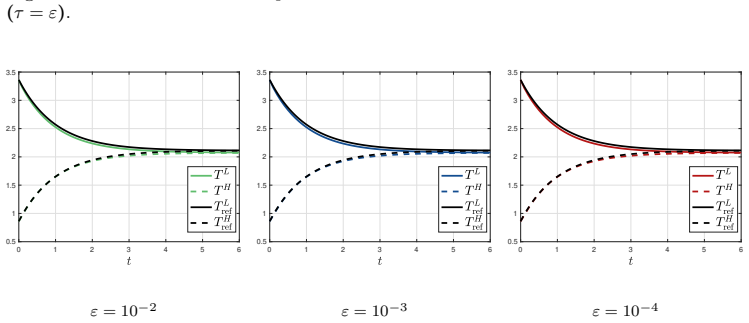
- At τ=ε^2, with both species near Maxwellians, the discrete moments follow the macroscopic temperature relaxation equations (2.7).
- Under the stated O(ε) closeness assumptions, the scheme automatically switches from kinetic to macroscopic resolution without resolving ε numerically.
Reading between the lines
- The polar-grid evaluation strategy is not limited to Maxwell molecules: for general kernels the same angular/radial discretization would apply to the truncated operators, but the explicit moment closures would need to be replaced by a numerical moment solver, which the paper leaves for future work.
- By decoupling ε from the grid, the AE idea could combine with adaptive velocity meshes to push into mass ratios beyond 10^5, where spectral methods require unaffordable resolution.
- The scheme's uniform accuracy in τ suggests a natural extension to space-inhomogeneous problems: at each cell the same AP time step could be used, though the interplay with spatial transport is untested.
- A stricter test would compare the full distribution functions, not just moments, against a high-resolution spectral reference for ε=0.01 at times comparable to τ=ε^2; the paper reports such comparisons mostly for the inter-particle operators and macroscopic moments.
Editorial analysis
A structured set of objections, weighed in public.
Referee Report
Summary. The manuscript develops an asymptotic-preserving (AP) scheme for the homogeneous Boltzmann mixture with disparate masses in the regime ε = sqrt(m_L/m_H) << 1. Inter-particle collision operators are replaced by truncated asymptotic expansions (the AE method), evaluated on a polar grid at O(N_v^d) cost independent of ε, and the time stepping uses BGK penalization with a priori moment updates to handle the stiff time scales τ = 1, ε, ε². Numerical experiments compare AE against a scaled spectral method, demonstrate uniform accuracy for small ε, and show the epochal relaxation phenomenon including agreement of the slow temperature dynamics with the macroscopic limit (2.7).
Significance. The AE method is a genuinely useful practical contribution: it removes the O(1/ε^{2d}) velocity-grid penalty of spectral methods for disparate-mass mixtures, and the numerical experiments are carefully designed and internally consistent. If the moment-consistency proof is repaired, this appears to be the first practical AP scheme for the epochal-relaxation regime of the disparate-mass Boltzmann mixture. The main weakness is theoretical: the proof of Proposition 4.2 is not valid as written, and Theorem 4.4 does not establish the missing link between the approximate Maxwellians used in the BGK penalization and the true moments of the computed distributions. The restriction to two dimensions and Maxwell molecules is explicit in Remark 4.3 and is a scope limitation rather than a hidden flaw.
major comments (3)
- [Section 4, Proposition 4.2] The proof of Proposition 4.2 does not establish the stated error bound. The passage from (4.6) to the displayed equation for U_L^{n+1} - tilde U_L^{n+1} is algebraically not justified: solving (4.6) for that difference requires tracking the factor τ/(τ + ν_L^{n+1} Δt) through the O(Δt/τ) correction terms, and the printed expression is dimensionally inconsistent. More seriously, the conclusion that tilde u_L^{n+1} - u_L^n = O(Δt) in all regimes is false in the stiff regimes used in Section 5.2. For τ = ε² with Δt = 0.1 and ε = 10^{-2}, the definitions of α and β together with (4.5) give W = tilde u_L^{n+1} - ε tilde u_H^{n+1} = O(ε²) while α W = O(1), so the one-step velocity change is O(1), not O(Δt). Since the tilde Maxwellians built from (4.3) are the target states in the implicit BGK penalization (4.4), the consistency of the moment update is load-bearing for the AP claim. The numerical results in Section 5.2 suggest the scheme behaves correctly, but the proof needs to be corrected or the proposition must be explicitly labeled as a formal consistency statement.
- [Section 4, Theorem 4.4] The AP property is stated for the distributions f_L^{n+1} and f_H^{n+1}, but the Maxwellians actually used in the numerical scheme (4.4) are the approximate Maxwellians tilde M^{n+1} built from the moment update (4.3). The proof of Theorem 4.4 never uses Proposition 4.2 and never proves that tilde M^{n+1} is O(ε)-close to the exact Maxwellian M^{n+1} associated with f^{n+1}. Consequently the argument shows relaxation toward the approximate equilibrium defined by the moment update, not automatically toward the equilibrium of the original kinetic model. In particular, the final claim that the scheme 'automatically becomes a consistent discretization of the macroscopic limit equation (2.7)' is not established by the displayed proof; it requires the missing moment-consistency link between (4.3) and (4.4).
- [Section 5.2] The empirical evidence for the AP property is strong, but the temperature relaxation comparison in Figures 5.10 and 5.11 is presented without an explicit statement that it is currently supported only by the moment update (4.3). The paper would be strengthened by stating clearly which portions of the AP claim are proven rigorously and which are validated numerically, especially because the proof gap in Proposition 4.2 directly concerns this comparison.
minor comments (5)
- [Section 4, equations (4.1) and (4.4)] The notation for the implicit Maxwellian is inconsistent: (4.1) uses M_L^{n+1}, M_H^{n+1}, while Algorithm 4.1 and (4.4) use tilde M_L^{n+1}, tilde M_H^{n+1}. This is more than cosmetic because the distinction is the crux of the moment-consistency issue.
- [Section 4, proof of Theorem 4.4] There are several small typos in the proof, for example 'M_l^L' where 'M_L^n' is intended, and the implicit Maxwellians are sometimes written without the tilde; these should be corrected so that the formal argument can be checked.
- [Section 5.1, Table 3] The slope pairs for the SP method at ε = 0.1 include a negative slope (-0.4) and very large slopes (4.2, 14.0); the text should comment on this non-monotone behavior, which is typical of spectrally accurate methods on under-resolved grids, rather than presenting the numbers without explanation.
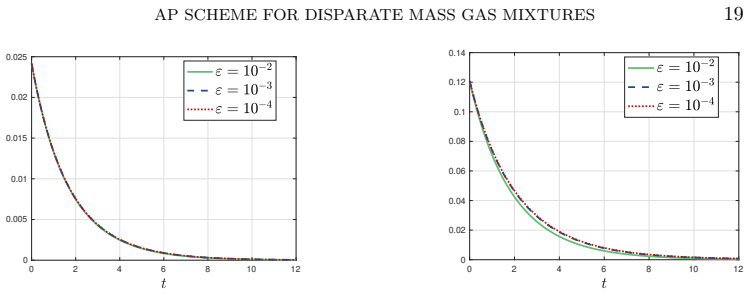
- [Section 5.2] The experiments use Δt = 0.1 for τ = ε² with ε as small as 10^{-4}, so Δt/τ can be as large as 10^7. The paper should explicitly state that this is a deliberately stiff regime chosen to demonstrate the AP property, and comment on the fact that the scheme remains stable in practice.
- [Throughout] The paper would benefit from a short statement in the introduction or conclusion summarizing the precise assumptions under which the AP property is proven (dv=2, Maxwell molecules, small ε) and which parts of the analysis are formal; this would help readers distinguish the rigorous claims from the numerical evidence.
Circularity Check
No significant circularity: the AE scheme is an implementation of an external asymptotic expansion, benchmarked against an independent spectral method; the few self-citations are contextual, not load-bearing.
full rationale
The derivation chain is: the external asymptotic expansion of Degond-Lucquin-Desreux [7,8] is truncated to form the AE operators (3.1)-(3.3); the BGK-penalized discretization (4.1) is closed by the a-priori moment system (4.3); and the AP property is then argued in Proposition 4.2 and Theorem 4.4. The relaxation statements in Theorem 4.4 rely on the continuous relaxation results of [8, Proposition 5.10, Corollary 5.11], but that is an external mathematical input, not a self-citation. No parameter of the scheme is fitted to the quantities it is said to predict: the AE approximation is measured against the SP spectral method for the untruncated operators in Section 5.1, and the epochal relaxation is compared with the macroscopic relaxation ODE (2.7), which is the target limit rather than an input to the scheme. The self-citations [16,17] are contextual: [16] is cited as prior AP work lacking numerical implementation, and [17] for a stiffness observation in moment systems; neither is used to justify the AE truncation, the moment-consistency statement, or the AP property. The proof of Proposition 4.2 does contain an algebraic inconsistency in the prefactor and an overly optimistic O(Delta t) bound on one-step changes in stiff regimes, but that is a correctness gap, not an equivalence-by-construction, and it does not make the derivation circular.
Assumptions & free parameters
free parameters (1)
- BGK penalty rates nu_L, nu_H =
nu_L=2 pi B_LH(n_L+n_H), nu_H=2 pi B_HL(n_L+n_H)
assumptions (6)
- domain assumption The asymptotic expansion (2.5) of Q_LH_epsilon and Q_HL_epsilon in powers of epsilon is valid with the stated O(epsilon^3) and O(epsilon^2) errors.
- domain assumption Explicit simplified forms (3.2)-(3.3) require dv=2 and Maxwell molecules, i.e., constant kernels B_LH and B_HL.
- domain assumption The continuous dynamics relaxes f_L to a centered Maxwellian for Q_LL+Q_LH0 and f_H to a Maxwellian for Q_HH on the respective time scales, per [8, Prop. 5.10, Cor. 5.11].
- domain assumption At intermediate and slow time scales, f_L^n - M_L^n = O(epsilon) and f_H^n - M_H^n = O(epsilon) hold.
- domain assumption The velocity domain is periodic with compactly supported data satisfying the de-aliasing condition of [25].
- standard math Sufficient smoothness of f_L and f_H so that Taylor expansion, integration by parts in angular variables, and polar-coordinate derivatives in (3.4) are valid.
invented entities (1)
-
None
Cite this review
Pith. "Pith review of An efficient Asymptotic-Preserving scheme for the Boltzmann mixture with disparate mass." pith.science (2026). https://pith.science/paper/OBXY5FSG
@misc{pith2026241113240,
  author       = {Pith},
  title        = {Pith review of: An efficient Asymptotic-Preserving scheme for the Boltzmann mixture with disparate mass},
  year         = {2026},
  howpublished = {\url{https://pith.science/paper/OBXY5FSG}},
  note         = {Machine review of arXiv:2411.13240}
}
abstract
In this paper, we develop and implement an efficient asymptotic-preserving (AP) scheme to solve the gas mixture of Boltzmann equations under the disparate mass scaling relevant to the so-called "epochal relaxation" phenomenon. The disparity in molecular masses, ranging across several orders of magnitude, leads to significant challenges in both the evaluation of collision operators and the designing of time-stepping schemes to capture the multi-scale nature of the dynamics. A direct implementation of the spectral method faces prohibitive computational costs as the mass ratio increases due to the need to resolve vastly different thermal velocities. Unlike [I. M. Gamba, S. Jin, and L. Liu, Commun. Math. Sci., 17 (2019), pp. 1257-1289], we propose an alternative approach based on proper truncation of asymptotic expansions of the collision operators, which significantly reduces the computational complexity and works well for small $\varepsilon$. By incorporating the separation of three time scales in the model's relaxation process [P. Degond and B. Lucquin-Desreux, Math. Models Methods Appl. Sci., 6 (1996), pp. 405-436], we design an AP scheme that captures the specific dynamics of the disparate mass model while maintaining computational efficiency. Numerical experiments demonstrate the effectiveness of the proposed scheme in handling large mass ratios of heavy and light species, as well as capturing the epochal relaxation phenomenon.
Figures


Figures from the paper (12 more)




Reference graph
Works this paper leans on
-
[1]
write newline
" write newline "" before.all 'output.state := FUNCTION fin.entry add.period write newline FUNCTION new.block output.state before.all = 'skip after.block 'output.state := if FUNCTION not #0 #1 if FUNCTION and 'skip pop #0 if FUNCTION or pop #1 'skip if FUNCTION new.block.checka empty 'skip 'new.block if FUNCTION field.or.null duplicate empty pop "" 'skip ...
-
[2]
S. I. Braginskii , Transport Processes in a Plasma , Rev Plasma Phys, 1 (1965), p. 205
work page 1965
-
[3]
Brun , ed., High Temperature Phenomena in Shock Waves , vol
R. Brun , ed., High Temperature Phenomena in Shock Waves , vol. 7 of Shock Wave Science and Technology Reference Library, Springer Berlin, Heidelberg, Berlin, Heidelberg, 1 ed., 2012
work page 2012
-
[4]
Cercignani , The B oltzmann equation and its applications , vol
C. Cercignani , The B oltzmann equation and its applications , vol. 67 of Applied Mathematical Sciences, Springer-Verlag, New York, 1988
work page 1988
-
[5]
S. Chapman and T. Cowling , The Mathematical Theory of Non-uniform Gases: An Account of the Kinetic Theory of Viscosity, Thermal Conduction and Diffusion in Gases , Cambridge Mathematical Library, Cambridge University Press, 1990
work page 1990
-
[6]
F. Charles and L. Desvillettes , Small mass ratio limit of B oltzmann equations in the context of the study of evolution of dust particles in a rarefied atmosphere , J. Stat. Phys., 137 (2009), pp. 539--567
work page 2009
-
[7]
R. M. Chmieleski and J. H. Ferziger , Transport Properties of a Nonequilibrium Partially Ionized Gas in a Magnetic Field , Phys Fluids, 10 (1967), pp. 2520--2530
work page 1967
-
[8]
P. Degond , Chapter 1 - asymptotic continuum models for plasmas and disparate mass gaseous binary mixtures , in Material Substructures in Complex Bodies, G. Capriz and P. M. Mariano, eds., Elsevier Science Ltd, Oxford, 2007, pp. 1--62
work page 2007
Show all 35 references
-
[9]
Degond and B
P. Degond and B. Lucquin-Desreux , The asymptotics of collision operators for two species of particles of disparate masses , Math. Models Methods Appl. Sci., 6 (1996), pp. 405--436
1996
-
[10]
Degond and B
P. Degond and B. Lucquin-Desreux , Transport coefficients of plasmas and disparate mass binary gases , Transport Theory Statist. Phys., 25 (1996), pp. 595--633
1996
-
[11]
Dimarco and L
G. Dimarco and L. Pareschi , Numerical methods for kinetic equations , Acta Numer., 23 (2014), pp. 369--520
2014
-
[12]
Filbet and S
F. Filbet and S. Jin , A class of asymptotic-preserving schemes for kinetic equations and related problems with stiff sources , J. Comput. Phys., 229 (2010), pp. 7625--7648
2010
-
[13]
Filbet, C
F. Filbet, C. Mouhot, and L. Pareschi , Solving the B oltzmann equation in N _2N , SIAM J. Sci. Comput., 28 (2006), pp. 1029--1053
2006
-
[14]
Folland , Fourier Analysis and Its Applications , Pure and applied undergraduate texts, American Mathematical Society, 2009
G. Folland , Fourier Analysis and Its Applications , Pure and applied undergraduate texts, American Mathematical Society, 2009
2009
-
[15]
I. M. Gamba and J. R. Haack , A conservative spectral method for the B oltzmann equation with anisotropic scattering and the grazing collisions limit , J. Comput. Phys., 270 (2014), pp. 40--57
2014
-
[16]
I. M. Gamba, J. R. Haack, C. D. Hauck, and J. Hu , A fast spectral method for the B oltzmann collision operator with general collision kernels , SIAM J. Sci. Comput., 39 (2017), pp. B658--B674
2017
-
[17]
I. M. Gamba, S. Jin, and L. Liu , Asymptotic-preserving schemes for two-species binary collisional kinetic system with disparate masses I : time discretization and asymptotic analysis , Commun. Math. Sci., 17 (2019), pp. 1257--1289
2019
-
[18]
I. M. Gamba, S. Jin, and L. Liu , Micro-macro decomposition based asymptotic-preserving numerical schemes and numerical moments conservation for collisional nonlinear kinetic equations , J. Comput. Phys., 382 (2019), pp. 264--290
2019
-
[19]
Goldman and L
E. Goldman and L. Sirovich , Equations for Gas Mixtures , Phys Fluids, 10 (1967), pp. 1928--1940
1967
-
[20]
Grad , Rarefied gas dynamics , in Rarefied Gas Dynamics, F
H. Grad , Rarefied gas dynamics , in Rarefied Gas Dynamics, F. Devienne, ed., Pergamon Press, London, 1960, pp. 10--138
1960
-
[21]
Jaiswal, A
S. Jaiswal, A. A. Alexeenko, and J. Hu , A discontinuous G alerkin fast spectral method for the multi-species B oltzmann equation , Comput. Methods Appl. Mech. Engrg., 352 (2019), pp. 56--84
2019
-
[22]
Jin , Efficient asymptotic-preserving ( AP ) schemes for some multiscale kinetic equations , SIAM J
S. Jin , Efficient asymptotic-preserving ( AP ) schemes for some multiscale kinetic equations , SIAM J. Sci. Comput., 21 (1999), pp. 441--454
1999
-
[23]
Jin and Q
S. Jin and Q. Li , A BGK -penalization-based asymptotic-preserving scheme for the multispecies B oltzmann equation , Numer. Methods Partial Differential Equations, 29 (2013), pp. 1056--1080
2013
-
[24]
Jin and Y
S. Jin and Y. Shi , A micro-macro decomposition-based asymptotic-preserving scheme for the multispecies B oltzmann equation , SIAM J. Sci. Comput., 31 (2009/10), pp. 4580--4606
2009
-
[25]
E. A. Johnson , Energy and momentum equations for disparate‐mass binary gases , Phys Fluids, 16 (1973), pp. 45--49
1973
-
[26]
Mouhot and L
C. Mouhot and L. Pareschi , Fast algorithms for computing the B oltzmann collision operator , Math. Comp., 75 (2006), pp. 1833--1852
2006
-
[27]
Pareschi and B
L. Pareschi and B. Perthame , A F ourier spectral method for homogeneous B oltzmann equations , in Proceedings of the S econd I nternational W orkshop on N onlinear K inetic T heories and M athematical A spects of H yperbolic S ystems ( S anremo, 1994), vol. 25, 1996, pp. 369--382
1994
-
[28]
Pareschi and G
L. Pareschi and G. Russo , Numerical solution of the B oltzmann equation. I . S pectrally accurate approximation of the collision operator , SIAM J. Numer. Anal., 37 (2000), pp. 1217--1245
2000
-
[29]
Petit and J.-S
J.-P. Petit and J.-S. Darrozes , Une nouvelle formulation des \'equations du mouvement d'un gas ionis\'e dans un r\'egime domin\'e par les collisions , J. M\'ecanique, 14 (1975), pp. 745--759
1975
-
[30]
L. J. Spitzer and R. Harm , Transport phenomena in a completely ionized gas , Phys Rev, 89 (1953), pp. 977--981
1953
-
[31]
W. T. Taitano, L. Chac\' o n, and A. N. Simakov , An adaptive, conservative 0 D -2 V multispecies R osenbluth- F okker- P lanck solver for arbitrarily disparate mass and temperature regimes , J. Comput. Phys., 318 (2016), pp. 391--420
2016
-
[32]
Takase , Three-dimensional numerical simulations of dust mobilization and air ingress characteristics in a fusion reactor during a lova event , Fusion Eng
K. Takase , Three-dimensional numerical simulations of dust mobilization and air ingress characteristics in a fusion reactor during a lova event , Fusion Eng. Des., 54 (2001), pp. 605--615
2001
-
[33]
Takata and F
S. Takata and F. c. Golse , Half-space problem of the nonlinear B oltzmann equation for weak evaporation and condensation of a binary mixture of vapors , Eur. J. Mech. B Fluids, 26 (2007), pp. 105--131
2007
-
[34]
L. Wu, J. Zhang, J. M. Reese, and Y. Zhang , A fast spectral method for the B oltzmann equation for monatomic gas mixtures , J. Comput. Phys., 298 (2015), pp. 602--621
2015
-
[35]
Yan and S
B. Yan and S. Jin , A successive penalty-based asymptotic-preserving scheme for kinetic equations , SIAM J. Sci. Comput., 35 (2013), pp. A150--A172
2013
Reviewed August 12, 2026 · model on record in the stance chip above.
Discussion (0). Continue with ORCID to comment.