REVIEW 1 major objections 3 minor 13 references
On Projective Delineability
T0 review · 1 major / 3 minor · reviewed 2026-08-12 · deepseek-v4-flash
Pith's one-line read Projective delineability relaxes CAD's delineability so root functions may take values in $\mathbb{RP}^1$, and the paper proves this relaxation is locally guaranteed and global on simply connected cells, enabling CAD single-cell…
desk verdict Projective delineability is a real new idea in CAD theory; the main theorem has a fixable gap, and the paper deserves a serious referee. read the letter →
The pith
A machine-rendered reading of the paper's core claim, the machinery that carries it, and where it could break.
The reading
What carries the argument
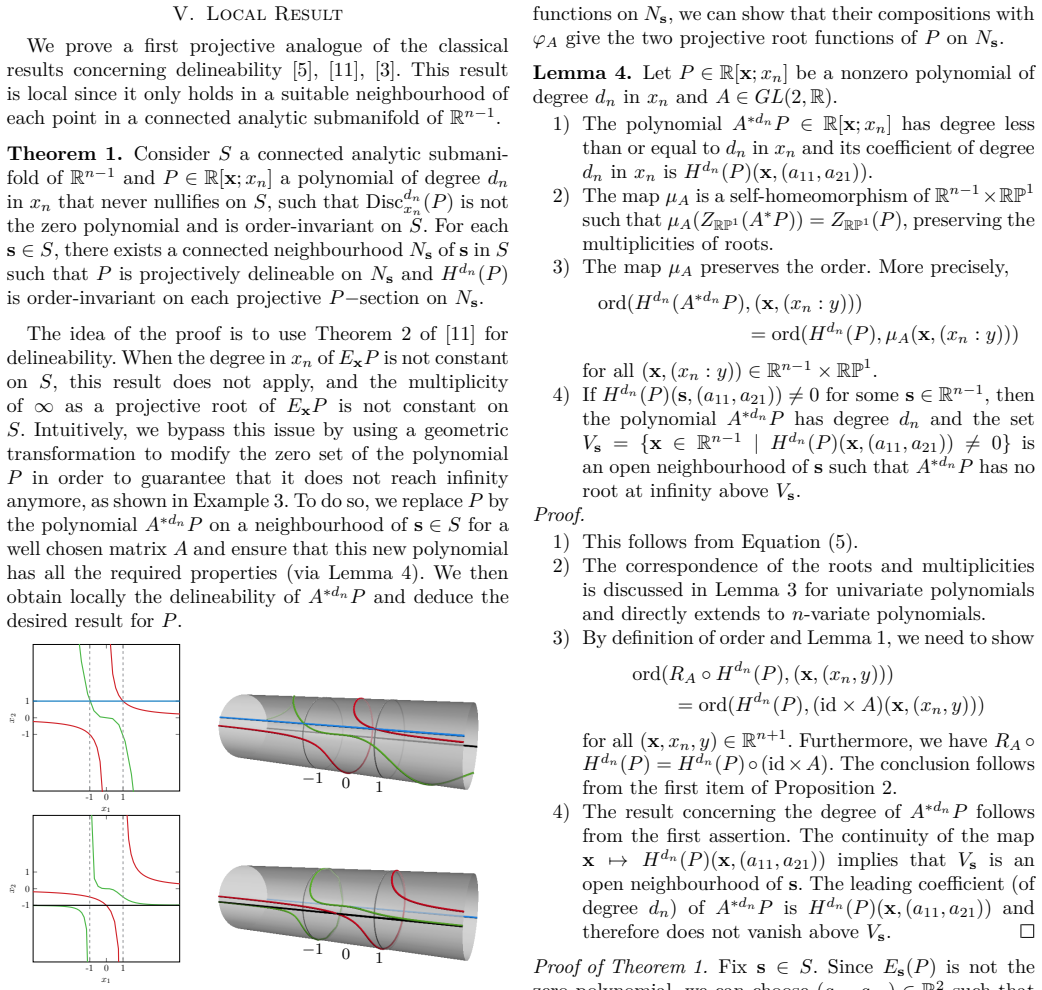
The machinery is the projective compactification of the cylinder: instead of following real roots $S \to \mathbb{R}$, one follows projective root functions $\theta_l : S \to \mathbb{RP}^1$ defined as graphs inside $S \times \mathbb{RP}^1$. The key algebraic tools are the binary-form homogenization $H_{d_n}$ with respect to a fixed degree, the projective roots-and-multiplicities factorization of binary forms, and for an invertible matrix $A$ the polynomial $A^{*d_n}P$ obtained by acting on the last variable; choosing $A$ so that the transformed polynomial has no root at infinity moves the singularities away, after which the classical delineability theorem for polynomials with nonvanishing leading coefficient applies. The global step is the observation that the zero set forms a covering space of $S$, and the covering is trivial when $S$ is simply connected; the circle counterexample isolates the failure of triviality as exactly the obstruction.
What would settle it
A reader can falsify the global theorem by taking $S$ to be the unit circle, $P = (1-x_1)x_3^4 + 4x_2 x_3^3 + (2+6x_1)x_3^2 - 4x_2 x_3 + (1-x_1)$, and computing that the discriminant is $2^{14}(x_1^2+x_2^2-1)^2(x_1^2+x_2^2)$, which is order-invariant on $S$, while the projective zero set is connected yet would have to split into two closed graphs if projective delineability held.
Extended reading notes
Core claim
The paper establishes that the classical delineability theorem for CAD generalizes when zeros are viewed in $\mathbb{RP}^1$. Writing $H_{d_n}(P)$ for the homogenization with respect to the degree $d_n$ of $P$ in the last variable, define projective roots as zeros of $H_{d_n}(P)$ in $\mathbb{RP}^1$, so a root may be the point at infinity exactly where the leading coefficient vanishes. Theorem 1 proves that under $P \neq 0$ on a connected analytic submanifold $S$ and order-invariance of a nonzero discriminant $\operatorname{Disc}^{d_n}_{x_n}(P)$ on $S$, each point has a neighbourhood on which $P$ is projectively delineable and $H_{d_n}(P)$ is order-invariant on each projective section. Theorem 2 upgrades this to all of $S$ when $S$ is simply connected, by observing that the projective zero set is a covering space of $S$ and every covering of a simply connected space is trivial. Proposition 4 shows the circle $x_1^2+x_2^2=1$ satisfies all local hypotheses while projective delineability fails globally, so the simple-connectivity assumption cannot be dropped.
Load-bearing premise
The global conclusion rests on the assumption that the cell has no holes in the sense that every loop can be shrunk to a point; on a cell with a hole, such as a circle, the same local hypotheses can hold while no global projective delineation exists.
Editorial extensions
If this is right
- In the single-cell CAD construction, leading coefficients of polynomials can be omitted from the projection when projective delineability of the polynomial is sufficient, because projective delineability is certified using only discriminants and resultants.
- For simply connected cells, the local projective delineability certificates patch into global projective root functions defined on the whole cell, with order-invariance of the homogenized polynomial on each projective section.
- On cells that are connected but not simply connected, CAD routines must either work with the local neighbourhoods provided by Theorem 1 or explicitly track the monodromy of projective roots around loops.
- When a polynomial never develops a root at infinity, projective delineability coincides with classical delineability; the new notion only matters where leading coefficients vanish, which is exactly the case where classical projection over-constrains the cell.
- The resultant theorem extends to projective delineability: along a projective section of $P$, a projectively delineable $Q$ either vanishes completely or never vanishes, provided their resultant is nonzero and order-invariant on $S$.
Reading between the lines
- The covering-space proof makes a further claim plausible: on a cell with a hole, the obstruction to global projective delineability is exactly the monodromy of the projective roots around the cell's loops. An algorithm that tracks how roots permute as they go around the loop, rather than demanding simple connectivity, could recover a global description in the non-simply-connected case. This is an
- The same projective compactification could be applied to other CAD-based data structures, such as cylindrical algebraic coverings and non-uniform CADs, wherever an artificial cell split is created only because a root is passing through infinity. A testable extension would be to see whether replacing real root functions by projective ones reduces the number of cells in those algorithms too.
- Because projective delineability is certified using discriminants and resultants only, it may combine with existing work that prunes resultants to produce a projection that is strictly smaller than the reduced projection in the single-cell construction. Whether the pruning remains complete for entire CADs, not just single cells, is a natural next question.
Editorial analysis
A structured set of objections, weighed in public.
Referee Report
Summary. The paper introduces projective delineability, a relaxation of McCallum delineability in which root functions are allowed to take values in the real projective line, so that roots may pass through infinity. It proves a local projective delineability theorem (Theorem 1), a global version under the additional assumption that the base submanifold is simply connected (Theorem 2), an explicit counterexample on the circle showing that this assumption is necessary (Proposition 4), and an extension of McCallum's equational-constraint theorem to the projective setting (Theorem 3). The stated motivation is to justify omitting leading coefficients in single-cell CAD construction when projective delineability is sufficient.
Significance. The notion is natural and well motivated, and the paper gives a clean mechanism — the GL(2,R) reparametrization of the last variable — for locally moving roots away from infinity. The global theorem identifies a genuine monodromy obstruction, and Proposition 4 supplies a convincing explicit quartic with a computable discriminant. The potential algorithmic payoff for SMT-oriented CAD is clear, and the paper is self-contained: definitions are precise, the supporting lemmas are stated with proofs, and the connection to McCallum's results is explicit. One step in the proof of Theorem 2 needs repair, but the central claims appear defensible.
major comments (1)
- [§VI, proof of Theorem 2] The assertion that Theorem 1 makes p : Z_RP1(P,S) → S a covering space in the sense of Definition 12 is not justified, because Definition 12 requires p^{-1}(U) to be split into a non-empty family of sheets. Under the hypotheses of Theorem 2 it can happen that p^{-1}(U)=∅ for every U: e.g. P=x_n^2+1 over any simply connected S, where Disc_{2,x_n}(P)=-4 is order-invariant and P is never nullified, but Z_RP1(P,S)=∅. Hence [7, Cor. 13.8] cannot be invoked without an explicit case split. The proof should first dispose of the empty total space, then show that when one fibre is non-empty the set {s∈S | p^{-1}(s)≠∅} is both open and closed using the local conclusion of Theorem 1, and only then apply the covering-space argument. As written, the proof does not cover the empty-fibre case.
minor comments (3)
- [§IV, Proposition 4] The statement 'Elementary computations show that it has order 2 on S' is misleading: the displayed discriminant restricts to the nonzero constant 2^14 on S, so its order of vanishing at points of S is 0, not 2. If 'order 2' refers to the multiplicity of S as a component of the zero set of Disc, this should be stated explicitly.
- [§IV, Proposition 3 proof] There is a typo in 'mutliplicity', and the reindexing argument would be easier to follow if the closedness of the sets C_i and the use of the finite pasting lemma were spelled out before the new functions θ'_j are defined.
- [§II, Definition 11 and §VI, Definition 12] The paper should state explicitly whether k=0 is allowed in Definition 11. This matters for the empty-fibre case in Theorem 2, since a projective delineability statement with zero root functions is exactly the case that the covering-space argument must handle separately.
Circularity Check
No significant circularity: the new projective delineability notion is proved from McCallum's delineability theorem and standard covering-space facts, with self-citations only motivational.
full rationale
The derivation chain is self-contained in the relevant sense. Projective delineability is introduced by Definition 11 as a new object, and the local Theorem 1 is proved by applying McCallum's delineability theorem [11, Thm 2] to the transformed polynomial A*_dn P. Lemma 4 verifies that this transformation preserves roots, multiplicities, order, and discriminant (Proposition 1), so the proof reduces to an external, prior, independent theorem rather than to the paper's own conclusion. Theorem 2 then invokes the standard covering-space fact [7, Cor 13.8] that a covering of a simply connected space is trivial; the only new work is the direct verification that the local projective sections satisfy Definition 12. Proposition 4 gives an independent counterexample on the circle, showing that the simple-connectivity hypothesis is doing real work and that the global claim is not forced by definition. The self-citations, e.g. [1] and [13], appear only as motivation for single-cell construction and are not load-bearing in the proofs of Theorems 1-3. The only flagged issue is not circularity: in the proof of Theorem 2, Definition 12 requires non-empty preimage sheets, so the case p^{-1}(U)=∅, e.g. P = x_n^2 + 1 over a simply connected S, should be split off before applying [7, Cor 13.8]. This is an omitted case analysis or correctness concern, not a reduction of the theorem to its assumptions. No fitted parameter is renamed as a prediction, and no ansatz is smuggled in through self-citation.
Assumptions & free parameters
assumptions (3)
- domain assumption McCallum's delineability theorem: if a polynomial with fixed degree has discriminant that is not the zero polynomial and is order-invariant on a connected analytic submanifold, then the polynomial is delineable and the homogenization is order-invariant on sections.
- standard math A covering space of a simply connected topological space is trivial (Corollary 13.8 of Fulton).
- standard math Resultant and discriminant transform under a unimodular linear change of variables: Resp,q(A*_p P, A*_q Q) = det(A)^{pq} Resp,q(P,Q) and Discp(A*_p P) = det(A)^{p(p-1)} Discp(P) (Proposition 1).
Cite this review
Pith. "Pith review of On Projective Delineability." pith.science (2026). https://pith.science/paper/E2XDT32S
@misc{pith2026241113300,
  author       = {Pith},
  title        = {Pith review of: On Projective Delineability},
  year         = {2026},
  howpublished = {\url{https://pith.science/paper/E2XDT32S}},
  note         = {Machine review of arXiv:2411.13300}
}
read the original abstract
We consider cylindrical algebraic decomposition (CAD) and the key concept of delineability which underpins CAD theory. We introduce the novel concept of projective delineability which is easier to guarantee computationally. We prove results about this which can allow reduced CAD computations.
Figures


Reference graph
Works this paper leans on
-
[1]
E. Ábrahám, J. H. Davenport, M. England, and G. Kremer. Deciding the consistency of non-linear real arithmetic con- straints with a conflict driven search using cylindrical algebraic coverings. J. Logical & Algebraic Methods in Prog., 119, 2021
work page 2021
-
[2]
S. Basu, R. Pollack, and M.F. Coste-Roy.Algorithms in Real Algebraic Geometry. Algorithms and Computation in Mathe- matics. Springer, 2007
work page 2007
-
[3]
C. W. Brown. Improved projection for cylindrical algebraic decomposition. J. Symbolic Computation, 32(5):447–465, 2001
work page 2001
-
[4]
C. W. Brown. Open non-uniform cylindrical algebraic decom- positions. In Proc. ISSAC ’15, pages 85–92. ACM, 2015
work page 2015
-
[5]
G. E. Collins. Quantifier elimination for real closed fields by cylindrical algebraic decomposition. In Automata Theory and Formal Languages. Springer, 1975
work page 1975
-
[6]
D. A. Cox, J. Little, and D. O’Shea.Ideals, Varieties, and Algo- rithms: An Introduction to Computational Algebraic Geometry and Commutative Algebra. Springer, 3rd edition, 2010
work page 2010
-
[7]
Fulton.Algebraic Topology: A First Course
W. Fulton.Algebraic Topology: A First Course. Graduate texts in mathematics. World Publishing Corporation, 1995
work page 1995
-
[8]
I.M. Gelfand, M. Kapranov, and A. Zelevinsky.Discriminants, Resultants, and Multidimensional Determinants. Birkhäuser, 2009
work page 2009
Show all 13 references
-
[9]
Jovanovic and L
D. Jovanovic and L. de Moura. Solving non-linear arithmetic. In Proc. IJCAR ’12, pages 339–354. Springer, 2012
2012
-
[10]
McCallum
S. McCallum. An improved projection operation for cylindrical algebraic decomposition of three-dimensional space.J.Symbolic Computation, 5(1):141–161, 1988
1988
-
[11]
McCallum
S. McCallum. An improved projection operation for cylindrical algebraic decomposition. In Bob F. Caviness and Jeremy R. Johnson, editors,Quantifier Elimination and Cylindrical Alge- braic Decomposition, pages 242–268. Springer, 1998
1998
-
[12]
McCallum
S. McCallum. On projection in CAD-based quantifier elimi- nation with equational constraint. InProc. ISSAC ’99, pages 145–149. ACM, 1999
1999
-
[13]
Nalbach, E
J. Nalbach, E. Abraham, P. Specht, C. W. Brown, J. H. Dav- enport, and M. England. Levelwise construction of a single cylindrical algebraic cell.J. Symbolic Computation, 123, 2024
2024
Reviewed August 12, 2026 · model on record in the stance chip above.
Discussion (0). Continue with ORCID to comment.