REVIEW 3 major objections 8 minor 47 references
Fine-tuning Myoelectric Control through Reinforcement Learning in a Game Environment
T0 review · 3 major / 8 minor · reviewed 2026-08-12 · deepseek-v4-flash
Pith's one-line read A rhythm game plus reinforcement learning doubles muscle-signal decoding accuracy for prosthetic control.
desk verdict A competent able-bodied pilot showing game-based fine-tuning improves myoelectric decoding, but the specific 'through RL' claim is not isolated from the added data. read the letter →
The pith
A machine-rendered reading of the paper's core claim, the machinery that carries it, and where it could break.
The reading
What carries the argument
The load-bearing mechanism is a Markov decision process whose reward is $r(s_t,a_t)=1$ for a correct non-rest prediction, $0$ for correctly predicting rest, and $-1$ otherwise, combined with Advantage Weighted Actor-Critic (AWAC), an off-policy actor-critic algorithm that keeps the policy close to the data seen so far. The environment is a Guitar Hero-style game in which notes specify which finger movement should occur at each step, so gameplay supplies both the usage data and the labels $a^*_t$ used to compute reward. AWAC lets the pretrained policy be fine-tuned on this dataset without the distribution shift that pure offline RL would suffer, and the game's timing demands mimic the temporal precision needed in daily prosthetic use.
What would settle it
Re-run the same eight-repetition fine-tuning protocol on new participants but delay the note-to-label alignment by one 200 ms step, so the reward is computed against the previous note's movement; if the method's gains persist under this systematic misalignment, the reward assumption is not what drives the improvement, and if they collapse, the assumption is confirmed as load-bearing.
Extended reading notes
Core claim
On its own terms, the paper establishes that an RL fine-tuning loop can replace part of the labeled-data burden in myoelectric control. Starting from a supervised policy trained on static recordings of thirteen finger movements (including simultaneous ones), the authors apply the Advantage Weighted Actor-Critic (AWAC) algorithm to data gathered while each participant plays an eight-repetition rhythm game whose notes define the desired movement at each 200 ms window. The final policy outperforms the initial one on every reported metric, with the largest gains in single-degree-of-freedom movements and in prediction stability, and the improvement transfers to a separate motion test that resembles the original recording protocol. The authors attribute the gains to RL aligning the policy with usage data rather than to human learning alone, since replaying the game with the original supervised policy yields markedly lower scores.
Load-bearing premise
The training signal assumes that whenever a song note appears, the participant is actually trying to perform exactly that movement at that moment; if a user lags, anticipates, or intentionally deviates, the reward punishes the wrong behavior and can reinforce mistaken mappings.
Editorial extensions
If this is right
- Gameplay data can substitute for part of the supervised recording session, shortening initial calibration for multi-degree-of-freedom controllers.
- Because the method works with any reward signal derivable from a task, the same fine-tuning loop could be applied to other serious games or daily-use tasks.
- Improvements concentrate in single-degree-of-freedom movements, which had the lowest initial accuracy, so RL fine-tuning acts partly as a corrective for weak classes.
- The number of prediction changes during gameplay drops consistently, meaning users experience a more stable and predictable controller.
- A gameplay mutual-information measure $I(s; a^*)$ predicts which participants will benefit, offering a pre-training diagnostic.
Reading between the lines
- A practical screening rule suggested by the paper's correlation results: compute the mutual information between a user's EMG features and the ideal labels during a short gameplay session, and only invest in RL fine-tuning above a threshold; the authors note a possible threshold around MI 0.28-0.35.
- The method's reliance on song-provided labels means it can only reward movements the game asks for; extending to free-form daily activity would require a different reward source, such as task success criteria, which the paper leaves open.
- Because the authors could not separate the contribution of the game environment from that of RL, one testable extension is to fine-tune on gameplay data with the same AWAC update but a shuffled or unrelated reward; if improvement persists, gamification rather than reward-driven learning is doing the work.
Editorial analysis
A structured set of objections, weighed in public.
Referee Report
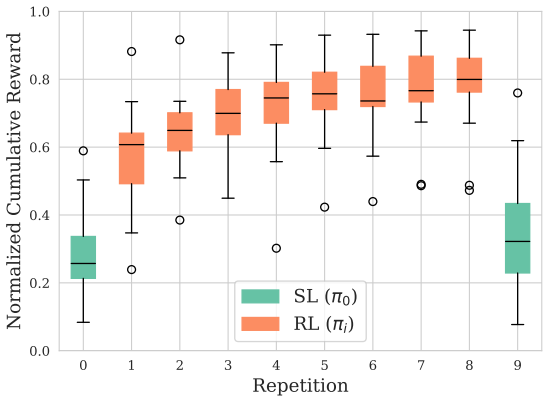
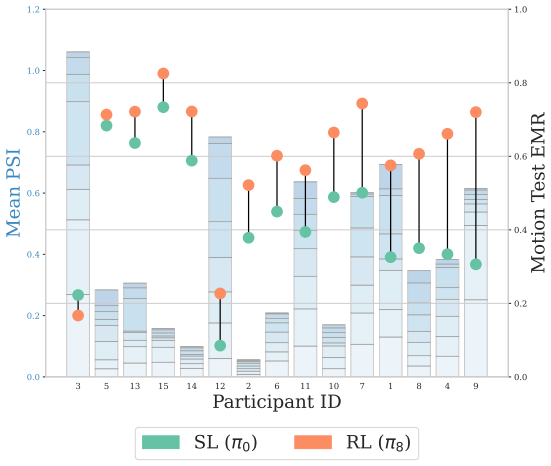
Summary. This paper proposes an approach to myoelectric control in which a supervised pretrained EMG classifier is fine-tuned with the AWAC offline RL algorithm using data collected while the user plays a Guitar Hero-style game. The game's song provides movement labels that define a reward function (Eq. 4), and the policy is iteratively fine-tuned over eight repeated play-throughs of the same song. In a 15-subject real-time human-in-the-loop experiment, the final RL policy π8 significantly outperforms the initial supervised policy π0 in gameplay EMR (0.36 vs. 0.78), gameplay F1 macro (0.55 vs. 0.75), Motion Test EMR (0.43 vs. 0.60), and Motion Test F1 macro (0.53 vs. 0.71), all by Wilcoxon signed-rank tests. The authors additionally analyze mutual information and population stability to explain inter-subject variability and to identify outlier participants. The central claim is that RL fine-tuning on usage-based data improves decoding accuracy and robustness for simultaneous finger movement control.
Significance. The paper addresses an important problem in myoelectric control: reducing the labeled-data burden and closing the offline-online gap. Its strengths include a real-time human-in-the-loop evaluation with 15 participants, a paired design with randomized test order for the Motion Test, the reuse of the initial policy after training (repetition 9) to separate human adaptation from policy improvement, and an independent Motion Test that is not used during training or model selection. The MI-based analysis yields a falsifiable diagnostic, namely a low-MI interval [0.28, 0.35] below which fine-tuning appears to fail. The empirical result that the combined game-plus-RL fine-tuning procedure improves decoding is credible and well supported by the Motion Test data. However, the stronger claim that RL specifically, rather than the addition of usage data under any fine-tuning rule, is the effective ingredient, is not established by the present design, and the abstract and title attribute the gains to RL. The authors are explicit about this gap in Section 7.1, which is commendable, but the attribution remains load-bearing for the paper's stated conclusion.
major comments (3)
- [Sections 5 and 7.1; Table 1] The experimental design cannot support the claim that RL is the cause of the observed improvements. The paired comparison of π0 and π8 varies two factors simultaneously: the training data (D0 versus D0∪...∪D8) and the learning rule (supervised RMSE minimization versus AWAC). Section 7.1 explicitly states that the distinct contributions of the game environment and the RL training procedure cannot be independently assessed. Because the title and abstract attribute the gains specifically to reinforcement learning, a control arm is needed in which the same accumulated gameplay dataset Dn is used to fine-tune the pretrained policy with supervised learning or behavior cloning. Without such a control, the Motion Test results support only the combined intervention, not the causal role of RL. I consider this the key missing experiment: it is feasible within the same experimental setup and would directly resolve whether the 'through RL' claim is warranted.
- [Section 6.3 and Table 1] The gameplay results for π8 are evaluated on data that were used for both training and model selection. Section 6.3 selects the deployed policy as the one with the highest simulated episodic return computed on the recorded game data accumulated so far, and the repetition-8 gameplay, whose EMR and normalized return are reported in Table 1 and Fig. 5, is part of that same dataset. The gameplay EMR for π8 is therefore optimistically biased, and the headline 'more than two-fold increase in decoding accuracy during gameplay' is not a clean out-of-sample measurement. The Motion Test is the only fully independent evaluation, as it is a different task not used in training or selection, and the paper should present it as the primary evidence for the method. At minimum, the gameplay evaluation should be performed on a held-out song or on a post-training replay that does not enter the training set; the Appendix A remark that using training data for model selection is 'not ideal' understates this concern.
- [Section 4.2, Eq. (4), and Section 7.3] The reward in Eq. (4) assumes that the song-provided label a*_t equals the participant's true intended movement at each 200 ms step. The paper acknowledges this assumption, but its validity is load-bearing for the quality of the RL training signal, and Section 7.3 shows that its validity plausibly varies across participants: the two participants with the lowest mutual information are exactly those for whom fine-tuning fails. Fig. 10 further shows that MI depends on the deployed policy, since it drops when π0 is replayed at repetition 9, indicating that participants adapt their muscle activations to the policy. This interaction between human adaptation and the assumed labels is not captured by Eq. (4). Since the paper already computes MI as a post-hoc diagnostic, it would strengthen the work to present label-alignment quality as a per-participant diagnostic and to discuss how reward misattribution arises when participants lag, anticipate, or execute a different movement than the note requires.
minor comments (8)
- [Abstract] The abstract highlights the gameplay accuracy gain as a two-fold increase, but that metric is evaluated on data used for training and model selection (see major comment 2); the independent Motion Test result (39% EMR improvement) is the stronger evidence and should be foregrounded.
- [Section 5.2] The action-randomization procedure (ϵ = 0.9, replacing negative-reward samples with uniformly random movements) is unusual and should be justified: it injects many samples with randomly relabeled actions into the training set, and the paper does not state how the new reward is computed for the selected random movement or why a uniform distribution over movements is appropriate.
- [Section 6.4] Multiple Wilcoxon signed-rank tests are reported (gameplay and Motion Test, overall and per-DOF in Fig. 6); please state whether any correction for multiple comparisons was applied.
- [Section 7.2 and Fig. 6] The claim that 'every measure in all scenarios improves with RL' mixes descriptive and inferential statements, since several per-DOF comparisons in Fig. 6 are not marked as statistically significant; please qualify the claim accordingly.
- [Author block] The email given for the first author appears as 'tamino@chalmers.se', which likely belongs to a different author; please correct the contact address.
- [Reference [20]] Reference [20] lists the author as 'C. labs at Reality Labs'; this should read 'CTRL-labs at Meta Reality Labs'.
- [Section 1] The introduction claims that gameplay data collection 'helps reduce the length of the initial recording session,' but no experiment quantifies this reduction; please qualify or support the claim.
- [Figure 5 caption] The caption is difficult to parse regarding which repetitions use π_i and which use π0; a concise statement of the repetition structure and of which repetitions produce training data would improve readability.
Circularity Check
Gameplay EMR is an in-sample model-selection metric; the independent Motion Test prevents full circularity.
-
fitted input called prediction
[Section 6.3 (Model Selection) and Section 7 / Fig. 6a (gameplay EMR)]
"During training, the song is simulated every 10 gradient steps, using the recoded data as input for each intermediate model to assess improvements in episodic return. For each repetition, we select the policy with the highest simulated episode return after 2000 gradient steps."
The final policy π8 is selected by maximizing simulated episodic return on the accumulated gameplay data D8. The reward in Eq. (4) is a per-step correctness indicator, so the selection score is essentially the EMR on those same recorded episodes. The paper then reports the gameplay EMR improvement of π8 over π0 from repetition 8 (Fig. 6a) as a headline result. Section 6.1 adds that each repetition 'first validates the latest policy trained on past data, and then serves as training data itself,' confirming the gameplay evaluation is in-sample. Without the separate Motion Test, this gameplay claim would reduce to selecting on the evaluation data.
full rationale
Most of the pipeline is self-contained and empirically grounded: SL pretraining, AWAC updates, and the Motion Test are externally validated, and the self-citations to [19] and [43] are not load-bearing. The only circular element is the gameplay headline: policies are chosen by simulating the song on recorded gameplay data, and the reported π8 gameplay EMR is computed on exactly that same data. Since the selection score (episodic return derived from the Eq. (4) reward) is a near-transform of EMR, the gameplay EMR gain is substantially an in-sample fit. However, the Motion Test is independent—participants execute prompted movements in randomized π0/π8 order, not the training song—so the central claim of improved decoding retains external support. Section 7.1's explicit admission that the distinct contributions of the game environment and RL procedure cannot be separated, and the absence of a supervised-fine-tuning control arm, are experimental-design limitations rather than derivation-level circularity; they weaken the causal 'through RL' attribution but do not make the result equivalent to its inputs by construction. Overall score 4 reflects this partial, non-fatal circularity.
Assumptions & free parameters
free parameters (7)
- Discount factor gamma =
0.8935
- Lagrange multiplier lambda for AWAC =
0.95
- Randomization probability epsilon =
0.9
- Policy learning rate =
9.844e-4
- Q-function learning rate =
7.627e-4
- Target network synchronization coefficient tau =
8.948e-3
- Batch size =
512
assumptions (5)
- ad hoc to paper Song-provided labels a*_t equal the participant's true intended movement at each time step (Section 4.2, Eq. 4)
- domain assumption Hudgins features extracted from 8 surface EMG channels over 200 ms windows contain enough information to discriminate the 13 finger movements
- standard math AWAC offline RL, as described by Nair et al., can fine-tune a policy from accumulated gameplay data with the reward defined here
- domain assumption The game task is representative of natural daily usage sufficiently for improvements to transfer to the Motion Test and, eventually, real prosthesis use
- standard math The Wilcoxon signed-rank test is valid for the paired metrics
Cite this review
Pith. "Pith review of Fine-tuning Myoelectric Control through Reinforcement Learning in a Game Environment." pith.science (2026). https://pith.science/paper/AKW3YUWK
@misc{pith2026241113327,
  author       = {Pith},
  title        = {Pith review of: Fine-tuning Myoelectric Control through Reinforcement Learning in a Game Environment},
  year         = {2026},
  howpublished = {\url{https://pith.science/paper/AKW3YUWK}},
  note         = {Machine review of arXiv:2411.13327}
}
read the original abstract
Objective: Enhancing the reliability of myoelectric controllers that decode motor intent is a pressing challenge in the field of bionic prosthetics. State-of-the-art research has mostly focused on Supervised Learning (SL) techniques to tackle this problem. However, obtaining high-quality labeled data that accurately represents muscle activity during daily usage remains difficult. We investigate the potential of Reinforcement Learning (RL) to further improve the decoding of human motion intent by incorporating usage-based data. Methods: The starting point of our method is a SL control policy, pretrained on a static recording of electromyographic (EMG) ground truth data. We then apply RL to fine-tune the pretrained classifier with dynamic EMG data obtained during interaction with a game environment developed for this work. We conducted real-time experiments to evaluate our approach and achieved significant improvements in human-in-the-loop performance. Results: The method effectively predicts simultaneous finger movements, leading to a two-fold increase in decoding accuracy during gameplay and a 39\% improvement in a separate motion test. Conclusion: By employing RL and incorporating usage-based EMG data during fine-tuning, our method achieves significant improvements in accuracy and robustness. Significance: These results showcase the potential of RL for enhancing the reliability of myoelectric controllers, of particular importance for advanced bionic limbs. See our project page for visual demonstrations: https://sites.google.com/view/bionic-limb-rl
Figures


Figures from the paper (10 more)




Reference graph
Works this paper leans on
-
[1]
C. L. McDonald, S. Westcott-McCoy, M. R. Weaver, J. Haagsma, and D. Kartin. Global prevalence of traumatic non-fatal limb amputation. Prosthetics and orthotics international , page 0309364620972258, 2021
work page 2021
-
[2]
F. Cordella, A. L. Ciancio, R. Sacchetti, A. Davalli, A. G. Cutti, E. Guglielmelli, and L. Zollo. Literature review on needs of upper limb prosthesis users. Frontiers in neuroscience, 10:209, 2016
work page 2016
-
[3]
L. C. Smail, C. Neal, C. Wilkins, and T. L. Packham. Comfort and function remain key factors in upper limb prosthetic abandonment: findings of a scoping review. Disability and rehabilitation: Assistive technology, 16(8):821–830, 2021
work page 2021
- [4]
-
[5]
W. Li, P. Shi, and H. Yu. Gesture recognition using surface electromyography and deep learn- ing for prostheses hand: state-of-the-art, challenges, and future. Frontiers in neuroscience, 15: 621885, 2021
work page 2021
-
[6]
T. A. Kuiken, L. A. Miller, K. Turner, and L. J. Hargrove. A comparison of pattern recognition control and direct control of a multiple degree-of-freedom transradial prosthesis.IEEE journal of translational engineering in health and medicine, 4:1–8, 2016
work page 2016
- [7]
-
[8]
M. A. Oskoei and H. Hu. Support vector machine-based classification scheme for myoelectric control applied to upper limb. IEEE transactions on biomedical engineering , 55(8):1956– 1965, 2008
work page 1956
Show all 47 references
-
[9]
Hudgins, P
B. Hudgins, P. Parker, and R. N. Scott. A new strategy for multifunction myoelectric control. IEEE transactions on biomedical engineering, 40(1):82–94, 1993
1993
-
[10]
H. E. Williams, A. W. Shehata, M. R. Dawson, E. Scheme, J. S. Hebert, and P. M. Pilarski. Re- current convolutional neural networks as an approach to position-aware myoelectric prosthesis control. IEEE Transactions on Biomedical Engineering, 69(7):2243–2255, 2022
2022
-
[11]
D. K. Luu, A. T. Nguyen, M. Jiang, M. W. Drealan, J. Xu, T. Wu, W.-k. Tam, W. Zhao, B. Z. Lim, C. K. Overstreet, et al. Artificial intelligence enables real-time and intuitive control of prostheses via nerve interface. IEEE Transactions on Biomedical Engineering, 69(10):3051– ...
2022
-
[12]
H. Cha, S. An, S. Choi, S. Yang, S. Park, and S. Park. Study on intention recognition and sen- sory feedback: Control of robotic prosthetic hand through emg classification and propriocep- tive feedback using rule-based haptic device. IEEE Transactions on Haptics, 15(3):560–571, 2022
2022
-
[13]
R. V . Godoy, A. Dwivedi, and M. Liarokapis. Electromyography based decoding of dexterous, in-hand manipulation motions with temporal multichannel vision transformers. IEEE Trans- actions on Neural Systems and Rehabilitation Engineering, 30:2207–2216, 2022. 18
2022
-
[14]
Ortiz-Catalan, F
M. Ortiz-Catalan, F. Rouhani, R. Br ˚anemark, and B. H ˚akansson. Offline accuracy: a poten- tially misleading metric in myoelectric pattern recognition for prosthetic control. In 2015 37th Annual International Conference of the IEEE Engineering in Medicine and Biology Society...
2015
-
[15]
Mouchoux, S
J. Mouchoux, S. Carisi, S. Dosen, D. Farina, A. F. Schilling, and M. Markovic. Artificial perception and semiautonomous control in myoelectric hand prostheses increases performance and decreases effort. IEEE Transactions on Robotics, 37(4):1298–1312, 2021
2021
-
[16]
A. K. Vaskov, P. P. Vu, N. North, A. J. Davis, T. A. Kung, D. H. Gates, P. S. Cederna, and C. A. Chestek. Surgically implanted electrodes enable real-time finger and grasp pattern recognition for prosthetic hands. IEEE Transactions on Robotics, 38(5):2841–2857, 2022
2022
-
[17]
Tommasi, F
T. Tommasi, F. Orabona, C. Castellini, and B. Caputo. Improving control of dexterous hand prostheses using adaptive learning. IEEE Transactions on Robotics, 29(1):207–219, 2012
2012
-
[18]
BAKIRCIO ˘GLU and N
K. BAKIRCIO ˘GLU and N. ¨Ozkurt. Classification of emg signals using convolution neural network. International Journal of Applied Mathematics Electronics and Computers, 8(4):115– 119, 2020
2020
-
[19]
Zbinden, J
J. Zbinden, J. Molin, and M. Ortiz-Catalan. Deep learning for enhanced prosthetic control: Real-time motor intent decoding for simultaneous control of artificial limbs. IEEE Transac- tions on Neural Systems and Rehabilitation Engineering, 2024
2024
-
[20]
labs at Reality Labs, D
C. labs at Reality Labs, D. Sussillo, P. Kaifosh, and T. Reardon. A generic noninvasive neuro- motor interface for human-computer interaction. bioRxiv, pages 2024–02, 2024
2024
-
[21]
S. Ross, G. Gordon, and D. Bagnell. A reduction of imitation learning and structured predic- tion to no-regret online learning. In Proceedings of the fourteenth international conference on artificial intelligence and statistics, pages 627–635. JMLR Workshop and Conference Pro-...
2011
-
[22]
Gijsberts, R
A. Gijsberts, R. Bohra, D. Sierra Gonz ´alez, A. Werner, M. Nowak, B. Caputo, M. A. Roa, and C. Castellini. Stable myoelectric control of a hand prosthesis using non-linear incremental learning. Frontiers in neurorobotics, 8:8, 2014
2014
-
[23]
Ketyk ´o, F
I. Ketyk ´o, F. Kov´acs, and K. Z. Varga. Domain adaptation for semg-based gesture recognition with recurrent neural networks. In 2019 International Joint Conference on Neural Networks (IJCNN), pages 1–7. IEEE, 2019
2019
-
[24]
X. Chen, Y . Li, R. Hu, X. Zhang, and X. Chen. Hand gesture recognition based on surface electromyography using convolutional neural network with transfer learning method. IEEE Journal of Biomedical and Health Informatics, 25(4):1292–1304, 2020
2020
-
[25]
Y . Du, W. Jin, W. Wei, Y . Hu, and W. Geng. Surface emg-based inter-session gesture recogni- tion enhanced by deep domain adaptation. Sensors, 17(3):458, 2017
2017
-
[26]
Cote-Allard, G
U. Cote-Allard, G. Gagnon-Turcotte, A. Phinyomark, K. Glette, E. Scheme, F. Laviolette, and B. Gosselin. A transferable adaptive domain adversarial neural network for virtual re- ality augmented emg-based gesture recognition. IEEE Transactions on Neural Systems and Rehabilitat...
2021
-
[27]
P. M. Pilarski, M. R. Dawson, T. Degris, F. Fahimi, J. P. Carey, and R. S. Sutton. Online human training of a myoelectric prosthesis controller via actor-critic reinforcement learning. In 2011 IEEE international conference on rehabilitation robotics, pages 1–7. IEEE, 2011
2011
-
[28]
Vasan and P
G. Vasan and P. M. Pilarski. Learning from demonstration: Teaching a myoelectric prosthesis with an intact limb via reinforcement learning. In 2017 International Conference on Rehabili- tation Robotics (ICORR), pages 1457–1464. IEEE, 2017. 19
2017
-
[29]
D. A. Rosenbaum. Human motor control. Academic press, 2nd edition, 2009
2009
-
[30]
L. E. Osborn, C. W. Moran, M. S. Johannes, E. E. Sutton, J. M. Wormley, C. Dohopolski, M. J. Nordstrom, J. A. Butkus, A. Chi, P. F. Pasquina, et al. Extended home use of an advanced osseointegrated prosthetic arm improves function, performance, and control efficiency.Journal o...
2021
-
[31]
Zbinden, P
J. Zbinden, P. Sassu, E. Mastinu, E. Eric J., M. Munoz-Novoa, R. Br ˚anemark, and M. Ortiz- Catalan. Improved control of a prosthetic limb by surgically creating electro-neuromuscular constructs with implanted electrodes. Science Translational Medicine , 15(704):eabq3665, 2023
2023
-
[32]
Zia ur Rehman, A
M. Zia ur Rehman, A. Waris, S. O. Gilani, M. Jochumsen, I. K. Niazi, M. Jamil, D. Farina, and E. N. Kamavuako. Multiday emg-based classification of hand motions with deep learning techniques. Sensors, 18(8):2497, 2018
2018
-
[33]
Jiang, K
N. Jiang, K. B. Englehart, and P. A. Parker. Extracting simultaneous and proportional neural control information for multiple-dof prostheses from the surface electromyographic signal. IEEE transactions on Biomedical Engineering, 56(4):1070–1080, 2008
2008
-
[34]
Ameri, M
A. Ameri, M. A. Akhaee, E. Scheme, and K. Englehart. Real-time, simultaneous myoelectric control using a convolutional neural network. PloS one, 13(9):e0203835, 2018
2018
-
[35]
Levine, A
S. Levine, A. Kumar, G. Tucker, and J. Fu. Offline reinforcement learning: Tutorial, review, and perspectives on open problems. arXiv preprint arXiv:2005.01643, 2020
2005 arXiv
-
[36]
A. Nair, A. Gupta, M. Dalal, and S. Levine. Awac: Accelerating online reinforcement learning with offline datasets. arXiv preprint arXiv:2006.09359, 2020
2006 arXiv
-
[37]
Prahm, F
C. Prahm, F. Kayali, A. Sturma, and O. Aszmann. Playbionic: game-based interventions to encourage patient engagement and performance in prosthetic motor rehabilitation. PM&R, 10 (11):1252–1260, 2018
2018
-
[38]
S. Azam, F. Munir, M. A. Rafique, A. M. Sheri, M. I. Hussain, and M. Jeon. N 2 c: neural network controller design using behavioral cloning. IEEE Transactions on Intelligent Trans- portation Systems, 22(7):4744–4756, 2021
2021
-
[39]
T. A. Kuiken, G. Li, B. A. Lock, R. D. Lipschutz, L. A. Miller, K. A. Stubblefield, and K. B. Englehart. Targeted muscle reinnervation for real-time myoelectric control of multifunction artificial arms. Jama, 301(6):619–628, 2009
2009
-
[40]
Y . Yang. An evaluation of statistical approaches to text categorization. Information retrieval, 1(1-2):69–90, 1999
1999
-
[41]
Kumar, A
A. Kumar, A. Singh, S. Tian, C. Finn, and S. Levine. A workflow for offline model-free robotic reinforcement learning. In Conference on Robot Learning, pages 417–428. PMLR, 2022
2022
-
[42]
Wilcoxon
F. Wilcoxon. Individual comparisons by ranking methods. Springer, 1992
1992
-
[43]
Hannius, R
A. Hannius, R. Laezza, and J. Zbinden. Towards pose invariant bionic limb control: A comparative study of two unsupervised domain adaptation methods. TechRxiv preprint 10.36227/techrxiv.173202841.15026283/v1, 2024
2024
-
[44]
Kraskov, H
A. Kraskov, H. St¨ogbauer, and P. Grassberger. Estimating mutual information.Physical Review E—Statistical, Nonlinear, and Soft Matter Physics, 69(6):066138, 2004
2004
-
[45]
B. C. Ross. Mutual information between discrete and continuous data sets. PloS one, 9(2): e87357, 2014. 20
2014
-
[46]
Pedregosa, G
F. Pedregosa, G. Varoquaux, A. Gramfort, V . Michel, B. Thirion, O. Grisel, M. Blondel, P. Pret- tenhofer, R. Weiss, V . Dubourg, J. Vanderplas, A. Passos, D. Cournapeau, M. Brucher, M. Per- rot, and E. Duchesnay. Scikit-learn: Machine learning in Python.Journal of Machine Lea...
2011
-
[47]
Yurdakul
B. Yurdakul. Statistical properties of population stability index. Western Michigan University, 2018. A Hyperparameter Selection We employed a hyperparameter optimization process to find the most suitable parameters for RL training. This required offline evaluation of policies...
2018
Reviewed August 12, 2026 · model on record in the stance chip above.
Discussion (0). Continue with ORCID to comment.