REVIEW 3 major objections 6 minor 42 references
Isogeometric collocation with smooth mixed degree splines over planar multi-patch domains
T0 review · 3 major / 6 minor · reviewed 2026-08-12 · deepseek-v4-flash
Pith's one-line read A modified C^s-smooth mixed degree spline space confines the high degree p=2s+1 to inner edges and extraordinary vertices, enabling isogeometric collocation for Poisson and biharmonic equations on multi-patch domains with far fewer…
desk verdict Solid extension of mixed-degree isogeometric collocation with genuine DoF savings; the superconvergent-point selection is heuristic and partly deferred to referenced figures, but the numerical evidence is consistent and the paper deserves peer review. read the letter →
The pith
A machine-rendered reading of the paper's core claim, the machinery that carries it, and where it could break.
The reading
What carries the argument
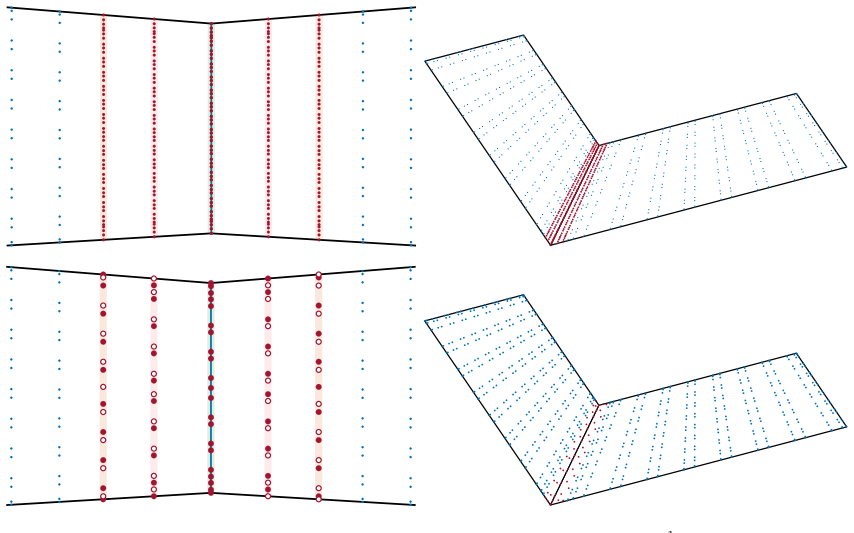
The machinery is the mixed degree underlying spline space $S^{(p_1,p_2),s}_h([0,1]^2)$, defined as the direct sum $S_1([0,1]^2) \oplus \bar{S}_1([0,1]^2) \oplus S_2([0,1]^2)$, where $p_1=s+1$ and $p_2=2s+1$. The subspace $S_1$ contains degree-$p_1$ B-splines whose derivatives of order up to $s$ vanish on the boundary portions corresponding to inner edges, $S_2$ contains degree-$p_2$ B-splines with nonvanishing derivatives there, and $\bar{S}_1$ contains truncated degree-$p_1$ B-splines added to restore completeness. The paper's adaptation restricts the high-degree part to inner edges and to vertices of valency greater than one, in contrast to the earlier mixed degree space that used high degree near all edges and vertices. On top of this space sit two sets of collocation points: mixed degree Greville points, which assign one Greville point to every basis function of the mixed degree space, and mixed degree superconvergent points, obtained by taking clustered subsets of the known univariate superconvergent points so that their cardinality matches the Greville count. The global linear systems are formed by inserting these points into the strong form of the PDE; for multi-patch domains the systems are slightly overdetermined and solved by least squares, and for a two-patch L-shape a subset selection of superconvergent points produces a square system.
What would settle it
Solve Poisson's equation on a bilinear multi-patch domain with an extraordinary vertex of valency 5, using the $C^2$-smooth space $W^2_h$ with mixed degree superconvergent points, and measure the $L^2$ error under $h$-refinement with $h=1/8,1/16,1/32,1/64$; if the rate is $O(h^2)$ rather than $O(h^3)$, the claimed superconvergence for multi-patch domains fails. Equivalently, compute the Galerkin residual $D^s(u-u_h)$ at the mixed degree superconvergent points for a known manufactured solution and compare its vanishing rate with that at the mixed degree Greville points.
Extended reading notes
Core claim
The paper's central claim is that the adapted $C^s$-smooth mixed degree isogeometric spline space has minimal possible degree $p=s+1$ everywhere on the multi-patch domain except in a small neighborhood of inner edges and of vertices of patch valency greater than one, where degree $p=2s+1$ is required, and that this space supports isogeometric collocation for Poisson's equation with $s=2$ and the biharmonic equation with $s=4$. The space is built from a modified mixed degree underlying spline space on the unit square, and the construction yields basis functions that are linearly independent, locally supported, nonnegative, and form a partition of unity, together with an explicit dimension formula. For the collocation points, the paper generalizes Greville points to the mixed degree setting and defines mixed degree superconvergent points via clustered subsets of known one-dimensional superconvergent points. The reported numerical results show, for Greville points, convergence orders of $O(h^{p_1-1})=O(h^2)$ in all tested norms for both equations; for superconvergent points, the observed orders rise to $O(h^{p_1+1})=O(h^4)$ in $L^2$ on one-patch domains for Poisson, to $O(h^{p_1-1})=O(h^4)$ in $L^2$, $H^1$, $H^2$ for the biharmonic equation on one-patch domains, and to $O(h^3)$ on the tested multi-patch domains in most norms. The method also extends to bilinear-like $G^s$ parameterizations, allowing curved boundaries.
Load-bearing premise
The higher convergence orders claimed for the mixed degree superconvergent points rest on the unproven premise that clustered subsets of one-dimensional superconvergent points, selected to match the mixed degree Greville cardinality, retain their superconvergence for the tensor-product mixed-degree multi-patch spaces; the paper only tests this numerically on the chosen domains.
Editorial extensions
If this is right
- Poisson's and the biharmonic equation can be solved by strong-form collocation on planar multi-patch domains using a discretization space that is mostly of degree $p=s+1$ rather than $p=2s+1$ everywhere, cutting the number of degrees of freedom substantially at equal mesh size.
- The mixed degree superconvergent points give higher convergence orders than the mixed degree Greville points: up to $O(h^4)$ in the $L^2$ norm on one-patch domains for Poisson's equation, $O(h^4)$ in $L^2$, $H^1$, $H^2$ for the biharmonic equation on one-patch domains, and $O(h^3)$ on the tested multi-patch domains in most norms.
- The method works for bilinear-like $G^s$ multi-patch parameterizations, so multi-patch domains with curved boundaries can be handled by the same construction.
- On multi-patch domains the collocation system is slightly overdetermined and is solved by least squares; for a two-patch L-shape, a subset of superconvergent points yields a square linear system with the same observed convergence orders.
- The high degree $p=2s+1$ is still required near inner edges and at vertices of patch valency greater than one, so the savings are limited to the interior of patches and near ordinary boundary vertices.
Reading between the lines
- If the clustered-selection premise behind the mixed degree superconvergent points fails on other geometries, the $L^2$ and $H^1$ advantages over Greville points could shrink from $O(h^3)$ back to $O(h^2)$ on multi-patch domains, so the superconvergence claim is the least certain part of the paper.
- The square-system subset strategy demonstrated for one L-shape two-patch domain may generalize to multi-patch configurations with extraordinary vertices, but the paper leaves that extension open.
- The same mostly-low-degree collocation idea could be applied to Kirchhoff-Love plates and shells or to multi-patch surfaces and volumes, as the authors suggest for future work.
- A rigorous error analysis for collocation at mixed degree superconvergent points, rather than numerical evidence alone, would be needed to guarantee the observed convergence orders on general multi-patch domains.
Editorial analysis
A structured set of objections, weighed in public.
Referee Report
Summary. The paper develops an isogeometric collocation method for the Poisson and biharmonic equations over planar multi-patch domains, using a C^s-smooth mixed-degree spline space adapted from the authors' earlier construction [20]. The space uses degree p=s+1 in most of the domain and degree p=2s+1 only near inner edges and vertices of valency greater than one. Two sets of collocation points are introduced: mixed-degree Greville points and mixed-degree superconvergent points, the latter obtained by taking clustered subsets of known one-dimensional superconvergent points. Numerical experiments on bilinear and bilinear-like G^s multi-patch domains report convergence orders under h-refinement for the L2 norm and H^m seminorms, and an L-shape two-patch example demonstrates three strategies for selecting superconvergent points, including one that yields a square linear system.
Significance. If the mixed-degree superconvergent points behave as claimed, the method offers a substantial reduction in degrees of freedom relative to the uniformly high-degree space of [29], while preserving or improving the convergence orders observed in earlier collocation work. The paper contains several strengths: the construction of the mixed-degree space is detailed and the five geometric variants are explicitly catalogued in Appendix A; the geometries used in the examples are fully specified, including the control points for the curved bilinear-like G^4 domain in Appendix B; and the numerical results are generated with an external manufactured solution rather than fitted to the method. The convergence rates are consistent across the tested domains and both collocation point sets.
major comments (3)
- [Section 4.2, Eq. (14) and Fig. 4] The mixed-degree superconvergent points are constructed by selecting 'clustered subsets' of the univariate superconvergent points in (14), but the exact selection rule is not given: the text refers to [28, Fig. 3] and [21, Fig. 3] and says the redundant points are skipped 'in a clustered way' and that other cases are 'straightforward' modifications. Because the convergence orders reported in Section 5 for these points (e.g., O(h^4) in L2 for one-patch Poisson, O(h^3) for multi-patch) are the basis for the method's accuracy advantage over the Greville points, the selection procedure must be precisely described in this manuscript. Moreover, no proof or analysis is provided that the tensor-product mixed-degree multi-patch space inherits superconvergence at these clustered points; if the clustering breaks superconvergence on other geometries with different valencies or more complex G^s maps, the convergence would degrade to the Greville order O(h^2), eliminating the headline improvement. At minimum, the paper should state that this is a heuristic and provide a reproducible algorithm for the clustering.
- [Section 5, Tables 2 and 3, Figs. 8–11] The abstract and introduction claim that the method solves the PDEs with 'a much lower number of degrees of freedom' compared to the C^s-smooth spline space [29] with degree p=2s+1 everywhere, but no quantitative comparison is presented. The numerical section reports errors and system dimensions for the proposed method only; there is no table or figure comparing accuracy versus degrees of freedom with [29] (or with the earlier collocation papers [28,21]). Since the entire motivation of the mixed-degree construction is the reduction of degrees of freedom, a direct comparison should be included to substantiate the claim.
- [Section 3.1, Eq. (8) and dimension formula] The linear independence, partition of unity, and the general dimension formula of the adapted mixed-degree underlying space are asserted with the phrase 'One can show (cf. [20])' and the formula is stated without proof. The adapted space differs from the space in [20] because the set of edges treated as 'inner' depends on the patch configuration (four, three, two adjacent, two opposite, or one inner edge), and the direct sum decomposition (8) is the basis for the collocation system size. If the dimension formula or the basis property fails for any of the five variants, the reported system dimensions in Tables 2 and 3 and the least-squares step would be invalid. The paper should either prove these properties for all five variants or explicitly identify which results in [20] carry over verbatim and which require adaptation.
minor comments (6)
- [Section 4.1, first sentence] Typo: 'dedicted' should be 'dedicated'.
- [Section 4.2, text after Eq. (14)] The phrase 'The modifications to all other cases are straightforward and follow the concept visualized in Fig. 2' is too vague for reproducibility; please provide at least one worked example of a non-four-inner-edge case, or a reference to a precise algorithmic description.
- [Section 5, Figures 8–11] The convergence orders are reported by visual inspection of log-log plots with reference slopes. Since the orders are a central numerical claim, a table listing the estimated convergence rates for each domain, norm, and point set (or a statement of the fitted rates) would be more informative and less ambiguous.
- [Example 3, Tables 2 and 3] The tables give the dimensions of the linear systems but not the dimension of the spline space W^s_h; adding the latter would clarify the degree of overdetermination and allow the reader to verify the 'reduced DOFs' claim directly.
- [Section 6, Conclusion] The paper explicitly states that the extension to extraordinary vertices and the generalization of the square-system strategy are future work; this limitation should be mentioned earlier, e.g., at the end of Section 4 or in the introduction, so that the scope of the present contribution is clear from the outset.
- [References] Reference [20] is an arXiv preprint; if the final version is published, the citation should be updated. Also, the superconvergent points in (14) for S^{3,2} and S^{5,2} are stated without derivation; adding the defining polynomials (as is done for the degree-9 case) would make the section more self-contained.
Circularity Check
No significant circularity: the convergence claims are tested against an external manufactured solution; self-citations supply the underlying spline-space construction and the clustered-point heuristic but do not define the predicted errors.
full rationale
The derivation chain is not circular. The adapted C^s-smooth mixed degree spline space is explicitly constructed in Section 3 and Appendix A; the citation to [20] supplies the underlying mixed-degree space and basis properties ('One can show (cf. [20]) ...'), which are prerequisites rather than the target convergence results. The mixed degree Greville points and mixed degree superconvergent points are defined in Section 4 from univariate Greville and superconvergent points; the clustering rule is deferred to [28, Fig. 3] and [21, Fig. 3], and the superconvergence of the clustered tensor-product points on multi-patch domains is only verified numerically, so this is a correctness and reproducibility risk rather than a circular step. Every numerical claim is benchmarked against the manufactured solution u(x1,x2)=cos(x1)sin(x2) for both the Poisson and biharmonic problems, with no fitted parameters and with the observed orders reported as empirical findings. The main caveats are unproven heuristics and deferred proofs, not a reduction of an output to an input.
Assumptions & free parameters
free parameters (1)
- Clustered subset selection for mixed degree superconvergent points =
Heuristic selection rule, no fitted number
assumptions (4)
- domain assumption The modified mixed degree underlying spline space S^{(p1,p2),s}_h([0,1]^2) has a basis of linearly independent, nonnegative, locally supported functions that form a partition of unity in all five edge-configuration variants.
- domain assumption The clustered subsets of univariate superconvergent points for S^{p,r}_h are exactly those tabulated in [28] (s=2) and [21] (s=4), and their superconvergence extends to the tensor-product mixed degree setting.
- domain assumption Bilinear-like G^s multi-patch parameterizations from [26,29] allow the same C^s spline space construction and collocation operator as bilinear parameterizations.
- standard math The strong-form differential operators can be pulled back to the parameter domain via the formulas in Eqs. (4) and (7), taken from [3,21].
Cite this review
Pith. "Pith review of Isogeometric collocation with smooth mixed degree splines over planar multi-patch domains." pith.science (2026). https://pith.science/paper/CNZLSTK6
@misc{pith2026241113338,
  author       = {Pith},
  title        = {Pith review of: Isogeometric collocation with smooth mixed degree splines over planar multi-patch domains},
  year         = {2026},
  howpublished = {\url{https://pith.science/paper/CNZLSTK6}},
  note         = {Machine review of arXiv:2411.13338}
}
read the original abstract
We present a novel isogeometric collocation method for solving the Poisson's and the biharmonic equation over planar bilinearly parameterized multi-patch geometries. The proposed approach relies on the use of a modified construction of the C^s-smooth mixed degree isogeometric spline space [20] for s=2 and s=4 in case of the Poisson's and the biharmonic equation, respectively. The adapted spline space possesses the minimal possible degree p=s+1 everywhere on the multi-patch domain except in a small neighborhood of the inner edges and of the vertices of patch valency greater than one where a degree p=2s+1 is required. This allows to solve the PDEs with a much lower number of degrees of freedom compared to employing the C^s-smooth spline space [29] with the same high degree p=2s+1 everywhere. To perform isogeometric collocation with the smooth mixed degree spline functions, we introduce and study two different sets of collocation points, namely first a generalization of the standard Greville points to the set of mixed degree Greville points and second the so-called mixed degree superconvergent points. The collocation method is further extended to the class of bilinear-like G^s multi-patch parameterizations [26], which enables the modeling of multi-patch domains with curved boundaries, and is finally tested on the basis of several numerical examples.
Figures


Figures from the paper (10 more)



Reference graph
Works this paper leans on
-
[20]
M. Kapl, A. Kosmaˇ c, and V. Vitrih. A C s-smooth mixed degree and regularity isogeometric spline space over planar multi-patch domains. https://arxiv.org/abs/2407.17046, 2024. 25
work page Pith review arXiv 2024
-
[29]
M. Kapl and V. Vitrih. C s-smooth isogeometric spline spaces over planar multi-patch pa- rameterizations. Advances in Computational Mathematics , 47:47, 2021
work page 2021
-
[28]
M. Kapl and V. Vitrih. Isogeometric collocation on planar multi-patch domains. Comput. Methods Appl. Mech. Engrg. , 360:112684, 2020
work page 2020
-
[21]
M. Kapl, A. Kosmaˇ c, and V. Vitrih. Isogeometric collocation for solving the biharmonic equation over planar multi-patch domains. Computer Methods in Applied Mechanics and Engineering, 424:116882, 2024
work page 2024
-
[1]
C. Anitescu, Y. Jia, Y. J. Zhang, and T. Rabczuk. An isogeometric collocation method using superconvergent points. Comput. Methods Appl. Mech. Engrg. , 284:1073–1097, 2015
work page 2015
-
[2]
F. Auricchio, L. Beir˜ ao da Veiga, T. J. R. Hughes, A. Reali, and G. Sangalli. Isogeometric collocation methods. Math. Models Methods Appl. Sci. , 20(11):2075–2107, 2010
work page 2010
-
[3]
A. Bartezzaghi, L. Ded` e, and A. Quarteroni. Isogeometric analysis of high order partial differential equations on surfaces. Comput. Methods Appl. Mech. Engrg., 295:446 – 469, 2015
work page 2015
-
[4]
L. Beir˜ ao da Veiga, A. Buffa, G. Sangalli, and R. V´ azquez. Mathematical analysis of varia- tional isogeometric methods. Acta Numerica, 23:157–287, 5 2014
work page 2014
Show all 42 references
-
[5]
Bercovier and T
M. Bercovier and T. Matskewich. Smooth B´ ezier Surfaces over Unstructured Quadrilateral Meshes. Lecture Notes of the Unione Matematica Italiana, Springer, 2017
2017
-
[6]
Blidia, B
A. Blidia, B. Mourrain, and G. Xu. Geometrically smooth spline bases for data fitting and simulation. Comput. Aided Geom. Des. , 78:101814, 2020
2020
-
[7]
Casquero, L
H. Casquero, L. Liu, Y. Zhang, A. Reali, and H. Gomez. Isogeometric collocation us- ing analysis-suitable T-splines of arbitrary degree. Comput. Methods Appl. Mech. Engrg. , 301:164–186, 2016
2016
-
[8]
C.L. Chan, C. Anitescu, and T. Rabczuk. Isogeometric analysis with strong multipatch C1-coupling. Comput. Aided Geom. Design , 62:294–310, 2018
2018
-
[9]
C.L. Chan, C. Anitescu, and T. Rabczuk. Strong multipatch C 1-coupling for isogeometric analysis on 2D and 3D domains. Comput. Methods Appl. Mech. Engrg. , 357:112599, 2019
2019
-
[10]
Collin, G
A. Collin, G. Sangalli, and T. Takacs. Analysis-suitable G 1 multi-patch parametrizations for C1 isogeometric spaces. Comput. Aided Geom. Des. , 47:93 – 113, 2016
2016
-
[11]
J. A. Cottrell, T. J. R. Hughes, and Y. Bazilevs. Isogeometric Analysis: Toward Integration of CAD and FEA . John Wiley & Sons, Chichester, England, 2009
2009
-
[12]
Fahrendorf, L
F. Fahrendorf, L. De Lorenzis, and H. Gomez. Reduced integration at superconvergent points in isogeometric analysis. Comput. Methods Appl. Mech. Engrg. , 328:390–410, 2018
2018
-
[13]
Farahat, B
A. Farahat, B. J¨ uttler, M. Kapl, and T. Takacs. Isogeometric analysis with C 1-smooth functions over multi-patch surfaces. Comput. Methods Appl. Mech. Engrg. , 403:115706, 2023
2023
-
[14]
Farahat, M
A. Farahat, M. Kapl, A. Kosmaˇ c, and V. Vitrih. A locally based construction of analysis- suitable G1 multi-patch spline surfaces. Comput. Math. Appl. , 168:46–57, 2024
2024
-
[15]
G. Farin. Curves and Surfaces for Computer-Aided Geometric Design . Academic Press, 1997
1997
-
[16]
Gomez and L
H. Gomez and L. De Lorenzis. The variational collocation method. Comput. Methods Appl. Mech. Engrg., 309:152–181, 2016
2016
-
[17]
Gomez, A
H. Gomez, A. Reali, and G. Sangalli. Accurate, efficient, and (iso)geometrically flexible collocation methods for phase-field models. J. Comput. Phys. , 262:153–171, 2014
2014
-
[18]
Hoschek and D
J. Hoschek and D. Lasser. Fundamentals of computer aided geometric design . A K Peters Ltd., Wellesley, MA, 1993
1993
-
[19]
T. J. R. Hughes, J. A. Cottrell, and Y. Bazilevs. Isogeometric analysis: CAD, finite elements, NURBS, exact geometry and mesh refinement. Comput. Methods Appl. Mech. Engrg., 194(39- 41):4135–4195, 2005
2005
-
[22]
M. Kapl, G. Sangalli, and T. Takacs. An isogeometric C 1 subspace on unstructured multi- patch planar domains. Comput. Aided Geom. Des. , 69:55–75, 2019
2019
-
[23]
M. Kapl, G. Sangalli, and T. Takacs. A family of C 1 quadrilateral finite elements. Adv. Comp. Math. , 47(6):82, 2021
2021
-
[24]
Kapl and V
M. Kapl and V. Vitrih. Space of C 2-smooth geometrically continuous isogeometric functions on planar multi-patch geometries: Dimension and numerical experiments. Comput. Math. Appl., 73(10):2319–2338, 2017
2017
-
[25]
Kapl and V
M. Kapl and V. Vitrih. Space of C 2-smooth geometrically continuous isogeometric functions on two-patch geometries. Comput. Math. Appl. , 73(1):37–59, 2017
2017
-
[26]
Kapl and V
M. Kapl and V. Vitrih. Dimension and basis construction for C 2-smooth isogeometric spline spaces over bilinear-like G2 two-patch parameterizations. J. Comput. Appl. Math. , 335:289– 311, 2018
2018
-
[27]
Kapl and V
M. Kapl and V. Vitrih. Solving the triharmonic equation over multi-patch planar domains using isogeometric analysis. J. Comput. Appl. Math. , 358:385–404, 2019
2019
-
[30]
Karˇ ciauskas and J
K. Karˇ ciauskas and J. Peters. Refinable G1 functions on G1 free-form surfaces. Comput. Aided Geom. Des., 54:61–73, 2017
2017
-
[31]
Karˇ ciauskas and J
K. Karˇ ciauskas and J. Peters. Refinable bi-quartics for design and analysis. Comput.-Aided Des., pages 204–214, 2018
2018
-
[32]
Lai and L
M.-J. Lai and L. L. Schumaker. Spline functions on triangulations, volume 110 of Encyclopedia of Mathematics and its Applications . Cambridge University Press, Cambridge, 2007
2007
-
[33]
Maurin, F
F. Maurin, F. Greco, L. Coox, D. Vandepitte, and W. Desmet. Isogeometric collocation for Kirchhoff-Love plates and shells. Comput. Methods Appl. Mech. Engrg. , 329:396–420, 2018
2018
-
[34]
Montardini, G
M. Montardini, G. Sangalli, and L. Tamellini. Optimal-order isogeometric collocation at Galerkin superconvergent points. Comput. Methods Appl. Mech. Engrg. , 316:741–757, 2017
2017
-
[35]
Mourrain, R
B. Mourrain, R. Vidunas, and N. Villamizar. Dimension and bases for geometrically con- tinuous splines on surfaces of arbitrary topology. Comput. Aided Geom. Des. , 45:108 – 133, 2016
2016
-
[36]
Nguyen, K
T. Nguyen, K. Karˇ ciauskas, and J. Peters. C 1 finite elements on non-tensor-product 2d and 3d manifolds. Applied Mathematics and Computation , 272:148–158, 2016
2016
-
[37]
Nguyen and J
T. Nguyen and J. Peters. Refinable C 1 spline elements for irregular quad layout. Comput. Aided Geom. Des., 43:123–130, 2016
2016
-
[38]
Reali and H
A. Reali and H. Gomez. An isogeometric collocation approach for Bernoulli-Euler beams and Kirchhoff plates. Comput. Methods Appl. Mech. Engrg. , 284:623–636, 2015
2015
-
[39]
Schillinger, J
D. Schillinger, J. A. Evans, A. Reali, M. A. Scott, and T. J.R. Hughes. Isogeometric colloca- tion: Cost comparison with Galerkin methods and extension to adaptive hierarchical NURBS discretizations. Comput. Methods Appl. Mech. Engrg. , 267:170 – 232, 2013. 26
2013
-
[40]
Toshniwal, H
D. Toshniwal, H. Speleers, and T. J. R. Hughes. Smooth cubic spline spaces on unstructured quadrilateral meshes with particular emphasis on extraordinary points: Geometric design and isogeometric analysis considerations. Comput. Methods Appl. Mech. Engrg. , 327:411– 458, 2017
2017
-
[41]
Wei, X Li, K
X. Wei, X Li, K. Qian, T. J. R Hughes, Y. J Zhang, and H. Casquero. Analysis-suitable unstructured T-splines: Multiple extraordinary points per face. Comput. Methods Appl. Mech. Engrg., 391:114494, 2022
2022
-
[42]
Wen. Z., Md. S. Faruque, X. Li, X. Wei, and H. Casquero. Isogeometric analysis using G-spline surfaces with arbitrary unstructured quadrilateral layout. Comput. Methods Appl. Mech. Engrg., 408:115965, 2023. 27
2023
Reviewed August 12, 2026 · model on record in the stance chip above.
Discussion (0). Continue with ORCID to comment.