REVIEW 2 major objections 6 minor 50 references
UKFin+: A Research Agenda for Financial Services
T0 review · 2 major / 6 minor · reviewed 2026-08-12 · deepseek-v4-flash
Pith's one-line read This research agenda argues that UK financial services research should concentrate on six named challenges, from financial inclusion to sustainable finance, and that each requires collaboration across academia, industry, regulators…
desk verdict A clean, well-referenced funding agenda whose only real weak spot is the opaque workshop process behind the selection of six challenges. read the letter →
The pith
A machine-rendered reading of the paper's core claim, the machinery that carries it, and where it could break.
The reading
What carries the argument
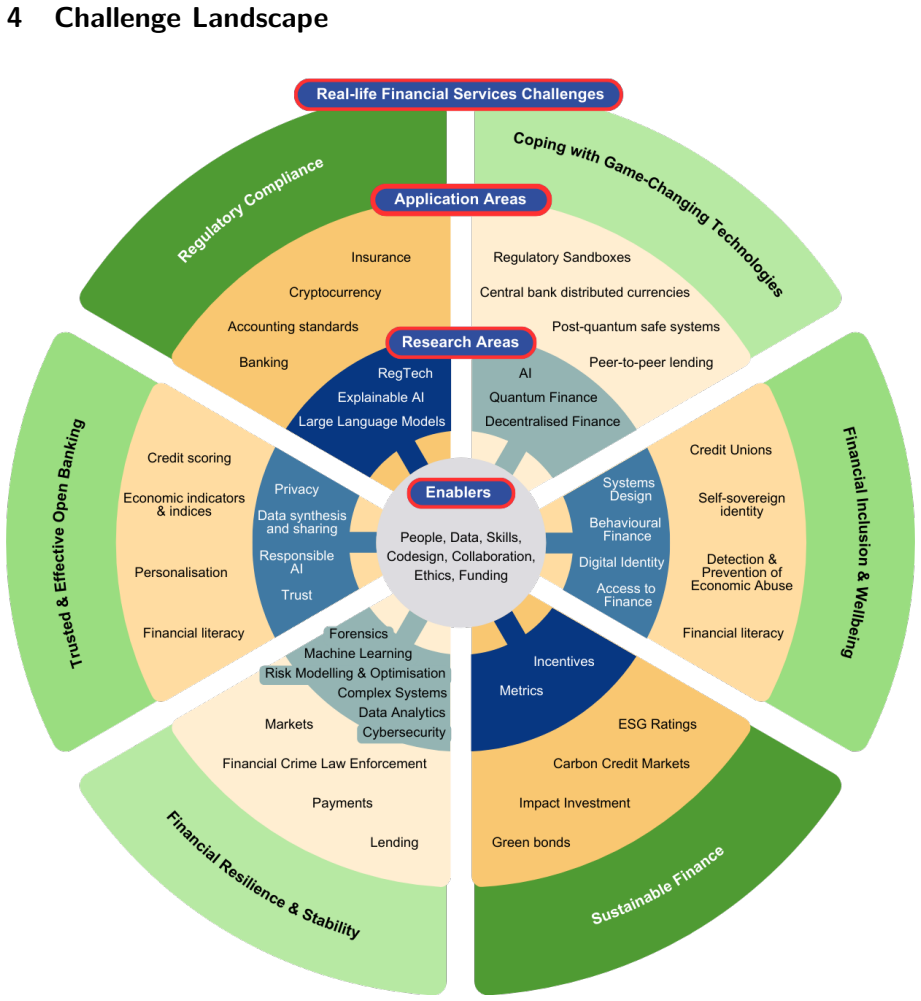
The carrying structure is a concentric challenge landscape with an outer ring of six real-life challenges, a ring of application areas, a ring of more fundamental research areas, and a central core of enablers. This map is paired with a spotlight mechanism under which one challenge at a time becomes the focus of funding calls and events, with financial inclusion and wellbeing first and game-changing technologies second. The map does the argumentative work by making every proposed project locatable: a non-academic partner can enter from a challenge and move inward to research, while an academic can enter from a research area and move outward to application and challenge.
What would settle it
A systematic, nationally representative consultation of UK financial services stakeholders, including consumers, small firms, and non-fintech incumbents, that yields a materially different set of top challenges would undercut the agenda's priority claims.
Extended reading notes
Core claim
The paper's central claim is that six primary real-life challenges should organize UK financial services research over the coming years. For each challenge the authors supply concrete context and research directions: inclusion requires fair access plus financial wellbeing; game-changing technologies centre on AI, blockchain, and quantum computing; compliance needs quantitative metrics and regulatory sandboxes; open banking needs trust and consumer-centred data sharing; resilience requires modelling markets as complex adaptive systems; and sustainable finance needs verifiable, tradeable green instruments. The authors also identify enablers as the shared core without which work on any challenge stalls. The agenda is grounded in stakeholder workshops and aligned with sector surveys, and its purpose is to steer funding and collaboration rather than report new experimental findings.
Load-bearing premise
The load-bearing premise is that the six challenges, drawn from UKFin+ stakeholder workshops, are the right priorities for the UK financial services sector; the workshops' participant composition and selection method are not described, and the document says it is not intended to be comprehensive.
Editorial extensions
If this is right
- If the six challenges are the right framing, funding calls and events will keep clustering around them, making the opening spotlights a test of whether the agenda produces collaborative proposals.
- Compliance research could deliver quantitative compliance metrics and language-model tools that turn regulation text into actionable checks, easing the documented regulatory burden.
- A trusted open-banking regime built on consent and financial literacy would let consumers and small businesses assemble personalised products from data that once belonged only to banks.
- Stability research would shift from overconfident simple models toward agent-based and generative simulations of markets as complex adaptive systems, including new ways to monitor systemic risk from cryptoassets.
- Sustainable finance could move toward tokenized green bonds, carbon credits, and impact tokens that are easy to trade and hard to greenwash, with IoT and blockchain providing verification.
Reading between the lines
- The spotlight schedule carries an urgency ordering the paper does not defend; a different workshop mix could plausibly reorder the six challenges.
- The enabler layer implies a testable hypothesis the paper does not test: projects that explicitly budget for codesign, data quality, skills, and ethics will outperform those that do not.
- Because the agenda is UK-centred, its challenge set is probably not fully portable; other countries might rank sustainable finance or financial resilience differently depending on market structure.
Editorial analysis
A structured set of objections, weighed in public.
Referee Report
Summary. This manuscript is a research agenda document produced by the UKFin+ Network Plus consortium. It argues that the UK financial services sector faces six primary real-life challenges—financial inclusion and wellbeing, coping with game-changing technologies, regulatory compliance, trusted and effective open banking, financial resilience and stability, and sustainable finance—and that these challenges should structure collaborative research across academia, industry, and regulators. Each challenge is described in a dedicated subsection with references to UK-specific data and policy documents, and the agenda closes with a set of cross-cutting enablers (people, data, skills, codesign, collaboration, funding, ethics) and an outlook connecting the challenges to a payments-industry survey. The intended use is to inspire and align funding proposals for UKFin+ and other funders.
Significance. Taken on its own terms, the paper is a useful and clearly structured scoping document. Its strengths are that it is well referenced, internally coherent, and explicitly non-exhaustive, and it translates broad societal problems into concrete application and research areas that can be used to shape funding calls. The paper also gives credit to its consultative basis by acknowledging UKFin+ event participants. However, the central prioritisation claim—that the six named challenges are the primary ones for UK financial services—rests on stakeholder workshops whose design and representativeness are not reported. If the challenge set is intended to guide substantial public research funding, the evidentiary basis for that selection needs to be visible. The paper does not make falsifiable predictions or provide machine-checked derivations; its value is organisational and inspirational rather than empirical.
major comments (2)
- [Section 4, Figure 1; Executive Summary] The claim that the six challenges are 'primary real-life challenges' and were 'identified through a series of stakeholder workshops' is load-bearing but unsupported. The manuscript nowhere describes the number of workshops, participant recruitment criteria, sector or seniority mix, format, or the analysis that turned workshop input into exactly these six categories (the Acknowledgements merely thank attendees of UKFin+ events). Because the agenda is explicitly intended to guide funding decisions and proposal alignment, a reader cannot tell whether the six challenges reflect the broader UK financial-services landscape or the specific UKFin+ network. I would ask for either a short methodology appendix describing the workshop process and its limitations, or a reframing of the claim to something like 'six challenges that UKFin+ stakeholders identified as salient', with 'primary' removed.
- [Section 4 and Section 6] The selection of the six challenges is not triangulated against systematic alternatives. Section 6 invokes a Payments Association survey as confirmation, but that survey covers only the payments subsector and is introduced after the six challenges have already been fixed. The manuscript should situate the challenge set relative to other UK financial-services priority exercises (for example, FCA business plans, HM Treasury and regulator strategies, or existing academic agenda articles) and explicitly discuss potential omissions such as operational resilience, data protection and privacy, and competition policy. This would strengthen the agenda's credibility without requiring a full Delphi or survey study.
minor comments (6)
- [Section 3] The word 'nuture' should be 'nurture'.
- [Section 4.6] The word 'multifacted' should be 'multifaceted'.
- [Section 4.2.2] The phrase 'Some of the the latter' contains a duplicated definite article.
- [Section 4.1] The phrase 'ones financial affairs' should be 'one's financial affairs'.
- [Section 5] The enabler subsection on data states that human-generated data is 'preferred' to synthetic data, but the cited evidence [41] supports a narrower claim about model collapse; please add a citation or qualify the preference claim.
- [References] Reference [1] appears to have a misspelled author name ('Argawal' should likely be 'Agarwal').
Circularity Check
No significant circularity: the paper is a synthesis and agenda, not a derivation, and its self-citations are not load-bearing.
full rationale
This paper is a research agenda and literature synthesis, not a derivation chain with predictions or fitted parameters. Its central claim is that six primary real-life challenges face UK financial services (Financial Inclusion & Wellbeing, Game-Changing Technologies, Regulatory Compliance, Open Banking, Resilience & Stability, Sustainable Finance). These six challenges are presented as inputs arising from stakeholder workshops and cited evidence, not as outputs of a formal derivation. No equation is fitted to data and later renamed as a prediction. The only overlapping-author citations are reference [43] (Toreini et al., on trust in AI) and reference [48] (Werner et al., SoK on DeFi), both used to support background statements rather than to justify the agenda's central challenge set. These are published, externally accessible works and do not constitute a self-citation chain that forces the paper's conclusions. The workshop representativeness concern noted in the reader's take is a legitimate limitation about evidence quality, but it is a matter of sampling transparency and not a circularity of the kind this pass looks for. Therefore the paper is self-contained in the relevant sense and receives a score of 0.
Assumptions & free parameters
assumptions (2)
- domain assumption The UK financial services sector is a critical pillar of the economy and its key problems are 'wicked problems' that demand cross-sector collaboration.
- domain assumption The six challenge areas identified in Section 4 are the principal real-life challenges for UK financial services.
Cite this review
Pith. "Pith review of UKFin+: A Research Agenda for Financial Services." pith.science (2026). https://pith.science/paper/4QI6ISI4
@misc{pith2026241113389,
  author       = {Pith},
  title        = {Pith review of: UKFin+: A Research Agenda for Financial Services},
  year         = {2026},
  howpublished = {\url{https://pith.science/paper/4QI6ISI4}},
  note         = {Machine review of arXiv:2411.13389}
}
read the original abstract
This document presents a research agenda for financial services as a deliverable of UKFin+, a Network Plus grant funded by the Engineering and Physical Sciences Research Council. UKFin+ fosters research collaborations between academic and non-academic partners directed at tackling complex long-term challenges relevant to the UK's financial services sector. Confronting these challenges is crucial to promote the long-term health and international competitiveness of the UK's financial services industry. As one route to impact, UKFin+ includes dedicated funding streams for research collaborations between academic researchers and non-academic organisations. The intended audience of this document includes researchers based in academia, academic funders, as well as practitioners based in industry, regulators, charities or NGOs. It is not intended to be comprehensive or exhaustive in scope but may provide applicants to UKFin+ funding streams and other funding bodies with inspiration for their proposals or at least an understanding of how their proposals align with the broader needs of the UK financial services industry.
Figures


Figures from the paper (8 more)


Reference graph
Works this paper leans on
-
[1]
A. Argawal, J. Gans, and A. Goldfarb. Power and Prediction: The Disruptive Economics of Artificial Intelligence . Harvard Business Review Press, 2022
work page 2022
-
[2]
D.W. Arner, R.P. Buckley, D.A. Zetzsche, et al. Sustainability, FinTech and Financial Inclusion. Eur Bus Org Law Rev , 21:7–35, 2020
work page 2020
-
[3]
Bank of England and HM Treasury. Response to the Bank of England and HM trea- sury consultation paper: The digital pound: a new form of money for households and businesses?, 2024. Available online at https://www.bankofengland.co.uk/-/media/boe/ files/paper/2024/responses-to-the-digital-pound-consultation-paper.pdf
work page 2024
-
[4]
Project Genesis – Report 1: A vision for technology-driven green finance, 2021
BIS Innovation Hub and Hong Kong Monetary Authority. Project Genesis – Report 1: A vision for technology-driven green finance, 2021. Available online at https://www.bis.org/publ/ othp43_report1.pdf
work page 2021
- [5]
-
[6]
Embracing the uk’s open finance opportunity
Centre for Finance, Innovation and Technology. Embracing the uk’s open finance opportunity. Inaugural Coalition Paper. Available online at https://cfit.org.uk/wp-content/uploads/ 2024/02/CFIT-Open-Finance-Blueprint.pdf
work page 2024
-
[7]
Y. Chang et al. A survey on evaluation of large language models. ACM Transactions on Intelligent Systems and Technology , 15, 2024
work page 2024
-
[8]
State of the sector: Annual review of UK financial services 2023, 2023
City of London and HM Treasury. State of the sector: Annual review of UK financial services 2023, 2023. Available online at https://assets.publishing.service.gov.uk/media/ 64ad6d32fe36e0000d6fa6a9/State_of_the_sector_annual_review_of_UK_financial_ services_2023.pdf
work page 2023
Show all 50 references
-
[9]
Reskilling everywhere all at once: Skills for the future of financial services, 2023
Financial Services Skills Commission. Reskilling everywhere all at once: Skills for the future of financial services, 2023. Available online at https://wp.financialservicesskills.org/ wp-content/uploads/2023/04/FSSC-Future-Skills-23-Report-FINAL.pdf . 19
2023
-
[10]
Recommendations for the next phase of open banking in the UK, April 2023
Joint Regulatory Oversight Committee. Recommendations for the next phase of open banking in the UK, April 2023. Available online at https://assets.publishing.service.gov.uk/ government/uploads/system/uploads/attachment_data/file/1150988/JROC_report_ recommendations_and_actions...
2023
-
[11]
Day and P.J.H
G.S. Day and P.J.H. Schoemaker. Wharton on Managing Emerging Technologies . John Wiley & Sons, Inc, 2000
2000
-
[12]
Edmans and M.T
A. Edmans and M.T. Kacperczyk. Sustainable finance. Review of Finance, 69:1309–1313, 2022. Available online at https://ssrn.com/abstract=4285892
2022
-
[13]
Preventing financial crime in cryptoassets: Identifying evolving crimi- nal behavior, 2024
Elliptic. Preventing financial crime in cryptoassets: Identifying evolving crimi- nal behavior, 2024. Available online at https://www.elliptic.co/resources/ elliptic-typologies-report-2024
2024
-
[14]
In the AI of the storm: How UK financial services firms are using AI, November 2023
Gillmore Centre for Financial Technology. In the AI of the storm: How UK financial services firms are using AI, November 2023. Available online at https://www.wbs.ac.uk/research/ research-centres-and-networks/gillmore-centre-financial-technology/ ai-report/
2023
-
[15]
Gressel, R
G. Gressel, R. Pankajakshan, and Y. Mirsky. Discussion paper: Exploiting LLMs for scam automation: A looming threat. In Proc. 3rd ACM Workshop on the Security Implications of Deepfakes and Cheapfakes (WDC ’24)) , 2024
2024
-
[16]
Flash loans and decentralized lending protocols: An in-depth analysis
Florian Gronde. Flash loans and decentralized lending protocols: An in-depth analysis. Master’s thesis, Center for Innovative Finance, University of Basel, Basel, Switzerland, 2020
2020
-
[17]
Regulatory initiatives grid, November 2023
HM Treasury et al. Regulatory initiatives grid, November 2023. Available online at https:// www.fca.org.uk/publication/corporate/regulatory-initiatives-grid-nov-2023. pdf
2023
-
[18]
Select committee on financial exclusion tackling financial exclusion: A coun- try that works for everyone? HL Paper 132, March 2017
House of Lords. Select committee on financial exclusion tackling financial exclusion: A coun- try that works for everyone? HL Paper 132, March 2017. Available online at https: //publications.parliament.uk/pa/ld201617/ldselect/ldfinexcl/132/13202.htm
2017
-
[19]
Green bond principles, 2022
ICMA. Green bond principles, 2022. Available online at https://www. icmagroup.org/assets/documents/Sustainable-finance/2022-updates/ Green-Bond-Principles-June-2022-060623.pdf
2022
-
[20]
Data age 2025: The digitization of the world from edge to core, 2018
IDC. Data age 2025: The digitization of the world from edge to core, 2018. Available online at https://www.seagate.com/files/www-content/our-story/trends/ files/idc-seagate-dataage-whitepaper.pdf
2025
-
[21]
Joseph, R
D. Joseph, R. Misoczki, M. Manzano, et al. Transitioning organizations to post-quantum cryptography. Nature, 605:237–243, 2022
2022
-
[22]
Krizhevsky, I
A. Krizhevsky, I. Sutskever, and G.E. Hinton. Imagenet classification with deep convolutional neural networks. Advances in Neural Information Processing Systems , 25, 2012
2012
-
[23]
Lankton and D.H
N.K. Lankton and D.H. McKnight. What does it mean to trust facebook? examining technology and interpersonal trust beliefs. ACM SIGMIS Database: The DATABASE for Advances in Information Systems, 42(2):32–54, 2011
2011
-
[24]
Maino, C
L. Maino, C. Martindale, L Panny, G. Pope, and B. Wesolowski. A direct key recovery attack on SIDH. In Advances in Cryptology – EUROCRYPT 2023 , pages 448–471. Springer Nature Switzerland, 2023. 20
2023
-
[25]
Markus, J.A
A.F. Markus, J.A. Kors, and P.R. Rijnbeek. The role of explainability in creating trustworthy artificial intelligence for health care: A comprehensive survey of the terminology, design choices, and evaluation strategies. Journal of Biomedical Informatics , page 103655, 2021
2021
-
[26]
J. McCrea. UK unicorn companies. Available online at https://www.beauhurst.com/ research/unicorn-companies/. Accessed September 2024
2024
-
[27]
The UK strategy for financial wellbeing 2020–2030, 2020
Money and Pensions Service. The UK strategy for financial wellbeing 2020–2030, 2020. Available online at https://maps.org.uk/content/dam/ maps-corporate/en/our-work/uk-strategy-for-financial-wellbeing/ maps-uk-strategy-for-financial-wellbeing-2020-2030.pdf
2020
-
[28]
Mosca and M
M. Mosca and M. Piani. Quantum threat timeline report 2023, 2023. Available online at https: //globalriskinstitute.org/publication/2023-quantum-threat-timeline-report/
2023
-
[29]
Nakamoto
S. Nakamoto. Bitcoin: A peer-to-peer electronic cash system, 2008. Available online at https: //bitcoin.org/bitcoin.pdf
2008
-
[30]
Nie et al
Y. Nie et al. A survey of large language models for financial applications: Progress, prospects and challenges, 2024. Available online at https://arxiv.org/abs/2406.11903
2024 arXiv
-
[31]
Noguer i Alonso
M. Noguer i Alonso. Economy and financial markets as complex systems model- ing the economy: A new framework, January 2024. Available online at SSRN: https://ssrn.com/abstract=4684075
2024
-
[32]
State of AI in financial services: 2024 trends, 2024
NVIDIA. State of AI in financial services: 2024 trends, 2024. Available online at https: //resources.nvidia.com/en-us-2024-fsi-survey/ai-financial-services
2024
-
[33]
Economic indicators: Number 02786, August 2024
House of Commons Library. Economic indicators: Number 02786, August 2024. Avail- able online at https://researchbriefings.files.parliament.uk/documents/SN02786/ SN02786.pdf
2024
-
[34]
Pay 360: State of the industry survey, 2023
Payments Association/Pay360. Pay 360: State of the industry survey, 2023. Avail- able online at https://pay360event.com/wp-content/uploads/sites/9/2023/07/5904_ Pay360_2024_Infographic_V4.pdf
2023
-
[35]
Plaitakis and S
A. Plaitakis and S. Staschen. Open banking: How to design for financial in- clusion. Consultative Group to Assist the Poor (CGAP)/World Bank: Work- ing Paper, 2020. Available online at https://documents.worldbank.org/ en/publication/documents-reports/documentdetail/35188162513...
2020
-
[36]
Financial inclusion report 2024: A divided nation
Plend. Financial inclusion report 2024: A divided nation. Available online at https://assets-global.website-files.com/64620846446d0cb110c5f31f/ 661f835fe7df160ada04f010_Plend_Financial_Inclusion_Report_ 2024-a-divided-nation.pdf
2024
-
[37]
Provenzano
D. Provenzano. An artificial stock market in a system dynamics approach. In Proc. 2002 International System Dynamics Society Conference , 2002
2002
-
[38]
The total tax contribution of UK-based financial and related professional services
PwC. The total tax contribution of UK-based financial and related professional services. Research Report, commissioned by the City of London Corporation and TheCityUK, May 2024. Available online at https://www.theglobalcity.uk/PositiveWebsite/media/Research-reports/ The-Total-...
2024
-
[39]
K. Qin, L. Zhou, B. Livshits, and A. Gervais. Attacking the DeFi ecosystem with flash loans for fun and profit. In Proc. International Conference on Financial Cryptography and Data Security (FC 2021), 2021
2021
-
[40]
T. Ritchey. Wicked problems: Modelling social messes with morphological analysis. Acta Morphologica Generalis, 2, 2013
2013
-
[41]
Shumailov, Z
I. Shumailov, Z. Shumaylov, Y. Zhao, N. Papernot, R. Anderson, and Y. Gal. AI models collapse when trained on recursively generated data. Nature, 631:755–759, 2024
2024
-
[42]
Srinivasan
R. Srinivasan. Sources, characteristics and effects of emerging technologies: Research opportu- nities in innovation. Industrial Marketing Management , 37(6):633–640, 2008
2008
-
[43]
Toreini, M
E. Toreini, M. Aitken, A. van Moorsel, K. Elliott, and K. Coopamootoo. The relationship between trust in AI and trustworthy machine learning technologies. In Proc. ACM Fairness, Accountability and Transparency Conference , 2020
2020
-
[44]
Trischler, S.J
J. Trischler, S.J. Pervan, S.J. Kelly, and D.R. Scott. The value of codesign: The effect of customer involvement in service design teams. Journal of Service Research , 21(1):75–100, 2018
2018
-
[45]
A. Turner. The crisis, conventional economic wisdom, and public policy. Industrial and Corporate Change, 19(5):1317–1329, 08 2010
2010
-
[46]
The impact of AI in financial services: Opportunities, risks and policy considerations, 2023
UK Finance and Oliver Wyman. The impact of AI in financial services: Opportunities, risks and policy considerations, 2023. Available online at https://www.ukfinance.org.uk/system/ files/2023-11/The%20impact%20of%20AI%20in%20financial%20services.pdf
2023
-
[47]
Vaswani et al
A. Vaswani et al. Attention is all you need. arXiv preprint arXiv:1706.03762, 2017
2017 arXiv
-
[48]
Werner, D
S. Werner, D. Perez, L. Gudgeon, A. Klages-Mundt, D. Harz, and W.J. Knottenbelt. SoK: De- centralised Finance (DeFi). In Proc. 4th ACM Conference on Advances in Financial Technologies (AFT 2022), 2022
2022
-
[49]
G. Wood. Ethereum: A secure decentralised transaction ledger, 2014. Available online at https://ethereum.github.io/yellowpaper/paper.pdf
2014
-
[50]
Xiong and J
X. Xiong and J. Luo. Global trends in cryptocurrency regulation: An overview. In Proc. 5th International Conference on Mathematical Research for Blockchain Economy (MARBLE 2024) , 2024. 22
2024
Reviewed August 12, 2026 · model on record in the stance chip above.
Discussion (0). Continue with ORCID to comment.