REVIEW 3 major objections 4 minor 1 cited by
Cancellation and regularity for planar, 3-connected Kronecker products
T0 review · 3 major / 4 minor · reviewed 2026-08-12 · deepseek-v4-flash
Pith's one-line read A 3-connected planar graph has at most one Kronecker factorization
desk verdict Polyhedral Kronecker cancellation is a real result, but the main proof is an informal picture argument that needs a rigorous case analysis before it is publishable. read the letter →
The pith
A machine-rendered reading of the paper's core claim, the machinery that carries it, and where it could break.
The reading
What carries the argument
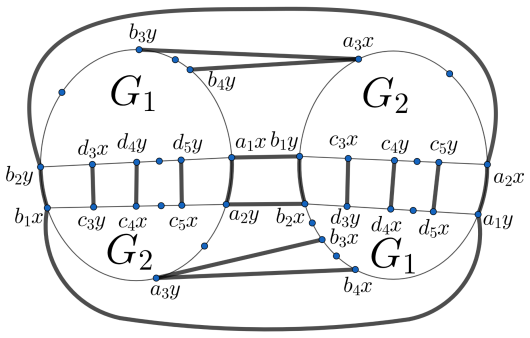
The central object is the Kronecker (direct) product of graphs, in the special form $J\wedge K_2$, called the Kronecker cover or double cover of $J$. The load-bearing machinery is the structural description of polyhedral Kronecker products: whenever $J\wedge K_2$ is a 3-polytope, $J$ is built from a planar bipartite core $J'$ plus a matching $a_1b_1,\dots,a_mb_m$ whose endpoints all lie on one region $R$ in one of two cyclic orders. The cancellation proof overlays two such factorizations on the same sphere, and the uniqueness of the embedding of a 3-connected planar graph forces the two copies of the region $R$ and the matching edges to align, so that the two factor graphs agree.
What would settle it
Enumerate all simple graphs $J$ on up to a fixed number of vertices whose Kronecker cover $J\wedge K_2$ is a given small polyhedron, such as the cube or the stacked cube $C_4\square P_4$, checking isomorphism of the covers directly from the product definition. The theorem predicts exactly one such $J$ for each polyhedral cover; any second non-isomorphic preimage would refute Theorem 1.10.
Extended reading notes
Core claim
The central claim is that a polyhedral graph has at most one representation as a Kronecker product. Since a 3-polytopal Kronecker product must have $K_2$ as one factor, the statement is precisely: $J\wedge K_2 \simeq L\wedge K_2$ with the common product a 3-polytope implies $J\simeq L$. The proof takes two factorizations of the same polyhedron, overlays them on the same planar embedding, and uses the uniqueness of planar embeddings of 3-connected graphs together with the forced facial 4-cycles to identify the two factor graphs. Alongside this, the paper establishes that the face-regular polyhedral Kronecker products are exactly the 3-connected quadrangulations of the sphere, the vertex-regular ones are exactly the cubic polyhedra, and it describes the extremal class with the fewest vertices of degree 3. It also determines which polyhedra have two distinct Cartesian decompositions and which are simultaneously Kronecker and Cartesian products.
Load-bearing premise
The proof of the main theorem inherits, without re-deriving, the full classification of polyhedral Kronecker products from the companion paper: every such product is $J\wedge K_2$ with $J$ of the special shape described in Definition 1.2, and if that classification missed a case, the cancellation argument would not cover it.
Editorial extensions
If this is right
- A polyhedral graph has a unique Kronecker decomposition, so any algorithm searching for Kronecker factorizations of polyhedra can stop once the factor $J$ is found.
- The Kronecker cancellation problem for simple graphs has a positive answer whenever the common cover is planar and 3-connected, even though it is false in general.
- The face-regular polyhedral Kronecker products are exactly the 3-connected quadrangulations of the sphere described in Theorem 1.4, and the vertex-regular ones are exactly the cubic polyhedra described in Theorem 1.8.
- A planar graph is a Cartesian product in at most two ways, with the stacked cubes other than the cube as the only ambiguous cases; the polyhedra that are both Kronecker and Cartesian products are precisely the two families listed in Theorem 1.11.
- Among stacked cubes, $C_4\square P_{2m}$ for $m\ge 2$ has a unique Kronecker factorization whose factor $J$ is non-planar, while its two Cartesian factorizations are also distinct.
Reading between the lines
- The overlay argument used in the cancellation proof may extend to other graph classes with unique embeddings, such as 3-connected graphs on higher-genus surfaces, where a surface-specific uniqueness theorem would replace Whitney's planar result.
- The iterative constructions in Theorems 1.6 and 1.8 give an explicit supply of extremal polyhedra; these families could be used to computationally test the open problem of polyhedral Kronecker products with exactly six quadrangular faces.
- Because the known counterexample to cancellation (the Desargues graph as a common cover of two non-isomorphic graphs) fails planarity, the boundary drawn by Theorem 1.10 suggests that planarity together with 3-connectivity, rather than bipartiteness alone, is the right rigidity condition for Kronecker uniqueness.
Editorial analysis
A structured set of objections, weighed in public.
Referee Report
Summary. The paper studies Kronecker (direct) products A ∧ B that are planar and 3-connected (polyhedral). Its main result is Theorem 1.10: if J ∧ K2 ≃ L ∧ K2 is a 3-polytope, then J ≃ L, i.e., cancellation holds for Kronecker products when the product is a polyhedron. The authors also classify face-regular and vertex-regular polyhedral Kronecker products (Theorems 1.4–1.8), characterize planar graphs that are Cartesian products in two distinct ways, and identify the polyhedra that are both Kronecker and Cartesian products (Theorem 1.11, Corollary 1.12). The proofs rely heavily on the prior classification of polyhedral Kronecker products by the second author [15].
Significance. If correct, the main theorem is a substantial contribution to the open problem of Kronecker cancellation for simple graphs: it establishes the first natural class of products for which cancellation always holds, complementing known counterexamples such as the Petersen graph. The regularity classifications are also valuable: they give concrete, constructive characterizations (Theorems 1.4, 1.6, 1.8) with explicit transformations and examples, and Theorem 1.11 completes the picture of simultaneous Cartesian and Kronecker representations. The paper is well written and the auxiliary results are mostly convincing. However, the proof of the central theorem, Theorem 1.10, contains a load-bearing gap: its key steps are justified only by planar-intuition arguments and figures rather than by a rigorous case analysis. The claimed result is plausible, but the proof as written does not establish it in full generality.
major comments (3)
- [§4.1, proof of Theorem 1.10 (paragraph after Eq. (4.2))] The assertion that if J is not isomorphic to L then 'S does not coincide with R' and that each copy of S contains a positive even number of edges from (4.1) is not proved. R and S are cycles in the same planar embedding, and non-isomorphism of the factors does not by itself exclude configurations where S and R are disjoint, equal, or nested. The subsequent case analysis therefore does not cover all possible relative placements of R and S, and the argument appears to verify only the configurations drawn in Figures 14 and 15.
- [§4.1, proof of Theorem 1.10 (paragraph 'Since (dα, y) and (dβ, x) ...')] The statement 'by planarity these two vertices are in fact adjacent' is not a valid consequence of the fact that two vertices lie on the same cycle S. Two vertices on a cycle need not be adjacent, and planarity alone does not imply adjacency. The proof seems to assume without justification that the overlay of R and S forces the specific local pattern of consecutive vertices used in the construction of the 4-cycles and the eventual isomorphism J ≃ L. A rigorous argument is needed to show that all configurations reduce to this pattern.
- [§4.1, end of proof of Theorem 1.10] The construction of the isomorphism J ≃ L via the graphs G1 and G2 is described verbally and with reference to Figures 14 and 15, but G1 and G2 are not defined formally, and the proof does not verify that the proposed correspondence is a graph isomorphism in all cases, especially when a copy of S contains several edges from (4.1). The sentence 'Please note that the above reasoning holds for any number of pairs of edges from (4.1) that a copy of S may contain' is an assertion of generality that is not accompanied by a proof.
minor comments (4)
- [§2.1, proof of Theorem 1.4] The exclusion of the first ordering of vertices on R ('otherwise a1x, b1x, a1y, b1y would all lie on the same face in P') is not fully justified; a short explanation or small figure would clarify why this forces a non-quadrangular face.
- [§1.4, Theorem 1.11] In the statement of Theorem 1.11, the two families 'C4n+2 □ Pm, n ≥ 1, m ≥ 2' and 'C4n □ P2m, n, m ≥ 1' are written as separate cases; it may be worth stating explicitly that the cube itself is excluded from the 'expressible in two ways' part, as is done in the text.
- [§4.2, proof of Proposition 4.1] The sentence 'Since the only cycle graph containing a copy of C4 is C4 itself, n must be 4' is slightly imprecise: a cycle graph C_n contains C4 as a subgraph only when n = 4; the intended meaning is clear, but the wording could be tightened.
- [General] The paper cites the classification from [15] as a black box (Theorem 1.3). Since the main theorem depends on this classification, the authors should state explicitly that Theorem 1.10 is contingent on the full correctness of [15], and ideally indicate whether [15] has been peer-reviewed.
Circularity Check
No circularity: the main cancellation theorem is derived from the prior structure theorem rather than restating it, and no fitted quantity is relabeled as a prediction.
full rationale
The paper's central derivation is not self-referential. Theorem 1.10 proves cancellation by taking two factorizations J ∧ K2 ≃ L ∧ K2, applying the classification of polyhedral Kronecker products from [15, Theorem 1.3 and Definition 1.2] to both sides, overlaying the two region cycles R and S in the common planar embedding, and constructing an isomorphism J ≃ L from the resulting common subgraphs G1 and G2. The conclusion is not an input to the classification: the classification describes the structure of a single product, while cancellation (uniqueness of the factor) is a new statement about pairs of factorizations. No parameter is fitted to a data subset and then predicted; the regularity theorems in Sections 2 and 3 are classifications whose proofs use the same prior structure theorem plus independent face and degree counting. The reliance on [15], a cited work by the second author, is substantial, but it is an external, parameter-free classification with stated assumptions and does not include the target cancellation result, so under the stated rules it counts as independent support rather than a circular self-citation. The proof of Theorem 1.10 does contain assertions such as 'S does not coincide with R' and 'by planarity these two vertices are in fact adjacent' that would need a more rigorous case analysis; that is a correctness gap, not a circular reduction, and therefore does not raise the circularity score.
Assumptions & free parameters
assumptions (6)
- standard math Standard graph-theoretic definitions: finite simple graphs, planarity, k-connectivity, duals of 3-polytopes.
- standard math Euler's formula for planar graphs: V - E + F = 2.
- standard math Rademacher-Steinitz theorem: a graph is planar and 3-connected if and only if it is the 1-skeleton of a convex polyhedron.
- standard math Whitney's theorem: 3-connected planar graphs have a unique embedding on the sphere up to homeomorphism.
- domain assumption Classification of polyhedral Kronecker products ([15, Theorem 1.3]): P = J ∧ K2 is a 3-polytope if and only if J satisfies Definition 1.2.
- domain assumption Characterization of polyhedral Kronecker products for planar J ([15, Theorems 1.1 and 1.4]).
Cite this review
Pith. "Pith review of Cancellation and regularity for planar, 3-connected Kronecker products." pith.science (2026). https://pith.science/paper/ZFIYSXDX
@misc{pith2026241113473,
  author       = {Pith},
  title        = {Pith review of: Cancellation and regularity for planar, 3-connected Kronecker products},
  year         = {2026},
  howpublished = {\url{https://pith.science/paper/ZFIYSXDX}},
  note         = {Machine review of arXiv:2411.13473}
}
abstract
We investigate several properties of Kronecker (direct, tensor) products of graphs that are planar and $3$-connected (polyhedral, $3$-polytopal). This class of graphs was recently characterised and constructed by the second author [15]. Our main result is that cancellation holds for the Kronecker product of graphs when the product is planar and $3$-connected (it is known that Kronecker cancellation may fail in general). Equivalently, polyhedral graphs are Kronecker products in at most one way. This is a special case of the deep and interesting question, open in general, of Kronecker product cancellation for simple graphs: when does $A\wedge C\simeq B\wedge C$ imply $A\simeq B$? We complete our investigation on simultaneous products by characterising and constructing the planar graphs that are Cartesian products in two distinct ways, and the planar, $3$-connected graphs that are both Kronecker and Cartesian products. The other type of results we obtain are in extremal graph theory. We classify the polyhedral Kronecker products that are either face-regular or vertex-regular graphs. The face-regular ones are certain quadrangulations of the sphere, while the vertex-regular ones are certain cubic graphs (duals of maximal planar graphs). We also characterise, and iteratively construct, the face-regular subclass of graphs minimising the number of vertices of degree $3$.
Figures


Figures from the paper (17 more)




Forward citations
Cited by 1 Pith paper
-
Automorphism Groups in Extremal Families of Polyhedral Graphs
Every minimum-order 3-polytopal graph with all degrees 3..n (n≥14) is asymmetric, and automorphism groups are classified for four other extremal polyhedral families.
Reference graph
Works this paper leans on
-
[15]
R. W. Maffucci. Classification and construction of planar, 3-connected Kronecker products. arXiv:2402.01407
-
[1]
G. Abay-Asmerom, R. H. Hammack, C. E. Larson, and D. T. Taylor. Direct product factor- ization of bipartite graphs with bipartition-reversing involutions.SIAM Journal on Discrete Mathematics, 23(4):2042–2052, 2010
work page 2010
-
[2]
G.Abay-Asmerom, R.H.Hammack, andD.T.Taylor. Factorialpropertiesofgraphs. Australas. J Comb., 44:265–272, 2009
work page 2009
-
[3]
M. Behzad and S. Mahmoodian. On topological invariants of the product of graphs.Canadian Mathematical Bulletin, 12(2):157–166, 1969
work page 1969
-
[4]
D. P. Biebighauser and M. N. Ellingham. Prism-hamiltonicity of triangulations.Journal of Graph Theory, 57(3):181–197, 2008
work page 2008
-
[5]
M. Farzan and D. A. Waller. Kronecker products and local joins of graphs.Canadian Journal of Mathematics, 29(2):255–269, 1977. 28
work page 1977
-
[6]
A. Fernández, T. Leighton, and J. L. López-Presa. Containment properties of product and power graphs. Discrete applied mathematics, 155(3):300–311, 2007
work page 2007
-
[7]
Gaspoz and R
S. Gaspoz and R. W. Maffucci. Independence numbers of polyhedral graphs.Applied Mathe- matics and Computation, 462:128349, 2024
2024
Show all 23 references
-
[8]
R. H. Hammack. On direct product cancellation of graphs.Discrete Mathematics, 309(8):2538– 2543, 2009
2009
-
[9]
R. H. Hammack, W. Imrich, and S. Klavžar.Handbook of product graphs, volume 2. CRC press Boca Raton, 2011
2011
-
[10]
Harant, S
J. Harant, S. Jendrol’, and M. Tkác. On 3-connected plane graphs without triangular faces. Journal of Combinatorial Theory, Series B, 77(1):150–161, 1999
1999
-
[11]
J. M. Harris, J. L. Hirst, and M. J. Mossinghoff.Combinatorics and Graph Theory. Springer, 2008
2008
-
[12]
Imrich and T
W. Imrich and T. Pisanski. Multiple Kronecker covering graphs.European Journal of Combi- natorics, 29(5):1116–1122, 2008
2008
-
[13]
Krnc and T
M. Krnc and T. Pisanski. Generalized Petersen graphs and Kronecker covers.Discrete Mathe- matics & Theoretical Computer Science, 21(Graph Theory), 2019
2019
-
[14]
L. Lovász. On the cancellation law among finite relational structures.Periodica Mathematica Hungarica, 1(2):145–156, 1971
1971
-
[16]
R. W. Maffucci. Constructing certain families of3-polytopal graphs.Journal of Graph Theory, pages 1–18, 2022
2022
-
[17]
R. W. Maffucci. Self-dual polyhedra of given degree sequence. Art Discrete Appl. Math. 6 (2023), P1.04., 2023
2023
-
[18]
R. W. Maffucci and N. Willems. On smallest 3-polytopes of given graph radius. Discrete Mathematics, 346(5):113322, 2023
2023
-
[19]
Steinitz and H
E. Steinitz and H. Rademacher. Vorlesungen über die Theorie der Polyeder unter Einschluß der Elemente der Topologie. Reprint, volume 41 ofGrundlehren Math. Wiss.Springer, Cham, 1976
1976
-
[20]
D. A. Waller. Double covers of graphs. Bulletin of the Australian Mathematical Society, 14(2):233–248, 1976
1976
-
[21]
H. Whitney. Congruent graphs and the connectivity of graphs. Hassler Whitney Collected Papers, pages 61–79, 1992
1992
-
[22]
Z. Zhang. Semi-hyper-connected vertex transitive graphs.Discrete mathematics, 309(4):899– 907, 2009
2009
-
[23]
Zhang and J
Z. Zhang and J. Meng. Semi-hyper-connected edge transitive graphs.Discrete mathematics, 306(7):705–710, 2006. 29
2006
Reviewed August 12, 2026 · model on record in the stance chip above.
Discussion (0). Continue with ORCID to comment.