REVIEW 5 major objections 5 minor 67 references
Universal properties of Wigner delay times and resonance widths of tight-binding random graphs
T0 review · 5 major / 5 minor · reviewed 2026-08-12 · deepseek-v4-flash
Pith's one-line read The paper claims that Wigner-delay-time and resonance-width distributions of sparse random graphs collapse onto universal curves under the single scaling parameter $\xi = \langle k \rangle N^{-\alpha}$, matching random-matrix theory in…
desk verdict A careful numerical extension that likely gives real xi-scaling for delay times and resonance widths, but the collapse is only shown visually and deserves a quantitative pass before publication. read the letter →
The pith
A machine-rendered reading of the paper's core claim, the machinery that carries it, and where it could break.
The reading
What carries the argument
The load-bearing object is the scaling parameter $\xi = \langle k \rangle N^{-\alpha}$, built from the average degree and the graph size, with model-dependent exponents taken from prior spectral studies. It fixes the horizontal scale on which delay-time and width distributions are compared and, through the empirical perfect-coupling formula Eq. (18), sets the lead-to-graph coupling strength $\varepsilon_0$ used in every calculation. The scattering formalism reduces the single-channel $S$-matrix to a phase $S(E)=e^{i\phi(E)}$; the Wigner delay time is $\tau=d\phi/dE$ at $E=0$, and resonance widths $\Gamma_n$ come from the complex eigenvalues of the effective non-Hermitian Hamiltonian $H_{\rm eff}=H-e^{ik}WW^T$. The reference universal curves are the one-channel RMT delay-time distributions (11) and (12), derived from the Porter-Thomas distribution of eigenfunction intensities, and the resonance-width distribution (17) for non-isolated resonances.
What would settle it
Compute the same $\xi$-fixed histograms for Erdős–Rényi graphs with $N=1000$ and $N=2000$ using Eq. (18) and $\alpha=0.075$; if the curves separate by size, the power-law scaling is not the full story. Alternatively, measure the ensemble-averaged scattering matrix at the predicted perfect-coupling strength for these larger sizes; if $\langle S\rangle$ is not close to zero, the comparison with the RMT reference distributions loses its justification.
Extended reading notes
Core claim
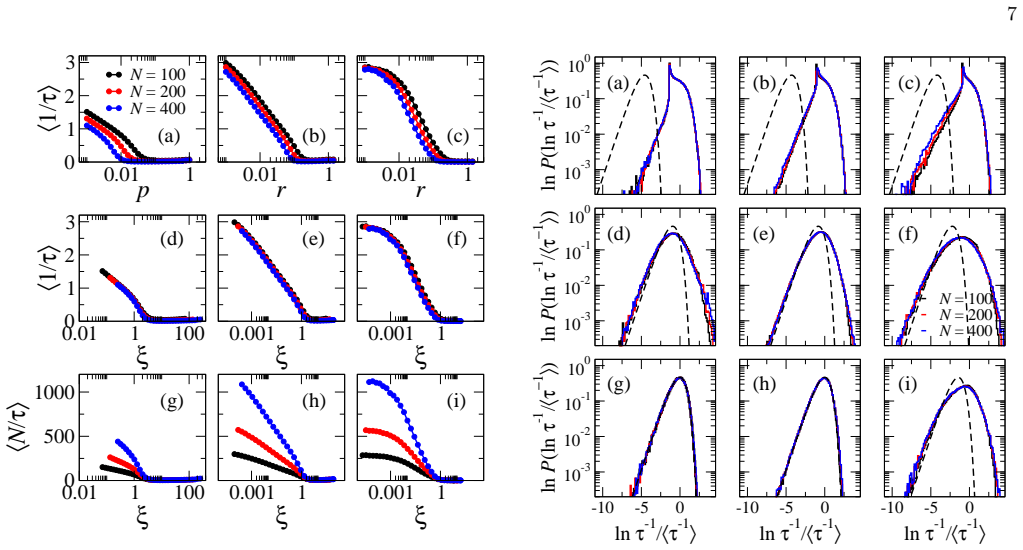
The central discovery is the invariance of the distributions of Wigner delay times and resonance widths under the scaling $\xi = \langle k \rangle N^{-\alpha}$, with $\alpha$ depending on the graph family ($0.075$ for Erdős–Rényi graphs, $0.26$ for random geometric graphs, $0.3429$ for bipartite random geometric graphs with $s=4N/5$). For graph sizes $N=100,200,400$ and fixed $\xi$, histograms of $\ln(\tau^{-1}/\langle\tau^{-1}\rangle)$, $\ln(\tau/\tau_{\rm typ})$, and $\ln(\Gamma/\Gamma_{\rm typ})$ coincide for different sizes and connectivities, and the same collapsed curves are shared by the three graph models. In the mostly connected regime the collapsed curves coincide with the random-matrix-theory distributions (11), (12), and (17), showing a smooth crossover from insulating to metallic scattering as $\xi$ grows. The exception stated in the paper is the bipartite random geometric graph with the lead attached to the larger set: the scattering setup is too asymmetric to reach the RMT reference, although its $\xi$-scaled distributions still collapse onto the common curves.
Load-bearing premise
The argument rests on the empirical formula Eq. (18) for the coupling strength that achieves perfect coupling, together with the fitted exponents $\alpha$; if that formula or the exponents are not transferable to larger graphs or to other lead attachments, the apparent universality could be an artifact of the studied parameter range.
Editorial extensions
If this is right
- For a random graph of either family, the full single-channel delay-time and resonance-width statistics can be predicted from $\langle k\rangle$, $N$, and the family-specific $\alpha$, without solving the scattering problem.
- Microwave photonic arrays that realize tight-binding random geometric graphs should observe the same $\xi$-collapse and the same RMT distributions in the dense limit, providing a direct experimental test.
- The mean Wigner delay time is tied to the closed graph's eigenvalue density through $\langle\tau\rangle/N = 2\pi\rho(E)$, so spectral information of the closed system controls the open-system delay.
- For the bipartite graph with an asymmetric lead attachment, the RMT reference is not attainable, but the $\xi$-scaling still organizes the data, indicating a universality distinct from the GOE limit.
- The crossover from insulator to metal as $\xi$ increases is smooth rather than critical, so the delay time can serve as a convenient transport probe of the crossover without access to eigenfunctions.
Reading between the lines
- Because the exponents $\alpha$ differ between graph families, the scaling variable is not a single universal quantity; one could test whether $\alpha$ is controlled by the spectral dimension or by the bipartite and geometric structure of the model.
- The collapse is demonstrated for $N\le 400$; an unambiguous test would push to $N=1000$ or beyond and ask whether the same fixed $\alpha$ still collapses the curves, or whether the power-law form is only an effective low-size description.
- The same $\xi$-scaling logic might extend to other one-channel scattering observables, such as conductance or shot-noise distributions, and to multi-channel leads, where the RMT reference distributions differ but the scaling parameter may still organize the crossover.
- The empirical perfect-coupling formula is fitted numerically; a direct measurement of $\langle S\rangle$ at the predicted $\varepsilon_0$ for larger $N$ would either confirm the universality or reveal the parameter range where the formula breaks down.
Editorial analysis
A structured set of objections, weighed in public.
Referee Report
Summary. The paper studies Wigner delay times and resonance widths of tight-binding random graphs (Erdős–Rényi graphs, random geometric graphs, and bipartite random geometric graphs) opened to a single-channel lead in the perfect-coupling regime. Using the scattering-matrix formalism, the authors compute numerically the distributions of the inverse Wigner delay time, the delay time normalized by its typical value, and the resonance widths, for graph sizes N = 100, 200, 400 with 10^6 samples each. Their central claim is that these distributions are invariant under the scaling parameter ξ = ⟨k⟩ N^{-α}, Eq. (19), with model-dependent α, and that for mostly connected graphs the distributions coincide with the RMT forms (11), (12), and (17). The perfect-coupling strength is set by the empirical formula (18), and the exponents α are imported from Ref. [26].
Significance. If the universal-collapse claim can be made quantitative, the paper would extend RMT-based scattering universality from fully connected random matrices to sparse random graphs and provide a useful single parameter, ξ, for classifying transport regimes in microwave or photonic realizations of tight-binding graphs. The numerical effort is substantial (10^6 realizations), and the reproduction of the known RMT distributions for complete ERGs and RGGs is a useful reference result. The main weaknesses are that the collapse under Eq. (19) is assessed visually, with no statistical metric, and that several load-bearing ingredients (α and the perfect-coupling formula) are imported from earlier fits rather than derived or independently verified here.
major comments (5)
- [Section IV, Eq. (19), Figs. 6–8] The central claim of the paper, that the distributions are invariant under ξ = ⟨k⟩ N^{-α}, is supported only by visual superposition of histograms. No quantitative collapse measure is provided, such as Kolmogorov–Smirnov distances, L2 differences, or scaling residuals as a function of N at fixed ξ. Because α is imported from spectral fits in Ref. [26] and is not fitted to or derived for delay times and widths, a small error in α would destroy the collapse at larger N. I ask the authors to quantify the collapse, for example by computing pairwise distances between empirical distributions at different N for fixed ξ and comparing them to the statistical fluctuations of the ensembles, and ideally to re-fit α directly from the delay-time and width distributions to check consistency with the spectral values.
- [Section IV, Tables I and II] The RMT reference distributions (11), (12), and (17) are evaluated using parameters k1, k2, and k3 computed only for N = 100 (Tables I and II). The text states that agreement with RMT improves as graphs become more connected, but the plotted comparisons at N = 200 and N = 400 reuse the N = 100 parameters without comment. If k1, k2, k3 vary with N, the comparison at larger N is not the true RMT limit for that N; if they are stable, this should be stated and demonstrated. The authors should either recompute the table parameters at each N or show explicitly that the parameter values are independent of N within the statistical accuracy.
- [Section IV, Fig. 6(c) and accompanying text] The authors acknowledge a residual graph-size dependence in the insulator regime, particularly for BRGGs in panel (c) of Fig. 6 and in the upper panels of Fig. 8. Since the claimed universality is meant to hold across regimes, this size dependence should be characterized quantitatively. The paper should state over which range of ξ the collapse holds to within a specified tolerance, and quantify the deviations in the insulator regime, rather than relying on the qualitative phrase 'slight dependence'.
- [Section IV, Eq. (18)] The perfect-coupling condition, which is the precondition for all the reported comparisons, is set by the empirical formula (18) imported from Refs. [25, 26]. The paper does not provide error estimates for the coefficients in (18), nor does it test the formula for the values of N used here. Since an incorrect ε0 would shift the entire delay-time and width statistics, the authors should at least verify ⟨S(ε0)⟩ ≈ 0 for representative (N, ξ) points across the three graph models, and report the uncertainty in the fitted coefficients if available.
- [Abstract and Conclusions] The statements in the abstract and conclusions that the distributions are invariant under ξ for all three graph models, and that mostly connected graphs match the RMT forms, are too broad given the manuscript's own caveat that BRGGs(4N/5) never reaches the RMT limit because of the asymmetry of attaching the lead to the larger set. The authors should explicitly separate the scaling universality claim, which is intended to hold for all three models, from the RMT-approach claim, which is restricted to ERGs and RGGs (and to BRGGs only in other bipartitions).
minor comments (5)
- [Section IV, Fig. 2 caption] There is a typo in the caption text: 'BRRGs' should read 'BRGGs'.
- [Section IV, Fig. 8 caption] The caption says 'Right, middle, and left columns show the results', while Figs. 2–7 use 'first, second, and third columns'. Please make the caption consistent with the other figures.
- [Section V] The word 'analitycal' appears in the Conclusions; it should be 'analytical'.
- [Section IV] The phrase 'deviations betweem numerical data' contains a typo; 'betweem' should be 'between'.
- [Tables I and II] The column header 'BRGGs(4 N/5)' is formatted inconsistently; consider using 'BRGGs(4N/5)' as in the text. Also, the tables would benefit from a statement of the statistical uncertainty in the quoted values of Δ, ⟨τ^{-1}⟩, τ_typ, and Γ_typ.
Circularity Check
No significant circularity: the xi-scaling and RMT comparisons are cross-observable tests, not self-referential reductions.
full rationale
The paper's central scaling claim uses xi = <k> N^{-alpha} with alpha imported from prior work by the same authors [26], but this is not circular: alpha was obtained from spectral and scattering-matrix-element transitions, not from Wigner delay times or resonance widths, so applying it to delay-time and width distributions is a cross-observable transfer rather than a fit to the target observable. The perfect-coupling epsilon0 formula (18) is likewise an input from earlier fits; it is chosen to make <S> approximately zero, so the uniform phase distribution follows from Eq. (5), but the phase uniformity is not the paper's central claim. The RMT comparisons in Figs. 6-8 use k1, k2, and k3 computed from the same simulated values of <tau^{-1}>, tau_typ, Gamma_typ, and Delta; this is a one-parameter shape test rather than a parameter-free prediction, yet it does not reduce the claimed universal collapse to the input because the collapse across graph sizes and graph models at fixed xi is not forced by the imported alpha or epsilon0. The paper also explicitly acknowledges residual N-dependence in the insulator regime and the failure of BRGGs(4N/5) to reach the RMT limit. No equation or fitted parameter in the paper is equivalent by construction to the result it is used to support.
Assumptions & free parameters
free parameters (4)
- alpha exponent for ERGs =
0.075 +/- 0.0029
- alpha exponent for RGGs =
0.26 +/- 0.0185
- alpha exponent for BRGGs(4N/5) =
0.3429 +/- 0.0371
- perfect-coupling coefficients in Eq. (18) =
0.462, 0.374, 0.760, 0.060
assumptions (5)
- domain assumption Adjacency matrix of a random graph with random Gaussian weights is equivalent to a tight-binding Hamiltonian of an electronic random medium.
- domain assumption Complete time-reversal symmetric tight-binding random graphs follow GOE random matrix statistics.
- standard math The Wigner delay time and resonance width distributions of Refs. [56] and [61] apply in the one-channel perfect-coupling regime.
- domain assumption E=0 scattering captures the relevant physics; energy dependence of S and Heff is neglected.
- domain assumption For ERGs and RGGs all vertices are statistically equivalent, so a single randomly chosen vertex represents the lead attachment.
Cite this review
Pith. "Pith review of Universal properties of Wigner delay times and resonance widths of tight-binding random graphs." pith.science (2026). https://pith.science/paper/7XACZPBQ
@misc{pith2026241113511,
  author       = {Pith},
  title        = {Pith review of: Universal properties of Wigner delay times and resonance widths of tight-binding random graphs},
  year         = {2026},
  howpublished = {\url{https://pith.science/paper/7XACZPBQ}},
  note         = {Machine review of arXiv:2411.13511}
}
abstract
The delay experienced by a probe due to interactions with a scattering media is highly related to the internal dynamics inside that media. This property is well captured by the Wigner delay time and the resonance widths. By the use of the equivalence between the adjacency matrix of a random graph and the tight-binding Hamiltonian of the corresponding electronic media, the scattering matrix approach to electronic transport is used to compute Wigner delay times and resonance widths of Erd\"os-R\'enyi graphs and random geometric graphs, including bipartite random geometric graphs. In particular, the situation when a single-channel lead attached to the graphs is considered. Our results show a smooth crossover towards universality as the graphs become complete. We also introduce a parameter $\xi$, depending on the graph average degree $\langle k \rangle$ and graph size $N$, that scales the distributions of both Wigner delay times and resonance widths; highlighting the universal character of both distributions. Specifically, $\xi = \langle k \rangle N^{-\alpha}$ where $\alpha$ is graph-model dependent.
Figures


Figures from the paper (3 more)


Reference graph
Works this paper leans on
-
[26]
A. M. Mart ´ ınez-Arg¨ uello, K. B. Hidalgo-Castro, and J. A. M´ endez-Berm´ udez, J. Stat. Mech. 013303 (2025)
work page 2025
-
[1]
S. H. Strogatz, Nature 410, 268 (2001)
work page 2001
-
[2]
S. N. Dorogovtsev and J. F. F. Mendes, Adv. Phys. 51, 1079 (2001)
work page 2001
-
[3]
Albert and A
R. Albert and A. L. Barab´ asi, Rev. Mod. Phys. 74, 47 (2002)
2002
-
[4]
M. E. J. Newman, SIAM Rev. 45, 167 (2003)
2003
-
[5]
S. Boccalettia, V. Latora, Y. Moreno, M. Chavez, D.-U. Hwang, Phys. Rep. 424, 175 (2006)
work page 2006
-
[6]
Durret, Random Graph Dynamics (Cambridge Uni- versity Press, UK, 2007)
R. Durret, Random Graph Dynamics (Cambridge Uni- versity Press, UK, 2007)
work page 2007
- [7]
Show all 67 references
-
[8]
Estrada, The Structure of Complex Networks: Theory and Applications (Oxford University Press, New York, 2011)
E. Estrada, The Structure of Complex Networks: Theory and Applications (Oxford University Press, New York, 2011)
2011
-
[9]
Penrose, Random Geometric Graphs (Oxford Univer- sity Press, New York, 2003)
M. Penrose, Random Geometric Graphs (Oxford Univer- sity Press, New York, 2003)
2003
-
[10]
Erd¨ os and A
P. Erd¨ os and A. R´ enyi, Publicationes Mathematicae6, 290 (1959)
1959
-
[11]
Cimini, T
G. Cimini, T. Squartini, F. Saracco, D. Garlaschelli, A. Gabrielli, and G. Caldarelli, Nat. Rev. Phys. 1, 58 (2019)
2019
-
[12]
Ozkanlar and A
A. Ozkanlar and A. E. Clark, J. Compt. Chem. 35, 495 (2014)
2014
-
[13]
S. N. Dorogovtsev and A. V. Goltsev, Rev. Mod. Phys. 80, 1275 (2008)
2008
-
[14]
Estrada, N
E. Estrada, N. Hatano, and M. Benzi, Phys. Rep. 514, 89 (2012)
2012
-
[15]
A. L. Barab´ asi and R. Albert, Science286, 509 (1999)
1999
-
[16]
D. S. Callaway, M. E. J. Newman, S. H. Strogatz, and D. J. Watts, Phys. Rev. Lett. 25, 5468 (2000)
2000
-
[17]
K.-I. Goh, B. Kahng, and D. Kim, Phys. Rev. E 64, 051903 (2001)
2001
-
[18]
G. J. Rodgers, K. Austin, B. Kahng, and D. Kim, J. Phys. A: Math. Gen. 38, 9431 (2005)
2005
-
[19]
Georgeot, O
B. Georgeot, O. Giraud, and D. L. Shepelyansky, Phys. Rev. E 81, 056109 (2010)
2010
-
[20]
Jalan, G
S. Jalan, G. Zhu, and B. Li, Phys. Rev. E 84, 046107 (2011)
2011
-
[21]
Farkas, I
I. Farkas, I. Der´ enyi, H. Jeong, Z. N´ eda, Z. N. Oltvai, E. Ravasz, A. Schubert, A. L. Barab´ asi, and T. Vicsek, Physica A 314, 25 (2002)
2002
-
[22]
S. N. Dorogovtsev, A. V. Goltsev, J. F. F. Mendes, and A. N. Samukhin, Phys. Rev. E 68, 046109 (2003)
2003
-
[23]
L´ opez, S
E. L´ opez, S. V. Buldyrev, S. Havlin, and H. E. Stanley, Phys. Rev. Lett. 94, 248701 (2005)
2005
-
[24]
Y. Xue, J. Wang, L. Li, D. He, and B. Hu, Phys. Rev. E 81, 037101 (2010) 11
2010
-
[25]
A. J. Mart ´ ınez-Mendoza, A. Alcazar-L´ opez, and J. A. M´ endez-Berm´ udez, Phys. Rev. E88, 012126 (2013)
2013
-
[27]
Aguilar-S´ anchez, J
R. Aguilar-S´ anchez, J. A. M´ endez-Berm´ udez, F. A. Ro- drigues, and J. M. Sigarreta, Phys. Rev. E 102, 042306 (2020)
2020
-
[28]
M. Sade, T. Kalisky, S. Havlin, and R. Berkovits, Phys. Rev. E 72, 066123 (2005)
2005
-
[29]
J. N. Bandyopadhyay and S. Jalan, Phys. Rev. E 76, 026109 (2007)
2007
-
[30]
Jalan and J
S. Jalan and J. N. Bandyopadhyay, Phys. Rev. E 76, 046107 (2007)
2007
-
[31]
Jalan, N
S. Jalan, N. Solymosi, G. Vattay, and B. Li, Phys. Rev. E 81, 046118 (2010)
2010
-
[32]
C. W. J. Beenakker, Rev. Mod. Phys. 69, 731 (1997)
1997
-
[33]
E. P. Wigner, Phys. Rev. 98, 145 (1955)
1955
-
[34]
Smith, Phys
F.T. Smith, Phys. Rev. 118, 349 (1960)
1960
-
[35]
Y. V. Fyodorov and H.-J. Sommers, J. Math. Phys. 38, 1918 (1997)
1997
-
[36]
Y. V. Fyodorov, D. V. Savin, and H.-J. Sommers, Phys. Rev. E 55, R4857(R) (1997)
1997
-
[37]
A. M. Mart ´ ınez-Arg¨ uello, A. A. Fern´ andez-Mar ´ ın, and M. Mart ´ ınez-Mares, Eur. Phys. J. Spec. Top. 226, 519 (2017)
2017
-
[38]
Y. V. Fyodorov and D. V. Savin, Phys. Rev. Lett. 108, 184101 (2012)
2012
-
[39]
Novaes, Europhys
M. Novaes, Europhys. Lett. 139, 21001 (2022)
2022
-
[40]
L. Chen, S. M. Anlage, and Y. V. Fyodorov, Phys. Rev. E 103, L050203 (2021)
2021
-
[41]
L. Chen, S. M. Anlage, and Y. V. Fyodorov, Phys. Rev. Lett. 127, 204101 (2021)
2021
-
[42]
Y. V. Fyodorov and D. V. Savin. Resonance Scattering of Waves in Chaotic Systems. Chapter 34 in the Oxford Handbook of Random Matrix Theory. (edited by G. Ake- mann, J. Baik, and P. Di Francesco) (Oxford University Press, Oxford, 2011): pp. 703-722
2011
-
[43]
Kottos and M
T. Kottos and M. Weiss, Phys. Rev. Lett. 89, 056401 (2002)
2002
-
[44]
J. A. M´ endez-Berm´ udez and T. Kottos, Phys. Rev. B72, 064108 (2005)
2005
-
[45]
A. M. Mart ´ ınez-Arg¨ uello, M. Carrera-N´ u˜ nez, and J. A. M´ endez-Berm´ udez, Phys. Rev. E107, 024139 (2023)
2023
-
[46]
Zhong, S
C. Zhong, S. M. Arisona, X. Huang, M. Batty, and G. Schmitt, Int. J. Geogr. Inf. Sci. 28, 2178 (2014)
2014
-
[47]
Stegehuis, L
C. Stegehuis, L. Weedage, Physica A 586, 126460 (2022)
2022
-
[48]
Barth´ elemy, Phys
M. Barth´ elemy, Phys. Rep.499, 1 (2011)
2011
-
[49]
U. Kuhl, S. Barkhofen, T. Tudorovskiy, H.-J. St¨ ockmann, T. Hossain, L. de Forges de Parny, and F. Mortessagne, Phys. Rev. B 82, 094308 (2010)
2010
-
[50]
Bittner, B
S. Bittner, B. Dietz, M. Miski-Oglu, P. Oria Iriarte, A. Richter, and F. Sch¨ afer, Phys. Rev. B82, 014301 (2010)
2010
-
[51]
Bellec, U
M. Bellec, U. Kuhl, G. Montambaux, and F. Mortes- sagne, Phys. Rev. B 88, 115437 (2013)
2013
-
[52]
Barkhofen, M
S. Barkhofen, M. Bellec, U. Kuhl, and F. Mortessagne, Phys. Rev. B 87, 035101 (2013)
2013
-
[53]
G. J. Aubry, L. S. Froufe-P´ erez, U. Kuhl, O. Legrand, F. Scheffold, and F. Mortessagne, Phys. Rev. Lett. 125, 127402 (2020)
2020
-
[54]
Dall and M
J. Dall and M. Christensen, Phys. Rev. E 66, 016121 (2002)
2002
-
[55]
J. J. M. Verbaarschot, H. A. Weidenm¨ uller, and M. R. Zirnbauer, Phys. Rep. 129, 367 (1985)
1985
-
[56]
Ossipov and Y
A. Ossipov and Y. V. Fyodorov, Phys. Rev. B 71, 125133 (2005)
2005
-
[57]
Feshbach, Topics in the theory of nuclear reactions , in Reaction Dynamics, edited by E
H. Feshbach, Topics in the theory of nuclear reactions , in Reaction Dynamics, edited by E. W. Montroll, G. H. Vineyard, M. Levy, and P. T. Matthews (Gordon and Breach, New York, 1973)
1973
-
[58]
P. W. Brouwer and C. W. J. Beenakker, Phys. Rev. B 55, 4695 (1997)
1997
-
[59]
Steinbach, A
F. Steinbach, A. Ossipov, T. Kottos, and T. Geisel, Phys. Rev. Lett. 85, 4426 (2000)
2000
-
[60]
Sommers, Y
H.-J. Sommers, Y. V. Fyodorov, and M. Titov, J. Phys. A: Math. Gen. 32, L77 (1999)
1999
-
[61]
Y. V. Fyodorov and M. Osman, J. Phys. A: Math. Theor. 55, 224013 (2022)
2022
-
[62]
A. D. Mirlin and Y. V. Fyodorov, J. Phys. A: Math. Gen. 24, 2273 (1991)
1991
-
[63]
Y. V. Fyodorov and A. D. Mirlin, Phys. Rev. Lett. 67, 2049 (1991)
1991
-
[64]
Y. V. Fyodorov and A. D. Mirlin, Phys. Rev. B 55, R16001 (1997)
1997
-
[65]
Peralta-Mart ´ ınez and J
K. Peralta-Mart ´ ınez and J. A. M´ endez-Berm´ udez, J. Phys. Complex. 4, 015002 (2023)
2023
-
[66]
P. W. Brouwer, K. M. Frahm, C. W. J. Beenakker, Phys. Rev. Lett. 78, 4737 (1997)
1997
-
[400]
Estancias Posdoctorales por M´ exico 2022
In all panels, each data value is computed by averaging over 106 realizations of the corresponding random graph. ciprocals of the proper delay times is known and given by the Laguerre ensemble [66], then it is instructive to study the behavior of the inverse of Wigner delay ti...
2022
Reviewed August 12, 2026 · model on record in the stance chip above.
Discussion (0). Continue with ORCID to comment.